
Quick Answer
Design contractor payout screens around server evidence, readable amounts, accessible controls, and safe recovery after interrupted requests.
Why mobile payout design now decides contractor trust and ops cost#
A contractor who taps Withdraw on a phone needs to know whether the request reached your server, whether the provider accepted it, and when to seek help. Design the mobile flow around that evidence, with readable amounts, recoverable interruptions, and statuses that finance and support can trace. A fast confirmation screen is useful only when it describes what actually happened.
Traceability comes first#
For each visible status, define its source event, payout reference, timestamp, and next action. Record the accounting effect where money or a liability changes; a scheduled request or eligibility review may have no journal entry yet. Keep those audit events without inventing a financial posting.
Balance speed with control#
Apply required release checks on the server, even if the mobile client reports setup complete. An unresolved prerequisite can prevent new execution under the applicable program rules. Show a safe, actionable explanation when disclosure is permitted, and preserve the internal reason and decision history.
Set scope before comparing providers#
This is an operations guide, not a vendor ranking. The examples assume multi-provider payouts, where coverage and behavior can vary by provider and program. In that kind of stack, you will run into different data models, timelines, and failure modes, and reconciliation becomes a multi-system problem. Start with explicit constraints: markets in scope, methods actually available, required compliance gates, and the exact artifact that proves success, hold, return, or failure.
Use one rule for the rest of this guide: do not promise a payout experience your controls cannot evidence.
If you want a deeper dive, read Mobile-First Payment UX: Designing for Contractors on the Go.
Gather prerequisites before touching UX screens#
Do not start with screens. In a 2026 rollout, you are ready to design payout UX only when operations can trace what happened to a payout from request to outcome. Before you draft flows, lock the operational prerequisites your UI will depend on.
Define the baseline operating model#
Define who owes the contractor, who initiates the payout, which provider executes it, and who investigates a delay. Use the same labels across product, support, and finance for requested, held, submitted, failed, and returned states. This ownership map determines which promises the app can make.
Use a simple gate for every in-app status. Tie each status to the backend signal and the next operational action. If teams use different labels across systems, reconciliation turns into multi-system cleanup.
- status label shown in app
- backend signal that creates it
- owner when the state stalls
- next action for the contractor or ops
Prepare compliance inputs by market and program#
Prepare compliance inputs by market and program before you finalize onboarding UX. Decide which records your flow may need for KYC (Know Your Customer), KYB (Know Your Business), AML (Anti-Money Laundering), and tax forms, while keeping exact requirements program-specific.
Ask for missing identity or tax records when they are actually required for that recipient and program. Distinguish an incomplete optional profile field from a release prerequisite. Explain how to provide a required item without exposing confidential screening details.
Confirm which settlement rails are truly live#
Confirm only the settlement rails you can operate now. Validate support for each rail in your launch scope.
Use evidence as the checkpoint. Ops should be able to run each rail end to end, and support should be able to explain settlement behavior and provider-specific timelines without engineering hand-holding. If that is not true, do not expose the method in mobile.
Lock the data contract before polishing UX#
Lock the data contract before you polish UX. Align on the payout data model and traceability fields that connect submission, outcome, and accounting across systems. You do not need final copy yet, but you do need these fields agreed up front so the operating flow stays connected.
This pairs well with our guide on Contractor Onboarding Optimization: How to Reduce KYC Drop-Off and Get to First Payout Faster.
Define your payout promise before building features#
We start with a narrower promise than your full settlement reality. If you cannot verify outcomes by corridor and method, do not present them as "fast." A scoped promise is more dependable because teams can test where it applies and where it does not.
Set one promise per corridor and method#
Set one promise for each corridor and payout method, in plain language. "Bank transfer scheduled today" or "wallet payout submitted where supported" is clearer than a blanket "instant payout." Promise only what your app can confirm directly, not what downstream networks may do later.
Keep each promise tied to an explicit scope: country, rail, and program. Reusing one promise across corridors with different settlement behavior creates avoidable trust problems.
Verification point: ask ops for recent payout examples behind each promise. If they cannot show payout references and explain the path from request to provider submission to outcome, you still have marketing copy, not an operating commitment.
Make compliance uncertainty visible#
Make compliance uncertainty a visible hold state rule. If required onboarding or tax data is missing, show a clear hold state, name the missing item, and present one next action.
Do not treat "required" as universal across all markets and programs. Define hold conditions in your policy, then mirror that policy in the mobile flow. The goal is to remove silent ambiguity, not imply one legal threshold everywhere.
Separate scheduled from settled#
Keep "scheduled" and "settled" separate in status language. Mobile can confirm acceptance and scheduling quickly even when final bank-transfer settlement may be asynchronous and outside your app's direct control.
| Status | Use when |
|---|---|
| scheduled | Your server saved an instruction for future submission; no provider execution is implied |
| submitted | The provider accepted the instruction and supplied a reference |
| in transit | The provider reports that the payout is moving through the banking path |
| provider reports paid | The provider reports success; recipient receipt may still need investigation |
| received | Receipt is confirmed by the evidence your program defines |
Keep provider success distinct from confirmed receipt. Stripe, for example, exposes pending, in_transit, paid, canceled, and failed statuses, and notes that some payouts initially marked paid can later fail. Map those provider events to your own user labels without implying that a label is irreversible.
Require evidence for every user-facing status#
For every visible status, specify the source signal, responsible owner, next action, and accounting effect if applicable.
Keep a sample event, payout reference, and support explanation for each state. Add a journal reference when a posting exists, or explicitly record that this state has no financial effect yet. Trace app copy to the source event and expected accounting treatment. Mirror that map in your payment issues help center.
- sample event and timestamp
- journal reference or explicit no-posting reason
- payout reference
- support explanation and next action
You might also find this useful: How to Build a Payout SLA: Setting Expectations for Contractor Payment Timing.
Pick payout methods by corridor and use case#
Treat method selection as an operating decision, not just a UI choice. For each corridor and use case, pick the rail you can validate, trace, and support. Start narrow, because provider differences in data models, file formats, settlement timelines, and failure modes add complexity quickly.
Choose one primary method for one corridor and use case#
Start with one corridor and one use case, then assign one primary method for that pair. This keeps rollout risk contained and gives ops a clear evidence path before you scale.
Use a compact comparison so the choice stays explicit:
| Method | Common use pattern to evaluate | Main operational risk to plan for | Verify before launch |
|---|---|---|---|
| Digital wallet | Speed-sensitive payouts where in-app experience matters | Market and provider variation can create availability confusion | Corridor eligibility, status events, FX handling, backup method policy |
| Bank transfer | Account-based payouts where settlement tracking is acceptable | Settlement timing can create status and reconciliation confusion | Required data fields, return handling, settlement states, journal mapping |
| International wire transfer | Corridors where local options need extra validation | Timing and exception variability across institutions | Beneficiary data requirements, FX handling, trace/reference coverage, exception owner |
| Prepaid card | Card-based access where the program supports contractor compensation | Fees, withdrawal limits, card delivery, and geographic eligibility | Recipient agreement, usable funds access, applicable charges, return handling |
| Gift card | A voluntary reward or explicitly agreed non-cash benefit where permitted | Restricted redemption can make it unsuitable for an amount owed in cash | Contract terms, recipient choice, issuer restrictions, and local eligibility; do not silently substitute for cash |
The goal is one primary method per corridor and use-case pair, with launch checks defined.
Add corridor constraints before exposure#
Add corridor constraints before you expose a method in digital apps. Method labels do not transfer cleanly across markets, because regulatory interpretation and rail behavior vary by country. Document these checks in policy for each corridor:
| Check | What to document |
|---|---|
| FX handling | Whether an FX quote is needed and how FX terms are confirmed at submission |
| Compliance gates | Visible eligibility states such as eligible, held, and not supported based on program requirements |
| Support burden | What support can explain for delays, returns, and unavailable payouts, with traceable backend events |
Verification point: ops should be able to show one payout example with provider reference, user-visible status path, and matching ledger impact.
Define fallback inside the payout policy#
Offer only approved backup methods, and use them after confirmed non-execution or a completed return that makes the obligation payable again. A pending request, missing webhook, or support timeout is not evidence that the first payout failed. Revalidate the destination and required release checks before a replacement instruction.
Avoid silent fallback. If the rail changes, update user-facing timing and status language at the same time.
Treat unsupported states as part of the design#
Treat not supported as a first-class outcome and surface it before confirmation. Slow payouts are often experienced as a platform defect, so eligibility needs to fail early and clearly.
Typical not supported states to document are method unavailable for this corridor, method not enabled for this program, payout setup incomplete, and corridor temporarily unavailable due to provider or compliance review.
Launch with one corridor, one use case, one primary rail, optional approved fallback, and explicit unsupported handling, then expand.
For a step-by-step walkthrough, see QuickBooks Online + Payout Platform Integration: How to Automate Contractor Payment Reconciliation.
Design onboarding and compliance gates into the mobile flow#
Keep setup and eligibility separate. Contractors should know whether they are still completing profile data or whether their account is under review for payout eligibility.
Sequence onboarding for clarity#
Save onboarding progress on the server after each completed step. Ask only for fields required by the chosen program, explain document requirements before opening the camera, and let users resume after an upload interruption. Separate profile completion from the server decision that makes a payout eligible.
| State label | When to use |
|---|---|
| setup in progress | When the user is still in setup |
| under review | When the flow is signaling eligibility review |
| needs action | When support needs to identify where a case is blocked |
| eligible | When payout clearance should appear as a distinct status |
Define explicit state labels early, such as setup in progress, under review, needs action, and eligible, so support can identify where a case is blocked.
Keep one auditable review record#
We recommend one auditable review record per contractor. The record can tie submitted documents, reviewer decisions, timestamps, and reason codes to the current eligibility state. This can reduce fragmented review history and make escalation paths clearer when a case is held or sent back for updates.
- submitted documents
- reviewer or automation decision
- decision timestamp
- reason code or next action
Separate tax checkpoints from payout eligibility#
Treat tax checkpoints as their own operational track. Internal tax-readiness labels can help reporting completeness, but they should remain distinct from broader eligibility operations.
Show eligibility as a distinct state#
Use progressive gating in the mobile experience so completed setup is not mistaken for payout clearance. Show eligibility as a distinct status with a clear next action and owner.
Operational verification should stay simple. For each eligibility state, your team should be able to retrieve the supporting record, decision history, and current gate reason immediately.
Build a status model users and finance can both trust#
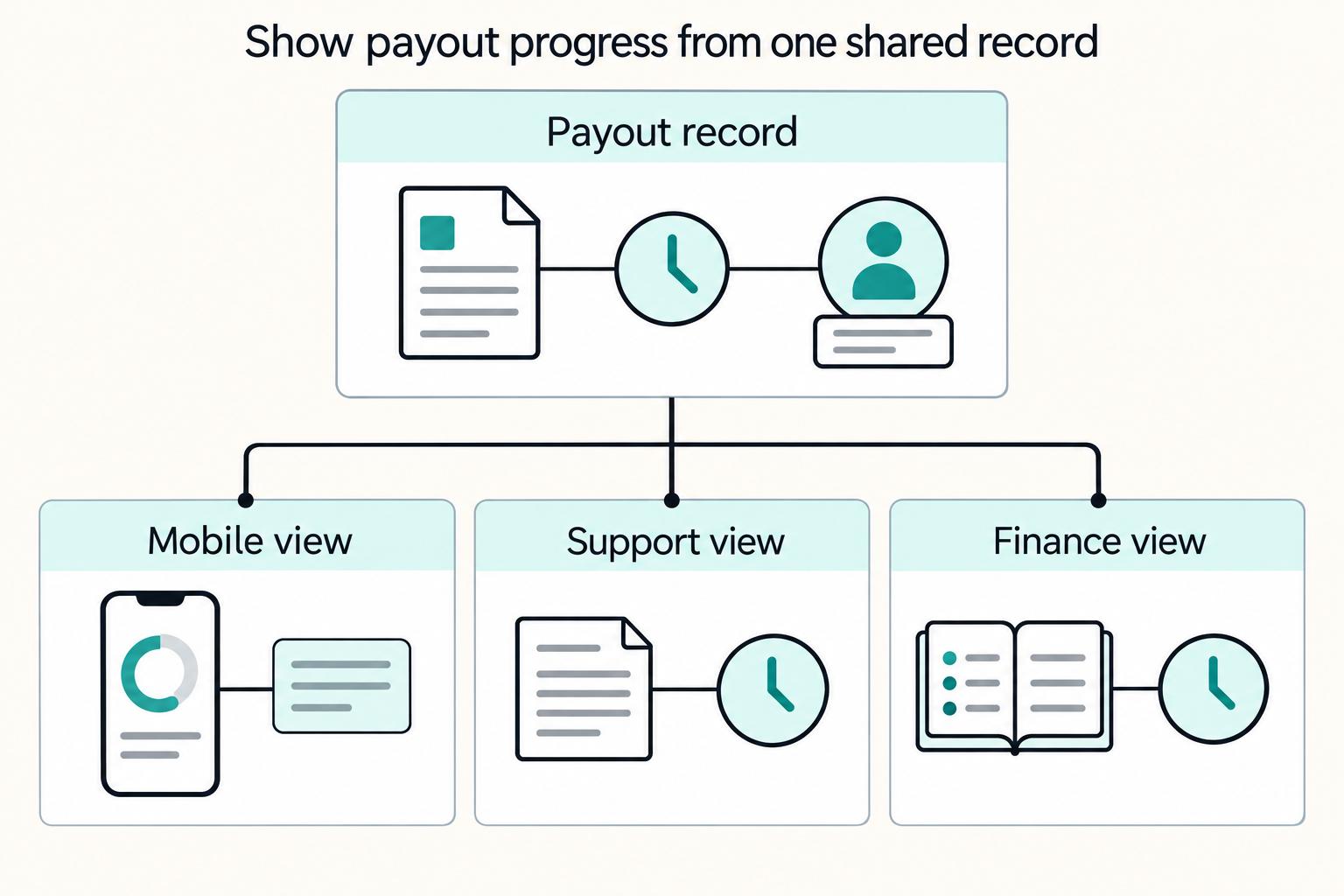
We use one canonical payout record as the internal source of truth, with one current state, one owner, and one evidence trail. This helps keep status consistent when a request moves across mobile and nonmobile channels such as SMS, Web, e-mail, and instant messenger.
Define payout states and owners#
Use a documented internal state map rather than assuming every provider uses the same labels. Give each stalled state an owner and distinguish an execution outcome from receipt evidence.
Keep payout execution states separate from onboarding or setup states so status updates answer payout progress directly.
Map each state to one dominant signal#
The following is a design example, not a provider taxonomy. Map each row to the actual API events and accounting policy in your stack.
| State | Evidence | Next action | Financial record |
|---|---|---|---|
| scheduled | Server instruction and planned submission time | Show timing; allow cancellation only if still supported | Audit event; no provider debit implied |
| submitted / in transit | Provider reference and latest event or lookup | Monitor the existing payout; show estimated arrival and last update | Record relevant liability or cash movement under your policy |
| provider reports paid | Provider success event | Offer reference for bank tracing; handle later returns | Reconcile provider movement; retain receipt uncertainty |
| failed / canceled | Confirmed provider non-execution or reversal state | Correct cause before an authorized replacement | Reverse or release affected records when supported |
| returned | Return reference and funds recovery evidence | Verify destination and reissue eligibility | Link returned funds to the original obligation |
Set timing windows by rail#
Set timing expectations from your own operational data instead of one generic "processing" promise.
Show the last server update and the expected next checkpoint. If the phone is offline, label cached status as last known rather than current. A timer can route a case to investigation; it cannot establish that money failed to move.
Standardize copy for non-final states#
For every non-final state, standardize user-facing copy into three parts: what happened, what happens next, and what action is required. If no action is required, say that clearly.
Let users open payout details from a stable reference shared with support. Show the amount, destination ending, method, event history, last update, and a help action. Keep sensitive account details masked.
Need the full breakdown? Read How to Build a Platform Help Center for Payment Issues: FAQ Templates and Escalation Flows.
Implement idempotent execution and retry rules#
Treat every payout create and retry as a replay-risk event, and make one payout reference chain the control point for execution, support, and audit.
Persist one idempotent reference chain#
Use and persist one internal idempotency reference, for example, an Idempotency key, for first submit and retries in your own payout contract. Do not treat retries as a separate, looser path. Keep one stable payout business reference, then log each attempt under that reference with attempt time and outcome.
Provider request-key retention and your internal payout history are different controls. Stripe can prune idempotency keys after they are at least 24 hours old. Retain the internal business reference and duplicate-prevention record for your own operating and retention requirements; an expired provider key is not permission to repeat an unresolved payment.
Reserve the payout instruction atomically before execution so two workers cannot both submit it. When a call times out, recover the existing result using the same supported request key and provider lookup. A lookup that finds nothing may be incomplete or delayed; do not create a second instruction while execution remains uncertain.
Draw clear retry boundaries#
Define retry boundaries as policy, not as a blanket "retry everything" rule. Separate cases where provider outcome is still unclear from cases that require a real state change before execution should continue.
When a payout is blocked by compliance or eligibility signals, such as KYC outcomes in your flow, route it to a non-executable state such as policy review or held and resolve the blocker first. If you have a separate identity remediation path, handle remediation there rather than repeatedly resubmitting the same payout request.
Verify every retry twice#
Use two internal checkpoints on every retry attempt before advancing status. First, capture the immediate provider or gateway response for that attempt. Second, verify downstream consistency in your own systems, including any Webhook trail and internal Ledger journal handling.
Do not assume webhook callbacks are guaranteed for terminal states; track missing callbacks explicitly in your retry evidence.
For each attempt, preserve one evidence set: payout reference, attempt number, internal idempotency reference, provider response or error, latest Webhook state or missing callback, and linked Ledger journal reference or exception note.
Investigate stalled payouts instead of retrying blindly#
When a payout stalls past your operating timeout, move it to investigation instead of retrying blindly. Assign an owner and investigate the chain directly. Was it accepted upstream? What downstream signal exists? What journal state was recorded?
This is where strong internal ledgers, clear settlement states, and automation prevent reconciliation drift at scale. Repeated retries can hide uncertainty. An investigation queue makes the next action explicit.
Handle cross-border FX and timing without breaking trust#
Cross-border trust comes from clear state boundaries. Keep FX acceptance, payout initiation, and final funding confirmation as separate checkpoints. These flows involve FX and compliance checks and can run on different rails, so vague status language quickly turns into delay escalations with contractors.
Block stale FX details before submission#
For an unexecuted request with an expired provider quote, show refreshed conversion terms and obtain any required renewed acceptance before submission. If the payout may already have executed, investigate its existing reference first. Repricing must not silently turn an uncertain request into a second payout.
Keep enough record detail to verify what was approved and what was sent: quote identifier or version when available, source amount, converted amount, and fees shown.
Show the amount breakdown before confirmation#
Show a full amount breakdown before confirmation. On the confirmation screen, show source amount, conversion amount, fees, and selected payout method together. If any value is provisional, label it that way and avoid final-status language until downstream confirmation arrives.
Keep wire initiation separate from completion#
For an international wire, submitted means the provider accepted an instruction, not that the recipient received funds. Keep in transit separate from provider success and confirmed receipt. Offer a trace reference and an investigation path when the recipient reports missing funds.
Document timing caveats and funding intake rules#
Document delay-handling and funding intake rules up front. In UI and ops docs, define the checkpoints used to investigate delays and communicate status to contractors. That way delayed payouts follow a known path instead of ad hoc support handling.
If you have funding intake requirements, define them in advance: required references, accepted funding paths, and how unmatched receipts are handled before any payout is treated as funded. That helps reduce error-prone manual payment handling. For teams formalizing those expectations, How to Build a Payout SLA: Setting Expectations for Contractor Payment Timing is a useful companion.
Make reconciliation and auditability first-class outputs#
Reconciliation should be designed as a first-class output of the payout flow, not a cleanup task after the fact. If finance cannot explain a payout from system records, manual work and risk expand quickly.
Keep the evidence trail on the payout record#
Keep the approved instruction, provider reference, event identifiers, destination version, and reconciliation result on the payout record. Link journal entries where they exist. These references let support and finance explain an outcome without reconstructing it from several inboxes.
Store the identifiers and timestamps needed to answer three basic questions quickly: what was approved, what was sent, and what was recorded internally. If key evidence lives only across separate tools, your audit trail can stay fragile.
Use batch processing as a control layer#
Use batch processing as a control layer, not just a scaling tactic. It gives finance a concrete unit to review for payout accuracy, timing, and cash-flow alignment.
Keep each batch reviewable as one unit, and flag items that need explanation. That keeps close review focused on exceptions instead of free-form investigation.
Review exceptions with a repeatable process#
Review payout exceptions on a regular cadence and make the evidence exportable for finance. Strong auditing improves payment efficiency when exception handling is repeatable and visible outside engineering.
For open exceptions, track clear status, owner, and next action so unresolved items do not sit without follow-up. The goal is controlled follow-up, not a growing queue of ambiguous mismatches.
Tie reporting readiness into the same review#
Tie reporting readiness into the same operational review so payout and compliance data do not drift apart. In payout flows with embedded tax compliance, confirm tax-form and recipient-validation data is complete and usable for the reconciled payout population.
When unresolved items remain, document ownership and a dated follow-up path. That keeps exceptions controlled and auditable instead of being rediscovered later. If you are tightening system handoffs at the same time, QuickBooks Online + Payout Platform Integration: How to Automate Contractor Payment Reconciliation gives a practical reconciliation angle.
Avoid common failure modes and recover fast#
Payment incidents are a reminder that stronger resilience is needed, especially as infrastructure becomes more digitalized, integrated, and interdependent. Recovery is more reliable when teams follow the same documented reliability objectives, redundancies, and fallback plan.
Hold back final success#
Treat final success as a documented reliability objective, and keep earlier states clearly non-final until your own objective is met.
Define whether your success label means provider completion or confirmed receipt, and say so in the interface. Keep later returns linked to the original record rather than hiding them under a new request.
Move required checks earlier#
Run critical-provider and endpoint-security checks early so disruptions are less likely to surface late.
Reauthenticate sensitive destination changes and show the new account ending before confirmation. Save the accepted destination version on the instruction so a later profile edit cannot silently redirect a submitted payout.
Make retries non-destructive#
For example, a contractor taps Withdraw and loses connectivity before the response arrives. Save the server instruction and request reference first; when the app reconnects, fetch that instruction and its provider result. Display Checking your request while the outcome is uncertain. A second tap must recover the same instruction, not pay the same balance twice.
Allow read-only access to a clearly dated cached receipt if your privacy policy permits it. Do not queue a money-moving action for automatic offline execution. Preserve entered non-sensitive form data, explain the connection error, and require an online server check before submission.
Pre-validate method availability and fallback#
Before final confirmation, validate what your current operating setup can reliably support.
A fallback rail needs a confirmed safe execution boundary, a verified destination, and updated timing and fees. Ask the contractor to approve changed terms where required. Keep the replacement linked to the failed or returned original so reconciliation cannot count both as an unpaid obligation. See the payment help center guide for support wording.
Set launch checkpoints and operating KPIs#
Before launch, verify the flow on a small phone with interrupted connectivity, double taps, delayed provider events, and screen-reader navigation. Confirm that the same payout reference appears in the mobile history, support view, and finance record.
Measure acceptance by payout method#
Measure submitted, provider-completed, confirmed-received where observable, failed, and returned payouts by method and corridor. State the observation window and include pending payouts in the denominator. Track elapsed time to each checkpoint rather than treating an accepted request as received money.
Match the displayed status to its source event. Track stale mobile views and delayed event processing separately from actual payment delays so an interface defect is not mistaken for a banking failure.
Tag operational risk so exceptions stay reviewable#
Track duplicate instructions prevented, unresolved execution outcomes, and exception age. Give each open case an owner and next investigation time. Reconcile returns and replacement instructions together.
Make errors usable: preserve valid input, name the field that needs attention, and move focus appropriately. Use text as well as color for status. Provide comfortably spaced controls; WCAG 2.2 specifies a 24 by 24 CSS-pixel minimum target or defined exceptions, while larger controls can help one-handed use.
Add trust metrics for confusing outcomes#
Track status-related support contacts, time to an understandable answer, and completed recovery flows. Announce changing status messages to assistive technology without unnecessarily moving focus. Allow password managers and paste during authentication rather than relying on memorization.
Look for contradictions between backend status and what appears on the user screen. Resolve message and state mismatches before assuming the payout method itself is the root cause.
If you want a deeper read on user-side measurement, Contractor Payment Satisfaction Survey: How to Measure and Improve Payout Experience is a useful companion.
Run a regular review with evidence#
Use a regular cross-functional review to validate the same core checkpoints each cycle.
Bring a compact evidence pack each cycle:
- outcomes and elapsed time by method, corridor, and observation window
- pending and returned payouts with owner and age
- duplicate-prevention and interrupted-connection recovery examples
- mobile status discrepancies, accessibility issues, and support resolution evidence
Final takeaway and copy-paste launch checklist#
We use one written checklist and do not launch on guessed statuses, vague promises, or untested branches. Mobile trust breaks when the app state and backend evidence diverge.
Write one promise per corridor#
Set one contractor-facing promise per corridor, and confirm it matches what you can observe in testing. Version the promise pack by date, for example 2025-Q4 corridor rules or 2026-Q2 launch rules, so support can tell which rule set governed a payout.
Validate from the mobile client flow and confirm it still holds across server-side and client-side setup paths. Because requests can move across mobile and nonmobile channels, verify handoffs instead of assuming one channel tells the full story.
Tie each visible state to an explicit source#
List every user-visible status and name the system record behind it in your stack. Define which internal record is authoritative for each state.
For each visible state, name the authoritative event and how the server verifies it. Test delayed, duplicate, and out-of-order events as well as the happy path. A client animation or button response must not create a success state without corresponding server evidence.
Confirm release gates before release#
Document which release gates apply for each market or program, then enforce them before release. Treat any program-specific compliance or eligibility checks as pre-release gates, not post-failure cleanup.
Keep the rule testable. When required information is missing, release should be blocked in a way operators can verify.
Freeze branch rules and failure handling#
Document which workflow paths are live at launch and what should happen when a step fails. Keep the rules explicit so operators can verify the same outcome each time.
Test branching and fallback handling before launch, especially where unsupported states, provider variation, or compliance holds can change the path a contractor sees.
Set a consistent review rhythm until behavior stabilizes#
Run the same regular review rhythm after launch until outcomes, statuses, and exception handling stay consistent. Bring the same evidence pack each cycle so product, support, ops, and finance review the same facts.
Keep the review focused on method-level outcomes, status accuracy, exception ownership, and whether user-visible messages still match backend evidence.
Frequently Asked Questions
What makes a contractor payout flow truly mobile-first instead of just mobile-accessible?
A mobile-first flow lets contractors review amounts, confirm a destination, and recover an interrupted request on a small screen. Save progress, use accessible controls and status messages, and show when cached information was last updated. Offline access can show dated read-only history; payout execution requires an online server check.
Which payout methods should we launch first for contractors in new corridors?
There is no one payout rail that should launch first in every market. Start with the method your team can operate reliably in that corridor, then expand. Base the decision on confirmed coverage and corridor-specific compliance requirements.
How should payout statuses appear in-app so users trust them and support load drops?
Show labels tied to authoritative events, with a last-updated time and a next action when needed. Separate scheduled, submitted, in transit, provider-reported success, and confirmed receipt. If receipt is unknown, say so and offer the reference needed to investigate.
What compliance checks must be complete before payout release?
Complete the release prerequisites actually required by the recipient program and applicable rules. Keep tax readiness distinct from execution eligibility, and do not block payment for every optional missing field. Show permitted next steps while keeping confidential screening reasons in the internal record.
How do idempotent retries work when payout calls or webhooks fail?
Reserve one instruction atomically and retain its stable business reference. Retry a timed-out call under the provider contract or look up the existing result; deduplicate webhook events separately. When execution remains uncertain, investigate instead of creating a new payout.
Which KPIs best prove that payout operations are scaling cleanly?
Track payout outcomes and elapsed time by method and corridor, including pending cases. Add exception age, duplicate prevention, reconciliation discrepancies, and status-related support contacts. State the observation window so unfinished payouts do not disappear from the results.
How do multi-currency flows and `FX quote` expiry change the mobile payout experience?
Show source and destination currencies, amounts, fees, and any quote expiry before confirmation. Refresh expired terms only before confirmed execution and obtain renewed acceptance where required. If the original instruction may already have executed, recover its result before considering a replacement.
Where Gruv fits
Plan and approve payout batches
See how payee status, approval rules, route review, and exception handling sit in one payout workflow.
See reconciliation and mismatch review
Compare ledger entries, provider payment records, and statement rows to see what matches and what finance needs to review.
Researched and edited by the Gruv editorial team. Gruv builds cross-border billing, payouts, and finance-operations software for global businesses.
Sources
Includes 2 external sources outside the trusted-domain allowlist.
Educational content only. Not legal, tax, or financial advice.
Related Posts

The Freelance Payment Penalty: A Modeled Audit of Platform Fees, FX Spreads, and Payout Delays
The money rarely disappears through a single, easy-to-spot fee. The real loss is stacked. A marketplace takes its commission, a processor adds a charge for international cards, a bank or payment company converts the currency at a spread, a platform holds the funds before release, and a wire sheds a little to intermediaries on the way in. Each layer looks defensible on its own, but the worker feels the combined result as a smaller deposit and a later payday.

How to Respond to a Subpoena for Business Records
Move fast, but do not produce records on instinct. If you need to **respond to a subpoena for business records**, your immediate job is to control deadlines, preserve records, and make any later production defensible.
A US Expat's Guide to Investing in UCITS ETFs to Avoid PFIC Issues
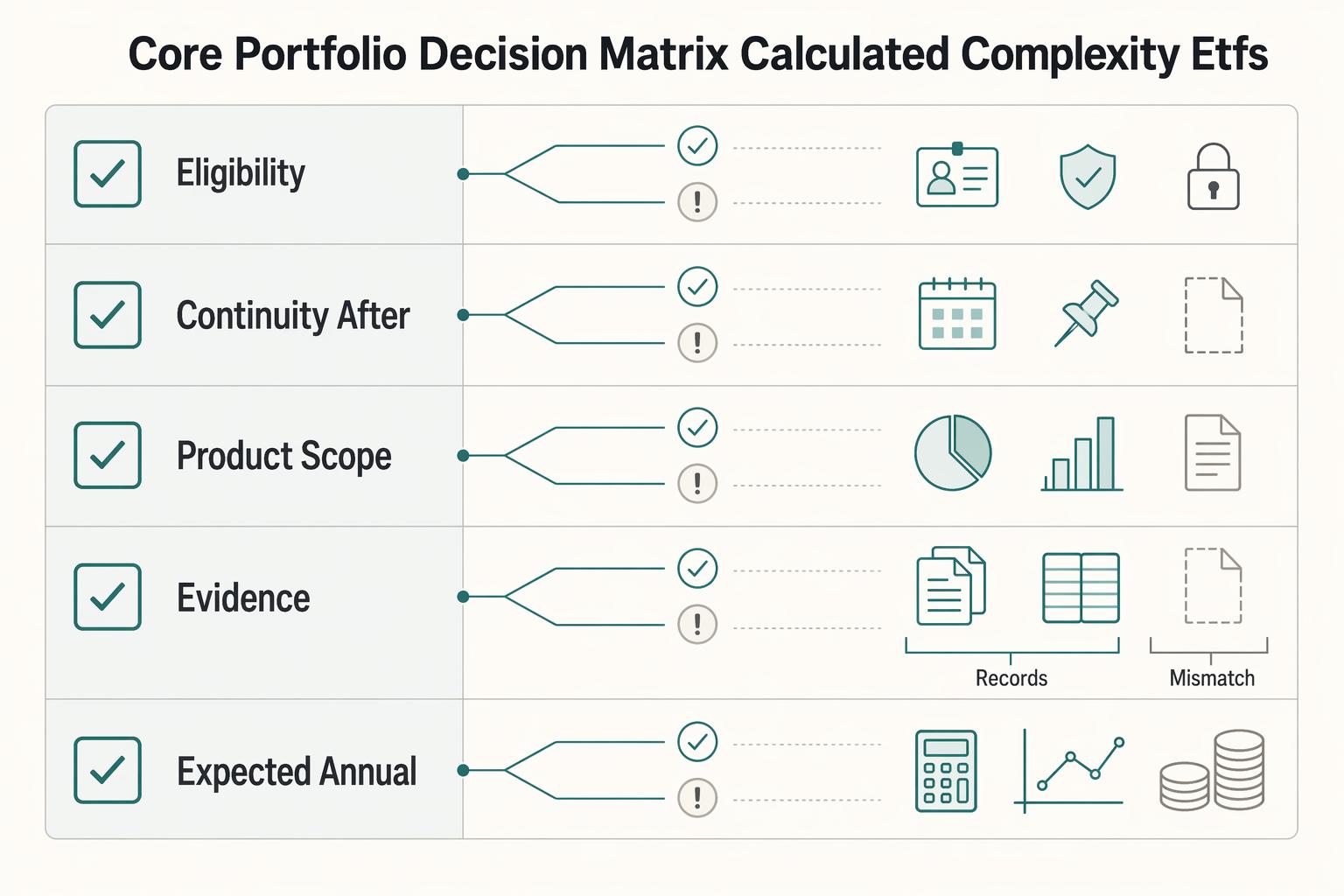
The real problem is a two-system conflict. U.S. tax treatment can punish the wrong fund choice, while local product-access constraints can block the funds you want to buy in the first place. For **us expat ucits etfs**, the practical question is not "Which product is best?" It is "What can I access, report, and keep doing every year without guessing?" Use this four-part filter before any trade: