
Quick Answer
Cut onboarding drop-off by removing redundant data collection, clarifying why checks are required, and speeding manual review for applicants who miss automated verification. The fastest safe path is the one that gets compliant contractors to first payout without rework.
Why contractor KYC drop-off is really a payout speed problem#
Treat contractor onboarding KYC drop-off as a payout-speed problem first. When contractors do not become payout-ready quickly, conversion, operations, and compliance can all be affected.
On major payment platforms, payouts are gated by Know Your Customer verification, so "KYC completed" is not always the operational finish line. The practical finish line is an approved contractor who can receive a first payout with minimal verification friction.
For founders, this can affect conversion and revenue timing. For product teams, it shows up as abandonment during digital onboarding. For finance and compliance ops, it increases operational handling burden. Reported onboarding research and bank-reported data point to the same operational risk: slow verification and siloed internal workflows can lose users before payout starts. Use those figures as directional signals, not contractor-specific benchmarks.
This guide stays focused on practical onboarding decisions: field order, document collection, straight-through versus human-routed cases, and the handoff from approval to payout activation. It is not legal advice, and controls are not identical across markets or programs. Verification scope depends on account context and can change over time, so simplification should follow a risk-based approach, not a one-size-fits-all flow.
Success means more approved contractors reach first payout with fewer escalations and less manual handling.
For identity standards and sanctions controls, review NIST's identity assurance guidance and the FFIEC customer due diligence overview when redesigning your onboarding flow.
Set your commercial target before you touch the flow#
Set the target around payout readiness, not form completion. If time-to-first-payout is the real bottleneck, prioritize review wait time and approval-to-payout handoffs before adding more onboarding screens.
Teams can chase lower front-end drop-off while the real delay sits in review queues or payout activation. That can make the funnel look better without improving payout timing. In platform payments, KYC is a prerequisite to payout enablement, so the target should map to when a contractor can actually be paid.
Define the KPI tree#
Start with a KPI tree, not a single completion metric:
- KYC drop-off rate: where contractors abandon across start, document submission, review, and approval
- Approval rate: accepted KYC documents divided by total KYC documents, if that is your provider definition
- Manual review rate: share routed into analyst review
- Time-to-first-payout: elapsed time from onboarding start to payout-ready status, and to first payout initiation if you track both
Use funnel analysis to find abandonment points and segment-level conversion differences, not just final completion. Before you trust any baseline, confirm each KPI maps to a real event or status source such as KYC started, document submitted, accepted or rejected, review queue entered, and payout enabled.
Split targets by segment#
Split targets by segment before you interpret results. Do not average together new and returning contractors, geographies, or account configurations.
Requirements can change by country and account profile, and risk should be assessed across customer, transaction, product, and geography dimensions. A blended approval rate can hide a weak corridor, and a blended drop-off rate can hide strong performance in lower-risk returning cohorts. If you expand into higher-risk regions, a higher analyst-review share can be the correct outcome.
Set one operating rule for what happens next#
- If drop-off is high and approval quality is stable, simplify front-end steps first.
- If approval quality falls after simplification, tighten Risk-based KYC for the affected segment, such as stricter analyst routing.
This keeps controls proportionate to risk while keeping conversion in view. Keep the commercial pressure in view: in a 2024 Fenergo survey of over 450 C-suite executives, 67% reported client loss tied to slow, inefficient onboarding. That is directional, not a contractor benchmark, but it supports fixing speed bottlenecks first. Related: State of Platform Onboarding: KYB Completion, Time to First Payout, and Drop-Off Benchmarks.
Map your contractor KYC funnel step by step#
Map the funnel exactly as it runs today before you optimize anything. If a stage has no owner, no status source, or no audit trail, treat it as unmapped.
Map every real stage from start to payout-ready#
Write the KYC funnel as a sequence of actual gates, not one catch-all "verification pending" block. Include account start, profile fields, document upload, identity verification, Customer Due Diligence (CDD) checks, approval, and payout-ready.
Keep these stages separate so you can see where the problem really sits: front-end completion, document handling, compliance review, or payout enablement. Risk-based CDD should be explicit in the map because it helps you assess the nature and purpose of the relationship and decide when deeper review is needed.
Split visible user steps from compliance gates#
Show both layers of the flow: what the contractor sees and what happens after submission. Visible steps are where abandonment appears. Compliance gates are where cases stall.
Track abandonment by stage, and add device or channel splits where they help you separate UX issues from policy or review issues. Also break out regulatory gates, including Sanctions screening and Politically Exposed Person (PEP) escalation, instead of hiding them in a generic review bucket. Sanctions controls are risk-based, and PEP handling may require enhanced due diligence rather than a simple pass or fail.
Use one routing rule consistently:
- If the contractor can fix it, keep it in a retry path.
- If only your team can resolve it, route it to review with a reason code.
Build one shared stage table#
Build one operating view that product, ops, and compliance can all read without translation.
| Stage | Owner | SLA field | Failure reason | Retry path |
|---|---|---|---|---|
| Account start | Product | Define internal target | User exits before account creation | Resume link or saved draft |
| Profile fields | Product/Ops | Define internal target | Required information incomplete | Return user to the exact blocked field |
| Document upload | Product/Vendor ops | Define internal target | Document does not pass checks | Re-upload only the failed item |
| Identity verification | Vendor/Compliance ops | Define internal target | Verification requires follow-up | Retry if user-fixable, else escalate |
| CDD + sanctions/PEP screening | Compliance | Define internal target | Screening or diligence alert | Enhanced review or targeted follow-up request |
| Approval to payout-ready | Compliance/Finance ops | Define internal target | Approval complete but payout not activated | Surface blocking action and owner |
Use named accountable owners, not abstract department labels, so day-to-day compliance responsibility stays clear.
Verify evidence before optimization#
Before you redesign screens, confirm each stage has three things: an event or status source, an accountable owner, and a retained record.
You should be able to reconstruct one contractor case end to end, from started to submitted, screened, escalated, approved, and payout-enabled, from system records and retained evidence. For review-heavy stages, keep the reason code, supporting evidence, reviewer notes, status history, and disposition together.
If you operate in an EU AMLD context, retain supporting evidence and transaction records for five years after the business relationship ends. Also map the non-happy paths. For legal-entity onboarding, beneficial owner verification may be a required written procedure and needs its own branch in the funnel.
For a step-by-step walkthrough, see How to Classify a Worker as an Employee vs. an Independent Contractor in the US.
Prepare prerequisites so optimization does not break compliance#
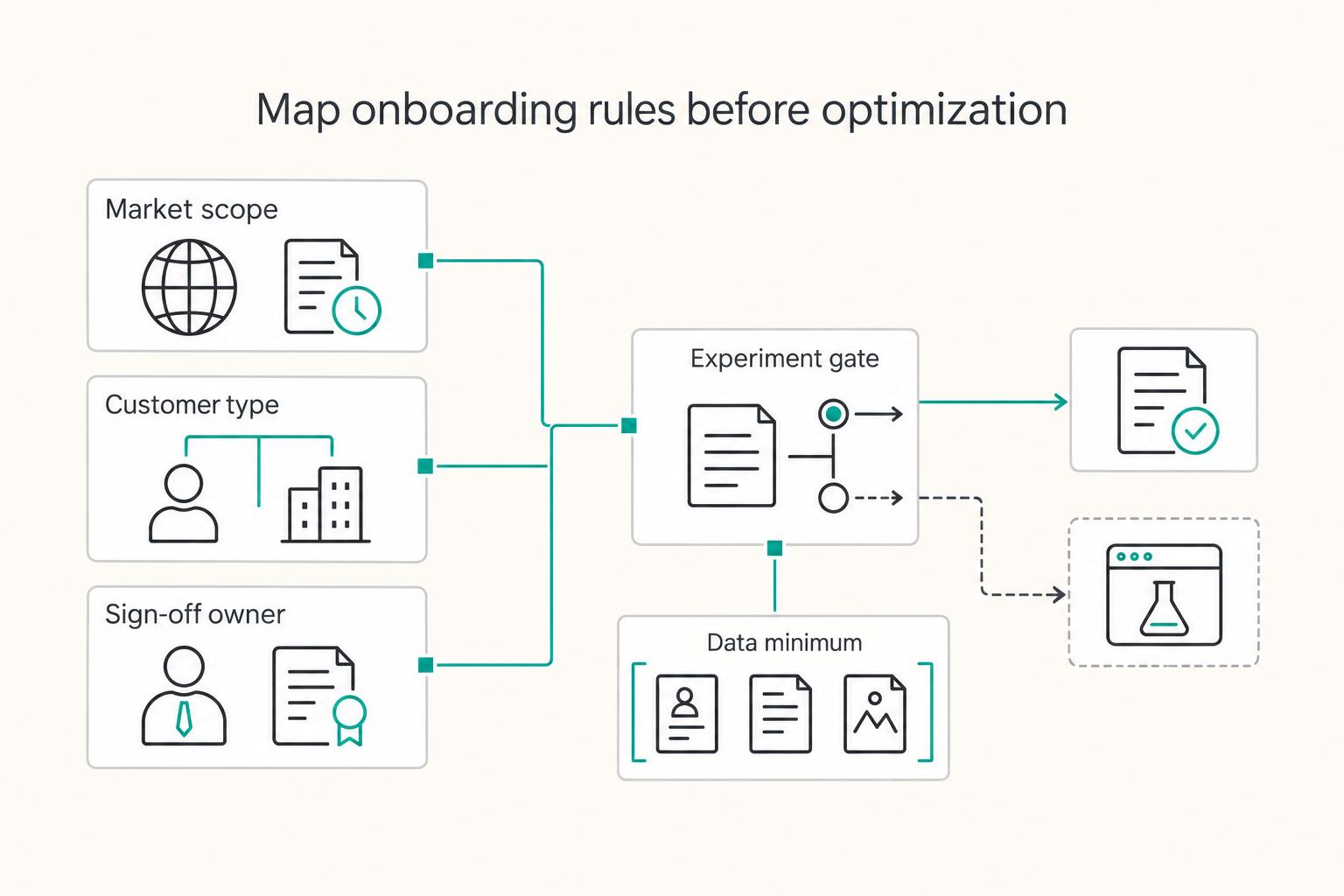
Before you optimize onboarding, lock the compliance perimeter by market and program so conversion gains do not come from drifting out of policy.
Step 1. Scope KYC and KYB by market and program.
Do not assume every contractor flow is KYC-only. If you onboard legal entities in the U.S., beneficial-owner procedures can apply under Customer Due Diligence rules, so separate individual contractor flows from company-account flows. For each market and program pair, record customer type, whether beneficial-owner checks apply, and who owns that decision.
Step 2. Name governing regimes and sign-off owners.
Map each footprint to its actual regime instead of a generic "global AML" label. U.S. onboarding may be shaped by Section 326 account-opening identity procedures. EU scope may sit within the AMLD perimeter and reference the EU 6th Anti-Money Laundering Directive (Directive (EU) 2018/1673, adopted 23 October 2018, with a transposition deadline of 3 December 2020). Ukraine operations may include Law No. 361-IX (06.12.2019). Define one approval chain for policy-impacting changes, since some AML regimes require written senior-management approval.
Step 3. Lock PII handling rules before testing.
Set clear rules for document images, profile data, and verification outputs before experiments launch. Apply data minimisation: collect only data that is adequate, relevant, and necessary for the stated purpose. Any test that adds fields, stores extra data, or expands data access should trigger compliance review.
Step 4. Separate testable UX from controlled compliance elements.
You can test UX elements like copy, step order, progress states, and reminder timing only after confirming required data collection and recordkeeping requirements for the applicable regime still hold. Treat required identity fields, beneficial-owner checks where applicable, and policy controls as approval-gated changes. Add a verification checkpoint to each experiment ticket: market, governing rule set, required evidence preserved, and approver.
Redesign data collection to remove avoidable friction#
Once the compliance perimeter is set, reduce drop-off by fixing sequence and duplication, not by weakening controls. Ask for high-confidence basics first, then trigger heavier checks only when risk rules or Customer Due Diligence requirements call for them.
Ask for easy-to-complete basics first#
Lead with fields a legitimate contractor can complete quickly, then branch into deeper checks only when needed. That keeps early momentum without forcing every user through the same path.
For each later screen, make the trigger explicit: legal requirement, risk rule, or approved due-diligence tier. If a field cannot be tied to one of those, defer it or remove it.
Remove duplicate asks across onboarding and identity verification#
Duplicate entry is avoidable friction. Audit onboarding forms, identity verification flow, and analyst-review intake together, then define one owner for each field.
Use a simple field sheet:
field namesource of truthfirst collection pointreused/prefilledstatusreason required
Some regimes permit reliance on third parties for parts of CDD, but that is market-specific, not universal. Prefill only when lawful for that flow and technically reliable, and keep an editable review step before downstream submission.
Fix mobile capture before you tune copy#
If drop-off clusters on phones, treat the mobile-first KYC flow as a capture-quality problem early. Production IDV flows reject blurry, distorted, pixelated, out-of-focus, or poorly framed images, so improving camera capture reliability can reduce avoidable verification failures.
Run real-time checks before upload, such as blur, glare, framing, and barcode or MRZ presence where relevant, and return immediate recapture guidance on failure. Keep pre-camera forms short, and test permissions and uploads on real devices.
At minimum, track:
capture startedcapture failedfailure reasonupload succeeded
Explain sensitive fields in plain language#
Sensitive asks should be explained at the point of collection. Use concise, transparent, intelligible, plain-language prompts next to fields like ID image, date of birth, and address.
For EU CDD flows, the core purpose is straightforward: identify the customer and verify identity using reliable evidence. Replace vague labels like "required for compliance" with direct purpose copy that tells users why the data is requested.
Cut verification delays with explicit routing rules#
A practical way to reduce verification delay is to route clearly low-risk cases straight through and send exceptions to human review. A risk-based approach does not mean one lane for everyone. Use explicit criteria so clean cases do not wait behind sanctions, PEP, or inconclusive identity checks.
Define lanes before tuning thresholds#
Set the lanes your team can operate consistently: straight-through approval, assisted retry, and analyst review. This keeps recoverable capture issues from getting mixed into higher-risk alerts.
Keep routing inputs explicit and limited to:
- document quality
- identity match confidence
- sanctions/PEP outcomes
This aligns with risk-based CDD rather than blanket treatment. US agencies (July 6, 2022) reinforced that customer risk is not uniform by type, so segmented routing is an appropriate operating model. Use practical lane logic:
- recoverable capture problems: assisted retry
- inconclusive identity outcomes: human review
- potential sanctions or material PEP matches: human review
Verification checkpoint: log the trigger inputs and final lane for every decision so you can audit and improve routing without guesswork.
| Route | Criteria | Risk level | Expected turnaround | Owner |
|---|---|---|---|---|
| Straight-through | Acceptable document quality, strong identity match, no sanctions hit, no PEP escalation trigger | Low | Immediate or same session | Automated rules plus vendor decisioning |
| Assisted retry | Capture quality issue, incomplete submission, or other recoverable mismatch | Low to moderate | Same session if user retries promptly | Product flow plus user support content |
| Analyst review | Possible sanctions match, PEP outcome needing additional AML/CFT checks, inconclusive identity result, or unresolved exception | Moderate to high | Human queue based on SLA band | Operations or compliance analyst |
Expand straight-through only when your data supports it#
If your funnel shows queue time is the main drop-off driver, widen straight-through criteria only for clearly low-risk cases. Save analyst time for cases where human judgment changes the outcome.
Do not relax sanctions or PEP controls to improve conversion. FATF requires additional measures for PEP relationships, and delayed sanctions action weakens controls, so sanctions matches should stay in hard-stop routing and material PEP outcomes should stay outside conversion experiments.
After each threshold change, sample auto-approved cases and compare downstream exception rates before widening further.
Use AI-powered identity verification with fallback and human intervention#
AI identity verification should improve decision quality and retry guidance, not remove fallback handling. Treat AI outputs as inputs to routing, with clear paths for rejects and inconclusive cases.
Two safeguards matter:
- provide a human intervention or challenge path for solely automated decisions where applicable
- maintain human oversight and override capability in contexts where high-risk AI obligations apply
Operationally, use reject reasons that can drive action such as retry, substitution, or analyst review, and keep exception and error handling for applicants who cannot meet standard evidence paths. NIST also expects identity proofing to conclude in a timely manner once requirements are met.
Verification checkpoint: review recent rejects and confirm the reason is specific enough to assign the next lane without guesswork.
Set SLA bands and stale-case escalation triggers#
Protect time-to-first-payout with route-level SLA bands and clear escalation triggers. One universal SLA matters less than clear ownership and fast escalation when cases stall.
Define, per route:
- turnaround band, such as immediate, same-day, next-business-day, or escalated
- owner of next action
- stale-case triggers, such as no analyst touch, no user retry after recoverable error, or no decision after sanctions or PEP review begins
Hybrid screening operations, whether automated, manual, or both, are valid. Clear ownership is what prevents aging queues.
For analyst-handled cases, keep a compact evidence pack: images, identity or liveness result if used, screening outcome, route reason, retry history, and analyst notes. That reduces second-touch time and preserves an auditable decision trail.
Balance conversion and risk with a clear approval policy#
Use a balanced approval policy as a practical default for many programs. It can protect conversion while keeping compliance risk controlled, depending on your risk profile. Routing decides where a case goes. Approval policy decides how strict each route is.
Choose an operating mode deliberately#
Choose an operating mode deliberately. These are internal operating stances, not regulator-defined categories. Use them as directional trade-offs, not universal benchmarks.
| Operating mode | KYC drop-off direction | False positive direction | Compliance risk direction | Best use |
|---|---|---|---|---|
| Strict-first | Higher | Higher | Lower | Elevated-risk periods or segments showing more alerts |
| Balanced | Moderate | Moderate | Controlled | Useful default in many contractor growth programs |
| Speed-first | Lower | Lower | Higher | Short conversion tests in clearly low-risk segments |
Strict-first can reduce borderline approvals but pushes more valid users into retry or analyst review. Speed-first can reduce friction but increases uncertainty and downstream exception risk. Balanced usually keeps straight-through broad for clean, low-risk cases while keeping sanctions, PEP, and inconclusive identity outcomes outside conversion experiments.
Tighten by segment, not globally#
Use a risk-based approach: FATF calls this the cornerstone of its Recommendations and expects implementation to be adapted to local circumstances. In practice, do not tighten every path because one risk pocket worsened.
If risk signals rise, tighten first by segment, for example by corridor or payout pattern, and keep other segments stable. Then compare approval rate, analyst-review rate, KYC drop-off rate, and post-approval exceptions before and after the change. If exceptions do not improve, you likely added friction without gaining real control.
Lock the controls that do not move#
Lock the controls that do not move. Sanctions outcomes, PEP enhanced-due-diligence obligations, and mandatory legal controls are not optimization levers.
FATF Recommendation 6 requires targeted financial sanctions implementation and fast, effective freezing for designated persons and entities, so sanctions outcomes are a non-negotiable control area. FATF also requires additional AML/CFT measures for PEP relationships, and FCA guidance (July 2025) includes close family members and known close associates in scope. These are preventive controls, not criminal judgments, but they still require enhanced handling.
If a US CIP applies, identity verification procedures must be risk-based. If US AML program rules apply, internal controls and independent testing are required.
Apply a formal change checklist before relaxing criteria#
Before widening approval criteria, complete all four checks:
- Legal review: Confirm which jurisdiction and program requirements apply and record approver sign-off.
- Analytics baseline: Freeze pre-change metrics by segment: KYC drop-off, approval, analyst review, and post-approval exceptions.
- Rollback trigger: Define clear reversal conditions, such as unresolved-alert growth or weaker audit quality.
- Post-change audit sample: Review a sample of newly auto-approved cases and confirm decision evidence is complete.
Keep the audit trail compact and usable: route reason, identity result, sanctions or PEP outcome, retry history, final decision, and reviewer notes where applicable.
If you are finalizing routing thresholds and escalation SLAs, review Gruv docs to align policy gates with implementation details before rollout.
Connect KYC approval directly to first payout activation#
KYC approval should start payout activation, not end onboarding. Define and track the post-approval path as separate stages so each block is visible, owned, and fixable.
Define the post-approval sequence as separate stages#
Treat these as four distinct states: KYC passed, payout method ready, payout policy checks cleared, and first disbursement scheduled. If all of that is collapsed into one "approved" label, you lose the point where activation stalls.
Keep these stages separate in ops tooling and in the contractor-facing status view. "Approved" should only mean the KYC decision is complete, not that payout can run. Quick verification check: from one screen, you should be able to see each KYC-approved profile's current stage and the single missing requirement.
Expose failure points that happen after KYC success#
Post-KYC failures can surface in handoffs across compliance, finance ops, and payout operations. KYC can be green while payout is still blocked by missing payout details, payout method validation issues, unresolved policy checks, or a scheduling gap.
Use explicit reason codes, not vague statuses like "pending review." Show ops the operational block and show contractors the next action in plain language.
| Post-KYC status | What it means | Primary owner | Contractor-visible next step |
|---|---|---|---|
| Payout method missing | KYC passed but no payout destination is on file | Contractor | Add bank or payout details |
| Payout method failed validation | Details were submitted but cannot be used yet | Finance ops or contractor, depending on issue | Correct and resubmit payout details |
| Payout policy hold | Internal payout checks are not yet cleared | Compliance or finance ops | Waiting for review, no new submission unless requested |
| First disbursement not scheduled | All checks are clear, but no payout event is queued | Payout ops or engineering | No action required, payout is being scheduled |
Keep this same mapping in product specs, support macros, and queue definitions so every team and contractor sees consistent status language.
Map every block reason to an action and owner#
Every payout block reason must map to a resolvable action and a named owner. If you cannot answer "who clears this and how," the status is not operational.
For each block code, require four fields: trigger, owner, contractor action, and evidence needed to clear it. If a hold is internal, do not send the contractor into repeated uploads they cannot resolve.
Track activation outcomes, not just approvals#
Measure conversion through each transition: KYC approved to payout method ready, payout-ready to policy-cleared, and policy-cleared to first disbursement scheduled. That shows where activation is really breaking down.
If approved users stall before payout setup, fix prompts and document requests. If stalls sit in internal holds, tighten ownership and queue rules before you change the front-end flow. To operationalize this, align the post-KYC sequence with your contractor onboarding checklist and review stage timing against external benchmarks separately.
Improve trust messaging so users do not abandon in uncertainty#
Once post-approval blocks are visible, tighten the messaging around them. In each KYC state, tell users what is happening now, why the check exists, and what they need to do next.
Add honest timing expectations to each waiting state#
Every waiting state in digital onboarding and identity verification should show a clear status, not a generic spinner. Verification can be asynchronous, so distinguish submitted, under review, and complete states.
Use step-specific timing copy based on your real program windows. Avoid vague language like "usually fast." For example: "Identity check submitted. We'll update this page when review finishes," and, where it applies, "First payout is typically scheduled 7 to 14 days after the first successful payment."
Explain the reason for checks in plain language#
Explain checks in user language: identity review helps verify identity and satisfy legal verification requirements before payouts can proceed. Do not rely on unexplained internal terms.
For each sensitive request, answer two points in one sentence: why you need it and what it unlocks. If payout is blocked because verification is incomplete, say that directly.
Preserve progress and give a recovery path#
When verification fails, route users to fix and resubmit instead of restarting the full KYC funnel. If the status is requires_input, show the exact issue and return users to the right resubmission step.
Show explicit progress states so users can recover quickly, such as account details complete, identity review in progress, new document needed, and payout setup ready. Avoid vague final-step messaging. As one payments leader said, "I couldn't figure out how to take that last step."
Related reading: How to Structure a Commission-Based Independent Contractor Agreement.
Fix common failure modes before they hurt growth targets#
A smoother visible flow is not enough if queueing, risk routing, and exception handling stay weak. Treat post-submit operations as part of the same conversion system.
Check for queue debt behind a smoother front end#
A faster form does not help if clean cases are piling up in under review. Track stage-time movement, not just completion rate. If starts and uploads improve but the review backlog keeps growing, you have likely moved friction downstream.
Use explicit routing and ownership for each case: straight through, analyst review, or waiting for updated information. Keep human handling for real exceptions such as document quality issues, identity mismatch, or sanctions and PEP outcomes that may require analyst judgment. Rebalance thresholds on a regular operating cadence and when queue age spikes.
Do not treat sanctions and PEP checks as conversion levers. FATF Recommendation 6 frames targeted financial sanctions as required controls, and FATF guidance says PEP relationships require additional AML/CFT measures.
Reintroduce targeted Risk-based KYC controls when pass quality drops#
If pass quality drops after simplification, add back only what risk handling now misses. The right fix is targeted, risk-based controls, not a full return to long forms.
EBA guidance says CDD should be adjusted to the ML/TF risk identified. In practice, that can mean introducing extra friction where risk signals or verification responses justify it.
Review failed, rejected, and requires_input outcomes after each simplification release. If many cases now require updated information, reintroduce the missing requirement at the stage where that risk becomes visible. Stripe Connect reflects this operating model: collect updated information from affected accounts and handle verification responses.
Centralize exception evidence before it fragments#
Exception handling can break at scale when evidence is scattered. Centralize each exception in one retrievable case record so decisions stay consistent and defensible.
For each case, keep identity verification outcomes, sanctions or PEP screening results, CDD notes, updated-information requests, contractor responses, and final disposition with reviewer and date. This aligns with 31 CFR 1010.430 requirements that records be accessible within a reasonable time and retained for five years. FFIEC also notes records can be maintained electronically.
As FCA Executive Director Mark Steward put it: "Systems and controls that are purposeful, efficient and courageous in identifying suspicious activity are vitally important;" efficiency matters, but control quality comes first.
30-day checklist to reduce KYC drop-off and speed first payout#
If you only have 30 days, do not rebuild the whole flow. Baseline the funnel, test one form-friction fix and one routing-rule fix, and keep sanctions and PEP controls as hard stops.
Baseline the funnel before you test changes#
Set your baseline first or you will not know what improved. Lock one definition each for KYC drop-off rate, approval SLA, review-queue load, and time-to-first-payout, and measure all four in the same conversion window. Because a KYC funnel is step-based, baseline at each stage rather than as one abandonment number.
Before testing changes, confirm each stage has a reliable event or status source. If milestones like "document uploaded," "CDD submitted," or "payout-ready" exist only in notes or inboxes, the baseline can be too noisy to trust.
Publish the real stage map with ownership and recovery paths#
Publish the real stage map with ownership and recovery paths, not just the happy path. Include start, profile completion, document upload, identity verification, CDD checks, approval, and payout-ready, and assign owner, expected turnaround, failure reasons, and retry path for each stage.
Make post-approval blockers explicit. If your map stops at "submitted" or "approved," you can improve form completion and still miss faster first payout.
Ship two changes in month one#
In month one, aim to ship two changes so the impact is easier to attribute: one form-friction fix and one routing-rule fix. Keep both narrow, such as removing one duplicate data request and updating one rule so lower-risk clean cases move faster while exceptions still route to analyst review.
Measure results by segment, not only in aggregate. Funnel reporting is built for conversion impact questions, and segment differences are often where regressions hide.
Lock the controls you will not relax#
Lock the controls you will not relax. Sanctions screening and PEP treatment should remain non-negotiable.
OFAC provides regularly updated U.S. sanctions lists, and under 31 CFR 594.201, blocked property may not be transferred, paid, withdrawn, or otherwise dealt in. FATF Recommendation 6 context expects designated assets to be frozen without delay and that no funds or assets are made available to designated parties. FATF PEP guidance also calls for additional AML/CFT measures in business relationships with PEPs. Apply these controls by market under a risk-based approach adapted to local circumstances.
Review results weekly and keep only the changes that hold up#
Review results on a regular cadence (for example, weekly) across the 30-day period, and keep only changes that improve payout activation without increasing unresolved compliance exceptions. Track the full chain: start to verified, verified to payout-ready, review-queue pressure, and exception aging.
Use the same evidence pack each review: segment conversion, stage-level loss, review volume, sanctions and PEP outcomes, and a small audit sample of changed cases. If speed improves but unresolved exceptions climb, roll back the change or narrow it to a lower-risk segment.
When your checklist is complete, use Gruv Payouts to validate whether your approval-to-disbursement handoff can stay fast without losing operational control.
Frequently Asked Questions
What is KYC drop-off rate in contractor onboarding, and how should we calculate it?
KYC drop-off rate should be measured as a funnel, not a loose abandonment estimate. A defensible base formula is users who complete the required KYC funnel divided by users who started step 1, measured within a defined conversion window. You should also track step-to-step loss so you can see where completion breaks.
Which step in a typical KYC funnel causes the most abandonment for contractors?
There is no universal worst step across contractor funnels. The biggest loss point is the one with the largest drop-off in your own funnel analysis. Validate it by key segments, and set a clear conversion window so long in-review delays are not misclassified as abandonment.
How do we reduce drop-off without increasing compliance risk?
Use a risk-based model: reduce friction for lower-risk cases while keeping stronger controls in higher-risk areas. FATF's approach is to prioritize resources to higher-risk exposure, and PEP relationships still require additional AML/CFT measures. In practice, simplify flow design where risk is lower, but do not relax sanctions or PEP controls for conversion.
When should we use AI-powered identity verification instead of manual review?
Use automated verification for lower-risk standard cases when the tool is adequate and reliable for remote CDD, and use enhanced/manual review for higher-risk or uncertain cases. Govern that split with measured performance, including FMR and FNMR, rather than vendor claims. There is no universal regulator-set numeric threshold for switching modes.
How does KYC design change time-to-first-payout in practice?
KYC design can directly change time-to-first-payout because some processors gate payments and payouts on successful verification. If verification or required information is incomplete, payout readiness is delayed even when onboarding starts strong. Track "payout-ready" as the operational milestone, not only "KYC approved."
Do we need KYB and KYC together for contractor payout flows?
Sometimes yes, especially when the payee is a legal entity rather than an individual. In the U.S., covered institutions have beneficial-owner identification and verification obligations for legal entity customers under 31 CFR 1010.230. A current nuance is that FinCEN's Feb. 13, 2026 exceptive relief removed the repeat verification requirement for U.S. credit unions each time a business customer opens a new account.
What metrics prove a KYC change improved growth and not just approval volume?
A strong result means more users move from start to verified to payout-ready within the same conversion window, not just more approvals. Compare segment conversion and funnel time-to-complete before and after the change. If approvals rise while segment conversion or time-to-complete worsens, growth quality likely did not improve.
Researched and edited by the Gruv editorial team. Gruv builds cross-border billing, payouts, and finance-operations software for global businesses.
Sources
- bsaaml.ffiec.gov/manual/OfficeOfForeignAssetsControl/01trusted
- bsaaml.ffiec.gov/docs/manual/09_RisksAssociatedWithMoneyLaund...trusted
- ecfr.gov/current/title-31/subtitle-B/chapter-X/part-1...trusted
- ecfr.gov/current/title-31/subtitle-B/chapter-X/part-1...trusted
- fdic.gov/news/financial-institution-letters/2024/fil2...trusted
- federalregister.gov/documents/2020/09/15/2020-20325/financial-cr...trusted
- federalreserve.gov/frrs/regulations/joint-statement-on-the-risk...trusted
- ffiec.gov/sites/default/files/media/press-releases/201...trusted
Educational content only. Not legal, tax, or financial advice.
Related Posts

The Freelance Payment Penalty: A Modeled Audit of Platform Fees, FX Spreads, and Payout Delays
The money rarely disappears through a single, easy-to-spot fee. The real loss is stacked. A marketplace takes its commission, a processor adds a charge for international cards, a bank or payment company converts the currency at a spread, a platform holds the funds before release, and a wire sheds a little to intermediaries on the way in. Each layer looks defensible on its own, but the worker feels the combined result as a smaller deposit and a later payday.

How to Respond to a Subpoena for Business Records
Move fast, but do not produce records on instinct. If you need to **respond to a subpoena for business records**, your immediate job is to control deadlines, preserve records, and make any later production defensible.
A US Expat's Guide to Investing in UCITS ETFs to Avoid PFIC Issues
The real problem is a two-system conflict. U.S. tax treatment can punish the wrong fund choice, while local product-access constraints can block the funds you want to buy in the first place. For **us expat ucits etfs**, the practical question is not "Which product is best?" It is "What can I access, report, and keep doing every year without guessing?" Use this four-part filter before any trade: