
Quick Answer
Separate entitlement from payment timing: in a commission-based contractor agreement, define when commission is earned and when it is payable as two different tests. Then anchor the formula to explicit base and exclusion rules, tie each claim to invoice and payment records, and add a post-termination tail for pre-approved pipeline deals. This structure lowers ambiguity, protects classification boundaries, and makes disputes easier to decide from documents.
Why this agreement fails in practice and how to make it hold#
Commission agreements usually fail when key terms stay ambiguous. In practice, disputes start when the contract blurs contractor classification, leaves payout timing unclear, or leaves room for competing interpretations.
Set expectations early: this is not a generic commission template. A contractor-first agreement should stay easy to sign, but it also needs enough detail to hold up when someone argues the commission was not owed, not yet due, or excluded.
Step 1 Frame the relationship as contractor first#
Start with classification before compensation. If the draft reads like an employment arrangement with commission attached, you create avoidable risk from the start. A final Wage and Hour Division rule on employee-versus-independent-contractor classification was published on 01/10/2024 (89 FR 1638).
Use a simple drafting check: keep the agreement focused on commercial outcomes and responsibilities, and strip out employment-style control terms. If a clause pushes the relationship toward employee-like control, rewrite it.
Step 2 Separate when commission is earned from when it is payable#
Treat these as two separate tests. Disputes often start when the agreement does not say clearly what must happen before commission is earned and what must happen before it is payable. Imprecise drafting has led to significant litigation over commission obligations.
If you collapse both into one vague sentence, you invite conflict. One side may argue the commission is not payable until later conditions are met, while the other says it was earned earlier. Clear earned and payable terms reduce that ambiguity.
Step 3 Build for enforceability, not just signature speed#
A fast signature is not the goal; enforceability is. State rules can differ materially on commission requirements, including writing requirements and payout treatment at termination, so confirm where services are actually performed before you lean on boilerplate governing-law language.
Also verify source status before you treat page text as final authority. FederalRegister.gov states its page text does not provide legal notice to the public or judicial notice to courts. In practice, success comes down to three things:
| Success criterion | What "good" looks like in the contract | What usually goes wrong |
|---|---|---|
| Clean classification boundary | Contractor-first framing with outcome-based duties | Employee-style control language creeps in |
| Predictable payout timing | Earned and payable are defined separately | One vague clause tries to cover both |
| Enforceable risk clauses | Terms reflect where services are performed | Boilerplate assumptions ignore jurisdiction differences |
Hold those three lines, and the agreement is much more likely to work in both day-to-day operations and payment disputes.
Related: How to Structure a White Label Service Agreement.
Gather your inputs before you draft a single clause#
Drafting gets easier once the inputs are fixed. If you draft from memory or start from a generic template, bad assumptions can flow straight into the agreement.
Step 1 Capture the deal facts in writing#
Write down the core facts before you touch the clauses. Capture party names, worker type, the start date, and the proposed commission rate or formula inputs. Also state when commission can be earned, which activities generate commission pay, and the equation used to determine the sales amounts on which commissions are based. Even basic commission templates only work if the names, dates, and rates are right. As a quick check, make sure the names in your intake sheet match your invoicing and payment setup details.
Step 2 Build a source packet, not just a blank draft#
Assemble a short source packet with your pricing model, payment flow, refund policy, and one baseline form, for example a Commission Sales Agreement or Sales Commission Agreement. Treat that baseline as reference material, not final language.
Screen it immediately for employee-style supervision language. Some commission templates are really employee forms and include terms like being "subject to the general supervision, advice and direction of," which is often a poor fit for an independent contractor structure. Template providers also warn that their forms are informational only and may contain errors, including unlawful provisions.
Step 3 Lock your negotiation positions before redlines start#
Decide your negotiables and non-negotiables now: non-compete scope, confidentiality, and IP ownership. If you wait until redlines, you are more likely to concede core protections just to keep momentum.
For non-competes, do not casually import broad language from templates. The FTC Non-Compete Clause Rule entry was published on 05/07/2024, and that entry states an effective date of 2024-09-04.
Step 4 Note the cross-border basics early#
Decide the cross-border basics before you treat the draft as complete. Set the expected payout currency, and flag any unresolved tax or governing-law points before signature. If any of those points are still unresolved, mark the draft incomplete and hold signature until they are decided.
We covered this in detail in How to Structure a 'Holdback' in a Purchase Agreement.
Draw the classification line first so the contract does not create misclassification risk#
Classification risk is easiest to control while you draft. If your agreement says "Independent contractor" but reads like an employee policy, the label alone will not save you.
State the relationship plainly. Put a clear relationship clause near the front of the agreement: the parties are in an independent contractor relationship, and nothing creates an employer/employee, joint venture, partnership, or shareholder relationship. Use that clause as a foundation, not a cure-all. A label alone does not repair employee-style control language elsewhere in the contract.
Define the Sales Representative role by outcomes, not supervision. Write the role around results and contract duties, not day-to-day management. Keep mandatory duties tied to what is specifically written in the agreement. Treat supervision-style terms as red flags. If clauses start requiring fixed hours, recurring internal meetings, or quotas, rewrite them.
Split service standards from control. If the client wants tighter operating standards, separate them from the classification clause. Put service standards in SOW or operating terms, and keep contractor-autonomy language in the main commission agreement. That can preserve operational clarity without turning the relationship section into employment-style control language.
Run a classification checkpoint on every added control clause. Ask one question in every drafting pass: "Does this clause change control or schedule enough to look like employment?" That is a practical risk check. Misclassification can deny workers protections they may be legally entitled to and can also create downside for businesses.
If you review federal background while drafting, verify text against the official govinfo PDF rather than relying only on FederalRegister.gov XML, for example the 01/10/2024 WHD rule at 89 FR 1638.
Related reading: How to Structure a Joint Venture Agreement Between Two Freelancers.
Build commission math that survives disputes#
This is often where the agreement either becomes usable or becomes fragile. Write the commission math as separate, mechanical rules: what is earned, what is payable, what amount is included in the base, and how reversals are handled.
Step 1 Separate earned from payable#
Do not blend these into one sentence. Define earned as the event that creates entitlement under your agreement, then define payable as when payment is actually due under the agreement. If a neutral reader cannot point to both triggers quickly, rewrite the clause.
Step 2 Choose a payout trigger and state it plainly#
Pick one trigger model and spell out how it handles edge cases:
| Issue | Invoice-issued trigger | Cash-received trigger |
|---|---|---|
| Core trigger | Commission ties to invoice issuance for covered work | Commission ties to cleared customer payment for covered work |
| Partial payments | State your rule explicitly | State your rule explicitly |
| Excluded charges | State exclusions explicitly before calculation | State exclusions explicitly before calculation |
| Main tradeoff | Can mean faster entitlement with higher adjustment risk | Can mean slower entitlement with lower collection-mismatch risk |
If the underlying client contract allows inspection, acceptance testing, or post-acceptance remedies, reflect that risk in the commission clause. Under FAR 52.212-4, the contractor tenders conforming performance, the Government may inspect or test tendered supplies or services, and nonconforming performance can lead to an equitable price reduction when correction is not possible. Post-acceptance rights are also tied to acting within a reasonable time after a defect is discovered or should have been discovered.
Step 3 Define the commission base and exclusions#
Many disputes come from base math, not just the rate. If you use terms like "net" or "gross," define them directly and list exclusions, for example pass-through or incidental charges, so neither side can reinterpret the formula later.
Step 4 Set reversal rules before first payout#
Do not wait for the first refund or chargeback to decide how adjustments work. Add written rules for split commissions, refunds, and chargebacks before live deals start.
State how adjustments are applied, for example future netting or direct reversal, and require a payout statement that shows the original transaction, any adjustment, and the revised commission calculation. When these elements are drafted separately, the clause is usually easier to operate, audit, and defend.
For a fuller breakdown, read How to Structure a 'Teaming Agreement' for a Government Contract Bid.
Set reporting, evidence, and approval checkpoints#
Good payout language still fails when the evidence process is loose. Reporting and approval checkpoints should work like operating rules, not placeholders.
Step 1 Require a claim packet that matches your payout trigger#
Match the claim packet to the same checkpoints that control when commission is due: confirmed sale, issued invoice, and full customer payment. Each commission claim should tie to evidence for those checkpoints and to the related company transaction record.
The template already supports regular sales-activity reports from the representative and company-maintained transaction records. If you want additional artifacts, such as account-ownership proof or attribution logs, add them explicitly in the agreement. Use a simple test: can a reviewer verify confirmation, invoicing, and full payment from one claim packet without chasing side messages?
Step 2 Set a real reporting cadence and approval window#
"Regular reports" does not set a specific cadence on its own. Payment timing is also a fill-in field (monthly or quarterly and a set number of days after receipt of customer payment), so the template does not provide a fixed reporting or approval SLA by itself.
Write the process in operational terms: when reports are due, where they are submitted, who acknowledges receipt, and when approval or rejection is issued. If both sides cannot calendar these dates on day one, the clause is still too loose.
Step 3 Define verification and payment-pause conditions#
The template gives you the records backbone: the company maintains transaction records and allows inspection on reasonable notice. Build each payout cycle around a verification step that checks claims against those records. Use a short checklist:
| Verification step | What to confirm |
|---|---|
| Deal match | Match each claimed deal to the company transaction record. |
| Invoice check | Confirm the invoice exists for the covered sale. |
| Payment check | Confirm customer payment was received in full. |
| Adjustment check | Apply any refund, return, or cancellation adjustment. |
Also state what pauses payment. A practical rule is to pause only the affected line item when records are missing or reversals are unresolved, instead of stalling unrelated items.
Step 4 Add an internal escalation path before formal dispute resolution#
The provided template language does not define an internal escalation path for attribution or record conflicts. If you want that step, add it before formal dispute resolution: require the representative to submit supporting records, require the company to review its transaction records, and state how conflicts are resolved before the matter escalates.
If the agreement involves shared territories or handoffs, define which records control when submissions conflict. Keep the approval rule simple: if a claim cannot be traced to the company record set on reasonable notice, hold approval for that claim until the record gap is resolved.
Handle cross-border payment and compliance friction before it happens#
Cross-border payout friction is usually preventable. Lock the FX rule, define holds with release mechanics, and document tax-record handling before any commission comes due.
| Control area | What to document |
|---|---|
| Currency rule | State which rate source controls, when the rate is captured, what makes a quote stale, and what happens on retry. |
| Verification holds | State who can trigger a hold, what notice is sent, whether the hold is line-item or full payout, and what clears the hold. |
| Tax forms and FBAR evidence | Document your W-8/W-9 and 1099 support process, and keep a separate evidence file for foreign-account maximum-value support. |
| Platform-rail payout records | Keep the payout ID, state history, timestamps, conversion snapshot, failure reason, retry reason, and final outcome. |
Step 1 Lock the currency rule and conversion evidence#
Use one conversion rule in the agreement so payout review stays mechanical. State which rate source controls, when the rate is captured, what makes a quote stale, and what happens on retry.
For FBAR-related reporting, non-U.S.-currency values are converted using the Treasury Financial Management Service rate for the last day of the calendar year. If that rate is unavailable, use another verifiable rate and document the source. Keep the rate source, timestamp, and payout reference in the same record set.
Step 2 Define verification holds as operational controls#
If your payout flow uses verification gates, write them as specific pause-and-release rules, not open-ended delay language. State who can trigger a hold, what notice is sent, whether the hold is line-item or full payout, and what clears the hold.
Your audit test is simple: one record set should show the trigger, hold date, missing item or review reason, and release date.
Step 3 Document tax-form handling and separate FBAR evidence#
Treat W-8/W-9 and 1099 support as contract operations and document your process. Avoid implying legal timing rules or default responsibility assignments you have not sourced.
For potential FBAR workflows, keep a separate evidence file for foreign-account maximum-value support. Certain U.S. persons may need to file FinCEN Form 114 when foreign-account aggregate maximum value exceeds $10,000 at any time during the calendar year. Periodic statements may be used when they fairly reflect the year maximum, values are reported in U.S. dollars, for example $15,265.25 is recorded as $15,266, and a negative computed maximum is reported as 0 in item 15. If you have fewer than 25 accounts and cannot determine whether aggregate maximum values exceeded the threshold, use the form's "amount unknown" checkpoint (item 15a).
Step 4 Keep payout-state and retry artifacts if you use platform rails#
If you use platform rails, retain an audit trail for each payout state and retry so failures are diagnosable and reconciliations are defensible. This is an operational control, not an FBAR-specific filing requirement. At minimum, keep the payout ID, state history, timestamps, conversion snapshot, failure reason, retry reason, and final outcome.
If a reviewer cannot reconstruct one payout end to end, from approved commission line to final release, from that record set, tighten the logging rule in the agreement.
For a step-by-step walkthrough, see How to Write a Master Service Agreement for Long-Term Client Engagements.
Define Territory, exclusivity, and account ownership so leads are not double-claimed#
Lead ownership disputes usually come from drafting gaps. To reduce them, write this section as operating logic: define a testable Territory, choose one overlap rule, and say exactly how non-exclusive conflicts are resolved.
Name Territory in terms a reviewer can test. Define Territory as specific countries, regions, states, cities, or sectors, not broad labels that invite interpretation. Pair each Territory label with a clear boundary condition so people can classify leads from the contract text alone. Also state that the Sales Representative's authority is limited to the defined Territory unless otherwise agreed in writing. This helps reduce off-territory disputes.
Checkpoint: a reviewer outside the deal team should be able to classify sample leads and named accounts from the clause without extra explanation.
Choose one overlap rule and tie it to evidence. Use one ownership rule for overlap and do not assume any option is the default.
Whichever rule you choose, define the evidence that controls the decision every time, such as:
- dated attribution log
- introduction record
- approval record (if approval-based)
- account assignment record in force at the time
Also document who owns the customer relationship and how renewals, upsells, and cross-sales are credited. If that is missing, disputes can shift from lead ownership to expansion ownership.
State what non-exclusive allows. If the appointment is non-exclusive, say so plainly and spell out the consequence. The Principal may appoint other agents or representatives in the same Territory and may also sell directly there. The agent has no exclusive rights to the Territory, customers, or specific accounts.
Add a short conflict protocol:
- who raises a collision
- what record is frozen during review
- who decides ownership
- what happens to the commission claim while the review is open
This gives finance a clearer decision path while deals are under review.
Pressure-test with a single-market versus broader-market contrast. Before finalizing, test the language with both:
- a narrow assignment (for example, a single city)
- a broader assignment (for example, country-wide) with explicit carve-outs
For the broader version, define carve-outs in writing, such as named house accounts, accounts already assigned to another representative, or accounts reserved for direct sales.
If you cannot resolve ownership for one new lead, one renewal, and one cross-sell using only the contract text plus the evidence pack, tighten the clause before payouts begin. If you want a deeper dive, read Germany Freelance Visa: A Step-by-Step Application Guide.
Write Termination terms that protect already-sold work#
Termination language should reduce future ambiguity without wiping out work that was already approved and sold. A clean approach is to separate exit mechanics from payment mechanics.
Step 1 Separate cause and convenience termination#
Use two distinct termination paths in the agreement: one for cause (defined breach or misconduct) and one for convenience (ending the relationship without proving breach).
Define which notice method(s) count, where notice must be sent, and when notice is effective. If you allow multiple notice methods, make each one traceable.
Keep payment-control events separate instead of blending them into one clause. FAR Part 32 separates related topics into distinct sections, including payment suspension (32.006) and overpayment notification (32.008). Termination, payout suspension, and overpayment correction are different events, and your contract can reflect that separation.
Step 2 Define a post-termination commission tail with a testable eligibility rule#
A workable tail should cover in-flight deals that are verifiable from records created before termination, rather than every lead ever touched. One option is a pre-approved deal register. Before termination, a deal could already be:
- logged in your CRM or attribution record
- assigned under the ownership rule
- approved at the stage named in the agreement
If eligibility depends on memory or informal messages, tighten the clause.
Step 3 Use an explicit if-then payment rule#
Write the trigger as a decision rule. If payment is received after termination for a deal that met the agreed pre-termination approval test, commission is paid under the tail. Otherwise, no new entitlement arises after termination.
That helps keep earned-versus-payable questions from being reopened at exit and limits claims on post-termination deals that were never approved.
Step 4 Require an exit handoff so payouts can be reconciled#
At termination, require a documented handoff so open commissions can be reconciled without rebuilding deal history. Define the records both sides will rely on and the as-of date for those records.
If the tail is tied to pre-termination records and a clear handoff process, it is more reliable.
Limit downside with Limitation of Liability and Indemnification that fits contractor reality#
Once the payment rules are stable, limit routine dispute exposure so ordinary contract problems do not turn into open-ended risk. In this kind of contractor deal, the practical baseline is to cap standard breach exposure and carve out only the categories both sides intentionally place outside that cap.
Step 1 Cap routine exposure instead of leaving every breach uncapped#
A limitation of liability clause caps damages one party can claim from the other for breach or other legal issues. In contractor deals, that usually means routine performance disputes should not create unlimited damages.
Set the cap clearly and tie it to the deal economics. The grounded examples here use either the "Contract Amount" or "$50,000, or the total fee for services rendered on the contract, whichever is greater." ACC also notes that some contracts are better served by limiting liability type, not only liability amount.
Before circulating a draft, make sure a single read answers three questions: what is capped, what damages are excluded or limited, and what sits outside the cap. Keep amendments disciplined. Changes should be in writing and signed by both parties.
Step 2 Split indemnity by control, not by bargaining power#
Indemnity becomes overbroad quickly if it is not tied to actual control. In the California sample, "indemnify" includes defend and hold-harmless duties and can extend to claims, lawsuits, losses, costs, liabilities, and damages.
A practical structure can be bilateral where the facts support it. The contractor covers its own negligence, intentional misconduct, breach, and legal or regulatory violations tied to its work. If the agreement is bilateral, the client can cover risks tied to what it controls. Keep causation limits explicit, including carve-backs like no indemnity when loss arises solely from the indemnified party's negligence or intentional misconduct.
Also keep recovery realism in mind: contribution rights may not help much if the indemnifying party is insolvent, so tight triggers matter more than broad after-the-fact remedies.
Step 3 Align Confidentiality clause and IP ownership with the indemnity trigger#
Read confidentiality, IP ownership, and indemnity together. If those clauses are drafted in isolation, they can quietly expand liability beyond what you intended.
If confidentiality or IP issues are outside the cap, say so expressly. If they are not, state that they remain subject to the cap except for listed carve-outs. Then confirm the definitions and proof paths are workable: each indemnity trigger should map to a clause and to a record you can actually produce.
Step 4 Review carve-outs explicitly before signing#
These carve-outs are negotiation points, but they are not mandatory everywhere and should be reviewed under the governing law and the deal profile.
| Carve-out to review | Typical drafting question | Why it matters |
|---|---|---|
| Fraud | Is fraud outside the cap and outside liability-type exclusions? | For mere breach of contract, punitive damages are not available, so fraud triggers should be drafted explicitly. |
| Willful misconduct | Is willful misconduct uncapped, and does that apply to both sides? | Scope can expand quickly if this term is left undefined. |
| Payment non-performance | Are unpaid fees carved out, and can work pause if invoices are in arrears? | The California sample allows the contractor to stop further work until overdue invoices are paid. |
Final check: review indemnity, confidentiality, and IP ownership as one risk package, not as separate redlines. If one side asks for broad defense duties plus broad IP or confidentiality language, require a clear claim map showing what is capped, what is carved out, and why that allocation matches control.
Related: A Deep Dive into California's Money Transmitter License Requirements.
Choose Governing Law, Jurisdiction, and Dispute Resolution without killing deal speed#
This choice should be driven by where a claim would actually be filed and whether a win could be collected. Pick governing law and forum for enforceability and collection reality, not template habit.
Step 1 Choose governing law by enforcement reality, not template habit#
Pick governing law based on where enforcement is workable, not where your template came from. Check where the Principal's assets are, where the Agent operates, where payment records are held, and where witnesses and contract documents can be produced quickly.
If you use an exclusive court clause, draft it plainly. The legal context can include Article 25(1) of Regulation (EU) No 1215/2012 and the Hague Convention of 30 June 2005 on Choice of Court Agreements. Hague Convention Article 5(1) supports jurisdiction for the designated court, unless the agreement is "null and void under the law of that State."
Case C-537/23 (27 February 2025) explicitly raised validity concerns where jurisdiction wording was imprecise or asymmetric. If one side can sue broadly and the other cannot, do not assume that wording survives challenge just because it appears in a precedent.
Before signing, run one clarity test: can an uninvolved reader identify, in one pass, the governing law, the exclusive forum if any, and whether either side has broader forum rights?
Step 2 Pick the court or arbitration seat where collection is realistic for both sides#
There is no universally best court or arbitration seat for every independent contractor deal. Choose the place where a judgment or award is most likely to be enforceable because the losing party has reachable assets, banking links, or business presence.
If you choose court, state whether jurisdiction is exclusive. If you choose arbitration, make sure the arbitration agreement is clearly incorporated into the signed deal record. SGHC 340 (30 November 2023) shows how disputes can turn on online incorporation, and it also highlights procedural "step in the proceedings" issues under s 6(1) of the International Arbitration Act 1994 in stay applications.
Drafting rule: do not hide arbitration terms in a link you cannot prove was accepted. Keep an evidence file with the executed agreement, exact terms version, online acceptance logs if used, notice emails, invoice history, and payment confirmations.
Step 3 Sequence dispute resolution so it helps operations instead of blocking recovery#
Use a short sequence people can actually run: operational escalation, then executive review, then the formal venue. That sequence is a drafting choice, not a legal requirement.
Make each step usable by naming the owner, the records to exchange, and the trigger to move forward. Vague "good faith negotiation" language with no owner, no record set, and no escalation trigger can create delay and fights over timing.
Step 4 Simplify the forum clause when cross-border enforcement is uncertain#
If cross-border enforcement is uncertain, simplify the forum clause and tighten evidence obligations instead of layering fallback venues. One clear exclusive forum, or one clearly incorporated arbitration clause, can be easier to defend than complex asymmetry when validity is later challenged.
In this kind of deal, outcomes can turn on proof quality as much as forum theory. Require written notices to stated email addresses, version-controlled amendments signed by both parties, deal-attribution logs, invoice copies, and payment confirmations.
This pairs well with our guide on How to Structure a 'Referral Fee' Agreement with a Partner.
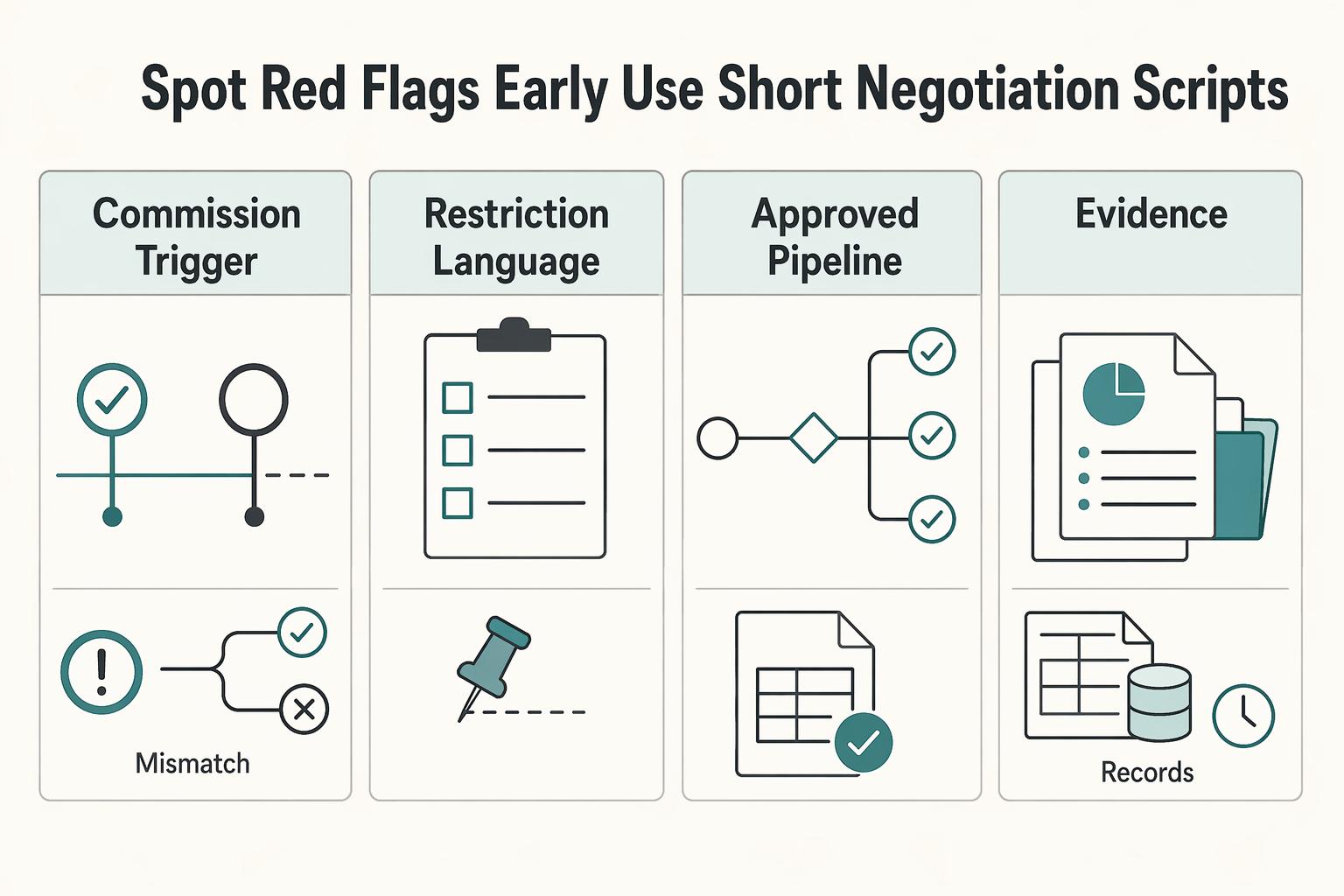
Spot red flags early and use short negotiation scripts#
Use this section as a practical screen. If a clause is unclear on execution, records, or risk ownership, flag it early and ask for one specific fix.
| Issue | Red flag | Script |
|---|---|---|
| Commission trigger vs payment date | The formula can be unclear when "earned" and "payable" are blended. | Let's separate earned date and payable date so accounting can execute consistently. |
| Restriction language | Restriction language is open-ended or undefined. | Let's define the scope narrowly so both sides can execute it. |
| Approved pipeline at exit | Post-exit payout treatment is unclear for deals already in motion. | If revenue closes from approved pipeline after exit, let's define whether and how a tail applies. |
| Indemnity and control | Tax and compliance ownership is unclear. | Let's align risk to control and document who handles each step. |
Separate the commission trigger from the payment date. Red flag: the formula can be unclear when "earned" and "payable" are blended. Use this script: "Let's separate earned date and payable date so accounting can execute consistently." The clause should also say what is recorded, who keeps each record, and how long records are kept. If those basics are missing, disputes are harder to resolve.
Narrow broad restriction language. Red flag: restriction language is open-ended or undefined. Use this script: "Let's define the scope narrowly so both sides can execute it." Ask for scope that is specific enough to operate in practice, rather than broad market-wide restrictions.
Protect approved pipeline at exit. Red flag: post-exit payout treatment is unclear for deals already in motion. Use this script: "If revenue closes from approved pipeline after exit, let's define whether and how a tail applies." Define "approved pipeline" in the agreement and tie it to clear records so payout decisions do not depend on memory after termination.
Align indemnity with actual control. Red flag: tax and compliance ownership is unclear. Use this script: "Let's align risk to control and document who handles each step." Historical IRS guidance for 2012 returns stated that if withholding fails, the payer may be liable for tax, penalties, and interest. Use that as a drafting checkpoint, but confirm current requirements before you rely on it: assign who handles withholding steps, who keeps supporting records, and the law or regulation those record rules follow.
If you want to pressure-test the language, use the Freelance Contract Generator.
Run a first-90-day operating sequence so the contract works in real life#
Use any first-90-day plan as an internal execution check, not a legally fixed timeline.
The grounding behind this section does not provide an official Week 1 / Month 1 / Month 2 / Month 3 playbook for private contractor commission agreements. The substantive source is a DOE procurement regulation page (DEAR Part 970), which is not a private commission-operations standard. The reliable takeaway here is narrower: use records you can actually download so decisions are verified from documentation, not memory.
Keep the process contract-led. Define how decisions are recorded, who owns approvals, and how exceptions are documented, then tighten the language where your workflow shows gaps. In practice, keep a usable record set of contract versions, amendments, and written notices.
Copy-paste closing checklist#
Use this as the final sign-off pass: confirm the controlling contract text is internally consistent, payment checkpoints are explicit, and the file is complete enough to support payouts and disputes.
- I reviewed the full contract text (not just summaries or notices) and treated the contract language as controlling where wording differs.
- I documented the work description clearly, either in the main body or in an appendix/schedule.
- I made acceptance and completion checkpoints explicit, including how long the commissioner has to accept or reject submitted work.
- I defined whether revisions are allowed and how revisions affect payment.
- I documented practical dispute-path steps, including notice and documentation requirements for claims.
- Where UK law is relevant, I confirmed the contract states the intended copyright ownership/allocation.
- I organized the core evidence pack (signed contract/schedules, submission and acceptance records, revision requests, invoices, payment confirmations, and written notices) so payouts and disputes are traceable.
When your agreement is signed, set up traceable disbursements and payout status visibility with Gruv Payouts.
Frequently Asked Questions
What is a commission-based contractor agreement and how is it different from an employee commission agreement?
A commission-based contractor agreement is a contract where one party pays another for generating business, usually with a sales-based amount. An employee commission arrangement is different because the salesperson is treated as an employee under the relevant labor framework. In New York, for example, a commissioned salesperson is defined as an employee whose principal activity includes sales and who is paid fully or partly on commission.
When is commission earned versus when it is payable?
Set the earned trigger explicitly in writing, because that is what controls when commission becomes earned. Payable timing should be stated separately in the agreement. If earned timing is silent under New York rules, defaults can follow past dealings, or a ready-willing-and-able buyer standard if no past dealings exist.
What should be excluded from commission calculations?
This guide does not provide a fixed list of items that must be excluded from commission calculations. If any exclusions are used, define them clearly so both sides can calculate the same result from the same records. A key drafting checkpoint is to describe how commissions and other monies earned and payable are calculated. If terms like “net” are left undefined, interpretation can vary.
What happens to commissions after Termination?
For New York employee commission arrangements, commissions that are already earned must still be paid after the relationship ends. If commissions are not yet earned at termination, the contract terms control. New York also treats earned commissions as wages, which affects what deductions are permitted.
Which clauses are non-negotiable in a contractor deal?
This guide does not support a universal list of non-negotiable clauses for every contractor deal. The safest approach is to make the core payment mechanics explicit: commission formula, earned trigger, payable timing, and any draw terms. If there is a draw, put the reconciliation frequency in writing.
How should Governing Law, Jurisdiction, and Dispute Resolution be chosen for cross-border contracts?
This guide does not establish a reliable cross-border rule for selecting governing law, jurisdiction, or dispute resolution. So this section cannot give a one-size-fits-all clause choice. What you can control now is a written, precise agreement on how commission is calculated and earned.
Try a related tool
Researched and edited by the Gruv editorial team. Gruv builds cross-border billing, payouts, and finance-operations software for global businesses.
Sources
- acquisition.gov/far/52.212-4trusted
- acquisition.gov/far/part-32trusted
- bsaefiling.fincen.gov/docs/XMLUserGuide_FinCENFBAR.pdftrusted
- bsaefiling.fincen.gov/docs/FinCENFBARElectronicFilingRequirements.pdftrusted
- courts.ca.gov/system/filestrusted
- dol.gov/agencies/whd/flsa/misclassification/myths/de...trusted
- dol.ny.gov/payment-commissions-faqtrusted
- federalregister.gov/documents/2024/01/10/2024-00067/employee-or-...trusted
Educational content only. Not legal, tax, or financial advice.
Related Posts

Germany Freelance Visa Application Path for Freiberufler and Gewerbe
Choose your track before you collect documents. That first decision determines what your file needs to prove and which label should appear everywhere: `Freiberufler` for liberal-profession services, or `Selbständiger/Gewerbetreibender` for business and trade activity.
California Money Transmitter License Requirements for First-Time Filers
Start with scope, not forms. If you're evaluating a California money transmitter license, map your money flow first: what you control, for whom, and where control starts and stops.

The Freelance Payment Penalty: A Modeled Audit of Platform Fees, FX Spreads, and Payout Delays
The money rarely disappears through a single, easy-to-spot fee. The real loss is stacked. A marketplace takes its commission, a processor adds a charge for international cards, a bank or payment company converts the currency at a spread, a platform holds the funds before release, and a wire sheds a little to intermediaries on the way in. Each layer looks defensible on its own, but the worker feels the combined result as a smaller deposit and a later payday.