
Quick Answer
Use a four-gate contractor onboarding checklist: completeness review, identity or required screening, tax-form path, and bank/payee verification. Keep payout access blocked until each required gate is cleared for that contractor’s risk tier. In practice that means deciding early whether the payee follows a W-9, W-8BEN, or entity tax-form path, resolving name and payee mismatches before approval, and recording every hold, override, and change request in one auditable case file.
Before the first payout goes out, your contractor onboarding process should answer a small set of high-stakes questions. Who is this contractor? What work are they doing? What risk do they create? What evidence supports the decision? Who can override the controls when something does not line up?
The fastest way to lose control is to treat onboarding as a form-collection exercise. The safer approach is to design it as a decision system. That means setting scope first, deciding ownership, collecting the right evidence in the right order, and only activating payout access when the profile is complete enough for the risk involved.
The sections below follow that sequence. They are meant to help you build a flow that is usable for operations, defensible for compliance, and clear enough that managers know what to do when a case lands in a gray area.
KYC is used here as an operating label for the identity and screening steps your payout program requires before activation. The exact checks vary by market, payment partner, and risk model, but the control sequence stays fairly stable: establish who the contractor is, collect the right tax-form path, verify who will receive funds, and record why the case was approved, held, or rejected.
Set scope and control ownership before tooling decisions#
Before you choose fields, workflows, or automations, decide what your onboarding process is meant to control. That sounds obvious, but teams often start inside the tool and only later realize they never agreed on the operating model.
Start with scope. Be explicit about who counts as a contractor in this process, what kinds of engagements are in scope, and which cases should be routed elsewhere. If your intake includes people who are only being evaluated, people who will never be paid through the same payout flow, or entities that need a different review path, separate those lanes early so exceptions stay manageable. Then decide ownership. A workable onboarding design usually needs clear owners for at least these areas:
- Intake and completeness review
- Identity and screening checks
- Tax profile collection and mismatch resolution
- Bank and payee verification
- Final approval, hold, or rejection
- Escalations and override authority
- Ongoing monitoring and refreshes
Without named owners, issues sit in limbo. One team assumes another team will resolve the mismatch, the contractor waits, and pressure builds to approve a profile that is still incomplete. Ownership is what keeps speed from turning into risk.
It also helps to define the standard of evidence for approval. Decide what "good enough to activate" actually means for your business. That standard should reflect the risk of paying the wrong party, paying before required checks are complete, or onboarding someone whose profile does not match what the business expects. If the standard is unclear, reviewers will apply personal judgment instead of a shared rule set. One practical way to pin this down is to write the core decision questions first:
- Do we know who this contractor is?
- Do we understand what they will do and where the risk sits?
- Do the submitted details match across the profile?
- Has any required check returned a result that should block activation?
- If something is inconsistent, who decides whether to hold, ask for more evidence, or reject?
These decisions should exist before any tool configuration, because the tool should enforce your operating model, not invent it for you.
It is also worth deciding how much friction you are willing to create for low-risk cases. The goal is not to make every contractor go through the same depth of review. The goal is to make sure the review matches the risk. That principle carries through the rest of the process. Collect what you truly need, in the order that protects you, and avoid asking for information no reviewer will actually use.
Finally, define how exceptions will work. Some contractors will have unusual structures, unusual documentation, or unusual timing pressures. If exceptions are inevitable, the process should say who can approve one, what evidence they need, and how the exception is recorded. An undocumented exception is not an exception. It is an unexplained gap.
For a step-by-step walkthrough, see Vendor Onboarding Automation: How to Collect Bank Details Tax Forms and Compliance Docs at Scale.
Gather prerequisites and evidence before first check#
A strong onboarding flow starts by gathering the information and evidence later checks will rely on. If you launch identity, tax, or payout reviews before the profile is complete enough to evaluate, you create rework. Reviewers end up chasing missing details, and contractors get asked the same questions more than once.
Think of this stage as building a usable case file. The point is not to collect every possible detail. It is to collect the minimum information needed to route the case correctly and support the next decision. In practice, that usually means collecting details in a sequence like this:
- Basic profile details needed to identify the contractor
- Information about the engagement and intended payout setup
- Evidence that supports identity, address, or business existence where relevant
- Information needed to determine tax profile requirements
- Payee and bank details for eventual activation
| Stage | What should already be in the case | Decision unlocked |
|---|---|---|
| Completeness review | Core profile, engagement context, and intended payee setup | Whether the case can enter risk routing |
| Identity and screening | Usable identity evidence and any program-required screening inputs | Whether the contractor can move toward payout approval |
| Tax profile | Correct W-9 or W-8 path plus matching payee details | Whether tax setup is complete enough for approval |
| Bank and payee verification | Confirmed payee relationship and payout destination details | Whether activation can proceed |
Even if your system can accept everything at once, your review flow should still treat some items as prerequisites for others. If a profile lacks basic identity information or the engagement details are unclear, there is not much value in running later reviews. Incomplete data increases false mismatches and slows everyone down.
Before the first check begins, define what "complete" means. A completeness review should answer questions like:
- Are the required fields present?
- Are the submissions legible and usable?
- Do the details across the form align at a basic level?
- Is there enough information to assign a risk tier?
- Is there enough information to determine which later checks are required?
A case that fails completeness should not quietly advance. It should be returned for correction with a clear reason. That sounds simple, but many teams allow incomplete profiles into downstream review queues because they do not want to block intake. The result is slower approval, more manual work, and weaker auditability.
Another practical point is to collect explanations while the contractor still has context for why something may look unusual. If the contractor uses a trading name, has a different payee relationship, or expects details to differ across records, give them a place to explain that up front. A short explanation captured early is much easier to evaluate than a mismatch discovered later with no context.
You should also decide how evidence will be stored and referenced. Reviewers need to see what was submitted, what was checked, what changed, and why the current state is considered acceptable. If the evidence is scattered across email threads, chat messages, and separate uploads, the case becomes hard to defend and hard to revisit. A good evidence package supports three things:
- A reviewer can make the initial decision.
- Another reviewer can understand that decision later.
- An auditor or manager can reconstruct the path without guessing.
This is why prerequisites matter. When evidence is collected in a structured way before checks begin, later decisions are cleaner. When it is not, the process turns into a series of exceptions.
Related: Paying the Unbanked: How Platforms Reach Contractors Without Bank Accounts in Developing Markets.
Build risk tiers and trigger rules before onboarding starts#
Not every contractor should go through the same path. A risk-tiered model helps you apply deeper review where it matters while keeping lower-risk onboarding usable and fast.
The key is to design the tiers before the first case arrives. If you wait until reviewers are already making exceptions, you end up with informal rules that differ by team or by reviewer. A risk model should guide the workflow, not merely describe it after the fact.
At a high level, risk tiers should reflect the features of the relationship that change the likelihood or impact of a bad onboarding decision. You do not need a complicated model to make the process better. What matters is that the model is understandable and tied to action. For each tier, define:
- What information is required
- Which checks must be completed before payout access
- Which results create an automatic hold
- Which results require manual review
- Who can approve an exception
- What refresh schedule applies after onboarding
The most useful trigger rules are concrete enough to route cases consistently. For example, you might create triggers based on mismatch conditions, missing evidence, unusual payout setups, unresolved tax profile issues, or identity results that need human review. You do not need dozens of triggers. You need the few that meaningfully change the decision.
A practical way to build this is to map the common reasons cases stall and convert them into rules. If reviewers repeatedly stop cases for the same issue, that issue probably belongs in your trigger logic. The rule should not live only in a reviewer's memory.
When defining tiers, keep two traps in mind. The first is overfitting. If you create too many categories, people stop using them consistently. A model no one can apply under time pressure does not reduce risk. It just adds labels.
The second trap is underfitting. If your tiers are so broad that very different cases land in the same path, your process becomes inefficient. Low-risk cases get too much friction, and higher-risk cases do not get enough attention.
The answer is usually a small number of tiers with clear trigger rules and a fallback escalation path for anything that does not fit cleanly.
It also helps to define what happens when a case moves from one tier to another. A contractor's initial profile may look straightforward, but a mismatch discovered later may increase the review depth. If the workflow cannot absorb that change, reviewers will work around the system. Instead, decide in advance:
- What new evidence becomes required
- Whether payout access remains blocked during the shift
- Who must review the updated case
- Whether a prior approval must be reconsidered
This is where teams usually gain real control. Risk tiers are not only about onboarding speed. They are about making sure the system reacts predictably when new information changes the risk picture.
Finally, document the rationale for the tiering model in plain language. Your teams should understand not only what the rules are, but why they exist. When people understand the purpose behind a trigger, such as a mismatch condition or a missing-evidence rule, they are more likely to apply it consistently and less likely to bypass it when time is tight.
For reducing KYC drop-off and shortening time to first payout, see Contractor Onboarding Optimization: How to Reduce KYC Drop-Off and Get to First Payout Faster.
Run identity and screening checks early and gate payout access#
Identity and screening checks belong near the front of the sequence for a reason. If you are not comfortable with who the contractor is, or a result needs review before payment, there is little value in pushing the profile toward activation.
This stage should answer two basic questions:
- Can we reasonably establish the identity of the contractor or payee based on the submitted information and evidence?
- Did any required screening result create a condition that requires holding the case before payout access is granted?
The details of how your checks work will depend on your setup, but the workflow principle is stable. Run these checks early enough to surface material issues before downstream approvals create momentum to activate anyway.
The exact screening pack depends on your markets, payout partners, and internal risk policy. Some programs only need basic identity verification before payout activation. Others also add sanctions, watchlist, fraud, or policy screening. The important part is to define those required results up front instead of improvising them case by case.
A common failure is treating identity and screening as background tasks that can finish later while payout setup moves ahead. That may feel efficient, but it creates pressure to release funds because "everything else is done." The safer design is to gate payout access until the required identity and screening results are cleared under your rules. Escalation keeps the hold in place until an authorized reviewer resolves the issue.
This stage works best when the outcomes are simple and visible. Reviewers should be able to tell whether the result is:
- Cleared for the current risk tier
- Incomplete and waiting for more information
- Returned with a mismatch that needs resolution
- Flagged for manual review
- Blocked pending escalation or rejection
If your system only shows a generic status, people fill the gap with side notes and informal messages. That makes the decision path harder to audit and easier to misread.
It also helps to separate "missing" from "failing." A case with missing identity evidence is not the same as a case where the evidence was submitted but does not support the profile. Those states should trigger different actions. One calls for collection. The other calls for analysis.
A practical reviewer checklist at this stage might include:
- Do the identifying details align across the submitted profile and the supporting evidence?
- Is the evidence usable and current enough for the check being run?
- Did the result return an issue that is resolvable with clarification, or one that must be escalated?
- Has payout access remained blocked until the issue is cleared?
That gating point matters. If payout access is not explicitly tied to the review result, someone will eventually approve activation because a contractor is urgent, a manager is pushing, or the case "looks fine." Good process design removes that ambiguity. It should be technically and operationally obvious that the contractor cannot move to payout-ready status until the required checks are complete.
You should also define what evidence of review is retained. For a clean case, a clear system result and the reviewer decision may be enough. For an escalated case, preserve the reason for escalation, the supporting notes, the final decision, and the approver. The important thing is not volume. It is reconstructability.
Finally, tell internal teams what these checks are for and what they are not. Identity and screening review should inform the onboarding decision. It should not become a vague catchall for any discomfort with a profile. When the purpose is clear, escalations are more consistent and less political.
Capture tax profile and resolve mismatches before payout approval#
Tax profile collection should happen before payout approval, not after activation. Once funds are ready to move, unresolved tax issues become much harder to control. Teams start looking for temporary workarounds instead of finishing the review properly.
The purpose of this stage is not to give tax advice. It is to make sure the tax-related profile information required for your payout process is collected, aligned with the rest of the case, and resolved if it does not match before approval.
Route the tax path as early as you reasonably can. In a U.S.-payer workflow, a U.S. payee usually follows the Form W-9 instructions. A foreign individual usually follows the Form W-8BEN instructions, and a foreign entity usually follows an entity form path such as Form W-8BEN-E. Your checklist does not need to teach tax law, but it does need to route the contractor into the right form path before approval. These are common paths, not universal rules. Effectively connected income, intermediary arrangements and other exceptions can require different forms; use the applicable IRS instructions rather than forcing every foreign payee into W-8BEN or W-8BEN-E. For a disregarded entity, apply the W-9 instructions for the owner name and TIN rather than rejecting an explainable difference between the trading name and tax-reporting name.
| Payee path | Typical tax form path | What should match before approval |
|---|---|---|
| U.S. individual or entity | W-9 | Legal name, tax classification, TIN, and payee record |
| Foreign individual | W-8BEN | Name, country details, tax-form answers, and payee record |
| Foreign entity | W-8BEN-E or another entity form path | Entity name, classification, tax-form answers, and payee record |
A good tax profile workflow usually does three things:
- It gathers the information needed for the applicable profile path.
- It checks whether that information aligns with the contractor and payee details already on file.
- It routes mismatches into review before payout is approved.
This is where sequence matters again. If the name, payee details, engagement details, or other profile information are still unstable, tax review becomes harder. That is why the earlier completeness and identity steps help. They reduce noise before you ask tax questions that depend on consistent data.
When your workflow depends on U.S. taxpayer data, decide who resolves name or TIN mismatches and when the case stays blocked. The IRS TIN Matching program and backup withholding guidance are useful reference points for designing that control. TIN Matching is restricted to eligible payers and authorized agents. Distinguish your internal activation policy from legal withholding obligations: a missing or incorrect TIN can require backup withholding rather than a universal prohibition on payment. A payout hold does not replace required withholding, remittance or information-return filing.
A mismatch does not always mean rejection, but it should always mean review. The review should focus on whether the mismatch is explainable, whether additional evidence is required, and whether payout approval should remain blocked until the issue is resolved. Avoid the temptation to treat tax mismatches as minor administrative cleanup. If the profile details do not line up, the safest assumption is that the case is not ready. For operations teams, the most useful design choice is to distinguish clearly between:
- A tax profile that is complete and consistent
- A tax profile that is missing required information
- A tax profile that appears inconsistent with the rest of the case
- A tax profile that requires escalation because the mismatch is not easily explained
These states should lead to different actions and different contractor messages. The more precise the state, the easier it is to drive correction without repeated back-and-forth.
This is also the right stage to make responsibilities explicit. Someone should own collection, someone should own review, and someone should own the authority to approve a mismatch resolution when it falls outside the standard rules. If those roles are blurred, tax issues get stuck between teams. A useful review approach is to ask:
- Does the tax profile belong to the same person or entity represented elsewhere in the case?
- Do the submitted details support the intended payout setup?
- If there is a mismatch, has the contractor provided a clear explanation and supporting evidence?
- Is the explanation enough for the applicable risk tier, or does the case need escalation?
The final point is procedural but important. Do not let payout approval become the mechanism that "solves" an unresolved tax issue. Approval should follow resolution, not replace it. If a mismatch is still open, the status should remain open. A clear hold is safer than an approval built on undocumented assumptions.
For a single flow that combines W-9 collection, bank details, and KYC, see One-Flow Supplier Onboarding for W-9, Bank Details, and KYC.
Verify bank and payee details before activation#
Bank and payee verification is the last major control before activation, and it deserves more attention than many onboarding flows give it. Even when identity and tax steps are complete, payout risk remains if the destination details are wrong, inconsistent, or unsupported.
The objective here is straightforward: confirm that the payee details and payout destination make sense for the approved profile before the contractor is activated for payment.
Do not leave bank verification as a cosmetic field check. Review whether the payout destination matches the intended payee relationship, whether change requests are coming through an approved channel, and whether your stack uses an account-validation step that fits the rails you support. Nacha's account validation resource center is a useful reference when you are designing ACH-oriented controls. Account validation does not by itself prove ownership or authorization. Nacha's WEB-debit rules concern that debit-entry scope, not a universal requirement for all credit payouts. Choose separate ownership or payee-relationship checks that fit the payout rail and risk.
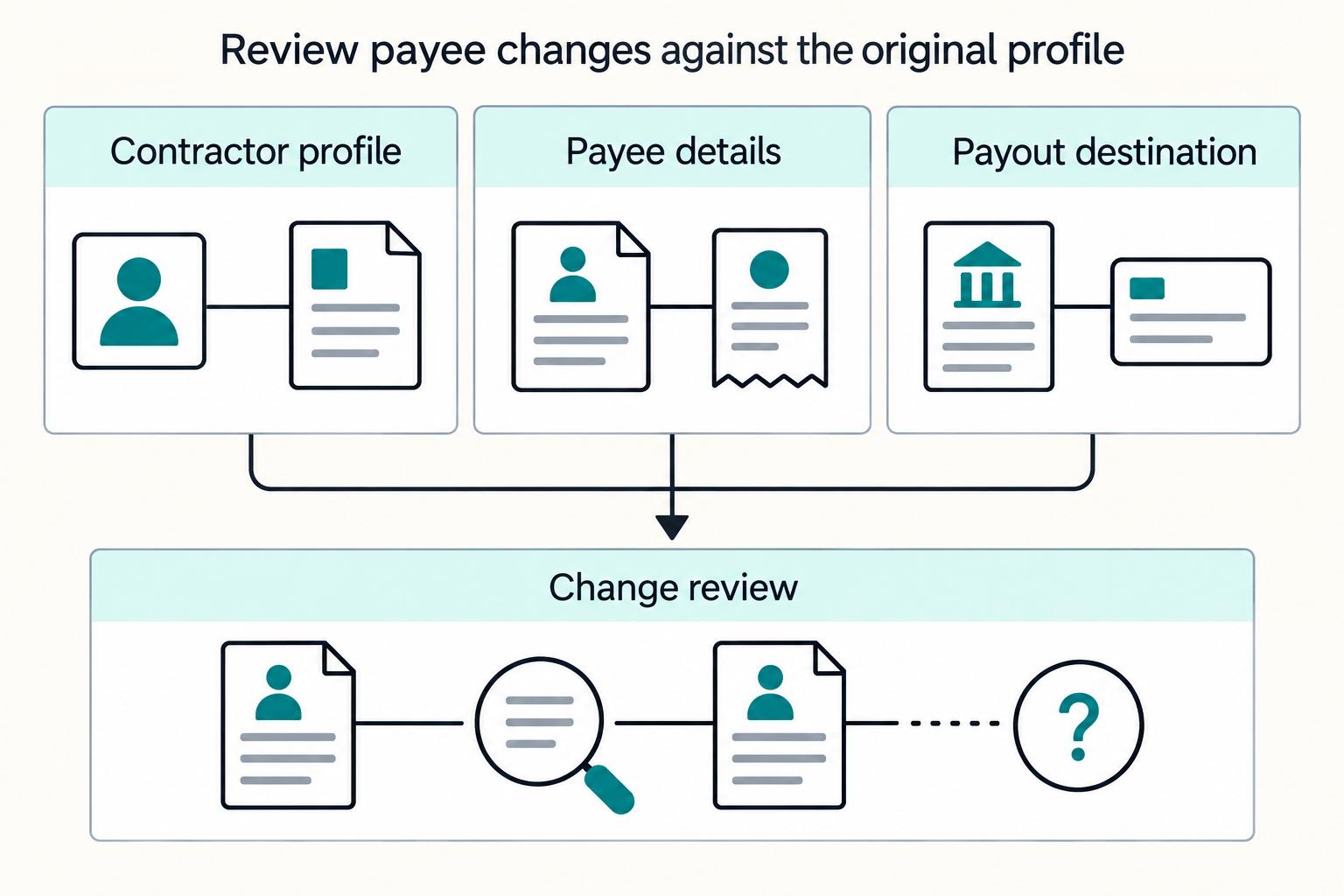
This is not a mere data-entry confirmation. It is a control decision. Reviewers are not only checking whether a field was filled. They are checking whether the payout setup aligns with the contractor, the payee relationship, and the evidence already collected. In practice, that means looking for alignment across:
- The contractor profile
- The intended payee details
- The payout destination details
- Any explanations or supporting evidence already submitted
When these elements align cleanly, activation can proceed according to the risk-tier rules. When they do not, the default should be a hold until the inconsistency is explained or corrected.
This is one of the places where pressure to move fast can cause the most damage. A manager may say the contractor has already been vetted, the work has started, or the amount is small. But the activation decision is specifically about whether funds can be sent safely to the approved payee setup. If that part is uncertain, the profile is not truly onboarding-complete.
A useful operational distinction is between a correction and a change. A correction fixes a clear error in a submitted detail. A change alters the intended payout setup in a way that may affect the review. Those should not be handled the same way. A meaningful change may require you to revisit prior decisions, not just update a field. Your bank and payee review should also define how detail changes are controlled. For example:
- Who can request a change after initial submission?
- What evidence is needed to support the change?
- Whether the profile returns to hold status during review
- Who must approve the revised setup before activation or continued payout access
If you do not define this, teams often process changes through informal channels, which is one of the most common ways payment controls break down.
From the contractor's perspective, this stage is easier when the requests are clear and specific. Instead of a vague message that something is "incorrect," tell them what needs to match, what evidence is missing, or what explanation is needed. Precision reduces friction.
A reviewer checklist for this stage might include:
- Does the payee setup align with the approved contractor profile?
- Is there any mismatch that should block activation?
- Were any recent changes made that require renewed review?
- Is the decision and supporting rationale recorded in the case?
Activation should be the result of a completed review, not the beginning of one. Once bank and payee details are verified and the case is approved, the profile can move into an active state with much less operational risk.
For more on validating bank accounts before payout, see Payee Verification at Scale: How Platforms Validate Bank Accounts Before Sending Mass Payouts.
Use a clear approve hold reject matrix with escalation paths#
Many onboarding programs fail at the final decision layer, not because they lack checks, but because they lack a clear decision framework. Reviewers collect information, identify issues, and still struggle to answer the practical question: do we approve, hold, or reject this case? A decision matrix solves that by turning review outcomes into repeatable actions.
At minimum, the matrix should define:
- What conditions support approval
- What conditions require a hold pending more information or review
- What conditions support rejection
- Who can make each decision
- Which cases must be escalated
- How overrides are documented
| Decision | Typical condition | Owner | Next move |
|---|---|---|---|
| Approve | Required evidence is complete and matches the approved profile for the risk tier | Final reviewer or approver | Activate payout access and store rationale |
| Hold | Missing evidence, mismatch, or unresolved change request that may still be fixable | Assigned reviewer | Request correction or escalate while payout stays blocked |
| Reject | Case cannot meet the program standard or fails a non-negotiable rule | Authorized approver | Close the case and record the reason |
The reason this matters is consistency. Without a matrix, one reviewer may approve a case with a minor mismatch and another may hold the same case. Inconsistent decisions create operational confusion and weaken the credibility of the control environment.
A strong matrix also makes it easier to train new reviewers. They do not need to guess what the organization considers tolerable. They can compare the case against a defined set of outcomes and follow the corresponding path.
The "hold" category deserves special attention. It should be a real working status, not a vague parking lot. A hold should always answer three questions:
- Why is the case on hold?
- What would clear the hold?
- Who is responsible for the next action?
If those answers are missing, holds become dead ends and teams start pushing for approval just to move the case.
The escalation path should be equally clear. Reviewers need to know when a case is beyond normal handling and how to route it. Good escalation design includes:
- A trigger for escalation
- The decision owner at the next level
- The evidence required for review
- The target outcome of the escalation
- Payout access stays blocked while the escalated issue remains unresolved
Escalation is not only for severe outcomes. It is also for cases where the standard rules do not fit cleanly and a documented judgment call is needed. The goal is not to eliminate judgment. The goal is to channel it through a controlled path.
Overrides need careful handling. In most programs, there will be pressure to approve a case because of urgency, revenue, or internal sponsorship. If an override is permitted at all, it should be rare, role-based, documented, and visible. The record should show who approved it, what risk was accepted, what evidence existed at the time, and whether any temporary conditions were attached.
A practical approve / hold / reject matrix often becomes the bridge between policy and operations. Policy says what the organization expects. The matrix says what a reviewer should do at the moment of decision.
That clarity improves the contractor experience too. If the team knows the exact reason for a hold or rejection, communications become direct rather than evasive. Contractors can then either fix the issue or understand that the case will not proceed.
If you want this matrix to run consistently in production, map each hold/reject rule to explicit payout statuses and webhook-driven updates in the Gruv docs.
Implement Controls with Auditability and Minimal Friction#
Implement the operating rules in your onboarding and payout tools. Confirm which controls are supported in your Gruv program or other chosen system before relying on automated enforcement.
The first principle is to map the process stages directly into system states. If a contractor is waiting on prerequisites, identity review, tax mismatch resolution, bank verification, or final approval, the system should show that clearly. Avoid collapsing distinct review stages into a single generic status. Granular but understandable states reduce confusion and support better reporting.
The second principle is to use gating intentionally. If a contractor should not receive payout access until certain checks are complete, make that dependency visible in the workflow. A reviewer should not have to remember an unwritten rule, and a manager should not be able to skip a blocked step without leaving a record. Use the following as implementation requirements and verify each capability in your chosen system:
- Structured intake with required fields where needed
- Evidence capture attached to the contractor record
- Review states that reflect real decision points
- Clear reasons for holds, mismatches, and rejections
- Approval actions tied to user roles
- An audit trail of submissions, changes, decisions, and overrides
Minimal friction does not mean minimal control. It means reducing avoidable effort while protecting the points that matter most. For example, do not ask reviewers to re-enter information the contractor already submitted. Do not force them to store rationale in scattered notes that nobody else can find later. And do not require contractors to answer questions that do not affect routing or approval.
At the same time, do not hide critical controls behind convenience. A smooth interface is helpful only if it still captures the evidence and decisions needed to support the outcome.
A strong implementation usually separates the contractor experience from the reviewer experience. Contractors need clear requests, short explanations, and a simple way to correct or supplement their submissions. Reviewers need comparison views, status clarity, access to prior decisions, and a clean place to record rationale. When those two experiences are designed together, back-and-forth drops.
You should also think about change control inside the tool. Onboarding rules evolve. Trigger conditions change. Teams learn where bottlenecks are. That is normal. What matters is that workflow changes are managed and documented so people understand what shifted and why. Otherwise, cases reviewed under different logic start to look inconsistent with no obvious explanation.
Reporting matters too, but only if it aligns with decisions. Choose operational views that help teams answer questions like:
- Which cases are waiting on the contractor?
- Which are waiting on review?
- Which holds are aging because no owner is clear?
- Which decision reasons are most common?
- Where are overrides happening?
These are not just performance questions. They are control questions. A queue full of unresolved holds or frequent manual overrides usually signals that the workflow design needs attention.
The final implementation principle is simple: make evidence travel with the decision. If a later reviewer or manager opens the case, they should be able to see what was submitted, what was checked, what failed or matched, and why the case is in its current state. That is what makes the process auditable without making it heavy.
Related reading: KYC at Scale: 10,000 Contractors Without Killing Conversion.
Monitor contractors after onboarding, refresh controls on schedule, and fix common failures early#
Onboarding is the start of the control lifecycle, not the end. A contractor profile that was acceptable at activation can drift over time as details change, documents age, payout instructions change, or new risk indicators appear. If your process only reviews at the front door, it will eventually miss issues created after approval.
Post-onboarding monitoring should focus on change, timing, and triggers. You do not need to re-review everything constantly. You do need a way to detect when the existing approval basis may no longer be enough. A workable monitoring model usually includes:
- Scheduled refreshes for the controls that need periodic confirmation
- Trigger-based reviews when key details change
- A method for reapplying the approve / hold / reject logic after new information appears
- Clear ownership for follow-up and reapproval where needed
The most important design choice is deciding which changes should reopen review. If a contractor updates details that affect identity confidence, tax profile alignment, or payout destination, that should not be treated as routine account maintenance. It should trigger the relevant control path again.
This is also where many common onboarding failures first show up. A contractor was activated correctly, but later:
- A detail changes through an informal request
- A mismatch is noticed but not routed into the hold workflow
- A reviewer assumes a prior approval covers a new situation
- A refresh comes due but no one owns the outreach
- A temporary exception silently becomes permanent
These are process failures more than individual failures. The fix is not just reminding people to be careful. It is building the workflow so that change is visible, review is re-triggered when it should be, and exceptions cannot disappear into the background.
A few common failure patterns are worth watching for. The first is "approval by age." A case sits long enough that people become more concerned about delay than about the unresolved issue. Eventually someone approves it just to clear the queue. The answer is to manage aging holds actively and escalate them before frustration takes over.
The second is "documentation by conversation." Reviewers resolve issues in calls, chats, or email but never update the case record. Later, no one can tell what was actually decided. The fix is to make the case record the source of truth and require decision rationale to be entered there.
The third is "change without reset." A contractor updates a key detail after approval, but the system does not return the relevant control state to review. The team assumes the profile is still approved because it was approved once. This is exactly the kind of drift that good trigger logic should prevent.
The fourth is "unclear escalation ownership." Everyone agrees a case needs a higher-level decision, but no one owns the escalation. The case then stalls or is pushed through informally. A named escalation owner is the practical solution.
Monitoring also creates a feedback loop for improving the onboarding flow itself. If the same mismatch, same missing evidence, or same escalation reason keeps appearing, that is a signal to redesign the earlier steps. Strong programs do not just process issues. They learn from them and reduce recurrence.
When refreshes are due, the communication should be as specific as the original onboarding requests. Tell the contractor what needs to be reconfirmed, what changed if the rules changed, what happens if they do not respond, and whether payout access may be affected. Vague requests create delay and frustration.
A mature onboarding program is not one that avoids all issues. It is one that finds issues early, routes them predictably, records decisions clearly, and updates the process when repeated failures point to a design weakness.
Final takeaway and copy paste launch checklist#
A reliable contractor onboarding flow is less about collecting more data and more about making better decisions in the right order. Set scope before tooling. Collect prerequisites before checks. Build risk tiers before the first case. Run identity and screening checks early and block payout access until they clear. Resolve tax profile mismatches before payout approval. Verify bank and payee details before activation. Use a clear approve / hold / reject matrix with named escalation paths. Then implement those decisions in your chosen system so the audit trail is built into the workflow, not reconstructed later.
If you want a practical launch checklist, use this and adapt it to your internal ownership model:
- Define which contractor relationships are in scope.
- Identify the owners for intake, review, escalation, approval, and monitoring.
- Write down the minimum evidence needed before the first check begins.
- Create a completeness standard so incomplete cases do not enter downstream review.
- Define your risk tiers and the trigger rules that change the path.
- Decide which identity and screening outcomes clear, hold, escalate, or block a case.
- Gate payout access until required identity and screening review is complete.
- Define what tax profile information is required and how mismatches are resolved.
- Block payout approval while tax profile issues remain unresolved.
- Define the evidence and review needed for bank and payee verification.
- Treat meaningful changes to payee or payout details as review events, not simple edits.
- Build an approve / hold / reject matrix with clear owners and escalation routes.
- Decide who can authorize overrides and how those overrides are recorded.
- Configure system statuses so each stage reflects a real decision point.
- Make evidence, notes, and decisions visible in the contractor record.
- Track common hold reasons, overrides, and repeat failure patterns.
- Set refresh rules for post-onboarding monitoring.
- Reopen review automatically or operationally when key details change.
- Train reviewers on the decision logic, not just the clicks.
- Review the workflow regularly and fix the stages that create avoidable rework.
If those pieces are in place, onboarding becomes easier to operate and easier to trust. That is the real goal: a process that lets the business move without asking reviewers to choose between speed and control.
Before full rollout, confirm which KYC, tax, and payout controls are enabled for your markets and program in a focused coverage review with Gruv.
Frequently Asked Questions
Should every contractor go through the exact same onboarding flow?
No. The process should be consistent, but not identical in every case. The purpose of risk tiers is to match the depth of review to the risk involved. What must stay consistent is the decision logic, the ownership, and the requirement that payout access is gated until the necessary checks for that case are complete.
What is the biggest mistake teams make during contractor onboarding?
A common mistake is allowing downstream progress before upstream questions are resolved. If identity, screening, tax profile, or payee details are still uncertain, later approvals create pressure to activate anyway. Sequence matters because it protects the final decision from being driven by urgency.
When should a case be placed on hold instead of rejected?
A hold makes sense when the issue may be resolvable with more information, clarification, or review. Rejection fits when the case cannot meet the required standard under your rules. The important part is that a hold should have a clear reason, a defined next step, and an owner. It should not be a vague waiting state.
Can a manager ask for an exception if the contractor is urgent?
They can ask, but urgency should not erase the control path. If exceptions are allowed, they should follow a documented escalation and override process with clear authority and recorded rationale. Otherwise, urgency becomes an informal way to bypass the workflow.
Why separate completeness review from later checks?
Because incomplete cases create false mismatches, rework, and inconsistent decisions. A basic completeness review makes later checks more reliable. It also gives contractors clearer requests at the start instead of multiple correction rounds later.
What should trigger a renewed review after onboarding?
Any change that affects the basis of approval should trigger the relevant review path again. That includes changes that affect identity confidence, tax profile alignment, or payout destination. The exact triggers depend on your rules, but the principle is simple: a meaningful change should not inherit approval automatically.
How much rationale should reviewers record?
Enough that another reviewer can understand what happened without guessing. For straightforward approvals, the system status and decision record may be enough. For holds, escalations, mismatches, and overrides, the record should show the issue, the evidence considered, the decision made, and who made it.
How do you reduce friction without weakening controls?
Remove steps that do not affect routing or approval, keep requests specific, use structured statuses, and make evidence easy to upload and review. At the same time, keep the hard gates where they matter: identity and screening review, tax profile resolution, and bank and payee verification before activation.
What is the point of an approve / hold / reject matrix?
It turns policy into operational decisions. Reviewers do not need to improvise when they see a mismatch or unclear case. They can follow a defined path, escalate when needed, and apply consistent standards across the queue.
Where Gruv fits
Researched and edited by the Gruv editorial team. Gruv builds cross-border billing, payouts, and finance-operations software for global businesses.
Sources
Includes 5 external sources outside the trusted-domain allowlist.
- irs.gov/instructions/iw9trusted
- irs.gov/instructions/iw8bentrusted
- apexanalytix.com/resources/blog/supplier-onboarding-checklistexternal
- gruv.ai/blog/kyc-at-scale-10000-contractors-without-...external
- gruv.ai/blog/payee-verification-scale-platforms-vali...external
- legal.thomsonreuters.com/blog/5-essential-steps-for-kyc-aml-onboardin...external
- nacha.org/rules/account-validation-resource-centerexternal
Educational content only. Not legal, tax, or financial advice.
Related Posts

The Freelance Payment Penalty: A Modeled Audit of Platform Fees, FX Spreads, and Payout Delays
The money rarely disappears through a single, easy-to-spot fee. The real loss is stacked. A marketplace takes its commission, a processor adds a charge for international cards, a bank or payment company converts the currency at a spread, a platform holds the funds before release, and a wire sheds a little to intermediaries on the way in. Each layer looks defensible on its own, but the worker feels the combined result as a smaller deposit and a later payday.

How to Respond to a Subpoena for Business Records
Move fast, but do not produce records on instinct. If you need to **respond to a subpoena for business records**, your immediate job is to control deadlines, preserve records, and make any later production defensible.

A US Expat's Guide to Investing in UCITS ETFs to Avoid PFIC Issues
The real problem is a two-system conflict. U.S. tax treatment can punish the wrong fund choice, while local product-access constraints can block the funds you want to buy in the first place. For **us expat ucits etfs**, the practical question is not "Which product is best?" It is "What can I access, report, and keep doing every year without guessing?" Use this four-part filter before any trade: