
Quick Answer
Give each supplier one onboarding record with separate tax, identity, sanctions, and bank-check statuses. Collect the right W-9 or W-8 form, verify the account under your payout policy, and release payment only when the required checks or documented exceptions are complete. Keep corrections on the same record and preserve reporting and withholding treatment for payments already made.
Why one onboarding flow reduces avoidable compliance surprises#
One flow reduces surprises only when it is built for payout readiness, not just document collection. A submitted Form W-9 or Form W-8BEN is only an input. It does not confirm that tax, identity, sanctions, and bank controls are complete enough to activate payment safely.
Late-stage failures often come from treating intake completion as approval. A supplier can look fully onboarded in a portal and still fail at payout activation, sanctions screening, or tax reporting. The practical goal is to move those checks earlier, while the profile is still in an intake state and your team can pause, correct, or escalate with less disruption.
Set the promise at the right level#
Keep the promise modest: earlier control gates reduce downstream blocks. Tax setup, identity review, sanctions checks, and bank-detail controls should work as linked checkpoints that determine whether a supplier is submitted, under review, or payout-eligible.
Eligible payers can use IRS TIN Matching to check name and TIN combinations before filing information returns. If errors surface only after filing, CP2100 or CP2100A notice handling adds work. Backup withholding may apply to affected reportable payments at the current 24 percent rate.
Enforce early gates across tax, identity, and bank setup#
Treat each control area as a gate, not a field. In practice:
- Collect the applicable tax form and core identity data. For U.S. persons, that is typically Form W-9. For foreign beneficial owners, it may start with Form W-8BEN.
- Validate before payout activation. The checkpoint is not "form received" but "required validation and screening completed for this supplier and payment method."
- Record pass, fail, or escalation with evidence, including form version, validation outcomes, and correction history.
This helps keep "approved but not actually payout-ready" profiles from reaching finance operations.
Keep scope boundaries explicit#
One flow is not one universal rulebook. FATF emphasizes a risk-based approach, and implementation still has to fit each country's legal and operational context. FFIEC OFAC guidance similarly ties program design to products, services, customers, transactions, and geography.
Use one intake path to centralize control points, then tune checks by jurisdiction, rail, and risk exposure. Account validation is broadly a payment-control best practice. Nacha also includes a first-use account-validation requirement for certain WEB consumer debit use cases effective March 19, 2021. That does not make one bank-check rule universal across all supplier payout scenarios.
For edge cases, especially around market-specific tax treatment, withholding, sanctions interpretation, or AML obligations, specialist legal or tax advice is still required.
For a step-by-step walkthrough, see Contractor Onboarding Optimization: How to Reduce KYC Drop-Off and Get to First Payout Faster.
What to prepare before you automate supplier onboarding#
Before you automate anything, lock three decisions: form routing, pre-payout control gates, and audit-evidence storage. If those are still fuzzy, automation will only make a weak process move faster.
Route tax forms by supplier type#
Route tax forms by supplier type, not by country label alone. U.S. payees generally provide Form W-9 with their Tax Identification Number (TIN). Foreign individuals who are beneficial owners may provide Form W-8BEN, and foreign entities should use Form W-8BEN-E rather than the individual path.
| Form | Supplier type | Detail |
|---|---|---|
| Form W-9 | U.S. payees | Generally provide this form with their Tax Identification Number (TIN) |
| Form W-8BEN | Foreign individuals who are beneficial owners | May provide this form |
| Form W-8BEN-E | Foreign entities | Should use this form rather than the individual path |
Keep intake fields structured and explicit. In W-9 flows, line 1 should match the name shown on the income tax return, so capture legal name directly instead of burying it in free text. At minimum, make sure each route captures supplier type, individual-versus-entity status, legal name, and tax-ID details where applicable.
Define pre-payout control gates#
Define which checks must clear before payout activation, and decide what counts as a pass, an approved exception, or an unresolved hold. In many programs, that can include KYC, KYB, and OFAC screening as true gates, not just statuses collected during intake.
Set scope carefully. OFAC screening matters for U.S. persons, but OFAC's search tool is not a substitute for broader due diligence. Build in a review path for possible matches and unresolved ownership questions. If you rely on regulated-partner requirements, map those directly, and confirm current beneficial-ownership applicability before hard-coding KYB logic, including any cited FinCEN exceptive relief context for covered financial institutions.
Choose where audit evidence lives#
Decide where evidence will live before launch. Your enterprise resource planning (ERP) system can track operational state, but regulated programs may also require a secure, time-stamped audit trail for submissions, reviews, edits, and overrides.
Treat retention and retrieval as design requirements. A W-9 is provided to the requester, not sent to the IRS during onboarding. Store enough evidence to reconstruct decisions later, including form version, captured line-1 name, tax ID, screening timestamps, reviewer identity, and correction history.
Related: Vendor Onboarding Automation: How to Collect Bank Details Tax Forms and Compliance Docs at Scale.
Set minimum control gates before you select tooling#
Set your hard stops before vendor selection. Payout eligibility should be a separate approval state, and it should remain blocked until tax ID verification and sanctions screening return either a pass or a documented exception approved by the right owner.
Define the minimum checks before money moves#
Define the minimum checks that must clear before money moves. In U.S.-linked W-9 intake, that usually means validating name and TIN data and, where applicable, screening against prescribed government lists, so teams do not confuse "form collected" with "record verified."
Be explicit about pass criteria. Eligible payers and authorized agents can use IRS TIN Matching before filing information returns; confirm access before making it a required automated gate. Store the legal name, TIN, result code, timestamp, and any approved exception. A tool that only shows "tax form received" cannot tell the payout team whether the record cleared your checks.
Escalate unresolved watchlist matches#
Possible watchlist matches should go to compliance review when ownership or identity cannot be resolved. Do not default that queue to finance ops just because finance owns activation in the ERP.
Use a clear escalation rule. If screening returns a potential match and you still cannot form a clear view of true identity, the case needs compliance ownership for evidence review, document follow-up, and disposition. For banks, FFIEC CIP examination procedures reflect that operating principle by calling for action when a reasonable belief in true identity cannot be formed and by including checks against prescribed government lists when applicable. Unresolved identity or sanctions ambiguity is a compliance decision, not an accounts-payable cleanup task.
Separate onboarding completion from payout eligibility#
Keep onboarding complete separate from payout eligible in both your data model and your UI. A supplier can finish submission while still sitting in pending, failed, or under-review verification status.
You can see this pattern in production systems. Stripe Connect separates required-information collection from payout enablement and can pause payouts when required information is missing or unverified. The takeaway is simple: profile submitted is not production-ready.
Before activation, require one auditable checkpoint with current tax verification status, current sanctions status, review owner, and decision timestamp. If a case reaches a blocked-property scenario under OFAC rules, handle it outside general ops. OFAC initial blocking reports are time-bound, within 10 business days, and related records should remain available for examination for at least 10 years.
Map the exact intake sequence from first form to payout eligibility#
Use a mixed model: strict gates at decision points, parallel processing everywhere else. Form intake can trigger multiple checks, but payout eligibility should stay blocked until each required check is either passed or formally overridden and recorded.
| Step | Action | Parallel or strict | Record in the audit trail |
|---|---|---|---|
| 1 | Collect Form W-9 or Form W-8BEN, plus legal name and Tax Identification Number where applicable | Strict first step | Form type, submitted fields, submitter, timestamp, version |
| 2 | Review name and TIN data for U.S. payees; use IRS TIN Matching if your payer is eligible | Starts after tax form intake and can run in parallel with identity checks | Name/TIN used, result code, source, timestamp, retry count |
| 3 | Run KYC/KYB checks, including legal-entity and beneficial-owner data where your program requires it | Can run in parallel with Step 2 after minimum identity fields exist | Check status, data sources used, reviewer or vendor result, timestamp |
| 4 | Run OFAC screening and related watchlist checks where applicable | Can run in parallel with Step 2 and Step 3 once identity data is available | List version or provider response, disposition, reviewer, timestamp |
| 5 | Collect bank details through an approved channel and complete the account check required by your payout rail and policy | Can run alongside tax and identity checks; must clear before payout approval | Account record version, check method and result, reviewer, timestamp, change history |
| 6 | Approve payout profile | Strict final step after all required checks are passed or formally overridden | Final decision, approver, decision time, linked evidence |
Start with the correct tax form#
Start with the correct tax form, not a generic upload. Use Form W-9 when a payee is providing a TIN for information returns, and Form W-8BEN when a foreign beneficial owner provides the form to a withholding agent or payer.
Make completeness a hard checkpoint before verification calls. Record legal name as submitted, form type, TIN presence, and whether the submission is consistent enough to proceed. If a W-9 path has no TIN, treat that as a stop condition for reportable payments. IRS backup withholding guidance says the payer must begin backup withholding immediately when no TIN is provided.
Run TIN validation early#
Review name and TIN data as soon as a usable pair is available. If your payer qualifies for IRS TIN Matching, use it before filing information returns and resolve exceptions during intake rather than at year-end.
For throughput planning, interactive mode supports up to 25 combinations with immediate results and a limit of 999 requests per 24 hours. Bulk mode supports up to 100,000 combinations with results within 24 hours. Run this in parallel with KYC or KYB collection where possible, but keep the gate strict. A passed identity check does not offset a failed name and TIN result.
Advance identity checks in parallel#
Advance identity checks in parallel, but approve only on complete identity outcomes. For individuals, this may be KYC. For entities, it may include KYB plus ownership data where your program requires it. If you are a covered financial institution, 31 CFR 1010.230 requires procedures to identify and verify beneficial owners of legal entity customers at account opening.
Checkpoint on outcome quality, not document count. Store pass, fail, or review status, the exact person or entity record reviewed, and supporting evidence. If names drift across sources, resolve the mismatch on the existing profile instead of creating a duplicate supplier.
Screen sanctions before payout approval#
Where your program is subject to OFAC controls, run sanctions and watchlist screening before payout approval, because OFAC rules block dealing in blocked property. Screening belongs before money moves.
You can run screening in parallel with tax and identity checks once enough identity data exists. Record disposition details, including the list data or provider response used at decision time. Keep complete records available, since OFAC-related records may need to be available for examination for at least 10 years.
Approve payout eligibility last#
Approve payout eligibility only after all required checks are in a complete pass state or have a documented override. Keep this state separate from both onboarding submitted and bank details collected.
For corrections, use one re-entry rule. Update the existing supplier profile, preserve prior failed attempts in the audit trail, and use an idempotency key for create or update retries so network failures do not create duplicates. When corrected data arrives, for example after a name and TIN mismatch, reopen only the failed checkpoint, rerun affected checks, and keep payout blocked until the new result is recorded.
Decide auto-approval versus escalation with a red yellow green matrix#
Use one decision matrix so payout status is clear at a glance: green can auto-approve, yellow stays blocked pending fixes, and red is a hard stop with escalation.
| Lane | Entry criteria | Payout rule | Owner | SLA lane |
|---|---|---|---|---|
| Green | Clean IRS TIN Matching result where a U.S. payee TIN is required, clear sanctions screening result, and no unresolved identity-verification mismatch in controls applicable to your program | Auto-approve payout eligibility when all required controls for that program pass | Operations executes; compliance and tax define rules | Automated decision path, no manual review |
| Yellow | Minor but credible mismatch or stale evidence that can be corrected, such as a required document refresh | Keep payout locked until corrected evidence is received and the failed checkpoint is rerun | Tax ops or compliance, based on failed check | Documented correction-review SLA owned by that lane |
| Red | Unresolved sanctions screening alert requiring compliance review, repeated name/TIN mismatch, no TIN where required, or suspected synthetic identity under your policy | Hard stop, no payout release, manual escalation required | Compliance for sanctions and identity, tax or finance for withholding impacts, legal as needed | Immediate assignment and escalation SLA |
Keep the matrix tied to actual gate outputs, not intake completion flags. Collected is not cleared. A W-9 on file, bank details on file, or uploaded documents alone do not qualify for green.
Yellow is for fixable records, not unresolved risk. Reopen only the failed checkpoint, keep the same supplier profile, and preserve old and new evidence in one audit trail. If the mismatch persists after resubmission, move it to red.
Red needs explicit handling rules. If no TIN is provided where required, backup withholding must begin immediately on reportable payments at 24 percent. For OFAC-related red outcomes, keep payout blocked until compliance adjudication is complete, and route any required blocked-property reporting (within 10 business days) or rejected-transaction reporting through the named owner.
Before launch, publish this matrix across operations, compliance, legal, finance, and tax so each lane has a named decision-maker, approver field, reason code, and internal SLA target.
Build tax and bank verification to prevent year-end rework#
Treat tax verification and bank verification as separate decisions. If you combine them, you make year-end reporting problems harder to see and harder to fix.
Validate name and TIN when Form W-9 arrives#
Validate payee name and TIN when you receive Form W-9, not at filing time. The IRS positions TIN matching as a pre-filing check, which can prevent rework.
Poor intake usually surfaces late. Missing or incorrect TIN data, or a name and TIN mismatch on filed returns, can trigger a CP2100 or CP2100A notice. At that point, an onboarding defect turns into notice handling, payee outreach, and possible backup withholding operations.
Use a strict checkpoint. Match the legal name captured from Form W-9 to the exact name string submitted in TIN matching, and store the result with a timestamp. One common failure mode is clean documentation paired with mismatched keyed data.
Keep reporting complete while resolving name and TIN issues#
Use an internal payout hold while an unresolved name and TIN mismatch is reviewed. Keep payments already made in the Form 1099 reporting workflow. The IRS 2026 General Instructions say to leave the recipient TIN box blank if no TIN was provided; missing data does not erase a reporting duty. Apply the relevant solicitation, correction, and backup withholding rules to those payments.
| Scenario | Action | Timing or condition |
|---|---|---|
| Mismatch unresolved after the correction window | Hold new payouts under policy; keep prior reportable payments in the filing workflow and resolve any withholding duty | During review and at filing |
| First CP2100 or CP2100A listing | Send the First B Notice and Form W-9 | Within 15 business days from the notice date or receipt date, whichever is later, when the notice matches your records |
| Still unresolved after the first listing | Begin backup withholding | No later than 30 business days after receipt of the notice for affected future reportable payments if the payee does not respond |
| Same payee listed again | A W-9 alone is not enough; stronger evidence is required | Within a three-year period |
If a filed return later triggers CP2100 or CP2100A, follow Publication 1281 timing.
Keep bank-detail validation separate#
Keep bank-detail validation on its own track. Collect account details through an approved channel, check the account by a method suited to the payout rail and your provider, and flag changed details for review before release. Record the bank-record version, method, result, and reviewer. A validated bank account does not prove Form 1099 readiness, and a clean tax record does not prove account usability.
If tax and bank checks share one status, operations cannot diagnose failures quickly. Keep separate statuses and retry paths so bank fixes do not reopen tax records, and TIN reruns do not reset validated bank details.
This separation also matches scope. Nacha makes account validation part of fraud detection for WEB debits, effective March 19, 2021, and also describes account validation as a broader payment best practice. That does not make bank validation a proxy for tax reporting readiness.
Require an evidence pack before overrides#
Require a compact evidence pack before overriding a TIN-matching failure or tax-profile warning. If the override cannot be defended in an audit trail, do not approve it. Keep, at minimum:
- the current Form W-9
- the failed TIN-matching result and any rerun result, with dates and request details
- the supplier correction submitted during the correction window
- the named approver, reason code, and written rationale
- for repeat B-notice scenarios, the stronger follow-up evidence required for second-notice handling
Your audit test should show what name and TIN were checked, what changed after correction, whether new payouts were held, and how payments already made were reported and withheld where required. If that trail is unclear, the override process is too loose.
Assign ownership and keep defensible evidence for every decision#
Set exception ownership before exceptions happen, and require enough written evidence for a second reviewer to reconstruct each approval. If approvals sit in shared inboxes or chat threads, you may have activity, but you do not have clear accountability.
Name one approver for each exception type#
Assign one approving role for each exception type before cases start. Management should assign responsibility and delegate authority, so map decisions to a named role or person, not to a broad group.
If a case spans compliance, legal, finance, and ops, still name one final approver. Tasks can be delegated, but accountability for effective internal control stays with senior governance. As a quick test, pull one recent exception and ask who had approval authority. If you cannot identify one named approver, tighten the control.
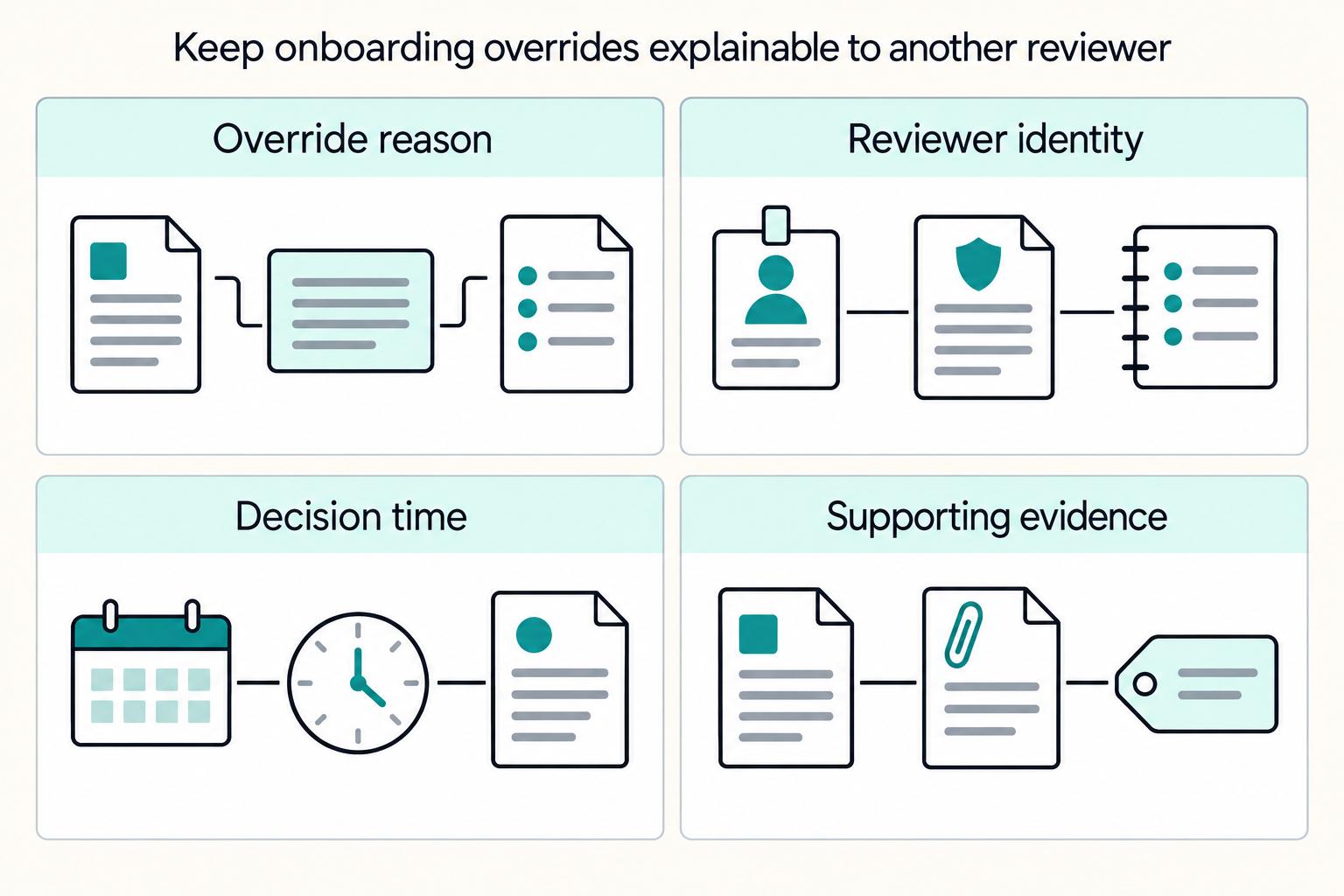
Require a complete override record#
Require a complete override record every time. The record should show the conclusion and the evidence behind it, not just a status change. Capture at least:
- reason summary or program reason code
- reviewer identity
- approval date and time
- linked supporting artifact
- short rationale tied to the policy rule being overridden
Artifacts can include submitted Form W-9 or Form W-8BEN-E documentation, TIN-related validation results, including reruns, supplier corrections, or policy and legal interpretation notes. If the approver cannot point to the exact artifact that changed the decision, the record is too thin. Test whether a second reviewer can reconstruct one approved exception in five minutes.
Keep scope notes explicit#
Keep scope notes explicit so supplier intake does not absorb unrelated obligations by accident. State what intake does and does not cover for the program.
Form W-9 provides a U.S. payee's TIN for information-return workflows, while Form W-8BEN-E documents a foreign entity's status for the requesting withholding agent or payer. Neither form verifies a bank account or clears identity and sanctions checks.
Write down which tax forms, identity checks, sanctions reviews, and bank controls apply to each supplier segment. Assign any separate regulatory filing duties to their own owners so an intake status is never mistaken for full compliance clearance.
For ongoing review after onboarding, see Continuous KYC Monitoring for Payment Platforms Beyond One-Time Checks.
Connect onboarding controls to ERP and payout operations without drift#
After you set approvers and evidence rules, one common failure point is state drift. Treat the enterprise resource planning (ERP) system as a downstream consumer of approved onboarding state, not a second place where tax, identity, or payout eligibility is edited ad hoc.
Anchor canonical fields before data hits ERP#
Define which intake fields are authoritative and mirror them into ERP. At minimum, keep one current value for legal name, normalized Tax Identification Number (TIN), tax form type, current KYC or KYB status where applicable, current sanctions screening status where applicable, payout eligibility, and exception reference.
This also reduces duplicate and rework risk. Oracle notes that duplicate supplier records create transaction problems and manual intervention, and duplicate prevention improves when taxpayer IDs are compared as alphanumeric values regardless of format. Normalize the TIN before sync, keep the intake source record ID, and update the existing supplier master when corrected tax data arrives. As a quick check, resubmit one supplier with the same TIN in a different format and confirm ERP updates one supplier record, not two.
Make payout release read the latest verification state#
Payout release should read current verification state at decision time, not a snapshot from onboarding. Webhooks are used to update internal resource state, and verification outcomes can arrive after review completes.
For sanctions and identity controls, stale state is the risk. In a UK-regulated context, FCA guidance expects effective, up-to-date screening systems appropriate to business risk. If the latest KYC or KYB or screening decision is missing, unreadable, or older than source state, keep payout blocked until the state is refreshed.
Open a supplier approved days ago and verify that the payout view shows the latest verification timestamp, decision, and source event reference.
Reconcile payout events against the audit trail#
Before releasing payouts, reconcile each payout event to the supporting audit trail record. The audit trail should let a reviewer reconstruct what happened and why a release decision was made.
The minimum record should tie supplier ID, payout profile ID, approval decision, reviewer or rule, decision timestamp, and linked supporting artifact. Typical artifacts include tax-form records and TIN matching checks where applicable, plus documented sanctions-review notes. Reconciliation helps catch cases where ERP shows active but supporting approval evidence is missing.
Define a no-bypass fallback for webhook delays#
Assume webhook delays and missed deliveries can happen, and design fallback controls up front. Stripe documents retries for up to 3 days and supports querying missed events from the last 30 days for reconciliation.
Make the fallback explicit. Place the supplier in a pending external status hold and allow only retry or escalation for manual review. Do not allow direct manual flips to payout-eligible in ERP to clear queues. If a release proceeds under pressure, require a written record of the missing event, provider reference, manual checks performed, and named approver accepting the risk.
Common failure modes and the fastest recovery path#
When onboarding fails, the fastest safe recovery path is to move the supplier back into controlled review, keep all evidence attached, and reapprove only after the failed control is rechecked.
| Failure mode | Recovery path | Key note |
|---|---|---|
| Repeated TIN matching failures | Route the record to controlled resubmission instead of open-ended self-serve edits | If the TIN is missing or obviously incorrect on reportable payments, begin backup withholding immediately at 24 percent |
| Watchlist hit | Escalate before any payout unlock with documented investigation | If the documentation is weak, keep payout blocked |
| Missing, incomplete, or inconsistent tax form | Roll back approval, remediate the document, and recheck | Examples include a U.S. supplier with only a W-8BEN on file or a W-9 missing a required certification or TIN |
Freeze repeated TIN failures into controlled resubmission#
If TIN matching fails repeatedly for the same supplier, route the record to controlled resubmission instead of open-ended self-serve edits. This is a product control choice, but it helps prevent name, Tax Identification Number (TIN), and tax-form fields from drifting across retries.
Before resubmitting a Form W-9, check the payee name, TIN, and any required certification and signature. Keep reviewer notes on what changed and why the prior submission failed. If a missing or obviously incorrect TIN affects reportable payments, apply backup withholding when payment is made; the current rate is 24 percent.
Checkpoint: the audit trail shows each failed match, the corrected W-9 version, reviewer identity, and the exact name and TIN pair resubmitted.
Escalate watchlist hits before releasing any payout#
Escalate watchlist hits before releasing any payout. Treat a likely false positive from watchlist checks as a potential match until a reviewer clears it. Do not auto-clear based on a common name or informal business confirmation. Use an escalation path with documented investigation.
Your enhanced review file should capture the alert details, the method used to clear or confirm the hit, and the reviewer's rationale. If that documentation is weak, keep payout blocked. The case record should explain how the non-match was determined, not just that it was reviewed.
Roll back approval when tax forms are missing or inconsistent#
Roll back approval when a required Form W-9 or Form W-8BEN is missing, incomplete, or inconsistent with status. A properly completed Form W-8BEN can support foreign status, while U.S. persons should use Form W-9.
Red flags include a U.S. supplier with only a W-8BEN on file, a missing TIN, or a missing certification when one is required. Recheck the documentation and tax treatment before any payout policy override.
Copy and paste launch checklist for one-flow onboarding#
Launch only when payout eligibility is controlled by the checks your program requires, clear decision ownership, and replayable evidence. Otherwise, you are only collecting intake data.
- Enforce pre-payout gates.
Define pre-payout gates for your market and program. A common baseline is tax ID verification and OFAC screening, plus KYC or KYB where required. For U.S. persons, collect a valid Form W-9 to request the TIN. For foreign individuals, use Form W-8BEN to establish foreign status. Keep suppliers onboarded but not payable until each required check is current.
- Publish an internal red yellow green escalation matrix.
Define who decides each lane and the SLA for that decision. Use green for clear checks, yellow for correctable data or document issues with payout still blocked, and red for unresolved sanctions alerts, repeated name and TIN mismatch, or identity concerns. Name specific owners for unresolved cases, not just teams.
- Store every decision and sync status downstream.
Record each pass, fail, retry, and override in an audit trail you can replay, and sync the current approval state to your ERP when that integration is in scope. Include reason code, reviewer identity, timestamp, and linked evidence. Your ERP should read current payout eligibility, not a stale approval from first intake.
- Test correction and retry paths before go-live.
Test W-9 and W-8 updates, rejected name and TIN checks, and reviewer-led resubmission paths before launch. IRS TIN Matching is a pre-filing control for name and TIN combinations, so your retry flow should mirror how operators actually correct and resubmit records. Block go-live if retries create duplicate supplier records or break evidence continuity.
- Verify reporting readiness.
Confirm that reportable payments to U.S. payees remain in the Form 1099 workflow, including Form 1099-NEC when applicable, even if the supplier profile is later held or corrected. Update downstream name and TIN data when resolved, and document any required backup withholding. Keep payout eligibility separate from filing status.
For a step-by-step checklist, read How to Build a Contractor Onboarding Checklist: KYC Tax and Bank Verification Steps.
Before go-live, map each checklist gate to a system status, owner, and retry path so payout eligibility cannot drift from evidence capture. Use Gruv docs to align implementation details.
Take the next practical step#
Start with a narrow segment, prove your exception handling with evidence, and scale only after you can replay decisions cleanly.
Choose one segment with the simplest form path#
Begin with a group that follows one primary tax-document route, not your full supplier base. A practical first slice is U.S. payees using Form W-9 and a TIN, because that keeps validation and escalation tighter than in a mixed pool that also includes foreign entities using Form W-8 documentation, for example Form W-8BEN-E.
Your checkpoint is one short policy statement naming the accepted form, pre-payout checks, and exception owner. If it keeps expanding with carve-outs or manual fallbacks, the launch scope is still too broad.
Implement gate order and test corrected resubmissions#
Run the gate order for that segment as designed, then test failure and correction paths before adding volume. The key test is not just clean approvals. It is whether corrected submissions stay in the same case and preserve failed attempts, reviewer notes, and final resolution.
Use one clean Form W-9 case and one name and TIN mismatch case from intake to decision. If mismatches create duplicate records, lose prior failed results, or get resolved outside logged evidence, treat that as a control gap, especially because IRS CP2100/CP2100A notices flag name/TIN mismatches that may lead to withholding steps.
Optimize for defensibility before speed#
Prioritize decisions you can defend over throughput you cannot explain. Record pass, fail, override, and retry events with timestamp, reviewer identity, and the supporting artifact. For tax checks, retain the submitted form version used for the decision, not only extracted fields.
For transactions subject to OFAC regulations, keep full and accurate records available for examination for at least 10 years.
Document scope boundaries before broad rollout#
Do not assume one global model fits every market or program. FATF's risk-based guidance says there is no single implementation model and that regimes should be tailored to country risk context, and IRS W-8 requester instructions state they are not inclusive of all applicable requirements.
Before scaling, document exactly where your policy applies, where it does not, and what depends on market, entity type, or program design. If obligations may differ by covered financial-institution context, confirm those boundaries with specialist legal, tax, and compliance advisors before launch.
If coverage or obligations differ by market, validate your planned gate order and escalation ownership with Gruv before rollout using this contact path.
Frequently Asked Questions
What is the minimum viable supplier onboarding flow for Form W-9, bank details, and KYC?
For a U.S. payee, a common minimum flow is to collect a valid Form W-9 with a correct TIN, capture bank details under your payout policy, validate name and TIN, run KYC or KYB based on supplier type, and perform sanctions screening before payout activation. Where you are eligible to use IRS TIN Matching, use it during that tax-validation step. For foreign payees, Form W-8BEN (individuals) or Form W-8BEN-E (entities) is generally used when requested by the withholding agent or payer instead of Form W-9. Keep bank validation and tax validation as separate controls so one failure does not hide the other.
Which checks must pass before payout activation and which can run after onboarding?
A practical pre-payout gate often includes tax-form completeness, name and TIN validation for U.S. payees, KYC or KYB, and sanctions screening. This is not a universal legal sequence for every program, but unresolved checks or undocumented exceptions are high-risk conditions for payout release. Post-onboarding work can include periodic refreshes, monitoring, and bank-detail remediation once your policy clearly separates onboarded from payable.
How should we separate KYC and KYB in a supplier onboarding context?
Separate KYC and KYB at intake because they are not the same control set. Individual and legal-entity verification require different fields, and CIP treatment for non-individuals includes business attributes such as principal place of business. In covered financial-institution contexts, legal entities can also require beneficial-owner identification and verification.
What events should trigger manual escalation instead of auto-approval?
Escalate unresolved sanctions hits instead of auto-approving. U.S. persons are generally prohibited from dealing with SDNs, and OFAC states that its search tool is not a substitute for due diligence. Also escalate repeated name and TIN mismatches, conflicting identity data across KYC or KYB records, or any file where the evidence does not support a clear pass decision.
How do we reduce risk of CP2100 notice and B notice rework?
Collect the right tax form early and use IRS TIN Matching before filing if your payer is eligible. A CP2100 or CP2100A requires notice review, possible payee outreach, and backup withholding on affected future reportable payments when applicable. Keep payments already made in the reporting workflow while correcting the record; a second B notice within three calendar years has a different documentation path.
What audit evidence should we retain for overrides and exception approvals?
Keep evidence that lets a third party replay the decision without asking the original reviewer. A defensible baseline is to retain the submitted Form W-9 or Form W-8, raw check outputs, reviewer notes, override rationale, approver identity, timestamp, and linked artifacts used to clear the case. An override logged only as approved is hard to defend when a warning or failed check existed.
Try a related tool
Researched and edited by the Gruv editorial team. Gruv builds cross-border billing, payouts, and finance-operations software for global businesses.
Sources
Educational content only. Not legal, tax, or financial advice.
Related Posts
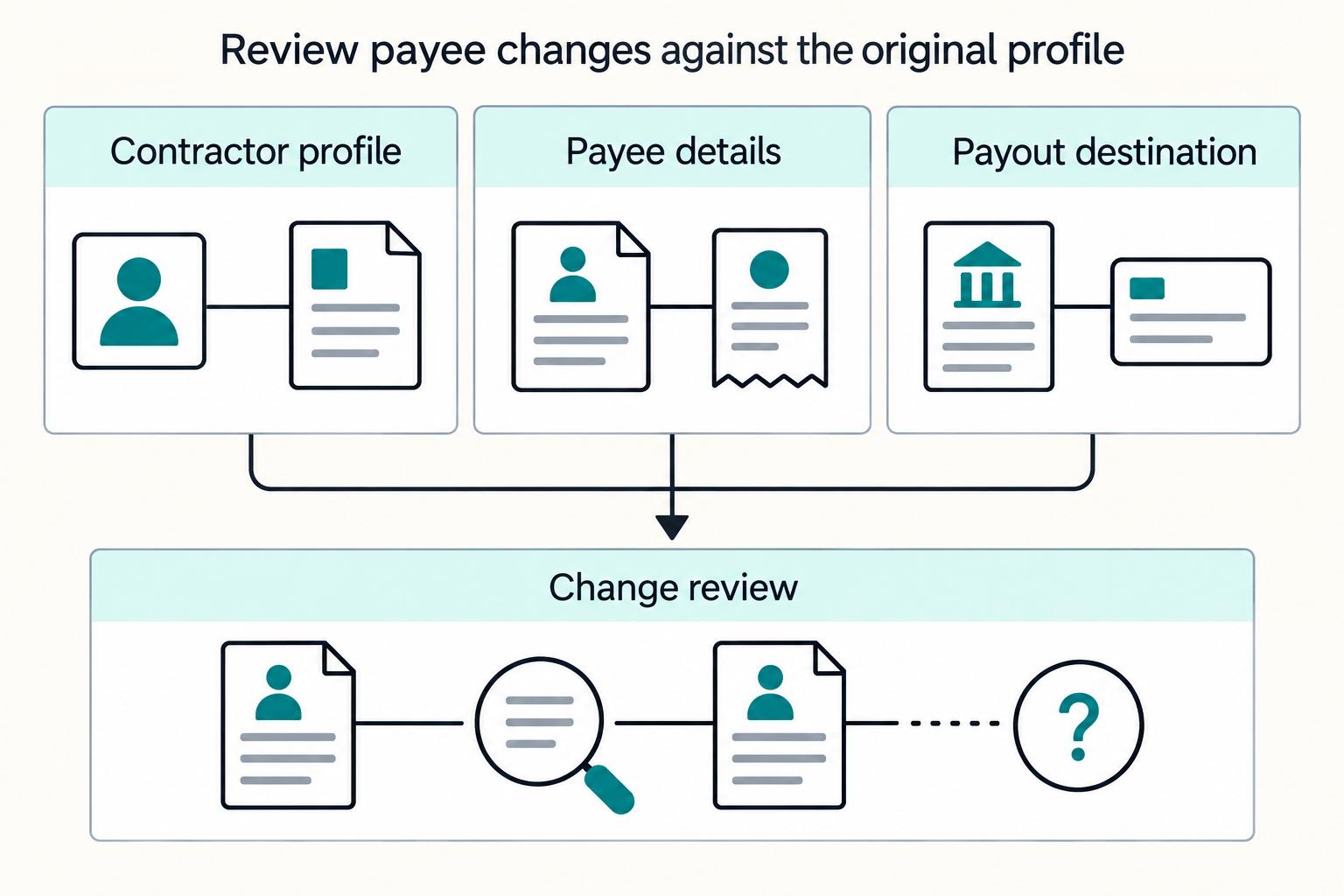
Contractor Onboarding Checklist for KYC, Tax, and Bank Checks
Before the first payout goes out, your contractor onboarding process should answer a small set of high-stakes questions. Who is this contractor? What work are they doing? What risk do they create? What evidence supports the decision? Who can override the controls when something does not line up?
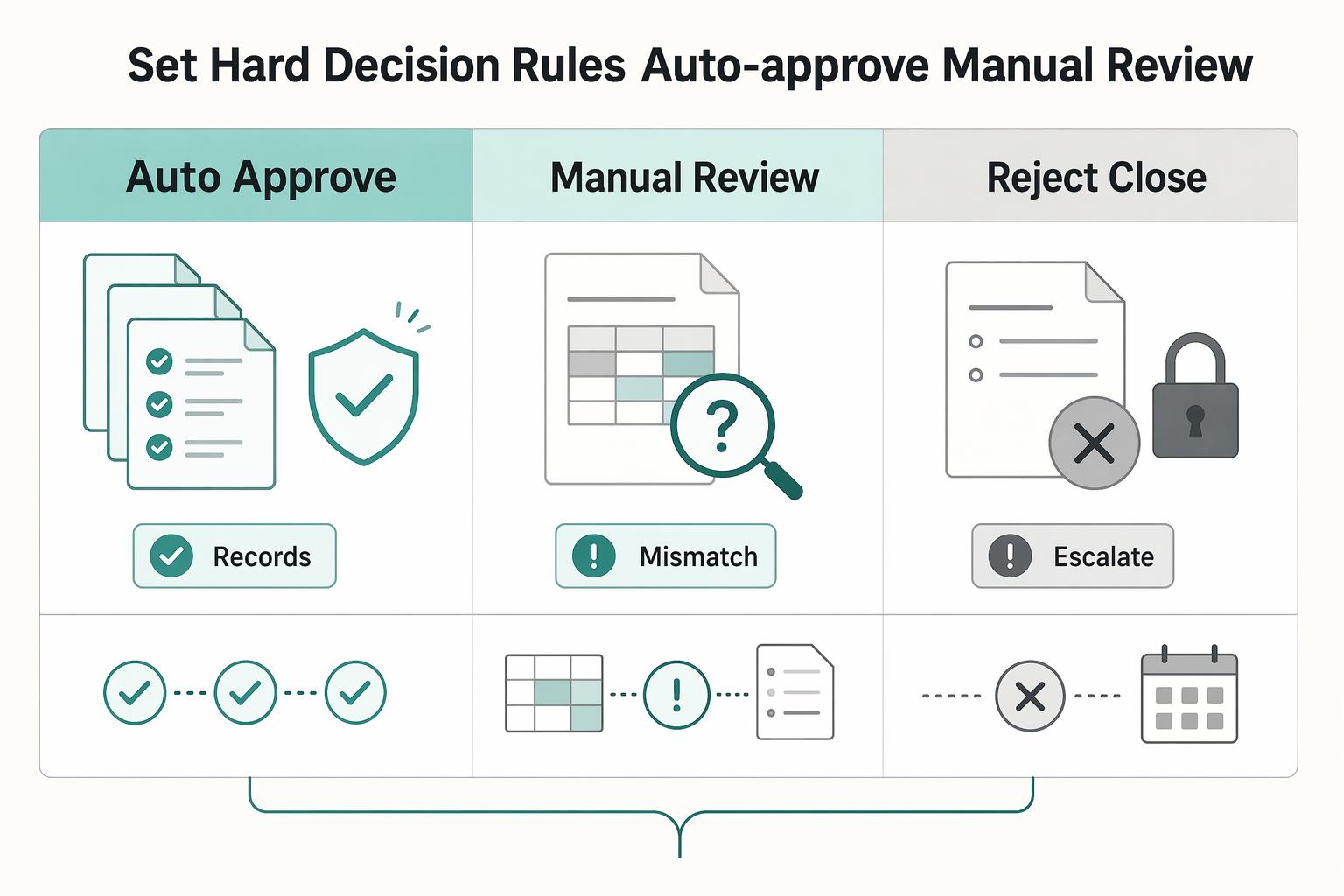
Vendor Onboarding Automation: How to Collect Bank Details Tax Forms and Compliance Docs at Scale
**Vendor onboarding automation for bank details, tax forms, and compliance documents works best when the control points are explicit.** If you cannot define what must be collected, what gets validated, what triggers manual review, and what blocks payout, automation can scale bad decisions faster.
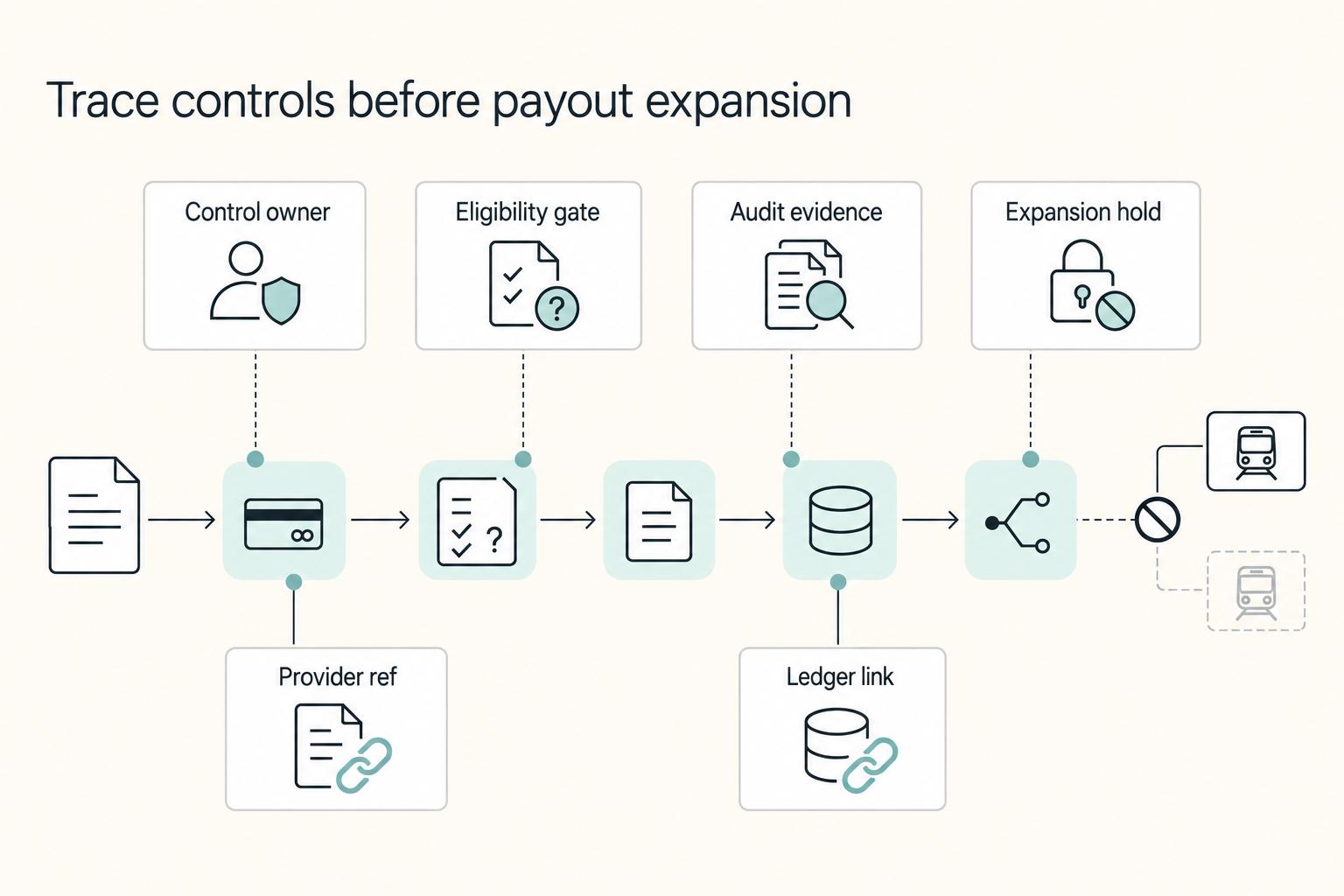
Manufacturing Accounts Payable Automation for Industrial Platforms Paying Subcontractors
Industrial finance teams do not need another feature checklist. They need a clear way to decide what belongs inside AP automation, what belongs in payout infrastructure, and what needs to stay tied to ERP and production controls so payables do not create downstream delays.