
Quick Answer
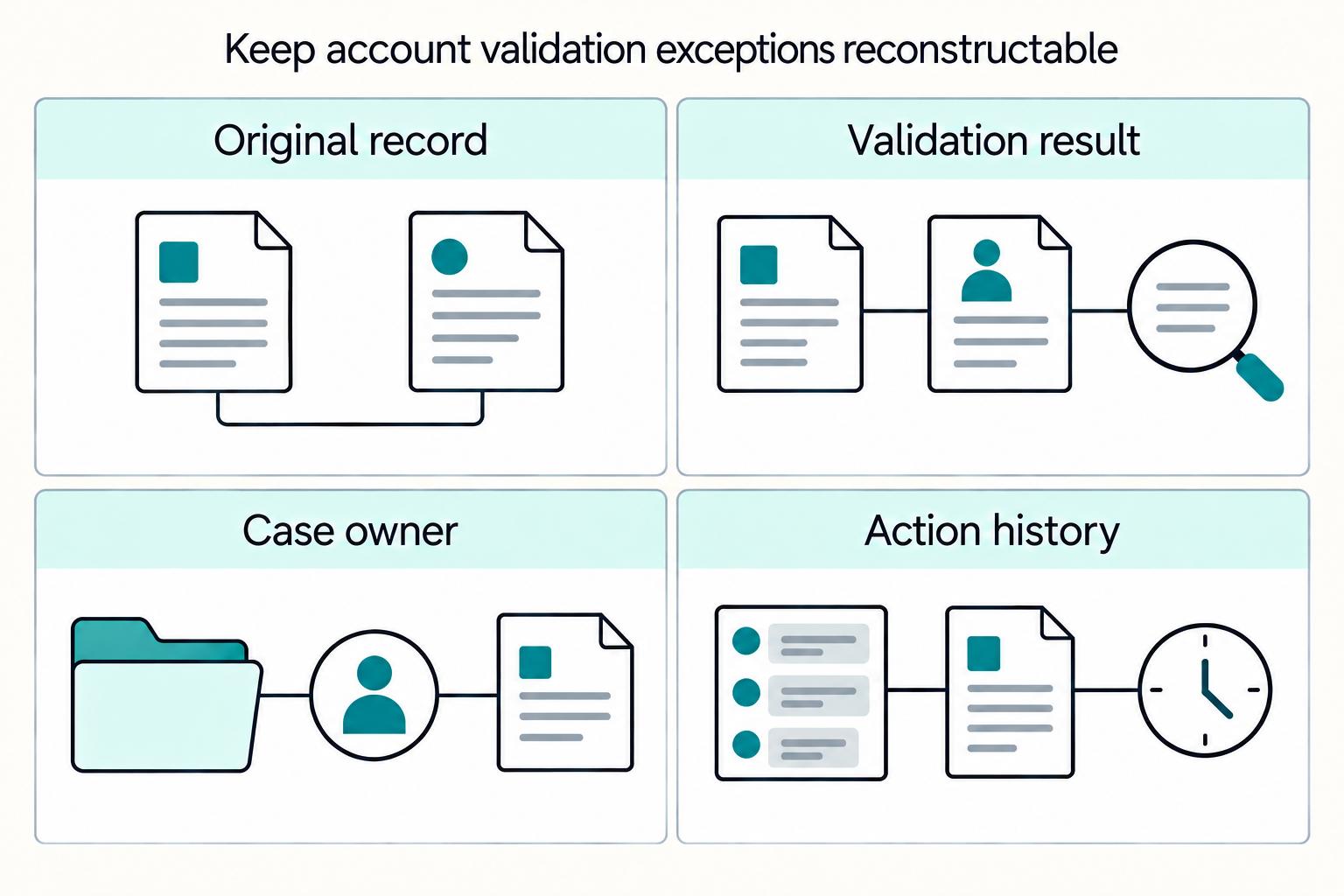
Set one pre-release gate with three outcomes: approve, hold, or review. Validate bank details at onboarding, run a second check before first use or after account changes, and block auto-release on close match, no match, or unavailable results. Keep evidence tied to each payout decision: API vs CSV source, check timestamp, returned status, override reason, and approver identity. That gives compliance and risk teams a defensible record when exceptions or regulator questions appear.
Why account validation comes before payout runs#
For mass payouts, the real question is not whether to verify payees. It is how much verification you require before release, who can override it, and what evidence you can produce later. If you cannot show that evidence on demand, your release rule is weaker than it looks.
That matters because weak pre-send controls are expensive to unwind. In ACH, bad routing or account details cost time and money. On real-time rails, the risk is sharper. Faster Payments cannot be cancelled once sent, and RTP settlement is final and irrevocable. If you wait until after submission to resolve recipient or account-detail issues, you may already be in the expensive phase.
This guide is for compliance, legal, finance, and risk teams approving contractor, seller, or creator payouts through API, CSV, or both. The practical goal is to set a risk-based level of verification and turn it into operating rules that still work under volume. FATF guidance supports proportionate controls, not one default for every case. A low-value domestic payout and a higher-risk cross-border transfer should not follow the same release path just because one provider supports both.
Start with your release gate and the records behind it, not vendor speed claims. Here, the release gate is your internal decision point: release, hold, or review. If a control cannot be tied to that decision and reconstructed later, it is weaker than it looks. We recommend keeping that gate visible in the same workflow your reviewers use. NIST defines an audit trail as a record of who accessed a system and what operations they performed. For payouts, that should cover who changed payee details, when checks ran, what result came back, who approved overrides, and which payout was affected.
A defensible evidence pack is usually small and specific. It should include:
- Input capture: submitted bank details, source channel (API or CSV), and timestamp.
- Decision evidence: returned check outcome, for example match/close match/no match where available, and any exception reason.
- Release evidence: hold, approve, reject, or resubmit outcome, plus user or service account ID and action time.
Those details matter because a generic "verified" flag creates false confidence. CoP-style checks can return match, close match, or no match. That gives you a clearer basis for release rules than a simple yes/no response. A close match may pass in one flow and trigger a hold in another. The key is to define that rule before funds move.
Scope boundary: this article focuses on pre-disbursement operating controls, not broad claims about failure reduction. Where legal frameworks require documented procedures, treat that as a baseline expectation. For example, Regulation E requires remittance transfer providers to develop and maintain written error-resolution policies and procedures. That does not apply uniformly to every payout type, but it shows why undocumented controls can fail under exceptions.
If you are deciding how to validate bank accounts before mass payouts, start with proportionate controls, named owners, and an audit trail you can defend.
Who this list is for and how to choose the right level of control#
Use this list if you run recurring contractor, seller, or creator payouts through API, CSV uploads, or both and need release decisions that hold up at batch volume. The right level of control depends less on provider defaults and more on where your operational risk actually sits. If your team is carrying repeated exceptions, your baseline control depth is probably too light.
| Team situation | Grounded signal | Control takeaway |
|---|---|---|
| API and file payout paths | Both paths can submit the same intended payout. | Use row-level intent IDs, equivalent validation gates and reconciliation records. |
| Repeated exceptions | Track actual data errors and payout returns by rail. | Review recurring causes and control gaps; do not import ACH-debit return thresholds into credit payouts. |
| Risk-tier controls | Payee type, rail and account-change exposure affect review depth. | Record the evidence and policy behind each release decision. |
- Teams running both API and file payout paths
Standardize controls across API and file uploads. Capture how each payout was submitted, validation results, approval and provider references at row level. Confirm actual batch limits with the selected provider; throughput alone does not establish verification quality.
- Teams already under exception pressure
Use recurring payout exceptions and returns to identify control gaps. Track causes by rail and provider, with documented internal review thresholds. ACH-debit return-rate rules are not universal standards for credit disbursements.
- Teams setting controls by risk tier instead of provider defaults
Set review depth by payee type, payout method and account-takeover exposure. Record which evidence and policy support each release. Determine any statutory recordkeeping duties from the entity and transaction scope, separately from this internal control design.
Related: Paying the Unbanked: How Platforms Reach Contractors Without Bank Accounts in Developing Markets.
Best starter model for low-to-mid complexity platforms#
For low-to-mid complexity platforms, use bank account validation as a day-one release control. The starter model is simple: validate at onboarding, re-check before batch release for first-time or recently edited payees, and route payouts to hold or manual review when results fail or are unclear at the release gate.
You can roll this out across API integration and CSV uploads, and it helps catch obvious bad account data before funds go out. It is still a baseline control, not full ownership or fraud assurance.
Best for: teams that need structured controls across both file and API payout paths. Key pros: works across common operating channels and catches obvious unusable account data earlier in the flow. Key cons: weaker for detailed fraud and ownership mismatch. Teams can also over-trust provider "valid" statuses. Concrete use case: onboarding check + pre-batch check + hold-on-fail at release for first-time payees.
Why this works as a first step#
Apply the same account-detail and release controls to API and file submissions, regardless of their provider-specific batch size. Preserve a distinct row or operation identifier for every intended payout.
That makes baseline validation useful early. You can catch malformed or unusable account details before approval instead of finding out only after release and return handling.
What the check really tells you#
For WEB debits, Nacha’s minimum validation checks that an account is open and accepts ACH entries; ownership is not established by that minimum. This rule is scoped to WEB debits, not all credit payouts. Select additional payee-relationship or ownership checks according to the payout rail and risk.
Treat "valid" as a usability signal unless the scope is explicit. For limited cross-border bank transfers, keep the same caution: a pass is not blanket approval.
The starter operating pattern#
| Step | When | Action |
|---|---|---|
| Onboarding check | When payout details are first submitted; for WEB debits before first use and again when account numbers change | Run validation |
| Pre-batch check | Before release for first-time payees and recently edited payout details on both file and API paths | Re-check payout details |
| Hold on failed/unclear results | If a result is failed, unavailable, or indeterminate | Route to hold or manual review; keep source channel, submission time, check result, and release decision in the audit trail |
- Onboarding check
Run validation when payout details are first submitted. For WEB debits, validate account numbers before first use and again when account numbers change.
- Pre-batch check
Before release, re-check first-time payees and recently edited payout details on both file and API paths.
- Hold on failed/unclear results
If a result is failed, unavailable, or indeterminate, route to hold or manual review rather than auto-release. Keep the audit trail complete: source channel, submission time, check result, and release decision.
Where this model breaks#
The main failure mode is false confidence. Baseline verification catches obvious bad account data, but it is weaker against detailed fraud and ownership mismatch.
If you still see administrative returns tied to invalid account data, including R03 ("No Account/Unable to Locate Account") or R04 ("Invalid Account Number Structure"), common gaps include control depth, inconsistent enforcement across paths, or weak exception handling at release. This starter model is the floor, not the full control stack.
Best model for high-volume platforms with mixed payout rails#
For mixed-rail payout programs, standardize your audit fields but keep release controls rail-specific. Same Day ACH, RTP, FedNow, and Push-to-card each need different pre-checks, fail handling, and evidence capture at the release gate.
This is most useful for teams managing multiple urgency tiers, where speed can otherwise outrun caution. It can improve exception triage, with the tradeoff of more policy maintenance and stronger dependence on status telemetry.
| Rail | Pre-check required | Fail behavior | Escalation owner | Evidence retained |
|---|---|---|---|---|
| Same Day ACH | Confirm account details before release and confirm rail eligibility, including the $1 million per-payment limit effective March 18, 2022 | Hold when payee validation is unresolved. A standard-ACH fallback may address Same Day eligibility or timing only after recipient checks pass. | Payments ops | Validation result, rail selected, batch approval timestamp, amount, file/API source, release decision |
| RTP | Require completed pre-submit validation and explicit release approval because submitted RTP payments are final and irrevocable and cannot be recalled by the sender | Do not submit on failed or indeterminate checks; if issues are found after submission, treat recovery as exception handling and use the request-for-return message flow | Payments ops plus treasury/risk | Validation result, submit timestamp, final status, rail selection reason, any request-for-return message |
| FedNow | Require pre-submit validation and explicit release approval, especially for after-hours flows, because FedNow runs 24x7x365, supports payments within seconds, and settlement is final | Do not send on failed, stale, or missing checks; route to hold or next-business-day review if exceptions cannot be cleared in real time | Treasury ops or real-time payments team | Validation and release approval, provider identifiers, acceptance/status messages, and final-settlement or Advice of Credit evidence |
| Push-to-card | Check program, geography, and use-case fit before release because Visa Direct OCT availability can vary by country, use case, receiving institution, and region | Hold or reroute when eligibility is uncertain; do not treat card payout as universally available just because the API is live | Card payouts/program ops | API request/response, region/use-case decision, payout status, settlement record, dispute/reporting record |
Same Day ACH#
The current Same Day ACH per-payment limit is USD 1 million. Nacha has approved USD 10 million effective September 17, 2027; do not apply the future limit early. Confirm provider cutoffs separately from the network amount limit.
Rules have also changed over time across availability, dollar limits, and processing windows. Treat this as an ongoing policy-maintenance track, not a one-time configuration.
RTP#
RTP needs strict front-end control because recovery options narrow after submission. The Clearing House states that the sender cannot revoke or recall a submitted RTP payment, and settlement is final and irrevocable.
A return-of-funds request message exists, but that is exception handling, not an on-demand reversal. For RTP, failed or indeterminate validation should stop release before submission.
FedNow#
FedNow deserves a separate release policy even if reporting is grouped with RTP. It is designed for 24x7x365 processing, supports payments within seconds, and settlement is final.
Retain acceptance/status messages and settlement evidence separately. FedNow settlement becomes final at the earlier of recorded debit/credit or sending Advice of Credit. A later request for return and separately executed return do not erase the original settled payment.
Push-to-card#
Push-to-card controls should prioritize eligibility over urgency. Visa Direct push payouts use Original Credit Transaction (OCT) rails. The documentation notes geographic and use-case restrictions in some countries, and funds availability depends on the receiving institution and region.
Operational readiness does not stop at API submission. Settlement, dispute management, and reporting controls should be in place and reflected in retained evidence.
We covered this in detail in Mass Payouts for Gig Platforms That Teams Can Actually Operate.
Best model for cross-border payouts with country-level variability#
For frequent cross-border bank transfers, use a country-and-corridor policy instead of one global pass rule. If a result is close match, unavailable, or unsupported in that market, hold the payout and route it to manual review with an exception reason code.
Account formats, name-matching services and provider coverage vary by country and corridor. Record the actual identifier requirements and the scope of each validation service; broad payout reach does not prove ownership-verification coverage.
What this model actually changes#
The shift is simple but important: stop treating every validation result as equally reliable across countries. Where market support exists, a Verification of payee (VoP)-style check can compare the account identifier with the intended payee name. Where support is weak, unavailable, or provider-specific, your policy should record that lower confidence explicitly.
A practical release rule is:
- Match + corridor-ready account format: release only if other payout checks pass.
- Close match: hold and request correction or recipient confirmation. A close match is similar, not exact.
- Unavailable or unsupported: do not auto-release. Send it to manual review and an exception queue.
"Unavailable" means it was not possible to check the name, not that risk is low. Match/close-match/no-match outcomes are meant to support correction before payment is sent, and close-match handling supports retry with updated details or contacting the recipient.
What to retain in the audit trail#
Retain submitted identifiers, payee name, corridor, provider, returned result, timestamp and validation method. Mask access according to your data policy. A format-only or account-usability check must remain distinguishable from ownership or payee-name verification.
Two issues come up repeatedly. First, treating an unavailable result as a low-risk signal. Second, reading provider coverage claims as proof of ownership verification quality in every country.
If coverage is uneven, a multi-provider setup can improve reach, but only if you log which provider returned which result by country pair. If country support, result type, or method provenance is unclear, do not force a binary auto-release decision.
Best model for tax and identity-linked payout controls#
Once corridor-level bank-validation rules are in place, tighten the gate: tie payout readiness to verified tax and identity status, not just bank-account validity. If your program touches US tax reporting or provider-managed verification, a usable account alone may not be enough to release funds.
Use a machine-readable payout gate, such as: tax profile complete, identity verified, and, where your process supports it, name/TIN validation accepted.
Best for#
This model fits platforms paying contractors, sellers, or creators when tax documentation is part of payout operations, especially if you file US information returns. The IRS states that Form W-9 is used to provide a correct TIN to payers filing information returns. Form W-8BEN is used by a foreign individual to establish foreign status.
Key differentiator#
Ask both whether the bank details are usable and whether the payee meets the program’s required identity and tax setup. A pass on one check does not establish the other.
| Control | What it establishes | Recommended payout rule | Evidence to retain |
|---|---|---|---|
| Form W-9 | Correct TIN for a payer filing information returns | Apply documented collection and payout policy; determine legal withholding and filing obligations separately | Certified form status, legal name, TIN presence, collection timestamp |
| Form W-8BEN | Foreign status for a foreign individual | Use the applicable foreign-status form and exceptions; apply documented program policy | Form version/status, payee name, country, submission timestamp |
| TIN Matching | Pre-filing validation of name/TIN combinations for eligible payers or agents | Route mismatches for correction and tax-owner review; do not automatically omit a required return | Match result, request timestamp, payer/agent context, retry history |
TIN Matching is a pre-filing service. If mismatches surface only at filing time, remediation moves into a higher-pressure period.
Key pros and the main tradeoff#
Missing or incorrect tax data can create withholding and reporting obligations. An internal payout hold is a program-control choice, not a substitute for required withholding, remittance or timely information-return filing. Assign those legal determinations to the tax owner.
The tradeoff is onboarding friction if requests are vague. Support load can rise when payees are not told exactly which form is required, why it is required, and what must match. A common failure mode is collecting documents but still allowing payout creation against incomplete profiles.
Concrete use case#
Define which incomplete identity or tax fields block release under your program or provider policy. Keep that policy separate from statutory withholding and filing duties, and verify the actual provider enforcement behavior before automating it.
Before release, confirm that the payee record has form type, certified submission status, identity status, and, if used, the latest TIN-validation result. If any field is blank, stale, or still in review, hold the payout with a reason code.
Best model for fraud-heavy environments and account takeover risk#
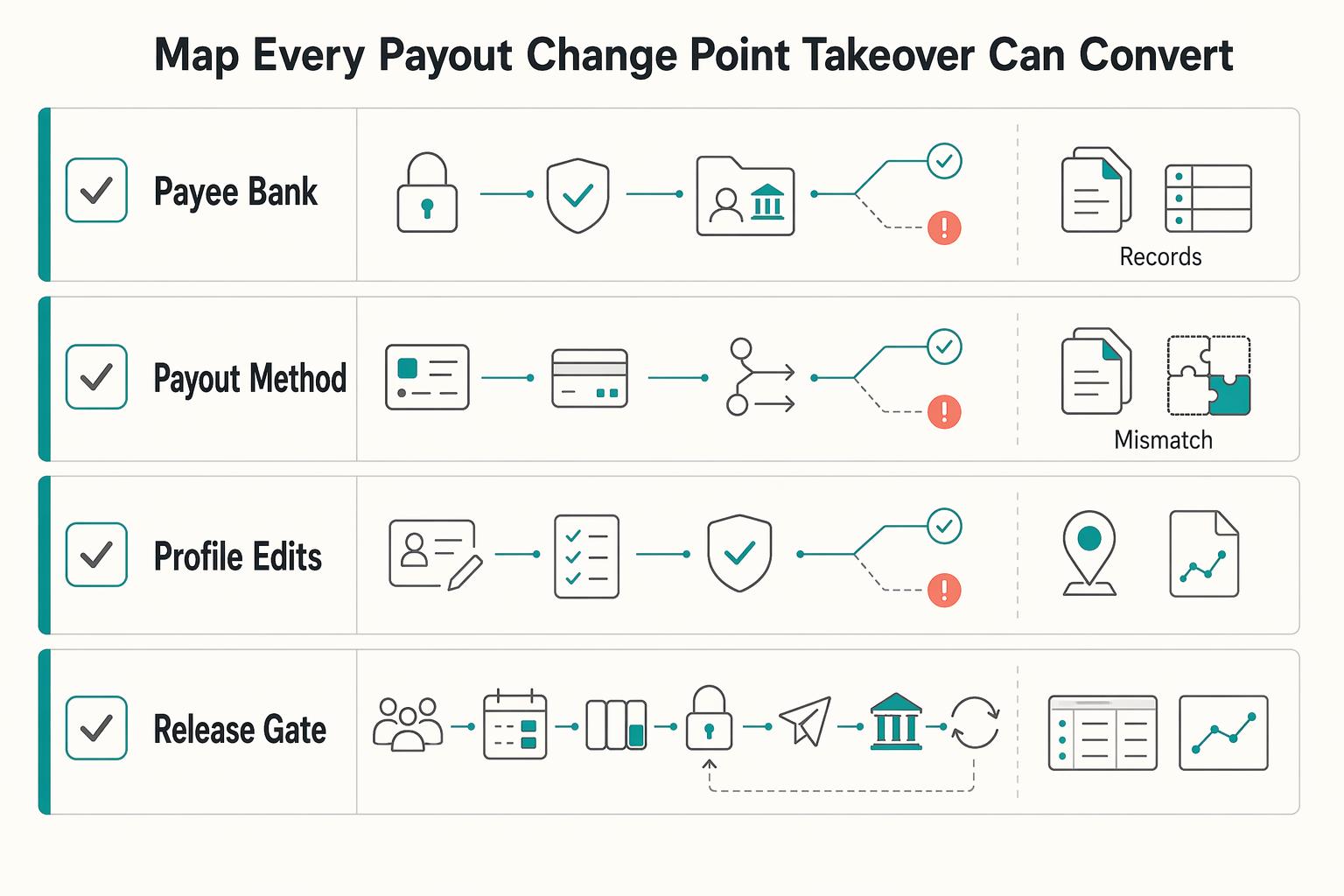
In fraud-heavy environments, bank validation is not enough. Use a dual-control model: run fraud screening and bank-account validation as separate gates, and hold late payout-detail changes until a human clears them. This section answers a different question from eligibility: whether the person changing payout details is actually the payee, or an account takeover attempt.
Best for#
This model fits platforms with elevated Account Takeover (ATO) risk or repeated beneficiary-change requests near release. ATO is unauthorized access to an existing account, and a key risk signal is profile or credential changes that can lock out the legitimate user.
It also fits teams exposed to Business Email Compromise (BEC)-style requests. The FBI describes cases where a trusted counterparty sends updated remittance details. In payout operations, a familiar payee asking for a destination change right before release is not proof of fraud, but it is a strong reason to stop auto-release and verify.
Three controls that matter most#
- Dual-check release rule
Run bank-account validation and fraud screening as distinct checks, not substitutes. Validation can confirm that details are usable and, where supported, whether the intended payee name matches account information before issuance. Fraud screening addresses a different risk: whether the payout attempt or recent account changes look suspicious.
This avoids a common failure mode: treating a validated account change as automatically safe. Validation and fraud screening answer different questions, and both should inform release decisions.
Apply all mandatory fraud-monitoring controls for your entity and transaction scope from launch. Internal staged improvements must not postpone applicable Nacha or other legal requirements. Record how fraud signals and validation results affected each release.
- Late-change hold with out-of-band confirmation
If payee details change close to payout cut-off, require manual review before the release gate. Define your own cut-off window in policy and enforce it consistently.
Treat timing as a fraud signal. Nacha's BEC guidance recommends confirming payment-instruction changes outside of the communication method used to request them. If the request came by email, confirm through a separate trusted channel. Before release, review the change timestamp, fields changed, initiator, nearby credential/contact updates, and out-of-band confirmation evidence.
- Human decision queue with explicit outcomes
Route unresolved cases to a reviewer with authority to decide. Fraud-review workflows can pause transactions for manual approve/decline actions, and unresolved automated cases should escalate to a human.
Use selective manual review with a clear owner, required evidence and outcome. Measure avoidable delay without treating unresolved concerns as approval.
Escalation matrix you can actually operate#
| Outcome | When to use | Owner | Evidence to retain |
|---|---|---|---|
| Approve | Fraud flags cleared, bank details validated, out-of-band confirmation completed where required | Fraud or risk reviewer with payout approval authority | Validation result, fraud-screen result, confirmation method, reviewer ID, approval timestamp |
| Reject | Clear evidence of unauthorized access, failed confirmation, or materially inconsistent beneficiary data | Fraud lead or delegated approver | Reason code, linked account-change history, failed confirmation notes, case record |
| Hold | Signals are suspicious but unresolved before cut-off | Payments operations or risk queue owner | Hold reason, next review time, pending items, impacted payout batch ID |
| Request resubmission | Data is incomplete, contradictory, or unsupported rather than clearly fraudulent | Operations or support with controlled handoff to risk | Missing fields, resubmission request, prior submission snapshot, customer communication log |
Retain evidence for both the decision and the timeline. Keep previous and new payout details, change timestamps, actor identity (if known), request channel, out-of-band confirmation record, fraud-screen result, and final reviewer action. Keeping only the final payee state may not be enough for later dispute review.
You might also find this useful: Account Takeover (ATO) in Payout Platforms: How Fraudsters Hijack Payee Accounts and How to Stop Them.
Best model for exception handling and escalations#
A generic "failed" status is too blunt to run at scale. Use a single cross-rail exception queue with clear internal buckets, named owners, and required evidence for each case type. That is easier to defend and better aligned with how the Federal Reserve's Exception Resolution Service defines exceptions broadly, including disputes, notifications, questions, and requests for additional information.
- Data error
Route malformed or incomplete payout instructions here: bad account fields, missing beneficiary data, broken API payloads, or bad CSV uploads. Operations can usually remediate these when the audit trail preserves the original payload, corrected values, timestamps, and actor identity. Do not overwrite the bad state and keep only the corrected record.
- Verification mismatch
Use this when validation returns a mismatch, an inconclusive result, or a result that does not support release. Treat ownership as a risk or compliance decision, not just data cleanup. A routable account may still require separate payee verification controls. Retain the validation response, submitted payee details, payout ID, and reviewer action.
- Sanctions or compliance hold
Legal or compliance should own sanctions disposition and determine any blocking, rejection and reporting obligations for the actual transaction. Retain the counterparty, amount, legal basis and filing record separately from routine payout errors.
- Rail outage or response failure
Use this for missing or failed rail responses, not just explicit rejects. RTP uses pacs.002 for immediate message status, and FedNow also requires a payment status response, so missing statuses need fast escalation and ownership. Preserve message IDs, reason codes where available, retries, and timestamps.
- Duplicate attempt
No replacement payout should proceed while the original outcome is unknown. A payments owner should query and reconcile the first attempt, record any confirmed rejection or settlement, and determine whether a replacement is safe under the provider’s rules.
Tie each bucket to an escalation matrix with SLA, approver role, and required evidence. FFIEC exam procedures emphasize traceability and separation of duties, so if a case ages past your SLA, consider policy-driven controls such as payout hold rather than auto-releasing by default.
Best model for implementation order in the first rollout phase#
Implement baseline account controls and rail-specific release rules, with all mandatory identity, sanctions and fraud checks in place from launch. Add refinements as the evidence and exception workflow mature; staged improvement does not defer applicable requirements.
| Order | Control focus | Grounded note |
|---|---|---|
| 1. Baseline account verification first | Verified account data before first use and after account-number changes | Uses WEB Debit Account Validation Rule trigger points as a practical baseline for payout verification control design |
| 2. Rail rules second | Split release logic by rail | Confirm the selected provider’s submission and funds-availability windows; instant-rail settlement and return handling remain distinct. |
| 3. Required risk controls from launch | Apply mandatory fraud, identity and sanctions controls before live release | Internal optimization comes after required controls are operational |
| 4. Day-one dual ingestion and idempotent retries | Control both API and file-based workflows from day one when both paths are in scope | Confirm provider-specific file/API limits and preserve row-level intent and attempt records |
- Baseline account verification first
Make the first release gate about verified account data before first use and after account-number changes. Nacha's WEB Debit Account Validation Rule is scoped to WEB debits, but those trigger points are still a practical baseline for payout verification control design.
- Rail rules second
Split release logic by rail. Confirm Same Day ACH submission cutoffs and availability windows with the provider. RTP runs continuously, and FedNow settlement is final under its operating procedures; later return handling is a separate process.
- Refine controls after required checks are operational
Required fraud, identity and sanctions controls must be operational before release. Use documented internal approval criteria and actual exception patterns to refine review depth; do not treat ACH-debit return thresholds as universal credit-payout metrics.
- Day-one dual ingestion and idempotent retries (when both paths are in scope)
Control API and file workflows from day one when both are in scope. Confirm provider batch limits and retry semantics, preserve row-level identifiers, and resolve uncertain original outcomes before any replacement submission.
Vendor due diligence checklist before signing any payout or verification tool#
Procurement is a control gate. If a provider cannot answer these items in writing and prove them in testing, treat that as a blocker. Outsourcing does not remove your responsibility for compliant payout operations.
- Get corridor limits and scoring behavior in writing
For cross-border bank transfers, do not accept vague "global coverage" claims unless the vendor provides a corridor matrix and shows what happens when verification is unavailable, inconclusive, or based only on format checks. Coverage and restrictions can vary by country or program, so require explicit detail on where validation is structure-only versus where stronger name/account matching is supported.
If they reference Verification of Payee-style logic, require exact outcome mapping, for example Match, No Match, Close Match (+Name), and where those outcomes apply. If they cannot define what "unknown" means by corridor, you are approving payouts without clear decision quality.
- Demand exportable decision artifacts, not just a dashboard
Verification decisions should feed your audit trail and release gate, so require a sample export or API payload. At minimum, confirm it includes decision and reason-code fields plus enough context, for example payee ID, request timestamp, rail, override flag, and rule or model version.
The practical test is simple: can your team reconstruct why a payout was released, held, or rejected without logging into the vendor portal? If not, the control is not operational.
- Separate native tax support from custom storage and manual steps
Confirm what is native versus custom for Form W-9, Form W-8BEN, TIN validation, and supporting-documentation retention. W-9 supports correct TIN collection for information returns, W-8BEN is submitted by foreign beneficial owners when requested, and IRS TIN Matching supports pre-filing name/TIN validation.
Confirm eligible payer or authorized-agent access and result retrieval for TIN Matching. Interactive supports up to 25 pairs and bulk up to 100,000 with results within 24 hours. Test the actual submission and remediation workflow before launch.
- Test failure scenarios against real rail behavior
Run scenario testing before signature, not after launch. Minimum cases: changed beneficiary, stale account details, duplicate payouts, and last-minute rail switch to Push-to-card.
Require rail-accurate behavior in results: RTP is final and irrevocable once submitted, FedNow indicates receivers can use funds immediately, and ACH reversals are only allowed in certain cases, including duplicate payment. For Push-to-card, require proof of country and use-case restrictions where applicable.
- Treat unanswered retention and exception questions as blockers
Unresolved unknowns are contract issues, not post-launch cleanup. Third-party due diligence is part of sound risk management and sits within a full lifecycle that includes planning, due diligence, contracting, monitoring, and termination.
Specify retention, access, export and termination handling for each record type. OFAC’s scoped sanctions-record rules now use a ten-year period; other duties depend on the applicable regime. Do not apply that period indiscriminately to every payee document.
Before signing, map your required controls to operational surfaces like idempotency keys, batch statuses, and audit events in the Gruv docs.
Conclusion#
Match internal payout controls to the payee, rail and change risk. Determine which mandatory requirements apply to the entity and program separately; do not assume every platform is a regulated money services business.
Keep escalation ownership, exception handling and audit trails in place when using vendors. If a banking partner applies interagency third-party guidance, map the responsibilities in that relationship rather than treating the bank guidance as a universal platform mandate.
Define evidence and retention by applicable regime. Keep provider responses, internal outcomes, timestamps, approvers and policy versions in a retrievable record, with access and masking appropriate to the data.
Build your comparison table and escalation rules first, then evaluate providers against those requirements instead of feature lists. We recommend forcing that comparison through your actual release gate before you buy new tooling. If you need to confirm corridor coverage and release-gate design for your payout flow, talk with Gruv.
Frequently Asked Questions
What is payee verification in mass payouts?
Payee verification is a pre-payment check of recipient identity and bank details to reduce fraud and payment errors. In mass payouts, the practical standard is to run it before funds are issued so the result can inform release decisions. If verification raises concerns, the payout can be held for review before money moves.
When should platforms validate bank accounts during the payout lifecycle?
Validate during onboarding, then validate again before first use of an account number and before any later account-number change. For WEB debits, Nacha explicitly calls out those checkpoints, and the related rule change became effective on March 19, 2021. If banking details change near release, rerun validation rather than relying on an older result.
What is the difference between bank account validation and fraud screening?
Bank account validation checks account details before payment, while fraud screening evaluates transaction risk and suspicious behavior. They work together but are not substitutes. For WEB debits, Nacha requires a commercially reasonable fraudulent transaction detection system, which goes beyond account checks alone.
What should trigger manual review before a payout is released?
Review account-number or credential changes, suspicious instructions and duplicate attempts before release. Keep the original request and supporting evidence. Any SAR or other regulatory filing decision depends on the covered entity and actual facts, not this generic trigger list.
How do API integration and CSV uploads change verification controls?
API and CSV change execution mechanics, not verification objectives. Preserve row-level intent IDs, validation and approval outcomes, provider references and reconciliation evidence. Confirm the selected provider’s actual batch limits and retry support.
What records should teams retain to support audit and regulator reviews?
Retain records needed to reconstruct release, hold and correction decisions under the duties applicable to the entity and transaction. OFAC’s ten-year sanctions-record rule is scoped; do not treat one period as universal for all onboarding and payout evidence.
Try a related tool
Where Gruv fits
Researched and edited by the Gruv editorial team. Gruv builds cross-border billing, payouts, and finance-operations software for global businesses.
Sources
- bsaaml.ffiec.gov/manual/Appendices/17trusted
- consumerfinance.gov/rules-policy/regulations/1005/33trusted
- csrc.nist.gov/glossary/term/audit_trailtrusted
- ecfr.gov/current/title-31/subtitle-B/chapter-V/part-5...trusted
- fbi.gov/how-we-can-help-you/scams-and-safety/common-...trusted
- federalreserve.gov/paymentsystems/fednow_about.htmtrusted
- federalreserve.gov/paymentsystems/fednow_faq.htmtrusted
- ic3.gov/CrimeInfo/AccountTakeovertrusted
Educational content only. Not legal, tax, or financial advice.
Related Posts

How Platform Teams Scale AP Volume Without Adding Headcount
Use this as a decision list for operators scaling Accounts Payable, not a generic AP automation explainer. In these case-study examples, invoice volume can grow faster than AP headcount when the platform fit is right, but vendor claims still need hard validation.

Paying Unbanked Contractors in Developing Markets: Best Payout Routes for Platforms
If your team needs to send money to contractors, creators, freelancers, marketplace sellers, or other non-payroll recipients across borders, the payout decision can look deceptively simple at first. On paper, you are choosing a payment rail. In practice, you are choosing an operating model that affects onboarding, compliance, support load, engineering effort, treasury visibility, failure recovery, and the degree of legal risk your company is willing to carry.
Account Takeover in Payout Platforms and How to Stop Payee Hijacks
Treat **account takeover payout platform payee hijack fraud** as a money movement control problem first and an account security problem second. Once an attacker can change payout details, contact points, or credentials, the issue is no longer just login abuse. It becomes a question of who can stop funds, who can approve a release, what evidence exists, and how quickly finance, risk, compliance, and legal can reconstruct the timeline.