
Quick Answer
Use a connected metric stack: read Accounts Receivable Turnover Ratio with CEI and DSO, then validate the signal against General Ledger postings, Reconciliation status, and Settlement timing from the same closed period. For platform finance and ops teams, that sequence prevents false confidence when turnover rises but payout cash is still constrained. If the metrics conflict, check aging, disputes, and unapplied cash before changing credit terms.
What Accounts Receivable Turnover Shows for a Platform#
Step 1 Set the real objective#
Accounts receivable turnover can help a platform measure collection efficiency, but only when you read it against cash timing. A higher Accounts Receivable Turnover Ratio usually points to faster collections and stronger cash flow. On its own, though, it does not tell you everything about collection health.
That matters because Accounts Receivable is not just an accounting balance. It is money from customer credit sales that is still unpaid. When collections slow, cash tightens, working capital gets squeezed, and bad debt risk usually rises with it. When collections stay efficient, collection costs are usually lower and the balance sheet is healthier.
For a platform team, the goal is not to admire a ratio. It is to make better calls with fewer surprises and to make those calls defensible when someone asks for the evidence later.
Step 2 Read the metrics as a connected set#
You get more decision value when you treat the Accounts Receivable Turnover Ratio as part of a connected operating view instead of a standalone headline. Used with other collection signals and consistent period evidence, it is harder to misread.
A good early checkpoint is simple. Verify that invoice, payment, and accounting evidence all point to the same reporting window before you call a trend "better." If your customers are on net30, you should be able to trace whether payment behavior is improving against that 30 day expectation. Do not rely only on a period-end ratio that looks cleaner than last month.
The first red flag is false confidence from reading one metric in isolation. A ratio can improve while cash timing still feels unstable in practice, especially when reporting windows are not aligned. When that happens, teams can disagree on whether collections are actually improving.
This guide is meant to prevent that split view. The aim is practical: tighter cash flow and fewer surprises in planning decisions. Keep that objective in view and the metrics become operating signals rather than vanity numbers.
Gather the data and controls before you calculate anything#
Treat AR turnover as a period-matched evidence check, not just a formula. Before you calculate, confirm every input uses the same accounting window so the result reflects collection timing for that period.
| Step | Action | Control |
|---|---|---|
| Build one period-matched input pack | Use one shared pack for invoice events, payment events, General Ledger postings, Reconciliation status, and Settlement status | Confirm every input uses the same accounting window so the result reflects collection timing for that period |
| Name ownership and isolate non-collection delays | Assign clear ownership for each input and one final approver, and keep non-collection delays out of the core collection read | Keeps disputes about definitions, exceptions, and event capture from surfacing after the metric is shared |
| Freeze the close cut and retain evidence | Freeze a period-close snapshot and keep the frozen extract, calculation sheet, and exceptions list together | Late postings or status changes after close can shift the Accounts Receivable position and change the story |
Step 1 Build one period-matched input pack#
Create one shared pack for the reporting window: invoice events, payment events, General Ledger postings, Reconciliation status, and Settlement status. Then spot-check a few paid and unpaid invoices to confirm invoice date, payment date, and outstanding Accounts Receivable position line up to the same cut.
If your terms are net30, use that as a sanity check. If the ratio improves while many invoices still run past 30 days, pause and review before calling collections healthier.
Step 2 Name ownership and isolate non-collection delays#
Assign clear ownership for each input and one final approver for the pack before analysis starts. That keeps disputes about definitions, exceptions, and event capture from surfacing after the metric is shared.
Also separate delays that are not collection behavior. Keep those items out of the core collection read so the turnover interpretation stays clean.
Step 3 Freeze the close cut and retain evidence#
Freeze a period-close snapshot before calculating turnover. Late postings or status changes after close can shift the Accounts Receivable position and change the story if you do not lock the cut.
Keep the frozen extract, calculation sheet, and exceptions list together. You will need that evidence when you compare turnover with other AR metrics instead of relying on one headline number.
If you want a deeper dive, read Accounts Payable Days (DPO) for Platforms: How to Measure and Optimize Your Payment Cycle.
Use one metric stack instead of a single vanity number#
Use turnover, CEI, and DSO together so one strong-looking number does not hide collection risk. A single metric can look healthy while cash is still delayed, unmatched, or not yet usable.
Step 1 Assign one job to each metric#
In this operating view, give each metric a distinct role: Receivables Turnover Ratio for collection velocity, CEI for in-period execution, and DSO for elapsed collection time. The point is decision clarity, not more charts.
| Metric | What it can prove | What it can hide | Required cross-check |
|---|---|---|---|
Receivables Turnover Ratio | Collections are moving across the period | Whether collected cash is usable yet, including timing lag or unapplied cash | General Ledger and Settlement |
CEI | In-period collection execution is improving or weakening | Aging concentration, disputes, and older balances still dragging results | Reconciliation and General Ledger |
DSO | Collection time is shortening or lengthening | Recent wins that can mask unresolved exceptions | General Ledger and Reconciliation |
Keep this stack tied to the same frozen period-close pack so each number is interpreted on the same cut.
Step 2 Validate the story in records, not just in ratios#
Before you share a performance claim, verify it across General Ledger, Reconciliation, and Settlement. If the metric view says collections improved but records show unresolved exceptions or delayed funds availability, treat the metric signal as incomplete.
A simple check is enough: sample a few invoices and confirm invoice timing, payment event, ledger posting, reconciliation status, and cash-ready status all align to the same reporting period.
Step 3 Apply decision rules before changing policy#
If CEI improves while DSO worsens, start with aging and dispute analysis before changing Credit Policy. If turnover looks strong but cash availability still lags, inspect settlement timing and unapplied cash before declaring collections healthy.
Use terms like net30 as a sanity check, not proof by itself. If the headline trend improves while many invoices still run past 30 days, investigate cohorts and exceptions first.
If you need the operational follow-through, see Accounts Receivable Management for Platforms: How to Collect from Buyers While Paying Sellers Fast. Related: Accounts Payable vs. Accounts Receivable for Platforms: The Two-Sided Ledger Explained.
Map Order to Cash into traceable checkpoints#
Map Order to Cash into explicit checkpoints you can inspect at close. If a payment looks collected but you cannot trace posting, reconciliation, settlement, and payout release, collection efficiency is still unclear.
Order to Cash is a cross-functional chain, not a finance-only task. Weak handoffs across billing, collections, finance, ops, and product can keep expected revenue from becoming usable cash, so checkpoint visibility matters more than a single "paid" status.
Step 1 Define the checkpoints#
Keep one consistent sequence for reporting, exception review, and payout operations.
| Checkpoint | Primary owner | System of record | Failure queue to watch |
|---|---|---|---|
| Invoice issued | Finance or billing ops | Billing or invoicing platform | Missing invoice references, incorrect invoice data |
| Payment initiated | Product or payments ops | Payment system record | Initiation errors, rejected attempts |
| Payment confirmed | Payments ops | Payment confirmation record | Confirmed payments not reflected downstream |
Ledger Journal posted | Finance | General Ledger | Posting failures, wrong accounting period |
Reconciliation completed | Finance ops or treasury ops | Reconciliation record | Unmatched receipts, unapplied cash |
Settlement completed | Treasury or payments ops | Settlement record | Delayed settlements, pending funds states |
| Payout released | Ops or payout team | Payout ledger or payout engine | Blocked payouts, release timing errors |
Use one owner, one system of record, and one failure queue for each checkpoint so stalled handoffs are visible.
Step 2 Make handoffs auditable#
Define clear boundaries between teams so each handoff is verifiable. Use a consistent reference chain so invoice, payment, ledger, reconciliation, settlement, and payout records can be linked without manual reconstruction.
A simple audit test: pick one invoice marked collected and verify that each checkpoint has a corresponding record and status transition. If that chain is incomplete, treat the process as not yet traceable for close decisions.
Step 3 Verify close with exception queues#
At period close, use the checkpoint map as a final control so records align with actual performance and transactions are accurately recorded. Confirm General Ledger posting, then review exception queues before sign-off:
- Unmatched receipts still pending
Reconciliation - Delayed settlement items where payment is recorded but funds are not yet usable
- Items blocked in compliance review
If payment confirmations rise while pending exceptions also rise, report that collections activity improved but cash readiness is still constrained by operational clearance.
This pairs with our guide on Best Merch Platforms for Creators Who Want Control and Compliance.
Set operating cadence and escalation rules by team#
Once your checkpoints are traceable, set a clear review rhythm: use one cadence to clear exceptions and another to read trend direction across CEI, DSO, and turnover.
Step 1 Run separate exception and trend reviews#
Use the weekly review to resolve live exceptions that delay collection outcomes, such as unreconciled items, repeated settlement delays, or blocked payout volume. The output should be assigned actions tied to record-level evidence.
Use the monthly review to evaluate trend direction in CEI, DSO, and turnover against what happened in those exception queues. Treat metric movement as reliable only when it matches underlying operational states.
Step 2 Separate actions by team#
Use finance for policy decisions, including Credit Policy and collection-term adjustments. Use ops for queue execution issues in the Collections Process. Use product for instrumentation, status propagation, and visibility gaps between payment confirmation, Ledger Journal, and payout state.
This separation keeps fixes aligned to root cause instead of moving the wrong lever.
Step 3 Escalate on operational states and keep one decision log#
Define escalation triggers using inspectable states, not headline ratio movement alone. Practical triggers include sustained growth in unreconciled volume, repeated settlement delays, or rising blocked payout volume.
Maintain one decision log that links each material change to owner, affected workflow, expected effect, before and after behavior in CEI or DSO, and supporting Ledger Journal evidence.
Diagnose when high turnover still hides risk#
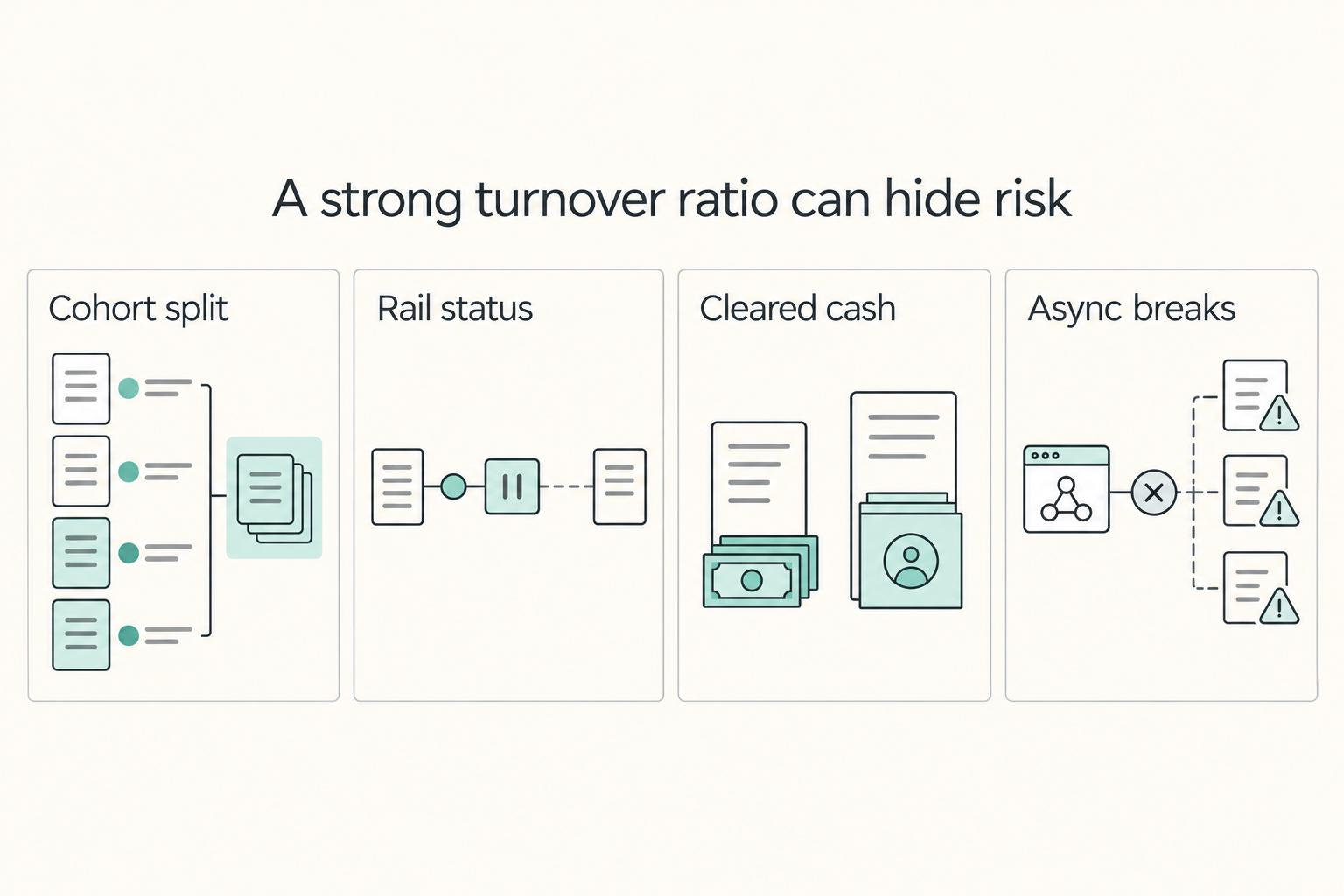
High turnover is not, by itself, proof that your collection risk is under control. If cash-ready balances lag, unreconciled items keep aging, or payout commitments exceed cleared funds, treat that as an operating risk even when the headline ratio looks strong.
| Check | What to compare | Why it matters |
|---|---|---|
| Split the book before trusting the blended ratio | Compare fastest and slowest cohorts, not only the portfolio average | A fast segment can hide a slow segment where cash stays trapped in old invoices |
| Segment by rail and flow type | Track payment confirmation, Reconciliation, and Settlement separately, including Virtual Bank Accounts | If one rail repeatedly stalls between confirmation and final funds availability, the problem is flow-specific |
Compare cleared cash to Payout Batches | Compare cash-ready balances to commitments already queued in Payout Batches | Turnover does not prove funds are ready for payout release |
| Fix async breaks before tightening dunning | Prioritize Webhooks reliability and exception handling before tightening dunning cadence | More reminders will not fix status-path failures after payment |
Step 1 Split the book before trusting the blended ratio#
Split Accounts Receivable into cohorts before you rely on one blended number. A fast segment can hide a slow segment where cash stays trapped in old invoices.
Then add context. A pace that looks acceptable on its own can still be weak against the right benchmark: collecting in 45 days can sound fine, but if the relevant benchmark is closer to 30 days, you are still financing customers longer than expected. Apply that same check inside your own book by comparing fastest and slowest cohorts, not only the portfolio average.
Step 2 Segment by rail and flow type#
Segment results by payment rail and flow type, including Virtual Bank Accounts, and track each stage separately: payment confirmation, Reconciliation, and Settlement. If one rail repeatedly stalls between confirmation and final funds availability, the problem is flow-specific, not overall collection efficiency.
Keep traceability tight in each segment: invoice ID, provider reference, Ledger Journal entry, reconciliation status, and final cash-ready state should all align.
Step 3 Compare cleared cash to Payout Batches#
Compare cash-ready balances to commitments already queued in Payout Batches. Turnover shows collection frequency over a period; it does not prove funds are ready for payout release.
If the same payout flow repeatedly shows a gap between cleared cash and batch commitments, escalate it as an operational release-timing risk, even with strong turnover.
Step 4 Fix async breaks before tightening dunning#
If unresolved items cluster around async events, prioritize Webhooks reliability and exception handling before tightening dunning cadence. Dunning is a structured follow-up process, so more reminders will not fix status-path failures after payment.
Use a simple rule: if finance sees lateness but ops cannot prove the full path from payment confirmation through reconciliation to final funds availability, fix event delivery and exception handling first, then revisit follow-up timing.
Related reading: Collection Agencies for Small Businesses: Use a Payment Assurance System First.
Fix common mistakes and recover quickly#
When you find a weak cohort or broken flow, fix interpretation first. The fastest way to make a bad collections decision is to trust one metric or one status view more than it deserves.
- Step 1 Keep
CEI,DSO, and turnover together
CEI is not a replacement for DSO or turnover. They reflect different parts of collection performance, and using them together gives a more complete view than relying on one alone.
Use a cross-metric rule before changing policy: if one metric improves while another is flat or worse, treat that as unresolved risk and investigate before acting.
- Step 2 Validate dashboard movement with underlying records
Treat dashboard gains as a signal, not proof. Before you change dunning, staffing, or credit terms, confirm the same pattern in the transaction-level records and period postings used for financial review.
A practical check is to sample invoices that changed status near period close and trace status, payment reference, and posting outcome end to end.
- Step 3 Remove double-counting before calling it improvement
Collections can look better than they are when repeated status updates are counted as new outcomes. Review duplicate-looking activity and confirm each customer payment is represented once in your collection results.
If gains come from counting behavior instead of distinct payment outcomes, fix reporting first, then reassess performance.
- Step 4 Separate non-collection delays from collection performance
Keep delays caused by non-collection operational holds out of your core collections view. Separate reporting gives you a cleaner read on actual recovery performance.
If delays cluster in that separate bucket, route the issue to the owning process instead of tightening collection actions.
For a step-by-step walkthrough, see Subscription Billing Platforms for Plans, Add-Ons, Coupons, and Dunning.
Implement this in Gruv without overpromising coverage#
In Gruv, treat traceability as a control requirement, not a default assumption. If a status, reference, or queue is not exposed in your environment, do not infer it just to make turnover reporting look cleaner.
| Step | What to map or expose | Guardrail |
|---|---|---|
| Map only the states you can prove | Link each collection event to durable identifiers such as request ID, provider reference, Ledger Journal reference, Reconciliation state, and payout status | Do not infer a status, reference, or queue just to make turnover reporting look cleaner |
| Expose exceptions before dashboards | Use API and Webhooks surfaces first to surface exception queues | Unmatched, delayed, or ambiguous items should be visible before you optimize presentation |
| Read bank-transfer activity conservatively | Include Virtual Bank Accounts statuses and return handling only where your implementation captures them reliably | Keep late or incomplete return events in a separate exception path until reconciliation is complete, and handle retries as replays, not new outcomes |
Step 1 Map only the states you can prove#
Build a field map that links each collection event to durable identifiers across your setup. Where supported, that can include request ID, provider reference, Ledger Journal reference, Reconciliation state, and payout status. Validate the map with a small close-window sample and confirm each item can be traced end to end without identifier changes.
Keep labels consistent across finance and ops. If one team tracks "paid" while another tracks "posted" as different moments, your metrics will drift before close.
Step 2 Expose exceptions before dashboards#
If your Gruv setup has API and Webhooks surfaces enabled, use them first to surface exception queues. Unmatched, delayed, or ambiguous items should be visible to finance and ops before you optimize presentation.
Near-real-time views are only useful when the underlying data is consistent and clean. Apply the same field standards across systems so reporting does not amplify bad inputs.
Step 3 Read bank-transfer activity conservatively#
For bank-transfer-heavy flows, include Virtual Bank Accounts statuses and return handling only where your implementation captures them reliably. If return events are late or incomplete, keep them in a separate exception path until reconciliation is complete.
Handle retries as replays, not new outcomes, so reporting reflects one financial result per real payment event.
If you need the operating side of that process, this pairs well with Accounts Receivable Management for Platforms: How to Collect from Buyers While Paying Sellers Fast.
Conclusion and copy paste checklist#
The takeaway is simple: do not let one AR number tell the whole story. Use a set of AR KPIs together, then verify what changed in accounts receivable before you change policy, assign ownership, or report improvement upstream.
A good close process needs less spreadsheet guesswork, not more. Receivables are a business-health indicator, and reviewing outstanding invoices plus non-payment risk helps you find weak points early. If your data still sits in separate files, you are more likely to see the metric move before you can prove why it moved.
- Read multiple AR KPIs as one decision set.
Treat isolated movement in a single KPI as an incomplete signal until you review the full period context. Verification point: use the same closed-period extract, the same aging snapshot, and the same cash-posting window for every KPI you compare.
- Anchor every interpretation to the same receivables evidence.
In your monthly review, match KPI movement to outstanding invoices and risk of non-payment in the same period. A cleaner dashboard without stronger underlying receivables outcomes is not a win. Red flag: headline KPIs improve, but overdue balances or non-payment risk patterns do not.
- Separate collections performance from other root causes.
If aging is driven by issues outside normal collection activity, tag those balances separately before assigning accountability. Evidence pack: aging report, risk reason, owner, open date, and cleared date.
- Preserve traceability from customer behavior to financial impact.
Group customers and monitor payment patterns so higher-risk segments are visible and comparable month to month. Failure mode: aggregate KPIs look healthier while higher-risk segments remain unchanged.
- Track risk directly and log decisions with proof.
Keep a short monthly decision log that records KPI changes, risk signals, action taken, and the result next month. This is how AR monitoring becomes repeatable improvement instead of commentary.
Copy, paste, and use this in your month-end note:
- Review multiple AR KPIs together, not one in isolation.
- Confirm all KPIs came from the same closed-period data cut.
- Tie the story back to outstanding invoices and non-payment risk.
- Group customers to identify risk patterns and segment exposure.
- Record the decision, owner, evidence, and next review date in one monthly log.
Frequently Asked Questions
What does `Accounts Receivable Turnover Ratio` measure for a platform team?
It measures collection velocity: how many times your team collects its average Accounts Receivable balance over a specific period, usually a year. The standard formula is Net Credit Sales ÷ Average AR. For a platform team, treat it as a diagnostic for collection efficiency and potential cash-flow risk, not a stand-alone success signal.
Is `Collection Effectiveness Index` better than turnover ratio, or do you need both?
You usually need both. Turnover tells you how efficiently receivables are being collected relative to average AR, while CEI gives you a broader percentage-based view of how well receivables convert into cash over a specific period, typically a month or a quarter. If you rely on only one, you can miss part of the picture that traditional collection metrics do not show well.
How should teams use `DSO` with `CEI` in the same reporting cycle?
Use both from the same reporting window and underlying AR dataset. CEI tells you how effective collection was during that period. There are no DSO formula details or benchmark targets set here, so interpret DSO with your internal definition and avoid over-reading a single movement in either metric.
Can high turnover still indicate weak collection efficiency?
Yes. Turnover is useful, but traditional collection metrics can be incomplete on their own. A strong turnover value can still miss part of true collection performance, so pair it with CEI and cash-flow context before calling collections healthy.
Which AR metrics should be reviewed weekly versus monthly?
This guide supports turnover as a broader-period metric (commonly yearly) and CEI as a shorter-window metric (typically monthly or quarterly). It does not define a weekly AR metric set, so weekly review cadence should be an internal operating choice.
What should finance check first when `CEI` rises but payout cash feels constrained?
First, reconcile the metric movement with cash-flow reality for the same period. Reported improvement can look positive while cash still feels tight, so verify that the CEI improvement aligns with actual receivables-to-cash conversion in that reporting window before concluding collections are truly healthier.
Try a related tool
Researched and edited by the Gruv editorial team. Gruv builds cross-border billing, payouts, and finance-operations software for global businesses.
Sources
Includes 3 external sources outside the trusted-domain allowlist.
- ocauditor.gov/wp-content/uploads/2023/04/Final-Requirement...trusted
- pmc.ncbi.nlm.nih.gov/articles/PMC12883517trusted
- sec.gov/Archives/edgar/data/898173/00008981732600001...trusted
- sec.gov/Archives/edgar/data/1676238/0001676238250000...trusted
- tiffin.edu/wp-content/uploads/AI-Tools-with-Description...trusted
- accountally.com/your-complete-guide-to-year-end-financial-bo...external
- emagia.com/resources/glossary/accounts-receivable-perfo...external
- emagia.com/resources/glossary/difference-between-dso-an...external
Educational content only. Not legal, tax, or financial advice.
Related Posts
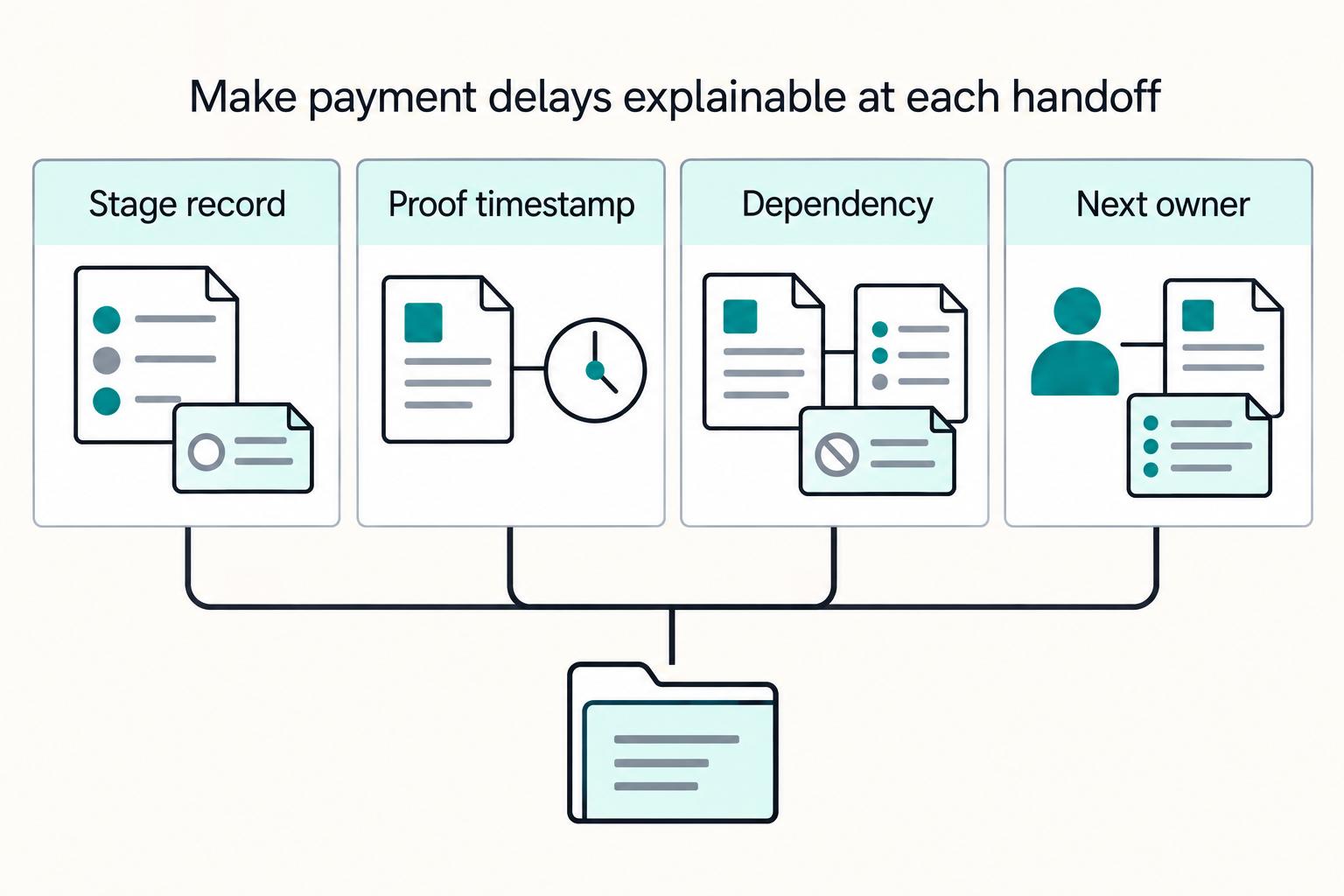
Accounts Payable Days (DPO) for Platforms in the Real Payment Cycle
Treat **Days Payable Outstanding** as an operating control, not a vanity KPI. It measures average supplier payment timing. For platform teams, the real question is whether cash outflows are being delayed on purpose or whether payment problems are being found too late.
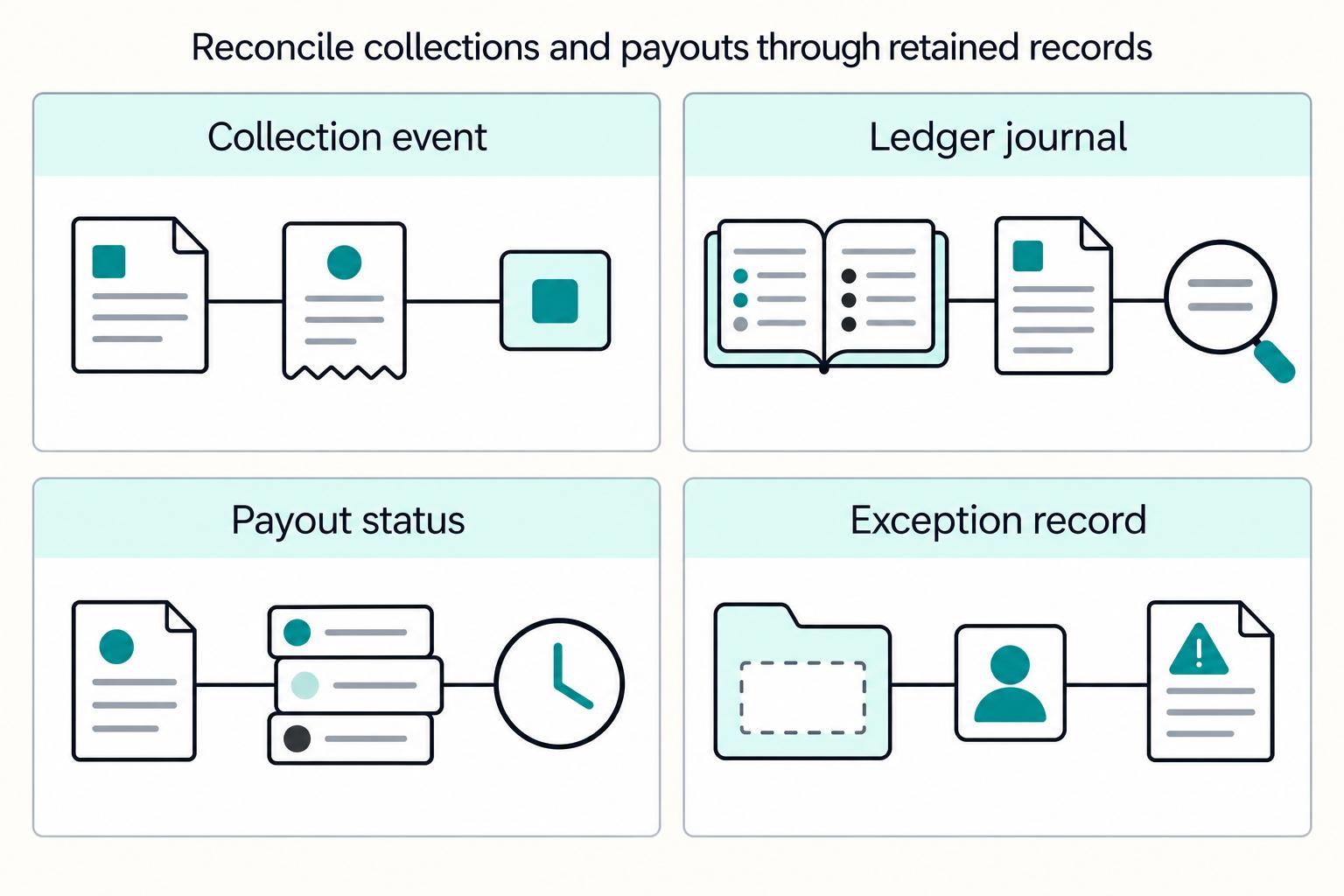
Accounts Receivable Management for Platforms: How to Collect from Buyers While Paying Sellers Fast
**Treat AR for a platform as a payout control problem, not just a collections task.** If you separate buyer collections from seller payouts, you risk releasing funds based on a status your ledger cannot actually support.
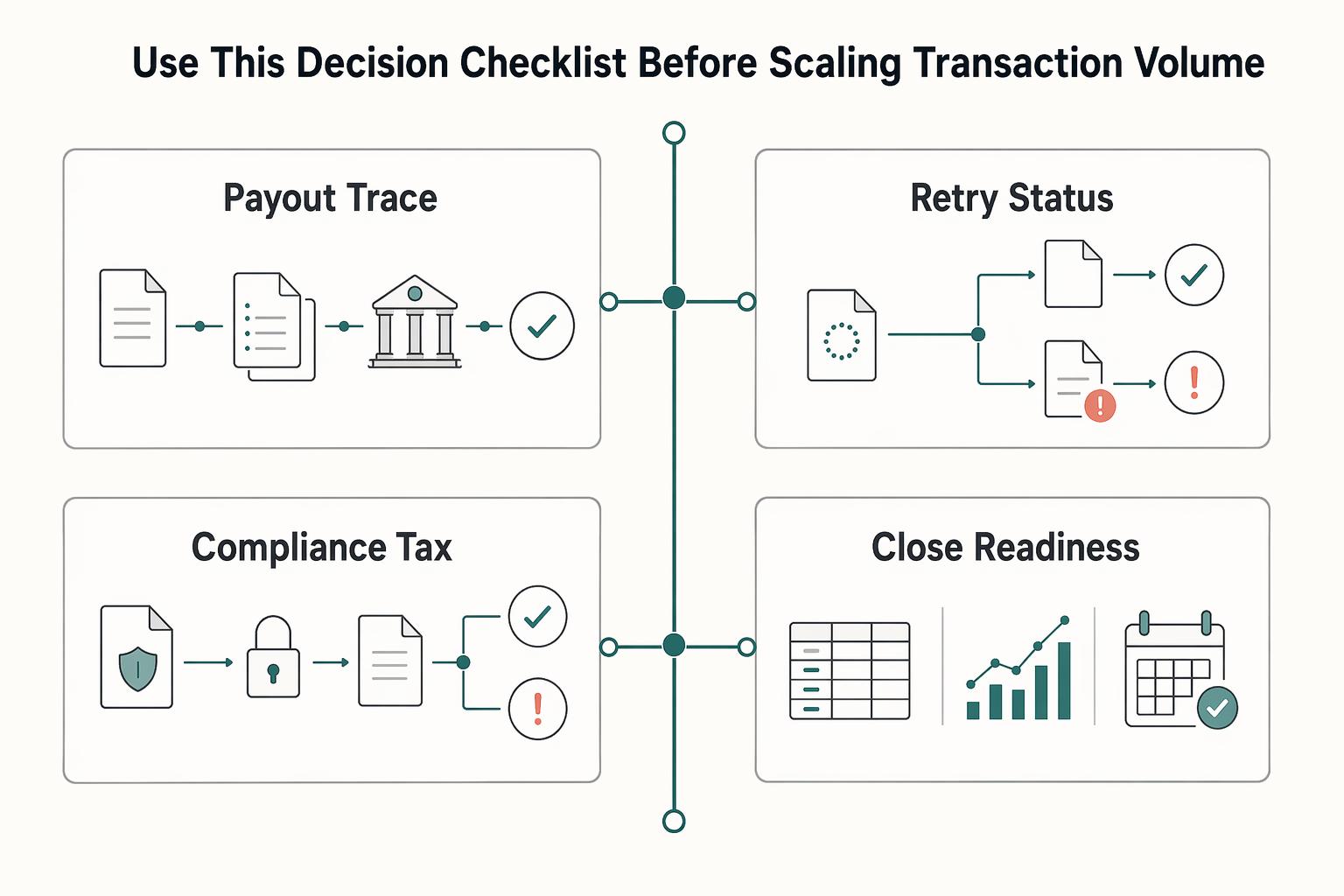
Accounts Payable vs. Accounts Receivable for Platforms and the Two-Sided Ledger
If you run a platform, Accounts Payable and Accounts Receivable are not just accounting labels. They are two connected operating flows, and treating them that way early helps you manage matching breaks, payment finalization, and payout readiness with fewer assumptions.