
Quick Answer
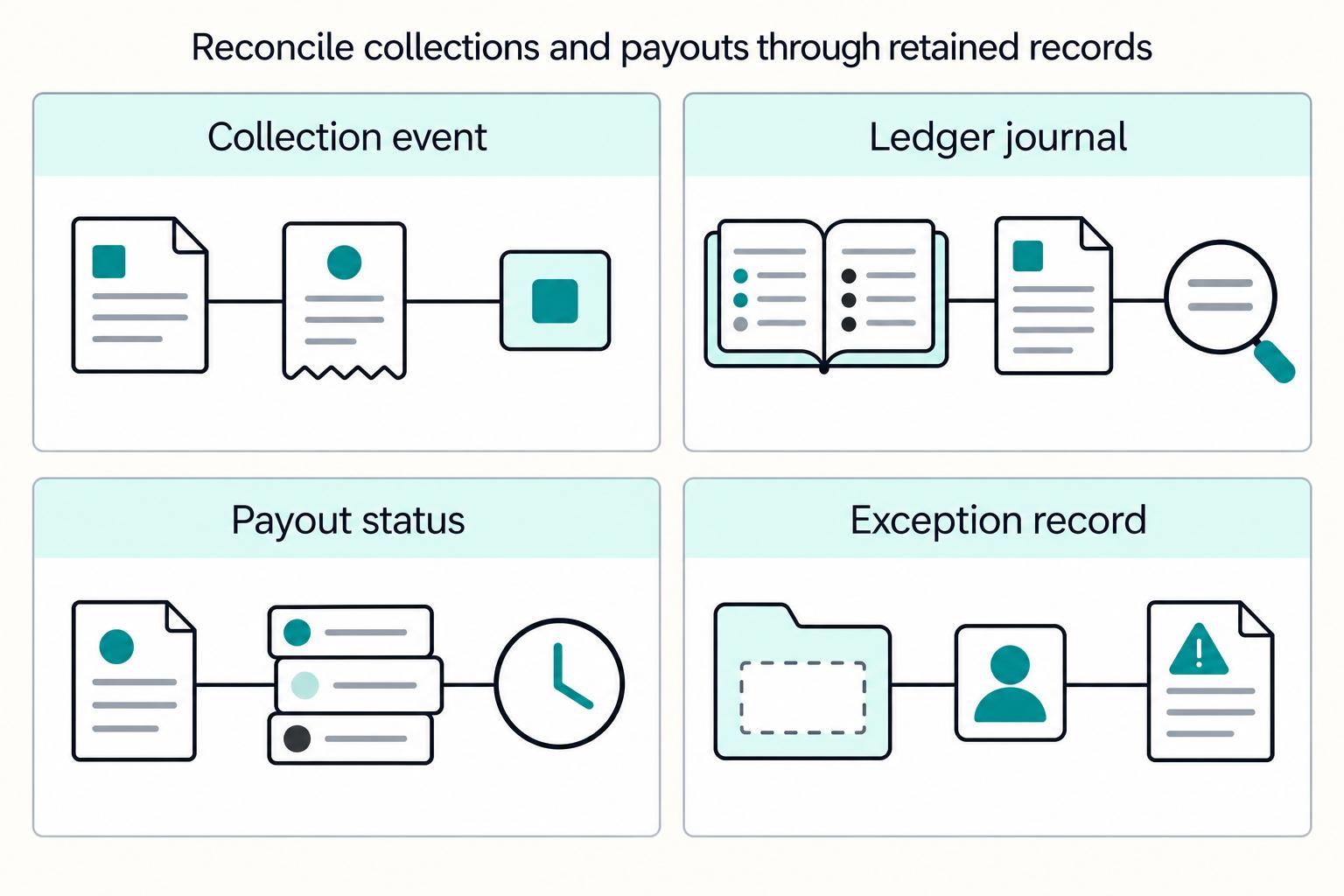
Use a ledger-gated release model: collect from buyers, verify payment confirmation, then release seller payouts only after the matching ledger entry is present. For accounts receivable management platforms collect buyers pay sellers, the practical rule is that a green payment status alone is never enough. Route missing postings, unsettled funds, and policy-blocked cases into payout hold or an exception queue, and reconcile daily plus at period close before batch release.
Why Buyer Collections and Seller Payouts Need the Same Control Layer#
Treat AR for a platform as a payout control problem, not just a collections task. If you separate buyer collections from seller payouts, you risk releasing funds based on a status your ledger cannot actually support.
Step 1. Define AR in platform terms#
Accounts Receivable (AR) management is the process of invoicing, tracking, and collecting payments. On a two-sided platform, that definition is necessary but incomplete. Your job is to move from invoice through payment confirmation to a release or hold decision for seller payouts, while keeping one ledger as the source of truth.
That is why this guide stays close to operations. Many collections-focused AR tools concentrate on reminders, overdue escalations, and dunning. Useful, but not enough when your team also has to decide whether money collected from a buyer is actually ready to support a seller disbursement.
Step 2. Connect payment confirmation to fund availability#
A practical AR flow needs one rule from the start: payment confirmation is a signal, not the final permission to pay out. You need to know whether funds are available under your processor's timing rules and whether your own ledger recorded the event correctly.
Stripe Connect payout settings describe both when funds are available and when the balance is automatically paid out. Adyen's platform quickstart documentation says the default sales day payout delay is two days. Its settlement documentation describes settlement delay as the business day lag before funds in a settlement batch are made available. If your product or ops team treats "paid" in the UI as equal to "ready to release," that is a red flag.
Verification checkpoint: before any payout release, confirm that the invoice state, the payment confirmation record, and the matching ledger posting all exist and agree. If one is missing, route the case to a hold or exception state rather than trying to fix it after money leaves.
Step 3. Keep the ledger as the source of truth#
The core promise of this guide is simple: connect invoice and payment confirmation flow to payout decisions without breaking accounting integrity. In practice, that means Collections, Billing, and Accounting need to align on the same financial record, not on separate dashboards that happen to look consistent that day.
One failure mode is straightforward: a buyer payment appears successful, ops sees a green status, and a seller payout is released before the journal entry or ledger posting lands. At that point, you are no longer debating AR process. You are cleaning up a reconciliation problem with real cash exposure. Throughout this guide, the default answer stays conservative and operationally useful: if the ledger cannot prove the state change, the payout is not ready.
Define your operating model before you automate#
Define the operating model first, then automate it. If you automate before scope, ownership, and release rules are explicit, you risk making avoidable mistakes repeatable.
Step 1. Write the scope sentence#
Use one sentence that Finance, Payments Ops, and Product all share: from payment method collection to payment confirmation, then payout release or payout hold based on risk. Standard accounts receivable management focuses on monitoring and collecting outstanding payments, but platform operations also need a clear post-collection decision path for seller funds.
Pressure-test that sentence with one real transaction. Each team should be able to point to where collection starts, what counts as confirmation, and when a hold is applied.
Step 2. Assign owners for each decision point#
Set one accountable owner for buyer collections, one for seller payouts, and one for the exception queue, plus a backup approver for release-blocking cases. The exact org split can vary; the requirement is clear accountability per queue and decision point.
Use the exception queue as your early warning signal. If failed confirmations can sit without a named closer, delays and manual overrides usually follow.
Step 3. Choose signals that reflect operating quality#
Track a small set of operational signals tied to cash flow and control quality, not vendor claims. A practical set is reconciliation completion, unresolved exception age, payout release timeliness after confirmed and available funds, and one collections-efficiency indicator such as DSO or another AR indicator.
Make the tradeoffs explicit. AR is a core cash-flow function, so decide your priority when goals conflict: faster release, lower reversals, or fewer manual touches.
If payout timing depends on reserves, settlement lag, or prefunding, How to Build a Float Management Strategy for Marketplace Platforms shows how to set those controls without losing visibility.
Prepare prerequisites and evidence before go-live#
Do not go live until four controls are explicit and tested: evidence pack, technical reliability, policy gates, and reconciliation ownership.
| Prerequisite | What to confirm | Key detail |
|---|---|---|
| Evidence pack | Contract terms, invoice policy, payout eligibility rules, and audit trail export fields are assembled | A reviewer can trace one transaction end to end, including what changed, who changed it, and when |
| Technical prerequisites | Stable proposal-to-payment states, required webhook handling for asynchronous outcomes, and proven idempotent retry on collection and payout endpoints | Idempotency keys can be up to 255 characters and may be pruned after at least 24 hours |
| Policy gates | Each release-blocking onboarding or compliance check routes to a payout hold with a named clearer | Record whether each hold blocks all payouts or only specific transactions |
| Reconciliation calendar | Each reconciliation checkpoint has a start date, end date, close date, frequency, and named preparation and review owners | A missed checkpoint creates an exception or blocks release |
-
Assemble the minimum evidence pack. Keep the contract terms that affect billing and release, your invoice policy, payout eligibility rules, and the fields needed for audit trail exports. The goal is simple: a reviewer can trace one transaction end to end, including what changed, who changed it, and when, from exported records.
-
Verify technical prerequisites under retry and delay. Confirm your proposal-to-payment workflow has stable states, and treat webhook handling as required when payment outcomes arrive asynchronously. Prove idempotent retry on collection and payout endpoints so one retried request produces one business outcome. If you use Stripe-style idempotency behavior, keys can be up to 255 characters and may be pruned after at least 24 hours.
-
Document every release-blocking policy gate. Where onboarding or compliance checks apply, define how they route to a payout hold and who can clear them. On some platforms, users must complete KYC verification before payout, and U.S. bank account opening flows require customer identification data before account opening under CIP rules. Also record whether each hold blocks all payouts or only specific transactions.
-
Set the reconciliation calendar and sign-off rhythm before launch. For each reconciliation checkpoint, define the period start date, end date, close date, and frequency, then assign named preparation and review owners. Your go-live test should confirm a missed checkpoint creates an exception or blocks release, instead of allowing payouts to continue with unresolved books. For a collection-focused metric, see Accounts Receivable Turnover for Platforms: How to Measure Collection Efficiency.
Implement the collection-to-payout sequence step by step#
Map collection to payout as explicit state changes, and do not release payout on payment success alone. Seller disbursement should wait for both payment confirmation and a matching ledger posting.
Step 1. Separate the sequence into explicit stages#
Treat each stage as its own state, even when one vendor runs multiple steps: proposal accepted -> payment method collection -> invoice issued -> collection attempts -> payment confirmation -> payout decision. Keep these separate in product and finance records, because invoice issuance and payment collection are separate workflow stages.
If you use Stripe Connect, this split is expected in the architecture. It supports multi-party money movement, and separate charges and transfers decouple the buyer charge from connected-account transfers. That means your platform still needs its own payout-readiness rule.
Quick check: for one completed transaction, confirm you can show one recorded transition per stage. If any stage exists only in email or notes, the flow is still implicit.
Step 2. Add one checkpoint per stage#
Use one checkpoint per stage with a clear blocker and required audit artifact. This matters because one action can emit multiple events, so a single "paid" flag is not enough.
| Input event | Expected state change | Blocking condition | Required audit trail artifact |
|---|---|---|---|
| Proposal accepted | Transaction moves from draft to billable pending payment setup | Missing accepted proposal record or unresolved contract terms | Proposal ID, acceptance timestamp, actor |
| Payment method collection completed | Buyer marked payable with a stored payment method reference | No valid payment method reference or collection attempt not authorized | Payment method token/reference, collection timestamp, actor or service ID |
| Invoice issued | Invoice status changes to issued/sent | Invoice missing required billing fields or not linked to proposal | Invoice ID, issue timestamp, invoice version/export |
| Collection attempt created | Receivable moves to payment in progress | Retry created without idempotency evidence or invoice already closed | Attempt ID, request ID/idempotency key, provider reference |
| Payment confirmation received | Payment marked successful or failed from provider event | Success event received but no corresponding internal journal or unmatched amount | Provider event ID, payment reference, confirmation timestamp |
| Payout decision evaluated | Eligible payout or payout hold recorded | Missing ledger posting, failed reconciliation, or unresolved policy gate | Ledger entry ID, decision timestamp, reviewer/service identity |
Step 3. Enforce the ledger gate before any seller disbursement#
Make the ledger gate non-negotiable: no payout release when ledger posting is missing. Payment confirmation shows collection progress; it does not prove your ledger is complete.
Before release, verify in order:
- A confirmed collection result exists.
- The matching journal entry exists in the ledger.
- No reconciliation or policy gate blocks release.
If any check fails, route to payout hold or exception handling. A practical control test is to attempt release on a transaction with a provider success event but no ledger entry; release should fail automatically.
Step 4. Use vendor automation for speed, but keep payout authority with your controls#
Anchor positions itself around automated billing and collections. Divinity Software positions itself around AR automation and efficiency. ChatFin positions itself around agent-based finance work, including reconciliation, reporting, compliance, invoicing, and analytics, with "100+" pre-configured agents. Stripe focuses on payment flows and multi-party money movement.
You can use that automation for throughput, but keep payout authority in your own checkpoints. Your operators still need to verify collectible invoice state, expected ledger posting after payment events, clean duplicate-event handling, and payout blocking when controls are not satisfied. For a clearer view of how receivables and payables interact on the same ledger, see Accounts Payable vs. Accounts Receivable for Platforms and the Two-Sided Ledger.
Set payout release rules for unsettled or partial collections#
Use a tiered payout policy: auto-release only funds that are fully confirmed and posted to the ledger, keep partial or unsettled amounts on payout hold, and route disputed or clearly inconsistent cases to an exception queue.
Step 1. Classify funds by release confidence#
Classify every transaction as confirmed, unsettled, or disputed before scheduling seller payouts. Confirmed funds can move to release after the ledger gate is satisfied. Unsettled funds stay held, and disputed or reversed funds require review because disputes can immediately reverse a previously collected payment.
If buyer payment timing varies, release only the collectible portion and defer the rest. This is especially important for ACH debit flows, where standard processing can take 3 to 4 business days while return risk is still active. Releasing the full seller amount before funds are truly final effectively extends credit from your platform balance.
Step 2. Tie each failure case to a default release decision#
Define the default decision, owner, and handling target for each common failure case before payout batches run.
| Scenario | What to verify first | Owner | Internal handling target | Release decision |
|---|---|---|---|---|
| Delayed settlement | Payment was initiated, but final settlement/confirmation is still pending; for ACH, check whether you are still within the 3 to 4 business day window | Payments Ops | By the next reconciliation checkpoint and before expected settlement-window end | Keep on payout hold until confirmation and ledger match exist |
| Returned payment | Return or failed transfer status is present | Payments Ops + Finance | Immediate hold and prioritized review | Do not release; move to exception queue if payout was already scheduled |
| Unmatched deposit | Provider credit/deposit exists, but no clean invoice or ledger match exists | Finance | Resolve in the next reconciliation cycle | Keep on payout hold until matched; only release the clearly matched portion |
| Duplicate webhook | Event delivery is repeated for the same payment/settlement event | Engineering + Payments Ops | Deduplicate before payout close/replay | Do not create a new release decision from the duplicate event |
Duplicate events are expected in production webhook integrations. Log processed event IDs and ignore repeats so payout logic cannot run twice for the same event.
Step 3. Write down the tradeoff between speed and reversal exposure#
State the tradeoff directly: faster seller cash flow raises reversal exposure unless you retain protection through reserve or minimum-balance controls. Stripe documents minimum balances for automatic payouts to reduce negative-balance risk from refunds, disputes, or fees. Adyen documents reserves to cover refunds, chargebacks, and other operational debits.
Write the policy explicitly. If speed is the priority, pair faster release with reserve logic and tested idempotent retry controls. If risk reduction is the priority, release only from available balance above your minimum-balance threshold and defer funds still exposed to returns or disputes.
For a step-by-step walkthrough, see Recurring Billing for Marketplaces: How to Charge Buyers and Pay Sellers on the Same Cycle.
Design reconciliation and audit controls that survive scale#
Treat your ledger as the source of truth, and treat wallet or provider balances as projections that must reconcile back to transaction records. If funds look available in a dashboard but you cannot evidence the state transition, hold payout release.
Step 1. Anchor reconciliation on state changes#
Anchor reconciliation on transaction state changes, not snapshot balances. A practical sequence is: request created, provider accepted or processed, funds movement recorded, ledger journal posted, payout status updated.
Use stable identifiers at each step. Request IDs can anchor API-level traceability, and balance transactions can anchor each movement in or out of account balance. For transactions that appear complete, verify you can show the request ID, provider reference, balance movement record, and matching ledger entry. If one of those is missing, treat it as a reconciliation exception before release.
Step 2. Define daily and period-close checkpoint sets#
Define separate checkpoint sets for daily operations and period close. Daily checks catch drift early; period-close checks prove completeness and support finance review.
| Checkpoint area | Daily check | Period-close check | Evidence artifact |
|---|---|---|---|
| Buyer collections | Match new collection events to balance transactions and ledger journals | Confirm in-period collections are represented once in the ledger | Request ID, provider reference, ledger entry ID |
| Internal ledger journals | Review unmatched or duplicate postings from the prior business day | Validate journal completeness for the period and investigate variances | Journal export, variance log |
| Seller payouts | Match payout status to approved ledger amounts | Reconcile settled payout batches to included transactions | Payout status and payout reconciliation export |
If automatic payouts are enabled, payout reconciliation reporting helps tie settled payout batches back to included transactions. Use that as period-close evidence, not as a substitute for ledger controls.
Step 3. Require a complete traceability chain#
Require a full traceability chain for routine reconciliation and exceptions: request ID -> provider reference -> ledger entry -> payout status -> exported audit-trail record. When a link is missing, pause release until the variance is resolved under your exception process.
Keep payout-status discipline explicit: pending, paid, failed, or canceled. Reconcile those states back to ledger intent so finance can explain every mismatch before close. If you operate under stricter recordkeeping rules, apply them directly; for example, FCA CASS requires records accurate enough to serve as an audit trail, with some records retained for five years.
Decide what to automate and what to keep human-owned#
Automate repeatable collection work, and keep humans on decisions that can change contractual or payout risk. Use this rule: if the action is deterministic replay after a known event, automate it with idempotency; if it needs interpretation, approval, or risk judgment, keep final ownership human.
| Work item | Owner | Reason |
|---|---|---|
| Reminders | Automate | Listed as a repetitive AR task |
| Failed-payment retries | Automate | Listed as a repetitive AR task; Stripe Billing can automate failed invoice recovery |
| Status updates | Automate | Listed as a repetitive AR task |
| Routing failed payment events to the exception queue | Automate | Listed as a repetitive AR task |
| Policy-gated payout hold reviews | Human-owned | Can change contractual or payout risk |
| Disputes or chargebacks | Human-owned | Require evidence and judgment |
| Contract-term overrides | Human-owned | Need contract interpretation or cross-team approval |
Step 1. Automate the repetitive AR tasks first#
Start with repetitive AR tasks: reminders, failed-payment retries, status updates, and routing to the exception queue from failed payment events. Webhook-driven handling is the right backbone here because it is designed to process large volumes of business-critical payment events.
If you use Stripe Billing, failed invoice recovery can run automatically, and invoice.payment_failed gives you a concrete trigger for retry tracking and exception routing. Stripe also documents a recommended Smart Retries default of 8 tries within 2 weeks. Treat that as a documented recovery path for recoverable cases, not a reason to retry every failure indefinitely.
Your checkpoint should stay explicit: for sampled failed payments, verify event ID, invoice ID, retry state (count or next retry time), and linked queue item. If provider state updates but no internal exception item is created, collections stall and payout decisions run on stale information.
Step 2. Keep human judgment on material exceptions#
Keep human ownership for high-impact exceptions, including policy-gated payout hold reviews, disputes or chargebacks, and contract-term overrides. These cases can change exposure and often require evidence and judgment, not just workflow execution.
Use a practical boundary in production: if resolution requires contract interpretation or cross-team approval, route it to a named owner with evidence attached. At minimum, include invoice record, payment event history, ledger reference, payout status, and any contract language tied to release timing.
Step 3. Evaluate AR automation tools by exposed controls#
Evaluate AR automation tools by control surfaces and evidence output, not autonomous claims or ChatFin-style positioning. For collections and payout-adjacent flows, operational controls matter more than demo polish.
Before you choose a tool, verify it supports:
- Configurable rules-and-exceptions workflows for AR processing
- Customizable approval paths for transactions that should stay human-owned
- Operational reporting with exportable evidence
- Idempotent retry so safe replays do not duplicate actions
If a vendor cannot show approval paths and auditable exception output, treat that as a control gap. For treasury context, see Global Treasury Management for Platforms Across 50+ Countries.
Handle the common failure modes and recover without payout chaos#
When collection status and payout status conflict, use the ledger as the decision record and recover from the underlying event and document state, not from the UI alone.
| Failure mode | Recovery action | Release impact |
|---|---|---|
| Payment confirmed but no journal exists in the ledger | Pause the affected payout and replay the ledger-posting action with idempotent retry | Hold the related seller payout until accounting is complete |
| Duplicate webhook delivery | Log processed event IDs and skip already-processed events | Prevent the same notification from applying state twice |
| Returns, holds, and settlement issues | Move the case to the exception queue with a named owner and recorded closure context | Keep unresolved risk out of the automated path |
| AR and AP document states conflict | Reconcile the general ledger against AR and AP subledgers and confirm document states are compatible | AP should not treat the seller amount as ready to release |
Step 1. Pause the affected payout and replay the missing ledger post#
If payment appears confirmed but no journal exists in your ledger, hold the related seller payout until accounting is complete. Use the server-side payment event as the recovery anchor; in Stripe, verify the relevant PaymentIntent status event, such as payment_intent.succeeded, was received and logged. If processing was interrupted, replay the ledger-posting action with idempotent retry so the request can be repeated safely without a duplicate side effect.
Before release, confirm one chain matches end to end: event ID, linked invoice, and journal entry.
Step 2. Deduplicate collection events before they mutate invoice state#
Treat duplicate webhook delivery as expected behavior and design for it. Log processed event IDs and skip already-processed events so the same notification cannot apply state twice.
Your recovery target is one authoritative invoice state in the ledger source of truth, even when duplicate collection events arrive. If duplicate handling can create two state transitions from one success path, tighten the idempotency boundary.
Step 3. Route returns and holds into named exception ownership#
Unresolved returns, holds, and settlement issues should move out of the automated path into the exception queue. Assign a named owner and an escalation timer that fits your operating cadence, and record closure context in the audit trail so disposition is reviewable later.
This keeps deterministic replay automated while unresolved risk stays human-owned.
Step 4. Align AR and AP document states before batch payout execution#
Before batch payout execution, reconcile the general ledger against AR and AP subledgers and confirm document states are compatible. If AR still shows a collection exception or unresolved hold, AP should not treat the seller amount as ready to release.
This checkpoint prevents a recoverable collections issue from turning into payout drift.
Conclusion and copy-paste launch checklist#
If you take one rule from this guide, make it this: do not release seller funds until your payout decision rules, ledger, and reconciliation checkpoints all agree. Speed matters, but defensible release matters more.
Step 1. Lock the workflow states before you automate. Write the proposal-to-payment workflow as named states with owners, not implied handoffs. Your invoice lifecycle should be explicit enough that Finance and Ops can point to the current state without interpretation. A practical baseline is to map invoice statuses such as draft, open, paid, uncollectible, and void, then define what each status allows or blocks. If a failed or partial payment leaves the invoice open, your payout rule should still treat that as unresolved, not "close enough."
Step 2. Make the ledger the release gate. Payment confirmation is not the finish line by itself. Your integration should inspect payment status to decide the next business action. Payout release should wait for the matching ledger-style transaction record that shows the balance movement actually entered or left the account. For reconciliation, start from that balance-transaction view, then verify the chain from request or event ID to provider reference, invoice, ledger entry, payout status, and audit trail. If one link is missing, route the case to a payout hold or exception queue rather than trying to patch it later.
Step 3. Prove retry safety, exception routing, and auditability before go-live. Idempotent retry needs real test cases for duplicate delivery, delayed delivery, and replayed events. Use stable idempotency keys so repeated requests return the same result, and design your replay tests with the 24 hour key-retention window in mind. Failed or unprocessable events belong in an exception queue, like a dead-letter queue, with a named owner and clear replay handling. Your audit trail should be a chronological record that lets finance reconstruct the sequence of events during review and period close, not just a status snapshot. Also make the reconciliation cadence recurring and documented, with at least monthly reconciliation.
Use this in your launch review:
- proposal-to-payment workflow states are documented and owner-assigned.
- invoice and payment confirmation events are mapped to ledger postings.
- payout hold and exception queue rules are explicit, with escalation owners.
- idempotent retry is tested for duplicate, delayed, and replayed events.
- audit trail records are complete enough for finance review and period close.
If you cannot check every box with evidence, you are not blocked on software selection. You are blocked on control design.
Frequently Asked Questions
What is accounts receivable management for platforms, beyond standard AR collections software?
For a platform, AR is not just reminders and cash application. It also has to manage invoices, credits, payments, and the decision point where buyer collection status affects seller payout release. The practical difference is simple: you are controlling transaction state across both sides, not just chasing payment.
How can a platform pay sellers fast when not all buyer payments are fully settled?
Use release tiers, not one blanket rule. If funds are available and posted to the ledger, release can follow policy. If funds are still pending, hold release or limit it to the portion your policy treats as collectible. A daily payout schedule does not make pending funds available, and pending funds are not money you can withdraw or spend yet.
Which controls are non-negotiable for two-sided AR automation at scale?
You need duplicate-safe event handling, payout blocks tied to ledger and approval evidence, rule-based exception routing, and proof that transactions are executed with authorization. In practice, that means logging processed event IDs, preventing duplicate mutation of the same invoice, and blocking payout when the journal entry or approval evidence is missing. If your tool cannot define rules and exceptions for AR processing, operators will end up patching risk in spreadsheets.
Where should idempotent retry end and manual exception handling begin?
Retry ends where the recovery is deterministic. If the same idempotency key should return the same result, such as replaying a missed posting after a transient failure, automate it. Move to manual handling when the case needs contract interpretation, policy review, approval, or cross-team judgment, because retries cannot resolve a disputed invoice or a payout hold decision.
What does a strong reconciliation checkpoint set look like for finance and ops?
At minimum, check the chain from request ID to provider reference to invoice to ledger entry to payout status to exported audit trail record. For payout-level review, reconcile the transactions included in each settlement batch, not just an ending balance number. A common risk is matching the provider dashboard to payout status while skipping the ledger posting that should justify release.
How should we compare Anchor, Stripe, Divinity Software, and ChatFin when operational detail is unclear?
Do not score marketing language. Ask each vendor to show how exceptions are defined, how duplicate events are handled, what audit evidence can be exported, and how a payout is blocked when funds are still pending. If product detail is thin, treat that as risk and compare them on observable control surfaces, not on broad AR automation claims. For a deeper buying lens, see Accounts Receivable Automation for Platforms: How to Collect from Enterprise Buyers at Scale.
What is the minimum audit trail we need before releasing payouts?
You need a chronological record that lets someone reconstruct the sequence of events. The minimum pack is the collection request or event ID, provider payment reference, invoice ID, ledger journal entry, payout decision or hold status, timestamps, and operator notes for any override. If one link in that chain is absent, payout release may not be defensible.
Try a related tool
Where Gruv fits
Gruv for marketplaces
Carry each seller’s approved payable amount, source reference, payout state, and exception context through one reviewed batch.
See invoice-linked collection
Issue a payment request against an invoice, open hosted checkout, and keep provider status and finance references connected.
Researched and edited by the Gruv editorial team. Gruv builds cross-border billing, payouts, and finance-operations software for global businesses.
Sources
- csrc.nist.gov/glossary/term/audit_trailtrusted
- docs.stripe.com/api/idempotent_requeststrusted
- docs.stripe.com/webhookstrusted
- ecfr.gov/current/title-31/subtitle-B/chapter-X/part-1...trusted
- occ.gov/publications-and-resources/publications/comp...trusted
- sao.wa.gov/sites/default/files/2023-05/Best-Practices-f...trusted
- sec.gov/spotlight/fcpa/fcpa-recordkeeping.pdftrusted
- stripe.com/resources/more/accounts-receivable-managemen...trusted
Educational content only. Not legal, tax, or financial advice.
Related Posts
Accounts Receivable Automation for Platforms to Collect from Enterprise Buyers at Scale
Enterprise AR teams are being asked to improve cash conversion and cut manual work at the same time. That sounds reasonable until you're collecting from buyers on terms like 0-90/other days. In that environment, weak AR operations do more than consume staff time. Manual, error-prone workflows can create bottlenecks that delay cash conversion.
Choosing Accounts Payable Document Management for Invoices, Contracts, and Payment Records
Choose an accounts payable document management platform for control, not storage alone. You need a traceable path from intake to approval, posting, and payout without pushing teams back into manual handoffs.
Accounts Receivable Turnover for Platforms to Measure Collection Efficiency
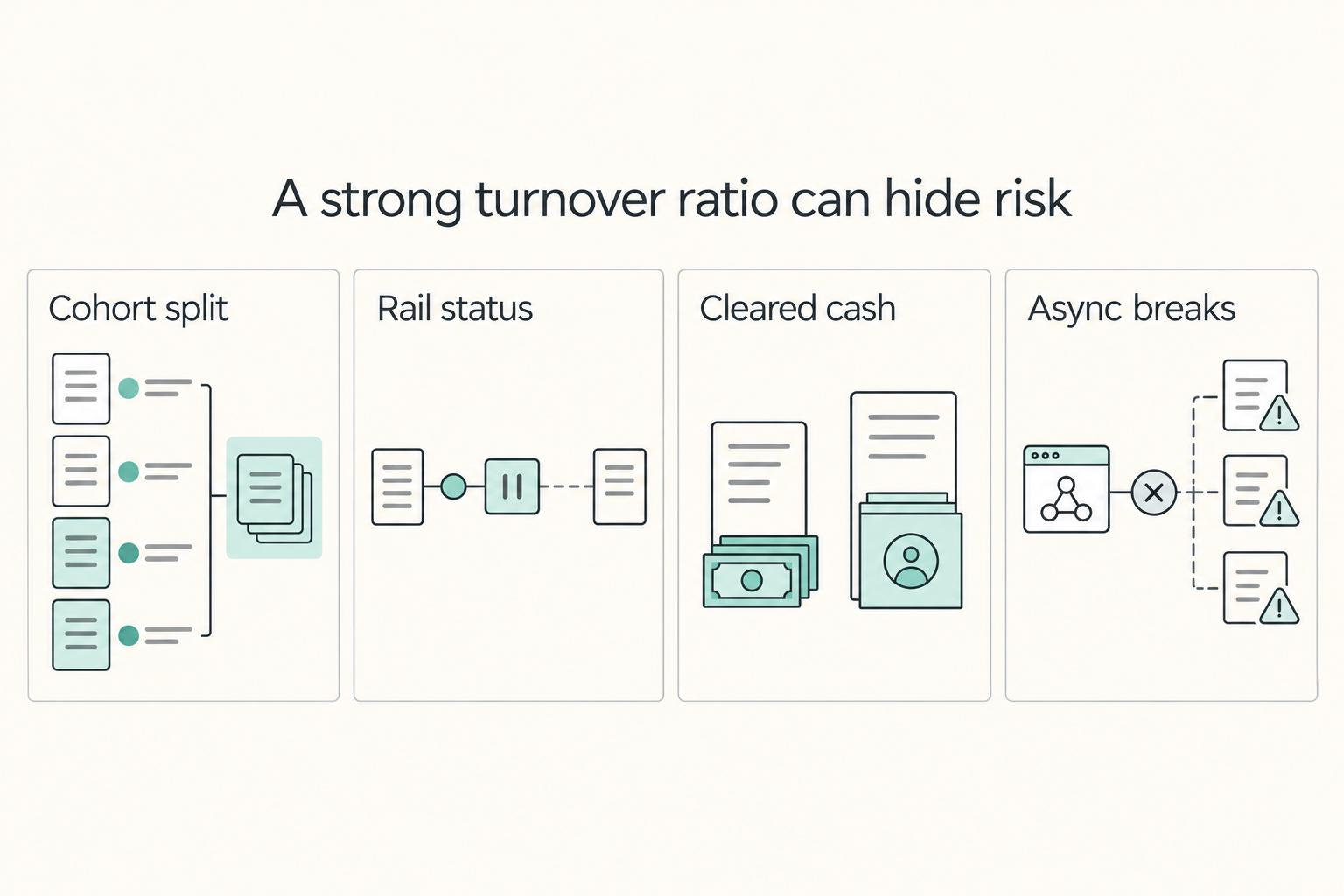
Accounts receivable turnover can help a platform measure collection efficiency, but only when you read it against cash timing. A higher [`Accounts Receivable Turnover Ratio`](https://www.netsuite.com/portal/resource/articles/accounting/accounts-receivable-turnover-ratio.shtml) usually points to faster collections and stronger cash flow. On its own, though, it does not tell you everything about collection health.