
Quick Answer
Map when collections become usable and when seller payments fall due. Separate seller funds from platform operating cash, forecast the funding gap by currency, and define release rules from reconciled ledger records plus provider availability. Set holds, reserves and payout schedules within your contracts, provider rules and applicable requirements, with explicit handling for returns and unknown payment outcomes.
What a Float Management Strategy Needs to Cover#
Marketplace float is the timing difference between collecting a payment, being able to use the funds and paying the seller or other beneficiary. A pending collection, an available provider balance and a seller payable can all show different amounts on the same day. Your strategy needs to explain those differences before it promises faster payouts.
Step 1. Agree the balance and ownership definitions#
Separate money held for sellers from platform revenue and operating cash. A wallet display describes a balance; it does not establish who owns the funds, where they are held or whether they can be paid out. Define those facts for every route. Customer or seller funds are not automatically a free funding source for the platform.
Make the definition explicit across Product, Finance, and Ops before anyone sketches wallet behavior or payout rules. A useful checkpoint is simple: ask three people, "What does float mean in this product?" If one answers with scheduling language and another with treasury language, stop there. Mixed definitions are an early warning that your balance states, approvals, and reporting can drift apart.
Step 2 Define the goal in operator terms#
The goal is to build a decision-ready approach for platform wallets, stored balances, and treasury workflows that can scale without quietly breaking controls, reconciliation, or operating clarity. You are not just deciding how long money sits in an account. You are also deciding who can trigger release and what records will exist when something goes wrong.
Use a practical test. Can you trace one unit of value from collection to ledger entry to visible balance to payout status without relying on a spreadsheet or someone "just knowing" what happened? If not, the issue is not payout speed. Your operating model is probably still informal, which is where float-related exceptions get expensive.
Step 3 Follow the build order that reduces avoidable risk#
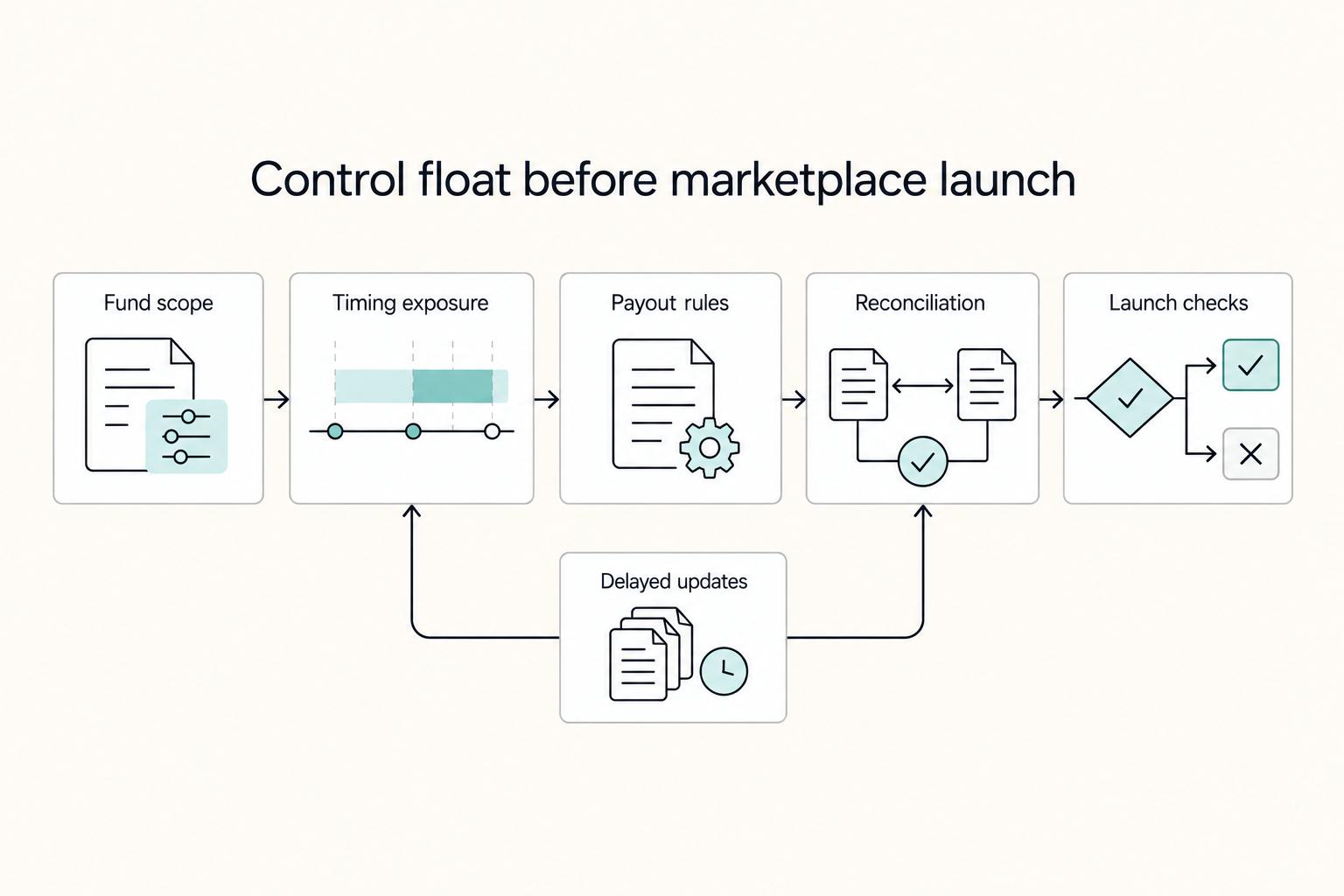
The rest of this guide follows an order that tends to hold up in production. First, define the scope of the funds you are actually managing. Next, map where timing exposure shows up across collection timing and payout cadence. Then set payout rules, implement controls and reconciliation checkpoints, choose an architecture that can cope with delayed updates, and launch with checks you can verify.
That order matters because teams often start with user-facing payout promises and only later discover that the ledger, exception handling, or approval logic cannot support them. When that happens, faster payouts do not feel like a product win. They feel like margin leakage plus cleanup work. Related: Inventory Management for Marketplace Platforms: How to Sync Stock Levels with Payment Triggers.
Define the float you are actually managing#
Define the timing gap across collection availability, FX timing and payout cadence, then measure it by currency and day. Faster payout can require platform-owned prefunding before collections are available. Slower payout leaves a continuing seller obligation; it does not turn that money into platform income.
Step 1: Name the money gap precisely. Record collection date, expected availability date, payout due date and beneficiary-credit evidence separately. Identify which entity owes the seller and which entity holds the cash. Keep operating liquidity, seller reserves and unsettled collections in separate categories.
Step 2: Choose one accounting truth and treat everything else as a view. Use your ledger source of truth as the record for what happened and what is owed. Treat wallet, dashboard, and payout-screen balances as UI-derived balances unless they map cleanly to ledger events and states your team can explain.
Step 3: Write the liability perimeter before expanding features. Define where platform and contractor balances are held, which balances represent seller obligations and what permits release. Confirm your role, provider agreement, holding limits and any applicable safeguarding or segregation duties before offering stored balances. For example, the UK FCA’s rules for payment and e-money institutions address customer-fund safeguarding; applicability depends on the actual entity and activity, not the word wallet.
Make a currency-by-currency funding forecast alongside those definitions. Hypothetical USD example: a provider reports USD 100,000 received, but USD 25,000 remains pending, leaving USD 75,000 available. Seller payouts due today are USD 70,000, and your approved scenario requires USD 10,000 for near-term refunds or returns. The immediate need is USD 80,000, so the funding gap is USD 5,000 before fees. Use permitted platform-owned prefunding or change payout timing within agreed terms; do not count the pending USD 25,000 as spendable. Stress the next day with collection delayed and a refund arriving. Track seller liabilities separately so you do not deduct the same reserve twice or use money held for another cohort to conceal the gap.
Gather prerequisites before you design anything#
Do not design payout or wallet behavior until Product, Finance, and Ops are working from one shared prerequisite pack. If state names, route maps, and exception notes differ by team, you will encode that confusion into the product.
| Evidence item | What it covers |
|---|---|
| Wallet state dictionary | Platform wallets and contractor wallets |
| Payout route map | From collected funds to settlement |
| FX path map | Any conversion step, even if it is manual today |
| Owner matrix | Who approves, changes, and explains each state or route across Product, Finance, and Ops |
Step 1: Build the minimum evidence pack. Create a pack that lets someone trace money movement without tribal context. At minimum, include:
- a wallet state dictionary for platform wallets and contractor wallets
- a payout route map from collected funds to settlement
- an FX path map for any conversion step, even if it is manual today
- an owner matrix showing who approves, changes, and explains each state or route across Product, Finance, and Ops
Checkpoint: pick one payout route and have each function explain it in the same order. If they describe different realities, the pack is not ready.
Step 2: Collect operating reality, not intended behavior. Document your current payout cadence, known failures, unresolved exceptions, and manual touches in exception workflows. The point is to see where float is actually created, extended, or trapped in real operations.
Use recent successful, failed, and unresolved cases. Note where handoffs broke, who intervened, and what had to be checked before funds moved again.
Step 3: Confirm compliance boundaries before feature design. List payout gating rules, hold conditions, and market-dependent behavior as "where supported." Before processing, you should be able to state which profile or policy condition makes a transaction permissible or not yet permissible.
For each hold or gate, capture what triggers it, who can clear it, and what evidence clears it. If those are unclear, do not promise faster release of funds.
Step 4: Lock technical constraints before scope expands. Set explicit assumptions for webhook reliability, retry semantics, and whether your stack supports idempotent retries and webhook-driven status handling. These choices directly affect reconciliation and exception handling.
For each payment gateway integration, identify the source event, duplicate-protection method, and final status your ledger trusts. If your current stack depends on synchronous success and weak retries, keep the first release narrow and roll out gradually.
Map money movement in strict order#
Map each money route in one fixed sequence and treat that sequence as the control surface for Product, Finance, and Ops. If a team cannot point to the record that justifies a balance or payout state change, the route is not production-ready.
Step 1: Sequence one route from collection to reconciliation. Write one path in strict order: collect, post ledger journals, update stored balances, convert (if needed), queue payout, settle, reconcile. Use it as your review sequence, not as a claim that every provider reports in that same order. If you run both platform wallets and contractor wallets, map them separately so liability and visibility are not conflated.
Record provider access and custody permissions in the same map: which account can collect, transfer, convert or pay out, which entity authorizes the action, and which entity carries losses. A marketplace integration credential is not permission to hold funds indefinitely or use seller balances for its own purposes.
Step 2: Assign transition ownership and audit evidence. Every status transition needs a clear owner and a required artifact. Tie each transition to a reconciliation checkpoint and a record such as journal IDs, provider references, conversion records, payout instruction IDs, settlement confirmations, or exception notes.
Separate two controls: deduplicate incoming events before journal posting, and use stable business-operation IDs plus provider-supported idempotency keys for outgoing payout requests. A timed-out request can have succeeded; retrieve its original outcome before another send. Keep ledger-to-provider and ledger-to-UI comparisons so an internally consistent display does not hide a provider mismatch.
Step 3: Add verification checks where trust breaks first. Add an explicit FX quote-freshness check before conversion or payout communication. Record quote timestamp, pair, amount basis, and whether the rate is committed or indicative so displayed balances do not overstate certainty.
Use idempotent retry controls to prevent duplicate postings or duplicate payout queueing, and compare ledger balances against UI-derived balances. Treat ledger/UI mismatches as operational incidents until resolved.
Step 4: Design for delayed truth, not instant finality. As payments shift from batch to always-on real-time exchange, latency and downtime become business risk. Do not treat a synchronous success response as final settlement truth.
If your flow depends on webhook-driven status handling, make sure late updates can move statuses cleanly without duplicating money movement or mutating balances without a journal. If that is not reliable yet, narrow release scope before expanding payout options.
Set payout and reserve rules by segment#
Once your route map is fixed, set payout and reserve decisions by segment in one table. Treat missing verification, collection, or risk signals as a stop to payout until a stricter policy gate clears the case.
Step 1: Build one segment table and route every payout decision through it#
Use one table to define release conditions for Ops and timing exposure for Treasury before payout speed is promised.
| Segment | Payout cadence intent | Hold and release basis | Reserve logic prompt | Collection timing checkpoint | FX timing checkpoint | Escalation owner and policy gate |
|---|---|---|---|---|---|---|
| New sellers | Start conservatively and speed up only after clean operating evidence | Release only after required verification is complete and payout-eligible ledger state is reached | Apply stricter reserve review while refund, dispute, or delivery confidence is still forming | Confirm funds are collected and journaled, not just visible in wallet UI | If cross-border, record quote timestamp, currency pair, amount basis, and whether rate is committed or indicative before showing a final payout amount | Ops + Risk; enhanced gate for incomplete onboarding, unmatched funds, or missing evidence |
| Established sellers | Consider faster cadence only when reconciliation is consistently clean and exception handling is stable | Consider lighter holds only when evidence quality remains strong | Tie reserve review to recent exception patterns and concentration risk, not account age alone | Verify expected settlement timing by route and watch for late returns before release | Recheck stale quotes or pending conversions before payout queueing | Finance + Ops; standard gate with exception escalation |
| High-risk corridors | Do not optimize for speed first | Hold until corridor-specific review and settlement evidence are complete | Use corridor-specific reserve review where treasury or compliance exposure is higher | Do not promise payout against pending collection states | Require dated FX evidence and Treasury signoff when conversion timing can materially change exposure | Compliance + Treasury; strict gate and documented applicability review where required |
If a row cannot state release basis in one sentence, that segment is not ready. Test each row against recent successful and failed cases and verify ledger journal, provider reference, verification status, FX record (if relevant), and named approver.
Step 2: Gate missing signals instead of relying on ad hoc judgment#
The tradeoff depends on what actually changes. A more frequent payout schedule may reduce the wait after funds become available; it does not necessarily shorten settlement availability. Faster release before collection is usable can create a prefunding need. Set the cadence from measured availability, seller commitments, permitted holds and forecast liquidity, then monitor refund exposure and support contacts.
For each higher-risk corridor, record the specific supported route, beneficiary eligibility, review condition and owner. If a required signal is missing, leave the payout blocked or under documented manual review until the evidence is available. Do not treat a generic country label or an unrelated investment rule as evidence that this payment route is permitted.
Make provider limits part of the segment row. Stripe’s manual-payout documentation, for example, imposes country-dependent holding limits. Its payout schedule and settlement-availability settings are distinct controls. Confirm the applicable account and country rules rather than using a universal hold period or assuming your platform can change every account’s schedule.
Step 3: Tie this table to reserve policy and supply strategy#
Treat payout cadence as a liability and control decision, not just a product setting. If you want faster cadence for a segment, confirm reserve posture can absorb delayed-truth events without shifting stress into Treasury or manual Ops.
Change one variable at a time. If supply pressure is high, reduce cadence friction for one proven segment while keeping collection and FX gates unchanged. If reserve pressure is higher, keep cadence stable and adjust reserve rules first, then review alongside Two-Sided Marketplace Dynamics: How Platform Supply and Demand Affect Payout Strategy.
For a deeper reserve-focused companion, see How to Build a Currency Reserve Strategy for Marketplace Platforms Operating in Volatile Markets.
Design the control layer that keeps float safe#
Once your segment rules are set, control float by stopping money movement at defined boundaries before exposure grows. Put a policy gate anywhere facts can still change or risk can increase.
| Checkpoint | What to confirm |
|---|---|
| Pre-payout | Payout-eligible ledger state, required verification status, and FX validity under your policy when relevant |
| End of day | Ledger journals with provider references, returns, and unresolved exceptions |
| Period close | An explainable open-items list with owner, aging, and next action |
Step 1 Map policy gates to the real risk classes#
Build gates around the actual risks: onboarding and beneficiary eligibility, collection availability, payout authorization, refund or return exposure, and post-settlement reconciliation. Record which controls are contractual, provider-required or legally applicable and which are your own operating policy. A bank-oriented risk checklist can inform the discussion, but it does not determine a marketplace’s licence or membership duties.
Use that structure in your gate logic. Onboarding gates can focus on fraud and compliance evidence. Withdrawal and payout gates can check operational completeness and open credit or liquidity exposure, especially when returns or FX timing can still change outcomes. If a provider or bank partner dependency can change a decision, record it explicitly.
Step 2 Make reconciliation checkpoints mandatory at boundaries#
Treat reconciliation checkpoints as required control points in your own operating policy. A practical pattern is to checkpoint before payout, at end of day, and at period close so delayed truth surfaces early.
At pre-payout, confirm payout-eligible ledger state and required verification status, plus FX validity under your policy when relevant. At end of day, reconcile ledger journals with provider references, returns, and unresolved exceptions. At period close, maintain an explainable open-items list with owner, aging, and next action.
Step 3 Write exception paths before you automate scale#
Keep an unmatched amount out of payout eligibility until the provider reference and journal are linked and ownership is resolved. If a collection returns after the seller has been paid, record the reversal without deleting the original movement, determine who owes the recovery under the route agreement, apply any permitted reserve or platform funding, and track the receivable to recovery or an approved loss. A failed payout needs its own returned-funds confirmation before you restore the seller’s available balance.
Keep exceptions out of payout eligibility until they are resolved under policy. If funds are unmatched, require linkage between provider reference and ledger journal before release. If a credit returns after release, route it through reserve and payout review rather than ad hoc fixes.
Step 4 Emit records that survive handoffs#
Require every gate and exception to produce a traceable record tied to your ledger source of truth. Capture journal ID, account or balance state, amount and currency, provider reference, decision or reason code, actor or service, timestamp, and linked case record.
This keeps outcomes explainable across Finance, Ops, and audit without reconstructing events from chat threads or raw logs.
Choose the architecture path with eyes open#
Choose based on operating reality, not brand preference: if your team does not yet run durable event processing, start with a modular provider stack; if you need custom routing and policy controls, plan for deeper in-house orchestration and its maintenance load.
Step 1 Match the path to the failure you are willing to own#
Use in-house orchestration when custom control is a real requirement, not a future maybe. It can fit teams that need marketplace-specific routing, policy logic, and control over how decisions are applied across segments or markets.
Use a modular stack when the bigger risk is operational fragility. If retries, duplicate suppression, and event history are still weak, adding custom orchestration usually increases failure surface before it improves outcomes.
Step 2 Evaluate the four capabilities before feature breadth#
Score options against control evidence, not demo polish.
| Capability | Why it matters | Verification detail |
|---|---|---|
| Webhook-driven status handling | Status changes may not arrive in a clean sequence | Review the event model, delivery states, and missed-event handling |
| Idempotent retries | Retried operations must not create duplicate outcomes | Check key scope and retention, recover unknown request outcomes and keep event deduplication separate from new sends |
| Audit exports | Ops and Finance need usable records without log reconstruction | Inspect sample exports with references, timestamps, and decision context |
| Multi-market policy configurability | Different markets can require different rule sets | Confirm whether policy variation is configuration-driven or code-driven |
Run a replay checkpoint before committing: deliver the same lifecycle event twice and then deliver an older event late. The resulting journals and eligible balance should remain correct, with distinct legitimate payments still preserved. Test a separate outgoing-request timeout by retrieving the original provider result; replaying a status event must not create another funds transfer.
Step 3. Require evidence for the operating model#
Choose a stack only after reviewing how it represents ownership, pending funds, payout eligibility and recovery. A scheduling tool or a broad platform comparison does not demonstrate these capabilities. Ask for the account and balance model, a delayed-collection scenario and the records from a returned payout.
Keep that framing separate from payout-control validation. For this decision, require concrete artifacts: event contract, retry behavior, audit export sample, and policy configuration model.
Common mistakes that break float operations#
The fastest way to break float operations is at the handoff points. Check these four failure patterns first.
| Failure pattern | Control reminder |
|---|---|
| Treating UI balances as payout truth | Use ledger-recorded state transitions as the payout eligibility source of truth, and trace each queued payout to journal entries, event IDs, and timestamps |
| Speeding up payout cadence before reconciliation is stable | Increase cadence only after your reconciliation checks are consistently passing and exception queues stay within the limits you already defined |
| Confusing event replay with another payout request | Deduplicate event processing separately from provider request idempotency. Recover unknown outcomes before a new send, and store monetary values in currency-appropriate exact units rather than binary floating-point amounts. |
| Leaving exception workflows without a named owner | Assign explicit Ops ownership, escalation timing, and closure criteria so unmatched or stale states get resolved instead of parked |
Conclusion#
The approach that holds up here is operational, not theoretical. If your team cannot explain who owns each payout decision and show the underlying records, you do not have a real float strategy yet. You have a timing bet.
Money held between collection and payout remains tied to its owner and obligations. Measure timing exposure without assuming that the platform can lend, invest or spend those funds. Any benefit from holding balances depends on the actual legal structure, provider terms and agreed treatment.
Use this as a copy-and-paste launch checklist:
- Confirm your float definition and balance-state language.
Write one plain sentence for each balance state and the event that changes it. Verification point: pick one visible balance and trace it back to system records with timestamps.
- Confirm the lifecycle sequence and status ownership.
Define your end-to-end flow in order and assign one owner to each transition. Verification point: delayed external updates do not leave funds in an unowned status.
- Confirm segment-level payout timing rules.
Define at least new, established, and higher-risk segments with payout cadence, hold treatment, and escalation owner. If two sellers get different timing, your team should explain the rule in one sentence.
- Confirm reconciliation checkpoints.
Set recurring checks that tie visible balances back to underlying records. Red flag: Support can see money that Finance cannot reconcile.
- Confirm exception handling paths.
Unmatched deposits, returned credits, stale quotes, and balance mismatches need a queue, an owner, and a closure condition. Failure mode: exceptions drift into chat threads and side spreadsheets.
- Confirm retry behavior for status updates.
Test duplicate and late status updates separately from money-movement retries. Verify that creation, reversal and recovery records remain linked without double-posting, and that an unknown payout result is retrieved before a new instruction is sent.
- Confirm audit artifacts for Finance, Ops, and Compliance.
Keep the evidence pack simple: record references, event IDs, timestamps, approvals, exception notes, and reconciliation outputs. If you cannot explain one payout end to end from that set, you are not ready to speed up release cycles.
Frequently Asked Questions
What is float management for marketplace platforms?
It is the operating policy for timing gaps between collection, provider availability and seller payout obligations. Track the amount and duration by currency, distinguish seller liabilities from platform-owned liquidity, and decide when permitted prefunding, holds or schedule changes are needed.
How is financial float different from project float in Agile, Waterfall, or hybrid projects?
Project float describes scheduling flexibility. Marketplace financial float describes money and obligations at different lifecycle stages. For payout decisions, use collection availability, liability and settlement records rather than task dependencies or staffing capacity.
Which decisions drive most float exposure first: collection timing, FX timing, or payout cadence?
Measure the gap rather than choosing one universally. Collection availability constrains when received funds become usable; payout cadence determines when eligible funds leave; FX creates a separate currency and rate exposure. A daily currency forecast shows whether earlier payout needs prefunding and whether a delayed collection creates a shortfall.
What are the table-stakes controls to put in place before scaling payouts?
Define funds ownership and balance states, confirm provider and contract permissions, enforce beneficiary and release checks, and reconcile ledger obligations to provider and bank records. Give unmatched deposits, returns and unknown payout outcomes a named owner and closure condition. Test these cases before widening cadence or volume.
Why should the ledger be the source of truth instead of wallet UI balances?
The ledger records liabilities and explainable adjustments, while a wallet screen can be stale or omit pending and reserved amounts. Reconcile the ledger with provider availability and bank receipts before release. Neither an attractive UI balance nor an unverified journal alone proves funds are usable.
Which events must be idempotent, and what breaks when they are not?
Journal application and payout-instruction creation need duplicate protection. Incoming event IDs protect against repeated deliveries, with business-operation controls for separate events describing the same effect. Outgoing requests use the provider’s supported idempotency mechanism, whose retention and scope may be limited. If a request result is unknown, retrieve it before resending; event replay is not authorization for a new transfer.
How do policy gates affect payout speed and user experience in practice?
Gates delay release when required evidence or approval is missing. Give sellers a truthful status, the actionable reason where appropriate and the next review step. Monitor queue age and how long each gate adds to payment time. Improve evidence collection and review latency before weakening a necessary release condition.
Researched and edited by the Gruv editorial team. Gruv builds cross-border billing, payouts, and finance-operations software for global businesses.
Sources
Includes 1 external source outside the trusted-domain allowlist.
Educational content only. Not legal, tax, or financial advice.
Related Posts

How to Build a Currency Reserve Strategy for Marketplace Platforms Operating in Volatile Markets
A marketplace reserve strategy decides how much usable money to hold, in which currency and location, so approved payouts can meet their commitments when funding or FX execution is delayed. Its first objective is continuity. Rate optimization comes after the obligations can be funded.
Inventory Management for Marketplace Platforms: How to Sync Stock Levels with Payment Triggers
Real-time payment events are most useful when you decide in advance which ones move stock, which only update reporting, and who resolves mismatches. Without those rules, a fast integration can still turn into slow cleanup.
How Supply and Demand Dynamics Should Set Your Marketplace Payout Strategy
In a two-sided marketplace, payout strategy is not back-office plumbing. It can shape whether sellers stay active, whether transactions complete reliably, and whether buyers can find supply that is ready to transact.