
Quick Answer
Reserve scarce stock atomically, convert the same allocation under your capture/fulfillment policy, and release only eligible unfulfilled units after coordinated cancellation or expiry. Refunds and disputes do not prove goods returned. Deduplicate event delivery and business operations, commit stock effects atomically, and reconcile inventory, provider money records and bank receipts separately.
Why Stock Sync Needs Payment-Aware Logic#
Real-time payment events are most useful when you decide in advance which ones move stock, which only update reporting, and who resolves mismatches. Without those rules, a fast integration can still turn into slow cleanup.
Keep payment and stock records separate#
Keep payment and inventory as separate records. Here, a payment trigger means a payment-system event, often delivered by a webhook endpoint, that can start downstream actions. An inventory state shows whether units are on hand and available to purchase.
In a marketplace, checkout, goods fulfillment and seller payouts are separate lifecycles. Later refunds and disputes update the money record, but do not prove that goods came back or became sellable.
If you use Stripe PaymentIntents, use status as the decision point for business actions. Treat each payment state as either stock-moving or a deliberate no-op.
Scope the sync boundary before you chase speed#
Set the sync boundary across payment-provider events, your inventory system, and downstream reporting and reconciliation before you optimize for speed. Include retries, disputes, and other exception paths from day one.
In multi-location setups, inventory is tracked per location, not as one pooled quantity. A payment event without location context should not be treated as a valid stock instruction.
Resolve a verified provider event to a trusted order-line mapping: payment object, merchant or tenant, order line, SKU, quantity and location. These fields can come from your database rather than the provider payload. If the mapping is missing or inconsistent, hold and log the event instead of guessing.
Set the operating model before you write logic#
An event listener is not an operating model. You still need clear policy for when stock is reserved, committed, released, or adjusted. Those rules need cross-functional sign-off.
Minimum operating evidence:
- Named owner for stock policy, payment-state policy, and reconciliation acceptance.
- A short event map with exact meanings for the states you use, such as authorization, capture, and dispute.
- Raw event logs and an audit trail finance can match to reconciliation outputs.
Set stock-reservation expiry separately from the provider’s funds-hold expiry. Stripe’s authorization guidance gives different windows by network, transaction and method; for cards, inspect capture_before rather than assuming every hold lasts seven days. Release or cancel through a coordinated order transition so expiry cannot race with an in-flight capture.
You are ready to implement when each payment event has a clear stock intent, a clear owner, and a minimum evidence trail.
A seller payout is not evidence that stock should change. Keep payout approval and recovery in the finance workflow, linked to the order and payment records.
What to prepare before you wire inventory to payments#
Before you connect stock changes to payment events, lock four things in writing: ownership, system boundaries, shared vocabulary, and evidence outputs. If you skip that step, teams can end up using the same terms for different outcomes and leave mismatch decisions unresolved.
Assign clear owners#
Give each decision lane a clear owner. Define who owns stock policy, payment-state policy, and reconciliation policy, and who makes the call when cases are unclear.
Use a simple test. If a payment event does not change stock, or stock changes without a recognized payment event, everyone should already know who decides to reverse, hold, or escalate.
Map your actual system boundary#
Map the systems where inventory or order state can change, such as internal checkout, Point of Sale (POS), Enterprise Resource Planning (ERP), and external channels in multi-channel integration. Mark which records are authoritative, which are mirrors, and where location, SKU, and quantity first appear.
Validate that map with a recent order trace before implementation. If the trace does not line up cleanly across systems, your sync logic likely will not either.
Freeze the core nouns#
Standardize the payment and inventory terms used across engineering, finance, and ops, such as authorization, capture, settlement, refund, chargeback, and return. For each term, document whether it is stock-moving, reporting-only, or review-triggering. This becomes the base for the trigger matrix in the next section.
Agree the evidence pack up front#
Decide what outputs you will keep from day one, based on your controls, such as raw event logs, audit trail exports, and reconciliation reports.
Pressure-test this before go-live with one exception case. You should be able to assemble the payment event, inventory action, and reconciliation result into one evidence pack without ad hoc screenshots.
For the integration layer behind these workflows, see ERP Integration Architecture for Payment Platforms: Webhooks APIs and Event-Driven Sync Patterns.
Define the minimum event set and stock states first#
Start with a small internal event contract, then translate provider events into it. That keeps inventory behavior consistent even when providers describe the same payment lifecycle differently.
Define the internal event contract#
A useful starting vocabulary is auth-created, capture-succeeded, settlement-confirmed, refund-posted, chargeback-opened and return-received. These are internal labels, not provider standards. Add reservation-expired, cancellation, capture-failure and refund-failure transitions, plus partial quantities, where your workflow needs them.
Map provider messages to verified outcomes, not just similar names. Adyen CAPTURE with success=true confirms a valid request submitted for processing; a later CAPTURE_FAILED can still arrive, and automatic-capture notification requires the relevant configuration. Stripe refunds also have pending and failed outcomes. Keep these money states separate from stock allocation.
Map each event to stock states explicitly#
Do not leave the inventory meaning implied. Document what each contract event means for stock in your event-driven sync pattern, and define the rule for each state change. Use state names that match your own inventory model.
| Contract event | Typical stock outcome | State meaning |
|---|---|---|
auth-created | reserve units | internal reserved = not sellable to others |
capture-succeeded | commit units | internal committed = allocated to the order |
settlement-confirmed | often no stock move | may be reporting-only for inventory |
refund-posted | often financial action first | money-back is not the same as item receipt |
chargeback-opened | usually review path | dispute does not mean stock returned |
return-received | restock or inspect-adjust | physical receipt starts when the item is back |
Write one decision rule per transition#
Release an unfulfilled reservation after a confirmed expiry or terminal cancellation. A capture failure may be recoverable or arrive after shipment: inspect the current payment, retry and fulfillment state before releasing units. A refund is not a restock instruction, and a dispute is not proof of a return.
Enforce a resolved outcome for every processed event#
Each delivery should end in a committed inventory transition, a documented no-op, or a recoverable exception. A legitimate stock-moving business operation should have one durable effect even when several messages describe it.
Keep delivery identity and business-operation identity separately. Record provider account and event ID to deduplicate delivery, then an order-line operation key and expected state to prevent two distinct events from applying the same allocation. Replaying the batch should add no stock movement for an already committed operation.
Build your payment trigger matrix before writing code#
Build the trigger matrix before implementation so API behavior, inventory moves, and finance treatment stay aligned. Keep Payment capture and Settlement as separate rows, and put reversal handling on the same row as the trigger.
Build one row per trigger#
Use one row for each trigger in your payment flow: Payment authorization, Payment capture, Settlement, Refund, Chargeback, and Return. Where a payment method supports separate authorization and capture, keep them separate: authorization reserves funds, capture takes an authorized payment, and funds availability marks when money becomes available.
| Payment trigger | Inventory action | Ledger action | Timing and confidence | Reversal logic / exception path | Owner |
|---|---|---|---|---|---|
| Payment authorization | Atomically allocate units to a reservation; remove them from sellable availability | Record authorized exposure, not available cash | Provisional | Coordinate terminal cancellation / expiry with in-flight capture, then release only unfulfilled units | Engineering |
| Payment capture | Convert existing reserved units to committed allocation; do not subtract available stock twice | Record captured payment expectation | Provisional for cash | On failure or reversal, inspect retry and fulfillment state; release only eligible unfulfilled allocation, otherwise investigate | Engineering |
| Settlement | Usually no stock move | Reconcile available provider balance, payout and bank receipt as separate stages | Availability checkpoint; later disputes or reversals remain possible | If funds availability is delayed or missing, route to Exception queue | Finance |
| Refund | Usually no automatic restock | Track request, pending, successful and failed refund states; ledger treatment depends on charge type | Provider-specific money status; no inference of physical receipt | Do not reopen stock unless the item is actually received back | Finance |
| Chargeback | No restock by default; hold for review | Record dispute amount, any balance debit and fees under the provider’s applicable flow | Payment reversal can be immediate; case outcome is still disputed | Route to Exception queue; prepare dispute response | Payments ops |
| Return | Move units to restock, inspect, or adjust | Post inventory adjustment and link to money-back status | Final when item is received and checked | Restock if resale condition is confirmed; otherwise write off | Operations |
Tag provisional vs final states explicitly#
Authorization reserves funds; capture advances collection; provider-balance availability, payout and bank receipt are further checkpoints. None makes goods returned, and a payment can still face a later dispute. State the exact money checkpoint each reconciliation row measures.
Keep money and goods flows separate in the matrix. A refund is a money event. A return is a physical-goods event, and restock can be optional in money-back flows.
Put reversal rules and evidence on the same line#
Each row should define what unwinds, what becomes a write-off, and what goes to the Exception queue. This helps prevent oversells and reconciliation breaks.
Store order-line operation ID, provider account/event ID, payment object, prior and resulting stock state, quantity, amount and timestamps. Attach the relevant reconciliation line for cash checkpoints. For disputes, store case ID and the actual provider response deadline; do not infer the deadline from a generic weekly review.
Require row-level sign-off before go-live#
Before release, require row-level sign-off, typically with engineering and finance accountability. Engineering confirms event delivery and API behavior match the matrix. Finance confirms ledger and reconciliation treatment matches accounting expectations.
Exercise money-back without item receipt, capture failure after fulfillment, delayed delivery and duplicate deliveries with different event IDs for the same operation. Stripe live-mode automatic delivery attempts can run up to three days; your durable operation history must also cover manual replay and your own recovery policy.
Treat funds availability as a separate fulfillment-risk decision: it can delay shipping, but should not leave already allocated units available to other buyers.
At this point, turn your trigger matrix into implementation tickets and webhook retry tests in one runbook. Read the API and webhook docs.
Choose reservation versus deduction logic by risk profile#
Choose the stock rule based on the loss you most need to avoid: oversell and fulfillment failure, or payment reversal and cash uncertainty.
Classify the failure cost first#
Start by naming the more expensive failure.
For scarce goods, acquire an atomic stock reservation before confirming the allocation or initiating the relevant payment step. Payment authorization alone cannot prevent two buyers from claiming the last unit. If you wait for funds availability before fulfillment or an accounting deduction, keep those units reserved and unavailable meanwhile.
Authorization is a funds hold. Capture advances the payment process; it is not immediate bank cash or immunity from chargeback. Apply your payment-risk policy to fulfillment while the inventory record continues to reflect physical possession and allocation.
Define auth-reservation expiry and release behavior#
If you reserve on auth, set a clear release window so stock does not stay blocked after capture fails or never happens.
Use these timing constraints to anchor that rule:
- Use the actual provider authorization expiry and supported payment-method behavior; Stripe card holds expose
capture_before. - Set a business reservation deadline and coordinate its release with capture/cancellation state. A configured capture delay is not a guarantee that the funds hold remains valid.
Exercise both sides of the race: expiry starts while capture is in flight, and capture confirmation arrives after the local timeout. Lock or compare-and-set the reservation version, resolve the payment state, and route uncertainty to an exception so the same unit cannot be sold twice.
Delay fulfillment without reopening allocated stock#
Waiting for funds availability can be a fulfillment policy, but settlement is not irreversible money finality. Keep allocated units unavailable during the wait. Provider payout batches can net sales, refunds, disputes and fees; never derive stock quantity from a net cash amount.
If a hypothetical capture happens Monday and provider funds become available Wednesday, the allocated item stays unavailable throughout. The bank payout may arrive later. Tell the buyer what fulfillment depends on, and give operations a path for a delayed or failed payment.
Keep returns on staged restock rules#
For high-return categories, keep money and goods flows separate. Refunds and restocking do not have to happen in the same step, and returned items may need inspection before refund or resale decisions.
Use staged restock states, for example received, inspect, resale approved, adjusted/write-off, instead of instant reopen-by-default. Then enforce the same rule consistently in product requirements, the Inventory tracking system, and the Point of Sale (POS) system.
Worked example: reserve, ship, refund and inspect#
Hypothetical location A starts with 10 units on hand and 10 available. An order reserves 2: on hand stays 10, reserved is 2 and available becomes 8. Capture converts the same 2 units to committed allocation; available stays 8. Shipment reduces on hand to 8 and clears that allocation. A duplicated capture changes no quantity.
A full refund later changes the money ledger only. When both items physically return, on hand rises to 10, with 2 held for inspection and only 8 available. If one passes and one is written off, on hand becomes 9 and available 9. A delayed duplicate refund or return message must not add another unit. Tie each partial return quantity to the order line and receipt operation.
For a production view of webhook design and vendor selection, see Webhook Payment Automation for Platforms: Production-Safe Vendor Criteria.
Pick your sync architecture with clear tradeoffs#
Pick the sync pattern based on one question first: what must be confirmed in the customer path, and what can fail into a controlled repair flow?
Compare patterns by failure behavior, not by labels#
Use direct API calls, Webhook fan-out, and an Event-driven sync pattern as different ways to route failure, not as automatic quality tiers.
| Pattern | Where it can sit | If a downstream dependency fails | What you should define before launch |
|---|---|---|---|
Direct API calls | Often inline with the stock-changing request | Decide whether to block, retry, or fail the request | Timeout policy, retry policy, and user-visible outcome |
Webhook fan-out | Often after the triggering write | Decide whether and how subscriber failures are handled outside checkout | Delivery tracking, retry handling, and subscriber ownership |
Event-driven sync pattern | Producer publishes while consumers process separately | Plan for consumer lag or failure in consumer operations rather than the producer request path | Event ownership, replay process, and consumer error handling |
Checkpoint: for each integration, write one sentence describing what the customer sees during a dependency outage.
Set consistency rules per view#
Define consistency at the screen or endpoint level, not as a broad slogan. Mark each consumer as either blocks confirmation or does not block confirmation, and document the expected behavior when systems disagree temporarily.
Pick recovery paths per integration#
For non-blocking integrations, decide recovery up front, for example: replay endpoint, dead-letter Exception queue, manual override with audit logging, or a deliberate combination. Treat these as explicit design choices per integration, not defaults you assume are present.
Rehearse one full failure loop#
Run a staging test that matches your policy. Trigger a stock-changing event, break one downstream consumer, confirm the exception path, recover the consumer, replay, and verify no duplicate stock movement.
If this flow is unclear in staging, incident handling may also be unclear in production.
Implement event contracts that survive retries and out-of-order delivery#
Treat the event contract as the control point for inventory correctness. Retries, duplicate deliveries, and late messages are normal, so stock updates must be repeatable, version-aware, and blocked when context is incomplete.
Freeze one immutable schema and version it#
Define one internal, immutable event shape for stock-affecting changes, and include a schema version. Keep only the fields inventory decisions need, for example event type, source, provider event ID, object ID, occurred-at timestamp, and required decision fields.
Snapshot events preserve event-time data, while Stripe thin events refer you to the current resource. Verify the webhook signature, expected account and event type before accepting it. Resolve missing order context from trusted records or provider retrieval; a fetch can describe current state rather than the exact historical transition, so reconcile it before applying a stock delta.
Checkpoint: your consumer should parse both the current schema version and the previous version without changing stock behavior.
Require idempotency before any stock write#
Require an Idempotency key for your own mutating API requests so retries do not create duplicate side effects. Apply the same rule to internal inventory actions.
Record provider account plus event ID for delivery deduplication. Also enforce an order-line business-operation key and expected state/version so separate Event objects or concurrent workers cannot repeat one stock effect. Commit the dedupe/operation record and inventory change atomically; a check followed by an unprotected write can still race.
Keep operation history for the full replay and audit policy. Stripe retries failed live-mode deliveries automatically for up to three days, but Dashboard and CLI manual resends have longer windows. Provider retry limits are not a sufficient retention rule for your inventory ledger.
Handle out-of-order delivery explicitly#
Use a trusted internal entity version or compare-and-set precondition where available, alongside the current allowed state transition. Stripe does not guarantee webhook order, and separate events can share a created timestamp. Do not discard an event merely because its timestamp is older. Pub/Sub ordering can preserve order within an enabled key, but redelivery and dead-letter handling still need duplicate-safe business logic.
An older delivery can contain a distinct refund, partial capture or return that still needs processing. Identify the operation, fetch authoritative state if needed, and apply the permitted transition or investigate. Never let an old authorization recreate a reservation that was already fulfilled or released.
Prove replay safety with a duplicate-batch test#
Before go-live, replay the same event batch twice and confirm there are no duplicate inventory movements.
Use duplicate deliveries, two distinct event IDs for one business operation, concurrent consumers, equal timestamps and delayed reversals. Pass when each legitimate stock-moving operation has one effect, reporting-only events have none, and a second replay leaves totals unchanged.
Handle disagreements between payment and inventory systems#
Treat payment-versus-stock conflicts as incidents, not cleanup. If Payment capture is confirmed while a SKU still shows available, move that case to an Exception queue so normal consumers do not keep retrying and obscure what happened.
Isolate the mismatch before applying a correction#
Pull the conflicting message out of the main flow and attach the raw payment event, internal object ID, channel, and current stock snapshot. That gives operators one investigation record instead of scattered retries.
If you run FIFO queues, note the tradeoff: DLQ usage can break exact ordering assumptions. Use the queue for isolation and debugging, not as evidence that ordering is still preserved.
Use a documented triage order#
Use a deterministic sequence your team documents and applies consistently. One workable sequence is: confirm raw event receipt, validate the Idempotency key or processed-event record, inspect the latest reconciliation output, then decide whether a correction is needed.
Distinguish not received, durably received but unprocessed, committed, duplicate and exception states. Stripe’s undelivered-event workflow supports retrieval with delivery_success=false; automatic live-mode retries can run up to three days. Resume from durable processing state so a worker crash cannot turn “received” into a lost inventory effect.
Keep automated stock correction separate from finance edits#
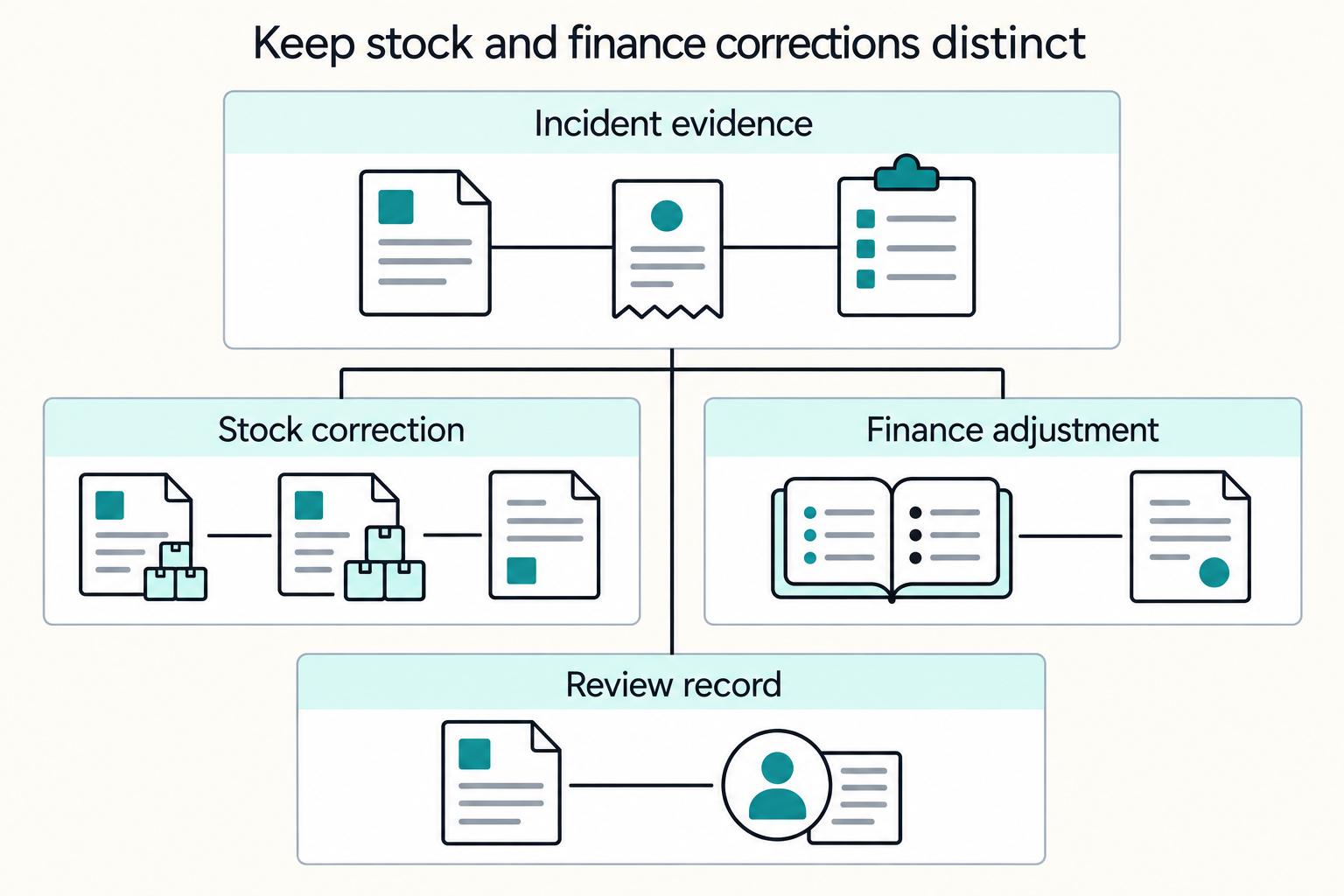
Do not let manual finance edits silently repair inventory. If stock is wrong, write an explicit inventory correction event. If finance needs a ledger or payout adjustment, keep that in the finance path and link both actions to the same incident.
This separation preserves auditability and makes reconciliation drill-downs usable when you need to prove what changed and why.
Limit force-corrections to defined evidence and authority#
Allow force-correct stock only under defined approval rules, with authority separated from custody and accounting responsibilities. Require an evidence pack: provider event ID, internal order or SKU ID, timestamped stock before and after, reconciliation output or payout reconciliation extract, and a written override reason.
If evidence is incomplete, stop at investigation rather than forcing a correction.
Reconcile daily and weekly so finance trusts the numbers#
Finance trust comes from a repeatable match between stock movements, payment events, and ERP postings. That means a scheduled Reconciliation job, a weekly exception review, and one shared pass/fail view for payments ops and finance.
Run a daily Reconciliation job across the three records of truth#
Reconcile inventory events, payment events, and Enterprise Resource Planning (ERP) postings daily, preferably in background or off-hours processing. Compare at event level first, then roll up to accounting outputs.
Match individual provider balance transactions and payout IDs, then reconcile bank deposits separately. Stripe payout reconciliation groups automatic payouts by estimated arrival date; report availability can lag the payout. Keep report timezone, event time, funds-availability date, payout date and actual bank receipt distinct. Use matched, unmatched and deferred buckets with an expected resolution date.
Review weekly exceptions, but treat disputes and late money as deadline-sensitive#
Review unresolved exceptions weekly, but route disputes and blocked fulfillment when they arise. Stripe notes many dispute response windows are 7–21 days; use the actual case deadline and escalation buffer rather than waiting for the next weekly meeting.
Bring the same evidence each time: provider event or dispute ID, last Reconciliation job result, and ERP or payout posting status. Keep manual clearing in scope for discrepancies that cannot be auto-resolved.
Track KPIs that tell operators what to do next#
Track action KPIs, not vanity metrics:
- mismatch aging
- replay backlog
- repeated event delivery failures
- manual clearing adjustments
Attach an operator action to each KPI. If replay backlog grows, account for retry and retrieval limits. For Stripe events, that means up to three days automatic resend and a last 30 days event retrieval horizon. If manual adjustments rise, review correction evidence quality rather than treating adjustments as normal noise.
Publish one shared pass/fail report for ops and finance#
Publish a shared daily and weekly report with checkpoint-level pass/fail status. Raw counts alone do not create trust.
| Checkpoint | Pass condition | Fail condition |
|---|---|---|
| Inventory to payment match | No open exceptions after review window, or only approved deferred items | Unexplained open mismatches |
| Payment to payout or settlement match | Provider report aligns to expected bank or funds-availability batch composition | Missing items or unexplained deductions |
| Payment and inventory to ERP posting | ERP posting exists or is explicitly deferred | Missing or duplicate ERP posting |
Use clear status language: open exception or fully reconciled. Assign an owner and next action for every failed checkpoint so the report drives control, not just history.
Set SLAs and SLOs that operators can act on#
Once reconciliation is stable, set explicit operating targets: one sync measurement, one target, and incident thresholds tied to named responders and a runbook.
Measure the sync path with one SLI and one SLO#
Define one SLI as elapsed time from Payment trigger receipt to stock update visibility in the channel with the highest oversell risk. The SLI is the measurement. The Service Level Objective (SLO) is the target for acceptable performance. Start from recent event-timestamp baselines, then set the target to match your customer-visible promise.
Verification point: confirm every team starts the timer from the same event. If one team starts at event receipt and another at internal queue ingest, the SLO can look healthy while storefront stock is stale.
Define an incident SLA for broken webhook delivery and backlog#
Set an internal incident-response commitment for delivery failures, including response and mitigation timers and a manual recovery path. Reserve “SLA” for an agreed service commitment; an internal response target is not automatically a customer contract. Stripe’s delivery attempts and retrieval windows are recovery inputs, not a promise of successful repair.
Queue age is useful, but SQS metric semantics matter: poison-message handling and dead-letter moves can change what oldest-message age represents. For FIFO backlogs, first inspect failed head messages, per-group serialization and downstream limits. Add capacity only where it helps; do not split one order’s updates into new groups solely to bypass ordering.
Attach every threshold to an owner and action#
Every threshold should map to an escalation owner, a runbook, and first-response evidence. Avoid alert-only metrics that create noise with no operator action. At minimum, require responders to capture failed event IDs, queue age, last successful delivery time, and replay status.
Revalidate targets against actual load#
Review targets on a regular operating cadence. Recheck whether current Multi-channel integration count, message volume, and burst patterns still fit the SLO. If channel growth increases alert volume faster than customer impact, tighten the SLI definition before loosening the target.
Assign ownership across product, engineering, payments ops, and finance#
After you set alert thresholds, assign one accountable owner per decision lane: policy, reliability, live incident handling, and reconciliation acceptance. If two teams can still say, "we thought the other group owned that," the payment-to-stock flow is still fragile. If your org uses different team names, map these lanes to equivalent roles.
A lightweight RACI chart can be enough. Keep one written matrix covering the Payment trigger, the inventory action, the escalation owner, and the evidence each team must retain.
Put product in charge of stock policy#
Product should own customer-visible stock policy in the Marketplace platform: reserve versus deduct, release timing, and what users see while payment state is provisional. That keeps value decisions with the product role.
Make it explicit in your trigger matrix. For each event, authorization, capture, funds availability, money-back, chargeback, item receipt, document what happens to stock, when it reverses, and what the user sees in between. Verification point: engineering and support should give the same answer for cases like expired authorizations.
Policy drift is a failure mode. If engineering sets release timing for API convenience or finance later pushes a funds-availability-based treatment, storefront behavior, ops procedures, and accounting expectations split.
Make engineering own the event path end to end#
Engineering should own reliability for the API, Webhook, and Event-driven sync pattern, including retries, ordering controls, and Idempotency key behavior. The team that builds the service should also run and maintain it.
Engineering owns signature validation, durable receipt, atomic stock effects and replay. Stripe automatic live-mode retries and the Events API’s recent-history window help recovery, but the platform still needs retained operation records and reconciliation when provider event history is unavailable.
Verification point: replay the same event batch twice and confirm there are no duplicate stock movements. If duplicates appear, engineering still owns duplicate-safe processing before production replay resumes.
Assign the live queue and incident seat#
Payments ops is often the practical owner for monitoring, queue triage, and first response on the Exception queue. What matters is explicit incident ownership.
Define what the incident owner can do without waiting for engineering. Typically: confirm raw event receipt, verify whether an event was already processed, triage backlog, and start approved replay steps. Because duplicate processing is a known risk, duplicate-aware replay checks should be in the checklist.
Red flag: the incident owner can see a stuck queue but cannot replay, cannot access failed event IDs, and has no escalation path before retry windows close.
Let finance define reconciliation acceptance and evidence retention#
Finance should own acceptance criteria for the Reconciliation job, internal sign-off rules, and evidence-retention requirements. Provider docs describe reconciliation processes, but your organization still needs one internal owner who can decide when reconciliation is acceptable to close.
Set acceptance rules in writing for your operating cadence: what counts as pass or fail, acceptable timing gaps, how unresolved exceptions are labeled, and which manual adjustments need attached evidence. A usable evidence pack includes reconciliation reports, exception lists, disposition notes, and final conclusions.
Retention periods vary by context. Finance should publish the exact rule your business follows, and engineering and ops should store logs and reports to match it.
Roll out in phases with verification checkpoints#
Do not roll out to every channel at once. Treat go-live as a canary decision: release to a representative slice, run an explicit verification checkpoint, and expand only if that checkpoint passes.
Start with a shadowed pilot#
Start with a representative selling path while your current Inventory tracking system remains the decision reference. Phase 1 is about proving that payment triggers produce the intended inventory state changes, not about volume.
Use event-level verification, not only dashboards. For each payment or reversal event in scope, confirm the expected stock movement or a documented no-op tied to the same event ID. If finance requires payout accuracy checks, reconcile by payout settlement batch so grouped transactions are reviewed as they settle.
Expand by ring and verify retry safety#
Expand only after the pilot checkpoint passes. Add the next ring in Multi-channel integration and re-verify before expanding again. If your tooling supports staged percentages, a progression like 25% to 50% to 100% helps limit blast radius.
Replay a representative batch and confirm no duplicate stock deduction. Exercise both automatic redelivery and manual recovery, with queue age, failed event IDs and durable processing state visible. Distinguish Stripe’s up-to-three-day automatic attempts from its longer manual resend / recent-event retrieval windows; do not describe those as a 30-day automatic retry queue.
Stress refunds, disputes, and returns#
Before broad rollout, harden reversal paths under load. Simulate Refund and dispute spikes, and validate related returns handling along with inventory behavior and incident recovery.
Verify retry and exception-queue handling within your defined recovery window, replay actions stay duplicate-safe, and stock is not treated as sellable again before item handling is complete. Keep evidence from the test run: event IDs, queue snapshots, exception dispositions, reconciliation output, and approved manual adjustments.
Promote only when verification gates hold#
Full rollout should be a promotion decision, not a date on the calendar. Require clean reconciliation results under your finance acceptance rules, and include any sync-latency checks your team has defined for channels already in scope.
If your team uses an internal gate such as two clean cycles, keep it as policy, not as an industry rule. The operating principle is simple: each phase has a verification checkpoint, and a failed checkpoint pauses expansion.
Before expanding, review a scarce-item concurrency trace and a shipped-item capture failure. Both should lead to an explicit operator outcome without increasing sellable stock incorrectly.
Make the sync reliable before you scale volume#
Reliable scale comes from control design, not from "real-time" alone. Treat volume as blocked until your trigger matrix, retry handling, reconciliation checks, and owner-led recovery paths are proven in tests.
Use this as a go/no-go launch check:
- Trigger matrix approved for
Payment authorization,Payment capture,Settlement,Refund,Chargeback, andReturn(where applicable) -
APIwrites enforceIdempotency key, and event-delivery flows enforce replay safety - For this launch,
Reconciliation jobruns daily with documented pass/fail criteria -
Service Level Objective (SLO)andService Level Agreement (SLA)thresholds mapped to named owners -
Exception queuetriage process tested with finance and payments ops in the loop
Approve the trigger matrix before more traffic hits it#
Your trigger matrix is the operating control point. For each event, define the inventory action, ledger impact, whether the state is provisional or final, and the owner who signs off.
Keep capture, provider funds availability, payout and bank receipt separate. Their timing and later reversal risk differ. Use the money checkpoints for reconciliation while the inventory ledger records units on hand, reserved, committed, shipped or returned.
For each business operation, verify the expected stock effect or a documented no-op/exception; multiple deliveries must not multiply that effect.
Make retries and duplicate delivery boring#
For API writes that can change stock, require an Idempotency key so retries do not repeat the same operation. For event intake, assume duplicate delivery and out-of-order, stale, or partial payloads.
Persist verified receipt first, then atomically commit the operation record and stock update. Mark processing complete only after that commit. Exercise crashes before and after commit, concurrent workers and replay: none should lose a required move or create a second one.
Run reconciliation daily and define pass/fail clearly#
For this launch checklist, run a daily Reconciliation job with explicit pass/fail rules. Reconciliation is record matching, so compare payment events, inventory events, and downstream postings, then show matched items, mismatches, and manual corrections.
Keep the evidence pack complete: reconciliation report, mismatch export, exception IDs, and reason for each adjustment.
Attach SLOs and SLAs to named owners#
An SLO is an internal reliability target. An SLA is a provider-customer service commitment.
Set thresholds for your operating model, then assign ownership. Each threshold needs one response owner, one escalation path, and one defined action on breach.
Test exception handling with finance and payments ops#
Route failed events into an Exception queue, or a DLQ when you use message queues, then test failure scenarios on purpose: missed event delivery, duplicate Payment capture, delayed Settlement, Refund after fulfillment, open Chargeback, and late Return (where applicable).
Pass criteria is cross-functional agreement on one correction path using shared evidence: raw event, queue record, event ID, Idempotency key, latest reconciliation result, and correction reason.
If you want a second set of eyes on payout, ledger, and reconciliation ownership before rollout, talk with Gruv.
Frequently Asked Questions
What is a payment trigger in marketplace inventory sync?
A payment trigger is a verified payment-state event mapped to an internal business operation, often received by webhook. Deduplicate delivery by provider account/event ID and protect the stock effect with a stable operation key and an atomic state transition. Refund and dispute events usually update money or review state, not sellable inventory.
When should we reserve stock versus decrement stock?
Acquire an atomic reservation before confirming scarce stock, then convert that allocation to committed stock under your capture/fulfillment policy without deducting availability twice. Release only eligible unfulfilled units after coordinated terminal cancellation or expiry. Use the actual authorization expiry; seven days is not universal. A post-shipment capture failure needs investigation, not automatic restocking.
How do we prevent overselling across multi-channel integrations?
Use one authoritative stock allocation service with atomic quantity checks per SKU and location, then mirror availability to other channels. Two buyers competing for the last unit must produce one reservation and one unavailable result. Shopify POS also needs inventory tracking enabled and inventory assigned by location; these settings complement the platform’s allocation and concurrency controls.
What should happen when payment and inventory states disagree?
Isolate the mismatch, check verified event receipt and durable processing state, then compare the order-line allocation, physical fulfillment and money records. Replay committed operations as no-ops. Correct stock and finance separately, linking both to the incident and retaining approval evidence.
What is the minimum event set we need before launch?
Use the smallest internal contract that covers your payment methods, reservation, expiry/cancellation, capture/failure, refund states, disputes and physical returns. Partial captures and returns need line-level quantities. A stock-moving operation must have one durable effect; reporting-only events need a documented no-op and unresolved cases an exception.
Which metrics prove the sync is healthy in production?
Track end-to-end event delay as well as receipt-to-stock latency, rejected oversell attempts, duplicate effects, mismatch aging and recovery backlog. If Amazon is a channel, also monitor its current Account Health targets: order defect rate under 1%, late shipment rate under 4% and cancellation rate under 2.5%, in their applicable market and fulfillment scope. Check the displayed measurement windows instead of assuming they are identical everywhere.
Researched and edited by the Gruv editorial team. Gruv builds cross-border billing, payouts, and finance-operations software for global businesses.
Sources
Includes 6 external sources outside the trusted-domain allowlist.
- docs.stripe.com/payments/place-a-hold-on-a-payment-methodtrusted
- docs.stripe.com/webhookstrusted
- docs.adyen.com/online-payments/captureexternal
- docs.adyen.com/development-resources/webhooks/webhook-typesexternal
- docs.aws.amazon.com/AWSSimpleQueueService/latest/SQSDeveloperGui...external
- docs.aws.amazon.com/AWSSimpleQueueService/latest/SQSDeveloperGui...external
- docs.cloud.google.com/pubsub/docs/orderingexternal
- go.amazonsellerservices.com/account-healthexternal
Educational content only. Not legal, tax, or financial advice.
Related Posts

The Freelance Payment Penalty: A Modeled Audit of Platform Fees, FX Spreads, and Payout Delays
The money rarely disappears through a single, easy-to-spot fee. The real loss is stacked. A marketplace takes its commission, a processor adds a charge for international cards, a bank or payment company converts the currency at a spread, a platform holds the funds before release, and a wire sheds a little to intermediaries on the way in. Each layer looks defensible on its own, but the worker feels the combined result as a smaller deposit and a later payday.

How to Respond to a Subpoena for Business Records
Move fast, but do not produce records on instinct. If you need to **respond to a subpoena for business records**, your immediate job is to control deadlines, preserve records, and make any later production defensible.

A US Expat's Guide to Investing in UCITS ETFs to Avoid PFIC Issues
The real problem is a two-system conflict. U.S. tax treatment can punish the wrong fund choice, while local product-access constraints can block the funds you want to buy in the first place. For **us expat ucits etfs**, the practical question is not "Which product is best?" It is "What can I access, report, and keep doing every year without guessing?" Use this four-part filter before any trade: