
Quick Answer
Start by aligning charge timing, transfer timing, and close timing under one documented settlement cycle, then release seller funds only after compliance checks pass and money is available. For recurring billing marketplace buyers sellers operations, the practical order is charge confirmation, allocation, transfer, payout batch, and reconciliation. Keep commission separate in the ledger and store both internal and provider references on each posting. If any gate fails, hold the payout and route to the predefined recovery path.
Map the billing and payout cycle first#
Recurring billing in a marketplace works best when buyer charges, seller payouts, and finance close follow aligned cycle logic. When checkout timing, payout timing, and finance close are designed separately, you can end up with charges that succeed, payouts that stall, and records that only make sense after manual cleanup.
The outcome that matters is narrower and more useful than saying "subscriptions are live." You need to charge buyers on a recurring basis, route funds to the right sellers, keep commission visible as its own movement, and close the same settlement cycle with entries you can trace back to external payment records. That is the real operating problem, and it is mostly a coordination problem.
The practical starting point is to treat the money flow as one connected sequence. In marketplace payments, a common pattern is separate charges and transfers. The charge is created on the platform account, and transfers to connected accounts happen downstream. This charge type is designed to help split payments between multiple parties.
That gives you flexibility, but it also creates an obvious failure mode. If the charge event, transfer event, and close cutoff do not share the same cycle logic, your team can end up deciding exceptions by hand.
If you take one recommendation from this guide, make it this: do not automate payout release until your team can name the exact event that makes seller funds payable and the exact record set that proves the cycle is closed. Use a simple checkpoint. At cycle close, you should be able to match your internal book of record to external records across payments, payouts, fees, and balance changes without guessing which system is the source of truth.
Before you start#
Before you go deeper, assume these boundaries:
- Recurring payments are already part of your charging model. The guide is about coordinating repeated buyer charges with marketplace payout timing, not about introducing subscriptions from scratch.
- Seller payout is compliance gated. Connected account verification requirements can change based on location, business type, and requested capabilities, so payout readiness is not uniform across sellers.
- Coverage varies by market and program. The examples assume split payments, commission, and seller payout controls, but they are not meant to imply one universal setup across jurisdictions.
Same-cycle design is not a promise of lower risk or faster money movement in every case. It is a way to make tradeoffs explicit. If buyer funds are charged on one cadence and seller funds are released on another, you can still operate well, but only if your book of record, payout rules, and close pack all agree on what happened and when.
The rest of the guide builds that sequence in the order operators usually need it.
Set the operating boundary before you automate anything#
Write the cycle boundary down before you automate: your team should be able to say exactly when a buyer charge is in-cycle, when seller funds become payable, and what record set closes the cycle.
| Control | What to lock | Why it matters |
|---|---|---|
| Define same cycle | Use one definition across the same calendar window, the same settlement cycle close, and the same close-pack cutoff | If a charge captures one minute before cutoff, it should appear in the current posting export, the current payout batch logic, and the current close pack, or in none of them |
| Lock payout prerequisites | Confirm onboarding completion, compliance/KYC status, payout rail availability, and marketplace payment gateway payout behavior up front | Payout availability varies by country and industry, instant payout eligibility varies by country, and some providers typically schedule the first payout in 7-14 days after the first live payment |
| Choose one accounting authority | Use the Ledger as accounting truth | Balance and digital wallet views are derived from underlying ledger entries, and each payout should tie to the transaction batch it settles and to matching entries |
- Define "same cycle" in three places.
Use one definition across the same calendar window, the same settlement cycle close, and the same close-pack cutoff. Run a simple test: if a charge captures one minute before cutoff, does it appear in the current posting export, the current payout batch logic, and the current close pack, or in none of them? If those answers differ, your cycle definition is not operational yet.
- Lock payout prerequisites before launch.
A successful charge does not mean payout is ready. Confirm onboarding completion, compliance/KYC status, payout rail availability, and your marketplace payment gateway payout behavior up front. Validate eligibility assumptions early too: payout availability varies by country and industry, instant payout eligibility varies by country, and some providers typically schedule the first payout in 7-14 days after the first live payment. If your payout interval or delay configuration can move funds outside the cycle, document that before go-live.
- Choose one accounting authority and keep it consistent.
Use the Ledger as accounting truth. Balance and digital wallet views are useful operational views, but they are derived from underlying ledger entries. At close, require settlement-batch reconciliation: each payout should tie to the transaction batch it settles and to matching entries. If close depends on wallet views instead of ledger entries plus payout-batch evidence, timing disputes are predictable.
Pick the charge and payout timing model that matches your risk profile#
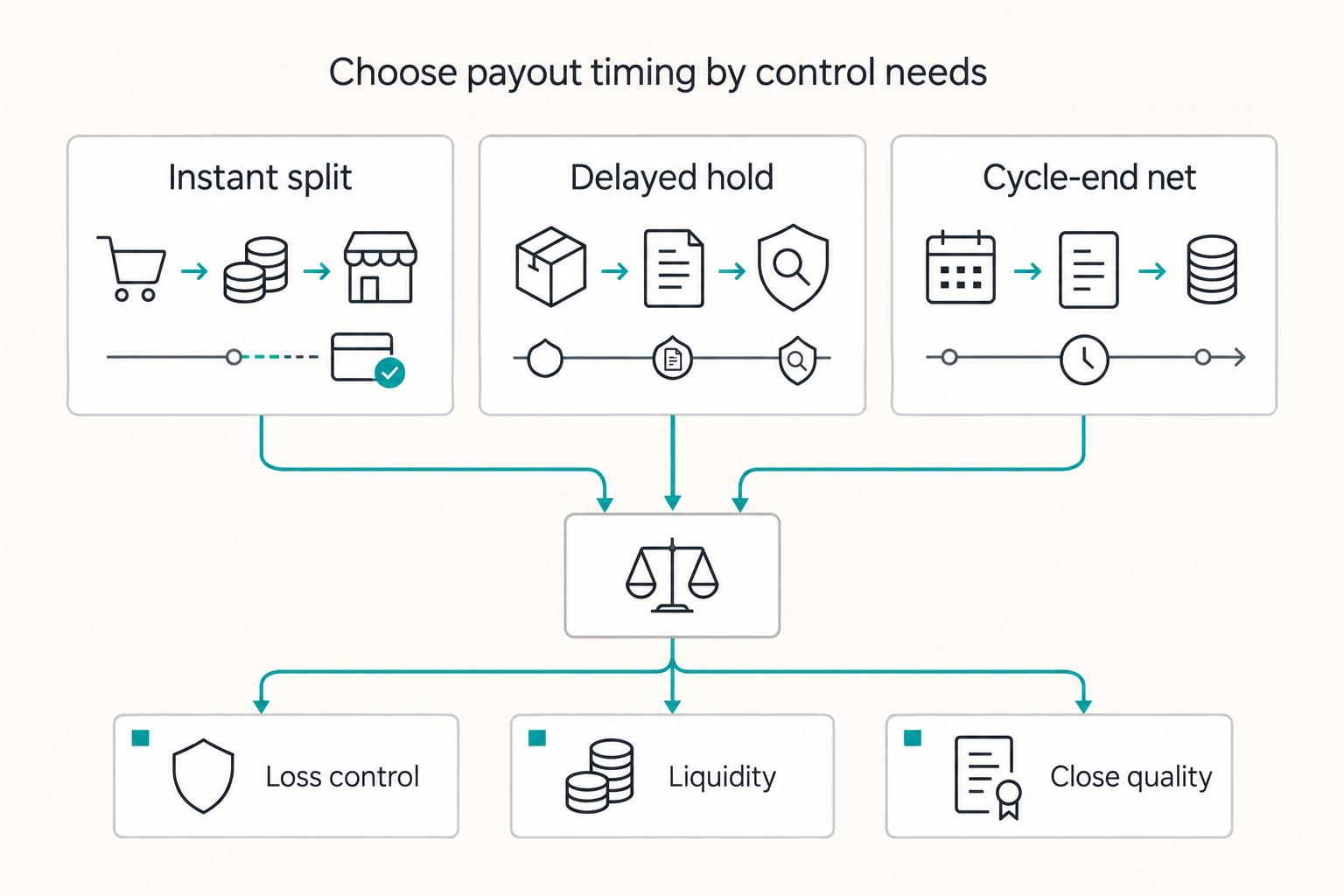
Choose payout speed by risk first: if dispute, fraud, or fulfillment uncertainty is high, use hold logic; if seller liquidity is the priority and loss rates are low, move faster only after the buyer charge is truly payout-ready.
Step 1 Compare the three timing models against operating friction#
These models are not interchangeable. They change where risk sits, how many fund movements you run, and how much reconciliation work your team carries.
| Model | Best fit | Buyer checkout realities | Fund transfers and reconciliation effort | Regulation exposure by jurisdiction |
|---|---|---|---|---|
| Instant split payments | Low-loss environment, sellers need faster access to funds | Supports multi-seller carts: the platform can charge once and transfer to multiple connected accounts. Weak fit if payout release happens before retries finish or async confirmation completes. | More transfer activity because platform charge and seller transfers are separate. Keep each transfer tied to the originating charge and ledger entries. | More design sensitivity. Unsupported borders or balances can fail transfers, so market-by-market setup review is required. |
| Delayed split with escrow-like hold | Higher dispute, fraud, or fulfillment uncertainty | Strong fit when confirmation can arrive later or when you need vetting time before release. | More state handling: held funds, release decisions, and exceptions. | Useful for added control, but do not treat hold logic as legally equivalent to regulated escrow in every jurisdiction. |
| Cycle-end net payout after commission | Finance-first model, predictable close, sellers can wait | Handles retries and async confirmation cleanly because payout runs at cycle close. | Lower payout frequency and cleaner close evidence. Scheduled sweeps can run daily, weekly, or monthly. | Still jurisdiction-dependent, but standardized timing is usually easier to review operationally. |
In separate charges and transfers, a successful buyer charge does not automatically mean a successful seller transfer. Use one two-seller test order as a checkpoint: one platform charge, two seller allocations, and commission posting should all reconcile to the same cycle records.
Step 2 Pressure-test against retries and delayed confirmation#
Failures usually happen between systems, not on the happy path. Keep seller payout release tied to final successful collection, not invoice creation or a failed attempt. One documented retry pattern is 8 tries within 2 weeks, which can push timing outside the cycle if release logic is not gated.
Treat async confirmation and authorize/capture the same way: do not release seller payout from authorization alone. In one documented auth/capture flow, authorization can remain valid for 29 days, but that is still a hold state, not a completed payout event.
Also test transfer errors after a successful buyer charge. Unsupported borders or balances can leave buyer-side status complete while seller movement fails. Your review pack should include charge status, transfer attempts, payout schedule config, and held/failed exception lists.
Step 3 Approve a one-meeting recommendation matrix#
- Choose instant split payments when seller liquidity is critical, supported markets are already validated, and release is gated on final buyer charge success.
- Choose delayed split with hold logic when dispute, fraud, or fulfillment risk is still material and operations need vetting time.
- Choose cycle-end net payout after commission when finance needs the cleanest close and sellers can operate on scheduled daily, weekly, or monthly release.
If the team is split, use this tie-breaker order: loss control first, seller liquidity second, payout speed third.
Map ledger postings and commission logic before the first recurring run#
Lock your internal posting sequence before go-live so recurring renewals, refunds, and exceptions reconcile cleanly.
Step 1 Set one internal posting order and gate seller value on capture#
You do not need a provider-universal order, but you do need one order your team uses every time.
| Event | Minimum book effect | Verification checkpoint |
|---|---|---|
| Buyer charge authorized | Record authorization state only (no seller payable yet) | Confirm it is linked to your internal transaction ID and still uncaptured where auth/capture applies |
| Buyer charge captured | Move funds into captured buyer funds | In PaymentIntent-style flows, capture when status is requires_capture |
| Commission carved out | Post Commission as its own ledger movement | Confirm Commission is visible separately from seller funds |
| Seller payable created | Create seller liability for the net due | Verify seller payable matches captured amount minus Commission and approved adjustments |
| Payout settled | Clear seller payable against payout settlement | Match payout settlement back to the same internal transaction |
If funds are only authorized, do not treat them as payout-ready seller value. Uncaptured PaymentIntents can be canceled after 7 days by default, so posting seller payable from authorization can create false liabilities.
Step 2 Keep Commission explicit, even when transfers are netted#
Record Commission as a distinct posting every cycle. Even if your gateway applies application-fee mechanics or reduces seller transfer amounts in separate-charge flows, explicit Commission entries keep reconciliation, reversals, and audits clear.
Step 3 Define refund and reversal handling before exceptions happen#
Set reversal rules before the first live exception. If a refund occurs before payout, adjust seller payable and Commission per your policy; if payout already settled, do not assume automatic clawback.
For transfer reversals, track the balance movement explicitly: reversals add to platform balance and subtract from the destination account balance. Your reconciliation view should clearly separate resolved balance changes from still-open exceptions.
Step 4 Require dual references on every posting#
Attach both keys to every posting: your internal transaction ID and the provider reference. Provider and merchant identifiers are strong tracking keys for reconciliation, but they do not replace internal control mapping.
Run one full renewal test before go-live. Confirm each lifecycle event is traceable in both directions between your books and provider lifecycle reporting (for example, payment accounting lifecycle reporting) without manual inference.
This pairs well with our guide on The Best Tools for Managing Subscription Billing.
Build the recurring execution sequence for each settlement cycle#
After you map posting intent, sequencing becomes the control point for every cycle: do not let payout instructions get ahead of charge state, and do not let transfers get ahead of available funds.
Step 1 Check billability and payout eligibility before you create any charge#
Start each cycle with one pre-bill pass across subscription status, payment method status, and seller eligibility. If any of these are stale, you risk charges you cannot settle cleanly or payouts you cannot justify.
| Check | What to verify | If not ready |
|---|---|---|
| Subscription status | Treat unresolved status as a hard stop; in one documented path a subscription stays incomplete while the invoice remains open | Keep first-cycle invoices out of the payout path until payment is confirmed |
| Payment method status | Verify the method is still attached to the buyer, still valid for that charge type, and not already flagged for replacement | Keep card and bank-rail logic separate because bank confirmation may arrive later through webhook events |
| Seller eligibility | Check seller eligibility in the same pass and record the ineligibility reason code | Do not schedule payout in that cycle; buyer funds may still be collected under a hold model if policy allows |
That hard stop matters most on first-cycle invoices. In one documented path, a subscription stays incomplete while the invoice remains open, and the customer has about 23 hours to make the first successful payment. If your run includes first-cycle invoices, keep them out of the payout path until payment is confirmed.
For payment methods, keep card and bank-rail logic separate even under one billing schedule. A credit card attempt can look synchronous, while bank confirmation may arrive later through webhook events. Before the run, verify the method is still attached to the buyer, still valid for that charge type, and not already flagged for replacement by your dunning or account-update flow.
Check seller eligibility in the same pass. If a seller is not payout-ready, you may still collect buyer funds under a hold model if policy allows, but do not schedule payout in that cycle. Record the ineligibility reason code for close and reconciliation.
Step 2 Charge buyers with idempotency keys and persist every state change before payout logic#
Run buyer charges with an idempotency key on each write request so retries do not duplicate the same operation. Then persist each state transition and process webhook events before any payout release logic.
This matters most when confirmation is asynchronous. If bank rails confirm later, or a charge state changes after the first API response, webhook events are the control signal that payment actually progressed. A common failure pattern is treating an early success-looking response as final and paying before bank confirmation or invoice resolution.
Your checkpoint is not "charge returned 200." It is: internal transaction ID, provider reference, and latest charge status are saved together, and the charge remains payout-blocking until your required final state is present.
Step 3 Allocate split amounts or holds, then transfer only payout-eligible funds#
After charge confirmation, apply your allocation model: immediate split, hold allocation, or delayed transfer. In a separate charges and transfers design, the platform charge is decoupled from the transfer to the connected account. If you need a holding state first, funds segregation supports allocating designated funds on the platform account before transfer.
Do not initiate transfers from pending funds. The transfer gate is available balance. Settled funds move from pending to available, and one documented example shows a 2-day rolling basis for that movement. If the transfer amount exceeds available balance, the transfer can fail. When funds are not available, keep the seller amount payable and retry in the next eligible window.
For each transfer attempt, keep an evidence pack with charge reference, seller payable amount, transfer amount, and platform balance state at instruction time.
Step 4 Release seller payouts in batches, then close the cycle with exports#
Release seller payouts in batches with a defined cutoff per cycle. Some providers support explicit cadence settings such as daily, and some enforce business-day payout cutoffs. Set one internal cutoff aligned to provider behavior and publish it to finance and ops.
After batch submission, post final confirmations only from settled payout events, not batch creation. Then export cycle artifacts: payout batch file, itemized payout transaction export, exception log, and a payout reconciliation report when available. That report is designed to reconcile transactions included in each payout batch.
Use one operating sequence and enforce it every cycle: charge, confirm, allocate, transfer, pay out, close.
Related: Subscription Revenue for Platforms: How to Build Recurring Billing on Top of Your Marketplace.
Apply payout release gates that prevent avoidable losses#
Do not release seller payouts from charge creation alone. Default to hold, then release only after compliance, fund finality, and balance checks pass.
| Gate | Release rule | Evidence to store |
|---|---|---|
| Seller account readiness | Keep payout on hold when payouts_enabled is false, or the account has open onboarding, verification, or risk requirements | Account ID, payouts_enabled, open requirement codes, and any current_deadline |
| Funds finality | Use balance state as the release gate: funds move from pending to available after settlement, and only available funds should be used for payout release | Charge reference, latest invoice or payment state, seller payable amount, and relevant balance bucket |
| Gate decision audit trail | Every release or hold decision should be auditable without rebuilding the story from raw logs | Decision, reason code, timestamp, actor or service, seller account ID, provider reference, balance state, and which gate passed or failed |
Step 1 Block payout when the seller account is not fully payout-ready#
Treat seller compliance as a hard gate. Connected accounts must meet KYC requirements before payouts can be sent, and failed verification can keep payouts disabled.
Check payout capability directly on the account. If payouts_enabled is false, or the account has open onboarding, verification, or risk requirements, keep payout on hold even when a buyer charge succeeded. Store the account ID, payouts_enabled, open requirement codes, and any current_deadline tied to missing information.
Do not rely on manual follow-up for missing verification data, because payout disablement can be deadline-driven. Keep provider- or regulation-driven holds distinct from generic onboarding failures. Risk, tax, compliance, and dispute states are all valid hold reasons until resolved.
Step 2 Release only from final funds, not from pending or reversible money#
If buyer funds are pending or reversible, keep payout in hold state. Use balance state as the release gate: funds move from pending to available after settlement, and only available funds should be used for payout release.
A successful-looking attempt is not enough on its own. If payment fails or an invoice is not fully paid, the invoice remains open, so keep payout blocked. If a dispute starts, treat those funds as held until the dispute is resolved.
Apply your own policy checks for negative balance conditions before release. A practical checkpoint is to require the charge reference, latest invoice or payment state, seller payable amount, and relevant balance bucket. On a documented T+2 schedule, incoming card-payment funds may become available two business days after receipt, so same-cycle payout may still require a hold.
Step 3 Store each gate decision so finance can defend it later#
Every release or hold decision should be auditable without rebuilding the story from raw logs. Record the decision, reason code, timestamp, actor or service, seller account ID, provider reference, balance state, and which gate passed or failed.
Use account-level exports where available to support that trail. Some platforms let you filter by requirements, volume, and risk signals, then export accounts with open requirements and remediation links. Archive that with payout batch artifacts so reconciliation can explain each outcome clearly.
You might also find this useful: eCommerce Reseller Payouts: How Marketplace Platforms Pay Third-Party Sellers Compliantly.
Prepare failure recovery paths before they happen#
Make failures boring by deciding the recovery path before the event occurs. For each failure type, pre-assign one action: retry, requeue, manual review, or rollback posting with a linked ledger correction.
Step 1 Name the failure and map it to one recovery path#
A failed recurring charge should usually start in retry, not immediate manual handling. If you use Stripe Billing, Smart Retries can retry failed subscription and invoice payments automatically, with a documented recommended default of 8 tries within 2 weeks. If your stack supports orchestration, you can also route a recoverable failure to a different processor.
Duplicate webhook delivery must not create a second payable or payout attempt. Stripe notes webhook endpoints can receive the same event more than once, so log processed event IDs and suppress repeats before posting or payout actions. Store at least event ID, event type, internal transaction ID, and processing outcome.
For partial split-payment failures, pause payout initiation until posted and missing legs are reconciled. Then either requeue the missing leg or post a rollback with a linked correction if the payable was already recognized. Keep failed refunds and reversals as separate correction categories.
Returned payouts should start in manual review, then move to requeue after correction. Stripe states returned payouts fail to reach the destination and funds are returned in a separate transaction, typically within 2-3 business days. Review the return reason first; do not assume one cause.
Step 2 Require evidence before retry or correction#
Do not run blind retries. Require a minimum evidence pack: provider reference, internal transaction ID, original posting IDs, seller account ID, payout or payment attempt ID, and current balance state.
If you post a rollback, create a one-to-one link between the original posting and the correction posting. If a charge is marked successful but no payout instruction exists and no hold reason is recorded, open an exception with an owner.
Step 3 Put stuck states on a clock and assign ownership#
Use your internal threshold for the gap between charge success and payout initiation. If charge success is recorded, payout gates are passed, and payout still is not initiated by that threshold, escalate to the assigned operations or finance owner. If funds are pending or a hold reason exists, keep hold status instead of incident routing.
| Trigger | Owner | First action | Evidence required | Closure checkpoint |
|---|---|---|---|---|
| Recurring charge failed | Payments ops | Retry through Smart Retries or approved alternate processor path | Invoice/payment attempt ID, decline outcome, retry history | Paid, failed, or moved to manual collection |
| Duplicate webhook/event delivery | Engineering or payments platform team | Check processed event ID log and suppress duplicate side effects | Event ID, event type, internal transaction ID, prior processing result | No duplicate ledger entries or payout records |
| Partial split payment state | Finance ops | Pause payout initiation and reconcile posted vs missing legs | Charge reference, split/transfer references, posting records | All legs posted correctly, or correction linked in ledger |
| Returned payout | Payouts ops | Read return reason, verify destination details, then requeue if corrected | Payout ID, return reason, returned-funds transaction, seller account data | Funds returned, destination corrected, and replacement payout settled or seller remains on hold |
For a step-by-step walkthrough, see Subscription Billing Platforms for Plans, Add-Ons, Coupons, and Dunning.
Track cycle health with operator checkpoints not vanity metrics#
Your cycle is healthy only when charges, payouts, and exceptions reconcile at close, not when top-line numbers look good.
Step 1 Run close checks against what should have happened#
Run three checks every cycle: expected charges vs successful charges, expected payouts vs settled payouts, and total open exceptions. If any of these are off, the cycle is not closed.
Use payout-batch reconciliation as the control point instead of dashboard totals. Stripe's Payout reconciliation report is designed to match bank-received payouts to the payment batches they settle, and you can review payout composition in the Dashboard, downloadable reports, or via API. If you use Stripe, prefer automatic payouts so transaction-to-payout association stays intact for reconciliation. If you use Adyen, review both the Settlement details report and the Aggregate settlement details report, and store the Batch Number (Integer) in your internal cycle record.
Step 2 Require the same evidence pack every close#
Close faster and with fewer misses by requiring a standard evidence pack each time. At minimum, include a ledger export, payout batch report, exception log, and reconciliation summary.
Sign-off should require traceability from each settled payout back to underlying transactions and ledger postings. Also review failed payout activity, not just successful settlements. Stripe reconciliation reporting includes a Failed payouts section, so check it before marking the cycle complete.
Step 3 Watch drift and use it to change policy#
Treat drift as an operating signal: rising manual interventions, repeated transfer failures, or a widening gap between charge capture and payout settlement. When manual handling rises, pause volume growth until you fix root causes. When transfer failures repeat, tighten payout-release gates or seller-data checks. When settlement lag widens while charges still succeed, revisit hold rules or commission timing before the next recurring cycle.
Related reading: Retainer Subscription Billing for Talent Platforms That Protects ARR Margin.
Final checklist to launch and run this model#
Use this as a go-live gate, not a courtesy checklist: if any item is vague, you will feel it later in payout holds, refund recovery, or close.
- Same-cycle definition is documented with separate settlement cutoff, payout cutoff, and reconciliation/close cutoff. Define "same cycle" from funds availability, not checkout time alone, and note if non-standard terms (for example, Net 45 or Net 60) shift payout timing.
- Timing model is selected and approved with explicit tradeoffs for risk, liquidity, and ops load. Record who approved it and the exact event that moves funds from hold to payout-eligible.
- Ledger posting map is finalized for charge, commission, split/transfer, payout, refund, dispute, adjustment, and reversal events. Keep commission explicit, and if you allow transfer reversals, define whether related application fees are refunded.
- Compliance and payout release gates are implemented with auditable pass/fail reasons. Include onboarding/KYC completion plus operational checks (for example unresolved charge states or negative balances), and store reason codes for each hold/release decision.
- Failure matrix is live with owners, recovery actions, and escalation triggers. Cover failed charges, partial split booking, payout rail rejection, and duplicate/undelivered webhooks; map payment failure states (
requires_payment_method,canceled) to retry, requeue, manual review, or correction paths; escalate before the up-to-three-day resend window ends. - Cycle evidence pack is standardized and reviewed each run: book export, payout batch report, exception log, close summary, and (for Stripe flows) the Payout reconciliation report. Treat the cycle as open if the pack is incomplete, even if payouts were sent.
Frequently Asked Questions
Can buyers be charged and sellers be paid on the same cycle without increasing risk?
Yes, but only if you treat payout release as conditional, not automatic. A practical pattern is separate charges and transfers: charge the buyer first, then transfer to connected accounts after the charge succeeds and the funds are actually available for payout. If funds are still pending or the order carries meaningful fulfillment or dispute risk, same-cycle payout can still raise loss exposure.
What minimum controls are required before enabling recurring billing in a multi-seller marketplace?
There is no single global minimum, because compliance duties vary by market and program. A sensible floor is seller onboarding and verification, your own KYC review where required, ongoing fraud monitoring, and hard payout blocks for unresolved charge states or funds that are not yet available. You also want traceable records linking each charge, transfer, payout, refund, and reversal so finance can reconstruct the chain later.
When should we use hold logic or Escrow-like timing instead of immediate split payments?
Use hold timing when buyer funds are still pending, when fulfillment or dispute risk remains, or when seller eligibility is incomplete. Stripe is explicit that manual payouts are a payout timing control, not legal escrow, so do not treat them as the same thing. The operator check is simple: if the balance is not available yet, do not release it. In some setups funds only become available on a 2-day rolling basis, depending on country and account settings.
How should Commission be posted so refunds and reversals stay auditable?
Post Commission as its own posting, not as hidden netting inside the seller payout. Adyen’s split guidance supports separately booking the sale amount, platform commission, and transaction fees. That is the cleaner pattern for audit and reversal handling. When you reverse a transfer, keep the correction linked to the original charge and transfer, and where supported record whether related application fees were also refunded.
What is the right order between Buyer checkout confirmation and Seller payout release?
Do not release seller payout from checkout intent alone. First persist the successful buyer charge event, then create the seller payable or transfer instruction, then release payout only after your gates pass and the funds move into available balance. If one buyer payment funds multiple sellers, you can still transfer to multiple connected accounts, but each disbursement should remain tied back to the original charge.
Which reconciliation artifacts should finance require every settlement cycle?
Require a consistent reconciliation artifact every settlement cycle. If you use Stripe, the exact artifact that matters most is the Payout reconciliation report, because it ties out the transactions included in each payout as a settlement batch.
Try a related tool
Where Gruv fits
Gruv for marketplaces
Carry each seller’s approved payable amount, source reference, payout state, and exception context through one reviewed batch.
See recurring billing operations
Launch recurring billing, manage plan changes, and configure failed-payment recovery as the billing model grows.
Researched and edited by the Gruv editorial team. Gruv builds cross-border billing, payouts, and finance-operations software for global businesses.
Sources
Includes 3 external sources outside the trusted-domain allowlist.
- docs.stripe.com/connect/marketplace/tasks/payouttrusted
- docs.stripe.com/connect/separate-charges-and-transferstrusted
- stripe.com/resources/more/payment-reconciliation-101trusted
- docs.adyen.com/marketplaces/payout-to-users/scheduled-payoutsexternal
- docs.adyen.com/marketplaces/reports-and-fees/payout-reportexternal
- learn.microsoft.com/en-us/partner-center/marketplace-offers/payo...external
Educational content only. Not legal, tax, or financial advice.
Related Posts
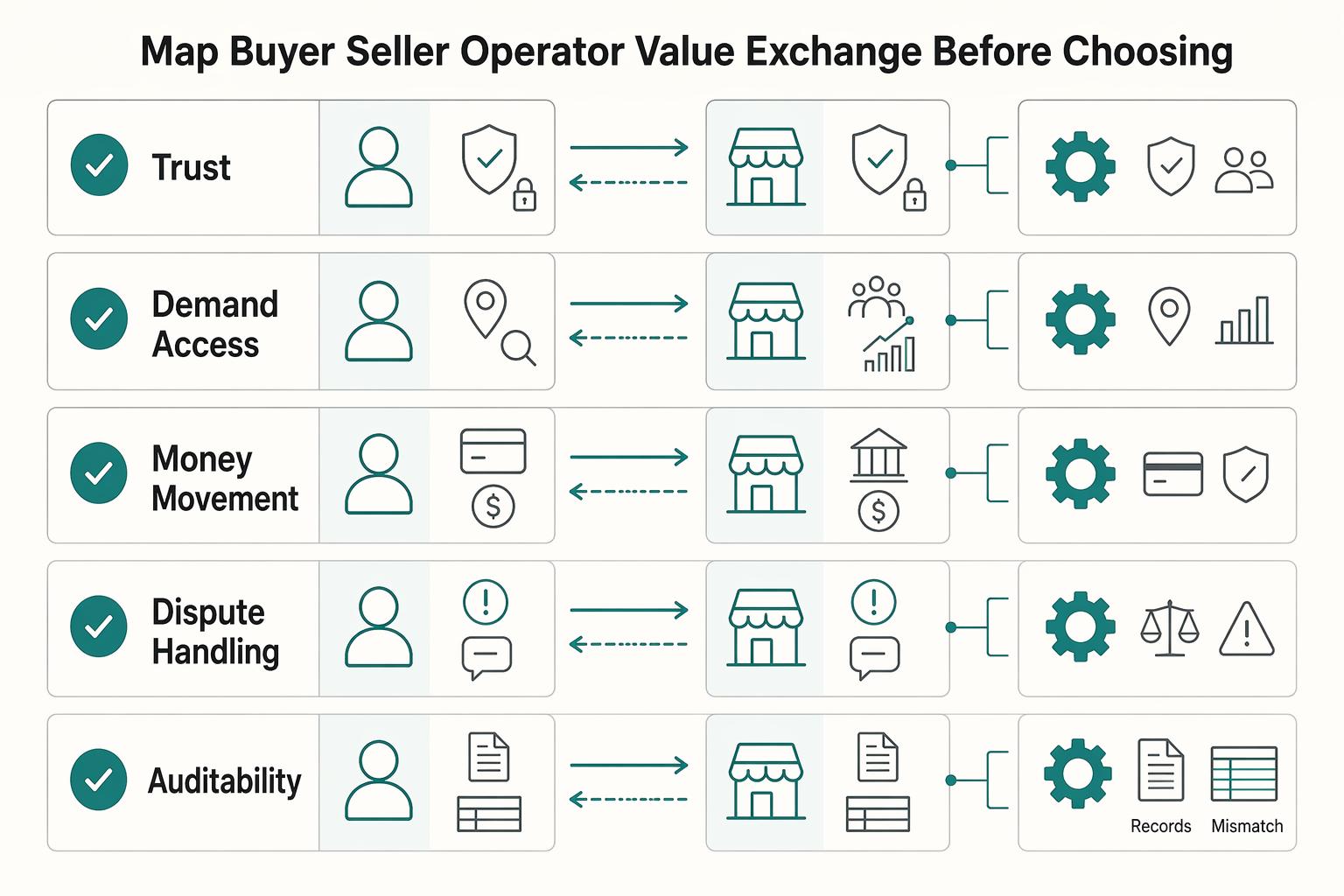
Marketplace Economy 101 for Buyers, Sellers, and Operators
Choosing between a **Marketplace business model** and a **Platform business model** should be an operating decision, not a branding exercise. This guide is built to help you make that call with go or no-go checks that reflect how the business will actually run once buyers, sellers, and expansion pressure show up.
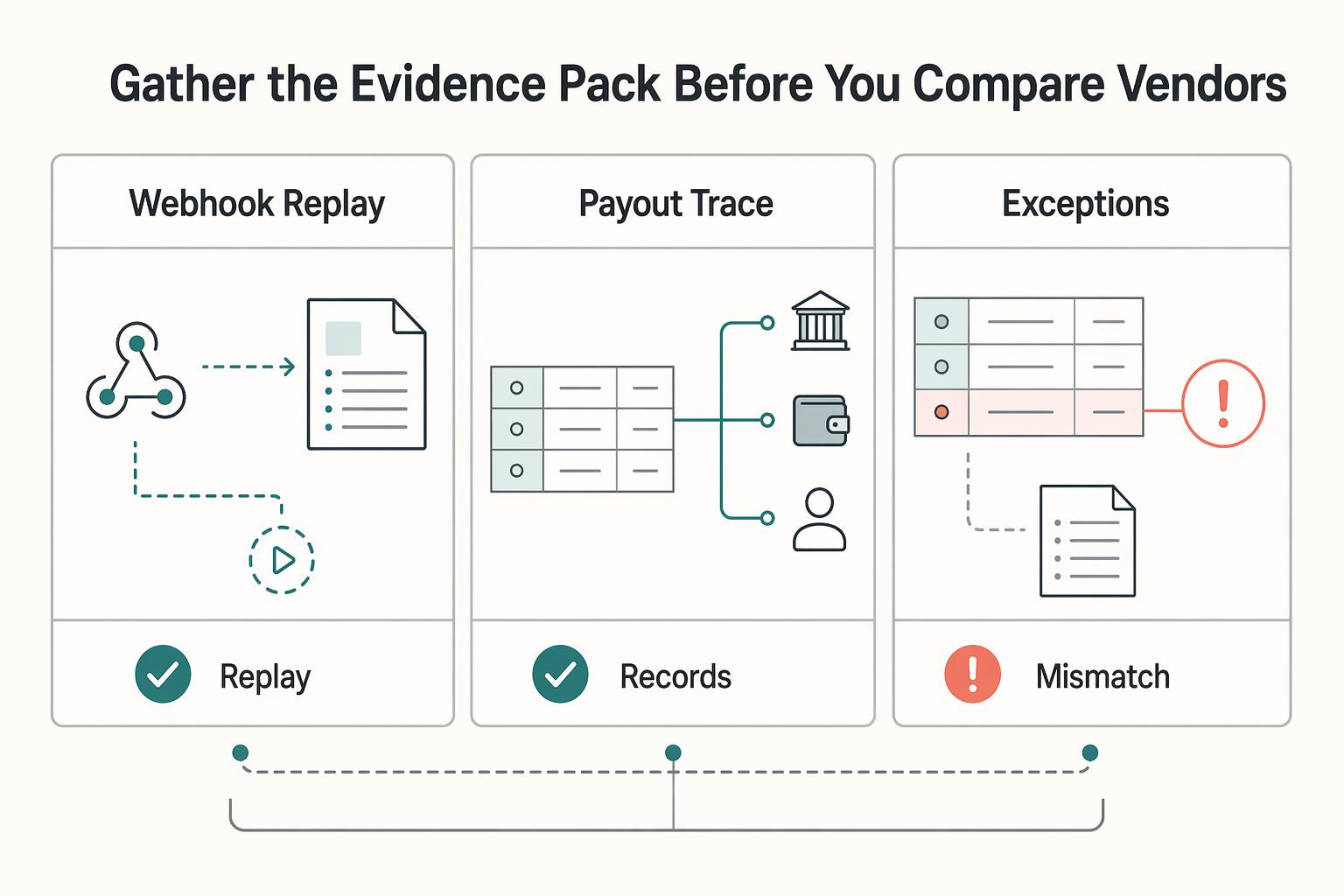
Building Subscription Revenue on a Marketplace Without Billing Gaps
Recurring billing usually breaks after the pitch stage for a simple reason. Teams buy a feature story when they really need an operating decision. If you are evaluating a subscription revenue platform for marketplace billing, the real question is not which vendor demo looks strongest. It is where you can launch first, which recurring-charge rules apply, and what your finance team can prove after go live.

How Marketplace Platforms Pay Third-Party Sellers Compliantly
Generic marketplace payout advice usually skips the part that breaks in production. Paying many sellers is not just moving money out. It is deciding who gets paid, when they become eligible, what happens when a buyer disputes a payment, and how finance proves every release later. If you are working on **ecommerce reseller payouts marketplace platforms pay third-party sellers**, this guide is for the marketplace operator, not for solo freelancer banking tips.