
Quick Answer
Calculate DPO from average in-scope supplier trade AP and a matching period cost flow, using a documented day count. Keep merchant settlement receipts, seller/customer funds and unrelated liabilities separate. Reconcile the accounting inputs, then use actual invoice, dispatch and recipient-credit milestones to explain operational delays. A higher DPO is not success if agreed payments become late.
Why DPO Looks Different for Platforms#
Days Payable Outstanding estimates how long a business carries in-scope supplier trade payables relative to the associated cost flow. It is a period ratio, not the measured duration of each invoice or payout. Use actual invoice and payment milestones alongside it to investigate delays.
Treat DPO as a payment cycle control#
DPO is a cash-flow control point, not a standalone success metric. Extending it can improve working capital, but a higher number is not automatically a win. If DPO rises while supplier-relationship risk signals, reconciliation exceptions, or payout delays also rise, treat that as an execution warning.
For platform teams, the work does not end when an invoice is approved. Reconciliation still has to match transaction records to the books, settlement may follow provider-defined batches, and payouts still have to reach bank accounts. A finance report can show better payment timing while downstream reliability is getting worse.
Keep one non-negotiable check in place. Do not trust a DPO trend unless records are being matched to the books and discrepancies are logged for investigation. If the timing metric improves while matching discipline weakens, that is drift, not control.
Scope the work across the teams that actually move money#
This guide is for teams that own the full path from payable to completed disbursement:
- accounts payable
- reconciliation
- settlements
- payout execution
Each team sees a different version of the same delay. Accounts payable may see invoices waiting for payment. Reconciliation may see unmatched records. Settlements may reflect provider batching rules. Payout execution may show funds landing later than expected even when upstream payable status is complete.
Separate the platform's own supplier AP from merchant settlement receipts and money owed to marketplace sellers. Incoming payment-provider settlement schedules may affect funding, but they do not define how long an invoice has remained in supplier AP. Measure each leg and liability population separately.
Define the outcome before you start optimizing#
The outcome here is practical: measurable checkpoints, decision triggers, and recovery steps you can use immediately. The goal is to protect cash flow without creating missed timing or avoidable strain with suppliers and payout partners.
Your checkpoints should confirm that records match, settled transactions can be traced to paid-out transactions, and exceptions are visible enough to act on. If transaction-level settlement reporting is available, use it as operating evidence. Your triggers should be explicit. If DPO improves while supplier-relationship risk signals worsen, pause optimization and investigate. If sources conflict, fall back to auditable accounting records before you change policy.
Keep one red flag in view from the start. An extremely high DPO can indicate payment stress, not operational strength. The rest of this guide is built to help you spot that early and recover before it turns into a supplier-trust problem.
We covered this in detail in Accounts Payable vs. Accounts Receivable for Platforms and the Two-Sided Ledger.
What DPO means for platform operations#
In platform operations, DPO is a payment-timing signal for liabilities, not proof that your payment cycle is healthy. If DPO improves while reconciliation quality or payout reliability worsens, treat that as an execution issue, not a strategy win.
Translate the terms into one plain meaning#
Accounts Payable Days, AP days and DPO commonly refer to the same period ratio. Define which supplier trade payables and cost flow you include. Do not automatically add seller wallet balances, customer funds, tax liabilities or unrelated accrued expenses to a trade-AP numerator.
That makes the metric useful for cash-cycle and working-capital timing analysis. On its own, though, it does not tell you whether downstream payment execution is working.
Separate reported DPO from operating reality#
A cleaner DPO trend can still hide process defects. Reconciliation is its own control, and it requires matching transaction records to accounting records to verify payment accuracy. If matching is weak, a higher DPO may simply reflect delayed outflows while issues stay unresolved.
Keep funding availability, outgoing payment schedule, dispatch and recipient receipt as separate milestones. A change in merchant settlement timing may affect available cash, while a supplier payable remains governed by its terms and accounting treatment. No single provider setting defines DPO.
Apply an operating gate before calling DPO a win#
Before you treat a higher DPO as progress, confirm these checks over the same period:
- Transaction-to-ledger matching is current, and reconciliation exceptions are visible.
- Payout reliability is stable, including whether returned payouts are being driven by incorrect destination details.
If either check worsens, pause optimization. A higher DPO can help cash-cycle timing, but it can also strain suppliers and lead to credit restrictions.
If you want a deeper dive, read Days Payable Outstanding (DPO): How Payment Platforms Help Finance Teams Optimize Cash Flow.
Prerequisites and data to prepare before measurement#
Do not calculate DPO until your timing fields and liability balances are ledger-reliable. If dates conflict or open liabilities do not reconcile, you are measuring data quality, not payment timing.
Assemble the minimum data pack#
Build one record set that explains each payable from invoice entry to payment confirmation. Keep, at minimum:
| Field | Why keep it |
|---|---|
| invoice date | Keep, at minimum |
| terms date | Keep if separate in your ERP; Net 30 means 30 days after Terms Date in Oracle Payables |
| due date | Keep, at minimum; keep due-date inputs intact |
| payment-confirmed date | Keep, at minimum |
| ledger posting timestamp | Keep, at minimum |
| current open liability amount and status | Open payables subledger balances should tie to the corresponding general ledger balance for the period |
Keep due-date inputs intact. In Oracle Payables, scheduling is driven by Payment Terms and Terms Date at invoice entry. For example, Net 30 means 30 days after Terms Date. If you collapse those fields, you lose the ability to separate negotiated terms from execution delay. Before you calculate anything, run a period-level reconciliation check. Open payables subledger balances should tie to the corresponding general ledger balance for the period.
Choose one source of truth for timing fields#
Use reconciled AP and cost records for the DPO ratio. For operational timing, use the authoritative timestamp for each actual milestone: receipt, approval, dispatch, bank debit or beneficiary credit. A ledger posting timestamp may lag the event and must not automatically replace its execution time.
Keep rail and provider timestamps for investigation. Settlement timing can depend on settlement-date availability and cutoff conditions, including ACH file-receipt timing. Those fields still matter for root-cause analysis even when ledger events are your reporting anchor.
Segment suppliers before analysis#
Segment suppliers before you measure, or your DPO result will blur very different risk and criticality profiles. At minimum, separate:
- Critical suppliers where failure to deliver would cause material harm.
- Lower-criticality suppliers where timing flexibility is typically broader.
That prevents overgeneralized targets. A cycle length that is workable for lower-criticality suppliers can still be risky for critical suppliers.
Confirm adjustment, reversal, and override controls#
Treat audit-trail quality as a prerequisite, not a cleanup task. Your dataset should preserve a chronological record for late adjustments, manual overrides, and reversals so cycle-time math reflects what actually happened.
Verify controls over journal entries and other adjustments, then test a reversal path end to end. Where possible, preserve linkage details, such as matching document number and posting date to the original entry, so each reversal remains traceable to the original liability.
If due dates, payment timing, or posting dates can be changed without visible audit-trail entries, pause DPO measurement until that control gap is fixed.
For a step-by-step walkthrough, see Accounts Payable Outsourcing for Platforms When and How to Hand Off Your Payables to a Third Party.
Map your payment cycle from invoice to payout completion#
Map the full invoice-to-payout path before you interpret DPO. Otherwise, you can mistake process failures for intentional payment timing. If a stage has no owner, timestamp, or failure signal, a longer payable cycle can hide blocked invoices, delayed payment runs, or payouts that posted but did not complete.
Name each stage and assign one owner#
Use actual handoffs, not department labels. For most platform teams, the minimum map is invoice intake, invoice validation, approval, scheduled pay date, provider handoff, settlement status, payout execution, and reconciliation confirmation.
Keep invoice validation as its own stage. In Oracle Payables, validation is required before payment or accounting, so it needs an owner, entry condition, and visible blocked state. Do the same for payment scheduling. If one team approves and another schedules Payment Process Requests, split those stages so delay is traceable.
Define one proof timestamp and one dependency per stage#
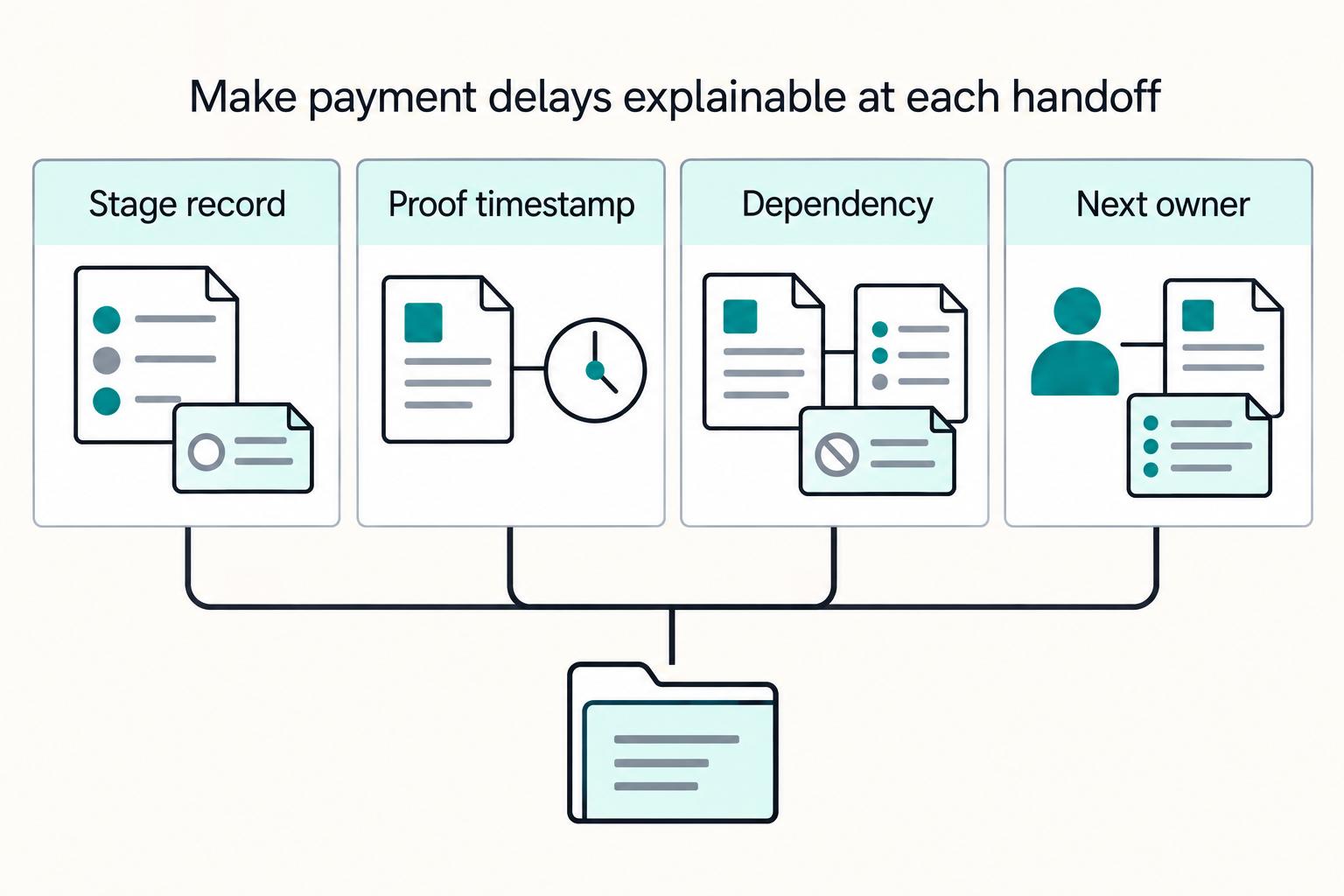
For each stage, capture the system of record, proof timestamp, dependency, failure signal, and next owner. If you cannot fit that in one line, the stage is too vague.
For scheduled payment, include the fields that drive installment selection. In Oracle PPR, Pay Through Date and Payment Date affect installment selection and discounts, so they belong in the cycle map. For settlement, keep intermediate status events where available, such as file received, technical validation, business validation, and accepted or rejected, instead of only a final "paid" label.
| Stage | System | Timestamp field | Dependency | Failure signal |
|---|---|---|---|---|
| Invoice intake | ERP / accounts payable | Invoice entry timestamp | Invoice recorded | Missing required intake data |
| Invoice validation | Oracle Payables | Validation completion timestamp | Invoice entered and validation completed | Validation incomplete or invoice invalid |
| Approval and hold release | ERP / AP controls | Approval timestamp, hold-release timestamp | Approval policy met, invoice holds released | Invoice on hold, matching hold unresolved, approval pending |
| Scheduled pay date | Oracle PPR | Pay Through Date, Payment Date, PPR creation timestamp | Validated invoice and eligible installment | PPR not created, installment excluded, payment date misaligned |
| Provider handoff and settlement | Bank / payment provider | File submission timestamp, status event timestamps | File submitted for settlement processing | File rejected, validation failure, status stalled before acceptance |
| Payout execution and confirmation | Payout platform | Payout posted timestamp, return/completion status timestamp | Destination details correct, settlement accepted | Posted but not received, returned payout, destination error, exception queue item |
| Reconciliation confirmation | Ledger / reconciliation tool | Reconciled timestamp | Payment or payout event matched in reconciliation | Unmatched item or unresolved exception |
Add checkpoints that force action#
Every stage should end in either a clean pass or a practical queue item. Avoid open-ended statuses like "in review" unless you also store age and blocker reason.
Review invoice holds and installment-selection results before payment submission. Then confirm what the provider's dispatched, posted or completed status actually means. A submitted file or scheduled payment does not prove the supplier received funds; investigate returns under the actual product's process.
Close with reconciliation proof#
Reconciliation is the closing proof that the cycle actually completed. Confirm payment and payout events are reconciled, and keep exceptions visible for direct remediation.
If a stage supports retries, retain the retry-safe identifier in the event trail. For payout execution, preserving the idempotency key, or equivalent, helps distinguish delayed confirmation from duplicate payment attempts.
Related reading: Designing an End-to-End Accounts Payable Workflow for Platforms.
Calculate a baseline AP days metric your team can trust#
Once your stage map exists, lock the baseline before you optimize. Use one fixed period, one reconciled dataset, and a clear stop rule for unresolved exceptions so your AP days result is decision-grade.
Lock one baseline window before you calculate#
A common DPO convention is average trade AP divided by period COGS, multiplied by days in the period. Match the numerator and denominator to the same business and cost population. For a hypothetical 90-day period, opening trade AP of USD 60,000 and closing AP of USD 90,000 gives a simple average of USD 75,000. With related period COGS of USD 450,000, DPO is75,000 /450,000 x90 =15 days. More frequent AP observations may better capture seasonal balances. The ratio is an estimate, not proof that every invoice was paid in15 days.
Use the documented number of days in the selected reporting period: an actual quarter can have90,91 or92 days, and an annual convention may use365. Keep the convention and averaging method visible. If your AP mainly relates to operating expenses or purchases that do not align with COGS, use a controller-approved matched cost basis and label the adjusted measure; do not compare it silently with a conventional DPO benchmark.
Record the period as part of the metric, not a footnote: start date, end date, day count, AP inputs, and COGS source. Every report feeding the calculation should use the same date range.
Reconcile the dataset to liabilities and posted ledger entries#
Do not trust the metric until the payable population is reconciled. DPO reflects supplier payment timing, so your baseline dataset should match in-scope trade payables recorded in current liabilities for the defined period, not a partial export.
Run a period reconciliation between the AP subledger and the general ledger. Compare open payables to the corresponding GL balance for the same period, then match transactions to entries where discrepancies exist and identify exceptions. If you cannot explain the delta with named exceptions, pause. That result is not a usable baseline yet.
Produce an aggregate view and at least one segmented view#
Publish two views from the same reconciled baseline:
- Aggregate DPO for a shared headline metric.
- Segment views with matching AP and cost populations, or invoice cycle-time and due-date metrics where a ratio denominator is unavailable.
For a segment ratio, use that segment's own average AP and corresponding cost flow. Dividing segment AP by total company COGS does not produce a comparable segment DPO. Where a suitable cost denominator is unavailable, report invoice cycle time and due-date performance instead.
Add a stop rule for unresolved exceptions#
Define your unresolved-exception tolerance before interpretation starts. Set it based on your own volume and materiality, then apply one rule consistently.
If unresolved discrepancies exceed approved materiality, qualify or withhold the affected result and investigate. Explain immaterial known differences rather than imply every open operational exception makes all financial reporting impossible. Keep reconciled inputs, averaging method and the exception log with the report.
Set operating bands and decision triggers by segment#
Once you have a clean baseline, stop thinking in blended averages. Set segment-specific operating bands tied to payment timing, invoice-to-payment cycle time, and exception signals, or you can misread slower payment as performance.
Define bands by supplier and payment sensitivity#
There is no single healthy DPO number across all businesses, so your bands should reflect segment risk, not one global average. Critical suppliers should not share the same operating band as routine vendors with lower payment sensitivity.
| Segment | What the band should protect first | Early warning signal | First owner |
|---|---|---|---|
| Critical suppliers | On-time payment against agreed due date | Supplier escalations, missed due dates, supplier-impact risk | Finance ops |
| Standard vendors | On-time contractual payment, considering discounts and cut-offs | DPO drift without service issues | AP manager |
| Higher-exception payment paths | Reliable payment transmission after invoice processing | Payments marked scheduled but not transmitted, repeated exception cases | Payments ops |
Verification point: for each segment, confirm the core fields are reliable before you trust the band. That includes invoice receipt date, due date, payment-transmitted date, and the status fields you use to mark completion.
Write if-then rules before the number moves#
A band only helps if it triggers action. Write the decision rules before movement starts.
If DPO rises and supplier escalations rise with it, treat it as a process warning first, not automatic evidence that stricter supplier terms are working. DPO tracks how long invoices remain unpaid, so a higher value can simply mean slower payment behavior.
Use enforceable rules such as these:
- If DPO increases in a segment and invoice-to-payment cycle time also lengthens, investigate process delays before changing supplier terms.
- If DPO rises while exception cases rise, assign recovery work to process owners first. Exceptions include disputes, notifications, questions, and requests for additional information.
- If DPO is stable but cycle time or exception pressure worsens, do not mark the segment healthy.
Set trigger and review layers#
Use a faster trigger layer and a deeper review layer so signals get the right response speed.
For the faster layer, review by segment: DPO movement against band, invoice-to-payment cycle time, and exception cases. For the deeper layer, reassess whether the band still matches supplier sensitivity and operating risk using escalation patterns and due-date performance. If unresolved exceptions are building, pause decisions on tightening payment timing until causes are clear.
Keep the operating evidence light but complete. Preserve segment definitions, active bands, the exception log, the payment-status records used to mark completion, and any manual override notes.
Assign escalation ownership when signals diverge#
Define ownership before metrics split across teams. The hardest failures are mixed signals, such as stable DPO with rising exception cases, or improving DPO with rising supplier escalations.
If the issue sits in invoice handling before payment transmission, finance ops or AP should lead. If it appears in payment processing and exception handling, payments ops should lead, with finance validating supplier impact. Every open trigger should have one named owner, one next action, and one expected resolution date.
Choose the right lever for each DPO problem#
When a segment breaches its band, choose the lever based on where the delay occurs, not by defaulting to supplier-term changes. Terms address term mismatch, scheduling addresses payment timing behavior, accounts payable automation addresses approval routing and visibility gaps, and process redesign addresses broken handoffs.
Match the lever to the actual delay point#
Start with evidence before you change policy. Sample invoices in the affected segment and compare invoice receipt date, due date, approval-complete timestamp, scheduled pay date, and payment-confirmed date. If you cannot locate where time was lost, do not choose a lever yet.
| Lever | Implementation effort | Risk to supplier trust | Impact on cash flow | Effect on audit trail quality |
|---|---|---|---|---|
| Supplier terms negotiation | Medium to high | Medium to high if longer terms are pushed without clear segment logic | Can improve working capital when terms are extended | Improves only when terms are documented and applied consistently |
| Payment scheduling changes | Low to medium | Medium if payment behavior changes without clear communication | Can be immediate when unnecessary early payments are reduced | Strong when scheduling is system-driven; weaker with manual overrides |
| Accounts payable automation | Medium to high | Low to medium, mostly indirect unless rollout causes payment errors | Indirect but meaningful when routing, reconciliation, and reporting improve | Often stronger because invoice, approval, payment, reconciliation, and reporting events are captured digitally |
| Process redesign | Medium | Low when internal; higher during unstable transitions | Indirect, but can be the durable fix for recurring delay and exception patterns | Can improve when off-system work is removed and exception handling is standardized |
Term changes can move cash flow, but they also carry the clearest supplier relationship risk. Extending payables too far can reduce supplier willingness to extend credit, so do not use term extension to hide internal approval delays.
Apply simple if-then rules before you touch terms#
Use root-cause rules, not vendor pitch or preference.
- If delay is between invoice receipt and approval completion, fix approval routing first.
- If delay starts after approval, fix scheduling next and align it to due-date logic.
- If early payment occurs, compare the cash cost with any valid discount and supplier benefit before changing the schedule.
- If invoices are approved on time and scheduled as designed, but due dates still do not fit the business, treat it as term mismatch and renegotiate terms first.
AP automation can help when the issue is in receipt, matching, approval routing, payment origination, reconciliation, or reporting. It does not replace term or policy design.
Protect the audit trail while you optimize cash flow#
Do not rely on manual timing exceptions to lift DPO. They can raise the metric temporarily while weakening controls and can make disputes harder to resolve.
For any lever, keep a short evidence pack: current supplier terms, approval policy snapshot, payment scheduling rule, exception log, and a before-and-after sample with invoice date, due date, approval completion, scheduled pay date, and payment confirmation. After changes, verify that manual overrides decreased, reconciliation breaks stayed flat or improved, and supplier escalations did not worsen.
Use vendor claims as evaluation prompts, not recommendations#
Evaluate an AP product against your real invoice population, approval rules, supplier eligibility, payment paths and reconciliation exports. Ask for a representative workflow and evidence of exception handling rather than choose from advertised speed, OCR accuracy or network-size claims.
Ask each vendor to prove your actual workflows: your invoice types, approval exceptions, settlement handoffs, and reconciliation outputs. If your issue is approval latency, test disputed-invoice approval routing. If your issue is cross-border complexity, test coverage and execution behavior. If your issue is audit evidence, test event-level history and override visibility.
Before changing terms or schedules, map your root cause to system controls and retry behavior in Gruv Docs.
Assign clear ownership across finance, ops, and product#
Make ownership explicit before you implement fixes, or decisions will stall between teams. Use one accountable decision-maker per lane, even if execution spans multiple people.
Assign one accountable owner per lane#
Use a simple RACI for three lanes: accounts payable, reconciliation, and settlements. Keep a single accountable owner in each lane so decision rights stay clear.
One operating split is finance for DPO and payment-timing policy, ops for day-to-day exception handling, and a product or systems team for instrumentation and system reliability. Adapt the split to your org, but keep accountability singular per lane. Senior leadership still owns the overall control environment and cannot fully delegate that responsibility away.
Separate duties at the handoff points#
Build segregation of duties into key handoffs: posting, payment execution, and reconciliation. As a control baseline, the person posting transactions should not also reconcile the related bank account.
Define one explicit handoff for each lane:
accounts payable -> settlements: approved invoice becomes a scheduled paymentsettlements -> reconciliation: payment status is ready to match against ledger and bank datareconciliation -> ops: unmatched item is assigned as an exception with an owner and due date
Lock decision rights before exceptions pile up#
Document who can change payment timing rules, who approves term exceptions, and who signs off on control changes. If those rights are unclear, DPO execution is under-owned.
Assign a preparer and reviewer for reconciliation, with a cadence based on transaction volume, close needs and applicable requirements. Record any required timetable for your entity instead of import another organization's monthly or30-day rule.
Instrument controls and evidence for audit-ready execution#
Treat instrumentation as a control, not just reporting. If you cannot reconstruct a payment from invoice approval through payout execution with linked IDs, timestamps, and outcomes, your DPO execution is unlikely to be audit-ready.
Capture a complete event chain#
Record a full chain of custody for each payment event. For in-scope payment systems, capture at least user identification, event type, date and time, success or failure, and event origin so your audit log is chronological and usable.
Link invoice, obligation and attempt IDs to ERP, provider and bank references. Keep each milestone's source, timestamp and accounting date so finance can reconstruct both the ratio inputs and actual execution. Investigate conflicts; ledger posting dates are accounting evidence, not universal proof of when a supplier received funds.
Make retries safe before they touch the ledger#
Design retries so replays do not create duplicate business actions. Use idempotent requests where supported, and link replayed events to the same internal payment action.
Use an atomic execution claim and durable obligation guard across payment attempts. Reuse the same provider idempotency key and unchanged request within its documented window. Stripe can prune keys after at least24 hours; an old key is not permanent protection. For uncertain or expired-window attempts, retrieve and reconcile the original before approving replacement. Keep ledger transitions separately duplicate-safe.
Test a timeout after submission and concurrent requests with different client keys for the same obligation. Confirm they cannot execute a second payment or ledger action. Include expired-provider-window recovery, requiring investigation rather than a blind replay.
Preserve an evidence pack for each review period#
Keep a period evidence pack that shows what happened, what was reviewed, and what conclusions were reached. Treat this as an operating control set, not a universal legal template.
| Evidence item | Include |
|---|---|
| DPO snapshots | The period snapshot and any segmented views you use |
| Exception logs | Owner, open date, and current status |
| Approval records | Timing changes, term exceptions, and manual overrides |
| Reconciliation proof | Matched, unmatched, and resolved items |
Use a clear checkpoint: someone outside day-to-day execution should be able to read the pack and understand why AP days changed and whether reconciliation conclusions are supportable.
Apply compliance gates by market and program#
Do not apply one global control set to every country or payout program. Coverage should be defined by market and program variant, then documented in a control matrix.
| Area | Article caveat | Control implication |
|---|---|---|
| Supplier AP | The platform's own trade obligations | Use matched trade AP and cost flow for DPO |
| Merchant settlement receipts | Cash arriving from collected customer payments | Measure funding timing separately from supplier AP |
| Seller/customer funds | Funds may belong to others or be subject to safeguarding rules | Do not treat them as working capital for supplier-term extension |
| Market or program rules | Eligibility, fees, payment and safeguarding obligations vary | Confirm the actual entity, contract, jurisdiction and product |
Document country, program and transaction-purpose eligibility, actual quoted fees, account and destination support, and applicable rules. Merchant settlement, supplier payments and safeguarded customer funds are different populations; do not treat customer or seller funds as cash available to extend supplier payment terms.
Before launch or market expansion, confirm country, program variant, payout route, and applicable compliance obligations, then record caveats in the controls finance and ops actually run.
Common failure modes and how to recover fast#
If DPO improves while reliability signals worsen, treat it as a failed operating change. Recover by reversing timing changes for affected segments, re-basing measurement on ledger truth, and forcing hidden exceptions into a visible queue with owners. These checks tell you whether DPO moved for the right reason or because execution quality slipped.
Roll back timing changes when supplier complaints rise#
If supplier complaints rise after payment timing is extended, unwind the change for critical suppliers first. A higher DPO can lead suppliers to impose credit restrictions, and abrupt payable extensions can trigger retaliation with operational and financial damage.
Do not run a blanket rollback. Re-segment terms by criticality and apply different timing rules to core payout partners, operationally sensitive vendors, and standard vendors. For critical suppliers, restore prior timing and require approval before future extensions. For other segments, confirm whether issues came from term changes, approval delays, or execution failures that made agreed terms appear late.
Map complaints to agreed terms, due dates and actual execution records. Confirm any applicable payment law or procurement contract separately. Renegotiate future terms with supplier agreement rather than unilaterally delay existing invoices to improve a metric.
Re-base conflicting dashboards on ledger truth#
When dashboards conflict, reconcile the AP and associated costs used for the ratio. For invoice timing, verify each milestone against its actual source, including provider and bank evidence. Correct delayed or misdated ledger posting rather than use it to erase a genuine execution delay.
The key checkpoint is control integrity, not visual dashboard alignment: subledger open payables should tie to the corresponding GL balance, and every break should be listed as an exception with ownership. Oracle guidance is explicit on comparing subledger and GL balances and, when discrepancies exist, matching transactions to their accounting entries.
Provider reports can show dispatch, settlement or beneficiary-credit facts that differ from accounting posting dates. Preserve those facts and investigate the reason for the difference. Use accounting balances for DPO and execution evidence for payment performance; neither view substitutes for the other.
Expose hidden exceptions after automation#
If automation reduced manual work but increased hidden failures, tighten exception handling and alerting immediately. Also separate unique failures from retries so retry noise does not mask real performance.
Monitor authenticated provider events and retrieve state when events are missing or inconsistent. Distinguish a failed payout, a disabled destination account and an unresolved attempt; provider product labels are not interchangeable. Keep each affected obligation in a named exception queue.
Then enforce queue discipline: each exception needs an owner, timestamp, linked payment ID, and visible status. Review unique failures separately from retried failures, consistent with guidance to exclude failed retries from failure-rate analysis. A practical check is end-to-end traceability for one failed payout: originating event, retry path, and idempotent handling to prevent duplicate operations. If that chain is missing, the issue is hidden exception debt, not automation success.
Conclusion and copy paste checklist#
Treat success as controlled payment timing with reliable settlement, not a vanity DPO number. If AP days improve while reconciliation exceptions or payment execution issues rise, the payment cycle is not actually healthier. Use this as an implementation closeout checklist. Each item should tie to auditable records, logs, approvals, and reconciliation output.
- Reconcile the in-scope trade AP and matching cost flow; document average balances, period days and ratio convention. Keep seller/customer funds and unrelated liabilities separate.
- Map invoice-to-payout stages with failure checkpoints. Cover the full AP cycle from purchase orders and invoice intake through approval, payment, and reconciliation. For each stage, define owner, source system, timestamp field, and failure signal for invoice received, approved, scheduled, provider handoff, settlement, and payout completion.
- Use segment AP and matching segment costs for any segment DPO; otherwise use invoice cycle time, on-time payment and exceptions.
- Choose the lever by evidence: approval delays, scheduling, agreed terms or outgoing-payment failures. Consider valid discounts and dispatch lead time before reducing early payments.
- Assign owners across finance, ops, and product. Set clear ownership for policy, exceptions, and instrumentation. Preserve separation of duties: transaction posting, reconciliation, and reconciliation review should not sit with one person.
- Run a recurring evidence-pack review for audit trail and reconciliation integrity. Set the cadence to match your control needs (monthly can be practical), not as a universal mandate. Include DPO snapshots, approval records, exception logs, reconciliation proof, and event logs linking invoice, payment, settlement, and payout IDs. Confirm retry behavior is idempotent so replays do not create duplicate payout or accounting impact.
Use one decision rule: do not push payment timing further until accounting records, reconciliation results, and settlement outcomes tell the same story.
When you are ready to operationalize segment-specific payment timing with traceable execution, review Gruv Payouts.
Frequently Asked Questions
What is the difference between DPO, AP days, and Accounts Payable Days in a platform setting?
These labels commonly refer to DPO: a ratio of average in-scope trade AP to a matched period cost flow, multiplied by the documented period days. It estimates payment timing; it is not an invoice-level average or AP turnover itself. Keep liability scope, averaging method and denominator fixed or explain changes.
How do you optimize DPO without hurting supplier relationships or delaying payout execution?
Remove avoidable early payment only after considering contractual due dates, discounts and supplier needs. Schedule dispatch early enough for the agreed payment requirement, accounting for cut-offs and bank delivery. Renegotiate future terms by agreement; do not delay existing invoices unilaterally. Measure actual due-date performance and payout reliability alongside DPO.
Which metrics should be reviewed weekly versus monthly alongside DPO?
As an example cadence, review due-date performance, approval queues and payment exceptions weekly. Calculate and reconcile period DPO monthly or at the chosen reporting interval using matching cost and AP data. A rolling DPO view is useful only if those inputs and its averaging method are reliable; weekly operational checks need not recalculate the ratio.
When should we renegotiate supplier terms versus invest in accounts payable automation?
Change terms when agreed commercial timing is the problem and the supplier accepts new terms. Improve AP controls or automation when intake, approval, scheduling or outgoing-payment exceptions cause delay. Merchant settlement-batch reports alone do not establish supplier payment performance.
Who should own DPO decisions across finance, ops, and product?
There is no universal ownership split that fits every platform. What matters is explicit decision rights for the DPO method, payment-timing changes, exception handling, and control sign-off. If those rights are unclear, the metric can improve on paper while operational risk increases.
What is the first thing to check when DPO improves but reconciliation and settlement issues increase?
Check whether the DPO input population or cost denominator changed, then inspect supplier due dates, approval and dispatch times, recipient-credit evidence and unresolved outgoing payments. Merchant automatic-versus-manual payout reports describe a different incoming settlement leg and are not the default explanation for supplier AP days.
Try a related tool
Where Gruv fits
Plan and approve payout batches
See how payee status, approval rules, route review, and exception handling sit in one payout workflow.
See reconciliation and mismatch review
Compare ledger entries, provider payment records, and statement rows to see what matches and what finance needs to review.
Researched and edited by the Gruv editorial team. Gruv builds cross-border billing, payouts, and finance-operations software for global businesses.
Sources
Includes 3 external sources outside the trusted-domain allowlist.
- csrc.nist.gov/glossary/term/audit_trailtrusted
- docs.stripe.com/api/idempotent_requeststrusted
- ojp.gov/ovc_fmrc_guide_sheet_internal_control_separa...trusted
- docs.oracle.com/en/cloud/saas/financials/26c/fappp/payment-p...external
- docs.oracle.com/en/cloud/saas/financials/25d/fappp/pay-throu...external
- wallstreetprep.com/knowledge/ap-daysexternal
Educational content only. Not legal, tax, or financial advice.
Related Posts

The Freelance Payment Penalty: A Modeled Audit of Platform Fees, FX Spreads, and Payout Delays
The money rarely disappears through a single, easy-to-spot fee. The real loss is stacked. A marketplace takes its commission, a processor adds a charge for international cards, a bank or payment company converts the currency at a spread, a platform holds the funds before release, and a wire sheds a little to intermediaries on the way in. Each layer looks defensible on its own, but the worker feels the combined result as a smaller deposit and a later payday.

How to Respond to a Subpoena for Business Records
Move fast, but do not produce records on instinct. If you need to **respond to a subpoena for business records**, your immediate job is to control deadlines, preserve records, and make any later production defensible.

A US Expat's Guide to Investing in UCITS ETFs to Avoid PFIC Issues
The real problem is a two-system conflict. U.S. tax treatment can punish the wrong fund choice, while local product-access constraints can block the funds you want to buy in the first place. For **us expat ucits etfs**, the practical question is not "Which product is best?" It is "What can I access, report, and keep doing every year without guessing?" Use this four-part filter before any trade: