
Quick Answer
Calculate DPO from average trade AP, a matching period cost base and actual period days. Keep seller pass-through liabilities separate. Improve scheduling within agreed terms, then reconcile accounting clearance, cash movement and unresolved supplier delivery. Higher DPO is useful only when the retained cash is available to the company and overdue payments do not rise.
Why DPO Can Improve Cash Flow Without Adding Reconciliation Risk#
A payment platform needs two views of its obligations: the accounting record and the payout history. DPO describes the company’s own trade payables relative to a matching cost base. Seller funds held for onward payment may belong in a separate liability and settlement report. Reconcile both views before changing payment timing.
A common formula is DPO = average trade accounts payable / cost of goods sold × days in the period. APQC publishes this basis for annual comparisons. It is a balance-based estimate of payment days, rather than a direct average of invoice processing times. Use the actual period length and document whether average AP uses opening/closing balances or more frequent observations.
The direction matters: keeping more AP outstanding raises DPO when the denominator is unchanged; clearing AP early lowers it. Either can be misleading if the balances are wrong. A higher DPO caused by overdue invoices is not better execution, and a lower DPO caused by premature clearance does not prove suppliers received their money.
This article compares operating models through three practical lenses:
- Cash impact
Does the model improve real control over payment timing and liquidity, or only reporting optics? DPO movement should hold up when tied back to settlement and payout status.
- Execution reliability
Does the model stay predictable under normal and exception load? The key question is how many exception paths finance, ops, and product teams have to clean up later.
- Relationship risk
Extending payable timing can improve working capital, but pushing too far can damage supplier relationships. The goal is better control without avoidable friction.
One rule is worth stating up front: do not chase the biggest DPO gain first. Prefer the model that gives you cleaner verification. Each payable should be traceable from payout initiation to settlement outcome to ledger posting, with a clear exception state when something breaks.
Keep the trade-payables scope and denominator consistent, then reconcile accounting entries to payout evidence. A provider balance becoming available, a transfer to a connected account and a bank payout are different events. None should silently replace the accounting policy for extinguishing a payable.
Track the full supplier journey even after an accounting entry clears AP. A provider may report a payout as paid and later report failure. That requires an investigation and any appropriate correction; it does not justify calling all available balances or initiated instructions completed payments.
Related reading: How Payment Platforms Really Price FX Markup and Exchange Rate Spread.
Pick the right DPO optimization path for your operating reality#
Start by naming the dominant constraint that is actually driving your DPO behavior, then optimize around that first. If you are unsure where to start, we recommend tracing your last few payment exceptions end to end before you change timing policy. On payment platforms with meaningful AP volume, shared payout ownership, or complex settlement patterns, mixing goals too early can hide the real bottleneck.
| Constraint | What it looks like | First move |
|---|---|---|
| Supplier trust risk | Vendor escalations, payout complaints, or renewal friction when payment-timing changes | Tighten invoice approval and scheduling before asking vendors to absorb slower payment |
| Settlement lag | Accounting entries and bank-payout evidence diverge, or available processor funds are mistaken for supplier receipt | Map funding availability, release, provider outcome and accounting derecognition separately |
| Reconciliation lag | Ops, treasury, and accounting do not use the same paid-state definition | Use a recurring tie-out across AP aging, ledger entries, and payout status definitions |
| High manual touch in AP | Manual data entry, invoice processing, and payment scheduling are the bottleneck | Simplify manual execution first, then track whether cycle times and exceptions are improving |
- Supplier trust risk
If timing changes trigger vendor escalations, payout complaints or renewal friction, supplier trust is the constraint. Compare your agreed terms and actual late-payment rate before choosing a DPO target. Faster approval lets you schedule predictably; it does not require paying earlier or asking suppliers to accept longer terms.
- Settlement lag
Separate incoming collection availability from outgoing supplier payment. Pending processor funds may not be usable, while available funds can still await payout. Schedule outgoing payments far enough ahead of the contractual deadline for the relevant bank calendar, currency and provider lane. Maintain open or in-transit obligations according to the accounting policy, with a separate unresolved-payout queue.
- Reconciliation lag
Fix scope and comparability before timing. A formula using trade AP and COGS cannot include customer or seller balances unrelated to that cost base. Use a separate settlement-age report for pass-through liabilities, and tie each liability population to its own ledger account.
- High manual touch in AP
If manual data entry, invoice processing, and payment scheduling are the bottleneck, throughput is the constraint. In that case, simplify manual execution first instead of forcing a headline DPO change, then track whether cycle times and exceptions are improving.
Lock the DPO baseline before comparing tools#
Do not compare tools until finance and ops are working from the same DPO baseline. If you cannot explain your denominator, period basis, and paid-state rule in one short memo, we recommend fixing that first. If formula inputs, paid-state rules, or period boundaries differ, you are looking at measurement drift, not performance change.
| Baseline area | Rule | Detail |
|---|---|---|
| Formula inputs | Keep one shared DPO definition across teams | Use average trade AP, a matching period cost base and actual period days; disclose the averaging method and any denominator variant |
| Accounting-period source | Baseline from a period-specific reconciliation | Tie the payables subledger to the corresponding GL payables balance and define which record closes the period |
| Accounting and operational states | Document separate derecognition and payout-completion rules | Map instruction acceptance, cash debit, funds in transit, bank outcome and any failure or return; retain unresolved items after an accounting clearance where necessary |
| Recurring tie-out | Validate more than totals before trusting trendlines | Check AP aging, ledger journals affecting payables, and payout completion or settlement states so aged AP reporting and the period AP trial balance align with the current-period payables balance being reported |
- Standardize formula inputs first
Use one definition of trade AP, one matching cost denominator and the actual number of days in each reporting period. Monthly and annual readings can be compared when the balance and cost scopes are consistent; changing from a 30-day cost base to annual costs without changing days creates a false trend. Label purchases-based or service-cost variants separately from the published COGS benchmark.
- Use one accounting-period source of truth
Reconcile the payables subledger to the corresponding GL accounts at the same cutoff. Include approved manual journals, credits, FX movements and reclassifications in the bridge. Restrict and review journals to control accounts; do not exclude legitimate period-end adjustments just to force the subledger to match.
- Map accounting clearance and payout states
Finance owns the accounting rule; payout operations owns the status evidence. Under IFRS 9 amendments effective for annual periods beginning on or after 1 January 2026, a qualifying electronic-payment policy election can permit liability derecognition before settlement. It requires inability to cancel the instruction or access the settlement cash, and insignificant settlement risk, with consistent treatment for the same system. A generic processing label is insufficient. Confirm the applicable framework and policy rather than imposing one universal “wait for receipt” rule.
- Run a recurring tie-out before trusting trendlines
Use a recurring control across AP aging, ledger journals affecting payables, and payout completion or settlement states. Validate more than totals. Catch cases where AP aging is cleared but GL posting is missing, or ops marks payment complete while funds remain pending. Aged AP reporting and the period AP trial balance should align with the current-period payables balance being reported.
Before you compare platforms, write a short baseline memo with your denominator, period length, source tables, and paid-state rule by rail. That helps you avoid optimizing execution before the metric is defensible.
For the finance case behind workflow changes, see Accounts Payable Automation ROI for Platforms That Need Defensible Results.
A worked DPO and usable-cash bridge#
Assume a 30-day month with $300,000 COGS and average trade AP of $180,000: DPO is 18 days. Average AP of $240,000 on the same cost base gives 24 days. The $60,000 difference approximates additional supplier funding under steady purchasing, not profit or a guaranteed cash gain. Check whether it comes from agreed timing or overdue bills.
At one cutoff, suppose $40,000 of a $240,000 AP balance was cleared without valid policy evidence. The reported $200,000 produces 20 days; restoring the $40,000 produces 24. This closing-balance illustration uses that balance as a simplified average only to show direction; the monthly report must recompute its documented average.
Separately, a bank balance of $150,000 includes $90,000 owed to sellers that the platform cannot use. With another $20,000 reserved for tax and near-term commitments, only $40,000 is available for other operating bills. Delaying the $90,000 seller payout does not make it free operating cash. Finance should reconcile the exact custody and restriction treatment for its arrangement.
Compare the best platform operating models for DPO control#
Pick the model with fewer hidden exception paths, even if the headline DPO gain is smaller. If you need a tie-breaker, we recommend choosing the path your close team can verify fastest. A smaller, clean improvement is often worth more than a bigger number you cannot reconcile, explain, or repeat at month end.
Compare the cost of each model using your own invoice volume, exception hours and close adjustments. A model that saves cash but adds unresolved payout work can be more expensive after support, supplier penalties and rework. Keep those costs beside the DPO movement.
Compare like periods and populations: the same suppliers, liability scope, cost basis and averaging method. Growth, purchasing seasonality and one large unpaid invoice can move the ratio without changing payment policy.
| Model | Best for | Key pros | Key cons | Failure mode | Verification checkpoint | Expected effect on working capital |
|---|---|---|---|---|---|---|
| Centralized scheduled AP | High-volume AP with stable vendors and repeat invoice patterns | Strong control over approval cadence, predictable payment batching, cleaner treasury timing, fewer early payments | A backlog in one approval queue can stall a large invoice cohort; weak intake discipline creates off-cycle payments | Approved invoices sit in a ready-to-pay queue but miss the scheduled run, so AP aging and cash forecasts drift apart | Each period, tie the approved-not-scheduled queue to AP aging and sample vendor reconciliation against vendor statements to confirm invoices, payments, credits, and balances match | Can support steady improvement from tighter payment timing and fewer accidental early disbursements |
| Supplier-tiered timing | Platforms with mixed supplier criticality or fragile supplier relationships | Lets you protect strategic suppliers while extending timing for less sensitive cohorts; explicit policy by supplier tier | More policy complexity; manual overrides can multiply quickly; supplier communication burden rises | DPO improves on paper because lower-tier suppliers are stretched, but disputes or escalations rise | Track agreed terms, overrides and on-time payments by cohort. UK Fair Payment Code awards are voluntary performance benchmarks, not permission to defer a contractual payout. | Selective gain, often meaningful but capped because key suppliers stay on tighter timing |
| Settlement-aware close by rail | Cross-border or multi-rail payout stacks where initiation and settlement do not happen together | Better reconciliation resilience, fewer false "paid" states, stronger alignment between ops status and ledger close | Status mapping and accounting-policy documentation take work; unresolved payouts can remain after valid accounting clearance | AP clearance, in-transit cash and supplier receipt are collapsed into one status, leaving failures untracked | Reconcile accounting clearance separately from rail settlement and supplier-facing delivery; investigate differences rather than forcing timestamps to match | More reliable liquidity and exposure reporting; the corrected DPO may rise or fall |
| Audit-traceability-first | Finance teams that need audit-grade traceability across AP, reconciliation, and payout ops | Clear chain from payment request to ledger event, strong exception visibility, easier period-close review | More evidence and ownership requirements can slow early-cycle throughput | Teams bypass required exception codes to get payments out, leaving unmatched records at close | Each accounting outcome has a supported posting; financial status changes without a posting remain explainable and traceable | Modest direct DPO improvement, but strong protection against reversals, restatements, and close surprises |
The real separator is not raw delay. It is where the delay happens and whether you can prove it. Use centralized scheduling when approval timing is the core issue, settlement-aware logic when payout and ledger states diverge, and audit-traceability-first when close confidence is the binding constraint.
There is no single healthy DPO target across industries, so do not choose a model just because another company reports a higher number. Higher DPO is not automatically better. Persistent delays can strain supplier relationships, and late or prolonged payment behavior can disrupt supplier cash cycles.
Use this practical decision rule:
- If exceptions mostly happen before initiation, start with centralized scheduled AP.
- If exceptions mostly happen after initiation because settlement is asynchronous, fix paid-state and ledger-close logic first.
- If your supplier base is sensitive or strategic, do not chase extra days until dispute rates, vendor statement matches, and approval SLA breaches are stable across multiple cycles.
- If two models show similar cash benefit, choose the one with fewer manual overrides, fewer rail-specific exceptions, and a shorter close evidence pack.
Keep the evidence pack boring and consistent. For each model, ask for the same artifacts: AP aging, the current-period payables balance, payout status distribution by rail, a vendor reconciliation sample, and the exception queue with owners and aging. If one model needs much more explanation to defend the same result, it is usually the weaker choice for durable DPO control.
For a clearer view of how payables and receivables interact on a platform ledger, see Accounts Payable vs. Accounts Receivable for Platforms and the Two-Sided Ledger.
Best for high-volume AP with stable vendors#
For high-volume AP with repeat vendors and predictable terms, centralized intake plus due-date scheduling can be a practical model. It can improve payment-timing control while keeping exceptions visible instead of pushing them into ad hoc cleanup at close.
Why this operating model fits#
Measure invoice receipt to approval and scheduling, then separately measure release to supplier receipt. APQC’s invoice-receipt-to-payment-transmission cycle measure is useful process context, but it does not establish beneficiary receipt. Your own stage timestamps show which queue needs attention.
It is strongest when vendor terms are known, invoice patterns are stable, and approvals can follow clear rules. In that setup, AP can schedule to contractual due dates instead of paying early, which supports treasury planning.
What the model does well#
The main gain is clearer scheduling discipline. With defined approval timelines, teams can run payment schedules against approved invoices instead of relying on frequent ad hoc timing decisions.
Track exception invoices as a share of the same period’s processed population, plus their age and staff time. Define whether a reopened invoice counts once or once per exception. Compare those results to your baseline before adopting an external processing-speed target.
Record receipt, approve under the agreed policy and schedule release early enough for the supplier to receive payment by the contractual deadline. If the due date is a bank holiday, apply the contract and relevant calendar; “send on due date” may be too late.
What can go wrong#
Exceptions are the weak point. Invoices with missing data, mismatches, or approval bottlenecks require manual intervention, so exception rate is the key risk signal.
If exceptions and approval delays drive invoice aging, DPO can rise for the wrong reason. APQC explicitly warns that inefficient AP processes can drive DPO up, and it also flags supplier and vendor relationship risk when payment timing stretches for operational reasons.
How to verify it is working#
Use one hard-to-game checkpoint: measure calendar days from invoice receipt to approved and scheduled in each period. Then compare the AP aging extract, the pending approval and exception queue, and the scheduled payment file with due date, approved date, and planned payment date.
If approved invoices are routinely scheduled on or near due date and exception levels stay stable, the model is behaving as intended. If backlogs rise while DPO improves, fix routing and ownership before treating the result as a cash-flow win.
For the forecasting side of cash planning, see Payment Volume Forecasting for Platforms: How to Predict Cash Flow.
Best for marketplace payouts where supplier trust is fragile#
Use seller timing controls only within the agreed payout terms and applicable custody requirements. A marketplace handling seller funds cannot assume that delaying their bank payout makes those funds available for its own operating costs.
The operating model#
Keep eligible seller cohorts explicit, with a promised payout date, any disclosed reserve or hold and an escalation owner. Risk-based reserves and commercial term changes serve different purposes. Do not relabel an overdue payout as a new timing tier.
Stripe Connect exposes separate controls for settlement availability and payout cadence. Its settlement_timing.delay_days_override can be set up to 31 where the platform owns fraud and dispute liability; the day convention depends on account country. That is not a universal 31-day payout entitlement. Check account controls, agreed terms and the actual funds flow before changing either setting.
Why it is different from standard AP#
For an agency marketplace, seller principal may be a pass-through liability rather than an expense in the platform’s COGS. In that case, measure seller payout age and on-time performance separately. If the platform buys services as principal, finance must establish the relevant payable and cost treatment before including that population in DPO.
Show sellers the promised release date, the latest payout outcome and a route for tracing a missing payment. A provider reserve release makes funds eligible for a later movement; it does not by itself confirm bank receipt.
What to do in practice#
Keep the controls narrow and auditable:
- Apply timing bands only where you can clearly communicate the rule and expected release date.
- Track payout lifecycle events, not just scheduled dates. If a payout fails, Stripe emits
payout.failed, and that case should move to escalation. - Separate
scheduled,initiated, andcompletedin reporting so finance does not treat an outbound attempt as a finished payout.
What breaks first#
A common failure is false confidence: DPO can improve on paper while payout reliability issues are missed when reporting stops at scheduled. A second failure is extending delays without clear release visibility and escalation ownership.
For commercial transactions covered by the EU Late Payment Directive and national implementation, B2B terms beyond 60 days require express agreement and must not be grossly unfair. National rules can be more creditor-friendly. This is not a blanket rule for marketplace custody or consumer payments. The UK Fair Payment Code separately awards Gold for at least 95% of all invoices within 30 days; Silver adds small-supplier 30-day performance to the 60-day overall threshold, and Bronze uses the 60-day threshold.
How to verify it is working#
Run one weekly control check by supplier tier. Compare scheduled payout date, actual completion date, payout failure count, and complaint volume. If DPO rises while payout.failed events, missed release dates, or complaints rise, treat that as a control failure rather than a cash-flow win.
Keep a timing change only when it complies with the agreed obligation and leaves seller reliability intact. Report restricted or seller-owned funds separately from cash available for the platform’s own bills.
Best for cross-border payout stacks with settlement lag#
Use this model when cross-border status gaps make exposure difficult to explain. Preserve the accounting-policy clearance event, the movement through cash or clearing accounts and the unresolved supplier-delivery state. Do not close an operational exception merely because AP has been derecognised.
Cross-border flows make status misreads more likely because initiation and completion are different lifecycle stages. That is why this model treats provider status as operational evidence, not automatic accounting completion.
Why this model fits#
Cross-border payments still face structural frictions, including low speed and limited transparency, and public programs have been targeting those gaps since the G20 roadmap in 2020 with 2027 targets. Uneven settlement timing can be a normal operating condition, not just an exception.
Payment execution and accounting derecognition can occur at different times under a valid policy. Reconcile that difference explicitly. Do not describe every gap as an error or claim it automatically improves DPO.
The control sequence#
- Confirm payable approval
Lock approved amount, currency, beneficiary, and scheduled release details.
- Confirm payout initiation
Verify instruction acceptance and provider reference creation.
- Confirm settlement finality
Confirm what the provider’s success event establishes for that particular payment. Fedwire settlement is final at processing between participating institutions; that fact alone does not prove the beneficiary bank has credited the intended supplier. Record the bank or trace evidence appropriate to the supplier-delivery question.
- Apply the accounting policy and preserve unresolved delivery
Post the supported accounting event using the approved policy. Keep any continuing delivery exposure in the in-transit or exception report with the original invoice, provider reference, amount, currency and owner. A valid clearance must remain traceable through a later failure or return.
What you gain and what you risk#
Align the cash forecast to the actual release, debit and availability events. Reconcile differences between the ledger and provider history so corrected balances and open delivery risks are visible at month end.
The tradeoff is operational complexity from asynchronous provider states and FX settlement risk. A payout can look active while final settlement is still uncertain. One failure mode is AP closed early and exception handling later, which can create downstream correction work.
Trace a partial payment and a later return#
For a $10,000 invoice, a confirmed $6,000 payment allocated to it leaves $4,000 payable. A separate $20 provider fee borne by the platform is an expense: it does not increase the supplier’s unpaid amount to $4,020. If the $6,000 movement later fails and $6,000 returns, link the return to the original payment and restore the supported obligation. Record any retained fee separately.
Before releasing replacement funds, confirm whether the provider or bank will automatically retry the original instruction. Resolve an unknown result first, secure the corrected beneficiary details where relevant, and keep one active payment path. Reconcile return cash, the reopened obligation and the replacement reference rather than overwriting the first attempt.
Weekly verification#
Run one control review by provider or corridor and compare approval date, initiation time, latest provider status, settlement confirmation date, and ledger close date.
Investigate dates that differ from the documented accounting and rail mapping. If the exception queue cannot explain valid in-transit items versus failed or unknown instructions, fix that visibility before changing payout timing.
Practical rule#
Keep instruction acceptance, processing, cash debit, provider completion, beneficiary receipt and accounting clearance as separate fields. On an unknown outcome, retrieve the original request and authoritative provider state before sending another payment. A supplier complaint or timeout alone is not proof the first payment failed.
The EU Settlement Finality Directive protects transfer orders and netting in designated systems under specified conditions. It does not turn every cross-border provider status into irreversible supplier receipt. Use evidence from the actual system and account path, rather than treating Fedwire or a legal framework as a universal status dictionary.
Best for finance teams that need audit-grade traceability#
Pick this approach when period-close defensibility matters as much as DPO movement across accounts payable, reconciliation, and payout operations. It is built to show, step by step, why a payable was closed and how that decision reached the ledger.
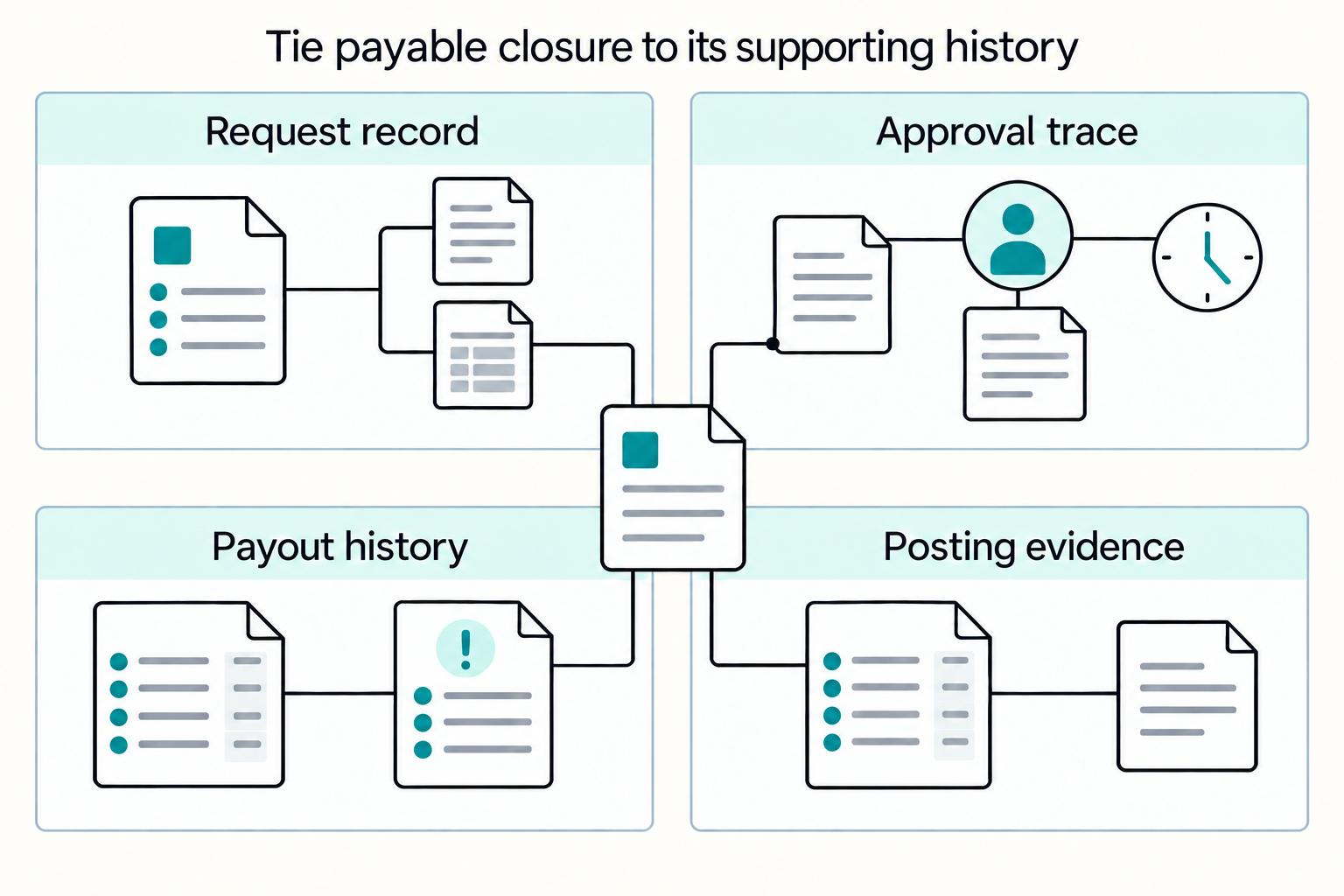
A chronological history lets a reviewer reconstruct the request, approval, payout, exceptions and accounting outcome. Preserve event identifiers and corrections without overwriting the original sequence. The diagram shows those evidence groups; it does not prescribe an accounting recognition date.
Why this model fits#
Pick this when teams regularly ask: "Why was this payable closed?", "Who changed the status?", or "Which payout event supports this journal?" DPO is a cycle-time measure. Once it is used for working capital decisions, weak traceability can become a reporting risk.
It also keeps DPO interpretation grounded. A high DPO can strain supplier relationships, while a low DPO can constrain liquidity, so the number has to be explainable, not just favorable.
What to require before close#
Set one rule: any status that can affect financial reporting must be traceable to an event record, owner, timestamp, and posting outcome. Not every operational update needs a journal entry, but every accounting outcome needs a clear link to operational history.
At minimum, month-end support should trace:
- payment request or invoice receipt
- approval decision and approver
- payout initiation or payment release
- failure, return, hold, or manual override, if any
- final ledger posting and follow-up correction, if any
If you use exception codes, keep them specific enough for reconciliation and close review.
The checkpoint that matters most#
Run a weekly sample that starts in AP and traces forward to the ledger. Include both standard payments and exceptions, then verify timestamp sequence completeness and posting logic against status history.
Keep the DPO basis beside the event trail: liability scope, cost scope, period days, average-balance method and derecognition policy. APQC’s annual COGS measure is one benchmark; a purchases-based operational variant needs its own label. Do not compare the two as if they were identical. See Accounts Payable Days (DPO) for Platforms.
Where teams usually break it#
A common failure point is a broken link between operational history and accounting action. A payment may be marked complete in payout ops, then later flagged in reconciliation. It may then be adjusted with a manual period-end journal that is not directly linked to the original event trail.
Another red flag is unclear ownership of exception handoffs between AP, payout operations, and reconciliation. When ownership is unclear, exceptions can accumulate until close and may be resolved through manual entries. Fix that traceability gap before further DPO tuning.
For a step-by-step walkthrough, see Accounts Payable Outsourcing for Platforms When and How to Hand Off Your Payables to a Third Party.
Best for improving cash flow without damaging supplier relationships#
Use a due-date discipline model first. It can improve working capital without forcing a blanket term extension on suppliers. Extending DPO means holding cash longer, and a supplier-sensitive version is often paying on agreed due dates instead of paying early.
Why this model fits#
Segment suppliers using their actual terms and payment constraints. A limited scheduling change is easier to evaluate than a blanket term extension, particularly where a late payout could interrupt a supplier’s service.
Where gains come from, and where they stop#
The gains may be incremental because you are not forcing a broad reset of payment terms. Term extensions can preserve cash flow, but hidden costs can show up, and some suppliers may respond with price increases.
A common failure pattern is a blanket policy. Supplier relationships are not interchangeable, so using the same timing shift across all cohorts can improve DPO while creating commercial or operational friction.
The control point that keeps it honest#
Track results by supplier cohort, not just portfolio averages. Review current terms, actual payment date versus due date, and pricing changes after timing shifts.
Keep the DPO period basis consistent, for example 30, 90, or 365 days, so finance and operations interpret movement the same way. If you use supplier finance arrangements, treat them as a liquidity and disclosure topic as well as a timing tactic. Where a finance provider pays suppliers and you pay on the same date or later, reporting should clearly support assessment of liabilities, cash flows, and liquidity risk.
Red flags that make your DPO look better than reality#
Treat improving DPO as unreliable if reconciliation gaps, posting lag, or supplier friction are rising at the same time. DPO should stay consistent with payout status, open payables, and ledger records.
| Red flag | Why it distorts DPO | What to check |
|---|---|---|
processing that never clears | A processing payout is a pending state, not confirmation that the supplier received funds | Check provider-specific failure and return evidence, bank debits and returned cash against the original obligation; investigate unresolved items beyond the expected lane timing |
| Ledger posting lag near period close | Delayed posting can distort trendlines even when cash movement has not changed | Compare posting dates with payment initiation and settlement records around close |
Ops and finance use different paid definitions | One team may treat initiated or posted payouts as complete while another waits for settlement or ledger recognition | Standardize one definition set and keep the day-count basis consistent, commonly 365 for annual views |
| Disputes rise while DPO improves | Improvement can coincide with payment-process exceptions and disputes rather than healthier control | Track dispute volume and status exceptions by supplier cohort before pushing payment timing further |
- "Processing" that never clears
Stripe payout status can move from paid to failed. Preserve the provider ID and failure reason, reconcile any returned funds, and restore or reclassify the obligation as the accounting policy requires. Do not apply a generic two-to-three-day return window across rails or assume that every failed instruction has already returned cash.
- Ledger posting lag near period close
DPO measures how long it takes to process and pay supplier invoices, so delayed posting can distort trendlines even when cash movement has not changed. This is a control issue, not just a reporting nuisance, because transactions need to be recorded for financial reporting and asset accountability. Compare posting dates with payment initiation and settlement records around close.
- Ops and finance use different "paid" definitions
Accounting and payout operations need the same mapping, rather than one interchangeable timestamp. An initiated instruction may be sufficient for a qualifying accounting policy yet still require delivery monitoring. Separately document COGS or another matching cost base; do not compare seller liabilities to platform operating expenses.
- Disputes rise while DPO improves
If DPO improves while disputes and payment-process exceptions increase, treat that as a quality warning. Late-payment research points to process and technology issues, along with disputes, as common reasons businesses pay late, which fits this pattern. Track dispute volume and status exceptions by supplier cohort before pushing payment timing further.
Execute in 30 60 90 days with measurable checkpoints#
Run the first 90 days as a controlled test, not a broad DPO expansion. Keep one calculation method, make one operating change at a time, and scale only when AP aging, payout status, reconciliation, and ledger tie-outs stay clean.
That helps reduce false gains caused by posting lag, status misclassification, or unresolved payout failures.
- Days 1 to 30: lock the baseline
Document the DPO population, matching cost denominator, average-balance method and actual period days. Map invoice approval, instruction acceptance, cash debit, provider outcome and accounting clearance. Build the baseline pack with not-due and overdue AP, funds in transit, seller liabilities separately, exception owners and the GL bridge. Set expected timings by lane; a payout marked paid can still fail later.
- Days 31 to 60: ship one operating-model change and measure side effects
Implement one change only, for example one batch cutoff change or one approval-routing ownership fix, so you can attribute impact. Set exception SLAs for approval stalls, failed payouts, and reconciliation breaks, with clear ownership and escalation. Publish a weekly review of DPO, AP aging movement, exception backlog, and supplier-impact signals. Keep period windows aligned so reconciliation timing does not distort week-over-week interpretation.
- Days 61 to 90: scale only if controls hold
Expand only if results remain stable versus baseline: payable aging is stable, exception backlog is lower or controlled, and supplier-impact signals are stable. Check by supplier cohort, not only in aggregate, so risk is not hidden in blended averages. Use liquidity gains selectively. Extending timelines can improve flexibility, but if escalations or manual exception work rise, narrow timing changes before broad rollout.
| Monthly verification pack | What to check | Red flag |
|---|---|---|
| AP aging extract | Unpaid invoices by aging period, including not-due and overdue, on a consistent cutoff date | DPO improves while overdue or oldest aging buckets expand |
| Payout status distribution | Counts and value by status, including explicit failed and non-final statuses | Provider availability, payout completion and accounting clearance are collapsed into one status |
| Reconciliation breaks by cause | Match payout batches to underlying transactions and classify root causes | Breaks rise, or failed payouts appear in provider reporting but not in open AP |
| Ledger tie-out summary | AP journal posting ties to general ledger and source activity | Payment activity exists, but ledger recognition is incomplete by close |
If the checkpoints fail, pause further timing pressure and fix the control gaps first. After AP aging, reconciliation, and ledger tie-outs are reliable again, test the next increment.
Turn your 30-60-90 plan into an implementation checklist by mapping approvals, payout states, and exception handling in the Gruv docs.
Conclusion#
Treat Days Payable Outstanding as a controlled operating outcome, not a number to maximize at any cost. More liquidity and working-capital flexibility only help if your DPO still matches ledger reality, reconciliation results, and how suppliers experience your payment behavior.
For a steady flow of eligible purchases, changing agreed terms from 30 to 60 days can add about 30 days of funding to the buyer. That benefit depends on actual purchase volume, supplier agreement, discounts, pricing and penalties. It does not mean every cash balance doubles or seller funds become available to the platform.
Do not scale timing changes until payables data and the general ledger agree for the same period. Use a repeatable payables-to-ledger reconciliation with subledger-to-GL comparison, and review beginning and ending balances, period activity, and any differences that require investigation and correction. If finance and operations disagree on what is payable versus paid, your DPO may not be decision-grade.
A practical closeout looks like this:
- Match the model to the constraint
If process timing is the bottleneck, fix ownership and cutoffs first. If reconciliation noise is the bottleneck, fix posting discipline first.
- Keep one completion rule and one period basis
Keep the trade-payables scope, matching denominator, averaging method, accounting policy and actual period days consistent. Preserve separate supplier-delivery evidence even when accounting clearance is valid.
- Track supplier impact with the same rigor as the metric
If supplier strain or credit friction rises while DPO improves, reduce timing pressure for the affected supplier group and correct the control gap before expanding changes.
Pick the operating model that fits your real bottleneck, verify it at each close, and scale only when both execution quality and cash-flow outcomes hold.
If you want to pressure-test your DPO control design against your payout and reconciliation constraints, talk to Gruv.
Frequently Asked Questions
What is Days Payable Outstanding and why does it affect cash flow?
DPO estimates payment days from average trade AP relative to a matching period cost base. Paying the company’s own suppliers later within agreed terms can retain usable cash. Holding customer or seller funds for onward payment does not automatically create working capital for the platform. Review DPO alongside receivables, due dates and restricted funds.
Is a higher DPO always better for working capital?
No. A higher DPO can improve liquidity, but pushing it too far can strain supplier and vendor relationships. Treat DPO as a balance metric, not a maximize-at-all-costs target.
How do you calculate DPO correctly when settlement timing is asynchronous?
Use average trade AP divided by the matching period cost base, multiplied by actual period days. Document the averaging method and accounting derecognition policy. Reconcile asynchronous payouts in a separate in-transit report; do not substitute processor availability or supplier receipt for the approved accounting rule.
What usually breaks DPO accuracy in payment platforms?
Common errors are combining pass-through seller liabilities with trade AP, using an unrelated denominator, clearing balances without the accounting-policy evidence or leaving returned payments uncorrected. Clearing AP too soon lowers DPO; leaving liabilities outstanding raises it. Neither direction proves better cash control.
How can you improve DPO without hurting supplier relationships?
Approve invoices promptly and schedule reliable receipt by the agreed due date before negotiating longer terms. Review changes by supplier cohort and maintain a separate view of unresolved payouts. Revert a timing policy that creates late payments, complaints or excessive exception work.
When should a marketplace shorten payout timing?
Shorten payout timing when payout reliability and seller health become the bigger risk than holding cash longer. Delayed payouts are linked to missed or delayed payment obligations for sellers, and frequent late payments are associated with financing stress for SMEs. In that situation, protecting payout reliability can be the better decision even if DPO falls.
Try a related tool
Where Gruv fits
See reconciliation and mismatch review
Compare ledger entries, provider payment records, and statement rows to see what matches and what finance needs to review.
Plan and approve payout batches
See how payee status, approval rules, route review, and exception handling sit in one payout workflow.
Researched and edited by the Gruv editorial team. Gruv builds cross-border billing, payouts, and finance-operations software for global businesses.
Sources
Includes 2 external sources outside the trusted-domain allowlist.
- docs.stripe.com/connect/manage-payout-scheduletrusted
- docs.stripe.com/api/payouts/objecttrusted
- federalreserve.gov/paymentsystems/fedfunds_about.htmtrusted
- finance.ec.europa.eu/financial-markets/financial-markets-policy/p...trusted
- single-market-economy.ec.europa.eu/smes/challenges-and-resilience/late-payment_entrusted
- smallbusinesscommissioner.gov.uk/fpc/code-criteriatrusted
- apqc.org/resources/benchmarking/open-standards-benchm...external
- endorsement-board.uk/projects/amendments-to-the-classification-an...external
Educational content only. Not legal, tax, or financial advice.
Related Posts
Accounts Payable Days (DPO) for Platforms in the Real Payment Cycle
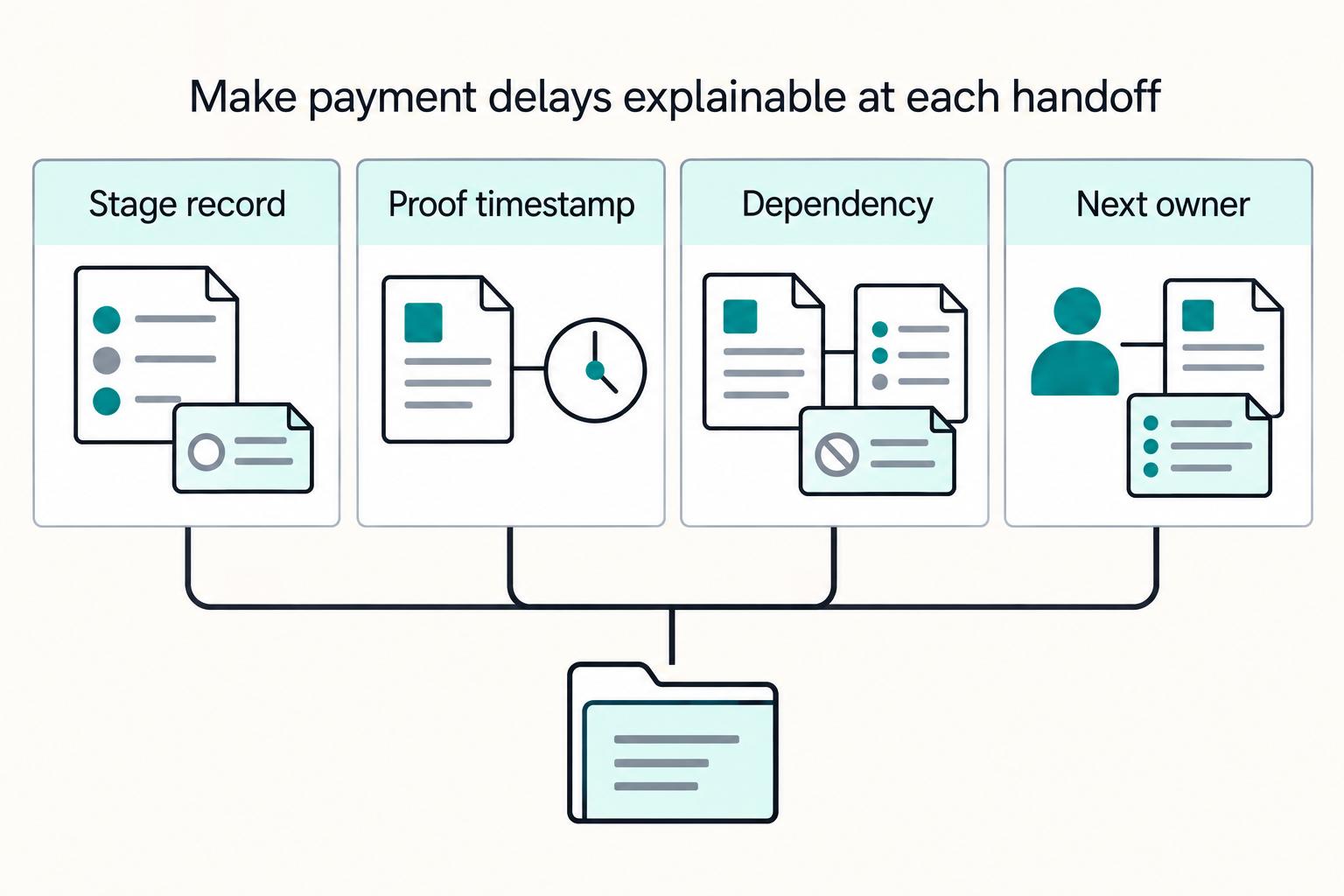
Days Payable Outstanding estimates how long a business carries in-scope supplier trade payables relative to the associated cost flow. It is a period ratio, not the measured duration of each invoice or payout. Use actual invoice and payment milestones alongside it to investigate delays.
Payment Volume Forecasting for Platforms: How to Predict Cash Flow
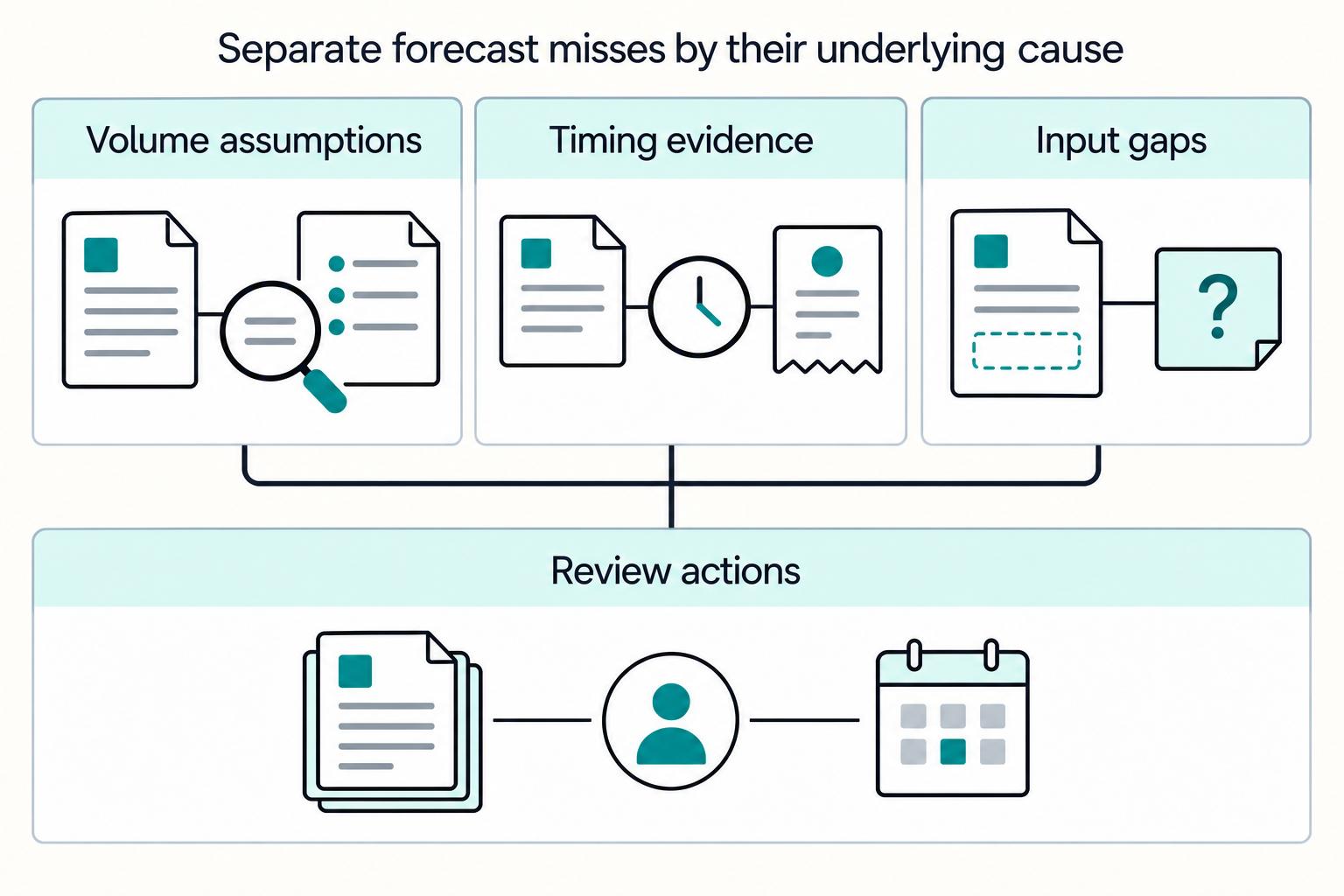
Build this as a payout-reliability forecast, not a generic finance projection. The job is to flag when payout obligations may overtake cash that is actually available. Your model has to track payment volume, settlement timing, and payout schedule together.
Days Payable Outstanding (DPO) for Marketplaces: How to Optimize Working Capital Without Hurting Sellers
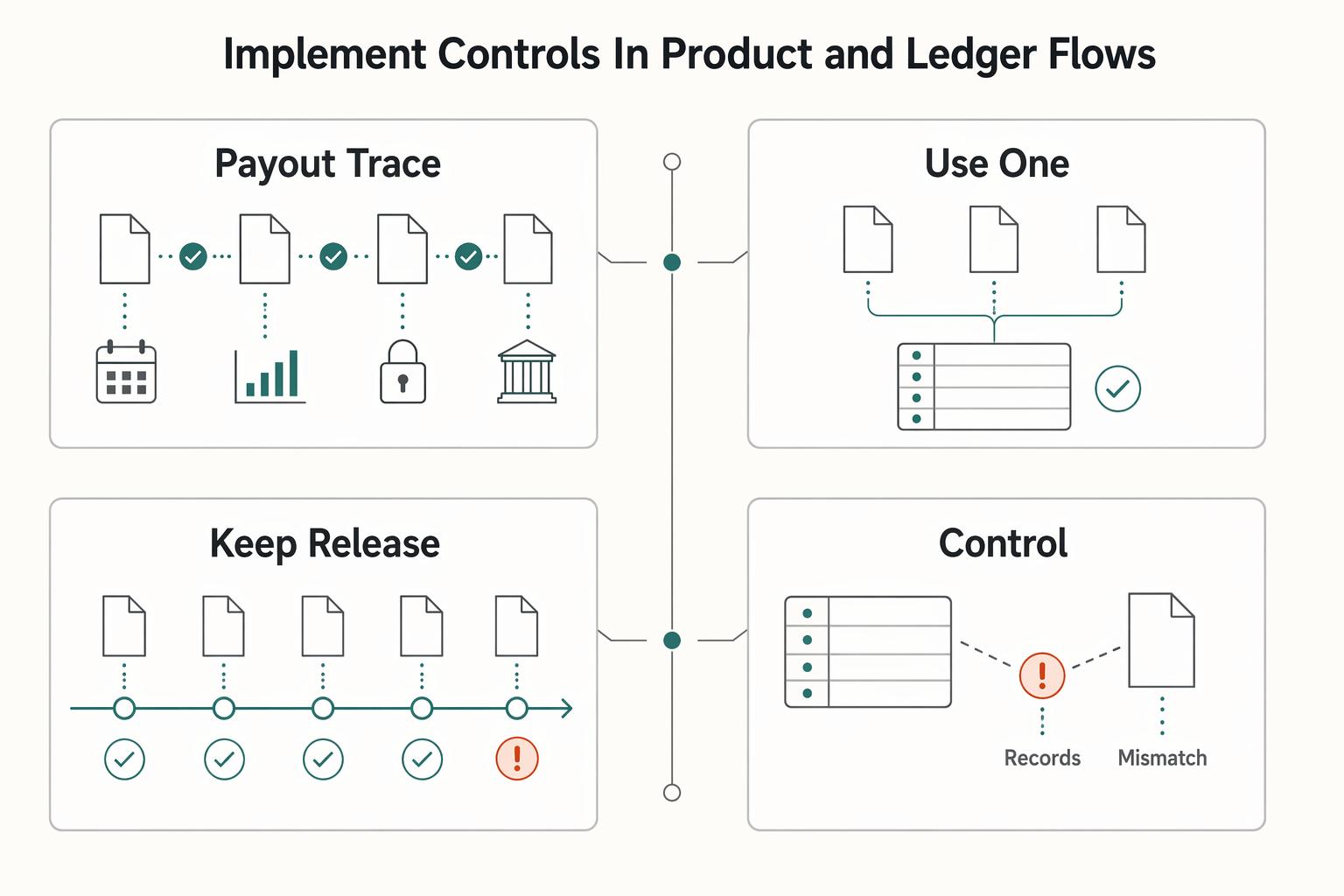
Use trade-payable DPO to understand how your own supplier credit affects cash timing. Measure seller payout reliability separately. Seller or customer funds may be restricted, safeguarded or contractually owed; retaining them does not make them platform operating cash.