
Quick Answer
To predict cash flow on a platform, model payout coverage, not just payment volume. Keep payment activity separate from available cash, map settlement timing to payout timing, and reconcile ERP, bank, and payout-obligation data before forecasting. Use a rolling near-term view of about 10 to 15 days for payout windows and a mid-term view of about 3 to 6 months for planning.
Why Volume Forecasting Matters for Platform Cash Flow#
Before you start#
Build this as a payout-reliability forecast, not a generic finance projection. The job is to flag when payout obligations may overtake cash that is actually available. Your model has to track payment volume, settlement timing, and payout schedule together.
In platform operations, volume growth can look healthy while liquidity tightens because funds are not yet available for payout. Cash forecasting estimates future inflows and outflows over time, and timing alone can still break payout operations. If settlement lands later than expected or reconciliation lags, a forecast can look right on paper and still miss the next payout run.
Treat this as a rolling process, not a monthly exercise. Keep a short-term tactical view of about 10 to 15 days for upcoming payout windows, and a mid-term operating view of about 3 to 6 months for planning. The near-term window is where payout misses surface first, so verification should be stricter there.
Who this is for#
This guide is for platform finance, payments operations, and product owners who manage settlement timing, reconciliation, treasury visibility, or payout execution. It is most useful when forecasting, cash control, and payout release sit with different teams, because handoff gaps can create significant errors.
If you run multiple provider setups or payout rails, timing differences can become material quickly. Stripe separates payout schedule, the cadence funds are paid out, from settlement timing, how long funds take to become available. Your model needs the same separation. Adyen’s Sales day payout documentation illustrates a two-day delay, rather than a universal availability promise. This is another reminder that cash received and cash available for payout are not the same thing.
Before you trust any output, run a simple checkpoint. Compare expected available cash from recent payout cycles against actual bank movement and payout outcomes. If they do not match, fix timing assumptions and source data before tuning forecast drivers.
What you will build#
You will build an operating model that starts with payment activity and ends with a clear payout-coverage decision: covered, delayed, or at risk.
- Collect the minimum input pack from finance and systems: inflows, outflows, open payout obligations, bank data, and calendar assumptions.
- Map the money timeline from payment collection to funds availability to payout execution so settlement timing is explicit.
- Build the baseline forecast for expected inflows, expected outflows, rolling cash position, and near-term payout demand.
- Set decision rules for delayed settlements, payout spikes, and other liquidity-gap scenarios.
- Define recovery steps for stale imports, reconciliation lag, and provider timing shifts that can create false confidence.
- Run a repeatable variance review so this becomes routine, not an ad hoc rescue.
The result is practical: you will know which inputs matter, the order to model them, what to verify before acting, and what to do when the next payout window tightens unexpectedly.
Set the forecasting scope and ownership model#
Set scope and ownership before you tune assumptions. If you do not, forecasting work turns into debate instead of payout decisions.
Step 1 Define volume and cash flow as separate views#
Define Payment volume forecasting as an activity view and cash flow forecasting as a liquidity view. Volume estimates payment demand. Cash flow forecasting estimates available cash, expected inflows, and required disbursements. Keep them separate so growth in processed volume is not mistaken for payout-ready cash.
Use one written metric definition for volume inputs. If you use a TPV-style metric, document that it can be defined as the value of payments net of reversals and can still exclude specific flows, such as gateway-exclusive transactions. Mark markets, providers, and rails as included or excluded.
Step 2 Assign clear ownership for each artifact#
Assign clear ownership to each artifact instead of treating the process as one undifferentiated task. For example, name primary and backup owners for forecast build, Forecast variance review, and Exception queue triage. Route exceptions by type instead of dropping everything into one inbox.
Step 3 Lock decision rights before the first liquidity gap#
Lock decision rights before the first Liquidity gap shows up. Define who can approve policy changes that affect timing and amounts, and ensure treasury is part of that decision process. Also define who can authorize actions related to the Liquidity buffer, the stock of liquid assets held to cover cash-flow needs.
Document approved risk tolerance, named approvers, and periodic review. Also define the minimum evidence needed to act.
Step 4 Write scope exclusions as clearly as inclusions#
Write scope exclusions as clearly as scope inclusions. If coverage varies by market, legal entity, payout rail, or provider setup, state it directly so the forecast does not imply false precision.
If you want a deeper dive, read Cash Flow Forecasting for Payment Platforms: How to Model Payout Obligations.
Gather the minimum input pack before you model#
Clean inputs are a prerequisite, not a formatting step. If actuals, bank movements, and payout obligations are misaligned on timing, a forecast can look precise and still miss a cash squeeze.
| Input area | What to confirm | Blocking note |
|---|---|---|
| ERP system and Bank data | Align selected periods using the posting cutoffs your team actually used | Cash movement should tie across periods, with only known in-transit items as exceptions |
| Inflows, outflows, and Payout obligations | Build reconciled views and keep pending funds separate from available funds | Unresolved reconciliation differences are a blocker |
| Operating calendar | Include settlement windows, payout batch days, weekends, and holidays | Use rail-specific and provider-specific cutoffs as specific assumptions, not universal rules |
| Three-statement structure | Inputs should flow coherently across the Profit and loss statement, Balance sheet, and Cash flow statement | Required for an integrated three-statement model; a direct cash forecast needs its own balance and obligation checks |
Step 1 Align ERP and bank actuals on posting cutoffs#
Start by aligning period actuals from your ERP system and your Bank data using the posting cutoffs your team actually used. The goal is consistency across sources, not a universal cutoff rule.
Checkpoint: cash movement for the selected ERP period should tie to the selected bank period, with only known in-transit items as exceptions. If one source includes late postings that the other excludes, label that gap before you model.
Step 2 Build reconciled views and keep pending funds separate#
Build reconciled views for inflows, outflows, and open Payout obligations, and keep pending funds separate from available funds. Pending balances are not payout-ready cash.
Keep unresolved reconciliation differences visible in an exception view. If bank activity, payout reports, and ledger entries do not reconcile, resolve the discrepancy before automating a payout decision. Pending inflows can be excluded from usable cash, but retain known payout obligations and model uncertain liabilities conservatively so missing rows do not create false coverage.
Step 3 Map the operating calendar that drives settlement timing#
Map the operating calendar that drives Settlement timing before you set timing assumptions. Include settlement windows, payout batch days, and relevant weekends and holidays.
Use rail-specific and provider-specific cutoffs where available. For example, ACH same-day handling depends on transmission deadlines such as 10:30 a.m. ET or 2:45 p.m. ET windows, and provider-specific availability and payout settings. Keep these as specific assumptions, not universal rules.
Step 4 Confirm the three-statement structure before running projections#
If you choose an integrated three-statement forecast, make sure its income statement, balance sheet, and cash flow links agree. A direct cash forecast can still support near-term payout decisions without a complete profit-and-loss forecast when it accounts for usable balances, known obligations, and timing.
For an integrated model, map each material driver to its statement effects. For a direct cash forecast, check opening usable cash plus expected receipts minus outflows against the projected closing position. Match the validation to the model you are using.
Map the money timeline before touching formulas#
Before you build formulas, confirm when cash becomes usable, not just when activity is booked. If you skip this timeline, reported performance can look healthy while a Liquidity gap is forming.
| State | What it shows | Timing note |
|---|---|---|
| Captured | Payment has been collected | Do not treat capture as payout-ready cash on day zero |
| Pending | Funds are not yet available | Availability can vary by market, payment method, and transaction type |
| Available | Funds are usable cash for payout | Keep availability separate from payout cadence |
| Payout initiated | Payout has been sent but may not yet be visible in Bank data | Use the account’s expected arrival date and the receiving bank’s posting estimate |
| Posted to bank | Movement is visible in Bank data | Compare expected posted dates with actual results during reconciliation |
Step 1 Map money movement from collection to availability to payout#
Map money movement from collection to availability to payout. For each inflow and outflow, track five states: captured, pending, available, payout initiated, and posted to bank.
Use that map to encode Settlement timing as variable, not fixed. Funds first appear as pending, and availability can vary by market, payment method, and transaction type. Use the selected account and payment method’s settlement estimate; capture should not be treated as payout-ready cash on day zero.
Keep payout cadence separate from availability. A daily payout schedule does not control how long pending funds take to become available. Daily schedules can still run with a 3 business day payout speed.
Step 2 Separate revenue recognition from cash availability#
Separate revenue recognition from cash availability before you connect the Profit and loss statement to the Cash flow statement. Under accrual accounting, income can be recorded when earned even if cash is received later.
If your model pulls booked revenue forward but does not apply the same timing discipline to cash, it can overstate near-term liquidity. When timing diverges, profit and cash should diverge in the forecast too.
Step 3 Mark timing risk zones directly in the timeline#
Mark timing risk zones directly in the timeline, with special attention to pending balances, held funds or reserves, and late reconciliation. Processors can temporarily hold funds, and bank posting can follow provider payout initiation, with timing determined by the selected route.
Your map should surface both cases: payouts initiated but not yet visible in Bank data, and expected funds still pending or held.
Step 4 Treat reconciliation as a hard release gate#
Treat reconciliation as a hard release gate. No model update should go live until timing assumptions match recent Bank data and payout outcomes. This keeps forecast timing tied to operations, not spreadsheet assumptions.
Match bank statement lines to system transactions, then compare expected available, payout, and posted dates with actual results. If dates drift, update assumptions or add buffer. If reconciliation is incomplete, hold the model change. For an adjacent workflow, see Net-30 Payment Terms for Platforms: How to Set Vendor Payment Terms Without Killing Contractor Cash Flow.
Build the baseline model that predicts cash needs#
Once your timing map reconciles to recent bank movement, the baseline model should answer one question first: when does usable cash stop covering upcoming obligations. If you are using payment volume to help predict cash flow, start with driver-led cash lines, then connect them to a three-statement view.
Step 1 Build driver lines before statements#
Start with Driver-based planning at the cash-line level. Use the operating inputs that actually move cash, then roll those lines up. Cash-driver methods are built for specific line items, and there are multiple driver-based methods available for inflows and outflows.
You do not need every method in the first version. You do need named drivers instead of one blended growth rate. Keep each driver tied to the line it explains, and separate lines that settle on different schedules.
Use a simple verification rule: each material line has an owner, a source file, and a method label. If a cash line has no clear driver, treat it as weak until proven otherwise.
Step 2 Connect drivers into a three-way model#
For an integrated plan, tie those cash drivers into Three-way forecasting so the income statement, Balance sheet, and Cash flow statement move together. If forecast volume changes, the related statement impacts should move with it.
A practical sequence is to model expected inflows, model expected outflows, calculate rolling cash position, and then test that position against near-term obligations. Keep obligations visible as their own view so pressure points stay obvious.
If obligations come from a separate source, version that extract with the forecast. Otherwise the assumptions get updated while the obligations queue does not.
Step 3 Make legal-entity logic explicit from day one#
If multiple companies or regulated units touch the flow, treat Multi-entity consolidation as part of the baseline model from day one. A legal entity can enter contracts and produce its own financial statements, so cash in one entity is not automatically usable in another.
Define entity ownership for each inflow and outflow line, map related accounts and obligations, and set consolidation rules upfront. Maintain separate views of operating cash and money owed to customers or sellers. A provider balance can be available for its recipient’s payout without being available for the platform’s expenses or another recipient’s obligations. Group totals should not hide account restrictions or transfer dependencies.
Step 4 Add horizon checkpoints and keep it rolling#
Run a rolling forecast, not a fixed snapshot. Common cadences are daily, weekly, or monthly, and treasury guidance recommends at least a 12-month rolling period.
| Horizon | Practical cadence | What to verify | Failure signal |
|---|---|---|---|
| Near term, rolling about 10 to 15 days | Daily | Cash available versus scheduled obligations and posted bank movement | Cash misses cluster near obligation dates while monthly totals still look acceptable |
| Mid term, about 3 to 6 months / about 12 to 26 weeks | Weekly | Trend reliability for key drivers such as volume, settlement timing, and spend | Direction keeps changing because drivers are too aggregated or source data is stale |
| Long view, at least 12 months rolling | Monthly | Whether the baseline still aligns with broader funding needs and month-close financial movement | Rolling cash view drifts from month-close ending cash and balance movement |
That month-close check is a practical control, not a formal requirement. Run variance analysis by component, not only on one headline cash number.
Add scenarios and hard decision rules for operators#
Once the baseline shows when cash may get tight, lock in actions before it happens. Scenarios help most when each one changes a specific assumption, hits a named trigger, and routes to a defined action in the Exception queue.
Step 1 Start with three scenarios that stress timing, not just totals#
Model a practical three-case What-if scenario set: base, delayed settlements, and payout spike with unchanged inflows. Keep each case narrow enough that an operator can explain the result in one sentence.
Use the base case as your current best view from the prior section: reconciled inflows, expected outflows, rolling cash, and visible payout obligations. In delayed settlements, move cash availability later while keeping demand mostly intact. In payout spike, increase expected payouts or payout requests while inflows stay unchanged.
Check that timing scenarios really change timing, not hidden volume assumptions. If a rail has known provider timing constraints, model them directly. Stripe documents that an initial payout is typically scheduled 7-14 days after a first successful live payment. Timing stress should show up as later usable cash, not lower revenue.
Step 2 Write hard rules that convert forecasted shortfall into action#
Define explicit if X, do Y rules for when forecasted liquidity falls outside your approved range. Thresholds are policy choices, but the actions should be concrete and pre-agreed.
A practical example: if forecasted liquidity falls below policy range for the next payout window, consider pausing non-urgent payout windows and escalating funding decisions immediately. Document the tradeoff clearly. Preserving payout speed can consume Liquidity buffer, while protecting buffer may require deferring lower-priority payouts or using slower windows.
Treat reconciliation lag and rising return rates as signals to tighten controls. ACH return periods depend on the entry, reason code, and account type; a consumer unauthorized-debit return and a bank-to-bank warranty claim follow different rules. Keep the affected inflows and potential return liabilities visible while payments operations confirms the applicable timeline.
If you maintain a contingency funding plan, link these rules to it. Banking-sector interagency guidance is a useful design reference, rather than a blanket requirement for software platforms. It emphasizes cash flow projections, stress testing, liquid-asset cushions, and a formal CFP. FDIC guidance says CFPs should be practical across a range of stress scenarios.
Step 3 Route every scenario to an owner and evidence pack#
Each scenario needs a trigger, owner, response expectation, and required evidence. Without that, exception handling turns into opinion instead of policy execution.
| Scenario trigger | Impacted metric | Operator action | Approval owner | Rollback condition |
|---|---|---|---|---|
| Base case stays within policy range through next payout window | Rolling cash position versus scheduled payout obligations | Continue normal payout schedule and monitor variance at the normal cadence | Forecast owner or treasury/finance lead | Move to exception handling if the next refresh shows policy breach or unresolved reconciliation lag |
| Settlement timing slips versus baseline, whether from provider delay or late posting | Cash availability date, near-term liquidity buffer, entity-level usable cash | Tighten payout timing, pause non-urgent payout windows, review contingency funding readiness, and escalate the same day | Finance lead with payments ops sign-off, plus funding decision owner if external funding is needed | Restore the standard payout window after delayed credits post, bank data reconciles, and returns are back inside policy range |
| Payout spike with unchanged inflows | Next payout window coverage, daily cash burn, projected shortfall date | Prioritize obligations by policy, defer lower-priority outflows, escalate funding decision, and document the customer-impact choice | Payments ops lead plus finance approver | Resume normal release after the payout queue normalizes and the next forecast refresh shows coverage without emergency actions |
In the exception queue, require the model version, bank-data snapshot, payout-obligations extract, unresolved reconciliation items, and override approver. Stripe Instant Payouts can accelerate an eligible account’s instant-available balance to a supported destination, typically within 30 minutes, for a fee. They do not make held funds available or create new liquidity. Record any such timing decision and its cost explicitly.
Step 4 Review whether the rule held up in live operations#
After each scenario-triggered action, test whether the rule protected cash without avoidable payout disruption. For banking organizations covered by the cited liquidity framework, governance cadence is explicit: tolerance approval at least annually and senior-management review at least quarterly. Other platforms can use a similar discipline, adapted with counsel/compliance for their setup.
Use one checkpoint: did the action preserve enough buffer for the next payout obligation, and did the evidence pack clearly support the decision? If not, tighten trigger definitions or reduce operator discretion. Related: What Is Invoice Factoring? How Platforms Can Offer Early Payment to Contractors in Cash Flow Crunch.
If your team is defining pause/continue rules for payout windows, use this section to map those triggers into a controlled execution flow with Gruv Payouts.
Choose tooling by operating fit, not feature lists#
Choose the stack that gives you cleaner inputs and a repeatable variance review, not the one with the best demo. In practice, that usually means less manual reconciliation and fewer surprises before the next payout window.
Step 1 Score tools on the four criteria that change operations#
Start with only four capabilities: ERP system connectivity, Bank data freshness, Driver-based planning, and Multi-entity consolidation. These are core inputs for keeping forecasts current and reducing spreadsheet rebuilds.
Use market names as anchors, not endorsements. Fathom emphasizes consolidation, forecasting, QuickBooks/Xero integrations, and driver-based planning. Trovata emphasizes current bank data and aggregation across bank accounts and ERPs. HighRadius, Cobase, and GTreasury emphasize bank and ERP connectivity, and GTreasury also emphasizes multi-entity cash consolidation.
| Tool or network | Publicly emphasized fit | What to verify in your trial |
|---|---|---|
| Fathom | Driver-based planning, cash flow forecasting, multi-entity consolidation, QuickBooks and Xero connectivity | Can you model payment-volume drivers and consolidate entity cash without export workarounds? |
| HighRadius | Secure API-based bank and ERP connectivity | How often does bank data refresh in practice, and are exceptions visible before forecast refresh? |
| Cobase | Standardized bank-to-cloud-ERP connection | Is your actual ERP and bank mix supported without custom file handling? |
| GTreasury | ERP integration, bank API connectivity, multi-entity treasury connectivity | Does bank API setup fit your banking footprint and entity structure? |
| Trovata | Aggregates multiple bank accounts and ERPs with current bank data | Are near-term cash updates fresh enough for payout-timing decisions? |
| QuickBooks and Xero ecosystems | Broad app ecosystems | Do the specific apps you need handle your payout and reconciliation workflow? |
A practical test is one full refresh from source data to forecast output with no CSV patching in the middle.
Step 2 Test operational gaps feature pages do not resolve for you#
Feature pages can confirm capability categories, but they do not prove your full operating process. In trial, require proof for three live tasks:
- Import fresh bank activity and show the timestamp you will rely on.
- Reconcile one payout-heavy week back to ERP and bank records.
- Walk a forecast miss from variance detection to a named owner, approval, and rollback.
If that chain breaks, you still have a manual process behind a polished reporting layer. Also treat app marketplaces as a starting point, not proof of fit. Xero notes that while it reviews apps in its App Store, it cannot give guarantees.
Step 3 Choose the stack that removes manual work first#
Use operating friction as the decision rule. If one option looks better in a demo but another shows less manual reconciliation in trial and supports clean Forecast variance review, choose the second.
Check consolidation boundaries early for multi-entity models. Fathom publishes limits of up to 300 entities for single-currency and up to 50 for multi-currency consolidations. If your structure pushes those limits, test treasury-oriented options earlier.
For bank connectivity claims, turn marketing into trial criteria. Ripple Treasury’s GSmart page advertises API-enabled bank connectivity within 7 days. Treat that as a vendor claim, then confirm your named banks, required fields, and implementation timeline during the trial.
Pick the stack that shortens the path from bank movement to decision. A trial that demonstrates fresh inputs, traceable exceptions, and a usable payout-coverage view tells you more than dashboard polish.
Run a weekly variance and escalation cycle#
Once your stack refreshes cleanly, run a fixed weekly variance loop and escalate early when repeated misses put payout obligations or your liquidity buffer at risk. Review forecast-to-actual misses by driver, not as one blended error rate, so teams can separate model error from timing and data issues.
Step 1 Classify misses by the driver that caused them#
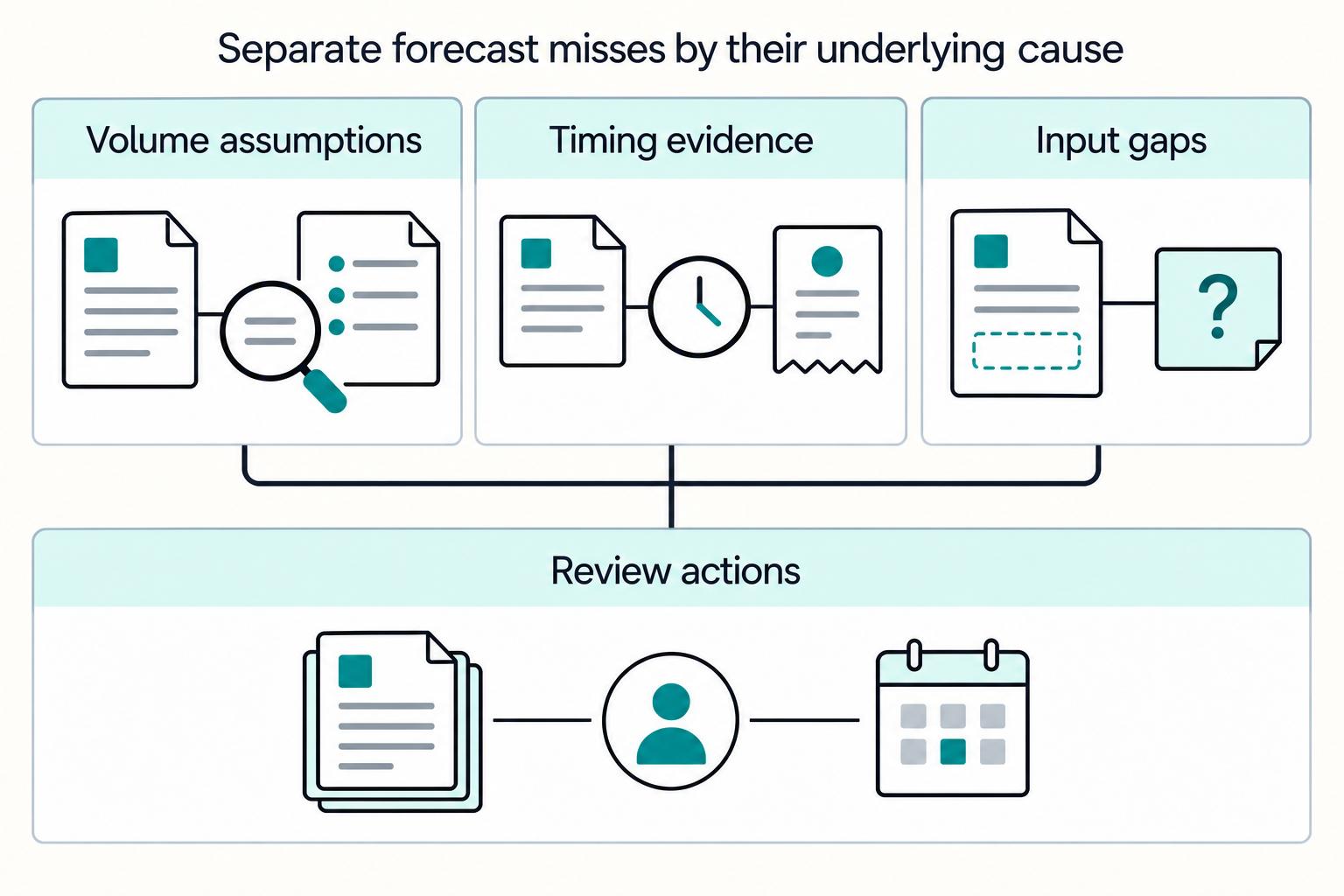
Start with variance analysis: compare planned or forecast values to actual results, then classify each material miss by practical driver. For platform cash forecasting, one practical split is volume error, settlement timing error, and input-data completeness issues when source data is still incomplete.
Use that classification to choose the next action. Volume misses point to demand or planning assumptions. Timing misses point to settlement or payout behavior. Unresolved input-data issues mean you should confirm data completeness before treating the miss as model failure.
Step 2 Hold one fixed Forecast variance review and close with owners#
Keep one weekly Forecast variance review cadence and use it consistently. Weekly is an operating choice, not a regulatory mandate, and it helps teams review the same period with reconciled inputs.
Run the review with the teams accountable for forecast inputs and payout execution, then close with named actions, due dates, and the forecast version that will incorporate each change. The meeting should end with two outputs: whether upcoming payout obligations are still covered, and what will reduce the next miss.
Step 3 Escalate on repeated misses that change liquidity risk#
Escalate when repeated misses become an early warning signal for liquidity risk, especially when confidence in near-term cash is falling. The trigger is practical: if misses could prevent payment obligations from being settled when due or materially consume the planned liquidity cushion, move to escalation.
If you maintain a contingency funding plan, use it here as the decision path instead of waiting for a crisis.
Step 4 Require an evidence pack before any escalation call#
Require a compact evidence pack for every escalation so decisions are traceable and based on current inputs. Include:
- model version and key assumption changes
- data inputs and timestamps used in review
- any unresolved data-quality gaps that could affect the variance call
- current view of upcoming
Payout obligations - owner sign-off
If input timestamps or data-quality status is unclear, verify inputs before changing payout behavior.
Recover fast when forecasts break in production#
When forecasts break in production, check for data-timing issues first, then treat it as a model issue if the data is current and the miss remains.
Step 1 Freeze risky decisions and verify source freshness#
Consider pausing near-term automated decisions that depend on current cash, including payout-release or funding logic. Then verify freshness of your ERP system imports, Bank data feeds or files, and open reconciliation status for the forecast period. If inputs are delayed or incomplete, label the forecast degraded and recover data quality before you retune assumptions.
Step 2 Rebuild from reconciled actuals before changing drivers#
Recompute the current position from reconciled inflows, outflows, and upcoming payout obligations. Compare that reconciled view to the forecast version that was driving decisions.
Keep payout timing separate from availability timing. Payout schedules do not control when pending funds become available, and bank posting can add time according to the selected payout route. Weekend and holiday calendars can extend receipt timing further.
Step 3 Rebuild the next payout window first#
If near-term obligations are at risk, prioritize the next payout window before you repair the full horizon. The immediate objective is to meet obligations as they come due.
When payout demand rises while settlement slows, use the approved prioritization policy and honor the affected recipients’ contractual rights. Defer an outflow only where its terms permit it, and escalate a real funding gap. Validate timing against the selected provider, account, and rail rather than assuming one payout-size threshold applies everywhere.
Step 4 Restore automation in stages#
Re-enable automation after restore checks pass: source feeds are current, reconciled reruns align with near-term movement, and payout-window assumptions reflect current timing behavior. If inputs are fresh and breaks persist, route the issue to variance review as a model or behavior problem.
Step 5 Capture the incident for future scenario quality#
Keep an auditable incident record. Record what failed, the affected forecast version, the source snapshots used in recovery, paused decisions, and restore time.
Feed those patterns into What-if scenario modeling so future stress cases reflect real stale-import and payout-timing failures, not clean-room assumptions.
Avoid the mistakes that make forecasts look accurate but fail operations#
Forecast failures are often process failures before they are formula failures. If your forecast cannot show whether upcoming Payout obligations can be met, your Cash flow forecasting is not operational yet.
| Rail | Timing detail | Modeling reminder |
|---|---|---|
| FedNow | Designed for 24x7x365 processing | Do not rely on one default timing rule across rails |
| ACH | Runs 23¼ hours every business day with four settlement times | Validate booking, settlement, and availability timing against recent bank postings and payout outcomes |
| Same Day ACH | Settles three times daily | Do not treat booking, settlement, and availability dates as interchangeable |
Step 1 Pull payment drivers out of finance-only ownership#
Treat forecasting as cross-functional, not finance-only. Finance, product, and payments ops should each own inputs that shape cash movement, because business behavior drives cash needs.
Before each refresh, confirm clear ownership for volume assumptions, Settlement timing, and sign-off on open payout demand. If any input is still a best guess, your next Forecast variance review can turn into avoidable miss analysis.
Step 2 Replace default rail timing with your actual timing map#
Do not rely on one default timing rule across rails. FedNow is designed for 24x7x365 processing, while ACH runs 23¼ hours every business day with four settlement times, and Same Day ACH settles three times daily.
Validate booking, settlement, and availability timing against recent bank postings and payout outcomes before promoting forecast changes. Treating those dates as interchangeable is a common way to create false confidence.
Step 3 Add multi-entity logic before month-end forces it on you#
Build Multi-entity consolidation into the operating process early. If you wait for month-end, entity-level blind spots and intercompany effects will be discovered too late.
Keep both views active: entity-level cash for execution decisions, consolidated cash for group exposure. Maintain current entity mapping, intercompany accounts, and elimination logic during the month, not only at close.
Step 4 Judge the process by controls, not dashboard polish#
Use control outcomes, not dashboard completeness, as your success test. Better signals are more timely bank-to-accounting reconciliation and variance reviews with fewer unexplained timing misses.
If you need a tighter standard, improve reconciliation and variance discipline before adding new reporting visuals. That is what makes forecasts trustworthy in operations.
Turn this into a repeatable operating rhythm#
The point of all this is not a better spreadsheet. It is a repeatable operating rhythm that tells you, before the next payout run, whether cash is truly available and what action to take if it is not.
- Confirm reconciled inputs from ERP and bank data.
Do not proceed until cutoffs match. Cash, receivables, payables, and bank activity should reflect the same as-of point, and you should either explain every material break or confirm the relevant area is fully reconciled.
- Update driver assumptions for payment volume and settlement timing.
Refresh assumptions from recent posting behavior, not generic expectations. Keep payout frequency separate from funds availability so the model reflects when cash is usable, not just when activity was recorded.
- Recompute baseline and scenario outputs for payout obligations.
Rerun the baseline and scenario cases for the next payout window and a short-term rolling view of about 10 days. If you also run treasury planning, keep the longer rolling view current as well, including a 12-month rolling period where used.
- Run a forecast variance review and assign actions with owners and due dates.
Review misses by driver category, especially volume error versus settlement-timing error, so root causes are clear. Close the review with explicit follow-ups for the next cycle.
- Escalate when triggers hit, document decisions, and clear open exceptions.
Escalate when repeated misses threaten upcoming payouts or unresolved reconciliation issues reduce forecast reliability. Include the model version, bank snapshot, unresolved items, and the decision taken, and clear open exceptions before the next cycle.
Once this weekly checklist is stable, turn it into a repeatable implementation plan with clear controls and status handling in the Gruv docs.
Frequently Asked Questions
How is payment volume forecasting different from cash flow forecasting for platforms?
Payment volume forecasting estimates throughput, such as TPV, using a documented convention for included transactions and reversals. Cash flow forecasting estimates usable balances, inflows, obligations, and when cash will arrive or leave. Volume is an activity measure, not profitability or payout coverage.
What inputs are required to predict payout cash needs with confidence?
Start with accounting and bank data, open receivables and payables, and payout obligations. Keep account ownership and restrictions explicit. Align cutoffs and timing, and validate settlement assumptions against recent postings and payout outcomes before trusting the forecast.
How often should platform teams refresh forecasts during normal weeks and during volatility?
There is no universal cadence. A practical baseline is a weekly liquidity projection with consistent variance review, and during volatility teams should refresh before the next critical payout event when payment patterns or settlement behavior change.
Which metrics should trigger escalation to protect payout reliability?
Escalate when upcoming payout obligations may be at risk. Repeated material forecast-to-actual cash variance, settlement delays on key inflow channels, and signs that assumptions no longer match current conditions are strong triggers.
What are the most common failure points in platform cash forecasting systems?
The biggest failure point is process design: too much manual compilation and too little validation against real cash movement. Other common issues are unvalidated settlement assumptions, overreliance on TPV trends, and operating without meaningful cash-flow projections or contingency plans.
How do I choose between a lightweight accounting-led setup and a treasury-oriented forecasting stack?
Use a lightweight accounting-led setup when connected accounting and bank data give enough short-horizon visibility. Choose a treasury-oriented stack when you need real bank plus ERP data across short-term and long-term horizons and greater organizational complexity.
Where Gruv fits
See reconciliation and mismatch review
Compare ledger entries, provider payment records, and statement rows to see what matches and what finance needs to review.
Plan and approve payout batches
See how payee status, approval rules, route review, and exception handling sit in one payout workflow.
Researched and edited by the Gruv editorial team. Gruv builds cross-border billing, payouts, and finance-operations software for global businesses.
Sources
- cisa.gov/resources-tools/resources/federal-government...trusted
- csrc.nist.gov/projects/incident-responsetrusted
- docs.stripe.com/payoutstrusted
- docs.stripe.com/payouts/instant-payoutstrusted
- ecfr.gov/current/title-12/chapter-II/subchapter-A/par...trusted
- fdic.gov/news/financial-institution-letters/2023/fil2...trusted
- federalreserve.gov/frrs/guidance/interagency-policy-statement-o...trusted
- federalreserve.gov/frrs/guidance/questions-and-answers-on-state...trusted
Educational content only. Not legal, tax, or financial advice.
Related Posts

The Freelance Payment Penalty: A Modeled Audit of Platform Fees, FX Spreads, and Payout Delays
The money rarely disappears through a single, easy-to-spot fee. The real loss is stacked. A marketplace takes its commission, a processor adds a charge for international cards, a bank or payment company converts the currency at a spread, a platform holds the funds before release, and a wire sheds a little to intermediaries on the way in. Each layer looks defensible on its own, but the worker feels the combined result as a smaller deposit and a later payday.

How to Respond to a Subpoena for Business Records
Move fast, but do not produce records on instinct. If you need to **respond to a subpoena for business records**, your immediate job is to control deadlines, preserve records, and make any later production defensible.

A US Expat's Guide to Investing in UCITS ETFs to Avoid PFIC Issues
The real problem is a two-system conflict. U.S. tax treatment can punish the wrong fund choice, while local product-access constraints can block the funds you want to buy in the first place. For **us expat ucits etfs**, the practical question is not "Which product is best?" It is "What can I access, report, and keep doing every year without guessing?" Use this four-part filter before any trade: