
Quick Answer
Forecast obligations due and executable funding separately for each legal entity and currency. Expected settlements inform planning; release requires verified usable cash or permitted confirmed prefunding. Reconcile one data cut, avoid double-counting restrictions or funds in transit, preserve unpaid liabilities and block duplicate execution while an earlier payment outcome is unknown.
What the Forecast Needs to Show Before You Release Payouts#
A payout forecast needs a clear distinction between expected inflows and verified executable funding. Reconciled available cash supports ordinary release; an accelerated or prefunded path needs actual product eligibility, lawful funding and confirmed capacity. Preserve obligations due even when funding is short, and keep one auditable data cut for the release decision.
Keep these checks in view from day one#
-
Separate payout timing from cash availability. In Stripe, funds are usable for payouts after they settle into the available balance. Stripe also states that payout schedule changes affect when payouts are sent, not when pending funds become available. A daily payout schedule does not mean today's batch cash is already usable.
-
Treat reconciliation as a release check. Payment reconciliation means matching transaction records with accounting records to confirm consistency. At the PSP layer, a transaction-level export like Adyen's Settlement details report supports transaction-level settlement reconciliation. If a forecast cannot point to the report extract and accounting snapshot used for the run, confidence in the release number drops.
-
Model a buffer, not just a balance. Stripe minimum balances are meant to reduce negative-balance risk after payouts when refunds, disputes, or fees arrive later. Releasing every available dollar can turn normal post-payout adjustments into liquidity stress.
Start with settlement truth#
Keep two views: expected inflows for planning and verified executable funding for release. Do not add bank cash to the same processor funds in transit twice. Funding must be available to the correct legal entity, currency and obligation, or supplied by an explicitly permitted, confirmed prefunding or credit arrangement.
Payout schedules do not establish cash availability. Stripe documents a three-business-day availability example, while actual timing varies by market, method and account. Adyen Sales day payout delays depend on configuration and processing mix; its two-business-day example is conditional. Model the actual account settings and observed bank arrival separately.
What good looks like#
For each payout run, you should be able to answer four questions. Which obligations are due? Which funds are settled and eligible? What reserves or holds reduce releasable cash? Which exceptions still block release? Finance, ops, and product should see the same answer from the same data cut, even if each team owns different checkpoints.
Before using the forecast for release, tie the funding and obligation views to accounting records and current reconciliation evidence. Investigate discrepancies and restrict the affected release while preserving due liabilities and required escalation.
Stop buying tools before you define payout decisions#
Define payout decisions and control ownership before selecting forecasting software. A common failure mode is unclear release actions and unclear accountability when numbers conflict.
Before comparing forecasting software, identify what action changes when the forecast changes: batch size, prefunding, reserve funding or an item hold. Require each tool to expose the same obligation and funding evidence used by finance.
Name the payout decisions before naming the tool. Your forecast should map to explicit actions, such as:
- release or reduce a payout batch
- prefund an upcoming run
- top up a reserve
- hold specific items for review
Then define the operating constraint for each action. With Adyen, reserve funding can be deducted from payable balance when the payout batch closes. With Stripe manual payouts, you can control timing, but payouts still must occur within the allowed country-specific timeframe.
Name who prepares the release recommendation, reviews reconciliation and approves the run. Escalate conflicting balances to those owners before relying on automation.
That split is a control, not admin overhead. Review-and-approval guidance supports explicit sign-off and can reduce single-operator risk when balances do not match during reconciliation.
Use vendor forecasts as inputs, not release proof. Release decisions should still tie to General Ledger records and reconciliation evidence.
Forecasting tools can integrate with core finance systems, but ledger settlement still has to be matched and checked. If forecast output cannot be tested against the ledger snapshot, reconciliation status, and open exceptions, treat it as planning support only.
Prepare the minimum inputs before modeling#
If inputs are not named, timestamped, and separated by confidence level, your forecast is planning input, not payout evidence. Before modeling, make the dataset auditable enough that another operator can rerun it and reach the same decision.
Confirm source systems, currencies and owners per legal entity. A group-level balance can hide funds unavailable to the entity that owes the payout. Assign an owner for the ERP, ledger, bank feed and provider reconciliation export, with explicit exchange-rate and reporting conventions.
Checkpoint. Every feed should have an accountable owner, extraction method, and fallback contact if the feed is late. Watch for cases where bank data appears complete while PSP reconciliation status is stale.
Create one canonical data cut. Stamp each item with clear timestamps for event time, Settlement Timing, and expected payout timing. This is not a universal standard, but it is a practical structure for separating transaction occurrence, cash availability, and payout obligation.
Set report boundaries and timezone explicitly. Stripe payout reconciliation groups payouts by estimated arrival date, which can differ from the bank posting date; report availability has its own processing schedule. Preserve event, availability, expected arrival and actual bank posting timestamps separately.
Split clean data from provisional data before the model runs. Keep posted ledger events and reconciled payouts in the clean set. Keep pending ACH or direct-debit items, other delayed-notification methods, and items with unresolved disputes in provisional until outcomes are known.
Cash can be overstated here. Settlement time is when funds become available, not when the transaction was created.
Build an evidence pack for every run. Include source extract IDs or Report Run IDs, reconciliation status, and forecast-versus-actual variance checks where available. For Stripe flows, retain the payout reconciliation reference that links each bank payout to the settled transaction batch.
Use the report appropriate to the payout model. Stripe payout reconciliation normally covers automatic payouts; its documentation describes a Connect exception for platforms on manual payouts whose connected accounts pay out automatically. Other manual flows use balance reporting, and instant payouts need operator-maintained transaction linkage.
Define the forecast unit and cash states#
Forecast at Payout Obligation level, not just account-balance level. Headline cash can look sufficient while payouts still miss cutoff when funds are pending, reserve-held, or otherwise not usable for the due cohort.
| Cash state | Use in model | Article detail |
|---|---|---|
| available | Cash usable by the actual entity and currency can fund eligible payouts | Use provider availability states as the base |
| restricted | Visible but not releasable cash | Release only after actual hold conditions and authorized release are satisfied |
| buffered | Internal operating cushion | Keeps withheld cash intentional and explainable |
| unsettled inflows | Track separately by Payment Rail | Include in labeled expected scenarios; executable funding requires verified availability or supported confirmed prefunding |
Model each Payout Obligation as its own liability line with fields like amount, due window, and eligibility status. That keeps exposure, timing, and release readiness visible in one record instead of scattering decisions across notes and exception lists.
Bucket each liability by contractual due time and release cadence, such as next cutoff, later today or a later batch. An internal cash restriction does not erase what is owed or change a contractual due date; record lawful eligibility holds separately and escalate a funding shortfall.
Checkpoint. Total modeled obligations for the run should reconcile to the payout file or the relevant General Ledger control total for that entity and batch.
One workable approach is to split cash into states that explain payout usability: available, restricted, and buffered, with unsettled inflows tracked separately by Payment Rail. The goal is decision clarity, not a universal naming standard.
Include pending inflows in clearly labeled expected scenarios with availability assumptions and uncertainty. Exclude them from executable funding until actual provider or bank availability is verified, unless a supported, lawful prefunding or credit arrangement supplies the required cash.
Use restricted for funds visible but not releasable, including reserve-held balances. Keep buffered explicit as an internal operating cushion so withheld cash is intentional and explainable.
Use the actual provider account and payment-method availability rules. FedACH’s third same-day window has a 4:45 p.m. ET transmission deadline and 6:00 p.m. ET settlement; banks can impose earlier deadlines. Fedwire processing finality differs from recipient operational confirmation and does not justify resending an unresolved instruction.
Move pending funds into executable funding only after verified availability and required reconciliation, not merely after the expected time passes. Move restricted funds back only after the actual contractual or legal release conditions and authorized release are satisfied. Keep each transition and its evidence auditable.
Make exclusion reasons operationally visible. Every excluded amount should carry one reason and one next-change condition, such as "awaiting settlement," "unreconciled," or "reserve hold active."
If obligation-level tagging is missing in the General Ledger, treat automation and forecast-frequency scaling as higher risk until the taxonomy is fixed. Otherwise, you may be automating account-balance math rather than payout decisioning.
Build a ledger-first dataset that survives audit#
Use the General Ledger as the authoritative base, then layer in reconciliation and bank or provider detail for timing and traceability. That keeps booked amounts and dates stable while still giving ops enough detail to explain payout decisions.
Anchor on the General Ledger. Start each forecast cut from posted General Ledger journals where possible. The ledger is your complete accounting record, so it is a strong control point when finance, ops, or audit asks how a payout decision was made.
Add historical accounting data from ERP modules, bank events, and provider exports as enrichment. Use them to improve context and timing, but do not let enrichment override booked ledger amounts or posting dates.
Join reconciliation records with stable references. Join PSP Reconciliation records to ledger events with stable matching attributes, not fragile text fields. Reconciliation is a comparison process, so match quality depends on durable references such as transaction IDs, payout or batch IDs, and reconciliation references.
Provider artifacts support this structure. Stripe separates payout-batch reconciliation from unsettled ending-balance reconciliation. Adyen settlement reporting includes batch, date, and unique-identifier fields that are useful for traceable joins. Keep unmatched lines in a documented exception workflow with a unique reference so they can be resolved and reviewed.
Keep settlement and payout events separate. Settlement time covers when funds become available, while payout activity is reported separately in reconciliation views. Combining them too early can hide usable-cash risk.
Keep that separation through your forecast inputs, and document reconciliation checks so breaks are visible and reviewable. If inputs do not tie cleanly to your accounting records for a run cut, flag and investigate the discrepancy before relying on the output. Related reading: Build a Contractor Payment Flow for Home Services Marketplaces.
Map settlement behavior by payment rail#
Choose a supported rail from reachability, funding, deadlines and actual performance before submission. A slow or unknown existing payout must be reconciled before creating an alternate transfer; a faster rail does not make duplication safe.
Build a rail table from documented timing and your own actuals. Start with published Settlement Timing, then add your observed lag from instruction time to funds-available confirmation. The goal is rail-level operating truth in your environment: expected timing, actual lag, reversal or return exposure, and repeat failure patterns.
| Payment Rail | Expected Settlement Timing | Observed Settlement Lag to track | Return or reversal behavior | Common failure pattern |
|---|---|---|---|---|
| ACH | Windowed and business-day constrained. FedACH same-day windows include 10:30 a.m. ET submission for 1:00 p.m. ET settlement, 2:45 p.m. ET for 5:00 p.m. ET, and 4:45 p.m. ET for 6:00 p.m. ET. ACH settles four times each business day. | Track actual settlement versus intended window, plus delay from settlement to usable-bank confirmation. | Return and reversal exposure depends on the entry type, reason and applicable rules; measure actual funding risk. | Missed cutoff, weekend or holiday assumptions, late file delivery, returns after funds were treated as clean. |
| FedNow | Near-real-time, 24x7 processing where the selected institutions and recipient are enabled. | Track accepted instruction time to recipient funds-available confirmation. | A common operational risk is reachability or availability rather than batch-window drift. | Recipient path not available on the rail at execution time. |
| RTP | The RTP network is available around the clock, including weekends, holidays, and after hours. Credit transfer settlement is final and irrevocable. | Track instruction acceptance to final confirmation; flag drift away from near-immediate behavior. | Final and irrevocable once processed for credit transfers. | Counterparty or path not reachable; select a supported route before sending, not a duplicate after an unknown outcome. |
| Fedwire | Real-time gross settlement. Transfers are immediate, final, and irrevocable once processed. Business day runs 9:00 p.m. ET to 7:00 p.m. ET, with a 6:45 p.m. ET third-party deadline. | Track release to processed confirmation, especially near deadline. | Final once processed. | Approval or file delay near cutoff turns same-day plans into next-day funding. |
Checkpoint for every run. Compare expected window versus actual bank or provider confirmation timestamp for the last completed cycle. If ACH submissions intended for the 2:45 p.m. ET window repeatedly miss the expected 5:00 p.m. ET settlement pattern, treat that rail as unreliable for that use case until performance recovers.
Set Reserve Account assumptions by reversal and timing risk. Set rail buffers from observed risk, not a fixed multiplier. ACH typically needs more caution because settlement is windowed and reversals or returns can change what is safe to release.
Separate "settled on schedule" from "safe to spend for payout." For ACH-backed inflows, hold more in Reserve Account when you see elevated return activity, recent reversals, unresolved exceptions, or repeated cutoff misses. Use evidence from current operations instead of a universal rail rule.
Use return behavior from the actual inflow method and cohort to size liquidity buffers. Debit-originator return-rate controls are distinct from credit-payout limits and do not establish a universal payout release threshold.
On real-time rails, timing buffers may be smaller when recipient reachability is confirmed. That benefit depends on actual execution conditions, not the rail label alone.
Route new urgent instructions away from unstable rails when the recipient, funding and partner support the alternative. For an existing instruction, first establish that it was never sent or definitively failed without money movement; an unknown outcome blocks replacement.
- For new urgent payouts, evaluate supported FedNow or RTP reachability, funding and actual partner limits.
- For customer Fedwire transfers, allow for the bank’s earlier operational deadline before the 6:45 p.m. ET service cutoff.
- A missed ACH window may leave a later supported window the same day; verify bank cutoff and funding. Reroute only if the original was unsent or definitively failed without money movement.
Log original and alternate rails, durable obligation/instruction ID, submission and outcome evidence, confirmation reference and routing reason. Never treat a timeout or missing callback as proof that the original transfer failed.
Model payout obligations and reserve logic#
Maintain two reconciled views: obligations due and executable cash capacity. Holds can affect lawful release eligibility; reserves and buffers restrict funding. They do not automatically reduce the underlying liability. Compare the eligible due cohort with cash actually usable by that entity and currency, then record any funding gap and its owner.
Start the obligation view with the ledger population, contractual amount due, due window and any supported eligibility hold. Build a separate funding waterfall from reconciled usable cash, subtracting restrictions and internal cushions only when they are not already reflected in the reported available balance. Record currency, ownership and any permitted confirmed prefunding. Do not double-count funds moving from provider to bank.
Keep obligations visible even when incoming funds are pending or unavailable. Exclude unverified inflows from executable funding, and tag unreconciled or lawfully ineligible items separately from payouts not yet due. A funding shortage requires an authorized response and communication under the applicable duties; it is not an accounting cancellation of the debt.
Reconcile the due-obligation total to the same ledger population, then compare the proposed release with the eligible cohort and executable funding capacity. Preserve unreleased liabilities and explain each hold or shortfall.
Model disputes as cash exposure alongside settled balances. Stripe’s chargeback documentation describes immediate reversal and debit of the payment amount and dispute fee. Which account bears the debit depends on the selected charge model and responsibility allocation; verify that configuration rather than assuming every platform bears every charge.
Set exposure horizons from actual card-network, payment-method and provider rules, dispute reasons and observed lag. A completed settlement can still face later adjustments. Keep expected loss buffers separate from both actual restricted cash and the recorded payout liabilities.
Distinguish provider deposit, reserve and internal buffer mechanics. Adyen’s merchant documentation describes daily deposit calculations separately from a configured reserve that can be funded from payable balance at batch close. Its platform reserve has a different negative-user-balance purpose. Use the selected product’s actual balance fields, restrictions and refund funding rules, avoiding a second deduction for an amount already excluded from available cash.
Stress-test the waterfall before release. Use a small set of operating scenarios before approval to confirm reserve policy still holds when conditions worsen.
| Example day type | What changes in the model | What to verify before release |
|---|---|---|
| Baseline day | Normal settlement lag, current reserve deduction, current dispute or refund load | Eligible due cohort fits executable cash capacity, leaving the required post-payout buffer |
| Delayed-settlement day | More inflows remain in pending balance; same-day payable cash is lower | Pending inflows remain planning-only unless permitted confirmed prefunding supplies executable cash |
| High-reversal day | Higher dispute or refund pressure and stronger reserve pressure | Post-payout balance remains clear of negative next payout balance and required reserve deductions |
Decision rule. If the stressed view breaches policy, baseline alone should not drive full-batch approval. Consider reducing payout amount, holding lower-priority cohorts, or releasing in stages after more funds settle or risk clears. This is where release discipline protects payout and refund continuity.
Keep a run evidence pack: ledger snapshot time, waterfall version, reserve amount used, next payout balance, open dispute count and value, and the scenario result that set the final release amount.
Set explicit payout release gates#
Use payout gates to decide what should be released now, not just what the waterfall says is theoretically releasable. This is where model output becomes an operational release decision.
| Gate | Batch check | Evidence from same run |
|---|---|---|
| Reconciliation | Confirm exactly which transactions are in the payout | Payout reconciliation report; unresolved Exception Queue count; unreconciled PSP Reconciliation value |
| Funding sufficiency | Verify the payout still leaves enough retained balance | Proposed payout amount; payout-ready balance; retained minimum balance; projected post-payout balance |
| Compliance and eligibility | Confirm required capabilities are active and verification is completed where needed | Actual verification/capability evidence; permitted hold conditions, owner and disposition deadline |
| Final decision | Log a named Payout Go/No-Go Decision and decision owner | Run snapshot references; reconciliation report or extract ID; unresolved exception count; unreconciled value; Forecast Variance if used |
One workable gate order is reconciliation, funding sufficiency, compliance and eligibility, then a final Payout Go/No-Go Decision. Keep all gates on the same data cut so approvals and investigations use the same run state.
Pass reconciliation before release. Confirm exactly which transactions are in the payout. Payout reconciliation is an operator responsibility, and the payout reconciliation report is the control view for transaction composition.
Make this gate measurable for the batch under review: unresolved Exception Queue count and unreconciled PSP Reconciliation value. Because exception queues are typed, classify exception drivers and check for reporting-period or timezone mismatches before escalation.
Where your controls support it, pause payouts on affected connected accounts. If not, hold the broader batch.
Confirm funding sufficiency on the same cut. After reconciliation passes, verify the payout still leaves enough retained balance. Automatic payouts release funds above the configured minimum balance, and draining too far can leave insufficient funds for refunds or disputes.
Review these fields together: proposed payout amount, payout-ready balance, retained minimum balance, and projected post-payout balance from the same run snapshot. You can also log Forecast Variance as an internal review signal if your team uses it when deciding whether to slow or stage release. If the post-payout cushion is thin, reduce scope or release in stages instead of forcing a full batch.
Validate compliance and payout eligibility. Treat compliance and eligibility as release gates, not post-approval checks. For connected accounts, required capabilities must be active, and activation often depends on completed verification.
Record required verification and capability states for the actual account and product. Give isolated pauses an owner, permitted duration and next action under the applicable provider terms and legal duties; no universal ten-day cancellation rule applies to every payout pause.
Log the final decision for reconstruction. Close with a named Payout Go/No-Go Decision, decision owner, and evidence references. Log each gate outcome with run snapshot references, reconciliation report or extract ID, unresolved exception count, unreconciled value, and any review metrics used, including Forecast Variance if it is part of your process.
After execution, attach payout tracking identifiers. Webhook payout events and payout Trace ID create a clear trail from approval through bank investigation if expected funds do not arrive. Before you lock release tolerances, map each gate to concrete payout states and retry behavior in Gruv Docs.
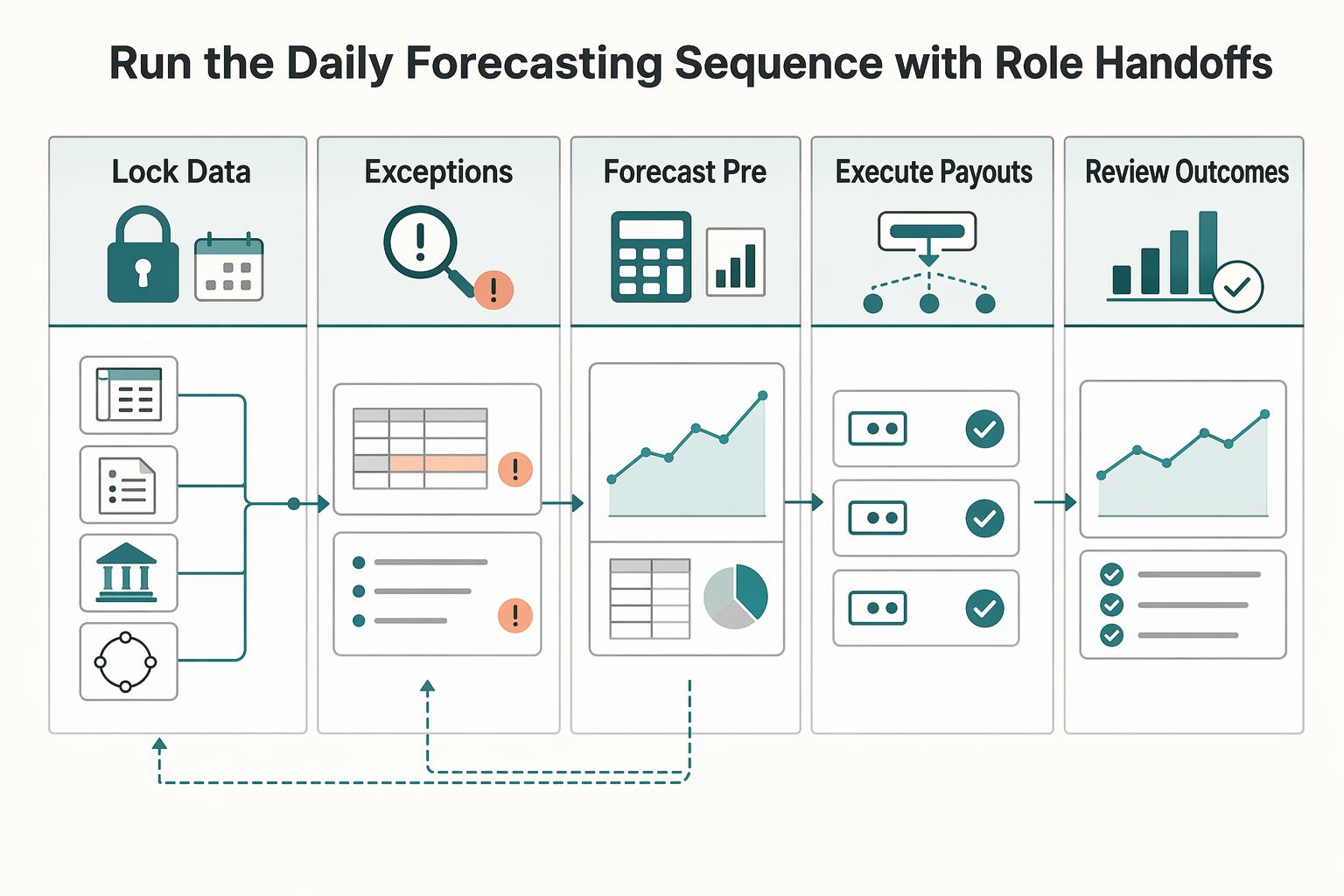
Run the daily forecasting sequence with role handoffs#
Daily forecasting is easier to govern when each run follows a consistent sequence, uses one shared data cut, and has explicit handoffs before the Payout Go/No-Go Decision.
| Run step | Key action | Recorded detail |
|---|---|---|
| Lock the data cut | Pull one consistent cut across General Ledger, payables or receivables data, bank activity, and PSP Reconciliation exports | Assign a run ID; record extract IDs and timestamps; mark the run provisional if a required bank file or PSP export is late |
| Reconcile and route exceptions | Use the appropriate automatic-payout, balance or operator-maintained reconciliation evidence for the selected model | Move mismatches into the Exception Queue; Finance owns reconciliation evidence; Ops triages exception items |
| Forecast and pre-cutoff check | Run the forecast on the same frozen cut, then hold a pre-cutoff decision check | If inputs change during approval, reopen on a new run state; time sign-off to the rail cutoff such as 2:45 p.m. ET for same-day ACH |
| Execute payouts | Atomically reserve one durable instruction per obligation; apply provider-specific request protection | Preserve instruction references across runs; reconcile unknown outcomes before replacement, even after provider key expiry |
| Review outcomes | Attach payout tracking identifiers and review failed payout outcomes in the daily reconciliation cycle | Route process-flow or control-setting changes through formal review |
Lock the data cut and ingest source data. Start by pulling one consistent cut across core finance and payout inputs, including General Ledger, payables or receivables data, bank activity, and PSP Reconciliation exports. Cash flow forecasting can integrate data across core finance modules, so analyzing a single run cut helps avoid mixed snapshots.
Assign a run ID and freeze the extract set before review starts. Record the exact extract IDs and timestamps, and mark the run as provisional if a required bank file or PSP export is late.
Reconcile before trusting executable funding. Use the appropriate payout or balance report and bank evidence for the selected model; manual and instant flows can require operator-maintained linkage. Route mismatches to an owned exception queue without suppressing urgent obligations or notices.
Keep ownership clear at handoff:
- Finance owns reconciliation evidence from the frozen run cut.
- Ops triages
Exception Queueitems by exception type and coordinates investigation. - Approval and reconciliation responsibilities stay separated by role.
Run the forecast and hold a pre-cutoff decision check. After required setup and reconciliation tasks are complete, run the forecast on that same frozen cut, then hold a pre-cutoff decision check. If inputs change during approval, reopen the decision on a new run state.
Time sign-off to your payout rail cutoff. For example, if targeting a same-day ACH transmission at 2:45 p.m. ET, finalize with enough time to act. The approval pack can include run ID, reconciliation report or extract ID, unresolved Exception Queue count, unreconciled PSP Reconciliation value, projected post-payout balance, and runtime alerts.
Document accountability for the Payout Go/No-Go Decision, while still keeping dual-control initiation and approval duties separate from reconciliation.
Keep one durable business instruction for each financial obligation, and atomically reserve its execution across concurrent runs. Use the provider’s supported idempotency mechanism within its exact scope and retention period. After a timeout, reconcile status through supported references before any replacement; a new key is not proof that the prior payout failed.
Separate recalculation and approval from financial execution. Reapproval can authorize a changed decision but cannot erase an unresolved prior transfer. Preserve instruction and provider references across run IDs; block new submissions until the existing outcome is resolved. Stripe’s documented key retention of at least 24 hours is a provider example, not durable internal duplicate protection.
Review outcomes and control changes after execution. Close the run by attaching payout tracking identifiers and reviewing failed payout outcomes in the daily reconciliation cycle. This confirms not just approval quality, but settlement outcomes.
If process flow or control settings changed during execution, route those changes through formal review so future daily runs stay consistent and auditable. For upstream demand assumptions, read Payment Volume Forecasting for Platforms: How to Predict Cash Flow.
Measure forecast quality and tune assumptions#
Once the daily run is stable, judge forecast quality where payout decisions are made, not only at the platform total. Track Forecast Variance at Payment Rail, cohort, and payout-batch levels, and keep assumptions explainable enough to diagnose misses before cutoff.
Break variance down to the decision level. Review three cuts every cycle: Payment Rail, payout cohort, and payout batch. A platform-level result can look acceptable while one rail settles late or one cohort carries more dispute activity than expected.
Show forecast versus realized cash at each layer, with the signed-off run ID and payout identifiers. If transaction-to-payout linkage is preserved in reconciliation, you can trace misses to the exact batch instead of debating aggregate totals.
Before updating assumptions, confirm actuals come from realized outcomes, not refreshed estimates. Mark still-moving periods as provisional and exclude them from tuning.
Run rolling error review on cash-availability assumptions. Use rolling review across test windows, not a single score. Forecast performance should be checked by window because one calm period can hide assumptions that fail under settlement stress.
Prioritize assumptions that directly move payout decisions:
Settlement Timingby segment (for example, location or payment method/rail)- observed
Settlement Lagbetween expected and available funds Chargebackor dispute incidence by cohort and age bucket
Keep dispute review lag-aware. Measure matured cohorts over the actual rule and reason-specific exposure window; recent dispute data can change and should remain provisional for model tuning.
Use metrics suited to the series and decision. RMSE emphasizes large absolute misses; percentage errors can be unstable near zero. MAPE is undefined for a zero actual, WAPE needs a nonzero total actual denominator, and MASE needs a nonzero scaling baseline. Report those cases explicitly instead of hiding them in a favorable score.
Validate every revision on a holdout slice of historical data. Before promoting a model or assumption change, test it on a holdout period not used for fitting. That is the clean check for out-of-sample improvement.
Use chronological holdout or rolling-origin windows that cover material forecast horizons and stressed settlement conditions. Keep future information out of fitted inputs; choose enough independent, matured observations to assess the relevant cohorts rather than a universal sample percentage.
Record each revision in a short change note: prior assumption, new assumption, holdout period, metrics by backtest window, and any rail or cohort that worsened even if aggregate results improved.
Favor explainable controls for payout operations. For payout control, explanation speed is operationally important. Predictive Modeling can help, but if the team cannot quickly isolate whether misses came from Settlement Lag, dispute behavior, or stale inputs, the control is too opaque.
Use transparent inputs and documented assumptions by default, then add complexity only when holdout results support it. Keep ongoing monitoring and outcomes analysis focused on two questions: what changed, and why realized cash differed from forecast.
Handle late records and unresolved payment outcomes#
Treat reconciliation drift as a payout-control risk first. When upstream files arrive late or incomplete, matches break because counterpart records have not landed yet. The Exception Queue can swell as unmatched items are routed for investigation.
Monitor these patterns each cycle:
- late settlement or bank files that leave gaps in payout matching
- stale transaction-to-payout joins that no longer tie out cleanly
- instant payout paths that are not fully reconciled to transaction history
- failed payout cases tied to bank-account data errors or return-code outcomes
When PSP Reconciliation is incomplete near cutoff, take a conservative release approach based on your risk controls. Unresolved cohorts can be deferred to the next run until transaction-to-payout matching is complete.
For every incident, publish a short postmortem that records impact, mitigation steps, root cause, and follow-up actions.
Conclusion#
Release decisions need a due-obligation view, a separate executable funding view and evidence from the same data cut. Preserve unpaid liabilities, escalate shortfalls and make each hold or staged release explainable to finance and ops.
1. Reconcile inputs before trusting the forecast. Use General Ledger, Enterprise Resource Planning (ERP), bank activity, and PSP Reconciliation outputs together. Match payouts to bank deposits and transaction batches, and use settlement reconciliation detail, including payments, refunds, and chargebacks, so unmatched items are explicit before release decisions.
2. Use actual timing and report settings. Adyen delay and closing-time configuration vary; Stripe schedule, availability, estimated arrival, bank posting and report availability are different timestamps. Confirm the selected account and method instead of applying one provider example globally.
3. Separate obligations from funding capacity. Keep the ledger liability and due date visible. Deduct restrictions and cushions from executable cash only where they are not already netted, then compare eligible due payouts with that funding view.
4. Treat unresolved exceptions as provisional. This is especially important for manual payouts, where reconciliation to transaction history is your responsibility. If you cannot tie a payout amount to its underlying transactions, hold that portion out of the release amount until it is resolved. We recommend forcing that hold in the same workflow your reviewer uses, so your team is not relying on memory at cutoff. If you leave that hold outside your workflow, your team will bypass it under pressure.
5. Document the final payout release decision as an internal control. Keep a replayable record: ledger snapshot, bank reconciliation status, payout or settlement reconciliation output, reserve treatment, and unresolved exceptions.
Use the same recorded funding, obligation and execution controls to review your next payout cycle. Escalate any unresolved owner, funding or replay condition before expanding automation.
Frequently Asked Questions
What is cash flow forecasting for payment platforms?
For platforms, cash flow forecasting is not just projected inflows and outflows. It forecasts when funds move from pending to available and what is actually releasable after reconciliation, settlement timing, and reserve holds are applied. If pending funds are treated as spendable, payout capacity is overstated.
How do I model payout obligations versus expected settlements?
Keep the contractual obligation, due time and lawful eligibility separate from the funding view. Expected settlements support planning; executable release needs actual usable funding or a permitted confirmed prefunding arrangement. Reserves restrict cash rather than automatically reducing what is owed. Reconcile provider and bank movements without counting the same money twice.
What data is mandatory before a forecast is trustworthy?
There is no universal minimum checklist. In practice, forecasts are more reliable when General Ledger, Accounts payable, Accounts receivable, bank activity, and payout reconciliation data align and tie payouts back to transaction batches. If bank deposits do not match payout records or unresolved exceptions remain, treat the forecast as provisional.
How often should a platform reforecast?
Use a rolling cadence that matches your operation: daily, weekly, or monthly. Re-run closer to payout cutoff when settlement timing shifts, returned payouts increase, or available-versus-pending balances move. The right cadence is the one that keeps release decisions aligned with current settlement and reconciliation state.
What are common failure points in payout forecasting?
Common failures include incomplete reconciliation, double-counted provider-to-bank funds, incorrect reserve deductions, unexpected returns and duplicate payout attempts after an unknown outcome. A verified failed payout can require corrected destination details under the provider’s actual process; a timeout alone is not a failure.
Do we need predictive models from day one?
No. Start with documented assumptions, transparent state transitions and reconciled funding evidence. Add predictive complexity when matured holdout results improve the decisions and reviewers can explain the change.
What settlement details should I watch most closely?
Track transaction time, verified availability, provider dispatch, bank arrival and the obligation due time separately. Use actual account/method settings, partner cutoffs and observed lag. A missed ACH window can still leave a later supported window that day; an unresolved submitted payment blocks replacement on another rail.
Try a related tool
Researched and edited by the Gruv editorial team. Gruv builds cross-border billing, payouts, and finance-operations software for global businesses.
Sources
Includes 4 external sources outside the trusted-domain allowlist.
- docs.stripe.com/payoutstrusted
- docs.stripe.com/reports/payout-reconciliationtrusted
- federalreserve.gov/paymentsystems/fedfunds_about.htmtrusted
- federalreserve.gov/paymentsystems/fednow-additional-questions-a...trusted
- docs.adyen.com/account/sales-day-payoutexternal
- docs.adyen.com/account/balances/reserveexternal
- frbservices.org/resources/resource-centers/same-day-ach-reso...external
- frbservices.org/resources/financial-services/wires/fedwire-f...external
Educational content only. Not legal, tax, or financial advice.
Related Posts

The Freelance Payment Penalty: A Modeled Audit of Platform Fees, FX Spreads, and Payout Delays
The money rarely disappears through a single, easy-to-spot fee. The real loss is stacked. A marketplace takes its commission, a processor adds a charge for international cards, a bank or payment company converts the currency at a spread, a platform holds the funds before release, and a wire sheds a little to intermediaries on the way in. Each layer looks defensible on its own, but the worker feels the combined result as a smaller deposit and a later payday.

How to Respond to a Subpoena for Business Records
Move fast, but do not produce records on instinct. If you need to **respond to a subpoena for business records**, your immediate job is to control deadlines, preserve records, and make any later production defensible.

A US Expat's Guide to Investing in UCITS ETFs to Avoid PFIC Issues
The real problem is a two-system conflict. U.S. tax treatment can punish the wrong fund choice, while local product-access constraints can block the funds you want to buy in the first place. For **us expat ucits etfs**, the practical question is not "Which product is best?" It is "What can I access, report, and keep doing every year without guessing?" Use this four-part filter before any trade: