
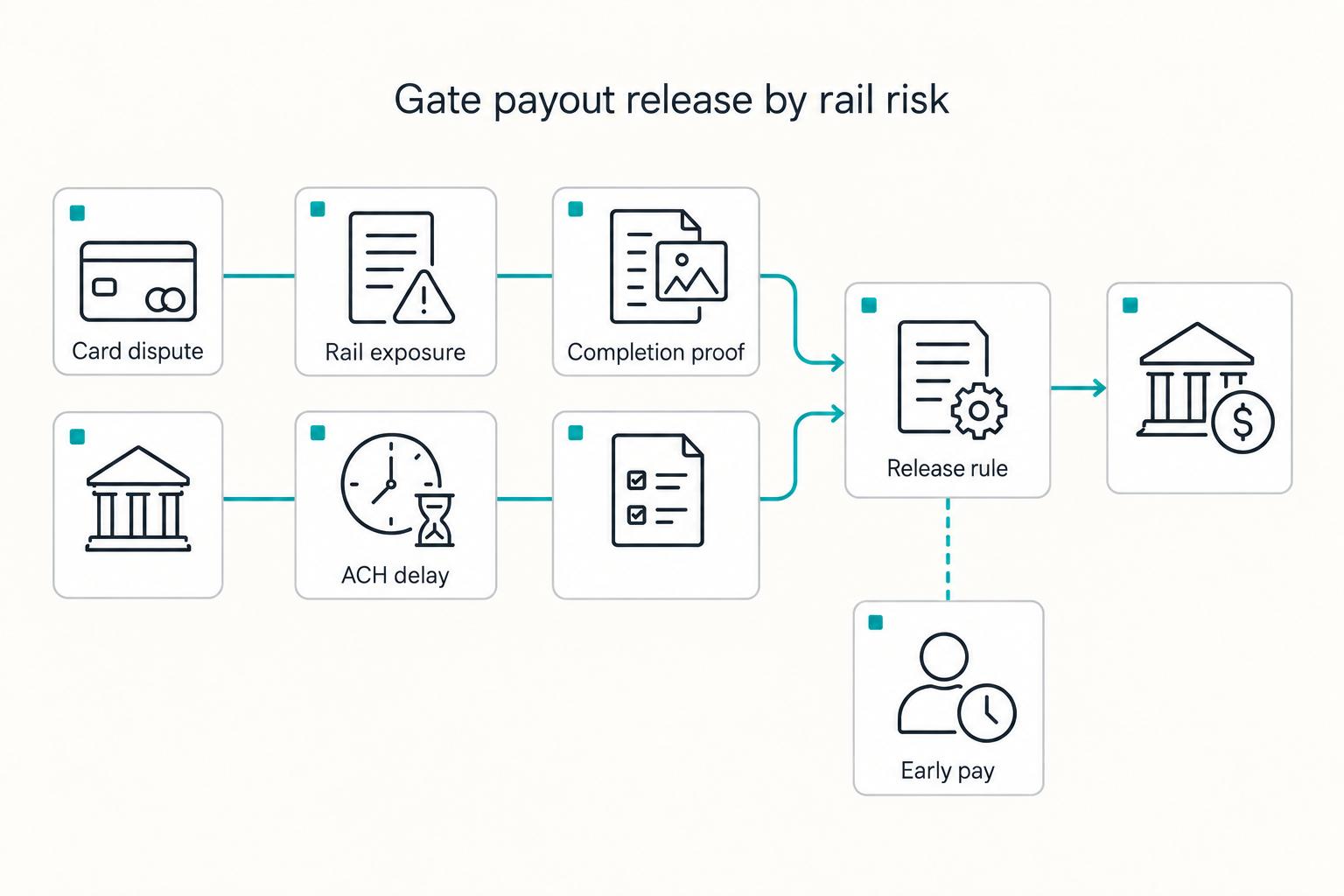
Quick Answer
Start by treating the contractor payment flow home services marketplace as a settlement operation, not a card form. Define each transition from pay-in through release and disbursement, assign ownership, and require evidence before moving funds. Launch with a narrow rail mix that matches job patterns, then enforce verification and compliance gates before payouts. Expand scope only after disputes, failed transfers, and period-close deltas are consistently controlled.
Build This as a Settlement System, Not a Standard Checkout Flow#
Build this as an end-to-end settlement system, not a standard checkout flow. If you treat a contractor payment flow home services marketplace like card-only commerce, pay-in may look fine while settlement breaks across onboarding, held funds, payout timing, split logic, and disputes.
Start with settlement design#
Start with settlement design, not the card form. Home services work can include progress billing, retainage, manual approvals, late payouts, and post-payment exceptions. Your flow has to cover onboarding and verification before payout, fund splitting, cost deductions, held funds, and dispute handling.
The first decision is not just how the homeowner pays. It is who receives funds first, who can hold them, who carries refund and chargeback exposure, and when funds become available for contractor payout. If those choices stay implicit, operational debt shows up later in support tickets, finance cleanup, and payout complaints.
Choose your operating model early#
Decide early whether you are the Merchant of Record (MoR). In Stripe Connect's separate charges and transfers model, the platform as merchant of record is the account debited for fees, refunds, and chargebacks.
The tradeoff is simple. More control usually means more responsibility. If your platform balance carries those costs, define release rules and reconciliation ownership from day one. Before launch, your team should be able to explain each money state from pay-in to payout, and the proof for each state: captured, held, released, paid out, disputed.
Lock the operating artifacts first#
Lock the operating artifacts before provider selection or UI work. Payout schedules can run daily with delay days, and some partner settlements are consolidated once daily. Those mechanics shape contractor expectations, cash forecasting, and support handling.
Run one early verification check: confirm split instructions book funds and fees to the correct balance accounts. If they do not, reconciliation can expose mismatches between what the homeowner paid, what the platform earned, and what the contractor should receive.
From here, the focus stays narrow: launch what you can prove, gate what changes by market, and delay advanced features until core money states reconcile cleanly. If you want a deeper companion on mapping each movement, Marketplace Payment Flow Design: How to Map Every Money Movement from Buyer to Seller is the right next reference.
Define the payment flow you are actually building#
Put the full payment lifecycle on one page before you choose tools. If you cannot explain it in one view, responsibility for refunds, chargebacks, and payout delays usually resurfaces later through support and finance cleanup.
Map money states, not screens#
Map money states, not screens: homeowner pay-in, hold logic, contractor release, payout execution, then exception paths for refunds and disputes. For each state, document who decides, what proof confirms the state change, and which account is debited if funds are reversed.
Be explicit about charge type. In Stripe Connect, direct charges send payment to the connected account, while indirect charges send payment to the platform first. That choice changes fund distribution and who is debited for refunds and chargebacks, so your diagram should make MoR ownership clear on each path.
Set metrics before tools#
Set operating metrics before provider or rail selection. Track payout predictability, failed payout rate, reconciliation latency, and support ticket volume by payment method.
Use rail behavior to set realistic promises. ACH Direct Debit is delayed-notification. It can take up to 4 business days for success or failure acknowledgement, and it is often shown with 2-5 day payout timing. Validate operability by checking the payout reconciliation report and confirming your setup preserves transaction-to-payout linkage where possible, for example with automatic payouts.
Decide on MoR or routing early#
Decide early whether you need MoR or simple routing. MoR depends on configuration, and in Stripe, indirect charges without on_behalf_of make the platform the MoR. If your platform is liable for negative balances, it is also responsible for disputes on those accounts.
If you need escrow-like timing control, be precise about the wording. Stripe does not provide legal escrow accounts, but manual payouts can delay release timing. The tradeoff is control versus operational load. You must reconcile manual payouts yourself, and failed payouts can disable the external account until updated. Related: How to Use Stripe Payment Links for Easy Invoicing.
Gather prerequisites before writing a single requirement#
Lock prerequisites by market before you write tickets. A single global spec for rails, onboarding, and reconciliation usually breaks once network, region, and entity-type rules diverge.
Build an evidence pack by market#
Build an evidence pack by market, not by product surface. For each country or region, document accepted pay-in and payout rails, wallet readiness, onboarding gates, and dispute norms.
Classify rails by payment-method family first, then add country detail. That keeps you from treating ACH transfers, debit cards, and Apple Pay as interchangeable across markets. Provider guidance already reflects this variation, such as ACH in the US and Bacs in the UK, and Apple Pay availability depends on country or region plus participating issuers.
Keep dispute handling notes split by network and region. Dispute processes vary across card networks, so refund and evidence flows should not assume one universal rule set.
Checkpoint: for each launch market, confirm three source-backed answers: which rails are available, which capabilities stay disabled until verification completes, and which dispute paths require market-specific handling.
Turn onboarding into a capability matrix#
Define onboarding and payout documents as a capability matrix, not one generic verification block. KYC, KYB, AML CDD, VAT validation, and tax forms should each have explicit gating rules.
| Item | Flow role | Timing or note |
|---|---|---|
| KYC | Verify individuals for money movement | Run at onboarding, or at the latest before an account can accept payments or send payouts |
| KYB | Verify businesses for money movement | Run at onboarding, or at the latest before an account can accept payments or send payouts |
| Beneficial-owner identification | US legal-entity onboarding in covered contexts | Include at account opening |
| AML CDD | Customer due diligence within the AML program | Keep the requirement framed as customer due diligence within the AML program |
| Form W-9 | TIN certification in information-return workflows | Use a separate capture path from VAT |
| Form W-8 BEN | Foreign beneficial-owner details when requested | Use when requested for foreign beneficial owners |
| VIES VAT validation | VAT-number status check | Treat the result as valid or invalid status validation, not a full tax-liability determination |
Verification should gate money movement. In marketplace flows, users must be verified before payments are processed or funds are paid out. Mark what is required at account creation, before payout, and only in specific markets or entity types.
For US legal-entity onboarding in covered contexts, include beneficial-owner identification at account opening. For AML, keep the requirement framed as customer due diligence within the AML program.
Give tax and VAT separate capture paths. Use Form W-9 for TIN certification in information-return workflows. Use Form W-8 BEN when requested for foreign beneficial owners. Treat VIES as VAT-number status validation, valid or invalid, not a full tax-liability determination.
Lock ledger and event prerequisites#
Lock ledger and event prerequisites before payment API integration. This control layer helps prevent duplicate side effects and reconciliation gaps.
Require an Idempotency-Key on write operations with financial impact so retries return the prior result instead of creating a second side effect. On webhook ingestion, design for duplicate deliveries and dedupe by event ID.
For reconciliation, define which payout lifecycle events your finance flow consumes, and do it asynchronously, for example payout.paid and payout.reconciliation_completed. If transaction-to-payout linkage is a day 1 requirement, prefer automatic payouts because they maintain that association. Before build starts, agree on the ledger journal export format finance ops needs so manual investigation does not become the fallback during reconciliation.
Choose a Day 1 rail mix that matches job types#
Pick rails by job pattern, not by feature count. A practical Day 1 baseline in many US-first builds is cards, ACH, and online invoicing, then wallets only where your real checkout flow benefits.
Match collection to job shape#
Match collection to job shape first. Urgent repairs, scheduled remodels, repeat visits, and milestone projects have different timing and dispute profiles, so they should not share one default pay-in path.
| Job pattern | Day 1 fit | Why it fits | Main caution |
|---|---|---|---|
| Urgent repair, same-day dispatch | Credit card processing, optionally POS capture | Supports in-field collection for urgent jobs | Card charges can be reversed through chargebacks, so avoid instant full release when completion evidence is thin |
| Scheduled remodel or larger planned work | Online invoicing plus ACH transfers | Works for planned, higher-ticket payments where bank pay is acceptable | ACH does not support authorize-now or capture-later holds |
| Low-ticket repeat work | Online invoicing with card, plus ACH option | Simple recurring remote collection with payment choice | Invoice payment-method behavior can vary by market or currency |
| High-ticket milestone work | Card for deposit, ACH or invoice bank transfer for later draws | Collect a deposit, then use bank-based milestone collection | Do not rely on long card holds; uncaptured PaymentIntents cancel after 7 days by default |
Use cards when speed matters most, and ACH or invoice bank transfer when the customer has time and the payment size justifies bank movement. The ACH Network reaches U.S. bank and credit union accounts, and FedACH is a batched debit and credit exchange, which fits planned flows well.
Keep Day 1 rails operationally simple#
Build only the mix you can operate reliably on Day 1. For many US-first launches, that means cards for speed, ACH for planned bank payments, and online invoicing as the remote collection surface.
| Option | Best fit | Operational note |
|---|---|---|
| Cards | When speed matters most | For many US-first launches, cards are part of the Day 1 mix |
| ACH | Planned bank payments | Use when the customer has time and the payment size justifies bank movement |
| Online invoicing | Remote collection after a quote or job visit | Some providers support requests by email, SMS, or shared links |
| Apple Pay | Faster completion in app or web checkout | Supports app and Safari web contexts |
| Google Pay | Faster completion in web checkout | Its web API returns a payment token to your site |
Online invoicing matters when payments happen after a quote or job visit. Some providers support remote requests by email, SMS, or shared links, and some invoice setups support bank transfer. Verify your launch market and currency defaults before go-live.
Add Apple Pay or Google Pay only where faster completion in app or web checkout is material. Apple Pay supports app and Safari web contexts, and Google Pay's web API returns a payment token to your site. Wallet impact can be smaller if most payments come through post-visit invoices.
Set release rules by rail risk#
Set payout release rules by rail risk, not just contractor cash pressure. Where card dispute exposure is higher, tighten instant release and require stronger completion evidence before full payout.
CFPB notes that card issuers can reverse charges in some cases through chargebacks. For first-time customers, emergency callouts, or contested scopes, avoid immediate full release on card-funded jobs unless evidence quality is strong.
Respect each rail's mechanics. Manual capture is available only on eligible methods, and ACH does not support that pattern. Card holds are short-window tools, and uncaptured PaymentIntents cancel after 7 days by default. ACH Direct Debit timing can be several working days, four on PaymentIntents API and six on Charges API, so payout timing should assume settlement delay.
If contractor cash timing is the issue, consider controlled early release as one option alongside invoice factoring. Same Day ACH can also help in some urgent bill-pay cases, with settlement three times daily and a $1 million per-payment limit, but it is still different from card-style manual capture.
Plan field fallbacks for weak signal and late payment#
Define field fallbacks for low-connectivity jobs and delayed homeowner payment. If a technician cannot rely on signal, your collection path needs a tested backup.
Payment-link QR collection can be useful because some providers can generate QR codes for payment links, and some note those QR codes do not expire unless the underlying link is deactivated. Keep links job-specific, map link IDs to work orders, and deactivate stale links at closeout.
For on-site capture, treat offline acceptance as provider-specific behavior rather than a universal assumption. Test a no-signal visit before launch. What can techs collect, how does sync behave later, and how does support explain pending states until transactions fully post?
If you want a deeper dive, read What Is a Proforma Invoice? How Platforms Use Pre-Payment Invoices in Contractor Workflows.
Map money states from payment intent to contractor settlement#
Treat money movement as a state machine, not a single status field. Internal control states can give you a safer payout decision than relying on any provider status alone.
Define internal states before provider statuses#
Define internal states first, then map provider statuses into them. Teams often use control states like initiated, authorized, captured, held, released, paid out, returned, disputed, and closed, but those are internal controls, not a universal provider taxonomy.
Give each state four fields: owner, entry condition, required evidence, and exit SLA. Keep the SLA as your operating target, not a provider promise.
| Internal state | Typical owner | Minimum proof to enter | Do not advance until |
|---|---|---|---|
| Initiated | Checkout or invoicing service | Provider object created and linked to internal order or work order | Request persisted with idempotency key |
| Authorized | Payments service | Provider reference plus provider status showing success or requires_capture for manual capture flows | Auth amount and customer or job link match |
| Captured | Payments service | Provider capture confirmation or success transition | Capture amount posted to ledger journals |
| Held | Risk or payout service | Internal release rule keeps funds pending | Hold reason recorded |
| Released | Payout service | Release decision approved under policy | Payable amount journaled |
| Paid out | Treasury or payout service | Payout object created and tracked | Payout reference linked to contractor balance |
| Returned | Treasury ops | Provider payout return or failure signal received | Reversal journal posted |
| Disputed | Risk or support | Dispute event received and case opened | Impacted balance isolated |
| Closed | Finance ops | Payouts, reversals, and disputes resolved | Net position is zero and audit trail complete |
Use provider states exactly where documented. Stripe PaymentIntents can move to requires_capture in manual-capture flows, and capture should happen from that state. Stripe payouts expose statuses including pending, in_transit, paid, canceled, and failed. Adyen payout webhooks include events such as initiated, authorised, booked, pending, failed, credited, and returned. Map them into your internal controls instead of assuming a 1:1 model.
Attach proof to every state change#
Attach a proof pack to every state transition. If proof is missing, the transition is not ready for payout decisions. Store these together for each transition:
- Provider reference
PaymentIntent ID, payout ID, dispute ID, or equivalent object ID.
- Webhook receipt record
Event ID, received timestamp, and processing status.
- Ledger journals posting
The debit and credit entries finance will reconcile.
Apply this strictly at release and payout boundaries. Provider state, webhook evidence, and ledger posting should all be present before contractor settlement.
Design for delayed or missing webhooks#
Treat delayed or missing webhook signals as a normal recovery path. Webhook-only logic is fragile.
Stripe retries undelivered webhook events for up to three days, supports pulling unsuccessfully delivered events with delivery_success=false, and recommends duplicate-processing guards. Adyen advises checking timestamps so event handling stays chronologically correct.
Use one clear rule. If webhook evidence is delayed or missing, reconcile from provider APIs, then replay idempotently into your state machine. Do not advance payout on uncertain status.
Persist both event ID and business idempotency key on each state-changing write so incident review can answer both questions: was the event received, and was its financial effect already applied?
Set payout execution and retry rules#
Set payout execution rules by volume and risk, then enforce item-level traceability. Single payouts can be easier to inspect early. Batches can help when volume grows and cutoff times matter.
If you use batches, separate batch-level tracking from item-level outcomes. PayPal Payouts supports up to 15,000 payments per call, but each contractor payment still needs its own payout reference, status, and reversal path.
Use manual approval when the evidence pack is incomplete or risk changes after release logic runs. Stripe manual payouts can support delayed disbursement states for those reviews.
Define retry policy before go-live. Retry transport failures idempotently. Re-queue provider failures only after return reason review. If a payout becomes failed or returned, post reversal journals immediately and move it to a visible investigation queue.
Set milestone release rules contractors can trust#
Release policy should feel predictable to contractors and controllable to your team. Fund early, release in stages, and trigger each release only on clear approval or a documented timeout.
Define milestone primitives you can enforce#
Define milestone primitives your team can actually enforce, even if your provider uses different labels. One practical internal set is deposit, progress draw, completion holdback, and final release. It is an internal framework, not a universal taxonomy, but it cleanly separates upfront commitment, in-progress work, and final acceptance.
For each milestone, require one entry condition and one approval checkpoint. A deposit should not be releasable just because the customer clicked pay. In milestone flows, pre-funding matters because protection can depend on funds being in place upfront. For progress draws and final release, store the submission timestamp, homeowner decision, and stage invoice reference. If you use a pro forma invoice, treat it as a quote-format request before work or the next draw, then issue the final invoice at completion.
Set release speed by risk#
Set release speed by risk, not by urgency alone. If job value or dispute risk is high, use delayed release with documented completion evidence and a review window. If risk is lower and contractor history is strong, use faster release windows after approval.
One common pattern is homeowner review with auto-release if no action is taken. Upwork fixed-price milestones use up to 14 days in review, then auto-release when the client does not respond, followed by a 5-day security hold before withdrawal. You do not need those exact windows, but you do need explicit windows that are published and enforced. Your evidence pack should confirm three facts before payout: funded stage, submitted work, and approval or timeout.
If you use manual card capture to delay settlement, track authorization expiry closely. If authorization expires before capture, the hold is released and the payment status becomes canceled.
Use escrow-like controls only when needed#
Use escrow-like controls when you need neutral, condition-based release. This is most useful when milestone acceptance risk is high and staged completion is clear.
Simple staged invoicing is often enough when risk is lower and the goal is billing clarity. In that model, a pro forma invoice frames the expected stage payment and the final invoice closes completed work. Keep the mechanism as light as possible while still protecting both sides.
Decide partial-dispute handling before launch#
Define partial-dispute handling before launch: where your flow allows, release the uncontested amount and isolate the contested amount for review.
Disputes can involve only part of an order. Because the issuer decides dispute outcomes, your contested-release evidence should be chronological: funded milestone, submission, homeowner response, partial approval if any, and amount still under review. If that timeline is unclear, holds can expand, support decisions can drift, and contractor trust can drop.
Build compliance and tax gates without killing conversion#
Gate by capability, not by page. Block payout capability until required checks pass, and do not force every compliance and tax question into the first signup screen.
Verify identity before enabling payouts#
Verification is a core gate for money movement. Run KYC for individuals and KYB for businesses at onboarding, or at the latest before an account can accept payments or send payouts. Adyen and Stripe Connect both position verification as required before those capabilities are enabled.
Operationally, both your payout UI and payout jobs should read provider verification status, not just your internal onboarding-complete flag. Document upload is not the same as verified status. If provider status is still restricted, do not queue payout release, even when a milestone is approved.
Treat requirements as a moving target. Stripe notes KYC requirements can change, so a one-time hardcoded checklist will drift and create payout-ready confusion later.
Run AML and VAT checks at the risk-creating action#
Place AML and CFT controls at the action that creates risk, with trigger timing set by provider and jurisdiction. A practical pattern is onboarding screening plus a fresh check before first payout release or when new risk is flagged.
For EU cross-border flows, validate VAT registration at the point where VAT treatment depends on it. VIES can be used to check whether a business is registered for cross-border EU trade. In the UK, HMRC's VAT check service can also provide proof of when a UK VAT number was checked.
Store the VAT number, check timestamp, result, and proof location. Use VIES or HMRC checks as evidence in your records, not as a complete VAT-compliance decision by themselves.
Collect tax forms early, then phase deeper automation#
Collect tax identity forms early, not at year-end. Use Form W-9 for TIN details provided to a payer filing information returns, and Form W-8 BEN when a foreign person provides details to the payer or withholding agent.
Day 1 requirements are form capture and audit-safe storage boundaries. Decide which sensitive fields live with your payments provider versus internal systems, and who can access them. At minimum, preserve receipt timestamp, contractor linkage, and form version.
As payments accumulate, track reporting eligibility. If you pay independent contractors, you may need to file Form 1099-NEC when reportable payments reach the IRS threshold amount, and nonemployee compensation paid to nonresident aliens is reported on Form 1042-S. Also plan filing operations early. IRS instructions lowered the aggregate information-return e-file threshold to 10, effective January 1, 2024.
Phase-two items like reminders, richer tax classification logic, and polished export tooling can follow once verification and payout gating are stable.
Implement eventing and reconciliation as first-class features#
Once payout gating is in place, event handling and reconciliation become the control layer that keeps money states accurate. Treat webhooks as operational inputs, keep a clear internal operating record, and make close readiness depend on explained cash movement.
Treat webhooks like money-movement inputs#
Your webhook endpoint is part of payment-state execution, not optional notification plumbing. Before launch, document retry behavior, deduplication, and failure handling.
Assume duplicate and out-of-order delivery as normal. Providers can send the same event more than once and do not guarantee event order, so persist processed event IDs, skip repeats, and validate full state before posting payout or release transitions.
Define recovery for missed deliveries. Undelivered webhook events can be retried automatically for up to three days, but failed processing should still route to a dead-letter queue for investigation. As a control check, force one processing failure and confirm the DLQ record captures enough detail - original payload, error reason, and first-seen timestamp - to support debugging. If recovery requires backfill, historical events can be listed for up to 30 days.
Reconcile against ledger journals#
Use internal ledger journals as a primary operating record, and use provider dashboards and payout reports to validate that record. This keeps internal and external money views tied together instead of competing.
Post journal entries for each money-state transition you manage, then include provider references so finance can trace entries to transactions or payout batches. Reconcile provider balances against internal wallet projections on a regular cadence, especially when funds are held before contractor release.
If you run manual payouts, keep explicit reconciliation ownership on your team. Do not assume provider totals alone will catch gaps from holds, adjustments, or replayed events.
Give operators one place to manage payout exceptions#
Operators need one place to manage payout exceptions, not scattered logs. Keep a payout status board with payout state, bank reconciliation status, and return-investigation status in one view.
If your flow includes Virtual Bank Accounts, keep unmatched inbound funds in a visible queue or review state so they are intentionally handled. For delayed payouts, define an investigation path and escalate to the bank with the Trace ID when a payout has not landed after 10 business days.
Set a hard close checkpoint for deltas#
Set close governance so period close happens after reconciliation review. Month-end signoff should not move forward on unexplained deltas.
Not every variance must be fully resolved immediately, but open items should be clearly classified, assigned, and timestamped before close. That checkpoint helps prevent unresolved webhook replays, returns, or unmatched receipts from compounding into the next close.
Plan for failures before scale exposes them#
Plan failure handling before launch, because the same breakpoints repeat at scale: failed payouts, duplicate webhook delivery, chargebacks, and identity mismatches during onboarding.
Separate the failure classes#
Do not bucket everything as "payment failed." A failed payout can disable the destination external account until account details are updated, so your response should focus on account validity before retries. Duplicate webhooks are expected in at-least-once delivery, so handlers should ignore already processed event IDs and still return success to stop further retries.
Chargebacks need their own path because they reverse payment and can immediately impact balance, including dispute fees. Treat each dispute as a linked money-state incident tied to the original payment, release decision, and payout batch.
Write explicit recovery rules#
Use short rules operators can execute without interpretation:
| Failure case | Operator action | Key note |
|---|---|---|
| Payout fails | Check whether the external account is disabled, pause payouts to that destination, and request updated bank details | Avoid blind retries |
| Webhook duplicated or replayed | Verify the event ID is already recorded, skip reprocessing, and acknowledge it | Duplicate webhooks are expected in at-least-once delivery |
| Identity mismatch or AML flag | Hold release and open a compliance review case with onboarding evidence | Keep the payout on hold for review |
| Dispute arrives | Isolate affected funds and stop any pending contractor release tied to that transaction | Treat each dispute as a linked money-state incident |
Before launch, test one case per failure class, including webhook backfill from the last 30 days and one failed-payout external-account update flow.
Match support messaging to the real state#
Support responses should mirror the actual payment state, not assumptions. For payout failures, state that payout was not completed and updated bank details are required. For duplicate-event incidents, do not imply a second charge unless your ledger confirms one.
For consumer EFT error claims, route cases through timelines that support investigation within 10 business days and communication of results within three business days after the investigation is complete. For AML-related holds, keep the wording factual: payout is temporarily on hold for review, without promising release timing before compliance clearance.
Roll out by market and segment instead of big-bang launch#
After you define failure handling, keep launch scope narrow so you can verify real payment behavior before scaling.
Start with one country and one contractor cohort#
A practical way to de-risk launch is to start with one country, one contractor cohort, and one payout cadence. Country rules and provider capabilities vary, and unsupported settlement-currency and bank-country combinations can fail before your product logic runs.
Use one contractor profile with similar payout behavior, for example solo operators paid weekly or small firms paid after job completion, so reconciliation signals are cleaner. Move forward when country capability checks are done, KYC and KYB requirements are clear for that cohort, and early payout cycles reconcile without a growing unmatched queue.
Choose ACH-first or mixed rails deliberately#
Pick rails based on job timing and cost tolerance, not preference. ACH-first can fit scheduled work that tolerates slower settlement and benefits from account-to-account cost efficiency, while mixed card plus ACH can fit urgent jobs where faster confirmation matters more.
If you add both rails early, plan for added support and operations complexity across settlement timing, chargeback handling, and release rules. Before launch, model your payout promise against rail realities. Same Day ACH has a $1 million per-payment maximum. Stripe next-day settlement is quoted at a 0.6% monthly fee. Automatic payouts above 1 million USD can take an extra day.
Set expansion gates before the next market#
Expand only after operational gates hold over a defined window. At minimum, gate on payout batch stability, unresolved webhook exceptions, and KYC and KYB completion health so accounts are not disabled for missing information.
Validate payouts in both provider events and your ledger. Use payout webhooks plus arrival-time monitoring, and treat webhook reliability as a hard gate because undelivered events can retry for up to three days.
Add advanced modules for proven problems#
Add advanced modules for a clear use case, and evaluate them against baseline flow stability. Virtual Bank Accounts may help in some setups, but some setups can carry higher payout-failure risk, so monitor payout success closely. Merchant of Record changes legal and compliance responsibility for payment processing.
Treat invoice factoring as financing, not just a payout-speed setting, because invoices are sold or assigned for upfront cash. If contractors need earlier access to funds, test whether cadence or settlement changes are enough before adding invoice factoring.
Common mistakes that create payment chaos#
After your first cohort, payment chaos usually comes from four repeatable mistakes: release-state gaps, weak reconciliation, delayed verification gates, and late tax-document sequencing.
Step 1. Design release states before checkout optimization. Contractor payouts are not just capture plus disbursement. If you skip explicit hold, release, dispute, and reversal states, you can pay out funds that are still contestable. Card disputes can be opened up to 120 days after payment, sometimes later, so release logic needs a dispute-aware window and clear rules for contested versus uncontested funds. Each release should map to a provider reference, a received webhook event, and a ledger journal entry.
Step 2. Build reconciliation discipline before adding rails. Adding rails multiplies failure cases if controls are weak. Webhooks are asynchronous events delivered to an HTTP endpoint, and the same business event can trigger handlers multiple times, including concurrently, so deduplication is required. If you retry API requests, use idempotency keys and account for 24-hour key expiry. Keep a hard daily checkpoint: webhook-triggered payout retrieval, including payout.paid or payout.reconciliation_completed, with no growing unmatched cash queue.
Step 3. Gate payouts with verification, not conversion goals. Verification is a payout prerequisite, not a later optimization. Connected accounts must satisfy required KYC checks before they can accept payments and send payouts, and payout eligibility should remain blocked until those checks clear. If you operate as a money services business, an effective AML program is mandatory. A common warning sign is deferring verification until the first urgent payout, which can block payouts when checks are incomplete.
Step 4. Sequence tax documents early. Set tax-document and reporting flags before year-end cleanup pressure starts. Track who submitted Form W-9, who submitted Form W-8 BEN, and whether payments route to Form 1099-NEC or Form 1042-S. IRS guidance ties reporting to threshold monitoring, and current FAQ language references $600 and $2,000 for payments made after December 31, 2025, so avoid hardcoding one permanent threshold. By January, payout ops should not be backfilling tax form status, TIN status, or reportability flags.
Conclusion and copy-paste launch checklist#
Build for real operations, not a happy-path demo: launch narrow, verify hard, then expand. A strong Day 1 flow does not require every rail or module, but it does require clear payout states, evidence for every money movement, and explicit owners for failure paths.
Choose rails by real job scenarios first. Lock release logic second. Add VBAs, MoR, or invoice factoring only after the base flow reconciles cleanly. For each enabled rail, verify pay-in, hold, release, payout, dispute, and reversal with provider references, webhook events, and ledger journal entries.
Do not release contractor funds just because checkout succeeded. Gate payouts on onboarding readiness, required tax document capture, and payout capability status where your provider supports active, inactive, and pending capability states, including combined payout and charge capability when used. Scope tax and compliance artifacts before launch: W-9 for U.S. persons, W-8BEN for foreign individual beneficial owners, Form 1099-NEC eligibility tracking, and VAT-number checks through VIES where relevant.
Test asynchronous and exception paths before expansion. Webhooks drive asynchronous payment-state handling, failed deliveries can retry for up to three days, and handlers must be replay-safe with dedupe logic. Use idempotency keys for safe retries without duplicate side effects. Keep explicit playbooks for chargebacks and payout failures, and investigate when status is uncertain instead of forcing completion.
- Day 1 rails chosen by job scenario (for example: credit card processing, ACH transfers, online invoicing)
- State map approved: capture, hold, release, payout, dispute, reversal
- Compliance gates mapped where required: KYC, KYB (if applicable), AML, VAT validation (where relevant)
- Tax artifacts scoped: W-8BEN, W-9, Form 1099-NEC
- Webhook events and idempotency tested end-to-end
- Ledger journals reconciliation run and signed off
- Failure playbooks written for payout failure and chargebacks
- Expansion criteria defined before adding VBAs, MoR, or invoice factoring
When your checklist is complete and you need to confirm market coverage, payout rails, and compliance gating, talk to Gruv.
Frequently Asked Questions
What is a contractor payment flow in a home services marketplace?
A contractor payment flow is one connected operation, not just checkout. It includes contractor onboarding, payment acceptance, split-fund allocation, payout execution, and exception handling for disputes. If one customer payment covers both your platform fee and contractor earnings, you need split-and-release logic, webhook-backed processing, and records that support reconciliation.
Which payment methods are minimum viable at launch for home services?
There is no universal minimum stack for every market. A practical launch baseline is more than one method, since payer preferences can differ across homeowner and commercial jobs. In many cases, cards and ACH cover early demand, with bank transfer support added where it fits your job mix.
How should milestone payouts work for contractor jobs with partial completion?
Milestone payouts should support installment-style billing and partial payments against open invoices. That lets you release approved portions of work without paying out the full job too early. For contested milestones, you can release the approved portion and hold the remainder until resolution.
How do you decide between faster contractor payouts and stronger risk controls?
Start with risk exposure, then add speed where controls hold. Instant payouts can improve contractor access to funds, but they should sit on top of reliable release states and strong dispute-response operations. If your early live volume is still in an initial payout window of about 7-14 days, set expectations before promising faster access.
What breaks first when contractor payments scale across cities or countries?
At scale, reconciliation and event handling are common failure points. Webhooks are asynchronous, undelivered events can be retried for up to three days, and event order is not guaranteed. Your handlers should be replay-safe and explicitly ignore events that were already processed.
When should a marketplace add Virtual Bank Accounts (VBAs) or Merchant of Record (MoR)?
Add VBAs when incoming transfers are creating manual matching overhead. A virtual account number per customer can help automate reconciliation and avoid exposing your real account details. Add MoR when you are ready for a legal and compliance boundary shift, because the MoR takes responsibility for payment obligations and can also take on tax collection and remittance duties.
Try a related tool
Researched and edited by the Gruv editorial team. Gruv builds cross-border billing, payouts, and finance-operations software for global businesses.
Sources
- comptrollerofthecurrency.gov/topics/supervision-and-examination/bank-oper...trusted
- consumerfinance.gov/ask-cfpb/how-can-i-get-a-refund-on-a-product...trusted
- ecfr.gov/current/title-31/subtitle-B/chapter-X/part-1...trusted
- ecfr.gov/current/title-31/subtitle-B/chapter-X/part-1...trusted
- fdic.gov/news/financial-institution-letters/2024/fil2...trusted
- federalregister.gov/documents/2016/05/11/2016-10567/customer-due...trusted
- federalreserve.gov/frrs/regulations/section-100511-procedures-f...trusted
- federalreserve.gov/econres/notes/feds-notes/pay-by-bank-and-the...trusted
Educational content only. Not legal, tax, or financial advice.
Related Posts

Invoice Factoring for Contractors: How Platforms Offer Early Payment and Manage Risk
If you run a platform for contractors, early payment is a product and risk decision before it is a goodwill feature. Ask four things up front: Who funds the advance? Who collects from the payer? Who absorbs nonpayment risk? Do the unit economics still work once disputes and exceptions show up?
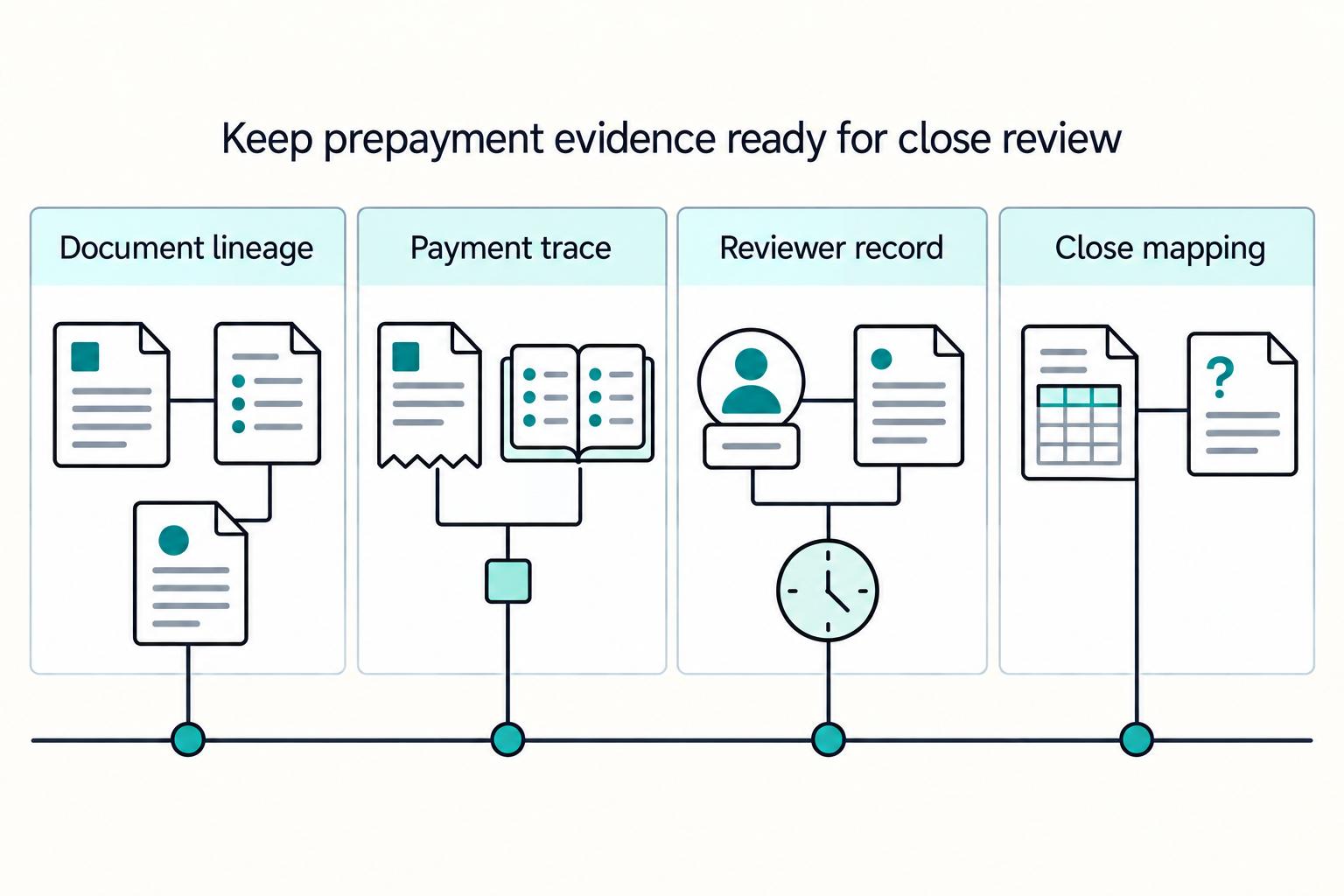
Proforma Invoice Controls for Contractor Platform Pre-Payment Workflows
Speed matters, but speed alone is not the job. If you are designing pre-payment contractor workflows around **proforma invoice platforms**, the goal is to keep contractor payments moving while giving finance clear states, verifiable records, and a clean path to matching and closeout.
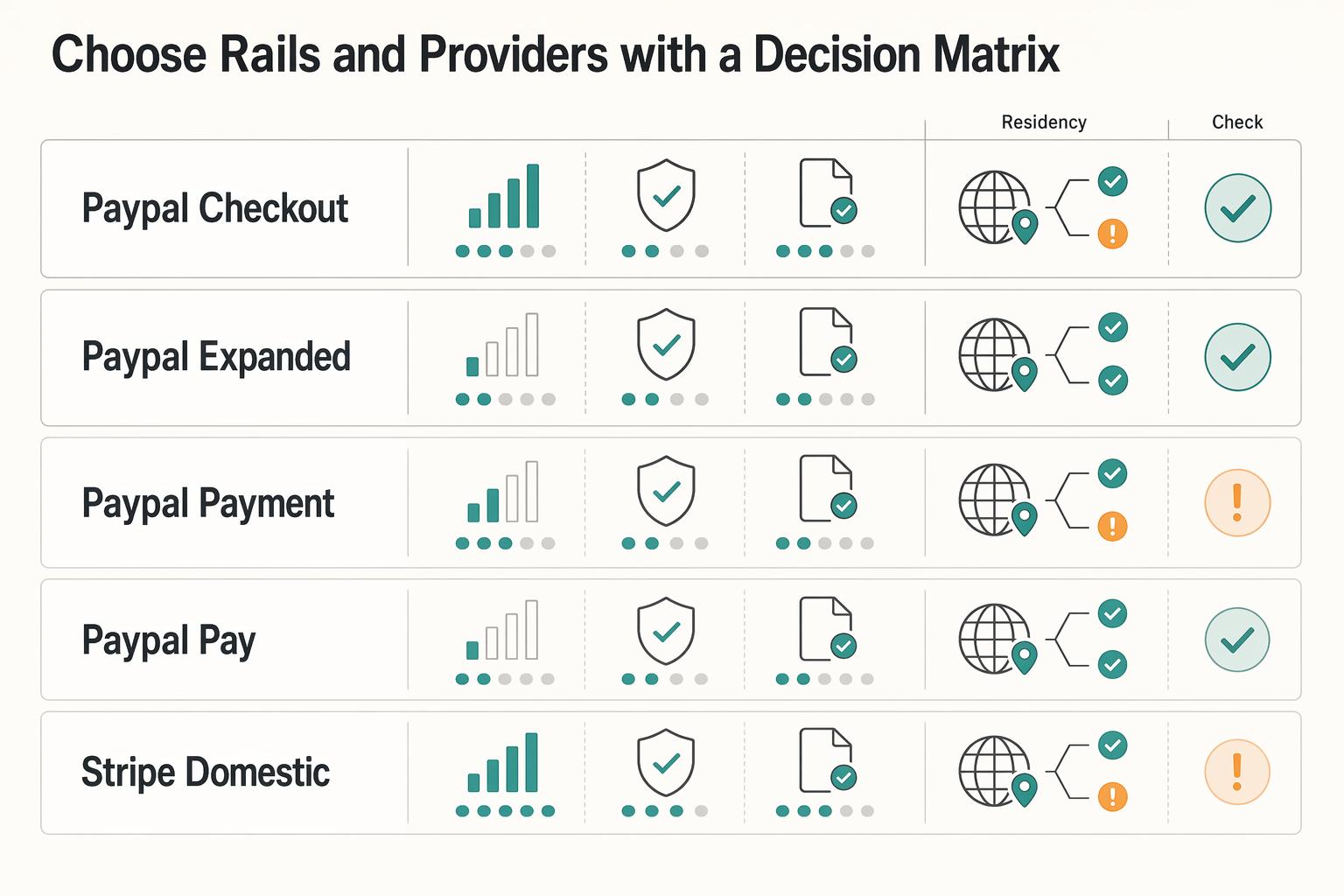
Marketplace Payment Flow Design from Buyer to Seller
Treat your payment design as one continuous chain, not three disconnected diagrams. The job is to map transaction states across payment collection, payout, and refunds, then test cost, controls, and recovery before launch.