
Quick Answer
Build your pre-payment flow around explicit state transitions: create a proforma invoice, confirm payment, then post the final invoice only after fulfillment evidence and approved changes are recorded. Keep release controls strict by requiring invoice verification before payout activity and matching before closeout. Treat partial payment as an in-review state, not completion, so unresolved scope and accounting links go through exception handling instead of spilling into month-end.
Why Proforma Invoice Controls Matter Before Payment Release#
Speed matters, but speed alone is not the job. If you are designing pre-payment contractor workflows around proforma invoice platforms, the goal is to keep contractor payments moving while giving finance clear states, verifiable records, and a clean path to matching and closeout.
A pro forma invoice is a preliminary document sent before a sale is finalized. The harder operational question is what happens after it. What changed state, who approved it, what payment was received, and how that payment maps to the final invoice, a payout batch, and the general ledger. Plenty of product pages talk about faster billing or getting paid faster. Platform teams still need controls they can prove.
A practical prepayment sequence is explicit: 1) create and send a proforma invoice, 2) receive and add a payment for the proforma invoice, 3) create a final sales invoice. That flow creates inspectable state changes and a natural control point. In practice, proforma invoicing can also work as a second level of approval before customer invoicing.
One caveat matters up front. Sources conflict on whether a pro forma invoice is itself a payment request. Some guidance says it is not. Other guidance says it can be used to request payment before delivery. So do not build around a generic definition alone. Define your own state logic, approval rules, and required evidence before money moves.
This article treats invoice creation as one step in a controlled chain, not as an isolated feature. In payout operations, matching means tying transactions to each payout batch. In ledger close, it means tying debit and credit entries together so balances clear. If your prepayment step cannot be traced into those downstream records, the process may be fast, but it will be hard to control.
The article breaks this down into four areas:
- Selection criteria
We focus on finance ops, payments ops, and product owners who need approval and verification discipline. The key question is whether each step is explainable from the proforma step to the final invoice.
- Platform options with real tradeoffs
We compare operating models by where they place friction, approval, and exception handling, not by feature count.
- Failure handling
We cover breakpoints such as unclear document status or payment confirmation that does not support downstream matching.
- Measurable checkpoints before payout release
We define the checks before release: document state, approval record, payment confirmation, and whether later close review can be done at transaction level or batch level.
Design for explicit state changes first, then optimize for speed. That is how you support faster contractor payments without weakening finance control.
Selection criteria and who this list is for#
Use this list if your team needs payment decisions that are fast to execute and easy to defend later. The focus here is finance ops and payments ops, where approval, verification, and payment-release controls happen before funds move.
- Audience fit
This is for teams that need to do three things together: approve invoices, confirm payment completion, and match transaction records to accounting entries. If you also manage workflow states for invoices and payments, use this as a control lens rather than a UI checklist. The practical test is simple: can you show who changed a record, when it changed, and which accounting entry it should match?
- Who should skip this list
Skip this if basic invoicing speed is the current goal and you do not yet need centralized control signals. This article assumes you care about audit-trail visibility and exception routing when payments fail or records do not line up. Those controls matter once you need to explain why payment moved forward and why records do or do not clear.
- What we are evaluating
We evaluate options on four criteria: control over invoice creation, explicit prepay state logic, invoice verification before release, and downstream reconciliation readiness. In a grounded AP pattern, stronger control comes from tracking prepayments against a purchase order and posting both the prepayment invoice and the final invoice as separate records. That creates a document chain you can review and match.
- The one rule that matters
If your team cannot clearly explain key handoffs in the prepayment-to-final-invoice flow, the process gets harder to scale. Labels can differ by platform, but handoffs should still be inspectable, such as a recorded prepayment request or invoice, payment completion, delivery decision, and final invoice posting. One breakdown to watch for is a completed payment with no matching accounting entry, which pushes close work into manual exception handling.
Proforma invoice, estimate, and final invoice decision checkpoints#
These are three different control points, not interchangeable labels.
| Document | Primary purpose | When to use it | Approval expectation | Partial payment | Matching depth |
|---|---|---|---|---|---|
| Estimate | Pricing intent and scope proposal | Before work starts, during quote/bid | Commercial signoff if your policy requires it | Not a payment record by itself | Usually none yet; should still map to agreed scope |
| Proforma invoice | Invoice-format quote used before final invoicing | After scope and price are agreed, before final delivery/completion | Pre-collection approval checkpoint | Deposits or staged prepayment if your policy allows | Policy-defined pre-collection checks |
| Final invoice | Completed billable record with final amounts and terms | After work is done/goods delivered or an accepted completion milestone | Posting/close approval as needed | May reflect deposits, remaining balance, or credits | 2-way or 3-way, based on whether receiving/acceptance evidence is required |
This split matches the public guidance the market already uses. Estimates are quote or proposal documents. Pro forma invoices are quote-style documents in invoice format used before final commercial invoicing, and invoices are sent after completion or delivery.
Recommended conversion rule#
Do not move from proforma to the posted bill only because payment arrived. Use a policy trigger instead: fulfillment evidence is confirmed, and any scope, quantity, or price updates are reflected in the record.
A practical checkpoint packet is: approved estimate, current proforma, payment proof, fulfillment evidence, and any approved change orders your process requires. If key items are missing, keep the record in review instead of posting.
Where controls differ in practice#
Controls should tighten as records move closer to posting. A workable model is estimate for commercial approval, proforma for pre-invoice approval, and the posted bill for accounting discipline.
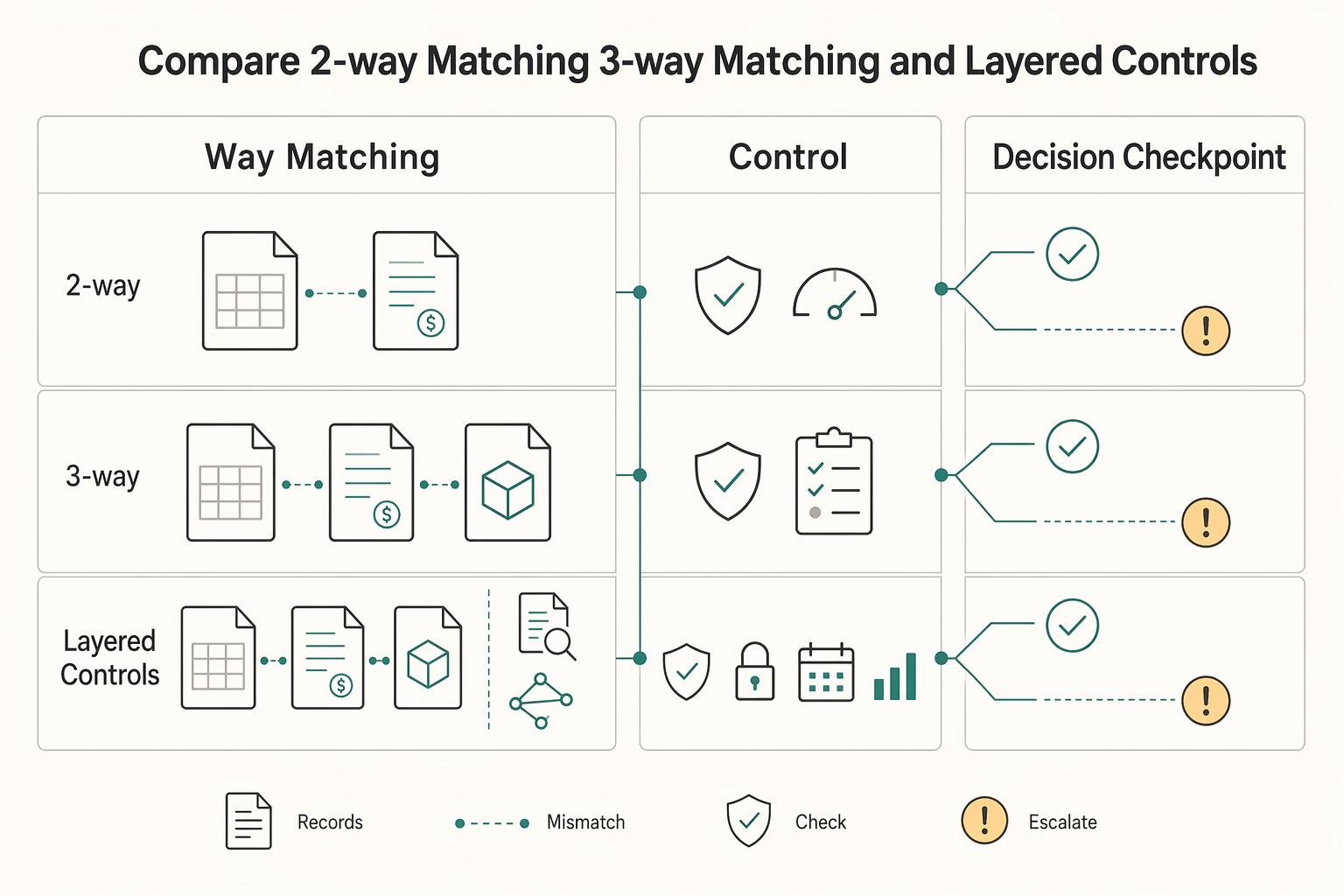
Matching depth should also increase at final billing. A 2-way match checks obligation against invoice. A 3-way match adds receiving or acceptance evidence. If completion can be disputed, require 3-way evidence at that stage.
Public product pages need careful reading#
Public product pages are useful prompts, but they are not proof of control depth. BuildOps, Joist, and Contractor+ all describe quote, invoice, and payment flows. Those claims do not, by themselves, confirm a native proforma record state, a distinct proforma approval path, or default partial payment controls.
When you evaluate tools, verify whether "proforma" is a true system state, a naming convention, or an estimate workaround. That distinction changes approval design, matching logic, and month end close effort.
For a step-by-step walkthrough, see Build a Contractor Payment Flow for Home Services Marketplaces.
End-to-end pre-payment process with explicit control points#
Treat pre-payment as a controlled sequence of states, with two hard gates in policy: no payout action before invoice verification passes, and no closeout before matching passes.
- Invoice creation
Start with a pre-delivery quote-format document, such as a pro forma or equivalent, before final billing. A pro forma invoice is a quote in invoice format, and in Microsoft's prepayment-invoicing method, both a prepayment invoice and a final invoice must be posted. Link this record to approved scope, price, and any PO or job authorization before it can advance.
- Invoice approval
Approval should be a formal state change with clear reviewer accountability. Microsoft's invoice approval journal model shows the control pattern: capture approver and approval details, for example time and approved amount or version. If amount, lines, or terms change, require reapproval.
- Invoice distribution
Send only the approved version to the payer and log the distribution event. Not every platform has a separate distribution state, but treating it explicitly helps with duplicate-send control and version disputes.
- Payment collection
Keep collection separate from confirmation. Payment events can happen outside the immediate request flow, such as webhook-driven updates, and payment status can change over time. A submitted payment is not the same as confirmed funds.
- Payment confirmation
This is the first gate. Require processor evidence and a finance-visible internal record before payout initiation, service release tied to cash receipt, or internal close actions. If confirmation appears at the processor but not in your internal finance trail, route it for exception handling.
- Service delivery evidence
Do not treat payment arrival as fulfillment proof. Set matching depth based on dispute risk: 2-way for PO and invoice, 3-way when you need receipt, or 4-way when you also need acceptance documents. Where GR-based controls apply, receipt must occur before invoice entry. For partial payments, define a policy that prevents automatic release of the full remaining scope without approved handling.
- Final invoice and reconciliation
Post the final bill after fulfillment evidence is confirmed and approved changes are recorded, not just because money arrived. This is the second gate: matching must pass before closeout. It should tie posted payments to open entries so related items can be closed cleanly.
Operationally, each meaningful state change should leave two traces: a finance-visible record, including ledger impact where applicable, and an audit trail record of who changed what and when. That is how you reduce false completion risk, where teams see "paid" and move forward before matching, posting, or closeout is actually complete.
If you need deeper controls on threshold design and match selection, use invoice verification as the decision layer.
If you want a deeper dive, read How Platforms Automate Pre-PO Approval with Purchase Requisitions.
The five platform options and when each is best#
Use these as operating models, not product labels. Pick the option that preserves your two gates: no release before verification passes, and no closeout before matching passes.
| Option | Best when | Control focus |
|---|---|---|
| App-led speed layer | Issue requests quickly and collect payment on straightforward work | Do not treat an in-app paid status as complete until finance has a matching internal record for close |
| Proforma-first controlled pre-payment | You need deposits or an approval step before final billing | Separate requesting payment from posting the completed billing record |
| Verification-first release model | Payout errors are expensive and release control matters more than request speed | Do not release until holds are resolved and required evidence is present |
| Exception-driven automation model | Clean invoices move straight through and only failures need manual review | Keep a reliable exception queue; track aging, repeat reasons, and resolution outcomes |
| Early-liquidity add-on model | You want faster contractor liquidity on receivables without replacing your core invoice controls | Keep approval state, assignment evidence, and payout status separate |
Option 1 App-led speed layer#
Choose this when the main job is to issue requests quickly and collect payment on straightforward work. Contractor apps and invoicing tools position fast invoice creation, sending, and collection as the core value.
It often fits when the same operator needs to move work forward without much handoff. The main checkpoint is simple: do not treat an in-app "paid" status as complete until finance has a matching internal record for close.
Option 2 Proforma-first controlled pre-payment#
Use this when you need deposits or an approval step before final billing. It cleanly separates requesting payment from posting the completed billing record.
A pro forma invoice is a transaction preview, not the posted bill, so it can give you a pre-payment control point before accounting entry and final posting. Confirm that the approved proforma still matches scope and approved amounts before you send it. Then create the final bill after fulfillment or other completion evidence, rather than treating payment receipt as the close signal.
Option 3 Verification-first release model#
Choose this when payout errors are expensive and release control matters more than request speed. Here, verification depth drives release decisions.
2-way matching checks PO and invoice details within tolerances. 3-way matching adds receipt verification. Matching holds are a key safeguard: do not release until holds are resolved and required evidence is present. Define where 2-way is enough and where 3-way is required, then review hold reasons to fix intake quality issues. For deeper design detail, see Invoice Verification for Platforms: How to Validate Contractor Bills Before Releasing Payment.
Option 4 Exception-driven automation model#
This works when clean invoices move straight through and only failures need manual review. Its real dependency is a reliable exception queue, not just automation rules.
An exception queue gives you traceability for failed items, which matters for audit discipline at volume. Keep queue hygiene tight: track aging, repeat reasons, and resolution outcomes so exceptions are actually resolved, not parked.
Option 5 Early-liquidity add-on model#
Use this when you want faster contractor liquidity on receivables without replacing your core invoice controls. This is an overlay, not a substitute for verification and close discipline.
The mechanism is invoice factoring: receivables are sold or assigned to a factor for a cash advance, typically with interest and commission costs. Keep approval state, assignment evidence, and payout status separate so ownership and final cleared amounts stay clear after fees. For related reading, see Tipping and Gratuity Features on Gig Platforms: Payment and Tax Implications.
How to choose the right option by risk and scale#
Start with your main failure mode, then check that the model still supports on-time payout.
- High dispute rate: choose verification-first release.
Use verification-first when scope changes, mismatches, or post-work edits are common, because validation is the gate before payment and accounting. Set matching depth by risk: start with order-to-invoice checks, and require 3-way matching when receipt or service acceptance must be confirmed. In contractor workflows, require approved change order evidence before release, and keep mismatched lines on hold until cleared.
- High volume and low disputes: choose exception-driven automation.
Automate the clean path and escalate only failed checks when throughput is the constraint. Keep exceptions explicit, and keep invoices non-payable until line-level issues are resolved. Review recurring exception reasons regularly so you can fix upstream intake or document quality instead of expanding manual review.
- Payment-timing pressure: use proforma-first with controlled partial payment.
When payment speed is the recurring friction point, use proforma invoice or prepayment-first controls instead of ad hoc advances. Track prepayments against the purchase order, and define clear partial payment rules in advance. Keep the unpaid remainder visible until fulfillment evidence is complete and the final posted invoice is in place.
- If two options look viable, use one tie-breaker metric.
Choose the model that reduces unresolved exceptions at close while preserving on-time payout. That ties control quality to cash timing: close pressure shows whether exceptions are truly being resolved or merely carried forward. Evaluate both outcomes together: unresolved exception load at close and realistic payout timing for your payment method.
The minimum data and evidence pack before payment release#
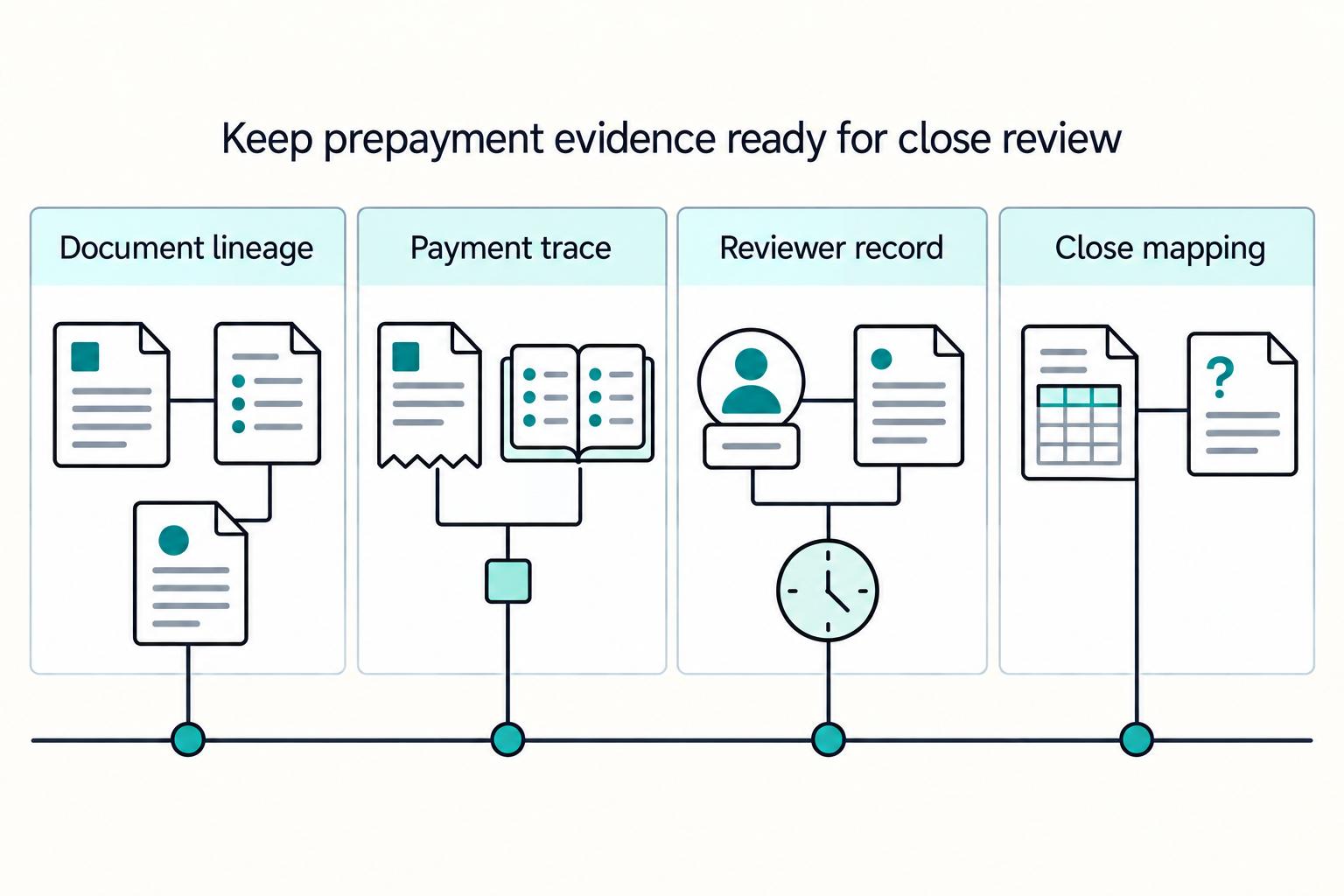
Lock the evidence pack before release. If you cannot show document lineage, payment traceability, reviewer attribution, and close-ready mapping, treat the item as an exception.
| Evidence type | Include | Release note |
|---|---|---|
| Core records | Current pro forma invoice, approved deltas for each change order, signed scope or estimate your workflow requires | Structure the file so the prepayment invoice and final invoice can both be linked from the start |
| Transaction evidence | Successful payment confirmation, processor or provider reference, matching ledger journal entry | If that chain is broken, hold release |
| Control evidence | Reviewer identity for invoice approval, timestamped audit trail events, and reason codes for overrides where used | Check who approved, who changed, and when each step happened |
| Close evidence | Mapped final invoice, completed matching, and documented exceptions when present | Confirm the transaction can close cleanly |
- Core records
Start with one commercial record set for the transaction: the current pro forma invoice, approved deltas for each change order, and any signed scope or estimate your workflow requires. This is a control choice, not a claim that every platform or jurisdiction requires identical paperwork.
The pro forma is a quote in invoice format, not the final bill. The change order is the contract-change instrument. In prepayment-invoicing flows, structure the file so the prepayment invoice and final invoice can both be linked from the start.
- Transaction evidence
Require proof that payment moved: successful payment confirmation, the processor or provider reference, and the matching ledger journal entry.
Use the provider reference as the anchor between the payment event and internal records. A PSP reference can be a unique 16-character alphanumeric identifier, which makes it practical for matching. Pair it with the ledger posting for the prepayment event. If that chain is broken, hold release.
- Control evidence
Keep approval evidence that names people and actions: reviewer identity for invoice approval, timestamped audit trail events, and, where your process uses them, reason codes for overrides.
The check is simple: who approved, who changed, and when each step happened. Audit trail examples support user-attributed, date-stamped changes. Also confirm retention windows, because some products keep audit log events for two years.
- Close evidence
Before release, confirm the transaction can close cleanly: mapped final invoice, completed matching, and documented exceptions when present.
In documented prepayment flows, prepayments are offset against the final invoice. Close review should tie activity to payout-batch tracking and account for failed-payout reporting when present. Since some payout reports are computed daily beginning at 12:00 am, time your checks so you do not review incomplete same-day data.
Use this evidence pack as an implementation checklist, then map each state transition to API events and statuses in Gruv docs.
Failure modes that break pre-payment operations and how to contain them#
Many breaks happen at the handoffs between collection, scope control, posting, and payout timing. Keep customer-facing success signals from outrunning internal state, or you risk duplicate charges, scope mismatch, and close failures.
| Failure mode | Control | Escalation |
|---|---|---|
| Duplicate collection from retries or repeated payment-link sends | Use idempotency keys and an internal duplicate check tied to invoice, customer, amount, and request timing | Before re-sending a payment link, verify whether a successful payment event is already attached; if state is unclear, route to review |
| Scope drift after a partial payment | Freeze fulfillment until the approved delta is posted | No approved change order, no additional scope release |
| Payment confirmation with no ledger event | Match confirmation event, provider reference, and ledger journal entry to the same record | Route the item to an exception queue and block payout |
| Internal status flips before settlement is actually available | Keep payment success and funds availability as separate states | If confirmation is in but funds remain pending, keep the record in payout review |
- Duplicate collection from retries or repeated payment-link sends
Treat duplicate delivery as normal, not exceptional. Retries and webhook events can arrive more than once, so make collection calls idempotent and run duplicate checks before you act.
Use idempotency keys for create or update requests so retries do not trigger the same collection action twice. Also keep an internal duplicate check tied to the commercial record, including invoice, customer, amount, and request timing, because key-retention windows can expire. Before you re-send a payment link, verify whether a successful payment event is already attached. If it is, do not reissue. If state is unclear, route to review instead of retrying blindly.
- Scope drift after a partial payment
If scope changes after partial payment, freeze fulfillment until the approved delta is posted. This is the control that prevents delivery from drifting beyond the signed and funded scope.
In documented prepayment accounting, a prepayment invoice and a final invoice must be posted, so informal scope expansion creates downstream close risk. Keep email or chat approvals as context only, and require a formal change order before additional work proceeds. The gate should stay binary: no approved change order, no additional scope release.
- Payment confirmation with no ledger event
If payment confirmation exists but no matching ledger posting exists, route the item to an exception queue and block payout. Do not allow downstream release from a "paid" signal alone.
Match three elements to the same record: confirmation event, provider reference, and ledger journal entry. Use typed exception routing so teams can separate missing ledger posts from duplicates or amount mismatches and repair faster. If this is a recurring failure point, add invoice verification as a required gate before release.
- Internal status flips before settlement is actually available
Keep payment success and funds availability as separate states. Pending funds are not yet available to spend or withdraw, so disbursement logic should wait for funds-available conditions.
Timing and payout schedule are related, but they are not the same control, and payout schedule settings do not determine when pending funds become available. Use the actual availability state before marking contractor disbursement as ready, and match bank payouts against completed payment batches rather than charge confirmations alone. If confirmation is in but funds remain pending, keep the record in payout review.
Related: How to Build a Contractor Payment System for a Nursing or Allied Health Staffing Agency.
The monthly verification and reconciliation checkpoints finance should run#
Finance should run a monthly checkpoint that tests whether prepayment controls held in practice: verify completeness, test approvals and segregation, re-run matching, and assign accountable dispositions for open exceptions.
- Completeness check
Start with paid advances and confirm they are not left unlinked at period end. Where your workflow uses pro forma or other prepayment documents, review whether approved and paid prepayments were applied to applicable final standard invoices or otherwise dispositioned under your policy.
Keep a review trail per sampled record so finance can trace the advance lifecycle from approval and payment through final treatment. A key failure mode to catch is an advance payment with no clear downstream application or documented disposition.
- Control check
Sample invoice approval and invoice verification records monthly, including straight-through volume and manual edge cases. The test is not only whether approval occurred, but whether segregation of duties held across users and roles.
Verify reviewer identity, role, and timing, including overrides. If conflicts are logged, require explicit resolution and role-compliance follow-up.
- Matching check
Re-run matching at the right rigor for each workflow. Use 2-way matching when the control is PO-to-invoice tolerance, and use 3-way matching when your release control includes receipt-based verification.
Do not skip matching because a prepayment was already collected. Matching exceptions can put invoices on hold, and payment release depends on clearing those holds. For a deeper breakdown, see Invoice Matching Explained: How Platforms Automate 2-Way and 3-Way Matching to Prevent Overpayment.
- Exception check
Age open exception items monthly and assign a likely root cause, not just a status. Use open-item aging plus reconciliation detail to separate unresolved differences by likely cause.
If you run Microsoft Dynamics 365 Finance 10.0.44 or later, the account reconciliation workspace model is a useful benchmark. Surface exceptions, take direct action, and treat records as fully reconciled only after exceptions are addressed. For close, define owners and clear rules for what blocks release, what blocks close, and what can roll forward with documented risk.
Implementation sequence for product and ops teams#
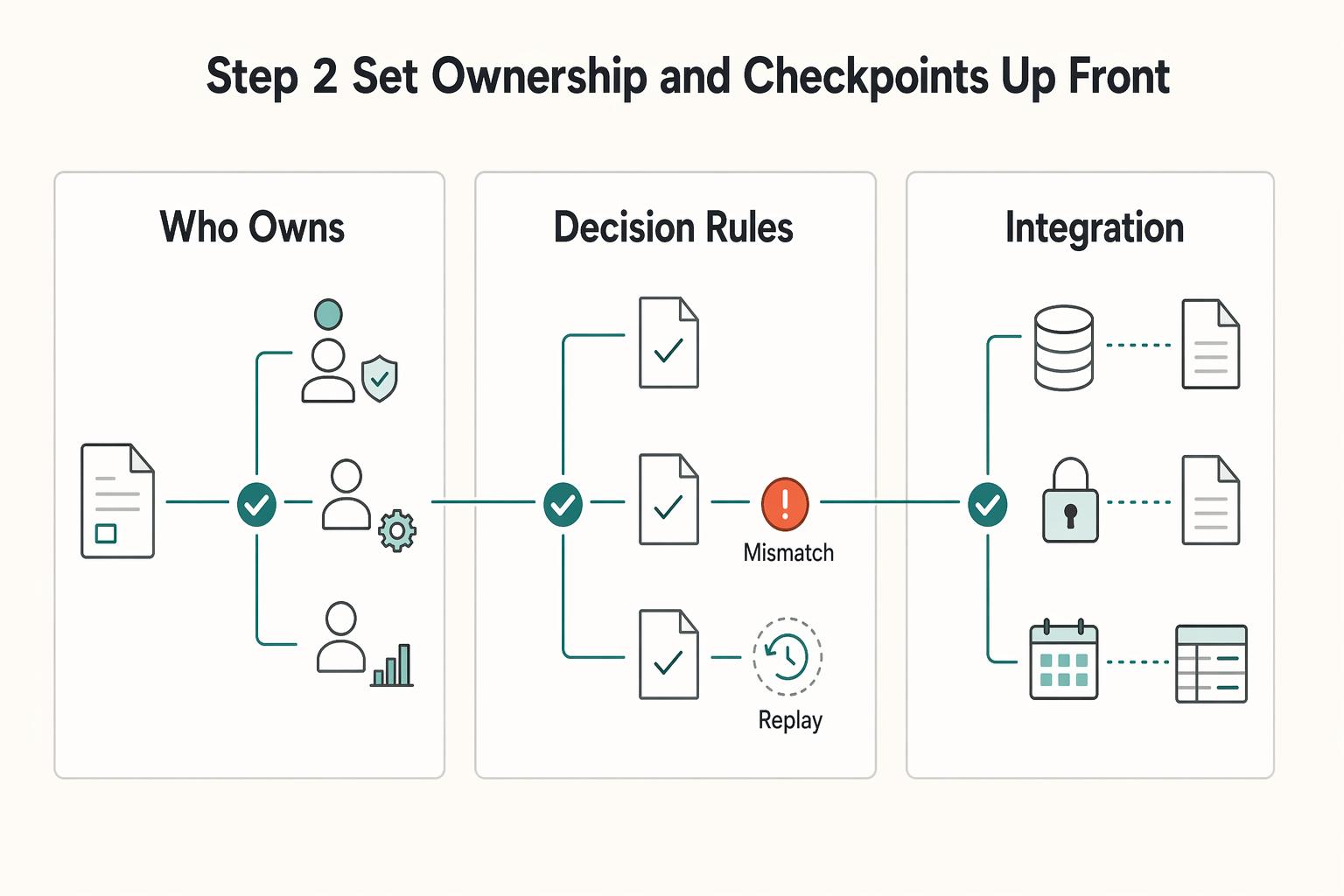
A practical order is: define state ownership, make each step provable in your ledger and audit trail, automate clean cases, then consider financing modules.
- Phase 1: Lock the states and owners first
Start by defining invoice lifecycle states and assigning an owner for each transition before you build automation. At minimum, track clear transitions such as draft to open to paid, and if you use a proforma invoice, treat it as a separate pre-invoice step rather than a finalized bill. A common split is that product owns state transitions and user actions, while finance owns approval rules, evidence requirements, and release blockers. The checkpoint is simple: for any record, you should be able to identify who changed the state, who approved it, and what evidence allowed payment confirmation.
- Phase 2: Post every meaningful event into the ledger and audit trail
Before you add advanced routing, make sure every material action is reconstructable. Your audit trail should capture actor, timestamp, prior state, new state, and override reason in chronological order. Payment confirmation should also link to the ledger posting finance will match. If posting is blocked by exceptions, treat it as a control failure and block downstream release until resolved.
- Phase 3: Automate the clean path and formalize exception handling
Automate only the records with complete approvals, expected amounts, and matching evidence. Route mismatches to manual exception handling with a reason code and a named owner. Keep exception handling explicit and assigned, not ad hoc. In practice, teams often resolve categories such as holds, import rejections, and approval rejections through delegated reviewers.
- Phase 4: Add factoring or financing only after reconciliation and settlement are stable
Add optional modules like factoring only after close processes consistently resolve discrepancies and payout behavior is predictable. Financing providers check invoice validity, dispute status, and payment reliability, so weak base controls create compounding risk. Keep payment confirmation separate from payout availability because pending funds are not yet available. Settlement can take one to three business days for some card payments, but timing varies by payment method and country. If transaction-to-payout linkage is weak, fix that before evaluating What Is Invoice Factoring? How Platforms Can Offer Early Payment to Contractors in Cash Flow Crunch.
You might also find this useful: SOC 2 for Payment Platforms: What Your Enterprise Clients Will Ask For.
Vendor due diligence questions before you trust platform claims#
Do not buy from screenshots. In a live demo, make the vendor answer four questions, and treat vague answers as control gaps.
- Ask whether "proforma" is a real state or just a renamed estimate
A proforma invoice is a preliminary invoice sent before a sale is confirmed, so confirm whether the product models that state directly or relies on an estimate-plus-invoice workaround. Microsoft Dynamics 365 shows an explicit proforma status model: a proforma invoice can be confirmed, and after confirmation it becomes read-only. If the flow looks like Zoho Books' quote-based proforma approach, treat it as a workaround and ask what state, approval, and ledger evidence replaces a direct proforma step.
- Ask where approval, verification, and overrides are visible for audit
You need to see exactly where invoice approval happens and how it is recorded. Tipalti's invoice-flow materials explicitly reference a "clear audit trail for bill workflow," which is a useful benchmark to test against. Ask for one sample record export that shows actor, timestamp, prior state, new state, and override reason. If override history is hidden or unavailable per record, control risk increases.
- Ask how failure cases behave after money starts moving
Test partial payment behavior, duplicate prevention, and post-payment changes in one walkthrough. Square documents that invoices can still be edited after a partial payment, so ask what is locked versus still editable once funds arrive. For duplicate collection attempts, ask whether the platform uses an idempotency key or equivalent unique request key. Stripe recommends this to prevent duplicate PaymentIntents, notes keys can be up to 255 characters, and says keys can be removed after 24 hours.
- Use published vendors as prompts, not proof
Use public claims from BuildOps, Contractor+, Joist, Dataforma, and Tipalti to build your question script, not to decide fit. Ask each vendor to run your exact edge case end to end: deposit request, partial payment, approved change order, final bill mapping, and audit export in one continuous demo.
Conclusion#
Speed in pre-payment workflows only helps when each state change is backed by ledger evidence, visible in an audit trail, and closed through matching. If that chain is missing between payment request, payment confirmation, and the posted invoice, you have moved risk earlier instead of reducing it.
- Tie each pre-payment step to posted accounting evidence
In the HMRC VAT context, a pro-forma can invite payment, but it is not an accounting document on its own. Your process therefore has to end with the formal accounting record after payment or supply. In controlled prepayment invoicing flows, that means treating posted records as the control point: a prepayment invoice and a final invoice are posted, and posting accounts are set up before prepayment posting.
Before you scale, confirm prepayment amounts are held in dedicated GL accounts until final-invoice milestones where your system supports that model. If your team cannot trace a paid pre-payment request to ledger posting and then to posted completion, fix posting design first.
- Choose the platform model that matches your risk profile
The right option is not the fastest invoicing flow. It is the one that fits your control needs and disbursement risk profile. Where scope changes are common, stronger approval and verification gates matter more than invoice speed. Where disbursement risk is the main issue, approval routing before payout is the higher-value control.
A practical signal is that proforma invoicing can function as a second approval level before customer invoicing. If your work is milestone-heavy, keep that extra approval step and clear mapping to posted invoices.
- Automate only after the minimum evidence pack is stable
Start with a complete, auditable record set for each case: current pre-payment document, payment confirmation, posted ledger evidence, approval history, final-invoice mapping, and detailed reconciliation files. The benefit is not automation by itself, but whether automation preserves action history and exception visibility.
If close quality still depends on chasing missing records across systems, automation is early. Detailed reconciliation files are still required for accurate auditing and reporting, so get that discipline stable first and then automate the clean path.
If you want to pressure-test your proforma-to-final invoice flow against payout controls and reconciliation requirements, talk with Gruv.
Frequently Asked Questions
What is a proforma invoice in contractor payment operations, and how is it different from a final invoice?
A proforma invoice is a pre-supply payment request, not the final accounting invoice. In the HMRC VAT context, it can invite payment for goods or services to be supplied, but it is not treated as an accounting document on its own. The final invoice is the formal accounting or tax record issued after payment or supply, and a full VAT invoice must be issued within 30 days in that context.
When should a platform use a proforma invoice instead of an estimate?
A practical distinction in many workflows is timing: use a proforma when you are requesting pre-payment, and use an estimate earlier at the pricing stage. A practical signal is conversion gating: in QuickBooks, an estimate must be Accepted before conversion, and a deposit-requested estimate becomes convertible after deposit payment and acceptance.
What is the minimum approval chain before accepting pre-payment from a contractor client?
There is no universal legal minimum approval chain across all contractor pre-payment contexts. In one documented pattern, a practical baseline is two layers: approval of underlying time, expense, or material entries, then approval of the customer-facing proforma before customer invoice creation. Keep segregation of duties where possible so one person is not creating, approving, and releasing payout on the same case.
How should teams handle partial payment without breaking settlement and reconciliation?
Handle partial payment as its own controlled state, not as full financial completion. Match what was actually received and keep any unpaid amount open for settlement. In prepayment AP models, post both the prepayment invoice and the final invoice, and keep prepayment liability separate from standard AP liability.
Do we need 2-way matching or 3-way matching for contractor pre-payment flows?
Two-way and three-way matching are control choices, not universal legal requirements. Two-way matching compares invoice unit price to purchase order unit price, while three-way matching also validates invoice quantity against matched receipt quantity. Where discrepancy tolerances and receipt evidence matter, deeper matching can support exception-based review. For a deeper walkthrough, see Invoice Matching Explained: How Platforms Automate 2-Way and 3-Way Matching to Prevent Overpayment.
What are the most common failure points between payment confirmation and payout release?
Common failure points include duplicate payment attempts during retries and payout release decisions made before funds are available. Use idempotency keys to prevent duplicate payment operations. Stripe documents keys up to 255 characters and notes pruning after 24 hours. Also separate payment confirmation from payout readiness, because payout schedule frequency does not control pending-balance availability, and banks may still take 2-3 additional days to post funds, with examples such as captures from 3 business days earlier.
Can contractor invoicing apps support platform-grade controls, or do we need additional finance ops layers?
Many contractor invoicing apps are strong for estimate, invoice, and payment execution, but that does not automatically give you platform-grade control coverage. Joist’s public positioning reflects execution features, while AP operations may still route imported invoices through formal workflow review before posting. If that review layer is required in your process, you likely need additional finance ops controls.
Try a related tool
Researched and edited by the Gruv editorial team. Gruv builds cross-border billing, payouts, and finance-operations software for global businesses.
Sources
- acquisition.gov/far/part-43trusted
- bia.gov/sites/default/files/dup/assets/public/raca/m...trusted
- csrc.nist.gov/glossary/term/audit_trailtrusted
- docs.stripe.com/reports/payout-reconciliationtrusted
- docs.stripe.com/api/idempotent_requeststrusted
- dot.ca.gov/programs/construction/construction-manual/se...trusted
- ecfr.gov/current/title-19/chapter-I/part-141/subpart-...trusted
- gao.gov/pdf/product/665712trusted
Educational content only. Not legal, tax, or financial advice.
Related Posts
How Platform Teams Use 2-Way and 3-Way Invoice Matching to Stop Overpayment
Platform teams do not need another glossary entry on invoice matching. They need controls that stop real overpayment paths before money goes out the door. At its core, invoice matching compares an invoice with supporting records before payment. The practical question is what you add when a clean match still does not mean the invoice should be paid as submitted.
Invoice Verification for Platforms: How to Validate Contractor Bills Before Releasing Payment
Treat invoice verification as a payout gate, not a back-office cleanup step. If a contractor bill can reach payout authorization before it clears your checks, you do not just have an AP process gap. You have a release-control gap.

Invoice Factoring for Contractors: How Platforms Offer Early Payment and Manage Risk
If you run a platform for contractors, early payment is a product and risk decision before it is a goodwill feature. Ask four things up front: Who funds the advance? Who collects from the payer? Who absorbs nonpayment risk? Do the unit economics still work once disputes and exceptions show up?