
Quick Answer
Build the system around approved shift data, documented payout cutoffs, and contractor tax-document controls before you optimize speed. If time capture, compliance review, and payout release do not share the same status model, finance cleanup and support load rise fast.
Payout Execution and Cash Timing Are Two Separate Decisions#
For contractor setup and reporting details, keep the IRS Form W-9 overview and the IRS independent-contractor reporting guidance in the same operating packet as your staffing payout workflow.
Before you start#
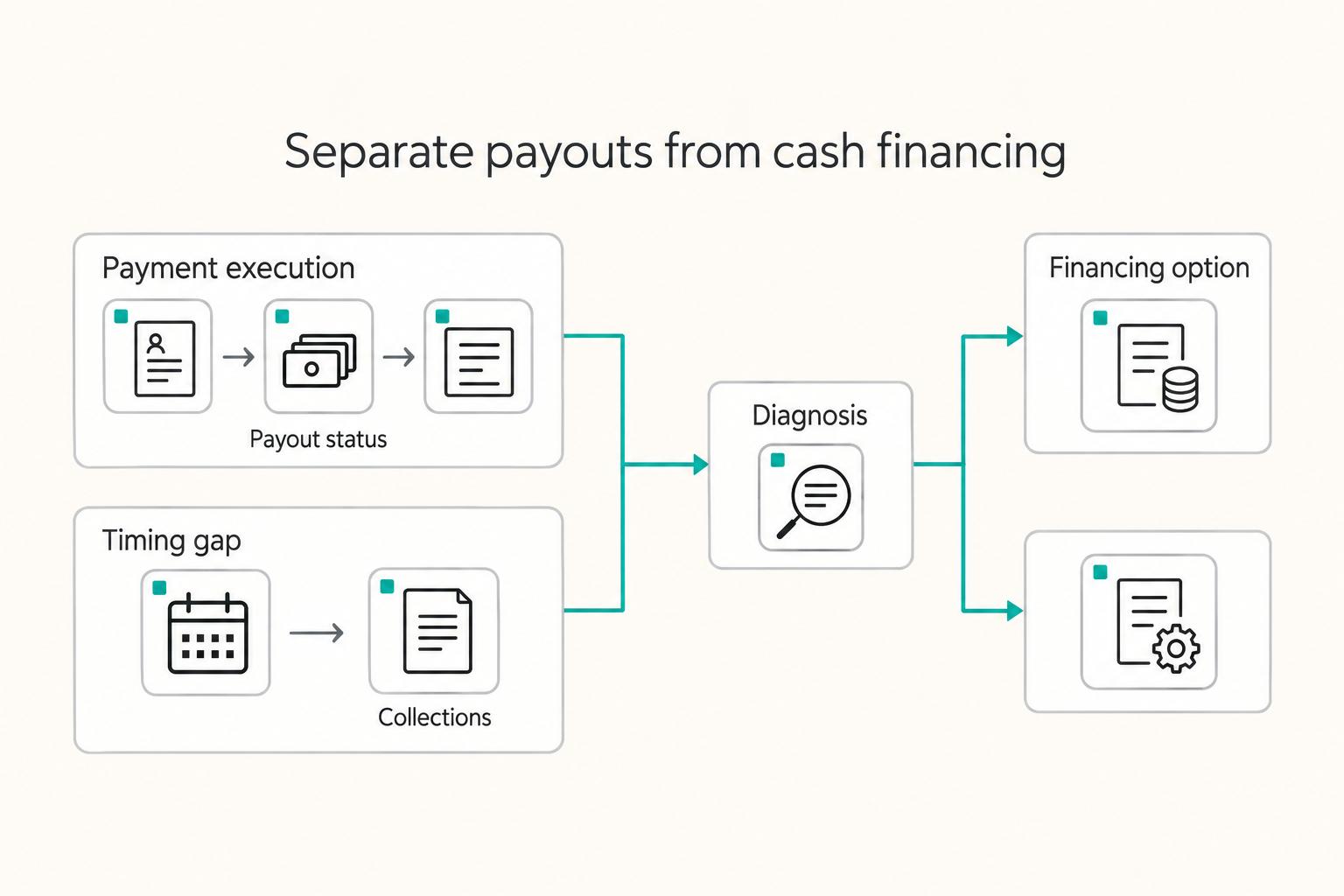
Treat payout execution and cash timing as two separate decisions. In nursing and allied health staffing, you often need to pay on a short, predictable cadence while client payments or reimbursement-linked collections arrive later. If you blur those issues together, you can end up buying financing for what is really an operations problem.
Step 1. Identify the timing mismatch you actually have.
In U.S. practice, pay cycles are often frequent: as of February 2023, biweekly was 43.0 percent of private establishments and weekly was 27.0 percent. For covered FLSA wages, payment is due on the regular payday for the pay period covered, so your outflow clock is usually fixed before your inflow clock.
If Medicaid sits in your payer chain, even clean-claim timing can stretch. The practitioner standard is 90 percent within 30 days and 99 percent within 90 days. Medicaid is state-administered, so operating conditions can vary by market.
Step 2. Decide whether the first issue is execution or liquidity.
If late or failed payments point to execution issues, fix execution first. Invoice factoring is a receivables-based financing tool, so it addresses liquidity tied to accounts receivable, not payout execution.
This guide follows a practical order: stabilize payout operations and reconciliation first, then add working-capital tools only for timing gaps that remain. Financing can cover cash constraints, but it will not fix payout-operation breakdowns.
Step 3. Set a narrow decision scope before you buy anything.
Start with one launch market, one care segment, and one payout promise you can support with operating data. Documentation load, payer timing, and compliance expectations can differ by market and payer mix.
Verification point: document your payout cadence, your slowest collection path, and the payer mix or program dependency behind it. If you cannot show those three items for a sample week, you are not ready to decide whether the next move is a payment-product change or a financing tool.
Step 4. Keep the scope note explicit.
Coverage and compliance requirements vary by market, payer mix, and program support. Once payments cross borders, expectations can diverge by jurisdiction because there is no single global regulatory standard. If phase one is domestic only, state that clearly and hold scope there until payout operations are stable. For a related planning framework, see How to Build a Predictable Content Strategy for Your Agency.
Separate payment execution from cash financing#
Once you document the timing gap, split the decision in two. Payment execution covers onboarding, disbursement, and payout status. Factoring, payroll funding, and SBA-backed loans cover liquidity.
Step 1. Define the jobs before comparing vendors. Payment operations are about onboarding and verifying the right person, sending funds, and tracking payout status (paid, held, failed, or returned). Financing products solve a different problem by lending or advancing against receivables or business credit so you can cover payroll before collections arrive. Those are credit tools, not payout infrastructure.
Step 2. Diagnose the failure point. If payouts fail because bank details do not match receiving bank records, or payouts are paused because required tax information is missing, fix that first. Those are execution and compliance problems. If payouts run cleanly, statuses are clear, and cash is still short because receivables land later, you have a financing problem.
A practical checkpoint: review one recent pay cycle and label each exception. Separate onboarding data issues, identity or tax gaps, rail failures, and status ambiguity from pure cash-shortfall incidents on payday. If most issues fall into the first group, do not shop for funding yet.
Step 3. Evaluate vendor claims against your own agency data, not marketing copy. Dots emphasizes forms and identity checks as payout blockers. eCapital emphasizes bridging invoicing to payroll. PayrollFunding.com emphasizes collections handling. PLEX emphasizes access without a high credit score. These are different problem categories, so compare them only after you know which category is actually hurting you.
Step 4. Keep comparisons like-for-like. Do not compare Dots Payouts and small-business loans as if they solve the same job. If you need payout control, choose payout tooling. If you need cash between invoicing and payday, evaluate financing after payment operations run clean.
Choose your first market and care segment before selecting tools#
Scope discipline matters early. For phase-one planning, pick one launch geography and one care segment before you compare tools, because licensure rules, payer timing, and cross-border obligations can change operations enough to distort vendor decisions.
Fix one jurisdiction first#
Start with the state or state group you will serve first. For nursing, licensing burden changes by geography because multi-state practice depends on Nurse Licensure Compact (NLC) participation. A launch concentrated in NLC states can look operationally very different from one that depends on non-NLC states and separate licenses.
For allied health, state policy drives education and training requirements, licensure and certification requirements, scope of practice, and Medicaid coverage. Physical therapists and physical therapist assistants are a concrete example: state boards manage licensure, and licensure is required to practice. A broad allied-health scope can therefore hide materially different approval and billing conditions across roles and states.
Verification point: write a one-page scope note with the exact launch state or states, worker role family, and license assumption per role. If you cannot state whether your launch depends on NLC participation, state-board licensure, or both, it is too early to compare platforms.
Choose one care segment and model payer mix#
Receivables timing can be segment- and payer-dependent, not one generic healthcare-staffing pattern. If you skip this step, you can mistake reimbursement lag for a payout-tool problem, or the reverse.
Bring Medicaid and Medicare assumptions in early. Medicaid prompt-pay framing uses 90% and 99% claim-payment thresholds within 30 and 90 days. A clean claim is one that can be processed without extra information, so missing data can push actual cash timing beyond the headline window.
Medicare timelines also differ by context. Cited Medicare Advantage rule text includes a 30-day clean-claim benchmark in non-contracted contexts. Medicare Part D sets 14 days for electronic claims and 30 days for non-electronic claims.
Practical checkpoint: tag your first ten expected client accounts as Medicaid-heavy, Medicare-linked, commercial, or unknown. Next to each, write the assumed collection window and whether that assumption depends on clean claims.
Decide whether phase one is domestic-only or includes global payouts#
Make this call before vendor demos go deep. If you support transfers to designated recipients in foreign countries, activity may fall under Regulation E remittance-transfer rules. The rule includes a 500-transfer safe harbor based on the previous and current calendar year, plus a compliance transition period of up to six months after crossing the threshold.
Cross-border activity can also trigger money services business obligations. If activity falls under MSB rules, FinCEN registration is required, and MSBs must maintain an anti-money laundering program. Rejected sanctions-related transactions also trigger OFAC reporting duties. In practice, that can change disclosure, support, and exception ownership early in operations.
Freeze the launch scope before signing#
Before signing a payout platform or factoring agreement, consider freezing four items for phase one. Set one geography, one care segment, one payer-mix assumption, and decide whether launch is domestic-only or international. If any of these are still TBD, you may be comparing tools against mixed operating cases.
That gives you a cleaner vendor evaluation because you are matching tools to one real operating model, not to a future expansion scenario.
Build the minimum operating model before adding complexity#
Keep phase one narrow. Make onboarding, payout approval, payout release, and exception resolution explicit, owned, and traceable before you add more rails or financing options.
Define the baseline stack and one source of truth#
Start with a baseline stack built around four parts. You need onboarding intake, approval logic tied to the engagement record, payout release through a Payouts API or equivalent operator tooling, and a visible exception queue.
Use your VMS as the lifecycle source of truth, and keep the payout layer focused on one decision: can this payee be paid now, for this amount, to this destination?
Do not release payouts without an approved source record, such as an approved timesheet, expense, or work-order amount. If you still use spreadsheet uploads in phase one, require stable IDs that match back to the VMS record.
Define onboarding evidence by payee class and map it to eligibility#
Define “onboarded” as required evidence, not a label. For U.S. independent contractors, IRS guidance puts Form W-9 first after classification, and collected W-9s should be retained for four years.
Use a practical launch split like this:
- Individual contractor: completed W-9, active payee record, payout destination details.
- Business payee / LLC vendor: completed W-9, active payee record, payout destination details.
Treat missing or incorrect TIN data as a release blocker, since backup withholding can apply at 24 percent. Then map VMS fields to payout eligibility explicitly (this mapping is implementation-specific), for example: active assignment, approved payable item, complete W-9, valid destination. If any condition fails, route to held.
Publish payout status promises and assign owners#
Do not wait until the first exception to define status handling. Publish timing promises before launch, and separate your internal business statuses from provider statuses. At minimum, define handling and ownership for on-time, held, failed, and returned.
| Scenario | Promise | Owner |
|---|---|---|
| On-time | Paid after approval/release within your normal window | Payout operations |
| Held | Not released until required approval or onboarding/tax data is fixed | Onboarding or finance ops |
| Failed | Payment attempt did not complete; reviewed before retry | Payments ops |
| Returned | Funds came back after release; corrected and reprocessed | Payments ops + payee support |
Returned payouts should have a dedicated queue, because incorrect destination information can cause returned payouts. If your provider emits status-change events, route them into the same operator view used to resolve cases.
Add tax readiness in phase one, not at year end#
Year-end reporting gets much easier if you design for it before the first payout. Build 1099 readiness into onboarding and payout records from day one. Form 1099-NEC filing is due by January 31, and the recipient copy is also tied to January 31. If you file 10 or more information returns, electronic filing is required.
Do not hard-code a single 1099 threshold from secondary summaries. Confirm current IRS instructions for the tax year you are filing.
Run 10 sample journeys end to end before launch#
Before go-live, prove the model with 10 sample contractor journeys from onboarding through final payout status. This is an operational checkpoint, not a regulatory requirement. Include at least:
- 1 failed onboarding case, for example a missing W-9 or incorrect TIN path to
held. - 1 failed payout case, for example an invalid destination or provider-side failure.
Pass only if each case is traceable from VMS record to approval decision to payout result, with one clear owner for each exception. If that chain is not visible yet, fix the model before adding complexity.
For a step-by-step walkthrough, see How to Build a Client Acquisition System for Your Agency.
Design reconciliation from day one or month-end will break#
Traceability is a launch requirement, not a cleanup task. If Finance Ops cannot follow a payment from client invoice to bank movement to general ledger, month-end turns into manual guesswork instead of reconciliation.
Reconciliation is a periodic control process: compare related records, explain variances, and identify adjustments so records agree. Build that control before you add financing products or international rails.
Build one traceable chain from invoice to payout#
Create one chain you can follow forward and backward: client invoice ID, receivable ID, payout instruction ID, provider confirmation ID, ledger entry ID, and reconciliation export ID. Use the VMS record as the business anchor, then carry that reference through payments and accounting records.
This matters because contingent-workforce invoice files can hold payment-critical data for both buyer-to-supplier and supplier-to-worker flows. If invoice and payout records cannot be tied to the same approved payable item, reconciliation work shifts into spreadsheets and email reconstruction.
Keep one operating rule: no payout without an approved source record, and no ledger posting without a payout or receivable reference. Validate with completed payouts. If any path still needs side records to explain it, the design is not ready.
Track funding states explicitly when a receivables reserve is involved#
If you use factoring, payroll funding, or similar structures, track funding states explicitly at the invoice level. A factoring reserve is a held portion of invoice value. It is released after collection, less fees or charges. If you collapse everything into one net cash event, you hide what actually happened.
At minimum, capture invoice issued, receivable open, advance received, reserve held, fee posted, client collection received, reserve released, and settlement complete. These do not all need to be customer-facing statuses, but they should exist in your books and exports.
One failure mode is net-only booking. If your team records only a net settlement deposit, you lose the link between advances, fees, reserve releases, and the original receivable. Reconcile arithmetically and document variances instead of forcing plug entries.
Make Payouts API retries idempotent#
Retries should be safe. Duplicate disbursements should not happen. Use an idempotency key on every payout creation call so repeated retries of the same request are recognized as the same instruction.
When responses are missing after a timeout, retry with the same idempotency key and the same payload. Do not resubmit with a fresh key for the same payment. That is exactly the case idempotency controls are designed for.
Store the idempotency key on the payout instruction record, not only in logs. Also store the original request details with that key so retries can be verified as identical.
Also align retry policy with provider windows. Stripe notes keys can be removed after at least 24 hours, while Adyen states a minimum 7-day validity period. Outside those windows, a retry may be treated as a new instruction depending on provider behavior.
Split exception queues by failure shape#
Do not send every exception into one bucket. Use separate queues for VMS mismatch, returned payment, and unmatched deposit events in international payment flows. These failures require different evidence, owners, and fixes.
| Exception queue | Typical trigger | What to check before clearing |
|---|---|---|
| VMS mismatch | Approved payable item does not match payout instruction, or stable ID is missing | Source VMS record, invoice/receivable reference, amount and payee match |
| Returned payment | Funds return after release | Provider return status, destination details, original payout instruction, reissue decision |
| Unmatched deposit | Inbound settlement or cross-border credit cannot be tied to invoice or payout | Bank/provider confirmation, receivable record, settlement reference, fees/reserve treatment |
For cross-border payments processed via SWIFT, store the UETR. It is required on those transactions and improves traceability. Tracker views may not be real-time, so status screens alone should not clear unmatched deposit cases.
Close each exception with documented variance notes and the exact adjustment taken. Reconciliation control is only complete when it is timely, documented, and verifiable.
Prepare compliance and tax artifacts before go live#
Incomplete identity checks, tax records, and payout restrictions do not stay back-office problems for long. At go live, teams can end up with workers marked "ready to pay" who still cannot receive funds.
Define market-specific verification gates before you promise payout timing#
Set go-live verification rules per market, not as one universal checklist. Requirements vary by location, business type, and requested capabilities, so a U.S. flow should not simply be copied across countries or entity types.
For each market, define whether individual verification, business verification, or both are required; whether legal-entity payees may require beneficial-owner details; what conditions trigger held or restricted payouts; and what clears the hold and who can approve release.
Your operator should be able to answer two questions immediately: why is this payee blocked, and what removes the block? Also document the provider-deadline failure mode where unresolved verification can disable payouts.
Collect tax data in onboarding, not after first payout#
For U.S. contractors, collect Form W-9 during onboarding. IRS guidance frames W-9 collection as the first step so you have a correct TIN for information returns.
Do not create a separate back-office chase after work has started. Before payout eligibility, contractor profiles should capture W-9 status, TIN completion state, and collection date.
Keep these operating rules explicit: retain W-9 records for four years; treat missing or mismatched TIN paths as a risk, since backup withholding workflows may be required (24% rate); lock in Form 1099-NEC filing and recipient furnishing deadlines for January 31; and document which NEC threshold applies for the payment year, because IRS materials currently show both $600 and $2,000 (for payments made after December 31, 2025).
Record what you do not know about each market#
A market can be supported without being ready. Global coverage is broad (more than 50 countries), but country support is not universal, some cross-border flows remain region-limited, and support changes over time.
Maintain a market assumptions log with confirmed, restricted, and unknown statuses. Track country onboarding constraints, recipient-type support, payout-method limits, and whether your model could shift legal or compliance responsibility to your platform. If your model involves managing customer funds, escalate licensing questions early.
Build an internal evidence pack for one full payout cycle#
Before go live, prove the controls end to end with one complete payout-cycle pack. Include:
- one approved contractor profile with W-9 status and payout-eligibility decision
- one held or restricted case with reason code and release evidence
- provider event logs tied to the payout
- API request logs for related onboarding or payout actions
- final payout result with internal review trail
If Finance, Ops, and Compliance cannot reconstruct the full flow from your documentation in minutes, you are not ready to scale beyond the first market.
Select rails and integration depth by operating stage#
Choose rail coverage and integration depth based on what your team can operate reliably outside business hours. Stage 1 should favor rails with clear timing rules and operator controls. Stage 2 should add webhook-driven payout automation only after after-hours incident ownership is in place.
Choose Stage 1 rails by support burden, not feature count#
If your team is small, start with fewer rails and better failure visibility. Every added rail brings more timing rules, exceptions, and support load.
| Rail | Operating pattern | What it means for ops |
|---|---|---|
| ACH | Scheduled windows and cutoffs | Same Day ACH is not always-on. FedACH publishes current-day windows such as 10:30 a.m. ET to 1:00 p.m. ET and 2:45 p.m. ET to 5:00 p.m. ET, so payout promises must match those windows. |
| FedNow | 24x7x365 continuous processing | Useful when you need around-the-clock movement, but your team still needs coverage for payout exceptions. FedNow went live on July 20, 2023. |
| RTP | Around-the-clock, including weekends and holidays | Similar staffing implications to FedNow: around-the-clock availability can remove batch-based daytime buffers. |
Practical rule: if evening and weekend coverage is not in place, start with ACH and explicit cutoff-based payout timing. Add an instant rail only when support ownership and corridor fit are clear.
Score providers on support and incident visibility before launch speed#
Do not choose a provider on launch-speed claims alone. Claims like “under one week” and “from no-code to fully native” can be useful diligence inputs, but they are not proof your rollout will run cleanly.
Before signing, verify who owns urgent payout issues outside local business hours, whether incidents are published and alert subscriptions are available, what operator tooling exists before deep API integration, and how payout timing varies by country and industry.
Support models differ. Some providers offer 24x7 phone, email, and chat support, and some use follow-the-sun coverage for urgent issues. You still need internal ownership for contractor-facing incidents.
Checkpoint: subscribe to the status page, get the escalation path in writing, and run one mock incident. If your ops lead cannot name who contacts the provider at 9 p.m. on Saturday, delay deeper automation.
Add webhook automation only when retries and duplicates are handled#
Stage 2 starts only when your webhook handling is retry-safe. Webhooks are HTTPS event posts, and duplicate delivery is normal behavior. Two common failure modes are worth testing early:
- Stripe can resend undelivered webhook events for up to three days.
- PayPal can reattempt non-2xx deliveries up to 25 times over 3 days.
Your handler should use idempotency and replay checks. Test by sending the same payout-status event twice and confirm you get one ledger update, one contractor notification, and no duplicate disbursement or case closure. If that test fails, stay on lighter integration and handle exceptions manually.
Confirm weekend ownership before expanding rail depth#
This decision is operational, not theoretical. Choose platform depth only after you confirm named ownership for payout incidents across evenings and weekends.
Instant-payment operations can increase staffing burden because batch-only handling no longer fits when money can move at any hour. If ownership and escalation are not clearly staffed, keep rail coverage narrow, keep payout promises conservative, and postpone deeper automation.
Add financing only after operational bottlenecks are measured#
Add financing only after payout execution and reconciliation are stable, and only when the remaining issue is cash timing.
Measure the real cash gap#
Measure from approved work to cash receipt, not from contract terms alone. A staffing firm can have net-30 terms and still get paid 60 to 75 days later, which is where payroll pressure starts.
Use weekly cash tracking, a 13-week forecast, and a client-by-client collection assessment. Then test payroll runway directly: can you fund at least 4 to 6 payrolls, and preferably 6 to 10, before customer cash arrives? If you cannot answer that from your own data, do not compare invoice factoring or other working-capital products yet.
Confirm the issue is collections timing, not billing quality#
Financing is a better fit when collections are delayed but predictable, not when disputes or billing controls are unresolved. Validate the full chain: client invoice, receivable, payout instruction, provider confirmation, ledger entry, and cash settlement.
If the same accounts repeatedly short-pay, dispute hours, or apply deductions, fix billing controls first. Otherwise, you can add financing costs or sell receivables before confirming invoices convert to cash on the timeline you modeled.
Compare factoring on structure, not speed#
Invoice factoring is the sale of outstanding invoices for upfront cash, with the factor collecting from the customer. Evaluate structure before speed: advance terms, reserve treatment, settlement timing, and recourse versus non-recourse obligations.
Reserve mechanics are central to payroll planning. The factor may hold back part of invoice value and release it after customer payment, minus fees and charges, and that reserve also covers dispute, deduction, return, and nonpayment risk. In staffing, reported factoring rates range from 1% to 5% depending on client mix, but rate alone is not enough to judge fit.
Verification point: request a sample settlement statement before signing. It should show invoice amount, initial advance, reserve held, fees, customer payment date, and final reserve release, including how disputes or deductions change your net cash.
Compare loan alternatives only after the cash pattern is proven#
Compare loans or lines only after your cash-conversion pattern is measured and repeatable. For recurring payroll gaps with stable collections, an SBA 7(a) Working Capital Pilot line may be easier to model than invoice-by-invoice selling. The maximum loan size is $5,000,000, maturity can run up to 60 months, and interest is charged only when in use.
| Option | When it fits | Main watchout |
|---|---|---|
| Invoice factoring | Predictable receivables are delayed | Reserve treatment, recourse terms, fees, customer disputes |
| SBA 7(a) Working Capital Pilot line | Recurring cash gap with underwriting support | Collateral and lender readiness may still be required |
| SBA 504 loan | Major fixed assets | Not for working capital or payroll float |
If payroll float is the issue, rule out SBA 504 early. It is designed for fixed assets and cannot be used for working capital or inventory.
Prevent the failure modes that sink staffing payout launches#
Once execution is stable, a major launch risk can be control drift across data, payout expectations, tax records, and financing decisions. Keep those controls explicit before volume increases.
Lock the VMS mapping#
Prevent data drift by enforcing one mapping from your Vendor Management System (VMS) record to payout beneficiary data. Treat the VMS as the system of record for worker identity, assignment, and approved work, and avoid split edits across Ops and Finance.
Verification point: for each released payout, confirm contractor ID, assignment ID, and bank-beneficiary record all tie to the same VMS record. If you see recurring name mismatches, duplicate beneficiaries, or spreadsheet overrides, pause releases until mapping is corrected.
Publish realistic payout SLAs#
Set payout expectations by payout state, not just through a generic “paid” promise. Define internal SLAs for standard payouts, held payouts, and returned payouts, even if your provider uses different labels.
Real flows can remain pending or in-transit, and some can be frozen or fail review. Require an operator note for every hold and return reason. ACH returns include standardized reason codes, and many administrative or processing returns are transmitted by midnight of the second banking day after settlement.
Collect tax data before first payment#
Collect Form W-9 data at onboarding, before first payment. Keep W-9 records for 4 years and run periodic completeness checks on TIN, legal name, address, and payee classification before year-end cleanup.
If TIN data is missing or incorrect, backup withholding can apply at 24%. Also avoid hard-coding one Form 1099 threshold, since current IRS materials show a transition risk between $600 and $2,000 for certain 2026 payments.
Review financing dependence when payer timing changes#
Recheck financing dependence whenever client mix, reimbursement timing, or care segment changes. Clean-claim timing is not uniform. Cited federal rules include Medicaid 90% within 30 days and 99% within 90 days. Medicare Advantage and managed care arrangements can follow different timelines or alternative schedules.
If your book shifts toward slower or less predictable reimbursement, verify that factoring is still covering timing rather than masking billing weakness. Review dispute rates, days-to-cash by payer, and your financing terms, not only whether last week’s payroll cleared.
Use a vendor scorecard before signing any payment or funding partner#
Score payout infrastructure and payroll funding separately before you sign anything, because they solve different problems. If you need onboarding, disbursement tracking, reconciliation, and tax/reporting support, evaluate that lane on its own. If payouts are already stable but collections lag by 30 to 90 days, evaluate payroll funding for that cash-gap use case.
Split the scorecard by job to be done#
Start with a binary filter: payout execution versus receivables financing. If the issue is contractor onboarding, payout tracking, or reconciliation, funding alone will not fix it. If operations are clean and timing pressure comes from delayed customer payment, funding belongs on the shortlist.
| Vendor | Publicly positioned for | Verifiable operator signal | Red flag to verify |
|---|---|---|---|
| Dots | Payout infrastructure | Payouts API, real-time webhooks, onboarding/compliance, payments, tax reporting | Coverage claims differ across pages: 190+ countries vs 180+ |
| eCapital | Payroll funding | Staffing cash-gap framing; factoring reserve, FMA, and early termination fee concepts documented | Deal terms are agreement-specific |
| PayrollFunding.com | Provider-matching marketplace | Helps find a payroll funding provider; staffing factoring explainer available | Not a single named funding product page |
| PLEX Capital | Medical staffing funding | Public fee-transparency claim | Reserve and support terms still require contract review |
| Advance Partners | Payroll funding | Buys invoices for working capital; public tax administration and invoicing mentions | Back-office scope needs exact definition |
Set must-have criteria before demos#
Fail vendors early against hard criteria. For payout partners, require API support, payout status transparency, and clear tax/reporting support; confirm ownership for held or failed disbursements in contract. Dots can be preliminarily scored from public claims, including Payouts API, real-time webhooks, and onboarding/compliance through tax reporting.
For funding partners, use the same criteria as a risk test. If API capability is not evidenced, exception ownership is unclear, or tax and admin language is vague, treat that as a functional gap. Do not assume your team can absorb it later.
Red-team the contract before signature#
Contracts define the real operating model, so red-team the governing agreement before approval. For factoring, that is typically the Factoring Master Agreement plus related terms for reserves, fees, and early termination. Public explainers describe common ranges, for example reserves around 10% to 30% and advances around 70% to 90%, but your signed terms can differ materially.
Verification checkpoint: require Finance, Ops, and Legal to document reserve release timing, total fee triggers, support scope, and exit constraints in writing before sign-off. Marketing claims like “24/7 support” or “transparent fees” are not enough unless the contract assigns operational ownership, timelines, and cost responsibility.
Related: How to Use Gusto for Payroll for a Small US-Based Agency.
Before signing, map your must-have controls (status visibility, retries, reconciliation exports, ownership) to a concrete implementation plan in the Gruv docs.
Conclusion#
For most teams, a practical sequence is simple: make payouts and reconciliation stable first, then add financing only for the cash gap that remains. If execution is still noisy, invoice factoring funds the mess instead of fixing it.
- Step 1: Freeze one launch scope.
Choose one market, one care segment, and one payout promise window, and keep that scope through launch. Base it on your actual collection pattern, not a vendor demo. If payer timing differs across your mix, do not turn that into aggressive contractor payout promises. Payer-side clean-claim rules do not guarantee instant contractor payout, and timelines vary by program and claim type.
- Step 2: Lock onboarding, compliance, and tax evidence before go-live.
Your minimum evidence pack should cover tax-ID collection, the correct tax form, approval records, and retention rules. For U.S. contractors, define your Form 1099-NEC process before year-end. IRS requirements include using Form 1099-NEC for qualifying nonemployee compensation, furnishing payee statements and filing by January 31, keeping W-9 records for four years, and e-filing when you submit 10 or more aggregated information returns for returns due on or after January 1, 2024.
- Step 3: Test the full payout path, including failures.
Run end-to-end tests before launch and after major changes, not just happy paths. Include at least one successful payout, one controlled hold-or-failure path, one retry after timeout, and one reconciliation check proving ledger alignment. Make idempotency non-negotiable so retries do not create duplicate disbursements.
- Step 4: Score vendors on lifecycle controls, not speed claims.
Evaluate vendors across the full lifecycle: planning, due diligence and selection, contract negotiation, ongoing monitoring, and termination. In practice, confirm incident ownership, payout-status visibility, exception handling, and auditability before you commit.
- Step 5: Add financing only after execution is stable and books are clean.
Use invoice factoring only after you can prove controlled onboarding, reconciled payouts, and clean ties between invoices, receivables, payout instructions, and settlements. If delays are predictable, financing may help. If records drift or exceptions stay unresolved, fix operations first. This order is an operating strategy, not a legal requirement. If you want a market-specific rollout review for coverage, compliance gates, and payout operating model decisions, talk with Gruv.
Frequently Asked Questions
What is the difference between a contractor payment system and payroll funding for a nursing staffing agency?
They solve different problems. A contractor payment system is payout infrastructure for onboarding, compliance, payments, and tax reporting, while payroll funding is receivables-based financing that turns unpaid invoices into payroll cash. If your gaps are in onboarding, compliance, or tax-document workflows, financing usually does not fix those operational issues on its own.
When should a staffing agency choose Invoice factoring instead of improving payout operations first?
Use invoice factoring after payout operations are stable and the main problem is timing between payroll and collections. Staffing collections are often delayed by 30 to 90 days, which is the cash gap factoring is designed to cover. If onboarding or compliance workflows are still breaking, fix operations first.
How does Invoice factoring work step by step for nurse staffing collections and payroll timing?
A common flow is: you issue invoices, receive an upfront advance against those receivables, then receive the remaining balance after client payment minus fees. Public payroll-funding examples describe advances of up to 90% upfront. Before signing, make sure advances, fees, and final settlements map cleanly to each invoice in your ledger.
What should founders compare before choosing Dots, eCapital, PayrollFunding.com, PLEX Capital, or Advance Partners?
Compare by category first, not by brand name: Dots is payout infrastructure, eCapital and Advance Partners are payroll-funding providers, PLEX Capital is receivables-based funding, and PayrollFunding.com is a partner-matching marketplace. Then compare the operating requirements that matter to your team, such as onboarding and compliance scope, API support, tax and reporting support, and contract funding terms. Treating these categories as interchangeable usually creates avoidable contract and workflow mismatches.
What operational checks are required before launching Global payouts for allied health contractors?
Confirm country and payment-method availability before launch, because options vary by country. Run jurisdiction-appropriate identity and compliance controls, including CIP-based identity verification, checks against government terrorist lists, and required tax forms like W-9 or W-8BEN when requested. Also remember OFAC’s search tool says it is not a substitute for appropriate due diligence.
How do Medicaid and Medicare reimbursement delays change payment system design decisions?
They should change your cash-timing assumptions, not your core payout workflow. Medicaid requires 90% of practitioner clean claims within 30 days and 99% within 90 days. For Medicare clean claims, the payment window is 30 days, with payment floors of 14 days for electronic claims and 29 days for paper claims. Build payout promises and financing triggers around that timing risk, especially when downstream payments depend on those reimbursement cycles.
Where Gruv fits
Gruv for agencies and contractors
Connect approved contractor work to a payable batch with invoice references, item-level review, and a clean finance export.
Plan and approve payout batches
See how payee status, approval rules, route review, and exception handling sit in one payout workflow.
Researched and edited by the Gruv editorial team. Gruv builds cross-border billing, payouts, and finance-operations software for global businesses.
Sources
Educational content only. Not legal, tax, or financial advice.
Related Posts

The Freelance Payment Penalty: A Modeled Audit of Platform Fees, FX Spreads, and Payout Delays
The money rarely disappears through a single, easy-to-spot fee. The real loss is stacked. A marketplace takes its commission, a processor adds a charge for international cards, a bank or payment company converts the currency at a spread, a platform holds the funds before release, and a wire sheds a little to intermediaries on the way in. Each layer looks defensible on its own, but the worker feels the combined result as a smaller deposit and a later payday.

How to Respond to a Subpoena for Business Records
Move fast, but do not produce records on instinct. If you need to **respond to a subpoena for business records**, your immediate job is to control deadlines, preserve records, and make any later production defensible.

A US Expat's Guide to Investing in UCITS ETFs to Avoid PFIC Issues
The real problem is a two-system conflict. U.S. tax treatment can punish the wrong fund choice, while local product-access constraints can block the funds you want to buy in the first place. For **us expat ucits etfs**, the practical question is not "Which product is best?" It is "What can I access, report, and keep doing every year without guessing?" Use this four-part filter before any trade: