
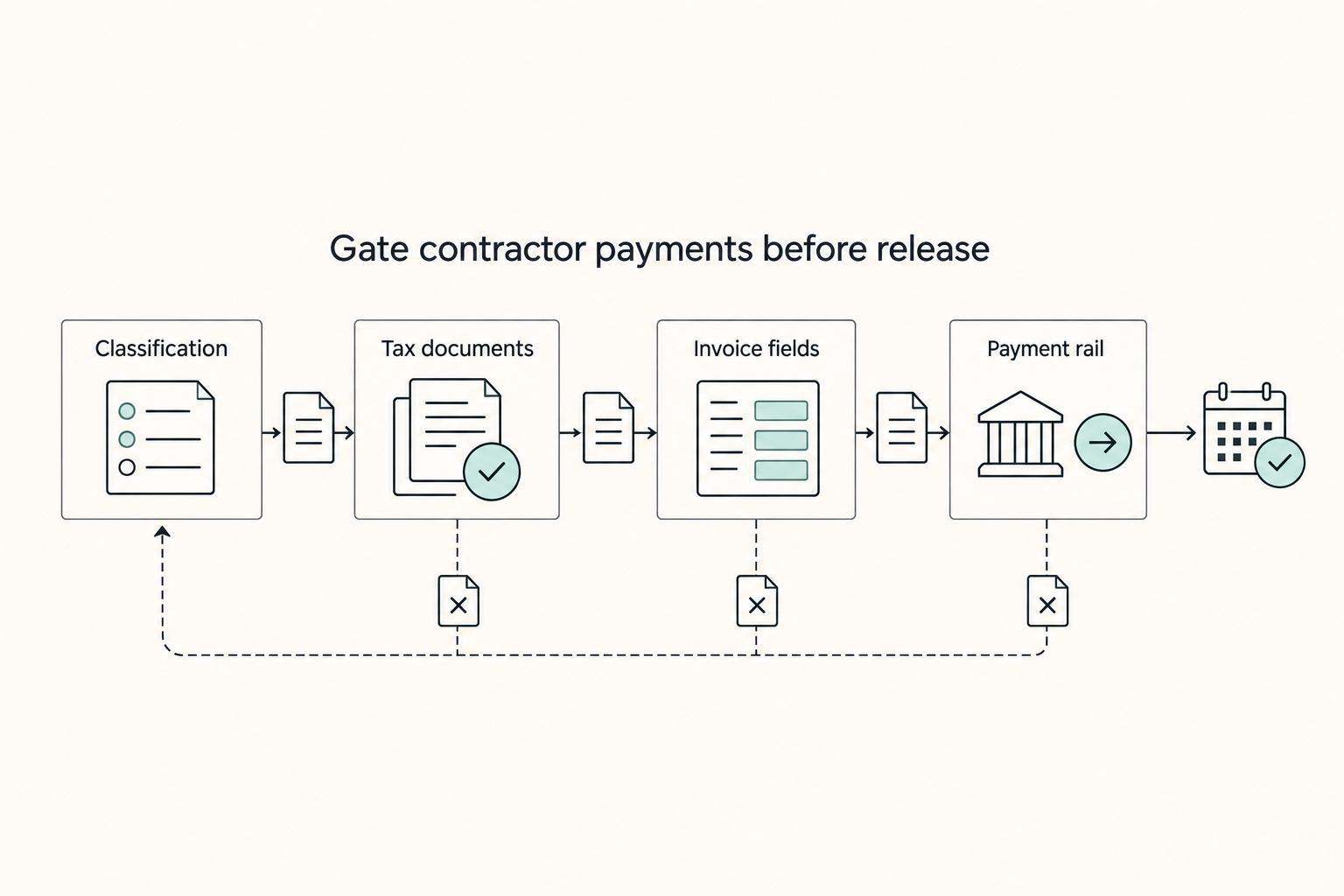
Quick Answer
Set up your legal entity, physical work locations, payroll tax accounts, verified company bank account and employee pay records in Gusto. Review the payroll preview and funding, submit by the displayed deadline, then reconcile bank and accounting records. Handle contractors and employees abroad through the appropriate Gusto service or another verified workflow.
Set Up Gusto Around Your Agency's Actual Workforce#
For a small U.S. agency, start with the people you employ, their physical work locations and the next payday. Gusto can run U.S. payroll, administer domestic contractors and connect payroll records to accounting. Its international contractor service and Gusto Global EOR, powered by Remote, offer additional routes. Decide the engagement and required controls before choosing a route; a second platform is an option when you need capabilities your chosen service does not provide.
Keep Gusto as the core for U.S. payroll#
Use Gusto as your core system when your needs stay in four lanes: U.S. payroll, domestic contractor administration, benefits administration, and accounting sync. Gusto states payroll is available in all 50 states, and it positions unlimited payroll runs, automated tax filing, and integrations as core functions.
| Function | Coverage in article | Named examples |
|---|---|---|
| U.S. payroll | Payroll is available in all 50 states, with unlimited payroll runs and automated tax filing | Payroll runs; tax filing |
| Domestic contractor administration | Supports contractor payments and 1099 workflows, with documents stored online | Employee and contractor documents |
| Benefits administration | Links benefits to payroll | Medical, dental, and vision |
| Accounting sync | Integrates payroll data with accounting software | QuickBooks, Xero, FreshBooks |
Use the payroll workspace for approved compensation, payroll tax settings, benefits deductions and pay-run records. Your agency supplies accurate inputs, maintains employer registrations and reviews exceptions. A completed setup is the beginning of payroll operations, not a guarantee that every later change is correct.
Run Your First U.S. Payroll in Gusto#
Follow Gusto's employer setup guide. Enter the legal business name, EIN, entity and physical work locations; home-based employees need the actual work location. Add compensation and pay frequency, invite employees to complete details, and review documents. Enter federal/state/local payroll-tax settings and verify the company checking account before the first deadline.
- Complete employment eligibility and withholding records, compensation approval, benefits/deductions and the pay schedule. When switching providers midyear, reconcile prior payroll and tax balances before the first Gusto run.
- Open the scheduled payroll and review approved hours, overtime, salary changes, reimbursements and deductions against the supporting records. Preview each employee and totals; investigate unexpected differences.
- Confirm available cash covers net pay, taxes and other displayed debits. Submit by the run-by deadline shown in the account; standard payroll submission is due at 4 pm Pacific on that date. Eligibility determines payment speed, so do not assume next-day payroll.
- Save the submitted run and approval. Verify payroll completion and bank debits, reconcile reports to accounting, and investigate rejected or delayed payments using the original run reference before issuing replacements.
Illustrative funding check: approved gross wages are $12,000; employee tax withholding is $2,400, with no other employee deductions in this example, leaving $9,600 net pay. Employer taxes of $1,000 make the total wage/tax funding obligation $13,000: $9,600 net pay plus $3,400 employee withholding and employer taxes. Add provider fees and employer-funded benefits not already counted. Actual provider debit components may differ; reconcile each remittance destination. Employee withholding is part of gross wages, not additional wage expense.
A remote employee moving to another state is a payroll-setting change, not merely an address edit. Review work location, registrations and required withholding before the next run. For a rejected direct deposit, preserve the payment status and payroll-tax record, determine the approved replacement method and reconcile it; do not create duplicate wages by rerunning the entire payroll.
Separate employee payroll from contractor and foreign-payee decisions#
Employee payroll and contractor payments carry different documentation and reporting requirements. A U.S. citizen living abroad remains a U.S. person for U.S. tax-document purposes; a mailing address alone does not determine the form. For foreign workers, record where services are actually performed and whether the person is an employee or independent business.
| Engagement | Records and review | Owner |
|---|---|---|
| U.S. employee payroll | W-4, work location, pay settings and applicable payroll taxes | Employer/payroll owner |
| U.S.-person contractor | W-9, classification and current 1099 reporting analysis | Finance/tax owner |
| Foreign contractor | Foreign status, service location, form selection and withholding/reporting analysis | Finance/tax owner with local advice |
| Employee working abroad | Legal-employer route, local payroll and client responsibilities | HR/legal owner and employing entity or EOR |
Do not treat payment execution as proof of compliance. The IRS states the withholding agent is personally liable for tax required to be withheld, and that liability is separate from the foreign payee's tax liability.
Decide whether you need another service#
Gusto supports international contractor payments and EOR employment through Remote. Compare the exact country, worker model, onboarding support, documents, cost and accounting output before adding another provider. Keep a separate operational review for foreign engagements even when payments and records share one interface.
Before onboarding, record the person's tax status, entity type, service location and proposed relationship. Services performed entirely outside the United States by a foreign person are generally foreign-source; a U.S. payer does not itself make the fee U.S.-source. U.S.-source personal services may require a different withholding and reporting path, including Form 8233 for an eligible treaty claim. Do not classify every foreign payment as Form 1042-S income.
Worker status depends on the working relationship under the applicable tax, wage-and-hour and local employment rules. Review control, independence, equipment, financial risk and continuity with the responsible adviser. A payment product, contractor label or hourly versus project price cannot settle that decision.
Outside U.S. Payroll, Treat It as Three Separate Jobs#
Gusto advertises international contractor payments in more than 120 countries. Confirm the individual corridor, currency, onboarding requirements and expected receipt date before committing to a contractor's payday. For an employee abroad, assess Gusto Global's country coverage and Remote employment terms separately.
Separate payment execution from accountability#
This matters early. If you blur these jobs together, you start treating a successful payment as proof the file was compliant, when it may only mean the transfer went through.
A payment rail moves money and supports onboarding and payment workflows. A compliance control is your pre-payment check, including tax form path, classification path, and local-law review. Legal accountability typically remains with your agency unless you use a structure that changes who employs the worker, such as an EOR for a full-time international hire.
Gusto's global contractor offer has broad reach, but it also states that you still need to manage hiring law, local labor law, and tax requirements.
| Scenario | What Gusto handles | What remains your responsibility | When another service is needed |
|---|---|---|---|
| U.S. employees | Payroll runs and automatic calculation, filing, and payment of local, state, and federal payroll taxes | Worker setup accuracy, classification facts, policy decisions, and record support | Case-by-case based on complexity and risk |
| Foreign contractors | Payment rail, onboarding support, form collection support, bank setup | Tax form review, withholding position, reporting path, contract terms, local labor law checks, classification review | Choose additional support when a documented review or capability gap remains in the selected service |
| Full-time international hires | Gusto Global EOR through Remote may support employment, subject to country and contract scope | Lawful employment route, local payroll, taxes, benefits, employment law handling | Compare a local employing entity, Gusto Global/Remote or another suitable EOR against the actual employment requirements |
Checkpoint: before any non-U.S. payout, confirm who owns tax review, who owns local-law review, and which document set supports worker status.
Tighten tax-form handling before money moves#
Select documents from status and income facts. A U.S. person generally supplies W-9 for contractor reporting. W-8BEN is for a foreign individual and W-8BEN-E for a foreign entity when the applicable documentation rules call for them. W-8BEN does not serve as the treaty-exemption form for compensation for personal services performed in the United States; review Form 8233 or W-4 as appropriate. Give forms to the payer or withholding agent and retain them; do not send W-8BEN to the IRS.
| W-8BEN control | What the article says | Timing or effect |
|---|---|---|
| Initial collection | Determine required documentation from payee status, entity and service location | Collect and review the applicable form or permitted evidence before relying on foreign status or a treaty rate |
| Review standard | Review correct form type, completeness, signature, date, and consistency with payee records | Collection alone may not be enough |
| Missing or inconsistent documentation | Presumption rules and payment type determine the response | Escalate before applying a rate; 24% backup withholding and generally 30% chapter 3 withholding concern different circumstances |
| Validity | A W-8BEN is generally valid through the last day of the third succeeding calendar year unless circumstances change | Third succeeding calendar year |
| Change in circumstances | The payee must notify the payer of a change in circumstances | Within 30 days |
| Recordkeeping | W-8 forms are kept in your records | Not filed with the IRS |
Missing documentation does not mean every overseas service invoice loses 30%. Determine whether the payment is subject to U.S. withholding and which documentation/presumption rules apply. Record the analysis rather than treating a signed W-8 as an automatic exemption. A valid foreign-status form also does not replace worker-classification or local-law review.
Assign ownership for renewals and records. A W-8BEN is generally valid through the last day of the third succeeding calendar year unless circumstances change. IRS instructions also state that the payee must notify the payer within 30 days of a change in circumstances. Requester guidance says W-8 forms are kept in your records, not filed with the IRS.
A platform folder alone does not establish sufficiency. Keep the applicable tax form or permitted evidence, contract, invoice trail, tax-status and service-location analysis, approvals and a dated note for unresolved items.
Screen for PE and classification risk before onboarding#
Review permanent establishment and classification before you create the profile, not after the first invoice arrives. The OECD baseline defines permanent establishment as a fixed place of business through which the business of an enterprise is wholly or partly carried on.
Escalate before approval if facts suggest a potential in-country fixed place of business. Do not guess jurisdiction thresholds. Record the threshold as pending jurisdiction-specific verification and get jurisdiction-specific review.
Run classification as a separate control. IRS tax-status analysis considers behavioral control, financial control and the parties' relationship. Wage-and-hour and local employment tests can differ; record the applicable jurisdiction and current adviser determination. If the relationship functions as employment, review an appropriate employing entity or EOR instead of relying on the contractor label.
Lock minimum controls before first international payout#
Before the first international payment goes out, set a minimum control set and hold to it. Use this checklist before the first international payment:
- Confirm country, worker type, and whether contractor treatment is appropriate or should move to EOR.
- Collect the required tax form before payment, review for completeness, and assign a renewal date.
- Document expected withholding and reporting path, and mark unresolved points as pending jurisdiction-specific verification.
- Store contract, invoice trail, tax form, classification note, and reviewer name in one record set.
- Escalate missing required evidence and unresolved classification or local-law questions; assign an owner and lawful resolution without treating earned wages or contractor due dates as optional.
A reviewer should be able to identify the payee, service period, approved amount, legal relationship, tax treatment and due date. Keep domestic employee wages on their required schedule while resolving separate foreign-contractor exceptions.
Review the next hiring request before signing it: what work will be done, where, by whom and under which legal relationship? This record is more useful than a generic country flag.
Stage 1: Treat First Contractor Onboarding as a Pre-Payment Control#
For your first foreign contractor, resolve classification, required documents, invoice requirements and payment ownership before agreeing to the engagement and starting work. If an issue emerges after work is owed, assign a prompt lawful resolution and preserve the contractual due date rather than imposing an indefinite administrative hold.
Define and collect before you pay#
Start by deciding what must be true before money moves. Four definitions should be set before the first payment is queued:
| Pre-payment definition | What to confirm | Article detail |
|---|---|---|
| Contractor classification | Assess status before first payment | Use behavioral control, financial control, and relationship evidence; escalate and consider Form SS-8 if uncertainty remains |
| Tax-document selection | Confirm U.S./foreign status, entity and service location | W-9 for U.S. persons; appropriate W-8/evidence for foreign status; review 8233 or W-4 for U.S. personal-service compensation |
| Invoice compliance fields | Set the minimum invoice details needed for review | The minimum details should support legal, tax, and approval review |
| Payment-rail responsibility | Assign who owns payout execution issues | Ownership should cover fee review, FX review, timing checks, and failed-transfer follow-up |
- Contractor classification: not a checkbox. Under IRS framing, assess behavioral control, financial control, and relationship evidence. If that review still leaves uncertainty, escalate and consider Form SS-8.
- Tax-document selection: record U.S./foreign status, individual/entity status and service location. Review W-9, the appropriate W-8 or permitted evidence, and any U.S. personal-service withholding path before relying on a form.
- Invoice compliance fields: the minimum invoice details needed for legal, tax, and approval review.
- Payment-rail responsibility: who owns fee review, FX review, timing checks, and failed-transfer follow-up.
Build one onboarding file with: signed contract, identity details, country, tax form, classification note, invoice instructions, reviewer name, and review date. Where local rules are not yet verified, mark the requirement as pending payroll/compliance verification. Keep the record trail under your retention rules.
Verification point: a reviewer should be able to show why the worker is classified as a contractor, which tax form supports payment, and who approved first payout.
Standardize invoice quality#
Invoice quality is one of the easiest places to lose control, so standardize it early. Use one base checklist, then apply country or regional checks before approval.
- Base invoice record: supplier/customer legal names and addresses, invoice number/date, contract and service period, description, currency, amount and payment due date.
- Tax-invoice review: determine whether VAT/GST applies and whether the supplier is registered; apply the jurisdiction's required identifiers, tax dates and wording only where relevant.
- Cross-border review: document why tax is charged, exempt or reverse charged under the actual supply and customer facts. A foreign customer does not automatically require reverse-charge wording.
- Approval: match the invoice to accepted work and contract terms, investigate duplicates and preserve the local invoice evidence.
| Invoice element | Why it matters | Common failure mode |
|---|---|---|
| Unique invoice number and issue date | Supports audit trail and approval matching | Duplicate, missing, or undated invoice |
| Tax language and tax point | Drives VAT treatment and timing | Missing UK tax point or unverified EU wording |
| Currency and amount due | Reduces FX and approval disputes | Invoice in one currency, payout request in another |
Choose the payout rail deliberately#
Choose the payout method only after the file is complete. Contractor payments are handled separately from W-2 payroll, and Gusto states coverage across 120+ countries, but you still need clear rail controls.
Compare options on four checks, and prefer rails that surface hard blockers, such as submission blockers, before release:
- Fee transparency: transfer and FX costs are visible before approval.
- Settlement predictability: confirm the displayed debit date, submission cutoff, expected receipt date and holidays for the chosen corridor; build the approval timetable backwards from the contractual due date.
- Exception handling: failed or delayed transfers have a named owner and response path.
- Pre-send disclosure: transfer amount, exchange rate, and fees are confirmed before authorization.
Ready to pay#
Release the first payment only if all five are true:
- Classification review is documented, and unresolved points are escalated.
- The required tax documentation and income-source analysis are reviewed; the record explains why this form or evidence applies.
- The invoice passes your base checklist and country checks, with open items marked as pending payroll/compliance verification.
- Fees, FX handling, debit timing, and exception ownership are confirmed.
- A reviewer can open the file and explain the payment decision quickly.
The W-8 Form Generator can support preparation when a W-8 is appropriate. It does not determine tax residence, service-income source or treaty eligibility. Resolve those questions with the responsible reviewer before relying on a form.
Stage 2: Keep Records and Approvals Auditable as Headcount Grows#
After your first clean contractor file, scale with controls, not reminders. If you use Gusto for U.S. hires, keep global contractor operations in the same controlled model so records, approvals, and exceptions stay auditable as headcount grows.
Build one record spine#
As volume grows, file quality matters more than software branding. Keep one primary record set for every person you pay: signed contract, current tax document, payout approval trail, and audit-ready change history. A reviewer should be able to see who changed payout details, who approved first payment, who approved later changes, and when each action happened.
Gusto positions Gusto Global as a unified platform for international workers, and Gusto payroll states forms are stored and organized online. Whether you use that stack or another one, lock in a minimum record set before you scale:
- Contract and country
- Form W-8BEN (when requested by the payer or withholding agent), or other required form, signed and dated
- Payout method, currency, and approval owner
- Invoice approvals and exception notes
- Access history for finance, ops, and system permissions
Use role-based access control and least privilege. The person collecting payout details should not be the same person who can both release funds and grant admin access.
Verification point: open any contractor file and confirm quickly which tax form supports payment, whether it is current, and who approved the latest payout change.
Assign owners before you automate#
Automation only helps when ownership is clear. Scaling breaks when decisions are shared but nobody clearly owns them, so assign named roles to three approvals:
- Legal or tax owner: approves contract fit, classification and tax-document analysis under applicable tax, wage-and-hour and local employment rules.
- Finance owner: approves payout setup, first-payment release, fee review, and exception handling.
- IT or ops owner: provisions access after approvals and removes access at offboarding.
One risk pattern is one manager collecting W-8BEN, approving payout-detail changes, and granting system access. Keep the evidence pack simple and complete: timestamps, approver name, payout-detail change log, and access request or ticket ID.
| Workflow stage | Primary risk | Control to implement |
|---|---|---|
| Contract and tax intake | Wrong status, source analysis or document | Review the applicable form/evidence and payment-specific withholding decision |
| Payment setup | Wrong payee details or unapproved rail | Separate setup from payout approval; log every detail change |
| Access provisioning | Over-permissioned accounts | Apply RBAC and least privilege; grant only role-required access |
| Ongoing payment cycle | Fee creep or FX surprises | Require pre-send review of amount, exchange rate, and fees |
| Recurring review | Expired evidence or unresolved legal/payment flags | Assign owners, resolution and independent payment due dates; escalate before relying on outdated documents |
Choose payout rails with a margin-first framework#
Payout choice affects margin, so do not choose a rail by habit. Compare options on fee transparency, FX exposure, settlement reliability, and margin impact before approval.
| Payout option | Fee transparency | FX exposure | Settlement reliability | Margin control |
|---|---|---|---|---|
| Fedwire | Confirm total cost before release | Confirm who absorbs FX before release | Immediate, final, irrevocable once processed | Use only with strict pre-release approval controls |
| ACH (including Same Day ACH where eligible) | Confirm fees before release | Confirm FX handling if cross-currency applies | Window-dependent; some items settle on a future business day | Approve only when timing and cost are acceptable |
| International rail/provider | Confirm corridor fees with the provider before release | Confirm FX spread and who absorbs it before release | Confirm settlement timing with the provider before release | Approve based on landed-cost impact to project margin |
If the client pays USD while a contractor is owed a fixed local-currency amount, forecast the USD funding cost at the quoted rate plus fees. For example, an illustrative €2,000 obligation at $1.10 per euro costs $2,200 before fees; at $1.15 it costs $2,300. That $100 increase reduces the agency's margin unless contract terms allocate the exposure elsewhere.
Run a recurring review with clear escalation#
Recurring review keeps a clean setup from drifting. Set an internal compliance-review cadence, document it, and follow it. Your dashboard should track expiring tax documents, failed or delayed payments, unresolved classification notes, and access-review items.
For W-8BEN where it applies, validity generally ends on the last day of the third succeeding calendar year, unless a change makes it incorrect earlier. The holder generally must notify the payer within 30 days of a relevant change. Track that expiry and changes in residence or entity status, then reassess the payment's documentation and withholding treatment. A document-review issue needs an owner and resolution; it does not erase an existing payment obligation.
You might also find this useful: How to Manage and Pay a Global Team of Contractors Compliantly.
Stage 3: The Modern Agency Stack - Integrating Gusto for US Hires#
Use separate employee and contractor workflows, even if one service supports both. U.S. employee payroll involves withholding, deposits, reports and wage payment. Foreign contractor review involves status, service location, local rules and applicable tax documentation. An employee abroad needs a local employing entity or an appropriate employment service; contractor payment cannot substitute for that relationship.
Gusto can support domestic payroll and additional international services. Define which product handles each engagement and which responsibilities your agency keeps. Document the provider's contracted scope rather than assuming that payment reach or shared branding covers every legal question.
Define system ownership and limits#
Use Gusto as the source of truth for U.S. employee payroll records: Form W-4 data, payroll runs, and payroll outputs that sync to your ledger. Gusto states payroll coverage across all 50 states. What this lane does not settle is worker-classification judgment or foreign-payee documentation risk.
Keep foreign-contractor files in the selected system of record: contract, status and service-location evidence, required tax documents, invoices and approvals. For an employee abroad, assess your own employing entity or an EOR, including coverage, client obligations and local start-date requirements.
Route work before onboarding or payment setup#
Routing should be a required first decision, not a later fix. Use the lane below before you onboard anyone or set up payment:
| Worker type | Tax status / service location | Engagement type | System of record | Compliance owner | Payroll/tax workflow | Accounting output |
|---|---|---|---|---|---|---|
| Common-law employee | U.S. | Employee | Gusto payroll | Payroll/HR | Complete and retain I-9 and W-4, then run payroll | Payroll sync to QuickBooks or bill/manual journal in Xero |
| Independent contractor | U.S. person; services in U.S. or abroad | Contractor | Contractor process | Finance + tax | Collect W-9 and required approval before payment | Contractor expense posting |
| Independent contractor | Foreign person; record actual service location | Contractor | Chosen contractor workflow/provider | Legal/tax | Review appropriate foreign-status form/evidence; U.S. services may require8233/W4 withholding analysis | Contractor expense posting |
| Full-time employee | Outside U.S. | Employee | Local employing entity or EOR | Legal + HR + finance | Complete local-entity or EOR employment onboarding before payroll | EOR invoice or related posting |
Sample one file from each active lane. For a U.S. employee, verify employment-eligibility and payroll-tax records; for a U.S.-person contractor, W-9 and reporting analysis; for a foreign contractor, the form/evidence and income-source decision; for an employee abroad, the employment-service scope and payroll owner.
Run one operating workflow from hire request to retention#
Use a repeatable sequence: hire request, relationship/location review, documentation, approved compensation or invoice, payment run, ledger reconciliation and retention. Assign the legal and operational owner for each step. Fix setup defects early while preserving wage and contractor payment deadlines.
Keep one accounting destination even with two worker systems. Gusto states integrations with QuickBooks and Xero. QuickBooks setup includes chart-of-accounts mapping, and payroll totals can auto-post to expenses. In Xero, Gusto pay runs create a bill or manual journal after clearing-account mappings are completed in Gusto. Also note the stated limitation: Gusto integration does not work with Xero Expenses.
Success here is operational, not cosmetic: clean reconciliation, traceable records, and lower risk of classification or payroll errors. Retain the audit trail for routing decisions, approvals, payroll outputs, and ledger sync. Align retention with the applicable rule set, since IRS and DOL minimum periods differ.
For the workflow detail, see How to Use Harvest for Time Tracking and Invoicing in a Small Agency.
Keep Payroll and Contractor Records Reconciled#
A small agency needs distinct employee and contractor controls, with as few tools as the actual requirements allow. Gusto may cover several lanes through different services. Add another provider when a verified capability gap justifies the cost and handoff; keep one accounting destination and named owners.
Keep your tool boundaries explicit#
Document the selected service's responsibilities for calculation, filing, deposits and notices. Your business must still provide accurate data, maintain registrations, review notices and confirm timely tax payments. IRS guidance on outsourcing payroll explains why a provider relationship does not automatically remove the employer's duties.
For cross-border contractor work, do not treat payment reach as compliance coverage. Even if you can pay contractors in 120+ countries, the control point should still be the file behind each payment: classification record, required form, and approval trail.
Use control language, not set-and-forget language#
This work is ongoing operations: routing, documentation, approvals, reconciliation, and retention. Worker classification remains fact-based under common law control and independence criteria, and required forms should be complete before payment.
Before each payroll or contractor run, do a quick pre-submit check: right worker lane, required documents present, approval captured, and payment record ready for retrieval. Keep records for at least 4 years under IRS employment-tax guidance, and preserve payroll records for at least 3 years under 29 CFR 516.5.
Run this operating confidence checklist#
- Confirm each worker is classified before onboarding or payment setup.
- Confirm employment records and the applicable contractor tax documents are present; use W-9 for U.S. persons and the appropriate foreign-status or U.S. personal-service documentation where relevant.
- Confirm named owners for payroll operations, contractor compliance, and final approval.
- Confirm payroll totals reconcile across payroll records, Forms 941, and W-2/W-3 totals.
- Confirm records and approvals are stored so supporting files are retrievable quickly.
Before scaling, review the next real payroll: approved hours and rates, deductions, employer taxes, bank funding, submission deadline and payroll report. Then reconcile the actual bank debits and accounting entries. Use discrepancies to correct settings before enabling routine automation.
This pairs well with our guide on HRIS vs Payroll, EOR, and MoR for Small Businesses in 2026. If you want to confirm which setup fits your agency across markets and compliance requirements, talk to Gruv.
Frequently Asked Questions
Can Gusto pay international contractors?
Yes. Gusto advertises payments to independent contractors in more than 120 countries. Confirm current country/currency eligibility, documentation, cost and timing for your payee. Keep the contract, classification and tax analysis with the payment record; sending funds does not establish the correct legal relationship.
What is the best setup for a fully remote small agency?
Start with the worker mix and physical work locations. Gusto may support U.S. payroll, domestic contractors, international contractor payments and EOR employment through Remote. Confirm coverage and service responsibilities, then add another system only when its capabilities are needed.
What is the difference between a payment platform, a payroll engine, a contractor compliance platform, and an EOR?
Choose the tool by legal relationship, not convenience. A payment platform moves funds. A payroll engine runs payroll, taxes, and employee records. A contractor compliance platform supports contractor classification, contracts, and monitoring. An EOR is a third-party legal employer for employees in countries where you do not have an entity. Using the wrong lane creates avoidable risk. Payment tools do not replace compliance workflows, and EOR does not remove every client-side responsibility in every jurisdiction.
How do you handle tax forms for international freelance contractors?
Determine U.S./foreign status, individual/entity status and where services are performed. W-9 generally covers U.S. persons; W-8BEN or W-8BEN-E may document foreign status when required. For U.S. personal-service compensation, review Form 8233 or W-4 as appropriate. Foreign-person services entirely outside the U.S. are generally foreign-source. A missing form does not automatically trigger 30% withholding on every foreign invoice; document the applicable withholding and reporting analysis.
How do I know whether someone is really a contractor?
Review the relationship rather than its label. For federal tax status, IRS factors cover behavioral control, financial control and the parties' relationship; Form SS-8 can request an IRS determination. Wage-and-hour and local employment tests may differ, so record the applicable jurisdiction and reviewer before choosing a contractor or employment route.
Gusto vs. Deel for a small agency?
Compare the specific services you need and their contracted responsibilities. Both brands offer several products; choose using worker model, country coverage, documentation support, fees, onboarding, payment timing and accounting handoffs. Coverage changes over time, so verify before procurement: confirm current contractor country metrics, EOR country availability, and start-date feasibility per country.
Does Gusto file 1099s for contractors?
Gusto supports 1099-NEC preparation and filing for eligible U.S. contractor payments. For payments made in 2026, IRS instructions raise the general reporting threshold to $2,000; the 2025 threshold was $600. Exceptions and other reporting rules remain, including reporting where backup withholding applies. Review tax year, payment category, payee status and payment method, reconcile the contractor ledger, and confirm the current filing workflow before year-end. Gusto currently says it files for contractors with payments recorded in Gusto regardless of the $2,000 threshold; review the stop-filing process if a form should not be filed. Its domestic contractor payment workflow does not support tax or backup withholding, so a withholding requirement needs another verified arrangement.
What is the one guardrail to keep before first payment?
Validate worker classification, tax-form requirements, and local-law responsibilities before money moves. Your minimum evidence pack is a classification note, signed W-9 or W-8BEN where relevant, the contract, and a retrievable approval trail. Fixing documentation after payment starts is usually slower, riskier, and more expensive.
Researched and edited by the Gruv editorial team. Gruv builds cross-border billing, payouts, and finance-operations software for global businesses.
Sources
Includes 3 external sources outside the trusted-domain allowlist.
- eitc.irs.gov/pub/irs-pdf/iw8ben.pdftrusted
- irs.gov/forms-pubs/about-form-w-8-bentrusted
- irs.gov/businesses/small-businesses-self-employed/ba...trusted
- gusto.com/product/global/contractor-eorexternal
- support.gusto.com/article/106622100100000/set-up-your-gusto-ac...external
- support.gusto.com/article/999754831000000/run-a-regular-payrol...external
Educational content only. Not legal, tax, or financial advice.
Related Posts
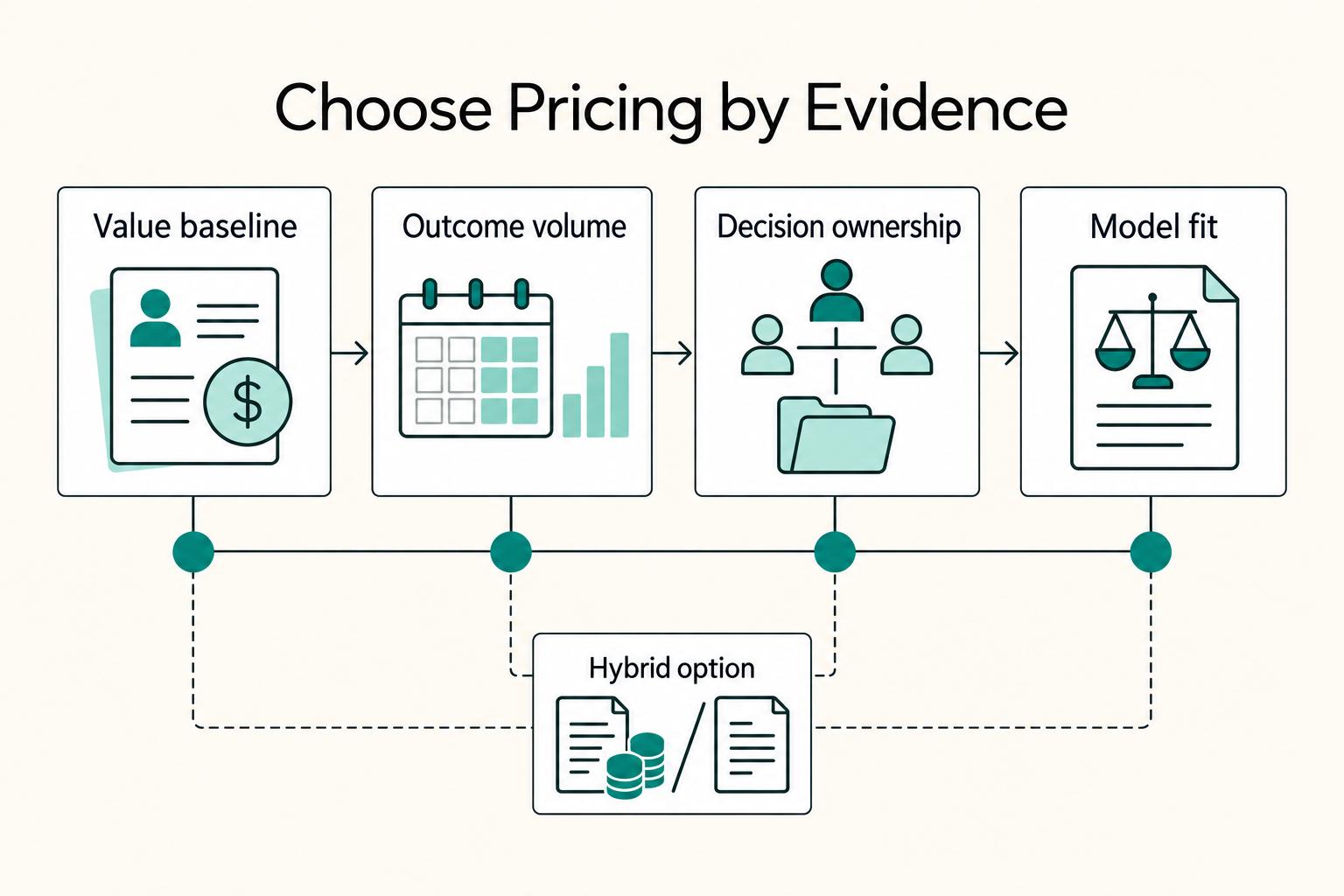
Value-Based Pricing for Freelancers Under Real Payment Risk
Value-based pricing starts with the client’s expected benefit and willingness to pay. It still needs a deliverable, scope and payment agreement you can perform. Use a discovery phase when the benefit or effort is too uncertain to support a defensible quote.

What to Do If You've Been Misclassified as an Independent Contractor
If a business calls you an independent contractor but directs your work like an employee, check the rules for the rights you need to recover. A contract label, LLC or Form 1099 does not decide every legal status. Federal wage law, federal employment taxes and state employment laws can use different tests and provide different remedies.
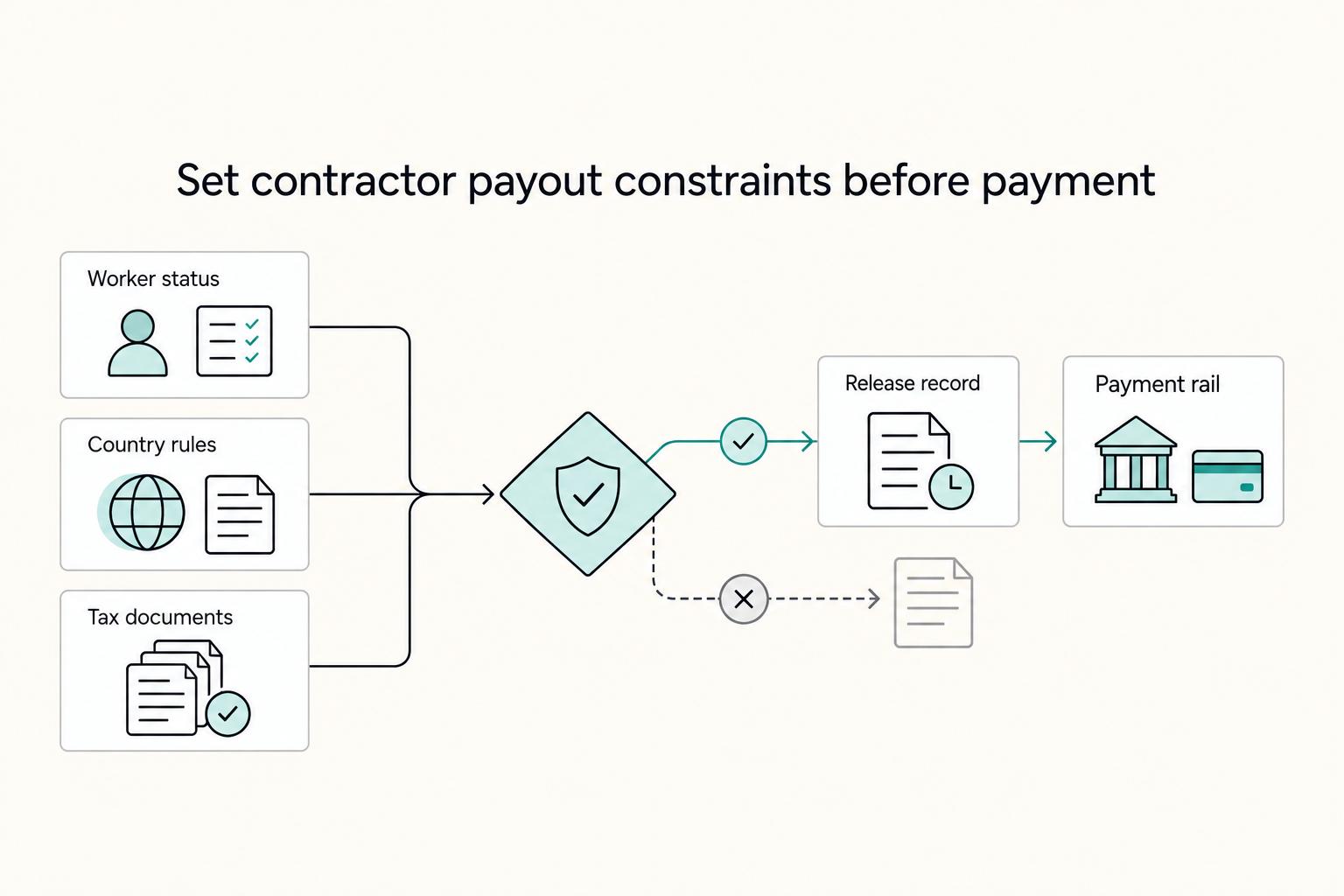
How to Pay International Contractors With Fewer Delays and Disputes
Reliable contractor payments begin with verified payee details, clear terms and the checks required for the actual engagement. Separate the payer’s release and withholding obligations from the contractor’s own tax-registration and filing tasks.