
Quick Answer
Build your agency client acquisition system as a 30-day operating setup: lock an ICP scorecard, map CRM stages with SLA response targets, and require proof before deals advance. Start with a small channel mix like LinkedIn and cold outreach, then expand only after qualification and follow-up stay stable. Keep discovery structured, route weak-fit leads to nurture, and confirm scope, responsibilities, invoicing details, and kickoff ownership before delivery begins.
What a client acquisition system looks like in an agency#
Build the first version of your agency client acquisition system over the next month so weekly decisions replace guesswork. The point is not to collect more tactics. It is to run one repeatable acquisition process with clear checkpoints, cleaner handoffs, and fewer avoidable risks.
This is a practical execution guide for independent professionals, not a roundup of disconnected tips from LinkedIn or Reddit threads. You will set a weekly decision cadence, run one sales pipeline, and improve it in small cycles.
Start with one operating constraint: do not add a new channel until follow-up and onboarding are documented. Cold outreach works best as a strategic, multi-channel effort, while inbound marketing builds over time by attracting and nurturing prospects with useful content. Treat that as a tradeoff, not an ideology.
- Step 1: Set a monthly target and weekly decision rhythm.
Choose three weekly questions tied to fit, speed, and conversion so each week ends with a clear keep, fix, or stop decision.
- Step 2: Build one pipeline with proof at each stage.
Define your stages and require one evidence item before a deal advances.
- Step 3: Document minimum SOPs and KPIs.
Write only the rules that protect quality, then track a compact KPI set that maps directly to those rules.
- Step 4: Add compliance-minded onboarding gates.
Confirm scope, responsibilities, acceptance criteria, and billing expectations before kickoff.
A failure mode to watch for is scaling channels before qualification is stable. If lead fit drops, tighten your ICP filters before expanding inputs. The same logic applies if you add delivery capacity through partners: capability can increase without headcount, but ownership, quality control, and promises still need to be explicit.
Define the operating promise and boundaries#
Set your operating promise in one sentence tied to a narrow Ideal Client Profile (ICP), then enforce boundaries before leads move forward. This keeps positioning clear and gives you a cleaner move from proposal to contract.
- Write a one-line positioning statement (ICP + USP).
Use one sentence to define buyer type, business stage, urgent problem, and offer boundary. If multiple buyer types could read it and all think it applies, tighten it.
- Define disqualifiers before a lead moves forward.
List what you will not sell, who you will not serve, and which project conditions are out of scope. Apply these filters before you schedule a strategy call.
- Set first-phase channel boundaries.
Start with a small channel set you can execute consistently. Add new channels only after qualification and follow-up rules are being enforced consistently.
- Set professionalism gates for handoffs.
No proposal without discovery notes. No onboarding without documented scope.
A practical check: if a proposal is being drafted from memory instead of written discovery notes, move the deal back, document the notes, and reconfirm outcomes before pricing.
For LinkedIn messaging that fits this boundary-first approach, see A Freelancer's Guide to LinkedIn Marketing.
Gather prerequisites and the minimum tool stack#
Before you increase outreach, build a lean setup: one CRM, one calendar integration, one source of truth for pipeline notes, and strict record hygiene.
Without the basic software infrastructure, teams can drift into chaos, and manual data extraction can consume 20+ hours per week. Start with the minimum that keeps decisions clear, then expand only when volume and complexity require it.
- Choose one Customer Relationship Management (CRM), one calendar integration, and one source of truth for notes.
Keep lead context, next action, and ownership in one connected place instead of splitting them across tools.
- Build your evidence pack before first outreach.
Prepare case snapshots, an offer sheet, an objection sheet, and an onboarding checklist so discovery and proposals stay consistent.
- Enforce data hygiene at lead creation.
Require these fields on every record: ICP fit, source channel, next action date, and owner.
- Automate admin work only, then document each automation in a simple SOP.
Automate reminders and status changes, but keep qualification and offer decisions under human review.
Use upgrades as a response to real load, not as a starting point. If you are managing 10+ clients, stronger governance and centralized data handling become more valuable, especially when extraction is still manual. Reported tool costs range from about $50/month to $3,000+ monthly, and custom integrations can take 2-4 weeks. Keep AI add-ons tightly scoped, since one report found many pilots failed to produce measurable business value.
Build your ICP and disqualification rules#
Use your ICP as a qualification gate before scheduling strategy calls. This keeps non-buyers from cluttering your CRM and protects sales time for leads with a realistic path to purchase.
Step 1 Build a pass/fail scorecard from your ICP#
Convert your ICP into a simple scorecard and assign points to traits your best clients share. Many teams use a 1 to 100 range. Tailor criteria to your services, such as problem severity, business context, urgency, and signs of buying intent. Keep each criterion explicit so scoring stays consistent.
Step 2 Add disqualifiers early#
Set hard disqualifiers at first contact based on your ICP, and ask these before deeper discovery so you do not spend time on low-probability opportunities.
Keep intake short. More required fields can reduce conversion, so collect only what you need to triage and gather the rest in follow-up.
Step 3 Route by fit first, then urgency#
Route leads by score first, then urgency.
| Lead pattern | Route |
|---|---|
| High urgency and weak fit | Move to nurture with a timed recheck and one proof asset |
| High fit and clear buying intent | Fast-track to discovery and reserve a near-term slot |
| Lower-scoring leads | Usually move to nurture |
Keep a manual review lane for edge cases, since simple scoring rules can miss detailed intent.
Step 4 Enforce the incomplete scorecard rule#
Set one non-negotiable: if the scorecard is incomplete after first contact, do not schedule a strategy call. Incomplete records can weaken handoffs, and weak handoffs can waste a substantial share of generated leads. Set a sales-ready threshold that fits your team and revisit it as you calibrate.
Map your pipeline stages and follow-up SLAs#
Use one shared lifecycle model so everyone handles opportunities the same way, with clear stage movement, response-time commitments, and handoff criteria.
Step 1 Define your stage map and exit criteria#
Treat this as your working map, not a universal taxonomy.
Use this as an example format and customize stage names for your process:
| Stage | Exit criteria |
|---|---|
| New lead | Owner assigned, source logged, first follow-up task set |
| Qualified | Fit decision recorded |
| Discovery booked | Meeting confirmed and agenda note saved |
| Proposal sent | Proposal date and scope summary recorded |
| Verbal yes | Buyer confirmation note and commercial next step captured |
| Closed won/lost | Outcome and reason code recorded |
| Onboarding started | Kickoff owner assigned and first milestone date set |
Step 2 Set a Service Level Agreement (SLA) for each handoff#
Define one SLA target per transition and assign ownership by role. A practical anchor is a 24h follow-up SLA for new leads, with separate response-time targets for later handoffs.
Treat these as operating commitments. If targets are repeatedly missed, adjust process capacity or qualification before you increase lead volume.
Step 3 Add handoff records and weekly review#
Define the core records your team expects before stage advancement, such as discovery notes and written next-step confirmation. This keeps handoffs cleaner and makes stuck opportunities easier to spot.
Run a 30-minute weekly scoreboard review to check stage ratios, stage conversion, time-in-stage, and stuck opportunities. Pair that with one coaching block and one business development block each week so review time leads to action.
Step 4 Set ownership milestones inside your operating cadence#
Once ownership is assigned, agree on the first milestone within 14 days so each active opportunity has a near-term next step.
Expected outcome: clearer accountability by stage and better visibility into pipeline flow.
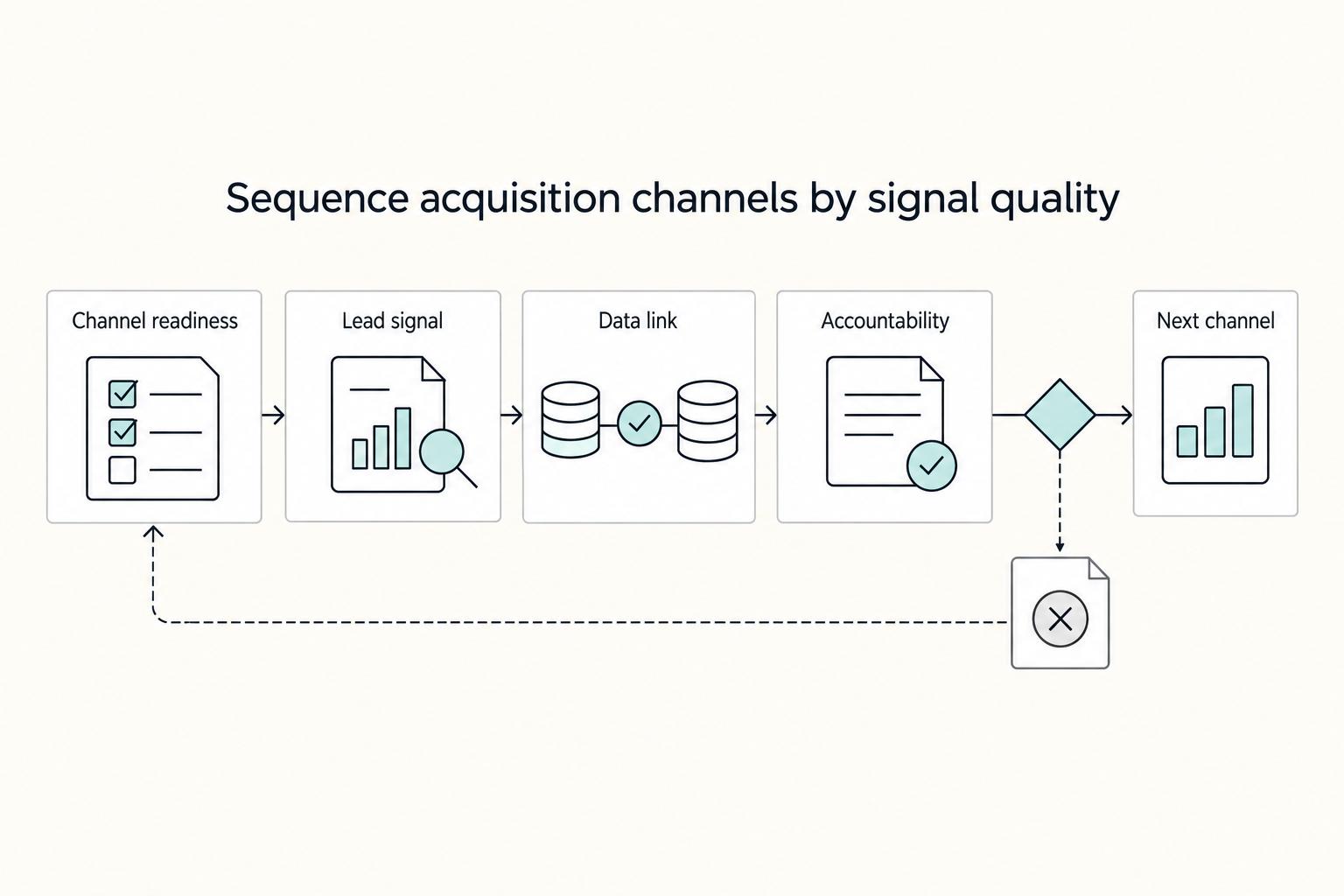
Sequence your channels with budget guardrails#
Channel sequencing is a budget decision as much as a marketing one. Expand only when conversion quality and follow-up discipline stay stable, and use guardrail metrics as early warnings before spend drifts and unit economics weaken.
Step 1 Sequence channels by risk and signal#
Sequence channels based on operational readiness and signal quality, then adjust with your own data. Multi-channel strategy most often fails at the operational layer, so keep integration, data unification, and accountability clear as you add channels.
| Phase | Primary goal | Guardrail check |
|---|---|---|
| Early lower-risk channels | Validate message and booking quality | Follow-up SLA adherence and qualified-call rate |
| Partnership channels | Improve trust-led deal flow | Stage conversion and time-in-stage |
| SEM tests (Google Ads, Microsoft Advertising, Meta Ads) | Add scalable demand | CAC trend and close-quality stability |
Step 2 Set paid-channel gates before scaling#
Do not scale paid channels until discovery-to-close quality is stable and follow-up commitments are consistently met. SEM uses bidding and pay-per-click mechanics, so spend can rise quickly without better outcomes.
Treat guardrails as early warning signals. Track:
CACtrend by channel- cost per qualified opportunity, not just cost per lead
- discovery-to-proposal and proposal-to-close conversion
If CAC rises while downstream conversion stalls, pause expansion and fix qualification, offer clarity, or follow-up execution first.
Step 3 Pair inbound with one focused conversion path#
Pair inbound with your other channels so returns can compound, but keep scope tight. Route traffic through one clear conversion path. Assign each investment a specific pipeline hypothesis and one success metric so decisions stay clear.
Step 4 Run a weekly channel review with explicit decisions#
Hold a short weekly review focused on quality, speed, and cost efficiency, not volume alone. Check SLA adherence, time-in-stage movement, and channel-level CAC direction, then assign one owner per channel for next actions.
Expected outcome: a disciplined channel mix helps validate messaging, build compounding returns over time, and scale paid acquisition without breaking unit economics.
Create outbound and inbound assets that earn trust#
At this stage, your assets should do two jobs: keep outbound moving and make inbound credibility easy to verify. Keep the starter set small, assign one job per asset in the sales funnel, and remove anything without a measurable purpose.
Step 1 Build the minimum set before adding volume#
Start with a focused baseline: a small set of cold email variants, a LinkedIn profile refresh, a post-click landing page, and an authority-style lead magnet. This gives you coverage for outreach speed and trust-building without fragmenting your message.
Keep offer boundaries, ICP language, and core promise consistent across all assets. Use each cold email variant for a different moment, such as first touch, referral-style intro, and reactivation. Align your LinkedIn profile to the same constraints before you scale outreach.
Step 2 Assign one job to each asset#
Each asset should do one job well. If one asset carries competing goals, quality signals get harder to read.
| Asset | Primary job | Measurable signal | Remove or revise if |
|---|---|---|---|
| Cold email variants | Awareness | Positive reply rate from ICP-fit contacts | Replies are high but qualified calls stay low |
| LinkedIn profile refresh | Proof | Profile visits to conversation starts | Visitors do not move to inquiry or DM |
| Post-click landing page | Booking | Visitor-to-booked-call rate | Traffic grows but booked calls stay flat |
| Lead magnet | Qualification | Opt-ins that match ICP criteria | Download volume rises but fit quality drops |
Step 3 Add trust mechanics#
A practical way to build trust is specificity. Add proof statements with context and constraints, not broad claims.
State implementation constraints in plain language: what is included, what is excluded, client responsibilities, and timeline dependencies. Add a clear not-for line so poor-fit prospects self-select out earlier.
Step 4 Rebalance outbound and inbound with weekly evidence#
Treat inbound and outbound as one process, not opposing choices. Rebalance by business stage, ICP clarity, sales-cycle length, and growth goals.
Run a weekly review by funnel stage and decide what to keep, rewrite, or retire. Each asset should have one owner, one stage job, and one primary metric. If it does not, pause new asset production and fix the current set first.
Run discovery calls and package offers by fit#
Treat discovery as a fit-and-clarity gate: qualify the problem, urgency, budget, and authority before discussing deliverables. Keep the call structured so obligations and practical implications are clear up front, not after scope is priced.
Step 1 Test fit before discussing scope#
Use the same script order each time: business problem, urgency, budget, then decision authority. Keep an advisor stance by making obligations explicit as you go.
| Topic | What to confirm |
|---|---|
| Business problem | Define the business problem in one sentence and the current cost of delay |
| Urgency | Set urgency with a real date, event, or target |
| Budget | Confirm budget as a range and who controls approval |
| Decision authority | Verify authority by naming who signs, who influences, and who can block |
Ask questions that force that level of clarity.
Checkpoint: before moving forward, notes should include one measurable outcome, one deadline, one budget range, and one decision owner. If any field is missing, do not estimate deliverables yet.
Step 2 Triage offers by client readiness#
Package by fit, not by channel. One workable option is a simple three-tier triage (baseline, growth, and premium) so scope reflects readiness and clarity.
| Tier | Best fit signal | Scope posture |
|---|---|---|
| Baseline | Problem is clear; team needs focused execution | Narrow scope, defined outputs, short timeline |
| Growth | Problem is clear; dependencies span teams or channels | Broader implementation with phased milestones |
| Premium | Outcomes and authority are clear; stakes are high | Senior oversight, cross-functional coordination, stricter checkpoints |
Step 3 Apply a diagnostic if-then check#
If the client cannot articulate outcomes, pause full scoping and run a diagnostic phase first. If outcomes are clear and decision authority is confirmed, move straight to proposal.
Step 4 Document assumptions before sending pricing#
Write a short assumptions record, keep human decision-makers engaged, and get written acknowledgment before pricing goes out.
| Item | What it covers |
|---|---|
| Assumptions | What must be true for the quoted scope to work |
| Dependencies | Approvals, access, assets, or data the client must provide |
| Responsibilities | Who owns each action on both sides |
| Change conditions | What triggers re-scoping and re-pricing |
Include those four items every time.
Keep the sequence firm: qualify, package by fit, document terms, then price. This keeps negotiation grounded in clear obligations and honest dealing.
Standardize proposals, close steps, and onboarding handoff#
Lock the close and handoff path before details drift. Every signed deal should move from proposal to kickoff with full context, clear ownership, and explicit next steps.
Step 1 Use one proposal template with fixed sections#
Use one proposal template with a fixed structure across deals: problem summary, outcomes, scope boundaries, timeline, responsibilities, and acceptance criteria. Customize the content inside each section, not the section order.
As an internal standard, keep proposal content, financial proposal content, and terms-and-conditions content separate. This keeps scope and acceptance criteria clear before commercial terms are finalized.
| Proposal block | Required check before send |
|---|---|
| Problem summary | Names the business issue and why it matters now |
| Outcomes | States how success will be judged |
| Scope boundaries | Lists included work and explicit exclusions |
| Timeline | Confirms milestones and approval points |
| Responsibilities | Assigns owner on both sides for key actions |
| Acceptance criteria | Defines what counts as complete |
Step 2 Enforce close-stage controls in the CRM#
In your CRM, make four close-stage fields mandatory: verbal yes date, contract sent date, invoice status, and onboarding kickoff owner. Do not advance the stage with blanks.
This follows the same organized-pipeline principle: every prospect should have a clear status and next step. Keep these controls identical across all deals.
Step 3 Build an onboarding handoff SOP packet#
Create a short SOP handoff packet before kickoff so fulfillment starts with complete context, not fragmented chat history. Include:
- final proposal version
- accepted scope boundaries and exclusions
- open dependencies and approval owners
- kickoff agenda and first-week deliverables
Operational issues often trace back to unclear scope, slow onboarding, and messy approvals. A complete handoff packet helps lower that risk.
Step 4 Confirm invoicing, payout path, and records expectations#
Before project start, confirm operational details in writing and log them in the CRM:
- invoicing entity name and billing contact
- payout path (where relevant) and approval owner for payout changes
- document storage expectations for contracts, invoices, and approvals
- who receives records and at what cadence
If details are unclear, resolve them before kickoff. This helps keep sales and delivery connected.
Add automation where it helps and keep human control#
Automate the repeatable admin work, but keep people accountable for exceptions and final decisions.
Step 1 Limit automation to repetitive actions#
Keep automation narrow and predictable, and leave judgment-heavy decisions manual.
| Auto action allowed | Keep manual |
|---|---|
| Repeatable data capture and updates | Final approval decisions |
| Standard tagging or status changes | Policy or exception decisions |
| Routine reminders or follow-up triggers | Ambiguous or high-impact calls |
| Structured intake steps | Edge-case review |
Step 2 Route edge cases to human review#
Create a manual review path for records that are unclear, high-risk, or high-value before confirming next steps.
Step 3 Keep event handling consistent#
Use one consistent method for booking and follow-up records across your process to keep handoffs and reviews clear.
Step 4 Define a pause rule before scaling automation#
Set explicit pause conditions and ownership before adding more automation, and document how restart decisions are made.
If automation influences outcomes, make oversight and accountability explicit.
Review KPIs weekly and apply if-then decisions#
Weekly KPI review keeps decisions data-led instead of intuition-led. Keep the cadence short, keep the metric set fixed, and require one decision per metric each week.
- Step 1: Track a compact KPI set in one shared view.
Use the same core metrics every week, such as new leads, qualification rate, booked calls, proposal rate, and close rate. Review all major acquisition channels in the same view so everyone is judging the same pipeline reality.
- Step 2: Apply if-then decisions immediately.
Treat each KPI as a trigger, not a report card.
| If this drops | Then do this |
|---|---|
| Qualification rate | Tighten ICP criteria and disqualify faster |
| Early-stage conversion rate | Improve first-touch messaging |
| Close rate | Review discovery quality and proposal quality before adding more top-of-funnel volume |
- Step 3: Compare channels by quality, not volume.
Judge each channel by qualification rate, booked calls, and close rate, not lead count alone. This can prevent a high-volume channel from masking low-fit conversations.
- Step 4: Run a weekly review and update process.
Follow a fixed sequence: check trend direction, identify likely cause, assign one owner, and set the next test. Then update process notes the same day. Keep a separate monthly profitability deep dive for margin and budget decisions.
One agency case narrative reported a quarter with 20% revenue growth and 50% profit growth. Treat that as an example of what disciplined measurement can support, not as a benchmark to copy.
Fix common failure modes before they stall growth#
When growth dips, fix the likely failure mode directly instead of adding more activity. Use this as a weekly recovery loop to stabilize your sales pipeline before scaling again.
| Failure mode | Fix |
|---|---|
| Too many channels too early | Pause expansion and refocus on fewer core channels until conversion signals are clear again |
| Generic messaging | Rewrite messages around one specific pain, one real constraint, and one clear outcome for your ICP |
| Over-automation without judgment | Use automation for repetitive admin work, but keep qualification and call-readiness decisions under human review |
| Trust erosion after close | Set a clear onboarding plan before kickoff with scope boundaries, client responsibilities, and communication cadence |
-
Too many channels too early: If lead volume rises while qualified and close rates fall, pause expansion and refocus on fewer core channels until conversion signals are clear again. Keep your time and budget on higher-fit prospects, then reopen channel tests once pipeline quality is stable.
-
Generic messaging: If outreach gets replies but buying intent stays low, rewrite messages around one specific pain, one real constraint, and one clear outcome for your ICP. Personalized outreach is usually stronger than generic language, so treat vague copy as a pipeline risk, not a style issue.
-
Over-automation without judgment: Use automation for repetitive admin work like scheduling, data entry, and task tracking, but keep qualification and call-readiness decisions under human review. AI-enabled processes need explicit oversight, so add a human-in-the-loop checkpoint before prospects move to deeper strategy steps.
-
Trust erosion after close: Weak onboarding can quickly create frustration and disengagement. Set a clear onboarding plan before kickoff with scope boundaries, client responsibilities, and communication cadence to reset expectations early. This also protects capacity: qualification affects whether the 10 to 20 hours spent with a prospect is worth it, and effective onboarding has been linked to stronger retention, including one benchmark citing a 50% lift.
Keep the loop simple: diagnose the specific failure mode, apply one clear fix, assign an owner, and review impact the next week.
Related: The Best Webinar Software for Freelancers.
Final takeaway and next step#
Growth gets easier when your sales funnel is run like operations, not improvisation. Your acquisition process is more reliable when each stage has clear ownership, visible metrics, and a correction path when quality drops.
That discipline is less common than most teams think. One KPI benchmark found only 23 percent of marketers were confident they track the right metrics. Use this checklist as your baseline, then refine it with your own results.
- Define ICP and disqualifiers. Document who you serve, who you do not serve, and what makes a lead a clear no.
- Set pipeline stages in your CRM. Keep stages tied to real decision points, and make owner plus next action explicit on every open opportunity.
- Start with a small channel set, including cold outreach. Expand only after core conversion behavior is stable.
- Keep your offer and post-click path aligned. Make sure the promise and next action stay consistent from outreach to landing page.
- Review KPIs with clear decisions. Track intermediate metrics, not just final outcomes, so bottlenecks show up early.
- Add automation only after qualification quality is stable. Automate repetitive admin first, and keep fit decisions explicit.
- Reconfirm scope and responsibilities before kickoff. Align roles before delivery starts.
Next step: block focused time, paste this checklist into your CRM notes, assign one owner per step, and set completion dates.
Frequently Asked Questions
What is an agency client acquisition system?
It is a repeatable setup to identify the right prospects, run targeted outreach, and book qualified appointments. In practice, it combines targeting strategy, messaging, and a clear booking path (for example, booking directly on your calendar). Keep it simple enough to run weekly and specific enough to qualify out bad-fit leads early.
Which channels should a small agency start with first?
Start with a focused outbound mix you can run consistently, then expand later. LinkedIn plus email outreach is a practical first pairing in the outbound approach described here. Keep the channel set narrow until qualification and follow-up quality are stable.
What pipeline stages should every agency track in a CRM?
Track stages that match your real path from first contact to purchase. A sales pipeline should break each deal into manageable stages and make progress easy to track. There is no universal fixed number of stages, so keep stage definitions stable and tied to clear decisions.
How do I qualify leads before I waste sales calls?
Set qualification criteria before outreach and apply them again before booking meetings. Check for alignment with your targeting strategy and messaging before moving a lead forward. If fit is unclear, keep the lead in follow-up instead of scheduling immediately.
When should I add Google Ads or Facebook Ads to outbound and referrals?
There is no single timing rule supported here for adding paid channels. Add paid only as a controlled test once your current outbound/referral process is consistently tracked in your pipeline. Define stop conditions before you increase spend.
How can I automate intake without lowering lead quality?
There is no single specific automation framework to follow. Keep qualification criteria explicit before appointments are booked, and review stage outcomes regularly so weak-fit leads do not move forward by default.
What KPIs should I check every week to keep growth predictable?
Use a compact KPI set tied to pipeline stage movement so progress is visible, not just activity. At minimum, review how leads move between stages and how many qualified appointments are booked. End each review with one if-then decision and one owner.
Try a related tool
Researched and edited by the Gruv editorial team. Gruv builds cross-border billing, payouts, and finance-operations software for global businesses.
Sources
Educational content only. Not legal, tax, or financial advice.
Related Posts

LinkedIn for Freelancers Who Want a Predictable Client Pipeline
Treat LinkedIn as two jobs you run at the same time: a credibility check and a conversation engine. If you only chase attention, you can get noise. If you only send messages, prospects may click through to a thin profile and hesitate.

Build a Freelance Sales Funnel You Can Run in One Hour a Week
Start smaller than you want. Your freelance sales funnel should survive a normal delivery week, not a rare week when you happen to have extra energy. If you cannot maintain it without pushing client work aside, it is not usable yet.
The Best Webinar Software for Freelancers
Start with one rule: do not buy from rankings or feature pages alone. A safer choice is the platform that handles your main webinar job, fits the exact plan you can afford, and passes a proof test in your real setup.