
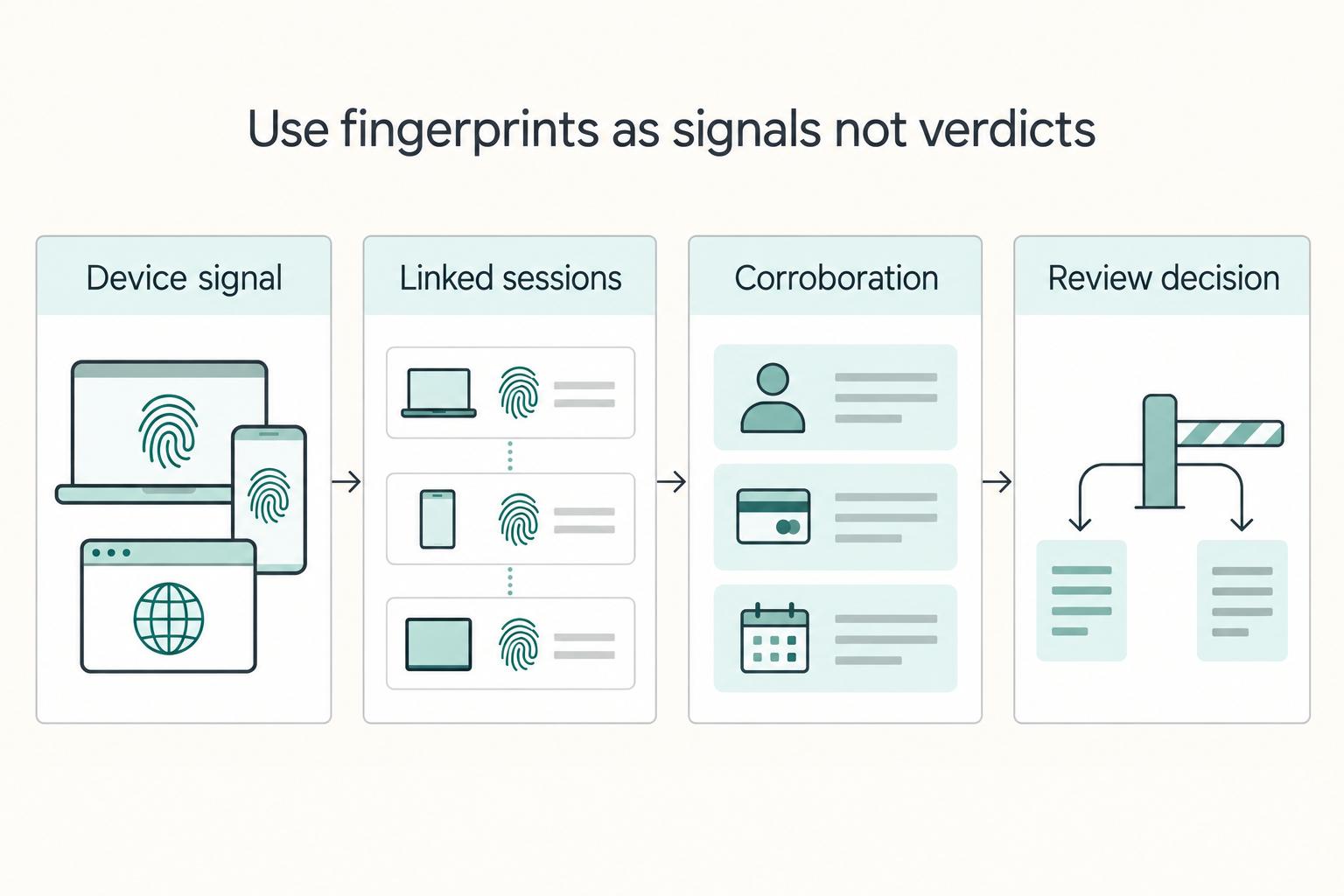
Quick Answer
Use device fingerprinting fraud detection platforms as a governed control layer, not a standalone verdict engine. The article’s core recommendation is to start with cross-functional ownership, validate persistence and tamper resistance in live onboarding and payout scenarios, and keep decisions defensible with exportable case evidence. A strong setup links device hash signals to bounded actions such as allow, step-up, or manual review, then escalates material restrictions to compliance and legal when required.
Device fingerprinting platforms can cut fraud risk but only if you govern them like a regulated control#
For payment platforms handling contractor, seller, or creator payouts across markets, the starting point is not vendor hype. It is control design. Device fingerprinting can help detect suspicious behavior and reduce fraud risk, especially when the same device appears across repeated sign-ups or refunds. But it only works if risk, compliance, legal, finance, and payments ops agree on what the signal can support and what evidence must exist when a decision is challenged.
- Start with ownership, not tooling
Treat device fingerprinting as a fraud-control input with named owners across risk, compliance, legal, finance, and operations. The practical reason is simple: a device identifier can affect onboarding, login, payout, and withdrawal decisions. The people who will have to defend those decisions should be involved before rollout. A useful checkpoint is whether you can name one decision owner for each action type, such as manual review, a temporary payout hold, or an account restriction.
- Define the signal in plain terms
Device fingerprinting combines browser, device and network attributes into an identifier. Browser identifiers can be probabilistic, change after configuration updates, or collide; they are not proof of one physical device or one person. Cookies can be session-based or persistent, while fingerprinting can use additional signals after cookies are cleared. Test the distinction for the specific web or mobile implementation.
- Be clear about what problem it solves and what it does not
The goal is not to stop fraud everywhere. The real value is linking devices, identities, and transactions so you can catch suspicious patterns earlier with less blanket friction. One device tied to multiple refunds or repeated sign-ups is a grounded red flag. The failure mode is overreach: if you let one fingerprint signal drive automatic hard blocks everywhere, you will create false positives and weak case records that are hard to defend later.
- Measure success like an operator and an auditor
Good results show up in fewer high-severity fraud incidents, cleaner escalation records, and evidence that stands up to legal and compliance review. Do not frame success as a model score or a dashboard screenshot. Your evidence pack should at least preserve the event timeline, the device-linked trigger, the action taken, the owner who approved it, and the final disposition.
If that record is missing, your fraud program may still catch abuse, but it will struggle when legal, compliance, or finance asks why a payout was delayed or an account was restricted. For fraud-control design, see Fraud Detection for Payment Platforms: Machine Learning and Rule-Based Approaches.
Who this list is for and how to use it#
Use this list if you own fraud outcomes and the audit trail behind decisions across onboarding, login, payout, and withdrawal. If you do not, use it to structure a cross-functional review, not as a standalone buying shortlist.
- Use it when you are accountable for losses and controls
This is most useful for risk, fraud, compliance, and payments ops owners who can explain why actions were taken and who approved them. If ownership for review, hold, or restriction decisions is unclear, a tool comparison is premature.
- Use it as a first-pass filter, not a final purchase decision
List-style comparisons can narrow options, but they are not legal, procurement, or security approval evidence on their own. Treat this list as pre-screening before formal review.
- If account takeover drives losses, prioritize durable signal quality over dashboard polish
If account takeover drives your losses, test new-device and linked-account alerts against confirmed incidents and legitimate users. Measure how much the signal changes review outcomes instead of using a market-wide loss estimate as evidence of vendor accuracy.
- If regulatory scrutiny is the main risk, prioritize evidence quality and policy traceability over model claims
Focus on readable case records and exports that show timeline, decision owner, policy logic, and outcome. Device fingerprinting alone is not enough, so treat it as one control input inside a layered decision process.
The selection criteria that actually matter in production#
Use seven production checks to decide your shortlist. Set persistence requirements for the browser or mobile channel you actually support; test VPN/proxy use and reset behavior alongside false matches and missed matches. Privacy tools and shared devices can also belong to legitimate users.
| Check | What it asks | Grounded details |
|---|---|---|
| Uniqueness | Whether the platform separates one device from another reliably | Treat as a table-stakes check |
| Persistence | Whether that identity holds when cookies are cleared, browsers are reset, or IPs change | Use live tests under VPN/proxy conditions and reset attempts |
| Risk identifiers | Whether the platform provides more than one opaque score | Important where phishing and credential misuse are part of breach patterns |
| Code protection | Whether protection covers tampering, replay, and blocking | Review resistance claims, not just dashboard output |
| Compliance readiness | Whether support is document-based and reviewable | Look for GDPR, CCPA, PCI DSS, and ISO-aligned controls rather than marketing claims |
| Investigation usability | Whether case teams can follow linked events and reviewer context | Should cover timestamps, account relationships, reviewer notes, and an event trail across onboarding, login, payout, and withdrawal |
| Evidence export quality | Whether exports hold up under compliance or legal challenge | Include event timeline, decision owner, policy reference, signal labels, and final disposition |
Five checks are table stakes. Uniqueness asks whether the platform separates one device from another reliably. Persistence asks whether that identity holds when cookies are cleared, browsers are reset, or IPs change. Risk identifiers should be more than one opaque score, especially where phishing and credential misuse are part of breach patterns. Code protection should cover resistance to tampering, replay, and blocking. Compliance readiness should be document-based and reviewable for GDPR, CCPA, PCI DSS, and ISO-aligned controls, not just marketing claims.
Two operator checks are equally important. Investigation usability should let case teams follow linked events, timestamps, account relationships, reviewer notes, and an event trail across onboarding, login, payout, and withdrawal. Evidence export quality should hold up under compliance or legal challenge, including event timeline, decision owner, policy reference, signal labels, and final disposition.
Use device signals as one layer, not the whole control model. Current fraud tooling coverage describes AI-driven attack pressure, including synthetic identities and phishing-based account takeovers, and points to layered controls that combine real-time monitoring, contextual intelligence, and behavioral signals.
Quick vendor scan#
| Product example | Documented approach | Test before selection |
|---|---|---|
| Sumsub Device Intelligence | Links device signals to verification, behavior and transaction monitoring; distinguishes browser identifiers from native mobile device IDs | Verify supported SDK, module enablement, channel-specific signals, review routing and export fields |
| SEON Device Intelligence | Describes device, network, environment and cross-account signals | Test collection on your supported clients, linked-account false positives and analyst evidence |
| Plaid Identity Verification | Describes device and IP checks within identity verification | Confirm the contracted product and flow; test how device evidence reaches your onboarding case records |
These examples show different integration contexts, rather than benchmark winners. Ask each provider for the exact product, client support, pricing, data-processing terms and export sample. Keep it on the shortlist only if it supports the workflow you need.
Match device intelligence to your existing workflow#
Evaluate the integration context before comparing detection claims. A verification module, a device-signal API and a broader fraud system create different work for engineering and investigators.
Put candidates through the same representative onboarding and payout cases, including legitimate shared-device use and privacy tools. Compare missed abuse, false positives, latency and investigator time.
| Existing workflow | Selection question | Proof to request |
|---|---|---|
| Identity verification | Can device evidence be attached to the applicant and review decision? | A completed case with signal, reviewer action and retained evidence |
| Custom login or payment risk engine | Can your service consume device signals and enforce its own rules safely? | Documented API/SDK behavior, failure modes and false-positive tests |
| Transaction monitoring and case management | Can investigators connect devices, accounts and money events? | An exported timeline with related accounts and the final disposition |
Treat this as a fit map, not a ranking result. If you can run only two deep evaluations, put both through the same two proofs: one onboarding case and one payout or withdrawal case with full exported evidence. For a related angle, see AI-Powered Fraud Detection for Subscription Platforms: Beyond Rules-Based Approaches.
Where fingerprinting programs fail and what to pair them with#
Device fingerprinting is a strong risk signal, but programs fail when teams treat it as a verdict instead of one layer in a broader control stack.
| Failure mode | Why it fails | Better pairing |
|---|---|---|
| Single-score blocking | Persistence is not proof of fraud | Keep hard declines and payout holds tied to additional corroborating signals |
| No connection to identity or money movement | Device intelligence creates more value when it connects identities, transactions, and devices | Use device signals to surface risk, then confirm through transaction monitoring and identity gates before enforcement |
| Aggressive enforcement without risk tiers | Jumping directly from detection to a hard block can create avoidable friction | Allow low risk, step up verification for medium risk, and reserve hard declines or payout holds for high-risk cases with corroborating evidence |
- Single-score blocking
A fingerprint should inform a decision, not make it alone. Browser identifiers can collide or change, and shared devices can be legitimate. Keep hard declines and payout holds tied to corroborating evidence. Test common reset behavior, false matches and spoofing, and ensure reviewers can see why sessions were linked.
- No connection to identity or money movement
Fingerprinting creates more value when it is joined to identity and transaction controls. Here, device intelligence is framed as a way to connect identities, transactions, and devices, and one device tied to multiple sign-ups or refunds is a clear risk pattern. Use device signals to surface risk, then confirm through transaction monitoring and identity gates before enforcement. For adjacent workflow design, see Transaction Monitoring for Platforms: How to Detect Fraud Without Blocking Legitimate Payments.
- Aggressive enforcement without risk tiers
Jumping directly from detection to a hard block can create avoidable friction. A safer pattern is risk-tiered action: allow low risk, step up verification for medium risk, and reserve hard declines or payout holds for high-risk cases with corroborating evidence. If your team cannot clearly explain a challenge decision or export a readable case file, the program is enforcing beyond what its evidence can support. For a related control perspective, read How to Secure a REST API: Prevention, BOLA Protection, Detection, and Response.
How to map signal to action to evidence#
Standardize the full chain: signal -> risk decision -> operational action -> retained evidence. If that chain is not explicit for each alert type, reviews drift and audit records weaken.
- Name the signal and source event clearly
Use a fixed alert label that says what happened and where it was observed, such as verification, transaction, or user interaction. "Repeated device hash across unrelated accounts during withdrawal review" is practical; "suspicious device" is not. A stable device hash can persist across sessions, but treat it as one input and pair it with another observable condition such as VPN/proxy use, unusual beneficiary changes or rapid withdrawals to the same beneficiary.
- Map that signal to a bounded decision
Keep decisions repeatable: allow, step up, or manual review. Tie the decision to a known pattern, for example account takeover, multi-accounting, or bot activity, so risk and compliance can see why the case moved forward. Example: repeated device hash across unrelated accounts plus VPN anomalies can trigger manual review, case creation, and, in payout workflows, a temporary hold while linked events are checked.
- Predefine action owners and escalation paths
Assign ownership before alerts fire: risk reviews linked behavior, payments ops executes payout actions, compliance checks evidence quality, and legal has a named path for privacy-related questions. This avoids ad hoc handling and makes decisions easier to defend if a restriction is disputed.
- Retain evidence a non-specialist can review quickly
Store the same core artifacts every time: event timeline, decision owner, policy reference, and final disposition. For linked cases, add related account IDs and the triggering transaction or payout event. As a control check, group declines by reason and compare them against confirmed fraud, then review gateway logs for clusters by BIN, IP range, or device fingerprint. If those patterns do not align with your alert labels, your mapping is too loose to trust.
The reporting checklist compliance legal and finance should require monthly#
Your monthly pack should be readable in one sitting and defensible when outcomes go wrong. If it does not tie fraud type, control performance, governance decisions, and retained evidence together, legal and finance are reviewing noise instead of risk.
| Monthly section | What to include | Why it matters |
|---|---|---|
| Incident summary by fraud type | Separate account takeover, credential stuffing, bot attacks, and multi-account abuse; report case counts and disposition outcomes | If one category is rising but mostly resolves as false alarms, treat that as a control-quality problem |
| Control performance by risk tier | Report alert volumes, manual review load, reversal rates, and friction outcomes by risk tier | Compare declined or held cases against confirmed fraud and confirm linked signals are present in final case records |
| Governance pack with named owners | Include policy changes, exception approvals, unresolved high-risk cases, and open remediation items with clear owners | Review privacy, security and sector-specific obligations applicable to your entity and market; record owners and remediation dates |
| Evidence readiness check | Spot-check that sampled cases include the event timeline, decision owner, policy reference, and final disposition | Keeping only score and action weakens audit, dispute, and enforcement response |
- Incident summary by fraud type
Separate account takeover, credential stuffing, bot attacks, and multi-account abuse. For each type, report case counts and disposition outcomes: allow, step up, manual review, restriction, payout hold. If one category is rising but mostly resolves as false alarms, treat that as a control-quality problem, not just a volume trend.
- Control performance by risk tier
Report alert volumes, manual review load, reversal rates, and friction outcomes by risk tier, not only in aggregate. Use a monthly check to compare declined or held cases against confirmed fraud, then confirm linked signals, for example device hash reuse, VPN, or proxy indicators, are present in final case records.
- Governance pack with named owners
Include policy changes, exception approvals, unresolved high-risk cases and remediation owners. Record the privacy, security and sector-specific obligations that apply to your entity and market. A vendor’s compliance statement does not establish your legal basis, notice requirements or retention policy.
- Evidence readiness check
Confirm logs, decision records, and exports are complete and readable by non-specialists. At minimum, spot-check that sampled cases include the event timeline, decision owner, policy reference, and final disposition. Keeping only score and action is a common failure mode that weakens audit, dispute, and enforcement response when security and compliance need to operate as interlocked requirements.
For related reading, see Merchant of Record for Platforms and the Ownership Decisions That Matter.
Escalation rules that prevent regulatory surprises#
Escalate when a fraud signal is about to drive a material action, raise a privacy-risk question, or send you down a decision path you cannot defend with records.
- Material adverse actions need legal and compliance review
Escalate before device fingerprinting signals are used for material account restrictions, payout freezes, or repeated adverse actions. Treat signals as early warnings, alerts as threshold events, and rules as the logic that determines action. Before any restriction stands, confirm the case file shows the signal source, alert threshold, rule or policy reference, decision owner, and final disposition.
- Privacy uncertainty is an escalation event, not a backlog item
Escalate as soon as the team cannot clearly explain why relevant device data is collected, how it is used for fraud decisions, where it is processed, and who can access it. Fast detection can help operations, but speed does not replace defensible documentation for customer-impacting actions. If your team can explain the fraud benefit but not the data path, escalate immediately.
- Weak evidence means tighten documentation before expanding automated blocks
If fraud pressure is high but evidence quality is weak, improve documentation and decision logic before widening automated blocks. Layered signals, alerts, and rules are more defensible than expanding hard blocks on thin records. Validate blocked cases against investigation outcomes first, then decide whether to increase automation; for complementary design guidance, see Transaction Monitoring for Platforms: How to Detect Fraud Without Blocking Legitimate Payments.
Choose the platform that improves decisions not just detection#
Pick the platform that improves decision quality under your real fraud pattern and audit burden, not the one with the best demo. If it cannot produce clearer case records and defensible actions in a controlled test, it is not the right choice.
- Fit to the fraud pattern you actually face
Prioritize fit to your dominant risk pattern, including card-not-present exposure where relevant. Validate detection accuracy on known-good and known-bad samples, and check whether investigators can explain each outcome in a case file. Also confirm the breadth of the vendor's centralized data network and whether pricing uses a transparent usage-based structure that still works at peak volume.
- Buy a governed control, not a standalone answer
Rule-only defenses are not enough on their own, and modern tooling combines real-time monitoring, machine learning, OSINT, and contextual intelligence. Device fingerprinting should sit inside that broader control stack, not replace it. During selection, weigh compliance features, data orchestration, and real-time case management alongside detection claims, and confirm data residency compliance in the regions you operate in.
- Build reporting and escalation before broader automation
Before expanding automated enforcement, define a reporting pack that ties alert volume to review load, outcomes, and friction by risk tier. Then lock an escalation matrix that names risk owners, review paths, and compliance/legal escalation triggers. If you cannot quickly export the event timeline, decision owner, policy reference, and final disposition, tighten operations first and delay wider rollout. For billing operations, see Subscription Billing Platforms for Plans, Add-Ons, Coupons, and Dunning.
Frequently Asked Questions
What is device fingerprinting in fraud detection platforms?
Device fingerprinting builds an identifier from browser and device attributes so you can recognize returning users and suspicious activity. Some vendors call that identifier a visitor ID. The practical value is whether your team can tie that identifier to relevant account or payment events in a case record.
Can device fingerprinting stop fraud on its own?
No. Device fingerprinting alone is not enough, so you should treat it as one control alongside other fraud controls. That matters because some scam flows still look clean on the surface: the customer logs in successfully, the device appears trusted, and MFA passes.
Which signals matter most when evaluating vendors for payment platforms?
Start with identifier quality and bot-detection quality. You want to know whether the vendor can spot abnormal browser behavior or inconsistent device attributes that suggest automation. Then check the operating details teams often miss: how pricing scales with identification API usage, including repeated calls for the same user, whether plan limits fit your volume, and whether the uptime commitment is good enough for a critical flow.
What fraud patterns can device fingerprinting catch earliest?
The earliest wins are usually account takeover attempts from an unrecognized or high-risk device and bot attacks. It also helps surface recurring patterns when the vendor analyzes large volumes of identification data. Still, a familiar device should never be treated as proof that the activity is safe.
How should compliance and legal teams review a rollout before go live?
There is no jurisdiction-specific legal checklist here. Before go live, have compliance and legal teams review what device attributes are collected, how they are used in fraud decisions, where they are processed, and what access and retention controls apply in your environment.
How do teams reduce fraud without adding too much customer friction?
Use the fingerprint to tier responses instead of turning every alert into a hard block. Lower-confidence cases can go to step-up checks or manual review, while stronger combinations of signals can support tougher action. Your checkpoint is outcome sampling: review a slice of challenged and blocked cases to confirm the device signal actually matched the final fraud decision rather than just creating extra friction.
Try a related tool
Researched and edited by the Gruv editorial team. Gruv builds cross-border billing, payouts, and finance-operations software for global businesses.
Sources
Includes 4 external sources outside the trusted-domain allowlist.
Educational content only. Not legal, tax, or financial advice.
Related Posts

Fraud Detection on Payment Platforms with Rules and Machine Learning
For cross-border payout platforms, effective fraud detection is less about a single model or rule than about controls you can document, explain, and defend under audit or incident pressure.
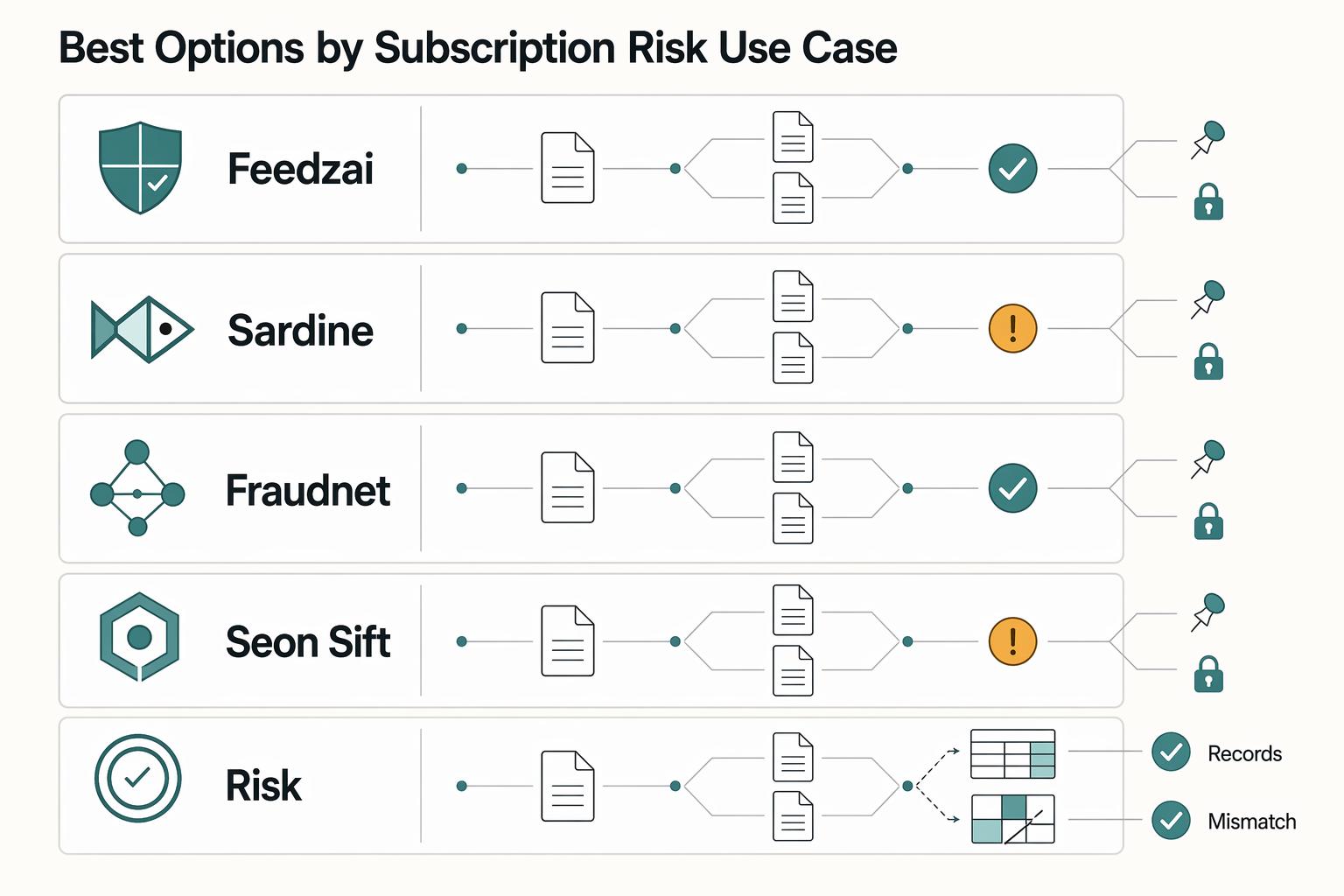
AI Fraud Detection for Subscription Platforms Beyond Rules-Based Approaches
An **AI fraud detection subscription platform** is not just a model score. For a subscription business, it should help you manage fraud risk and compliance exposure across onboarding, recurring payments, and payouts or withdrawals. It should also give your risk, finance, legal, and compliance teams decisions they can defend.
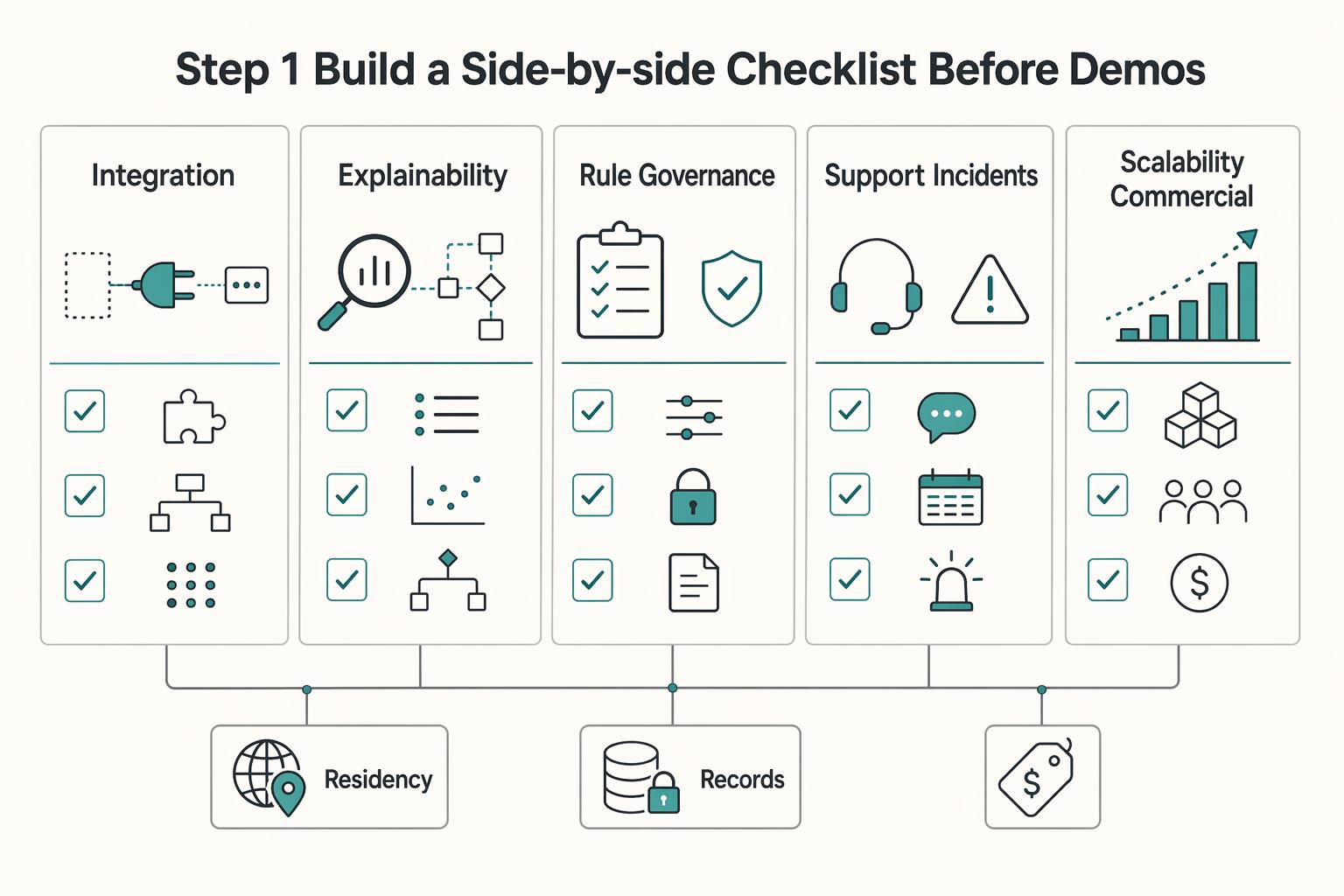
Transaction Monitoring for Platforms: How to Detect Fraud Without Blocking Legitimate Payments
The job is to catch fraud without choking legitimate payouts. If your controls stop more fraud by freezing every unusual payout, the loss shows up somewhere else: false declines, delays, and avoidable friction for real contractors and sellers.