
Quick Answer
Model total cost first, then prove savings under live exceptions before you commit. Build the ROI case with separate one-time and recurring lines, including engineering work for webhooks, reconciliation logic, idempotency safeguards, and evidence prep. Validate gains at each AP stage instead of relying on directional benchmark payback claims. A defensible decision comes from a scoped pilot that confirms status sync, replay behavior, and finance-ready exports, not from demo throughput alone.
How to Build a Defensible AP Automation ROI Case#
Most AP projects do not miss ROI because the spreadsheet was wrong. They miss it when real costs show up in exception handling and post-go-live process work. If you are evaluating AP automation, the useful question is not whether automation can create value. It can. The question is whether that value survives contact with your actual process.
At its simplest, AP automation ROI is the business value created by automating Accounts Payable work. That sounds obvious, but it matters because the business case has to compare implementation and operating costs against the outcomes you expect to get back. In manual AP, the starting point is usually familiar: paper-heavy handling, repetitive data entry, slow processing, errors, and surprise late payment fees. Those are real sources of waste, and they are often the easiest place to find measurable gains.
A practical business case separates direct ROI from indirect ROI. Direct ROI is the part finance can defend quickly, such as lower processing costs and fewer late fees. Indirect ROI still matters, but it is harder to convert into exact dollars, so treat it as supporting evidence rather than the core claim. If your model depends mostly on softer benefits like better visibility or a smoother vendor experience, expect heavier scrutiny.
Start with an operational checkpoint, not a financial one. Before you accept any savings estimate, verify that each claimed gain maps to a step you can observe and measure: invoice processing, payment approvals, or vendor management. You should also be able to answer three plain questions: who owns exceptions, where failed items are reviewed, and what evidence is kept when compliance or audit questions come back later. If those answers are fuzzy, the ROI is fuzzy too.
That is where rollout surprises usually hide. A platform team may buy software to remove manual work, then discover that parts of the process still need manual review and follow-up. In that situation, the tool may still be useful, but the savings case was overstated because the remaining manual effort was never priced in.
Be careful with headline benchmarks. Some sources cite first-year ROI claims in the 300 to 500% range, but those figures are directional at best, not typical or guaranteed. You should not assume payback speed without your own implementation and operating cost inputs.
This guide is for teams that need a defensible answer, not a hopeful one. The sections that follow move from scoring and buying patterns into cost modeling, proof testing, and pilot design so you can judge whether the promised value will hold after purchase.
Related: Accounts Payable Workflow for Platforms: How to Design an Efficient End-to-End Payables Process.
Who should use this list and how to score options#
Use this list if your AP workflow includes contractor, creator, marketplace, or embedded payout flows and you need auditable payment processing, not just faster invoice entry. If you only need OCR invoice capture for one domestic entity with simple approvals and no API integration, this framework is likely more than you need.
There is no universal winner, so score each option against your own operating data. Prioritize metrics like Straight-Through Processing (STP) Rate and fully-loaded labor cost, and validate vendor claims against your invoice mix, approval paths, and exception volume. Keep this constraint in scope: automated AP still needs human oversight.
| Criterion | What to check | Why it matters |
|---|---|---|
| ROI speed | Time to usable deployment and when labor or fee savings start | Slow time-to-value weakens the business case |
| Integration effort | ERP compatibility, API requirements, and effort to connect existing systems | Integration drag can erase expected ROI |
| Control over invoice matching and approval | Routing flexibility, matching rules, and exception controls | Weak controls break automation at edge cases |
| Audit trails quality | Traceability from capture to approval, payment status, and reporting export | Poor traceability creates audit and compliance rework |
| Compliance fit | How KYC, KYB, and AML checks trigger holds, reviews, and releases | Efficiency does not help if policy requirements fail |
| Cross-border readiness | Global payment support, currency handling, and status visibility | Cross-border complexity affects cycle time and support load |
Set decision ownership before demos: finance owns the business case, engineering owns integration risk, and ops owns exception handling. Treat it as a red flag if a vendor can demo OCR and routing but cannot clearly show failed-item review, payment-status sync, or exception clearing.
If you want a quick next step, try the free invoice generator.
The five AP automation options platforms actually buy#
Most teams are not choosing from an endless market. In practice, they are choosing between a few buying patterns, and the right fit depends on who will own integration, exceptions, and payment processing after go-live.
| Option | Best fit | Tradeoff |
|---|---|---|
| ERP-native AP suite | Finance-led modernization with AP anchored in a cloud ERP; multi-entity payables in one finance system | Slower change cycles when product or operations teams need fast workflow adjustments |
| Approval workflow specialist | When approvals and matching are the bottleneck; improve approval speed and matching rules without replacing the full stack on day one | Payment processing and reconciliation may still sit in other tools |
| Payment-rail-first platform | When payment execution and status visibility are the main pain, not invoice capture alone | Finance reporting design must be defined early |
| API-first infrastructure build using modular components | Product-led teams that want AP embedded into their own product experience | Higher engineering ownership and longer time to value |
| Hybrid outsource plus automation | Fastest way to stabilize throughput when the team is overloaded | Weaker internal process ownership over time |
- ERP-native AP suite
This is usually the strongest fit for finance-led modernization when you want AP anchored in a cloud ERP. The upside is tighter accounting alignment, familiar reporting and archiving, and a clearer path for multi-entity payables in one finance system. The tradeoff is slower change cycles when product or operations teams need fast workflow adjustments.
Ask to see the full path from invoice intake to posting to archive, plus how approval history appears in exports. If that flow is clear, this option can reduce slow, error-prone manual handling and support cleaner controls.
- Approval workflow specialist
Choose this when approvals and matching are the bottleneck. It is the classic standalone AP automation tool bolted onto your current setup, so you can improve approval speed and matching rules without replacing the full stack on day one.
The tradeoff is that payment processing and reconciliation may still sit in other tools. Confirm not just approval movement, but how approved items map to paid items and how that status returns to finance.
- Payment-rail-first platform
Use this pattern when payment execution and status visibility are the main pain points, not invoice capture alone. It can be a better fit when your AP outcome depends on reliable payout tracking and clear payment-state updates.
The tradeoff is that finance reporting design must be defined early. Ask for a live walkthrough of status sync, failed-item handling, and what gets exported back to your ledger.
- API-first infrastructure build using modular components
This path fits product-led teams that want AP embedded into their own product experience. You get more control over how approvals, exceptions, and payment workflows connect to your internal systems.
The tradeoff is higher engineering ownership and longer time to value. Before committing, define who will own exception recovery, integration maintenance, and finance-ready reconciliation outputs.
- Hybrid outsource plus automation
This is often the fastest way to stabilize throughput when the team is overloaded. In practice, it looks like an outsourced AP department with integrated software, which can ease manual pressure quickly while keeping automation in place.
The tradeoff is weaker internal process ownership over time. Set explicit checkpoints for what moves in-house later so convenience does not turn into quiet lock-in.
Whichever route looks best on paper, the next check is whether your cost model includes the work that usually gets left out.
For a deeper look at scaling AP without adding headcount, read Finance Automation and Accounts Payable Growth: How Platforms Scale AP Without Scaling Headcount.
Total cost categories most ROI models miss#
If you want a business case that survives finance review, model total cost first and treat headline ROI claims as directional. That includes common benchmarks like a 3 to 9 month payback period. Make every formula, assumption, and variable explicit so finance and engineering can challenge inputs before approval.
| Cost category | What to include | Why it matters |
|---|---|---|
| Commercial and services costs | Subscription fees, implementation services, configuration, and onboarding support, separated into one-time and recurring costs | Prevents first-year results from hiding setup spend inside software lines |
| Internal integration work | Webhook handling, reconciliation logic, idempotency safeguards, and data extraction and validation QA | Internal engineering effort is often the largest missed category; labor may only move downstream |
| Change management and ongoing support | Approver training, policy and role administration, cutover support, and post-go-live support across invoice capture, matching, approvals, and archiving | ROI weakens when teams do not absorb the new process |
| Operational exception and evidence labor | Failed payment investigations, duplicate checks, approval follow-up, and audit-evidence prep | Per-invoice savings comparisons are only credible when exception volume stays low and evidence retrieval is fast |
- Commercial and services costs
Start by separating one-time and recurring costs. Break out subscription fees, implementation services, configuration, and onboarding support in distinct rows so first-year results do not hide setup spend inside software lines.
- Internal integration work
For platforms, internal engineering effort is often the largest missed category. Budget for webhook handling, reconciliation logic, idempotency safeguards, and data extraction and validation QA, then verify how late events, duplicates, and ledger-ready outputs are actually handled. If invoice approvals speed up but payment status and posting still need manual cleanup, labor has only moved downstream.
- Change management and ongoing support
ROI weakens when teams do not absorb the new process. Include approver training, policy and role administration, cutover support, and post-go-live support across invoice capture, matching, approvals, and archiving. This is where broad benchmark claims, including 200-600% first-year ROI ranges, often stop being defensible for your operating reality.
- Operational exception and evidence labor
Do not assume a touchless state if you still run a real exception queue. Price failed payment investigations, duplicate checks, approval follow-up, and audit-evidence prep, and require a sample evidence pack before signing. The $12-30 manual versus $1-5 automated per-invoice comparison is only credible when exception volume stays low and evidence retrieval is fast.
Practical rule: keep one-time build and rollout costs separate from recurring software, support, and operations costs. That split makes the ROI case easier to defend in finance cycles.
Related reading: The Best Business Bank Accounts for Canadian Sole Proprietors.
Benefits you can defend in a finance review#
Lead with savings you can tie to records, then use AP-stage KPIs to show those gains are durable.
- Direct savings first, inside Net Annual Savings
Start with savings finance can book: lower processing cost per invoice, fewer late-payment fees, and better capture of early-payment discounts. Keep these in Net Annual Savings (total savings minus ongoing costs) instead of mixing them with softer value claims. Vendor benchmarks like up to 80% processing-cost reduction are directional, not proof for your platform. Your proof is a before/after view by invoice cohort, with exception-heavy invoices separated so savings are not overstated.
- Stage KPIs that show whether savings will hold
Track KPI performance across capture, matching and approval cycle time, and archiving/reporting completeness. Include a throughput KPI such as Straight-Through Processing (STP) Rate to show how much volume is actually moving without manual work. Require timestamped logs and exports finance can reconcile to the ledger. If approvals speed up but sync gaps, duplicates, or archive issues still require manual cleanup, labor has shifted downstream rather than been removed.
- Intangible value as second-layer evidence
Better vendor trust, less team rework, and stronger management visibility are valid, but they should support the case, not carry it. Use them after hard savings and KPI trends are established. Risk prevention can be meaningful in some cases, and some ROI models note that one avoided six-figure compliance penalty can outweigh software cost. If you do not have internal evidence for that scenario, keep the core case on measurable AP outcomes.
Decision rules for build vs buy vs hybrid#
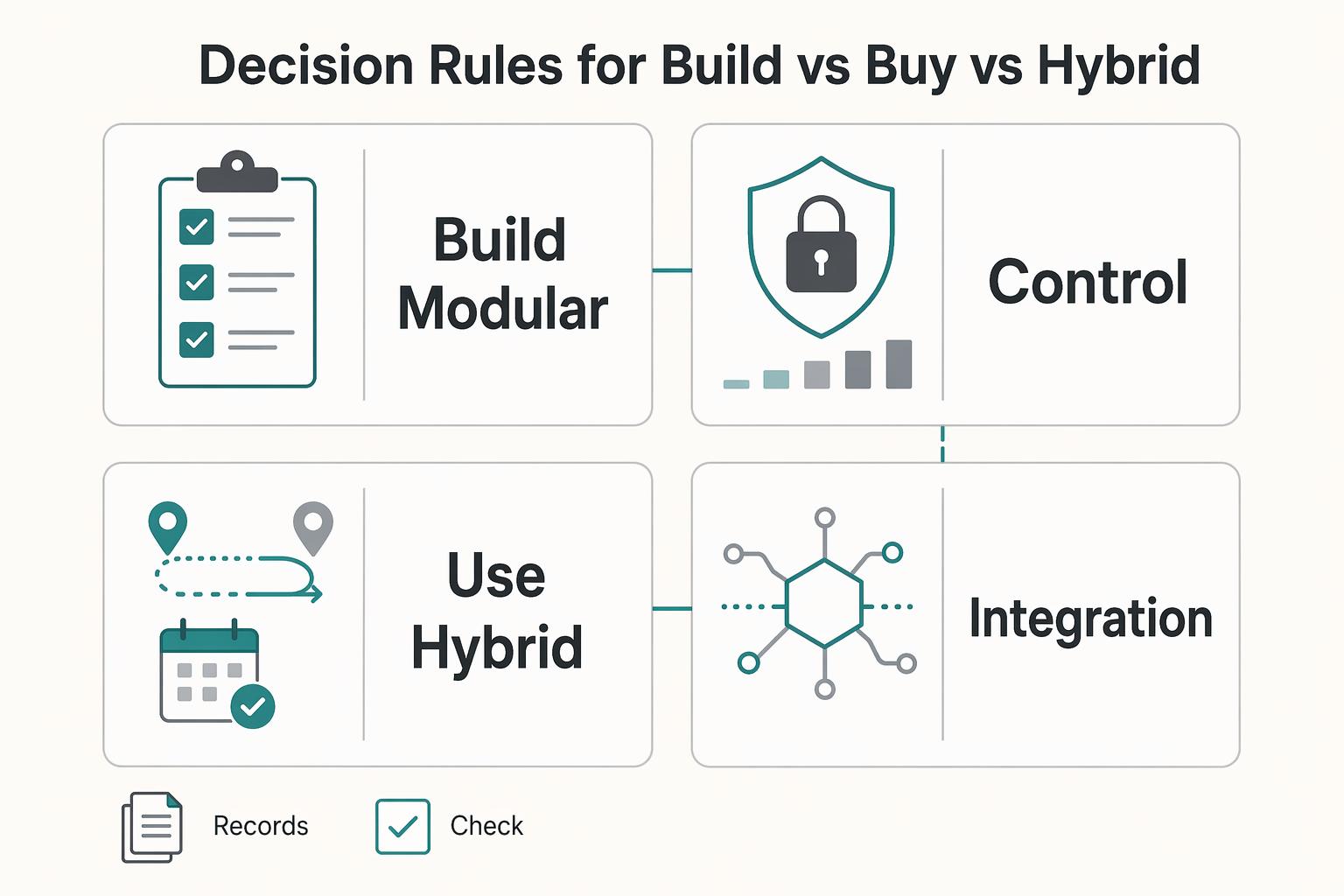
Once your savings model holds up in finance review, set ownership with clear gates: build for product control, buy for speed and standardization, and use hybrid as a transition model with a defined endpoint.
- Build or modular buy for product-facing payouts
Choose an API-first build, or a modular vendor with strong APIs, when your roadmap depends on custom payout experiences in your product. Control matters most in the areas that usually fail first under growth: invoice capture, matching, approval routing, webhook handling, and payment-status updates.
If your AP flow is mostly internal finance operations, avoid rebuilding standard AP functions. These workflows are already well understood, including capture, matching, approval routing, and three-way matching with POs and receipts. Source benchmarks differ on exact cycle times, but they align on direction: manual AP often runs in days, while cleaner automated flows move faster. If you do not need custom payout UX, suite tools are usually the faster path to value.
- Bias toward proven controls when compliance scope is broad
When you operate across markets, treat control evidence as a selection gate, not a post-purchase task. Global AP automation still has to satisfy tax, audit, and data-privacy requirements, and automation does not remove the need for oversight.
Ask vendors to prove auditability in real workflows, not just dashboards. You should be able to see who changed what, when approval states changed, what records are attached, and how outputs are exported for review. If faster approvals still leave teams stitching together screenshots, email threads, and CSVs, control quality is not production-ready.
- Use hybrid when delivery pressure is high and bandwidth is tight
Hybrid is the practical choice when you need near-term progress without committing to a fragile long-term architecture. Let automation handle pattern-heavy work like invoice capture and matching, while your team keeps judgment, policy, and exception handling under direct control.
Do not leave hybrid open-ended. Define a migration trigger before launch, tied to time or operating events, so manual side channels do not become permanent and reporting logic does not split.
- No signature without an integration proof test
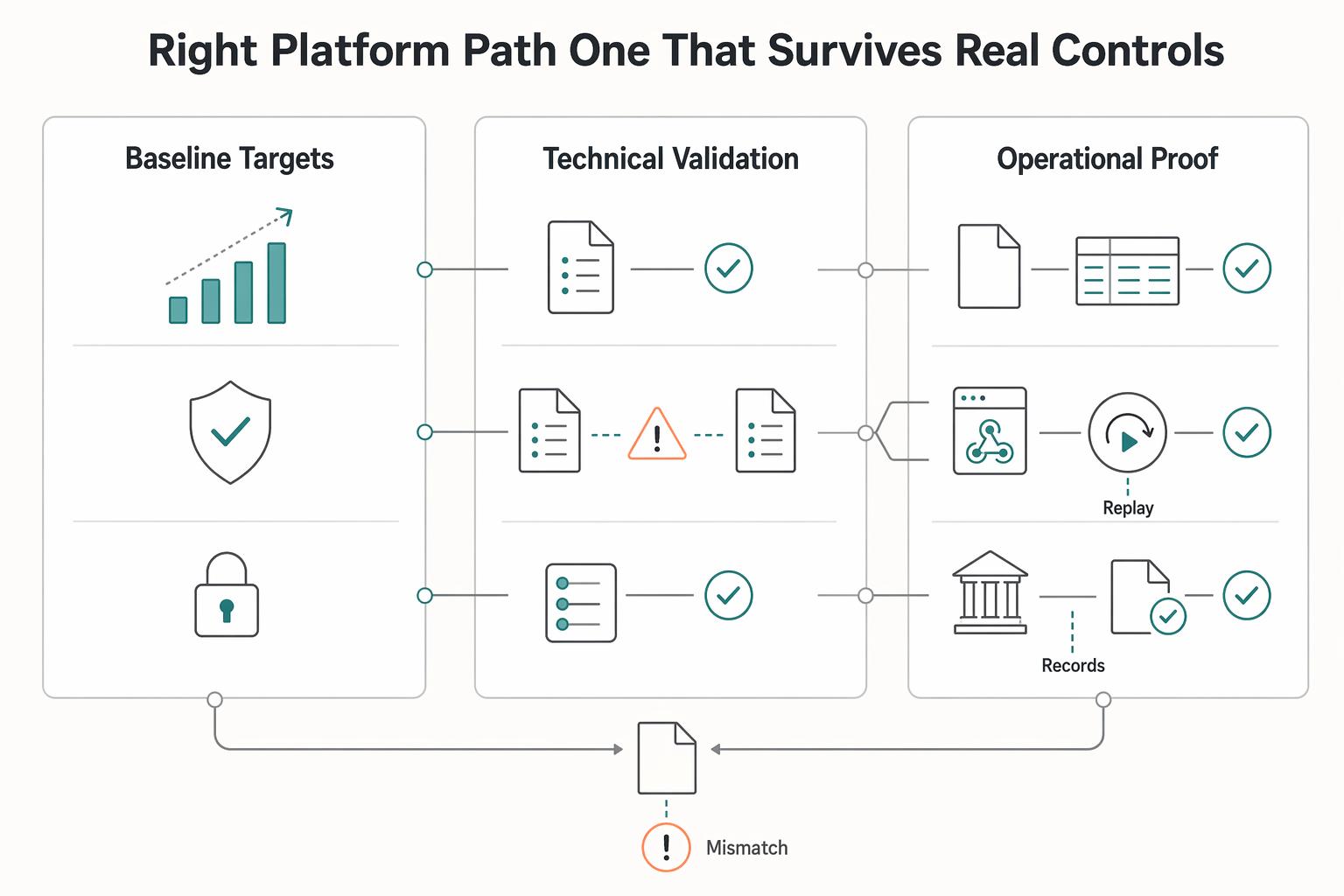
Set a hard gate: do not finalize a decision until status sync, exception replay, and reporting exports are tested. ROI usually breaks after happy-path flows fail, not during demos.
Your minimum evidence should show status movement across systems, replay of failed or delayed events, and exportable records finance can reconcile. If visibility exists only in UI views and not in reusable audit trails, you are shifting manual work downstream instead of removing it.
That proof test matters because even a sound integration can fail the ROI case once tax and compliance work enter the flow.
Compliance and tax constraints that change the ROI math#
Compliance and tax evidence can erase projected AP automation gains if you treat them as side work rather than core workflow cost.
- Tax evidence can outweigh invoice-processing savings
If your cross-border scope includes tax artifacts (for example W-8, W-9, Form 1099, or FBAR-related records), model retrieval, review, and reconciliation effort directly in the ROI model. The key test is whether finance can reproduce the exact evidence used at filing or review time.
FBAR record rules show why this matters. FinCEN defines maximum account value as a reasonable approximation of the greatest value during the calendar year, requires recording amounts in U.S. dollars rounded up to the next whole dollar, and requires using the Treasury Financial Management Service rate for the last day of the calendar year for non-U.S. currency conversion. In that method, $15,265.25 is recorded as $15,266.
- Hold behavior can become the real cost driver in mixed payment stacks
When MoR, Virtual Accounts, and payout modules are combined, ROI can break on hold-driven exceptions, not on straight-through invoice flow. Validate that holds are visible in the records finance and ops actually use, with clear status history from hold to release.
- Category-dependent filing timelines add operational overhead
FBAR timelines are not one-size-fits-all. The referenced notice states April 15, 2026 remains the due date for other FBAR filers, while some signature-authority filers are extended to April 15, 2027 (for reporting signature authority held during calendar year 2025). Your business case should include that date-management and control-check overhead, not just processing speed.
If this compliance review still supports the deal, move to a pilot that proves the workflow under live conditions.
For a step-by-step walkthrough, see The Best Business Bank Accounts for Freelancers.
90-day pilot plan with verification checkpoints#
Treat this 90-day pilot as a decision test, not a guarantee: the goal is to confirm the product can run real AP work, produce usable evidence, and recover predictably when things fail.
| Pilot phase | Timing | Checkpoint |
|---|---|---|
| Baseline the current state and lock assumptions | Weeks 1-2 | Define baseline for cost per invoice, cycle time, exception rate, and inquiry volume; lock metric definitions and owners |
| Run a scoped pilot through end-to-end AP flow | Weeks 3-6 | Run a narrow but real transaction set through capture, extraction and validation, matching and approval, and payment processing |
| Verify reconciliation, audit trail completeness, and recovery behavior | Weeks 7-10 | Reconcile outputs to ledger inputs, approvals, and payment records; test duplicate events, retry behavior, and lagged status updates |
| Publish a go/no-go memo with phased rollout scope | Weeks 11-13 | Compare pilot results to the locked baseline, list unresolved risks, and attach the evidence pack |
- Weeks 1-2: baseline the current state and lock assumptions
Define your baseline for cost per invoice, cycle time, exception rate, and inquiry volume using your own records, then lock metric definitions and owners before testing starts. Confirm delivery ownership up front under Project Organization and Staffing, including explicit integration and testing accountability (for example, a named Integration Manager) so interface testing, defect triage, and export validation are clearly owned.
- Weeks 3-6: run a scoped pilot through end-to-end AP flow
Run a narrow but real transaction set through capture, extraction and validation, matching and approval, and payment processing. Keep AP explicitly in core scope, not as an add-on: in grounded proposal language, this is the difference between AP being named in Core Phase Requirements (for example, 3.1.3 Accounts Payable) versus being deferred into later change requests.
- Weeks 7-10: verify reconciliation, audit trail completeness, and recovery behavior
Reconcile pilot outputs to your ledger inputs, approvals, and payment records, and confirm audit history is complete enough to explain state changes over time. Then test failure-handling paths, including duplicate events, retry behavior, and lagged status updates, and verify that final exports remain consistent and usable for finance operations.
- Weeks 11-13: publish a go/no-go memo with phased rollout scope
Close with a short memo that compares pilot results to your locked baseline, lists unresolved risks, and defines rollout boundaries by entity, country, and payout type. Attach the evidence pack (metric definitions, sample exports, exception logs, and recovery-test results) and scale only where controls were proven.
Conclusion#
Choose the option that matches how your AP really runs, not the one with the cleanest sales slide. If you want a decision you can still defend six months later, make it on four things: scope fit, hard-dollar ROI, audit and integration proof, and a pilot that survives exceptions.
- Match the tool to the actual AP job
AP automation is not just invoice capture. The supported scope in the research is broader: invoice capture, data entry, approval workflows, and payment processing. If your pain is mostly approval delay, an approval specialist may be enough; if the real drag is payment status, reconciliation, and supplier payment handling, you need stronger payout and reporting support, not prettier intake screens.
- Build the business case from your numbers, not vendor stories
There is real upside here. NetSuite cites research saying manual AP can cost four times more per invoice than fully automated AP, and automated teams can process more than twice as many invoices per AP employee. Treat those figures as directional, then prove your own case by separating one-time costs from recurring costs and pricing the items buyers often miss, especially engineering support, data extraction and validation QA, exception handling, and audit evidence prep. If soft benefits are doing most of the work in your model, that is a warning sign.
- Make one end-to-end verification test a non-negotiable gate
Before you sign or expand, run one real invoice through intake, approval, payment, and finance output review. Check that the entity, supplier, and reference IDs match in exports, that approval history is visible, and that the audit trail is clean enough to satisfy finance review. A platform that looks fast in demos but fails on reconciliation, status sync, or exception replay will create hidden operating cost after go-live. One risk to test for is an invoice that is approved in the app but still cannot be paid cleanly because a sync gap or missing supplier record blocks the final step.
- Scale only after the pilot proves the boring parts
Case studies can be encouraging. Ramp reports examples such as AP processing time cut by over 80% and reconciliation reduced from 5-6 hours to under 30 minutes, but those are not universal outcomes. The pilot should prove not just speed, but recovery behavior, human review for suspicious items, and reporting quality when something goes wrong. If the pilot only shines on straight-through invoices, you do not yet know your real ROI.
That is the practical answer to the accounts payable automation roi business case payables technology platforms question: pick for operating fit, validate with finance-grade math, and do not skip the evidence pack. The winner is the option you can reconcile, audit, and support without constant cleanup.
Related: Accounts Payable Outsourcing for Platforms: When and How to Hand Off Your Payables to a Third Party.
Frequently Asked Questions
How do you calculate AP automation ROI for a platform business with engineering costs included?
Start with a simple comparison: implementation and operating costs versus tangible savings. Put internal engineering time on the cost side for both initial implementation and ongoing operations. Keep indirect benefits separate so finance can see what is hard-dollar ROI and what is operational upside.
What costs belong in the business case besides software subscription fees?
Include implementation and operating costs beyond subscription fees, including internal time and any training or support needed. A good checkpoint is to split every cost into one-time versus recurring and then verify which items are explicitly named in the vendor scope.
Which benefits count as tangible ROI versus indirect operational value?
Tangible ROI is the part you can defend with normal finance math, such as lower processing costs and fewer late fees. Indirect value includes operational upside that is harder to price exactly but should still be included in the analysis. If your model depends heavily on soft benefits, treat the result as directional.
How should we estimate payback period when vendor benchmarks are directional, not guaranteed?
Treat vendor benchmarks as directional, not guaranteed. Use your own baseline and build low, base, and high cases rather than a single promised number. Only count gains you can verify in your process, including how exceptions are handled.
When is manual AP still acceptable, and when should we automate immediately?
Manual AP can still be workable in simpler, lower-complexity environments. Move faster toward automation when late fees, approval bottlenecks, or compliance demands are persistent. If tax, audit, or data privacy requirements are expanding, manual processes are usually harder to sustain.
What should we validate before selecting between NetSuite-style suites, ApprovalMax-style tools, and API-first platforms?
Use the same buyer questions across all three: how it integrates with your ERP, how payments are handled, and what support and training are included. Apply those checks consistently before comparing implementation and operating costs against expected ROI.
How do KYC, KYB, AML, and tax document workflows affect AP automation timelines?
These workflows can affect timelines, so treat them as part of implementation planning rather than an afterthought. For global AP automation, confirm how tax, audit, and data privacy requirements are addressed before setting timeline expectations.
Try a related tool
Researched and edited by the Gruv editorial team. Gruv builds cross-border billing, payouts, and finance-operations software for global businesses.
Sources
- bsaefiling.fincen.gov/docs/XMLUserGuide_FinCENFBAR.pdftrusted
- copyright.gov/1201/2024/comments/opposition/Class%202%20-%...trusted
- das.nebraska.gov/materiel/purchasing/contracts/pdfs/84289(o4)...trusted
- ets.hawaii.gov/wp-content/uploads/2025/04/Arctic-IT-Proposa...trusted
- fincen.gov/reporting-maximum-account-valuetrusted
- fincen.gov/report-foreign-bank-and-financial-accountstrusted
- ftc.gov/system/files/ftc_gov/pdf/D09407%20-%20RESPON...trusted
- sec.gov/Archives/edgar/data/1785592/0001193125221016...trusted
Educational content only. Not legal, tax, or financial advice.
Related Posts
How Platform Teams Scale AP Volume Without Adding Headcount
Use this as a decision list for operators scaling Accounts Payable, not a generic AP automation explainer. In these case-study examples, invoice volume can grow faster than AP headcount when the platform fit is right, but vendor claims still need hard validation.
Accounts Payable Outsourcing for Platforms When and How to Hand Off Your Payables to a Third Party
Start with the real choice, not the buzzword. Accounts Payable outsourcing means shifting AP work from your in-house team to a specialized external provider. In practice, your decision is usually narrower: hand off execution now, wait until the process is ready, or keep it internal and automate instead.
Designing an End-to-End Accounts Payable Workflow for Platforms
Start with the process, not the product demo. Full-cycle Accounts Payable (AP) runs from purchase order through payment and reconciliation. Weak design usually shows up later as invoice delays, duplicate payments, missed due dates, and supplier disputes.