
Quick Answer
Build a payment help center as an operating control with one FAQ template, a shared issue taxonomy, and hard escalation rules in the ticket record. Define scope, owners, required evidence, SLA clocks, and separate case or account escalation paths so routine questions resolve quickly and complex incidents transfer with context, auditability, and clear next actions.
Build a payment help center your ops team can run under pressure#
Treat this help center as an operating control, not a content project. The point is to resolve issues faster while keeping a clear, auditable record of what was reported, checked, and escalated.
Set the operating goal#
Set the goal as fast answers with traceability under pressure. An uninvolved operator should be able to reconstruct the case from the record alone: when the request arrived, who handled it, what guidance was given, and whether it was escalated.
Build around core capabilities from the start: knowledge base management, ticket management, interaction tracking, alerts and escalations, and omnichannel communication. In compliance-sensitive environments, immediate request logging with an audit trail is a practical control point. If questions can disappear into chat threads or inboxes without durable ticket history, fix that before you expand content.
Clarify who this is for#
Name the operating audience up front: support operators, escalation owners, and product owners. They may need different wording, but they should work from one source of truth.
When those groups are not clearly in scope, content goes generic and breaks down during real cross-team incidents. Keep each recurring answer usable for both self-service and internal handling so ownership and context stay aligned when a case moves.
Define the outcome you are building toward#
The deliverable is not a pile of articles. It is a working setup: FAQ templates plus escalation workflows that preserve context and leave a clean incident record. Templates help because they standardize recurring Q&As and let teams add new entries without rebuilding the structure each time.
Use performance evidence as directional, not guaranteed. Well-organized FAQ pages can reduce repetitive inbound questions, and reported deflection ranges vary across sources. Sources also report strong self-service behavior. The practical check is simpler than any benchmark debate: repeat contacts on common questions should fall, and escalated cases should transfer with enough history for the next owner to act without rebuilding context.
If recurring payment issues trace back to balance, reconciliation, or transaction-history disputes, building a deterministic ledger gives support, finance, and engineering a shared source of truth.
Define the operating scope before you write a single FAQ#
Set scope before you publish answers. If you do not, you can end up promising support that no team actually owns. Define what is supported, what is redirected, and who is responsible at each handoff.
Draw the boundary#
Start with a written scope of support that separates in-scope issues from redirected requests. For every out-of-scope path, name the destination team or queue to reduce dead ends.
Split by ownership lane#
Route issues by the lane that reflects real ownership. If you use tiering, document it clearly, for example Level One, Level Two, and Level Three, so escalation decisions are predictable before a ticket moves.
Label where coverage changes#
Make coverage differences visible where people actually route work: in lane labels, intake options, and article headers. Keep those labels current when product navigation changes, because stale labels can create false expectations and bad routing.
Publish one ownership map#
Keep one shared ownership map across teams so each supported issue type has a clear owner. Treat escalation as context preservation, not simple forwarding. If the handoff note only says "escalating" and adds no troubleshooting detail, the next team may spend extra time reconstructing the case before they can start resolving it. For related reading, see How to Build a Payment Health Dashboard for Your Platform.
Prepare the incident evidence pack and owners#
Before you tune routing, decide what evidence must travel with the case and who owns each step. Your evidence fields, SLA clock rule, and PII handling should be explicit internal policy.
Write the minimum ticket packet#
Define the minimum fields every incident must carry from intake to resolution, then make them required in your process. If you use fields such as transaction ID, ledger reference, provider reference, timestamps, customer impact, and current status, document them as your internal standard instead of leaving them implied.
Define a separate escalation packet for payout and settlement incidents#
If payout and settlement cases need tighter control in your environment, use a separate escalation packet. Document what must be included and exactly what starts the clock in your internal process.
Separate masked and restricted data handling#
Decide which values can be broadly visible in masked form and which must stay restricted to controlled access, then keep that policy consistent across tools.
Assign collection, approval, and customer communication owners#
Define role owners for collection, approval, and customer communication before escalation begins, including primary and backup coverage. Keep quick, simple intake lightweight, but route governance-heavy escalation through a more controlled path so ownership and approvals are explicit.
Build a payment issue taxonomy tied to routing#
Your taxonomy should control routing, not just naming. If finance ops, support, and product classify the same issue differently, triage slows, reporting gets muddy, and escalation becomes inconsistent.
Define a shared glossary before configuring rules#
Start with the six classes in your outline and publish them as your internal operating set, with clear definitions, examples, and ownership.
| Class | Definition |
|---|---|
| Failed collection | a payment attempt did not complete as expected. |
| Payout delay | funds were expected to move out but remain pending, blocked, or late. |
| Refund state mismatch | refund status shown to users, support, or finance does not match underlying payment or ledger state. |
| Chargeback | a dispute or reversal event that needs investigation or evidence handling. |
| Account hold | a restriction affecting the account's ability to transact or receive funds. |
| Reconciliation mismatch | records across transactions, ledgers, provider references, or settlement views do not line up. |
These are your policy classes, not a universal standard. Add one or two examples and one explicit exclusion for each class so teams do not route unrelated issues into the same queue.
Map each class to a default route#
Do not leave default routing to whoever happens to be watching the queue. Map each class to a default path in your own policy and define the destination owner up front.
If you use both case escalation and an internal account escalation track, define that boundary explicitly in policy. The grounded sources here only specify case-escalation mechanics: ordered criteria, explicit actions, and escalation to either a queue or a named user.
Then write conversion rules into policy so route changes are explicit and repeatable.
Write movement logic in clear if-then rules#
Taxonomy only helps if it changes what happens next. Put the classification rules into your routing logic and tools. Each class needs an initial route, a move trigger, and a minimum evidence check before reassignment.
| Condition | Action |
|---|---|
| If classification criteria are met and evidence is complete | apply the default route. |
| If a case remains open past the configured time condition | trigger the defined escalation action. |
| If investigation changes the classification | reclassify and reroute using documented criteria. |
| If required evidence is missing | pause rerouting unless your internal policy allows urgent escalation with partial data. |
Require an auditable log for every route change: original class, trigger or reason, evidence attached, and next owner. That keeps routing decisions from becoming guesswork later.
Add first-response targets and time-based triggers per class#
Urgency should be decided in advance, not improvised in the queue. If you set first-response targets, treat them as internal policy and pair them with at least one escalation trigger for each class.
A clean setup is to store explicit timing fields on each incident, such as first-response due, next decision checkpoint, and escalate after. Time-based rerouting is a valid pattern, and a Trailhead example uses 4 hours for unresolved cases. Use that as a design pattern, not as a payment-ops standard.
Before rollout, test sample tickets for each class. Confirm four things: classification is unambiguous, owner assignment is correct, timers start from your intake rule, and timed triggers reroute open cases as configured. If any of those fail, the taxonomy is still documentation, not an operating control.
For a step-by-step walkthrough, see How to Build a Payment Reconciliation Dashboard for Your Subscription Platform.
Write FAQ entries that cut repeat tickets#
Once scope and routing are set, the FAQ can do real work. Treat entries as practical self-service answers, not generic filler. A consistent template makes them easier to scan, easier to maintain, and faster to update without starting from scratch.
Use one entry template for every issue#
Keep one structure across all entries so contributors and readers see the same flow every time. For example:
- Question or symptom
- Short answer
- What we need from you
- Next step
Using the same template across entries helps teams add and revise Q&As quickly.
Write entries for real recurring patterns#
Avoid catch-all pages. Write separate entries for recurring patterns you actually see in your queue.
Keep each entry specific to the question and the intake details you actually need. If those details are fuzzy, the page may answer the question while still creating repeat inquiries.
Add ownership and review metadata#
Every entry should include Owner, Reviewer, and Review Date so updates are accountable and scheduled. Before you publish or revise an entry, test it against recent tickets and confirm the answer is clear, accurate, and practical.
End with one explicit next action#
Do not leave the reader to infer the next move. Close every entry with one unambiguous next step so readers know what to do next.
Set escalation levels and hard trigger rules#
Escalation rules should remove ambiguity, not add it. Decide routing by clear entry criteria, not by who happens to pick up the ticket. Keep every handoff in the incident ticket so ownership, timing, and decisions remain visible.
Define ownership by entry criteria, not by label#
If you use L1, L2, and specialist labels, they only help when each level has a specific reason to take a case. If two teams can accept the same issue without a tie-breaker, tickets can drift.
Base entry criteria on factors teams can test quickly: incident type, severity, duration, and scope. In ITSM-style operations, the service desk is commonly the control point for escalation. What matters is having one place to route and track handoffs. Keep decisions in the incident record, not in forwarded email or side chat, so the audit trail stays usable.
Write hard if-then triggers around time and risk gates#
Do not rely on judgment alone. Add automatic triggers tied to elapsed time or expanding impact so escalation happens before avoidable misses.
Start with your response-time clock. If current progress puts the case at risk of missing the target, escalate. Then add gate-based routing: if an internal policy gate changes who can approve the next action, route to that owner before proceeding.
Add stop conditions so escalation stays selective#
Good escalation rules also need a clear "not yet" branch. Without stop conditions, specialist queues can become a default destination. Use explicit non-escalation conditions where appropriate, such as stable scope with no time-risk trigger met. You can also define how incomplete intake data should be completed before escalation, unless severity rules override.
Require escalation notes that enable immediate action#
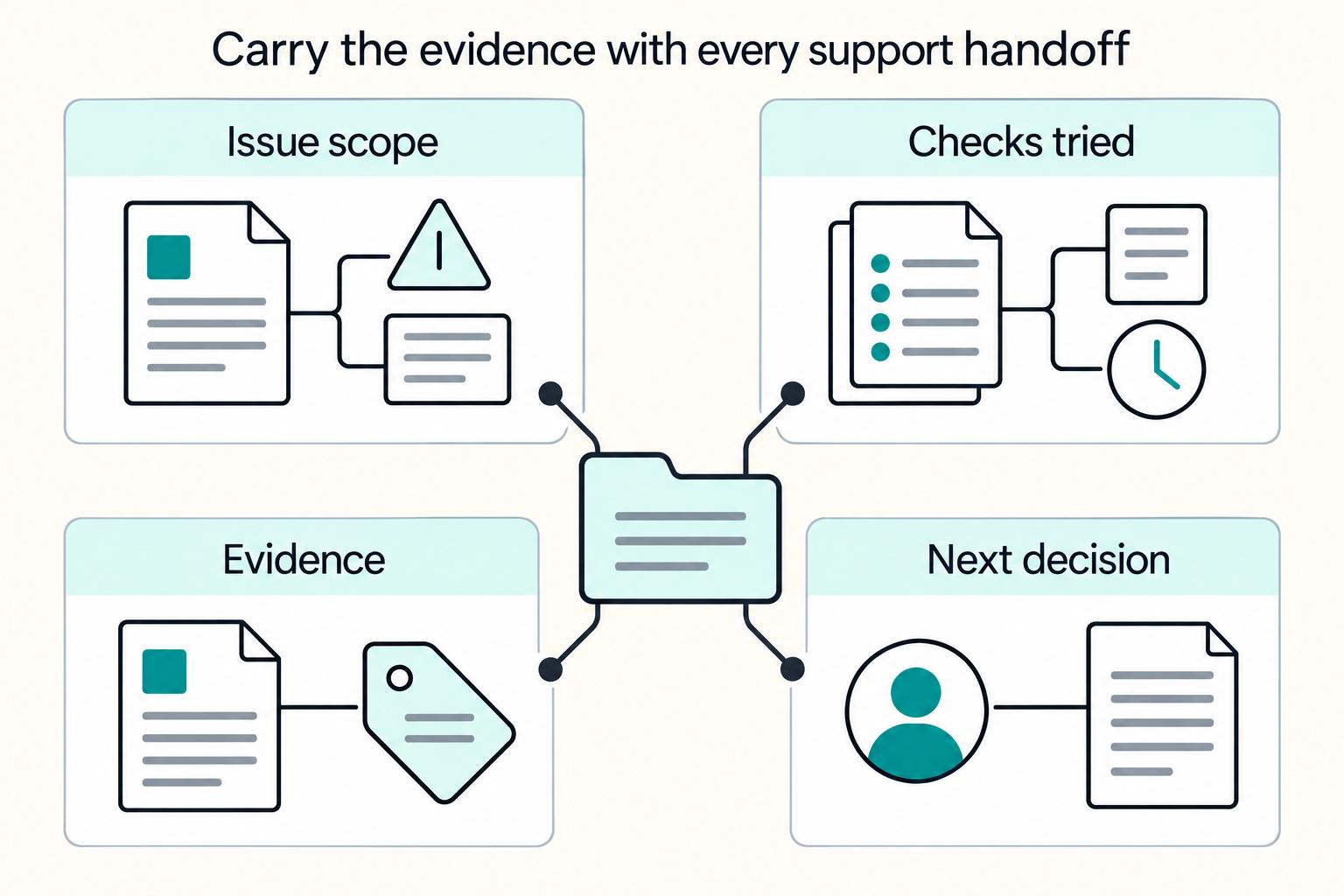
A handoff without usable notes is just delay. Record escalation notes directly in the ticket. Use a fixed template for your team, for example: what was already tried, what evidence is attached, current impact, and the next decision checkpoint.
That can reduce repeated re-triage and stalled cases. Unstructured email chains can sit idle, and cross-system handoffs can fail silently. A durable in-ticket record makes ownership changes and next actions explicit.
If you are formalizing escalation criteria and handoff fields, use Gruv's docs to align API events, statuses, and audit-ready workflows before rollout.
Design case and account escalation paths with context-preserving handoff#
Once hard trigger rules exist, the next risk is losing context during the move. Use clear escalation templates and require structured handoff notes so escalation does not collapse into simple forwarding.
Split issue-level and high-complexity escalation into separate templates#
Use distinct templates when the receiving team is making different decisions. Keep one shared field in both templates for the escalation trigger, whether time, severity, or customer sentiment, so the reason for handoff is explicit from the start.
A practical split looks like this:
| Field group | issue escalation | high-complexity escalation |
|---|---|---|
| Scope | Current issue, severity, immediate impact | Broader pattern or complex impact requiring specialized attention |
| Evidence | What was checked, key references, timestamps, current status | Related incidents, repeat history, current context |
| Next decision | What the receiving team must decide next, response target, owner | Decision needed from the specialized team, response target, owner |
If the trigger is time-based, record it directly, for example unresolved critical issue after 30 minutes. If a reviewer cannot quickly tell which path they are looking at, tighten the template split.
Force structured handoff notes instead of free text#
Structured notes are the main defense against "forward and forget." When escalation is only a queue change, the receiving team usually has to reconstruct context before acting. Require these fields in the escalation record:
- one-sentence issue summary
- what has already been tried
- evidence linked or attached
- current customer or operational impact
- urgency or service-level context
- exact decision needed from the next team
This keeps Level Two focused on diagnosis instead of rebuilding history, and it lets the original responder give reliable status updates from the ticket record.
Add service-level and ownership checkpoints for escalations#
Escalations should show priority-based response and resolution targets with a clear owner in the same record. Keep this simple and visible: priority, response target, resolution target, owner, and the condition that triggered escalation.
Apply these checkpoints to escalations that meet defined conditions and require specialized attention, not routine ticket handling.
Verify that context survives the handoff#
Do not stop at template design. Test the handoff itself. Run a drill across Level One, Level Two, and Level Three using two sample escalations with different triggers.
Confirm three outcomes from the ticket record alone:
- receiving team understands scope immediately
- service-level context remains visible
- upstream responder can provide a current status update
If any check fails, tighten the required fields or block submission until missing context is added.
Define SLA clocks and outbound status updates#
Support workflows should cover the full interaction lifecycle, from first customer contact through resolution and follow-up. For timing and outbound updates, document one approach your team can apply consistently across standard handling and escalations.
Set an incident start point and define handoff behavior#
Pick a clear incident-start rule and apply it consistently. Whether one SLA clock must be preserved unchanged across every handoff is not specified, so make your handoff rule explicit in your own process.
Use a simple audit check: trace one escalated ticket and confirm the recorded start point and handoff logic stay clear from intake through follow-up. If that breaks, treat it as a workflow gap.
Define outbound update cadence by severity#
Customers need predictable visibility during investigation, even when there is no new technical outcome yet. Set a written update cadence and keep the next update due time in the same record as owner and status.
Faster response expectations are supported, but required severity-by-severity intervals are not defined here. If you use severity-based cadence, keep it simple and consistent.
Use consistent status language across help center and support tools#
Use a shared status vocabulary across the surfaces customers and agents rely on. Consistent labels help teams follow the workflow and reduce handoff friction.
A universal status-language standard is not established, so keep status terms plain, documented, and aligned across your own help content, templates, and agent process.
Define escalation and remediation logging in advance#
For complex issues, define escalation paths before incidents happen. Keep remediation logging focused on process fixes: where delays occurred, how bottlenecks formed, and what changed to reduce repeat failures.
Specific breach roles, paging rules, and mandatory remediation fields are not defined here, so set those controls explicitly in your internal policy.
Add compliance and tax gates without blocking legitimate payouts#
Keep compliance and tax checks visible inside the same escalation path as payout issues. That keeps decisions visible and SLA handling consistent. Use one release rule throughout. If a required artifact is missing under your program rules, pause payout and record the exact blocker. If the artifact is present and valid, return the case to the normal SLA path.
Route compliance checks in the same escalation record#
Keep KYC, KYB, and AML decisions in the same ticket that already carries SLA start time, owner, next update due, and customer impact. This helps prevent a failure mode where operations sees a delay but the real blocker is an undocumented compliance review.
At minimum, track gate type, current state, blocking artifact, decision owner, and next review time. Validate this by sampling a paused payout and confirming the pause reason is visible in the same record the payouts team uses.
Control-heavy actions can create long delays if exit conditions are unclear. The Taxpayer Advocate described a processing moratorium implemented on September 14, 2023, followed by slower handling, with average ERC claim processing time later reported as more than a year. The operating takeaway is simple: keep pause reasons and release conditions explicit.
Split tax-document issues from payment rail failures#
Do not send tax-document blockers down the same path as rail, settlement, or provider-failure incidents. Missing or unresolved tax documentation, including FBAR correction context, often requires different owners, evidence, and next actions than transfer failures.
Use a simple classifier. If a document or validation artifact is blocking movement, route to compliance or tax review first. If documentation is complete and accepted, move the case back to the standard payout queue without resetting the original SLA clock.
Because these cases can include Federal Tax Information, apply tighter handling. IRS Publication 1075 frames safeguards around preventing loss, breach, or misuse of Federal Tax Information. Restrict file visibility, record where the authoritative copy is stored, and keep customer-facing updates free of sensitive tax details.
Add document-specific instructions when the issue is tax reporting#
If a case touches FBAR, handle it as a tax-reporting process, not a payout-rail process. FBAR is FinCEN Form 114, and your escalation notes should capture filing-specific facts such as whether the filing is original or amended, the relevant account period, and the value basis used.
Capture the details that commonly drive rework:
- Maximum account value must be recorded in U.S. dollars and rounded up to the next whole dollar, for example, $15,265.25 becomes $15,266.
- If no Treasury exchange rate is available, another verifiable exchange rate may be used, and the source must be provided.
If errors exist in a previously filed FBAR, an amended report is required. For filers with fewer than 25 accounts who cannot determine whether aggregate maximum value exceeded $10,000, instructions allow item 15a, "amount unknown."
Define the release rule and audit it#
Write the release rule as one repeatable instruction: missing artifact means paused payout with documented reason; valid artifact means resume standard processing in the same SLA record.
Audit two controls on a regular cadence:
- Paused cases: each one names the blocking artifact and decision owner.
- Resumed cases: each one returns to the normal queue without creating a new incident timer.
Related: What Is RegTech? How Compliance Technology Helps Payment Platforms Automate Regulatory Reporting.
Choose and configure your help center stack for operator speed#
The stack should help operators move quickly on routine issues and escalate cleanly on complex ones. Use your article system for fast FAQ publishing and retrieval, and keep escalation state in the system that owns case history and accountability.
Shortlist by operating model, not vendor branding#
Evaluate options based on how your team works under load. The real test is whether each option supports a consistent FAQ template, fast retrieval (categories, search, or chatbot-style access), and integration with your existing support stack, such as Zendesk, Intercom, Freshdesk, or Salesforce.
Templates matter when they reduce authoring friction and keep entries consistent across contributors. For Tier 0 self-service, retrieval quality matters just as much as writing speed.
Validate must-haves with a live payment scenario#
Run a working trial using one high-volume payment issue and one complex escalation path, such as a dispute or chargeback-type case that may need L2. In that trial, verify:
- consistent FAQ templates your team can update quickly
- retrieval paths users actually use (categories, search, or chatbot-style access)
- clear Tier 0 to L2 handoff for complex cases
- practical integration with your current support platforms
Treat this as proof, not brochure review. If agents cannot move from guidance to escalation without rework, the setup will slow operations.
Keep strict escalations in a control system#
When you need strict case escalation and account escalation governance, use your case system of record as the control point for escalation records. Let the knowledge base explain symptoms, required evidence, and next actions. Let the control platform hold authoritative status and ownership.
That keeps the AI and human split clear: self-service and automation absorb routine volume, while humans handle complex cases.
Prevent split-brain with shared IDs and operational metrics#
Use shared identifiers across articles and escalations, for example a case ID linked to an article ID or slug, to reduce drift between guidance and decisions.
After rollout, confirm operator-speed impact with concrete checkpoints: ticket volume trends, CSAT, handle time, and agent performance. If article usage rises but these metrics do not improve, treat that as a design problem, not a content-volume win.
Pilot the system with live incidents and verification checkpoints#
A pilot is where the operating model proves itself. Do not promote paths just because the content looks complete. Promote the ones that hold up under live conditions, with context, ownership, and SLA continuity intact.
Start with in-scope live incident classes#
Use incident classes already in rollout scope. Test them through the same intake and escalation flow operators will use after launch, with controlled volume high enough to expose queue pressure and handoff issues.
Verify every handoff with one checklist#
For each escalation, confirm the same checkpoints: correct owner, SLA clock intact, and documented decision. Require clear escalation triggers and auditable decision logs so confusion is not pushed downstream, and review real records in your control system.
A practical checkpoint is record export for trend and example review. Where available, use All Actions > Export to CSV to inspect failures and target rewrites.
Measure outcomes that reflect operational quality#
Track response time, SLA performance, escalation outcomes, and queue behavior. If you run multiple operating lanes, segment results by lane so you can spot routing and consistency gaps.
Treat external benchmarks as context, not pass-fail criteria. Use your own pilot data under live queue conditions to decide readiness.
Promote only verified paths, and fix weak ones first#
Publish only the FAQ entries and handoff flows that pass verification. Rewrite and retest any path that drives repeat contacts, ownership corrections, or inconsistent resolution outcomes.
Before you label a path weak, confirm the required configuration is actually active. Some capabilities remain unavailable until admins complete setup, so incomplete configuration can distort pilot results.
Recover from common rollout failures#
If the pilot shows repeat contacts or queue jams, do not expand and hope the issues settle out. Fix the failure modes first. Strong content can still fail when intake and escalation rules are weak.
Reject thin FAQ entries#
Generic FAQ answers are not enough, so enforce required template fields and reject incomplete entries. At minimum, each entry should clearly state the issue and how to reproduce it, then note what to check and whether L1 should resolve or escalate.
Before publishing, test entries against recent incidents and confirm the path is practical on first read. If operators still need to ask basic clarifying questions, the entry is not ready.
Tighten ticket vs account escalation rules#
A common routing mistake is using account escalation to add urgency to a single slow ticket. Keep the boundary clear: use the ticket-attention path for one open ticket, and reserve account escalation for broader customer situations such as delays across multiple tickets or systemic support experience concerns.
Review misrouted escalations, then rewrite the trigger language that caused them. Clear if-then rules can reduce specialist queue congestion.
Block handoff without minimum evidence#
Missing context at handoff is a process defect, so require a complete escalation submission before routing. Keep escalations in one centralized channel so communication stays consistent and auditable.
Require a clear issue statement and reproducibility detail before routing. Include relevant evidence and prior actions when available, and do not allow free-text forwards that force the next team to restart diagnosis.
Route compliance blockers separately from payment faults#
Cross-border payment flows move through financial institutions, currency conversions, and regulatory checkpoints, so keep compliance blockers and payment-processing faults clearly distinguished during triage.
Use severity-based communication for true incidents. Where Severity Level 1 applies, keep progress updates at least once per hour. For compliance blockers, communicate the blocker status and the next evidence checkpoint clearly.
If your escalation flow includes regulatory or policy edge cases, this guide on building a payment compliance training program for platform operations teams can help teams make cleaner handoffs and decisions.
Use this launch checklist to go live with confidence#
You are ready to launch only when scope, handoff, timing, and document gates are explicit enough for the next team to act without re-interviewing the case.
Define scope by lane, incident class, and named owner#
Set scope first: define boundaries for MoR, Virtual Accounts, and payouts, and assign a primary and backup owner for each incident class. If a case can land in multiple queues without a named resolver, treat that as a launch blocker.
Run a quick verification on recent incidents across those lanes:
- Who owns first response?
- Who approves escalation?
- Who sends the customer update?
If answers are inconsistent, ownership is not ready.
Standardize one FAQ template and enforce evidence rules#
Use one template shape across entries: issue statement, how to verify or reproduce, required evidence, internal checks, resolution branch, and escalation trigger. Keep the escalation floor explicit: what the issue is and how to replicate it.
Use this launch check:
- Frontline intake can complete handoff without inventing fields.
- "What we need from you" is specific, not optional or vague.
Document case escalation and account escalation as separate paths#
If your workflow distinguishes case escalation and account escalation, document them as separate processes rather than relabeling one form. Keep path-specific context and decision checkpoints explicit.
Use this verification test:
- Audit one draft handoff from each path.
- Confirm the next owner can see the issue statement, prior actions, evidence, and next decision checkpoint in one place.
If the specialist must restate the issue before acting, you have forwarding, not escalation.
Agree the clock, updates, and breach handling before first incident#
Set one shared interpretation for response clock, status updates, and breach handling across ops, finance, product, and compliance. Exact timings are local policy, but interpretation should not change when ownership changes.
Use conservative language when external tax processing is involved. External queues can run long and with limited transparency. For example, ERC claims were reported as averaging more than a year in 2024.
Integrate compliance and tax gates, then prove handoff quality in a pilot#
Put compliance and tax-document gates into routing where required by your market or program, not after escalation begins. Define local handling for W-8/W-9, 1099, and VAT workflows where enabled. If FBAR applies, handle it precisely:
| FBAR item | Requirement |
|---|---|
| Form | FBAR is FinCEN Form 114. |
| Threshold | Filing is required when a single-account maximum or aggregate maximum foreign account value exceeds $10,000 during the calendar year. |
| Account valuation | Each account is valued separately. |
| Currency conversion | Non-U.S. currency account values are converted to U.S. dollars. |
| Rounding | Values are rounded up to the next whole dollar, for example, $15,265.25 becomes $15,266. |
| Exchange rate | If a Treasury Financial Management Service rate is unavailable, use another verifiable exchange rate and provide the source of that rate. |
| Unknown aggregate value | If you cannot determine whether aggregate maximum values exceeded the threshold, Item 15a, "amount unknown," may apply. |
| Amendment | To correct a filing, submit a new full FBAR, check the Amend box in Item 1, and complete amendment fields such as the Prior Report BSA Identifier. |
| Due date | The instructions note an April 15 due date and automatic extension to October 15. Check FinCEN relief notices for event-specific extensions. |
Use these pilot pass criteria:
- Complete evidence
- Correct owner assignment
- Response clock preserved through handoff
- At least one corrective edit applied before full rollout
If the pilot shows repeated clarification loops, fix the article or intake template before broader launch.
When your checklist is complete and you need to confirm market/program fit for MoR, Virtual Accounts, or payouts, contact the Gruv team.
Frequently Asked Questions
What must every payment issue FAQ include to reduce back-and-forth?
Every FAQ should start with a clear statement of the issue and how to replicate or verify it. Then spell out the required evidence or checks and end with one explicit next step. If those basics are missing, the case usually turns into clarification instead of resolution.
What is the practical difference between forwarding a ticket and a true escalation handoff?
Forwarding only changes who has the ticket. A true escalation handoff carries the issue summary, reproducibility detail, prior actions, evidence, impact, and the exact decision needed in one record. If the next owner has to restate the problem before acting, it was a forward, not a full handoff.
When should a payment incident move from L1 to L2 to specialist review?
Use your existing severity protocol and documented triggers, not ad hoc tier judgment. In the grounded protocol, Severity Level 1 is critical impact tied to service or network unavailability, and escalation is defined for Severity Level 1 or 2 issues. Some Severity Level 2 issues may be treated as Severity Level 1 during specific windows, but exact L1 to L2 to specialist rules are still local policy.
What data is mandatory before escalating a payout or settlement incident?
The mandatory minimum before escalation is a clear statement of what the issue is and how to replicate it. Any additional payout or settlement fields should be defined in your own escalation template or internal policy. Do not treat extra fields as universally required unless you have documented them that way.
How should teams decide between case escalation and account escalation?
Keep case escalation and account escalation as separate paths with separate templates. Use the ticket path for one open issue, and reserve account escalation for broader customer situations such as delays across multiple tickets or systemic support experience concerns. Define the routing rule and required fields locally so the boundary stays predictable.
How should finance, ops, and product split ownership in escalation flows?
Do not assume a universal split applies across finance, ops, and product. Use one shared ownership map, one source of truth, and a focused single point of contact for reporting and resolution. Then document who owns collection, approval, and customer communication for your own process.
Which parts of common escalation guidance are still unknown or tool-specific?
Several items are still local or tool-specific: exact L1 to L2 transition criteria, payout evidence field sets, approval requirements, and SLA clock rules. Channel guidance is also tool-specific, such as reporting through Zendesk whenever possible rather than as a universal rule. The portable pattern is centralized communication plus separate case and account escalation templates.
Researched and edited by the Gruv editorial team. Gruv builds cross-border billing, payouts, and finance-operations software for global businesses.
Sources
- azmag.gov/Portals/0/Documents/MagContent/2021_MAG_Unif...trusted
- bsaefiling.fincen.gov/docs/XMLUserGuide_FinCENFBAR.pdftrusted
- citydocs.longbeach.gov/LBPDPublicDocs/DocView.aspxtrusted
- ecfr.gov/current/title-28/chapter-I/part-35trusted
- fincen.gov/reporting-maximum-account-valuetrusted
- fincen.gov/system/files/shared/FBAR%20Line%20Item%20Fil...trusted
- franklinwi.gov/Files/Agendas/2026/March2026/Common-Council-...trusted
- irs.gov/pub/irs-pdf/p1075.pdftrusted
Educational content only. Not legal, tax, or financial advice.
Related Posts

The Freelance Payment Penalty: A Modeled Audit of Platform Fees, FX Spreads, and Payout Delays
The money rarely disappears through a single, easy-to-spot fee. The real loss is stacked. A marketplace takes its commission, a processor adds a charge for international cards, a bank or payment company converts the currency at a spread, a platform holds the funds before release, and a wire sheds a little to intermediaries on the way in. Each layer looks defensible on its own, but the worker feels the combined result as a smaller deposit and a later payday.

How to Respond to a Subpoena for Business Records
Move fast, but do not produce records on instinct. If you need to **respond to a subpoena for business records**, your immediate job is to control deadlines, preserve records, and make any later production defensible.
A US Expat's Guide to Investing in UCITS ETFs to Avoid PFIC Issues
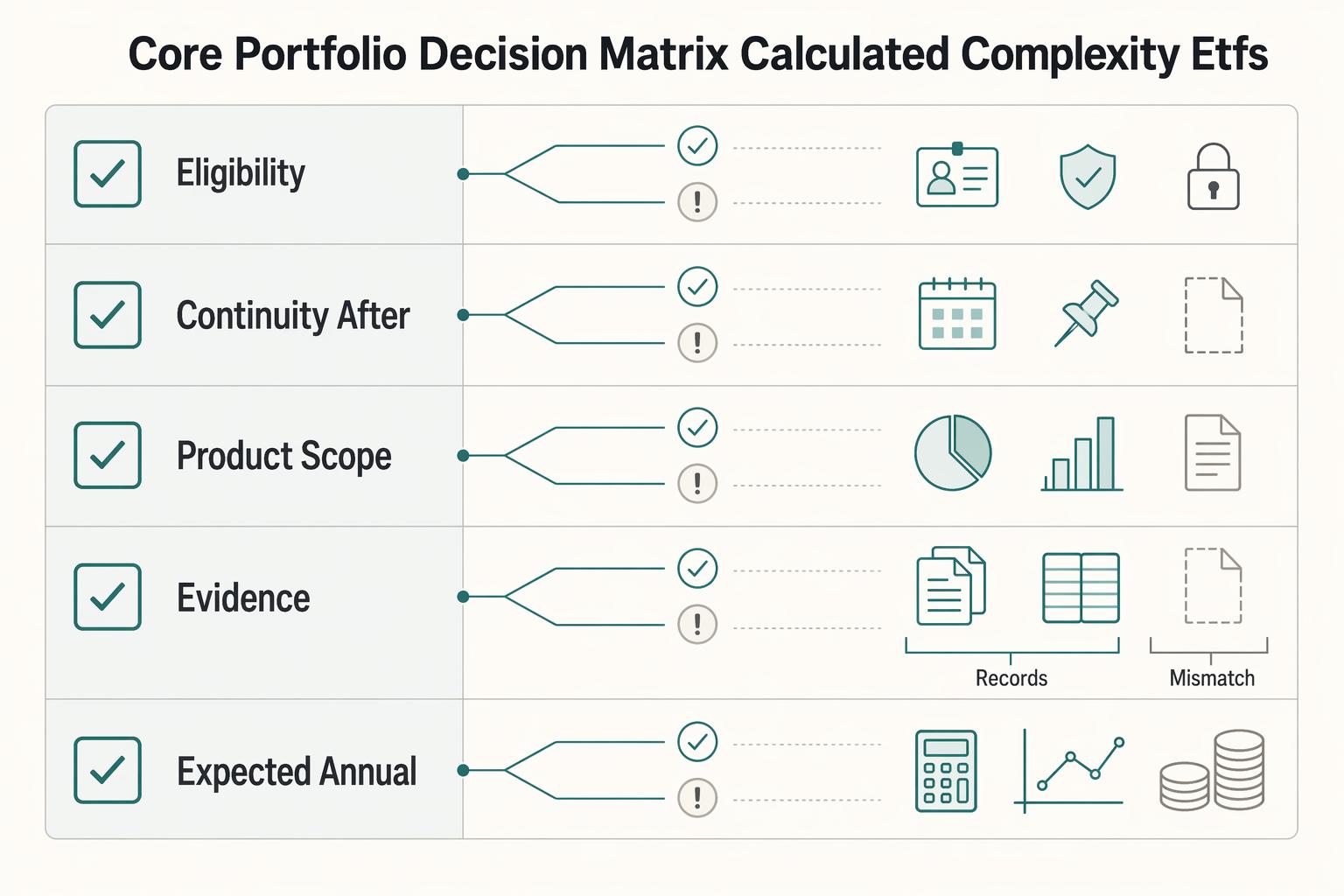
The real problem is a two-system conflict. U.S. tax treatment can punish the wrong fund choice, while local product-access constraints can block the funds you want to buy in the first place. For **us expat ucits etfs**, the practical question is not "Which product is best?" It is "What can I access, report, and keep doing every year without guessing?" Use this four-part filter before any trade: