
Quick Answer
Use an employee vs contractor checklist that focuses on how the work actually operates, not what the contract calls you. Look for control and supervision signals, economic dependence, and whether the engagement reads like a seat or a project. If it feels employee-like, pause and assess the applicable legal tests. A clear SOW and evidence pack help document an appropriate contractor relationship, but employment may be required.
You don't need a magic label-you need an employee vs contractor checklist you can defend#
Forget the label. Classification turns on the relationship you actually run, not the title you typed into the contract. It is also much easier to fix before you sign.
Worker classification (employee vs. independent contractor) turns on the real relationship between the worker and the business. A contractor label or detailed SOW does not establish independent status. Apply each relevant legal test to the actual facts; employment may be the correct outcome even when the work has deliverables and acceptance criteria.
The IRS puts it plainly: you have to consider all information that shows the degree of control and independence. Agencies and courts often look at the totality of the circumstances, weighing factors across the whole relationship instead of relying on any one line in a contract.
Keep this comparison in view from the first call through the final invoice:
| What you write (labels) | What you do (work patterns) |
|---|---|
| Job title, contract heading, "independent contractor" language | How the work gets directed day to day |
| "This is a contractor relationship" statement | How much independence exists in how and when the work happens |
| A template score or checklist output | The totality of the circumstances across the full relationship |
Use this checklist as a decision tool, not as a guarantee:
- Triage: If the setup already looks employee-like, stop and redesign the engagement before you sign.
- Fix the SOW: Frame the work as a business delivering outcomes, not a person filling a seat.
- Lock the clauses: Align the contract with the relationship you intend to run instead of expecting the label to carry the weight. For clause patterns, see Independent Contractor Status: The Most Important Clause for Avoiding Misclassification.
- Keep the evidence pack: Save the SOW, change requests, approvals, invoices, and communications that show independence over time.
One calibration point: even "20-point" style checklists can help you think clearly, but they do not guarantee the answer. The goal is not certainty. The goal is a defensible, consistent story you can stand behind because it matches the work as it really happened.
That matters because, in the DOL's framing, misclassification means treating someone who is an employee under the FLSA as an independent contractor.
If you want the deeper cleanup path after the fact, read What to Do If You've Been Misclassified as an Independent Contractor. If you are still at the front end of the deal, start with a fast triage.
Run the 10-minute triage (Stop / Yellow / Green) before you sign#
Before you negotiate price, clauses, or kickoff details, decide whether the deal should pause, be reshaped, or be signed. Start with one question: does this relationship operate like an outside business engagement, or like a job with a different label?
Two grounding truths help keep this clear:
- Behavioral control focuses on whether there is a right to direct or control how you do the work.
- Labels do not decide status. The substance of the relationship does.
Stop (red)#
Stop and redesign the engagement if the client is trying to buy a seat instead of a service.
- Operating model looks like employment: a manager assigns tasks day to day, you follow their methods, and they expect you to work like internal staff. That is a strong behavioral-control signal.
- No delivery frame: if you cannot point to a Statement of Work (SOW) that defines the work and acceptance criteria that say what makes a deliverable satisfactory, you are negotiating vibes instead of outcomes.
Yellow (caution)#
Yellow means the deal may still work, but only if you clean up the structure now.
- Exclusivity pressure: push for non-exclusive language and a defined project term. A definite-duration, non-exclusive, project-based relationship weighs in favor of contractor status in the factor language cited across these tests.
- Restriction creep: if the client wants to control your schedule and also limit your ability to work for others, treat that as a renegotiation trigger.
Green (go)#
Move forward when the setup looks like a project and the actual relationship satisfies the applicable classification rules. A project structure alone does not clear an ABC test or another legal framework.
- Project term + milestones: define what ships, when it ships, and what "done" means.
- Written acceptance flow: make acceptance explicit so you can invoice cleanly and keep approval from turning into manager-style supervision.
- Evidence discipline: keep the SOW, approvals, and invoices in one deal folder so the paper trail stays consistent later.
Verdict: Any red item is a redesign signal. Do not paper over it with contractor language and hope the rest sorts itself out.
Know the tests (IRS vs U.S. Department of Labor vs ABC vs cross-border)#
Once you know whether the setup is workable at all, make sure you are using the right legal lens. Classification is not one universal test. The question changes by agency and jurisdiction, and passing one standard does not automatically clear the others.
Use this step to decide which set of rules you actually need to satisfy before you tighten the paperwork.
| Lens | What it's trying to answer | What you should optimize for |
|---|---|---|
| IRS (tax) | Are you an employee or independent contractor for federal employment tax purposes under common law rules? | A facts-and-circumstances story you can document consistently. |
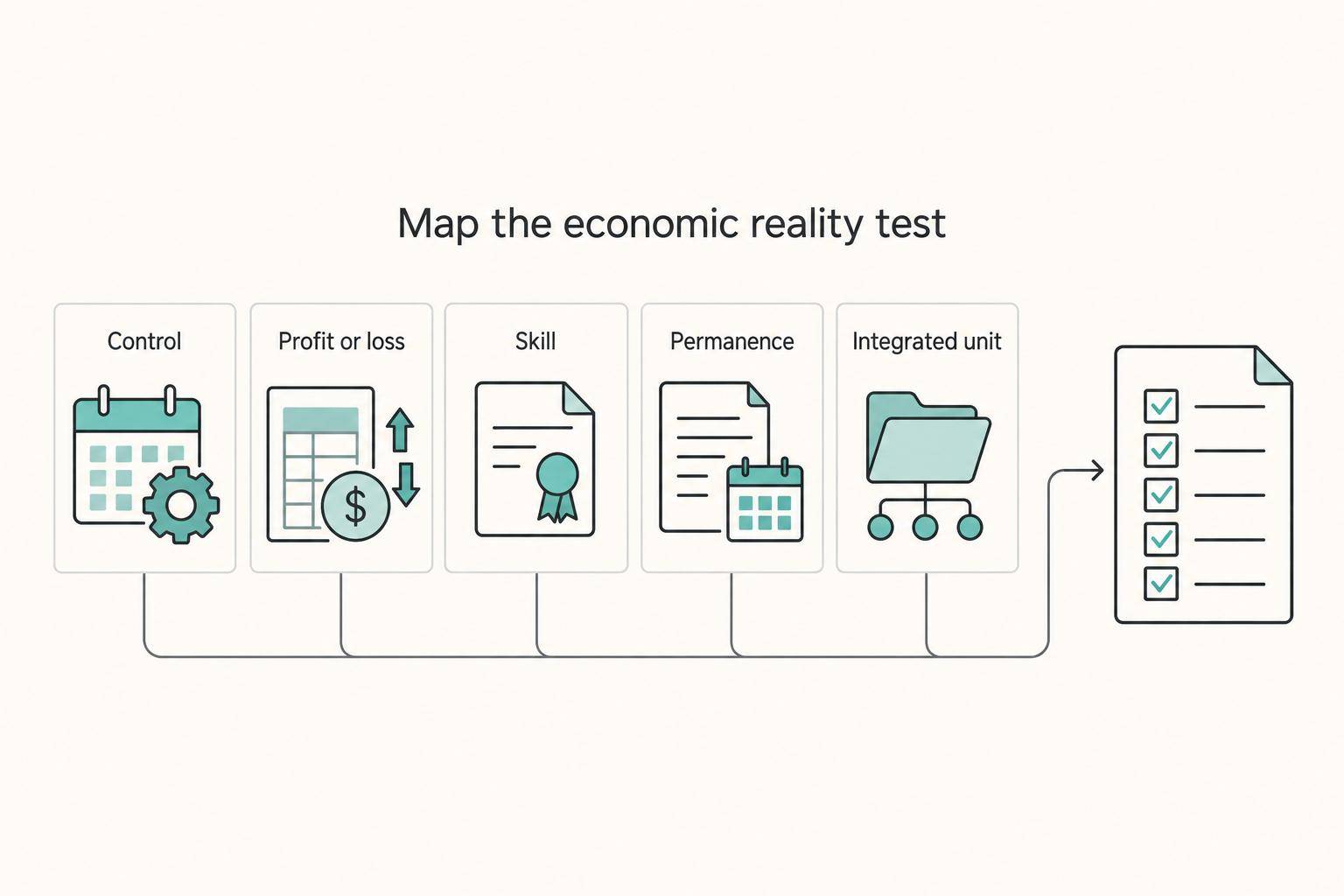
| U.S. Department of Labor (FLSA) | Do the economic realities show you are economically dependent on the business, or in business for yourself? | A relationship that looks like a real business engagement, not dependence. |
| ABC test (some states) | Are you an employee unless the hiring entity satisfies all three conditions? | Check freedom from control, work outside the hiring business’s usual course, and an independently established trade, where that ABC framework applies; confirm any statutory exception. |
| Cross-border | Would you count as an employee or "worker" under local concepts of direction, intermediaries, and employment status? | Country-specific compliance posture and paperwork planning. |
What this means in practice#
A common mistake is optimizing for one standard and assuming the others take care of themselves. They do not. Identify the right lens first, then shape the deal to fit it from the start.
- IRS vs DOL: The IRS applies common law rules for federal employment tax purposes. The DOL framing focuses on economic realities, specifically whether you are economically dependent or truly in business for yourself. Treat them as separate risk surfaces.
- Facts-and-circumstances beats factor-chasing: You will hear about "20 factors" because the IRS developed a 20-factor approach in guidance, often referenced through Revenue Ruling 87-41, but do not treat it like a scorecard. Collect the facts, align the relationship, and keep documents that match how the work actually runs.
- ABC regimes: California generally presumes employment unless the hiring entity proves freedom from control, work outside its usual course of business, and an independently established trade or business. Exceptions can change which test applies. Rewriting a SOW cannot cure facts that fail the governing test; employment may be required.
- Cross-border reality check: In the United Kingdom, IR35 and off-payroll rules can apply when services run through an intermediary and you would have been an employee if you provided services directly. In Canada, the CRA emphasizes that the facts of the whole working relationship decide status. In the European Union framing, a core "worker" characteristic includes performing services under another's direction for remuneration.
Verdict: Pick the governing lens first. Then make the facts fit that lens instead of hoping one contract label will satisfy every test.
Fix employee-like signals fast (Control, Integration, Dependence, Money)#
Most classification problems show up in the operating details long before anyone argues about legal language. If the work looks directed, integrated, exclusive, or financially open-ended, clean it up before kickoff.
A useful IRS anchor is that an employee relationship often shows up when the business can control what will be done and how it will be done. The DOL framing looks at the economic realities of the whole relationship and asks whether you are economically dependent or truly in business for yourself.
No single tweak saves a bad setup. What helps is stacking cleaner signals across the relationship.
| Signal bucket | Employee-like pattern (risk) | Contractor-grade adjustment (cleaner signal, not a guarantee) |
|---|---|---|
| Control | The client sets your schedule, supervises performance, dictates your method, and runs you through daily rituals. | Replace supervision with outputs: rewrite the SOW around deliverables, deadlines, and acceptance criteria. Keep meetings tied to milestones, not attendance. |
| Integration | You are treated like staff: slotted into internal structures, handed internal titles, asked to manage employees, or put under handbook-style rules. | De-integrate where it makes sense: avoid employee titles and manager-style responsibilities unless the contract is explicitly built for that reality. Limit access with an NDA and, when needed, a DPA for data handling. Keep the language contractual, not HR-flavored. |
| Dependence | You are effectively economically dependent: exclusivity expectations, restrictions on outside work, or one client becoming your only real pipeline. | If feasible, reduce exclusivity pressure. It is a factor, not a magic switch. Keep a visible "in business" trail through proposals, portfolio updates, outreach notes, and multi-client marketing. |
| Money | The business side looks controlled or undefined: open-ended hourly work with vague scope and "we'll figure it out" changes. | Price and scope like a business: milestone fees or a retainer tied to defined scope and acceptance. If you bill hourly, define scope boundaries and change handling. |
A few deserve extra attention in practice.
Control is often where the drift starts. A client asks for a daily standup, then a response-time requirement, then a preferred method, then core hours. None of those details alone decides the outcome. Taken together, they start to look like supervision. The clean fix is to define what you owe, by when, and how acceptance works, then keep routine communication tied to delivery rather than attendance.
Integration matters because the more you are absorbed into the client's internal structure, the harder it is to maintain the posture of an outside business. If you are given an internal title, routed through staff processes, or asked to manage employees as if you are part of the org chart, the relationship starts reading like employment. Limit what needs to be limited, but do it in contract terms rather than people-management terms.
Dependence is where many otherwise clean engagements get shaky. One major client is not automatically fatal. But if the deal also comes with exclusivity, indefinite duration, and restrictions on outside work, the picture changes fast. If you cannot reduce those pressures, at least be honest that the risk is rising and price or structure the deal accordingly.
Money is the quiet signal people overlook. Undefined hourly work with no clear scope, no acceptance standard, and no change process tends to invite direct control. By contrast, milestone billing or a rules-based retainer makes it easier to operate like a vendor delivering a service, not an employee being managed through a shift.
Verdict: If the relationship still looks directed, exclusive, and indefinite after these fixes, do not argue one factor at a time. Redesign the deal so the overall facts read like a project-based service you can document.
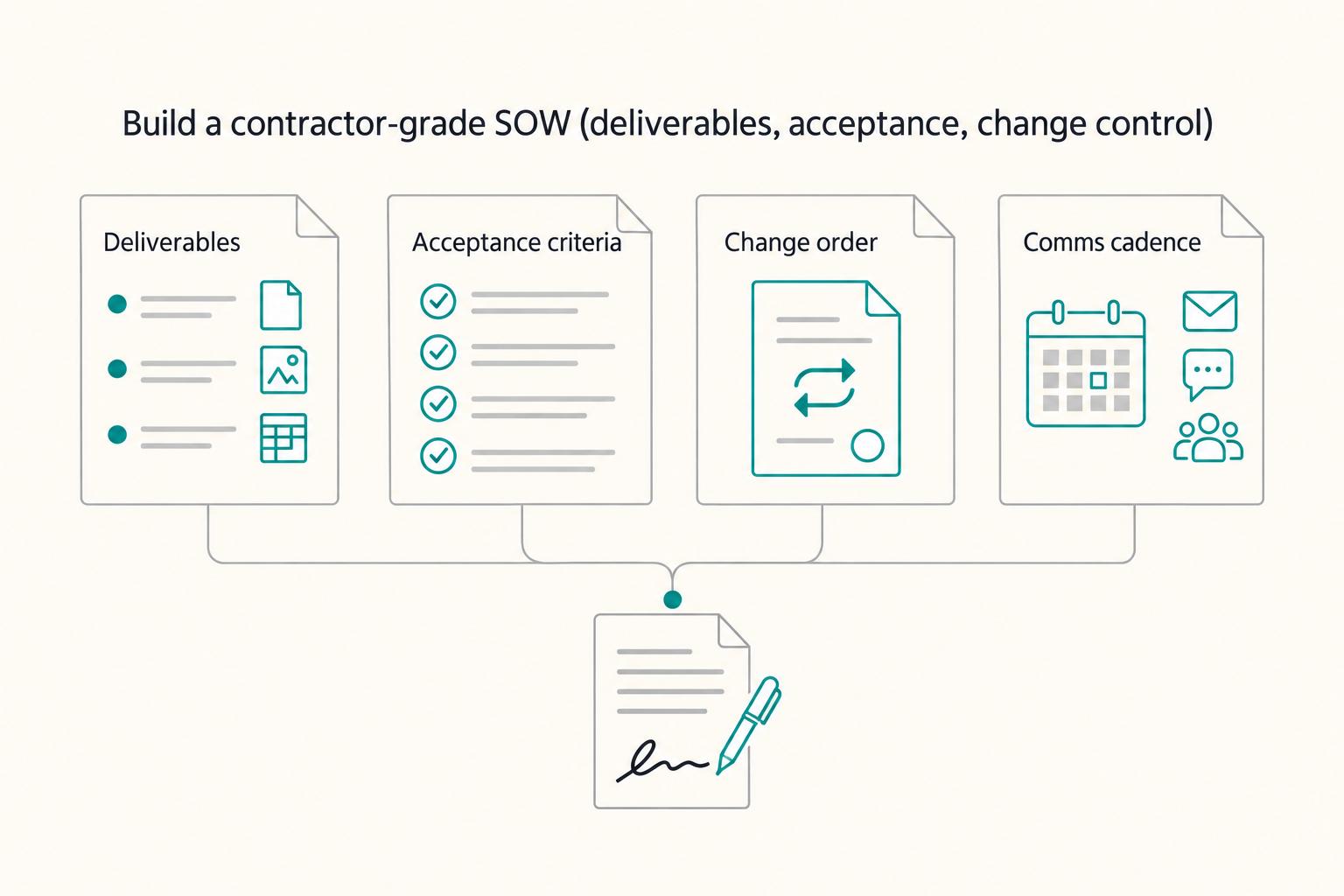
Build a contractor-grade SOW (deliverables, acceptance, change control)#
Once the working relationship looks cleaner, put it in writing. Your SOW is where independence turns into operating instructions.
A contractor-grade SOW makes the relationship about measurable results, not supervision. When the project gets messy, this is the document that keeps the deal from sliding back into day-to-day management.
A Statement of Work (SOW) is the part of the contract that describes the services or products you will deliver, including the specs, deadlines, and deliverables that keep everyone aligned.
| SOW element | What to write (copy the pattern) | Why it protects you (and the deal) |
|---|---|---|
| Deliverables | "Deliverables: A, B, C (with formats). Timeline: milestones with dates." | Keeps the engagement outcome-based, not attendance-based. |
| Acceptance criteria | "Done means: tests pass, doc updated, handoff call complete, and stakeholder sign-off on checklist X." | Defines satisfactory work up front so acceptance does not turn into manager approval rituals. |
| Change order | "Any change to scope/deliverables/terms requires a written change order approved by both parties, with revised fees and delivery dates." | Prevents scope creep and protects margin without a midstream argument. |
| Comms cadence | "Weekly status update + decision log + stakeholder review at milestones." | Keeps things transparent without creating a chain of command. |
The reason this matters is simple: if the project shifts and the documents do not say how changes get approved, clients usually fall back to managing the person. A clean SOW gives both sides another path. Instead of "just do it this way," the conversation becomes "is this in scope, and if not, what does the change order say?"
A practical default you can reuse:
- List deliverables and milestone dates.
- Write acceptance criteria for each deliverable.
- Require changes to be documented in a written change order approved by both parties.
- Send one weekly status update and maintain a decision log.
Tools boundary: use your own stack by default where you can. Many worker-classification guides note that independent contractors often invest in their own facilities and tools, but tools alone do not decide classification. Access should stay tied to delivery needs rather than becoming a sign of staff integration. Limit client-system access to what you actually need, and handle that access under the right confidentiality terms, such as an NDA, and if you touch personal data, the right data-processing terms, such as a DPA.
That supports a cleaner posture without pretending it solves the classification question by itself.
If you want language that reinforces independence without adding fluff, see Independent Contractor Status: The Most Important Clause for Avoiding Misclassification.
If you need a deliverables-first draft you can actually point to later, the SOW generator is a practical starting point for outcomes, acceptance criteria, and change control.
Lock the deal-protection clauses (Termination, Liability, Indemnity, Venue)#
With the operating model set, protect the downside in the contract. These clauses do not decide classification, but they do decide how expensive a bad deal becomes.
Think of them as the seatbelts.
| Clause | What it does (plain English) | Contractor-grade default (safe + practical) |
|---|---|---|
| Termination | A termination clause sets the terms for ending the agreement and clarifies responsibilities when it ends. | Make exit project-based: require notice, get paid for work in progress, and spell out offboarding deliverables such as handoff notes, access removal, and final invoice timing. |
| Limitation of Liability | A limitation of liability clause caps recoverable damages and puts boundaries on financial exposure. | Cap exposure to a defined amount you can survive, and state what categories of damages you will not cover unless you priced for them. Do not accept uncapped liability by default. |
| Indemnification | An indemnification (hold harmless) clause shifts certain risks and costs from one party to another. | Narrow triggers to what you actually control, such as your breach or your IP infringement. Push back on "all claims" language that makes you the insurer for the whole project. Ask for mutual terms where the client's conduct creates risk. |
| Governing Law / Forum / Arbitration | Governing law selects which laws apply, distinct from jurisdiction or venue. Forum selection chooses the court or location. An arbitration clause routes disputes to a private process instead of public court. | Pick a forum you can realistically use in terms of travel, counsel access, and language. Decide court versus arbitration up front based on how you want disputes to play out, not on vibes. |
During redlines, use three simple questions:
- If a clause makes you responsible for outcomes you do not control, narrow it.
- If a clause makes your downside unlimited, cap it.
- If a clause makes disputes practically impossible to pursue, change the forum.
This is also where you separate relationship risk from business risk. A deal can be structured cleanly for classification and still be commercially dangerous if liability is uncapped, indemnity is too broad, or the venue is unusable. Do not confuse those issues. Fix both.
Verdict: If the client will not move on unlimited liability, broad indemnity, and an unusable venue, treat that as a pricing and risk signal. Adjust scope or fees, or walk.
Set pay like a business (retainer, milestones, suspension rights)#
The payment structure should match the project structure. If the money flows like wages and the scope stays vague, the relationship starts drifting in the wrong direction.
Set payments around deliverables and clear terms so you keep leverage and avoid employee-like patterns. Money mechanics either reinforce independence or quietly erode it.
Milestone billing splits work into phases or deliverables, each tied to a predefined payment. That fits a contractor posture because it frames pay around project outputs, not a regular wage cadence.
When you submit a milestone, keep the review step simple: compare the deliverable against the acceptance criteria, log any gaps, then accept it or route a revision. That keeps the conversation tied to the work product rather than to personal performance management.
| Pay setup | What it looks like | When to use it |
|---|---|---|
| Milestones | Invoice after each deliverable or phase completes, with a review step. | Project work with clear handoffs and clear "done" definitions. |
| Retainer | A recurring fee for defined scope, with expansion routed to a change order. | Ongoing support where the client needs predictable access, not unlimited work. |
A retainer can still stay clean if you treat it like a defined commercial arrangement, not a disguised salary. That means the scope is spelled out, response expectations are clear, and extra work gets documented instead of absorbed.
Retainer rules that keep you sane:
- Clearly define what the retainer covers and what it does not.
- When scope expands, send a written change order with revised fees and dates.
- Keep the cadence professional: you deliver updates, and the client makes decisions.
You also need basic collection terms:
- Up-front payment at the start, before work begins.
- A late charge fee where lawful and agreed in the contract.
- A suspension for non-payment clause where lawful and agreed, with the required notice and cure process.
Avoid the worst combination: long payment terms, open scope, and indefinite hourly work. It strips your leverage and turns every invoice into a negotiation.
Verdict: Use milestones for project work and a rules-based retainer for ongoing work. Back either structure with a deposit, late fees, and suspension rights in the SOW and the master agreement. Confirm that late fees and suspension terms are enforceable in the governing jurisdiction.
Use pushback scripts that keep you independent (and keep the sale)#
Even with a clean contract, client habits can pull the relationship back toward employee treatment. This is where calm, practical pushback matters.
Use factual pushback that protects your control over time and method, then redirect to deadlines, deliverables, and the SOW. You are not trying to win a debate about classification law. You are protecting an operating model that keeps the deal clean.
The underlying principle is straightforward: contractors control the manner and means of delivering results. They choose their own hours within project deadlines. Many checklist frameworks also treat set hours as a control signal, so when a client asks for core hours or daily attendance, it is worth handling that carefully.
Do not debate labels. Reframe the work.
| Client request (risk) | What you're protecting | Pushback that keeps the deal moving |
|---|---|---|
| "Can you work core hours?" | Your control over time and scheduling. | "I can commit to response windows and milestone dates. I don't operate on employee hours, let's put deadlines and deliverables in the SOW." |
| "Join our daily standup / be part of the team." | Your control over how the work gets done, instead of being managed day to day. | "Happy to join key check-ins that unblock delivery. Let's keep it deliverable-based, and document the cadence, owners, and any review points in the SOW." |
| "Procurement is net-60." | Your leverage and cash-flow safety. | "I can work with net terms with an up-front payment and milestone billing. If we keep net-60 without that, we'll need to revisit scope, timeline, or commercial terms." |
| "No subcontractors, ever." | Your right to staff the work. | "I'm accountable for outcomes. If I use an assistant, I supervise them and remain responsible for deliverables and confidentiality under the NDA/DPA, and we can document any reasonable limits in the agreement." |
A useful negotiation move is to offer two workable options instead of arguing in the abstract.
- Option A: milestone plan with review checkpoints.
- Option B: tighter response windows and fewer meetings, with the same delivery dates.
That keeps the conversation commercial and practical. You are not saying "no" to the client's concerns. You are offering a structure that meets those concerns without turning the relationship into day-to-day supervision.
Verdict: If they insist on set hours, client-controlled methods, and zero delegation, treat that as misclassification risk moving in. Hold the boundary or change the deal structure before week one.
Cross-border checklist (paperwork, payments, and forum planning)#
If either side is in a different country, add one more pass before kickoff. Cross-border work is much easier to defend when the tax forms, payment trail, and dispute clauses all tell the same story.
Treat cross-border work like an audit file: the right tax form, clean receipts, and clear dispute forums. Once the boundaries are set, lock down the operational details that keep your record consistent.
1) Paperwork gate: get the right IRS form on day zero#
Form W-9 is generally used by a U.S. person to provide a taxpayer identification number (TIN) and certifications to a requester. A foreign individual may use Form W-8BEN; a foreign entity generally uses Form W-8BEN-E. Another W-8 form or Form 8233 may apply depending on status and income. Choose the form that fits the facts, not just the payer’s default onboarding option.
Operator rule:
- Request the form in onboarding, not after the first invoice.
- Store the signed PDF with the client's contract and SOW.
- Retain the form under the applicable tax-record retention requirements and your documented retention policy; restrict access to taxpayer identifiers.
2) Payment traceability: one folder per client, one story per payment#
You do not need fancy tooling. You need consistent artifacts that show gross receipts and tie payments back to work.
At minimum, keep:
- Invoices showing what you billed and when.
- Bank statements and deposit slips showing what you actually received.
3) Don't blur identity (without getting cute)#
Classification does not turn on one checkbox. Factors get weighed, and there is no magic number that decides it. You do not need theatrics. You need clean separation that reads naturally if someone reviews the file later.
- Use contractor language in writing: deliverables, milestones, acceptance.
- Keep communications scoped to project outcomes, not management routines.
4) Forum planning: decide jurisdiction and choice of law on purpose#
When parties sit in different jurisdictions, jurisdiction and choice-of-law clauses can get complicated. Decide this while everyone is still cooperative, not after a payment problem or a scope fight.
| Decision | Default for a small operator | When to change it |
|---|---|---|
| Choice of law | Pick one clearly | Regulated work or local mandatory rules |
| Jurisdiction | Name a specific forum | You cannot practically appear there |
| Arbitration | Consider it deliberately, because terms vary | You need a different dispute path for your situation |
If you want a clean classification backbone to pair with these cross-border mechanics, use Independent Contractor Status: The Most Important Clause for Avoiding Misclassification.
Build your audit-ready evidence pack (support independence on demand)#
Once the deal is live, keep the file as you go. Do not wait until tax season, a payment dispute, or a classification question forces you to reconstruct the relationship from memory.
Build a simple evidence pack that makes your independent-business story easy to verify. The best version is boring and complete. Someone should be able to follow the scope, the changes, the money, and the business posture without a long explanation from you.
Core docs (scope + changes)#
Your Statement of Work (SOW) is the foundation document because it defines scope, deliverables, timelines, and responsibilities. Pair it with every written change order, meaning any written update to the original deal when the project terms change.
Keep, for each client:
- Proposal or scope email thread showing the original intent.
- Signed SOW.
- Every change order, even a short signed addendum.
- The independent contractor clause from the agreement as useful context, not as a magic shield.
Money trail (what you billed, what you received)#
For tax purposes, keep records as long as needed to prove income or deductions. In practice, your gross-receipts proof starts with invoices, plus deposit information that ties payments back to those invoices.
Make it easy to trace:
- Invoice -> payment record -> milestone acceptance note, all in one place.
That sequence matters because it connects the business side of the deal to the delivery side. It also makes it much easier to explain why a payment was made and what deliverable it related to.
Compliance + security exhibits (only when they apply)#
Store the tax form the payer asked for:
- Form W-9 for providing a correct taxpayer identification number to payers who file information returns.
- Form W-8BEN for a foreign individual, Form W-8BEN-E for a foreign entity, or another applicable form based on status and income.
Then add only what the engagement actually requires:
- NDA for confidentiality terms.
- DPA when you process personal data under GDPR-style roles.
- VAT ID when applicable, because some invoicing contexts include it on invoices.
| Bucket | Always keep | Add when applicable |
|---|---|---|
| Scope control | Signed SOW, change orders | Security exhibits such as NDA or DPA |
| Proof of value | Acceptance criteria plus an "accepted" note | Extra review artifacts for regulated work |
| Tax/admin | Applicable W-9, W-8, or other tax-status form | VAT ID on invoices where required |
Independence proof (business posture)#
Do not over-lawyer this part. Save lightweight artifacts that help show you operate like a business: marketing presence, other proposals in flight, and, if it is useful, a calendar snapshot that reflects non-exclusivity. Just do not treat these as universally accepted proof. What a reviewer values can vary, and these items help most when they support a broader, consistent record.
If someone can follow scope -> delivery -> acceptance -> payment -> compliance from one folder, you are in much better shape. That still does not guarantee independent-contractor status by itself, but it makes your posture much easier to verify. For more classification framework context, see Independent contractor classification framework overview.
Conclusion#
The defensible path starts with the applicable legal tests and the actual relationship. Where independent contracting is appropriate, define results and keep records that show how the work happened. If the facts require employment, contract wording cannot replace that treatment.
Here is the conservative sequence:
- Triage first: run your own Stop/Yellow/Green screen on the real working setup. It is a practical tool, not an official IRS or DOL standard. Pay special attention to anything that creates economic dependence or otherwise makes the relationship look like employment.
- Turn role-filling into a project: use a Statement of Work (SOW) that defines deliverables, timelines, and responsibilities. Add acceptance criteria so "done" has a clear standard, and use a written change order when scope shifts.
- Protect the downside with enforceable terms: choose terms you can live with for how the work ends and how disputes get handled, including Termination, Governing Law, Jurisdiction, and Dispute Resolution. Those clauses manage risk. They do not prove status by themselves.
If you want one clean mental model, keep it here:
| Lens | What it asks | What to build toward |
|---|---|---|
| U.S. Department of Labor (FLSA) | What do the economic realities show? | "In business for yourself," not dependent |
| Contract posture | What do the documents show? | Project-based scope, acceptance, and change control |
| Records posture | What can you support later? | Supporting documents that match your tax return |
Your final check is practical: can someone trace SOW -> acceptance -> invoice -> supporting documents without calling you to explain it? If yes, you have reduced risk the right way by making your operations match your contract and your records match your operations.
Before you send the final PDF, make sure the contract language matches how you will actually work, especially scope, termination, and payment mechanics. Draft a clean baseline with the freelance contract generator.
Frequently Asked Questions
How do I know if I'm an employee or an independent contractor?
Start with how the work actually operates. Who controls the schedule, method, and day-to-day direction? Is the engagement fixed-term and project-based, or open-ended and role-like? For federal tax, the IRS looks at the degree of control and independence across the relationship. For wage-and-hour questions under the FLSA, the U.S. Department of Labor looks at the economic realities. The core issue is whether you are economically dependent on the business or operating as a business of your own.
What are the biggest red flags that I'm being treated like an employee?
The biggest red flags are high control and growing dependence. Common examples are set hours, day-to-day supervision, pressure to act like part of the team, exclusivity, and work that feels ongoing or indefinite instead of fixed-term and project-specific. If the work stops looking like a project and starts looking like a role, treat it as a serious risk signal.
Can a contract say "independent contractor" but I'm still an employee?
Yes. "Independent contractor" language can help explain the parties' intent, but it does not decide status by itself. Decision-makers look at the real relationship and what happens day to day. If the business controls the work like an employer, the label alone will not save it.
What is the IRS test for independent contractor vs employee?
The IRS evaluates control and independence under common-law rules and considers all the evidence. There is no single deciding factor. The analysis looks at the full facts and circumstances of the relationship.
What is the difference between the IRS test and the U.S. Department of Labor test?
They answer different questions under different laws. The IRS uses common-law rules for federal employment tax purposes. The DOL's FLSA approach uses the economic realities test. The 2024 regulations under 29 CFR part 795 took effect March 11, 2024. In May 2025, DOL instructed its investigators not to apply that rule’s analysis in enforcement investigations, instead using longstanding guidance. DOL’s 2026 rulemaking page describes a proposed replacement; a proposal is not a final rule. Check the current rule and enforcement posture separately. Passing one agency’s framework does not automatically clear another’s.
Do I need a Form W-8BEN or Form W-9 as a freelancer working with US clients?
A U.S. person generally supplies Form W-9. A foreign individual may supply Form W-8BEN, while a foreign entity generally uses Form W-8BEN-E. Other forms can apply depending on status and income. Confirm that the requested form fits your status and the payment. If the payer’s onboarding choice does not fit, ask its tax owner to resolve the mismatch before certifying it.
What records should I keep to prove I'm an independent contractor?
Keep the records that connect the work, the payment, and the business posture. A solid baseline is invoices, payment records that tie deposits back to those invoices, and the operating documents that explain what you were hired to deliver. That usually means your SOW, change orders, acceptance notes, and any compliance documents that actually applied to the job. If you want the DOL side in plain English, start here: The Department of Labor’s independent contractor framework.
Try a related tool
Researched and edited by the Gruv editorial team. Gruv builds cross-border billing, payouts, and finance-operations software for global businesses.
Sources
Includes 2 external sources outside the trusted-domain allowlist.
- dir.ca.gov/dlse/FAQ_IndependentContractor.htmtrusted
- dol.gov/newsroom/releases/whd/whd20250501trusted
- dol.gov/agencies/whd/flsa/misclassification/rulemakingtrusted
- irs.gov/newsroom/worker-classification-101-employee-...trusted
- irs.gov/businesses/small-businesses-self-employed/in...trusted
- canada.ca/en/revenue-agency/services/forms-publication...external
- gov.uk/guidance/off-payroll-working-for-clientsexternal
Educational content only. Not legal, tax, or financial advice.
Related Posts
DOL Independent Contractor Rule in 2026: Proposal and Current Standards
**Status checked 5 October 2026:** DOL’s official page still identifies the February 2026 action as a proposal, and says its comment period **closed on 28 April 2026**. The NPRM, published 27 February under RIN 1235-AA46, proposes replacing the 2024 FLSA interpretation with a modified 2021-style analysis and using the analysis for FMLA and MSPA. A proposal is not a final rule with an effective date.

Independent Contractor Status for Cross-Border Freelancer Contracts
An independent-contractor clause describes the intended arrangement; it does not decide legal status. Control over working methods matters, but the applicable test can also consider financial independence, permanence, the business relationship and the work’s place in the client’s business. Identify the worker’s location and the relevant tax and labor laws before drafting.

What to Do If You've Been Misclassified as an Independent Contractor
If a business calls you an independent contractor but directs your work like an employee, check the rules for the rights you need to recover. A contract label, LLC or Form 1099 does not decide every legal status. Federal wage law, federal employment taxes and state employment laws can use different tests and provide different remedies.