
Quick Answer
Use a ranked stack, not one score: start with NPS, CSAT, and retention, then verify each shift in a payout reconciliation report and a settlement details report. Read NPS on its 0-10 input and -100 to +100 output by segment, not as a blended average. If CSAT is strong while reconciliation exceptions age, escalate controls; if retention drops with flat sentiment, investigate cohort mix, pricing fit, and payout friction before deciding root cause.
Customer success metrics that actually catch payment ops failure early#
Use NPS, CSAT, and retention as customer signals, then verify each against transaction records, matching controls, funds-movement evidence, and payout data before you act. In payment operations, these metrics help when they surface money-movement risk early, not when they are treated as proof that operations are healthy on their own.
The practical mix combines leading and lagging signals. NPS reflects relationship sentiment, CSAT captures a recent interaction, and retention shows whether customers stayed. None of them, by itself, tells you whether payouts matched bank batches or funds settled cleanly.
What makes a metric worth keeping#
A metric belongs on this list only if it passes four checks and points to a clear next action:
- It points to an owner. Finance can verify against payout matching and settlement records, ops can trace payout behavior or timing, and product can address the customer touchpoint.
- It moves fast enough to warn you. CSAT is useful as a "right here, right now" read of a specific experience.
- It can be checked against hard records. If sentiment shifts but payout matching and provider records are clean, the issue may be expectation or communication rather than execution.
- It segments cleanly. NPS can be tracked by segment, geographic unit, or functional group, which helps uncover concentrated issues hidden by blended scores.
How the core signals map to operations#
| Signal | What it tells you | Best used with | Where it can mislead |
|---|---|---|---|
| NPS | Relationship loyalty: percentage of all valid respondents who are promoters minus percentage who are detractors, giving -100 to100. Scores9–10 are promoters,7–8 passives,0–6 detractors. | Segment-level checks by customer segment, geographic unit, or functional group, followed by matching or payout review if detractors rise. | Good directional signal, weak root-cause signal. A drop shows trust changed, not exactly where execution broke. |
| CSAT | Satisfaction with a specific interaction, commonly measured on a 1 to 5 scale. | Moment-level checks after payout status updates, support resolution, or funds-availability notifications. | Easy to mistime. A strong event score can coexist with unresolved back-office exceptions. |
| Customer retention | Share of customers who stay over time; inverse of churn. | Cohort reviews by onboarding month, transaction volume, or payout pattern. | Confirms impact late. By the time it moves, damage may already be material. |
| Operational truth | Whether money movement matched and settled correctly. | A payout reconciliation report to match bank payouts to batches, plus a settlement details report for transaction-level review. | Can miss customer pain if you stop at finance correctness alone. |
Decision checkpoints when signals conflict#
When metrics disagree, check the money trail first with payout matching and settlement records. Stripe's payout reconciliation report is designed to match bank payouts to payment and transaction batches, and Adyen's settlement details report supports transaction-level reconciliation. Then use these rules:
- If NPS falls, segment before you generalize. Check whether the change is concentrated in a customer segment, geographic unit, or functional group.
- If CSAT looks healthy but match quality slips, treat it as silent-failure risk. Customers may not have felt the issue yet, but control quality is degrading.
- If retention declines while sentiment is flat, expand the investigation. Keep operations in scope, but do not assume a single cause from sentiment alone.
That logic carries through the rest of the list. Keep customer metrics, but make each one earn trust against operational evidence. For adjacent payment-authentication issues, see Strong Customer Authentication (SCA) for Subscription Platforms: Reducing Decline Rates.
How this list was selected and who should use it#
This list keeps only metrics that help you detect payment risk early and trigger a concrete operational check. If a score cannot guide finance, ops, or product to verification in financial records, reconciliation controls, or settlement timing, it may still be informative, but it is not operational.
Three filters shaped the list and kept it practical:
- Practical in finance and ops
We prioritized measures that show where payments break down, not just top-line sentiment. Each signal should lead to a next check, such as reconciliation match accuracy, processing and settlement timing, or transaction-record review. If no team clearly owns the follow-up, the metric is lower priority.
- Sensitive to failure and fast enough to matter
NPS uses a0–10 recommendation question and reports a-100 to100 index; CSAT often uses a1–5 interaction rating. Pair both with operational indicators instead of using surveys alone as retrospective reporting.
- Verifiable with operational reliability metrics
Sentiment stays in scope only when it can be tested against hard evidence. Reconciliation controls are the direct check for transaction-record accuracy, and processing and settlement time is an established payment KPI checkpoint. If a dashboard change does not imply a concrete action, it adds noise instead of clarity.
This section is for finance, payments ops, and product owners who need a shared operating view. It is a weak fit when the goal is only a brand-level CX scorecard without operational ownership, incident follow-through, or verification against payment records.
The best metrics to track first in payment operations#
Start with these seven metrics in this order. Read them as one stack: sentiment and retention show impact, while matching accuracy, timing, payout reliability, and exception handling help show whether money movement is correct.
| Metric | Best for | Leading or lagging signal | Key pros | Key cons | Concrete use-case in Payment Platforms |
|---|---|---|---|---|---|
| 1. Net Promoter Score (NPS) | Directional trust and loyalty across accounts or segments | Mostly leading | Easy to trend; NPS = promoters% minus detractors%, using all valid responses as the denominator, including passives. Result -100 to100. | Weak on diagnosis. Misleads when you rely on one blended score and skip record and matching checks after a drop. | Track NPS by payout corridor, customer tier, or product path. If detractors rise in one segment, review unmatched transactions, timing breaches, and support tickets before blaming UX. |
| 2. Customer Satisfaction Score (CSAT) | Event-level friction at a specific payment, funds-availability, or payout touchpoint | Leading | Fast signal tied to a single moment; captures a "here and now" reaction to a specific interaction or event. | Results can vary with survey timing and trigger design. Misleads when you survey immediately after a status message before the customer feels the impact of a delayed or failed payout. | Send CSAT after payout success and payout failure notifications, then compare results against retry outcomes and unresolved payout cases. |
| 3. Customer Retention | Whether operations keep customers over time | Lagging | Durable business outcome; calculable from period start, period end, and new customers in period. | Slow to react. Misleads when treated as early warning or read without segment-mix context. | Monitor retention by onboarding month and payout-volume tier. If retention drops while NPS is flat, check pricing, product fit, and account mix before assuming service quality is the issue. |
| 4. Reconciliation accuracy | Proving transaction-record integrity | Usually leading operational control (can be both) | Auditable; transaction-level matching directly tests whether settled activity and payout details match recorded activity. | Aggregates can hide localized breaks. Misleads when you report only top-line match rate and ignore aging unmatched items. | Match processor reports, internal journal entries, and payout records at transaction level. Escalate unreconciled items that age beyond close tolerance. |
| 5. Settlement timeliness | Speed and predictability of funds reaching expected balance or merchant accounts | Leading for operational stress | Strong checkpoint when "where is my money?" demand rises. | No universal benchmark. Misleads when comparing providers without risk, reserve, or payment-method setup context. | Track actual timing against each provider’s configured model. Adyen custom balance-account settlement delay of one business day requires approval and excludes managed payout schedules; do not turn that configuration into a generic T+1 promise. |
| 6. Payout success rate | Reliability of payout execution | Leading | Directly tied to customer pain and support load; requires denominator discipline. | Do not assume a single public industry formula applies. Misleads when retries or bank rejections are hidden inside a blended success figure. | Measure successful payouts against total payout attempts using one fixed internal definition, then split failures by provider, corridor, and failure reason (including bank-account mismatch). |
| 7. Exception-resolution time | Speed of resolving disputes, notifications, questions, and information requests | Leading for recovery, lagging for root cause | Shows whether the team contains damage once failures occur. | Public benchmarks are limited. Misleads when the timing start point is inconsistent (for example, ticket creation vs. first failed event). | Track median resolution time and backlog aging using a fixed incident start point. Alert at the missed expected response or delivery window; cancellation availability depends on rail and state. |
How to use this ranking without over-trusting sentiment#
Use the first three metrics to detect impact, not to prove root cause. If NPS or CSAT moves, verify against transaction-level matching, timing by provider, and payout failure reasons with explicit codes and descriptions.
Keep transaction-to-payout traceability in your evidence pack. Stripe notes that automatic payouts maintain the association between each transaction and its payout. Without that traceability to payout IDs, journal postings, or unmatched items, sentiment shifts remain symptoms rather than evidence.
Benchmark caution matters more here than in generic CX work#
External CX benchmarks may cover different industries, customer populations, and survey methods. Compare those conditions before using a benchmark, and use your own segmented baseline for payout and reconciliation decisions.
The same caution applies to vendor-published points. ConnexPay published NPS 60 on October 2, 2025, based on 267 customers across multiple industries. That may be a valid company datapoint, but it is not a neutral market benchmark for your platform.
Best relationship signal when trust risk is rising#
NPS can work as a relationship-level early warning signal here, but it is directional, not diagnostic. One recommendation question on a 0-10 scale produces a score from -100 to +100, which makes it easy to trend and discuss quickly.
Use it to spot churn risk before it shows up in retention. Then verify with operational evidence before naming causes.
- Track NPS by segment, not only as one blended average
Cut by customer segment, geography, or functional group so a drop points to a specific area to investigate.
- Track Promoters, Passives, and Detractors as separate movements
Promoters are 9 or 10, Passives are 7 or 8, and Detractors are 0 to 6. A flat overall score can still hide trust risk if Promoters slide into Passives.
- Require a verification step before root-cause decisions
If detractors rise in a segment, check independent operational and customer evidence in that same segment before changing messaging or UX.
One red flag is a stable overall NPS with worsening segment mix, because a flat blended score can hide movement underneath.
Best moment-of-truth signal at checkout and payout touchpoints#
For step-level friction at checkout and payout touchpoints, CSAT is useful when you trigger it right after confirmed events. Use relationship-level metrics for drift, and retention for slower outcome tracking.
Timing determines whether the read is useful. If the survey fires before the backend confirms what happened, you may be measuring reaction to messaging rather than the actual outcome.
- Survey on confirmed events, not page views
Ask for feedback after your backend confirms the relevant outcome. Stripe Checkout can complete before a delayed payment succeeds: check payment_status and handle checkout.session.async_payment_succeeded or async_payment_failed where applicable. Tie each survey to the actual journey step and payment attempt.
- Keep success and failure CSAT separate
Post-success and post-failure scores answer different questions, so do not blend them. On payouts, track CSAT by status changes such as Payout initiated, Payout authorised, Payout booked, Payout pending, Payout failed, Payout tracking, Payout credited, and Payout returned to avoid masking issues in failed or returned flows.
- Read CSAT alongside failure and retry patterns
Keep collection recovery separate from payout recovery. Stripe invoice.payment_failed and Smart Retries describe subscription or invoice collection, with a recommended default of8 tries within2 weeks. They do not retry failed disbursements. Compare customer feedback against the relevant collection or payout outcome.
Best durability signal for whether the operation actually keeps customers#
Customer retention is the durability check. It shows whether customers stay over a defined period, not just report better survey scores.
Why retention matters more than sentiment here#
NPS and CSAT are useful CX signals, but retention is the outcome metric. It measures the percentage of existing customers who remain customers after a given period. That makes it a clear check on whether improvements translated into repeat customer behavior.
That matters operationally. NPS can look stable overall while a specific cohort weakens, and CSAT can look healthy after a resolved event without showing whether the customer returns later. Retention helps separate real improvement from cosmetic improvement.
How to measure it without fooling yourself#
Use cohorts instead of one blended retention number. Start with onboarding-month cohorts, then add internal segments relevant to your business model.
Keep the calculation strict: exclude new customers added during the measurement period. The standard structure is (customers you end with - new customers) / customers you started with. If new logos are included in the numerator, retention will be overstated and existing-account churn can be hidden.
What to backtrace when a cohort weakens#
When retention drops, trace it with the signals you already instrument and line them up by the same cohort:
- NPS by cohort or segment: stable overall scores can hide movement inside a specific onboarding month or customer group. Check whether promoter, passive, and detractor mix shifted in the affected cohort.
- CSAT at key journey moments: compare CSAT around success and failure points to isolate where friction is likely occurring.
- Operational exception signals: look for payment failures, service disruptions, and related issues that can drive involuntary churn.
Retention earns its place because it forces sentiment signals to line up with actual customer behavior.
The tradeoff and the decision rule#
Retention is a lagging signal by definition, so problems may already be expensive by the time a cohort declines. Use it to confirm early warnings, not to replace them.
If NPS is stable but retention falls, widen the diagnosis before assigning a single cause. Check product dissatisfaction and pricing-value issues alongside payment failures, service disruptions, and other involuntary churn drivers. That avoids a late, survey-only diagnosis.
Best reliability metrics for ledger and reconciliation integrity#
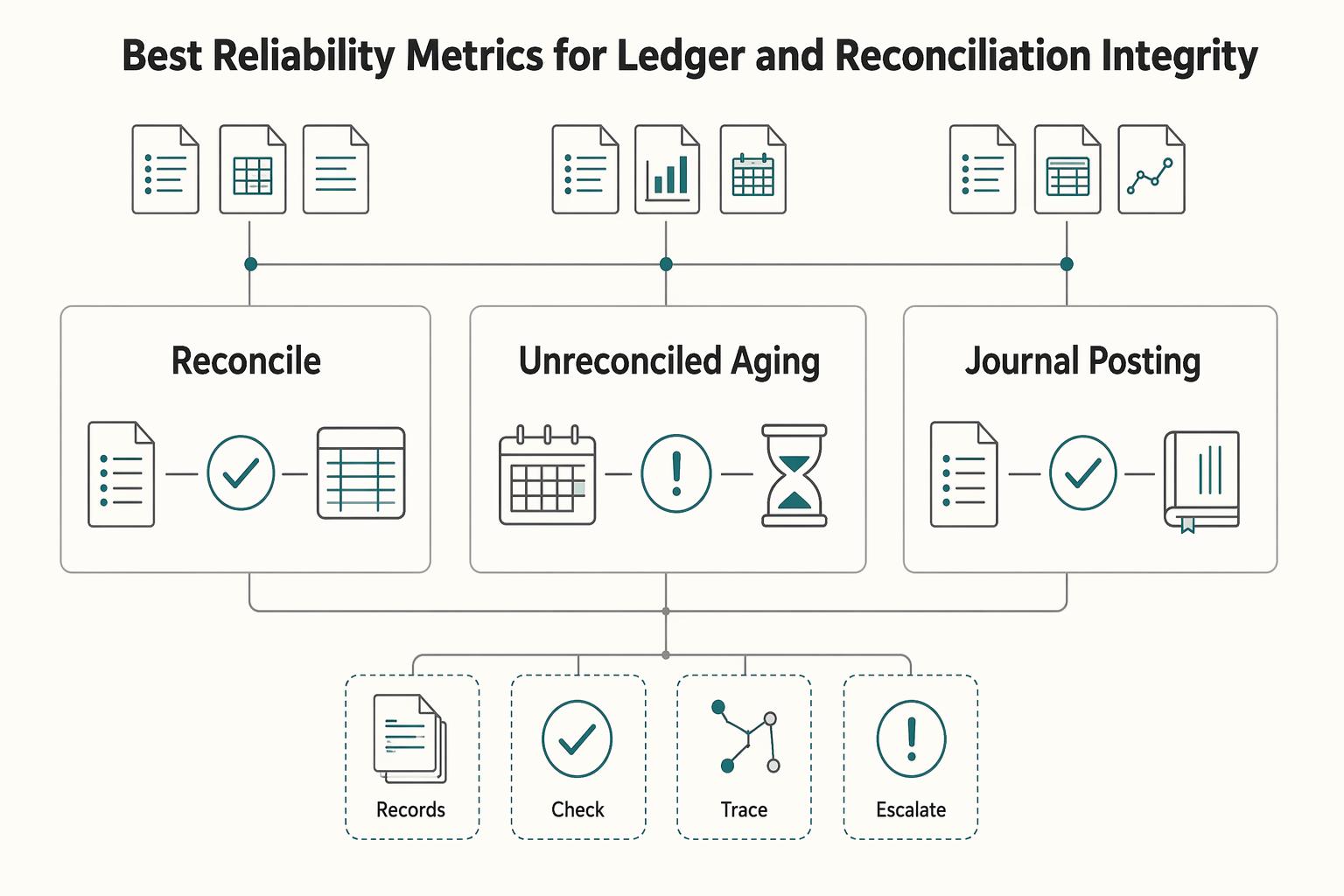
The clearest reliability view for ledger integrity is a three-part check: match rate, unreconciled aging, and journal posting completeness in the books.
| Metric | Use | Review focus |
|---|---|---|
| Reconciliation match rate | Fast correctness signal | Compare internal records with external statements or subsidiary ledgers; review weekly, split unmatched items by source system, and check whether matching logic changed or key fields are missing. |
| Unreconciled aging | Open matching items resolved on time | Run a weekly checkpoint with owner, due date, status, blocker, and resolution path for each item, then escalate unresolved items based on your close timeline. |
| Journal posting completeness | Backstop for complete and accurate journal-entry population | Reconcile source-event totals, the journal population extract, and posted totals; preserve the exact extract. See PCAOB journal-entry population guidance. |
These metrics are control-oriented and can support month-end confidence in operations. The tradeoff is scope. They can look healthy while customer frustration is building, so read them alongside CSAT and NPS, not as substitutes. NPS, reported from -100 to +100, and CSAT, often captured on a 1 to 5 scale, reflect sentiment; on their own, they do not confirm that records are complete and accurate.
If match quality drops while NPS stays flat, do not treat the flat score as proof that nothing is wrong. Treat it as a signal to verify record and timing exposure first, then communicate early when balances, timing, or corrections could affect customers.
Best execution metrics for settlement speed and payout reliability#
For Payout Execution, use settlement SLA attainment, payout success rate, and retry recovery as your primary control set. They show whether money moved on time and arrived. Track them next to Customer Satisfaction Score (CSAT) and Customer Retention so you can catch cases where operational performance improves while customer experience worsens.
| Metric | Measures | Key fields |
|---|---|---|
| Settlement SLA attainment | How often funds settle inside the promised window | Promised settlement timestamp, actual settled timestamp, and latest visible status transition. |
| Payout success rate | Completed payouts out of payout attempts | Failure reasons or refusal codes, including technical failures, incorrect destination details, and compliance or account-information holds. |
| Retry recovery | How many initially failed payments later succeed through retries | Attempt number, retry rule, recovery date, and final outcome. |
Settlement SLA attainment#
Settlement SLA attainment shows how often funds settle inside the promised window. It is a core speed-and-reliability metric because it makes the promised window explicit for each payment flow instead of relying on blended averages.
Separate initial onboarding payouts from steady-state performance and use the provider’s configured arrival estimate. For RTP, distinguish network finality from later customer-support or return processes rather than applying a delayed-bank-payout clock to every rail.
At review time, check three fields on each breach: promised settlement timestamp, actual settled timestamp, and latest visible status transition. This keeps a strong overall rate from hiding localized problems.
Payout success rate#
Payout success rate measures completed payouts out of payout attempts, not just queued payouts. It can be an early operational signal for support pressure.
Segment failures by provider reason and account-requirement state. Incorrect destination details, technical failures, and policy or verification holds need different responses. Keep provider-specific status meanings visible rather than assuming every failure means funds have returned.
For failed or paused batches, preserve a compact evidence set: provider status export, failure reason or code, account-requirement state, customer notification timestamp, and owner. If you ignore paused payouts, you understate customer-visible delay risk.
Retry recovery#
For outbound payouts, retry recovery means originally unsuccessful payout operations that later complete through an approved recovery path. Keep one original operation identity and count attempts separately so retries do not inflate the denominator.
Follow the payout provider’s recovery rules. Resolve an unknown original outcome before creating a new operation or switching rails. Invoice-collection tools such as Stripe Smart Retries should be measured in a separate collection-recovery cohort.
Track original operation ID, attempt count, failure reason, approved recovery action, and final outcome. Use the provider’s reason to decide whether to correct destination details, resolve a requirement, investigate, or retry.
Read recovery alongside customer communication. A recovered payment can still produce support work if status updates are unclear or the delay disrupted the customer’s plans.
Signal conflict rules that prevent bad decisions#
When sentiment and operations disagree, do not trust any single metric in isolation. Use customer signals for impact and operational signals for what actually happened.
| Scenario | Risk | Check first |
|---|---|---|
| High NPS, falling retention | A strong Net Promoter Score can coexist with customer loss | Compare survey respondents and retained customers in consistent cohorts instead of relying on blended averages. |
| High CSAT, rising reconciliation exceptions | High CSAT does not rule out operational risk | Review the source transaction record, journal or accounting entry, exception reason, opened date, and current owner. |
| Better payout execution, worse NPS | Improved payout success does not automatically mean improved trust | Review communication quality, status clarity, and long-tail delay handling before calling it a clean win. |
| Ledger first, Settlement second, CX third | Interpretation should follow verified operations | Verify transaction and accounting alignment and discrepancy aging first, validate promised versus actual settlement status and finality next, then read CSAT, NPS, and retention. |
For adjacent pricing context, see How Payment Platforms Really Price FX Markup and Exchange Rate Spread. You can turn these triage rules into repeatable runbooks with idempotent retries and traceable status events in the Gruv docs.
Governance rhythm and evidence pack for weekly metric reviews#
If you run this as a weekly review, each metric movement should leave the meeting with three things: a named owner, auditable evidence, and a decision deadline.
- Assign owners by control layer
One workable split is finance for Ledger and Reconciliation, ops for Settlement and Payout Execution, and product for Net Promoter Score (NPS) and Customer Satisfaction Score (CSAT) instrumentation. This is an operating choice, not an industry standard, but it helps keep the books, money movement, and survey quality from collapsing into one team's narrative.
Ownership should map to evidence depth. Finance should show journal and matching proof behind exception trends. Ops should explain timing or payout breaches with operational detail. Product should verify survey timing and segment logic so a well-timed score is not confused with real operational health.
- Standardize one auditable evidence pack
Use the same core pack each week: NPS, CSAT, Customer Retention, exception logs, aging of open items, and timing breach counts. For retention, keep the base formula consistent: (customers you end with - new customers)/customers you started with, then segment by cohort or corridor instead of relying on one blended line.
For payout issues, include a drill-down from summary amounts to transaction-level evidence. Treat payouts as batches for matching, and review failed payouts as a separate signal. If you use automatic payouts, preserve transaction-to-payout linkage so later reconciliation stays traceable.
Investigate at the provider or rail’s missed expected window. Record the payment reference, latest authoritative status, trace-request owner, and next update. A confirmed return is a separate event from a failed or pending payout; use its actual arrival record instead of a universal return-time assumption.
- Use named, time-bound escalation triggers
Do not watch and wait when reliability and sentiment deteriorate together. Trigger escalation when customer signals and operational signals move on the same segment, then assign one responder per layer with a decision deadline.
Time-bound ownership matters: if an incident is not acknowledged before the escalation timeout, escalate to the next response level. Clear roles reduce duplicate work and missed handoffs between finance and ops.
Keep triggers tied to customer impact, not internal-only noise. If timing or payout outcomes worsen and sentiment also drops, route the incident immediately instead of waiting for month-end.
- Use periodic calibration as a cleanup pass
If you run a periodic calibration pass, use it to remove metrics that do not drive action. Keep core measures that trigger concrete work: clearing unreconciled aging, investigating failed payouts, fixing instrumentation, or resolving timing breaches.
Treat averages without segmentation, ownership, or an evidence trail as weak operating signals. Set a reconciliation target your team can measure, and keep the unresolved population visible to its owner.
Final check: CX metrics should stay tied to verifiable operations evidence, and finance controls should not crowd out customer signals. The goal is one shared evidence set before a bad week turns into retention loss.
Common metric mistakes that create false confidence#
Even with a solid weekly evidence pack, clean dashboard averages can still create false confidence. The most common mistakes are interpretive, and they are avoidable.
- Using NPS as a standalone health score
NPS subtracts the percentage of detractors from the percentage of promoters, using all valid respondents. It measures recommendation intent, while payment and reconciliation records show execution. Keep both visible when interpreting customer trust.
Review NPS alongside other customer and payment metrics. If NPS is steady while acceptance rates worsen or failure patterns increase, treat the score as incomplete.
- Reporting one blended average across all flows
Blended reporting hides where payment outcomes are actually failing. NPS can be tracked by segment, geography, or function, and Stripe recommends slicing payment analytics by dimensions like brand, country, or input method while checking where and why payments fail.
In practice, segment by geography, payment input method, and failure cause. If a negative movement cannot be traced to a segment and failure diagnostics, the average is too blended to drive action.
- Ignoring the respondent mix behind the score
Passives remain in the NPS denominator, although they contribute to neither numerator. The same index can hide changes in the three response groups, so retain bucket counts by segment.
Do not stop at the -100 to 100 index. Review promoters, passives, and detractors by segment, using raw bucket counts alongside the final score.
- Copying generic vendor guidance into payment ops without adaptation
Qualtrics, Medallia, and Vitally are broad by design, and Vitally explicitly frames success metrics as custom KPIs from your own data. Their defaults are not a payment-specific standard.
Before you trust dashboards, confirm your survey definitions and segment fields map to your own operational data and reporting logic.
- Treating sparse public claims as true benchmarks
Self-published results are context, not strong benchmarking. For example, ConnexPay's October 2, 2025 post reports an NPS of 60 from 267 respondents, which is a single-company data point.
Use claims like this as directional context only, then benchmark against your own segmented baseline and operational outcomes instead.
Build a metric system that tells you what to fix next#
Build a ranked metric stack, not a scoreboard. Use NPS, CSAT, and retention as customer signals, then tie each one to verifiable transaction records, matching evidence, settlement data, and payout-execution evidence so the next fix is clear.
Start narrow with five measures: NPS, event-level CSAT, customer retention rate, matching quality, and payout status outcomes. Assign clear ownership, and set a triage rule you can apply consistently: when customer sentiment and operational evidence conflict, start by investigating the records.
- NPS for directional trust
Use NPS as a relationship signal, not a root-cause tool. Track promoters (9 or 10) and detractors (0 to 6) by segment instead of relying on one blended average. When detractors rise in a segment, check payout failures or returns, matching exceptions, and timing delays in that same segment.
- CSAT for moment-level friction
Use CSAT to measure satisfaction with a specific event. Tie each survey to the exact event and timestamp so you can compare sentiment with payout and timing outcomes. CSAT is a short-horizon signal, so treat it as an early indicator, not the final outcome.
- Retention for outcome truth
Use retention to confirm whether improvements actually keep customers over time. Calculate it consistently with CRR = ((E-N)/S) x 100, and review by cohort, not only at company level. If NPS or CSAT improves while retention weakens, treat that as a diagnosis gap and trace it back to operational evidence.
- Operational checks in reconciliation, settlement, and payout execution
Match payouts to bank deposits and use transaction-level settlement evidence to explain the batch. Track processing, completion, failure, confirmed return, and cancellation according to the provider’s meanings, with open items owned until reconciled.
Keep the weekly pack simple and auditable: NPS by segment, CSAT by event, retention by cohort, open-item aging, timing exceptions, and payout status counts. If a detractor, low CSAT response, or retention drop cannot be traced to an account, event time, and operational record, you still have disconnected charts, not a usable metric system. If your next step is tightening settlement and failure visibility, evaluate how Gruv Payouts can support that operating model.
Frequently Asked Questions
Is Net Promoter Score enough for payment platforms?
No. NPS is a loyalty signal on a -100 to +100 scale (Promoters% - Detractors%, where 9-10 are promoters, 7-8 passives, and 6 or less detractors), but it is not enough to diagnose payment operations on its own. Pair it with payout and settlement operational evidence so you can see where failures occur. If NPS stays stable while failed payouts rise, treat the operational signal as an incident trigger.
How should finance and ops teams combine NPS, CSAT, and retention in one dashboard?
Put experience and operations signals in one view, not separate tabs. A practical layout is segmented NPS trend, event-level CSAT on a 1 to 5 scale, retention using [(E - N) / S] × 100, and then settlement timing plus payout status outcomes. Keep each metric traceable to a specific event, segment, or exception class rather than one blended average.
What should trigger an operational investigation even if NPS still looks healthy?
Investigate a failed payout even when NPS is stable. Failure does not prove funds have already returned. Track failure, confirmed return, pending outcome, and cancellation separately using the provider’s status meanings and the corresponding financial records.
Which metrics belong to finance owners versus payments ops owners?
There is no universal ownership split, so assign ownership to the team that can verify and correct the issue fastest. In practice, align owners to the signals they can directly act on, such as payout status handling versus settlement reconciliation review. NPS and CSAT signals should still map back to operational evidence so experience signals and operational data can be investigated together.
How often should we review settlement and payout metrics against customer feedback metrics?
Review at your settlement and payout checkpoints, with more frequent checks during incidents. Adyen’s transaction-level Settlement details report supports settlement reconciliation; use the actual report availability and your account’s closing schedule when planning the review.
What do we do when CSAT and retention point in opposite directions?
Treat it as a diagnosis issue, not a scorecard contradiction. CSAT reflects event-level satisfaction, while retention reflects longer-horizon behavior, so divergence can indicate that the surveyed interaction and longer-term outcomes are not moving together. Check survey event design first, then segment retention by relevant cohorts and compare both against payout failures and delays; for deeper retention framing, use what payment experience metrics actually predict retention.
Try a related tool
Researched and edited by the Gruv editorial team. Gruv builds cross-border billing, payouts, and finance-operations software for global businesses.
Sources
- comptrollerofthecurrency.gov/publications-and-resources/publications/bank...trusted
- docs.stripe.com/reports/payout-reconciliationtrusted
- docs.stripe.com/checkout/fulfillment.mdtrusted
- federalreserve.gov/paymentsystems/files/psr_policy.pdftrusted
- federalreserve.gov/paymentsystems/fedfunds_about.htmtrusted
- sloanreview.mit.edu/article/a-smarter-approach-to-measuring-cust...trusted
- stripe.com/resources/more/payment-kpis-metrics-that-rev...trusted
- stripe.com/resources/more/payment-reconciliation-101trusted
Educational content only. Not legal, tax, or financial advice.
Related Posts

The Freelance Payment Penalty: A Modeled Audit of Platform Fees, FX Spreads, and Payout Delays
The money rarely disappears through a single, easy-to-spot fee. The real loss is stacked. A marketplace takes its commission, a processor adds a charge for international cards, a bank or payment company converts the currency at a spread, a platform holds the funds before release, and a wire sheds a little to intermediaries on the way in. Each layer looks defensible on its own, but the worker feels the combined result as a smaller deposit and a later payday.
How to Respond to a Subpoena for Business Records
Move fast, but do not produce records on instinct. If you need to **respond to a subpoena for business records**, your immediate job is to control deadlines, preserve records, and make any later production defensible.
A US Expat's Guide to Investing in UCITS ETFs to Avoid PFIC Issues
The real problem is a two-system conflict. U.S. tax treatment can punish the wrong fund choice, while local product-access constraints can block the funds you want to buy in the first place. For **us expat ucits etfs**, the practical question is not "Which product is best?" It is "What can I access, report, and keep doing every year without guessing?" Use this four-part filter before any trade: