
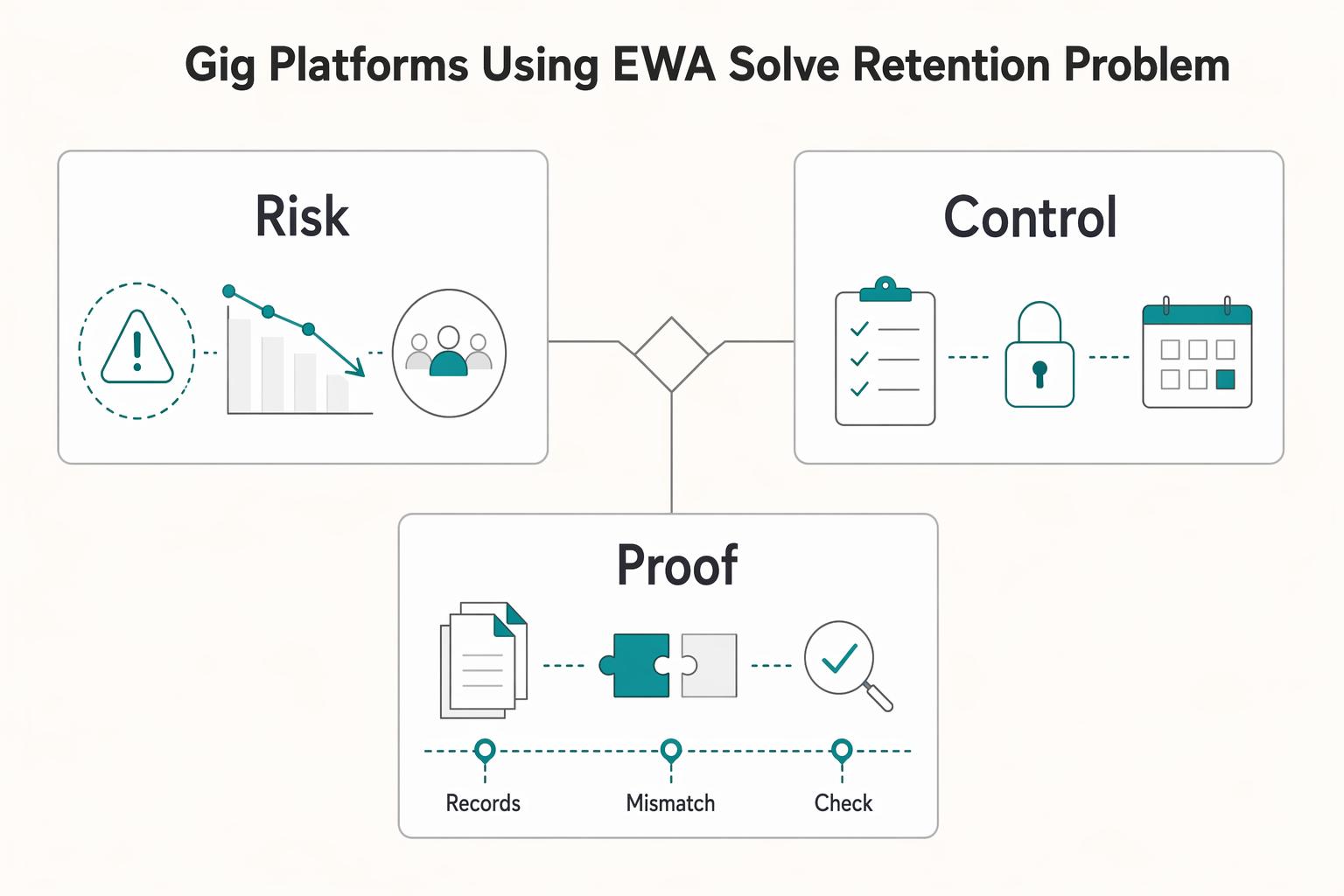
Quick Answer
Yes - earned wage access gig platform retention can improve when payout timing is a real churn driver and core disbursements already work reliably. Start with a narrow cohort test, compare model options (including fee-free Modern EWA versus fee-based paths), and require checkpoints across compliance gates, reconciliation, and support outcomes before expanding.
Gig platforms are using EWA to solve a retention problem, not just a payout feature gap#
Step 1. Diagnose payout experience before blaming price or demand. The real retention question is usually not "Do workers want faster money?" It is "Is payout timing and trust one of the reasons they stop taking jobs on our platform?" For many platforms, that is the right place to look first. If contractors are getting enough work but still disengage after a delayed payout, a failed transfer, or confusing settlement timing, you likely have a payout experience problem before you have a marketplace pricing problem.
The first check is practical. Review exits, support contacts, and re-engagement dropoff around payout events, especially in the first few payout cycles. If your payout latency logs and support tags already show repeated timing complaints, EWA is worth evaluating. If failed or delayed disbursements are common, do not use EWA to cover that weakness. You would be adding complexity on top of a trust problem.
Step 2. Choose the EWA model as an operating decision, not a feature request. Earned Wage Access, or EWA, is not just a button that lets people cash out early. It changes product rules, treasury timing, support handling, eligibility logic, and reconciliation. That is why this article focuses on how to choose the right model and launch path, with clear tradeoffs across product, finance, ops, and engineering.
You should expect hard choices, not a universal answer. A faster launch can create more support load. A worker fee model may look simpler financially but create brand risk. A tighter eligibility policy may reduce loss exposure but weaken adoption. The right decision is the one your team can defend when finance asks about settlement exposure and ops asks who handles exceptions.
Step 3. Hold the evidence to a higher standard than vendor enthusiasm. The market signal is real but limited. EWA companies have operated since the early 2010s, and EWA company growth accelerated during COVID-19. In parallel, the cited platform-work excerpt says more than two million platform jobs were added to the U.S. economy in 2020. That context matters. It is not the same as proven causal retention lift for gig contractors.
The strongest caution is that the June 2023 Harvard Kennedy School EWA paper is a working paper that says EWA sits in a legal gray area and that jurisdiction remains unclear. The same paper says multiple stakeholder groups have acknowledged the need for regulatory clarity, and it also notes the paper had not undergone formal review and approval. The September 13, 2022 U.S. Senate hearing on new consumer financial products reinforces that this is not just a product question. Use the market signal, but do not oversell the outcome or assume the rules are settled.
Step 4. Build from decision criteria to launch controls and measurement. Take a deliberate path. Define the retention mechanism you are trying to change, confirm compliance and data prerequisites, compare EWA models side by side, design money movement controls, roll out in phases, and measure impact with a causal mindset. You will also get rollback rules, risk controls, and a copy-paste checklist you can use with your owners.
The core recommendation is straightforward. If payout reliability is unstable, fix that first. If reliability is stable and payout timing still looks like a churn driver, test EWA with narrow cohorts and prove it against your baseline before you call it a win. That is the throughline for the rest of the article.
For a step-by-step walkthrough, see Indian Gig Economy in 2026: Treat Platform Income as Variable Until Settlements Prove Stability.
Start with the retention mechanism you are trying to change#
Start by naming the retention mechanism clearly: EWA is a payout timing and trust intervention, not a fix for low earnings or broken disbursements.
| Bucket | Signal | Implication |
|---|---|---|
| Earnings level | Not earning enough to stay active | It does not fix a segment that is not earning enough to stay active |
| Payout reliability | Complaints cluster around failed or missing transfers | Treat that as a reliability issue first |
| Payout timing | Complaints cluster around payment timing | EWA mainly fits payout timing |
Step 1. Separate retention drivers into three buckets#
Separate retention drivers into three buckets: earnings level, payout reliability, and payout timing. EWA mainly fits payout timing, and sometimes the trust layer around that experience. It helps close the gap between completed work and access to earned money before the normal payout date, but it does not fix a segment that is not earning enough to stay active.
Review exits, inactivity, and support contacts by bucket. If complaints cluster around payment timing, you have a timing case. If complaints cluster around failed or missing transfers, treat that as a reliability issue first.
Step 2. Map the payout options already in your stack#
Map the payout options already in your stack, including instant or real-time options and standard settlement paths. Do not add EWA to mask baseline payout failures.
Check payout completion and failure patterns by provider or corridor, then decide in order. If payout failures are high, fix reliability first. If reliability is stable, test EWA for retention and re-engagement lift.
Step 3. Define target cohorts before launch#
Define target cohorts before launch: new joiners after early completed jobs, at-risk cohorts with recent activity decline, and high-value supply segments where missed availability hurts the marketplace most. For each cohort, document the rule, payout method, and expected behavior change.
Keep this in a short cohort sheet shared across product, ops, and finance so the test stays specific instead of turning into a vague "faster money" project.
You might also find this useful: Bad Payouts Are Costing You Supply: How Payout Quality Drives Contractor Retention.
Prepare the data and compliance prerequisites before you build#
Before you sit through vendor demos or make architecture choices, confirm you can launch without payout holds, reporting gaps, or unclear ownership.
| Gate or record | Detail | Operational note |
|---|---|---|
| KYC / KYB / AML / VAT | Can block enrollment or payout release | Define ownership for each gate and where users can get stuck |
| W-8 / W-9 collection | Map where collection lives and how records are stored | Align tax documents and records logic early |
| Form 1099 workflows | Map how records feed workflows | Align tax documents and records logic early |
| FEIE physical presence test | 330 full days in a 12-month period | Qualifying days do not have to be consecutive |
| FEIE limits | $130,000 for 2025 and $132,900 for 2026 per qualifying person | Avoid treating limits as static |
| FBAR notices | FinCEN due-date and extension notices | Treat as an operational dependency |
Step 1: Build a minimum evidence pack first. Create one working file for each target cohort with:
- payout latency logs
- churn baselines
- support-ticket taxonomy
- cohort-level re-engagement rates
Keep support tags clean enough to separate timing issues ("I need my money earlier") from reliability issues ("my payout failed"), so your EWA test is interpretable.
Step 2: Confirm policy gates by market and program. Get a market-by-market view of which KYC, KYB, AML, and VAT checks can block enrollment or payout release. Define ownership for each gate and where users can get stuck, so onboarding, support handling, and release timing are clear before selection.
Step 3: Align tax documents and records logic early. Map where W-8 and W-9 collection lives, how records are stored, and how they feed Form 1099 workflows. If your contractor base includes U.S. citizens or resident aliens abroad, plan for worldwide-income reporting and filing complexity even when FEIE may apply; the IRS states qualifying taxpayers still file a return reporting the income.
For FEIE context, the physical presence test uses 330 full days in a 12-month period, and those qualifying days do not have to be consecutive. FEIE limits shown in IRS guidance are $130,000 for 2025 and $132,900 for 2026 per qualifying person, so avoid treating limits as static. If FBAR may be relevant, treat FinCEN due-date and extension notices as an operational dependency.
Step 4: Set owners and sign-off points before selection. Assign clear accountability across product, payments ops, engineering, legal, and finance, then require explicit sign-off before vendor selection or build approval.
If you want a deeper dive, read Earned Wage Access Architecture: How to Build EWA Into Your Gig Platform.
Choose your EWA model with a decision matrix your team can defend#
If your brand and unit economics cannot tolerate worker fees, do not use a fee-based launch just for speed. Prioritize a fee-free Modern EWA design and treat the added implementation work as the cost of staying aligned with your product promise.
This decision is about who pays for early access, how repayment works, and how much post-launch complexity your team will own across legal, finance, and support.
Step 1. Build a plain side-by-side matrix before provider shortlisting#
Build a plain side-by-side matrix before provider shortlisting or build planning, so product, finance, legal, and ops can challenge the same assumptions.
| Model | Best fit retention goal | Margin impact | Compliance burden | Implementation time | Support load | Repayment method | Worker fee policy | Dispute handling | Reconciliation complexity | Audit trail depth |
|---|---|---|---|---|---|---|---|---|---|---|
| No EWA + instant payout only | Reduce frustration from payout timing on completed earnings, without changing wage access rules | Usually clearer cost visibility to platform and worker | Lower than EWA models, but still tied to payout rails and market controls | Usually fastest when instant payout already exists | Lower if payout reliability is strong | No separate repayment event; earnings move on faster payout rails | Worker may still pay instant payout fees if your program charges them | Mostly payout failures, reversals, and timing issues | Lower because there is no advance-recovery flow | Good if payout ledger already tracks status, timestamps, and references |
| Fee-based Earned Wage Access (EWA) | Test whether earlier access improves re-engagement enough to justify worker-paid convenience | Can look lighter on platform margin upfront, with added brand and support risk | Higher because EWA can sit in a legal gray area depending on jurisdiction | Moderate with a mature vendor model | Higher due to eligibility, fee, limit, and repayment disputes | Usually recovered from future earnings or scheduled settlement logic | Worker pays an access or convenience fee | Clear handling needed for fee disputes, eligibility disputes, and partial recovery exceptions | Medium to high because advances, fees, and recoveries must reconcile to ledger events | Must capture earned-balance calculations, approvals, fee disclosures, and recoveries |
| Fee-free Modern EWA | Improve retention and trust when worker-fee friction is unacceptable | Platform absorbs more direct cost, so cohort targeting must be tighter | Higher for the same EWA reasons, plus tighter internal review of subsidy logic | Often slower because finance, product, and legal need tighter alignment | Medium to high, but fewer fee complaints | Usually recovered from future earnings or settlement offsets | No worker fee | Focuses on eligibility, earned amount, and repayment errors | High because advances and offsets still require tight tracking | Strong records are essential for subsidy, eligibility, and recovery logic |
Step 2. Score the models against your real constraint#
Score these models against your real constraint, not the market narrative. If your core problem is delayed payout on already earned funds, instant payout may be enough; if you need behavior change before normal settlement, EWA is the more direct lever.
Treat fee-based claims carefully. Vendor materials may describe retention or engagement benefits, but that is not proof of causal lift for your contractor base or proof that fee-based beats fee-free. Use this rule in practice: if worker fees conflict with your brand, support posture, or public positioning, treat fee-based EWA as a red flag.
Keep regulatory treatment in the main scorecard. The June 2023 Harvard working paper describes EWA as sitting in a legal gray area and discusses a possible "Covered" EWA program framework, so legal treatment may not be consistent across markets.
Step 3. Get three sign-offs before approval#
Before approval, get three sign-offs: finance on cost ownership and ledger treatment for advances and recoveries, legal and compliance on market-by-market implications, and support ops on expected dispute types from day one.
Include sample worker communications, fee disclosures (if any), repayment scenarios, and exception cases in the evidence pack. A common failure mode is choosing fee-based for cleaner unit economics, then seeing support volume cluster around fee complaints; another is choosing fee-free without tight cohort rules, then subsidizing usage that does not improve retention.
If the matrix still points in two directions, pick the model that is easiest to explain to workers, auditors, and your finance team. That usually leads to a more durable launch than the model that only looks faster on a roadmap.
For more on documentation, see How to Create a Document Retention Policy. If you need a quick tool while evaluating earned wage access for gig platform retention, try the free invoice generator.
Design the money movement and control points before shipping UI#
Do not ship the worker-facing flow until your team can trace one advance from earned-balance calculation to disbursement, repayment, and final ledger close. If finance cannot replay that path with timestamps and references at each hop, the UI may look simple while operations stay fragile.
This is especially important for EWA because the June 2023 Harvard Kennedy School working paper describes the category as a legal gray area with unclear jurisdiction. Build controls, records, and approval points that can stand up to internal audit and market-by-market review.
Step 1. Define the event sequence before screens or copy#
Define the event sequence before screens or copy. Map earned-balance calculation, eligibility, approval, disbursement request, provider response, repayment settlement, and ledger reconciliation, and assign an owner and system of record to each step.
For each advance, your team should be able to answer quickly: what amount was approved, what amount moved, and whether recovery matched the obligation. Keep provider acceptance separate from confirmed disbursement in your state model so workers are not told they were paid before funds are actually delivered.
Step 2. Define payout routes and fallback behavior by corridor#
Define payout rails and fallback behavior by corridor, then bind them to product rules. Do not present "instant" as a generic promise; specify the primary route, backup route, and worker message for each destination when a route is unavailable.
| Corridor or payout mode | Primary route to define | Fallback to pre-approve | Verification detail |
|---|---|---|---|
| Eligible debit card payouts | Visa Direct | Retry on approved secondary route or hold for standard settlement | Confirm provider reference and destination token match the request |
| Program-linked stored value | Reloadable card | Keep funds on card-program path or defer release if card status fails checks | Confirm card status, funding acknowledgment, and posting event reconcile |
| Bank account payouts | Bank-based flow | Re-route to next available bank path or queue for scheduled payout review | Confirm destination, settlement status, and return-code handling |
More routes can improve completion, but they also expand exception paths and support load. Start with the smallest set that covers your target cohort, then add routes only after reconciliation is consistently clean.
Step 3. Add traceable controls and checkpoints before release#
Add traceable controls before release. Use idempotent request handling to prevent duplicate advances, map each internal transaction ID to provider references, and route unmatched or reversed events to a named exception queue with an owner.
Place policy checkpoints where funds can still be stopped cleanly: before approval, before release, and before recovery posting. That can include AML holds, eligibility checks, and velocity controls, with clear states such as "approved, not disbursed" to avoid manual guesswork.
Your sign-off pack should include sample event logs, reversal and duplicate-request scenarios, and one failed-disbursement example per payout mode, plus worker notice templates for pending, failed, and reversed payouts. If legal is assessing whether your structure aligns with a regulator's idea of a "Covered" EWA program, those records matter more than polished UI mocks.
If you want one decision rule: if a webhook event cannot be reconciled automatically, route it to a named exception state with ownership and a response clock, not a generic failure bucket. This pairs well with Freelance Client Retention: Weekly Systems for Repeat Work and Long-Term Relationships.
Roll out in phases so retention gains are real and reversible#
Roll out EWA in controlled phases with enforceable gates, and only expand when you can pause or roll back without breaking your current payout experience.
| Phase | Scope | Gate |
|---|---|---|
| Internal pilot | Employee or test accounts, then a very small live cohort | One advance should move from approval to disbursement, repayment, and payout-batch close without manual finance cleanup |
| Limited contractor cohort | A cohort with clear value and bounded risk, small enough to review exceptions one by one | Tie each go/no-go decision to measurable outcomes and documented sign-off |
| Rollback | Affected users move to the stable instant payout path | Pause if payout failures rise above preapproved tolerance, support burden exceeds team capacity, or payout batches stop reconciling on time |
Step 1. Prove operations end to end with an internal pilot#
Start with an internal pilot to prove operations end to end, not launch messaging. Use employee or test accounts first, then a very small live cohort with payout patterns your team can inspect closely. The checkpoint is simple: one advance should move from approval to disbursement, repayment, and payout-batch close without manual finance cleanup.
Review a daily scorecard against your current stable instant payout baseline:
- webhook success rate
- payout completion time
- dispute volume
- reconciliation close time for payout batches
Do not expand if finance cannot close affected batches on schedule or support cannot explain failed or delayed disbursements from the event trail.
Step 2. Expand to a limited cohort only after controls are repeatable#
Expand to a limited contractor cohort only after controls are repeatable, not after one clean week. Pick a cohort with clear value and bounded risk, and keep it small enough for product, ops, and finance to review exceptions one by one.
Tie each go or no-go decision to measurable outcomes and documented sign-off. Your phase record should include dates, cohort definition, enabled payout modes, exception count, dispute themes, and unresolved reconciliation items. If that evidence is thin, delay expansion.
If support pain rises while completion metrics still look acceptable, pause and fix status handling, notice copy, or recovery paths before adding users.
Step 3. Define rollback rules before each phase starts#
Define rollback rules before each phase starts, then enforce them. If payout failures rise above preapproved tolerance, support burden exceeds team capacity, or payout batches stop reconciling on time, pause expansion and move affected users to your stable instant payout path.
Control tightness should match your operating pattern. High-frequency gig platforms usually need tighter disbursement controls and faster exception review because defects can repeat across many daily earnings events. Lower-frequency creator marketplaces can often expand more slowly, but single payout failures may still be highly visible.
Avoid broad conclusions from early tests. Platform work conditions vary: a European Parliament-requested study drew on 50 expert interviews across eight European countries plus a survey of 1,200 platform workers, underscoring that behavior and risk context are not uniform. Treat each expansion as a fresh decision.
Related: Real-Time Payment Use Cases for Gig Platforms: When Instant Actually Matters.
Measure impact with a causal mindset, not a vanity KPI dashboard#
Treat this as an attribution problem, not a charting exercise. Do not call EWA a retention win until EWA-enabled cohorts outperform your existing real-time payments baseline over multiple payout cycles, with a comparison group you trust.
Step 1. Define exposure first, then track outcomes by cohort#
Define exposure first, then track outcomes by cohort. Exposure should mean more than "eligible for EWA": log first offer view, first advance use, advance amount, repayment outcome, and any disbursement failure, reversal, or manual handling.
Track four primary outcomes by cohort: retention, reactivation, time-to-next-task, and payout satisfaction. Keep a separate line for payout-related support contacts and dispute themes. Broader rideshare evidence, based on survey data from more than 488 drivers plus 75 interviews, found that higher reported conflict was associated with lower platform engagement, so unresolved payout friction can distort your retention read.
Your checkpoint is whether you can explain movement with a defensible evidence pack: exposure logs, payout event timestamps, support-ticket taxonomy, and a written cohort definition.
Step 2. Use a comparison design that reduces false credit#
Use a comparison design that reduces false credit: matched cohorts or staggered rollout between EWA-enabled and non-enabled groups. Match on factors that predict engagement before launch, such as market, tenure, prior activity, earnings cadence, and previous use of instant or real-time payments.
Avoid comparing users who took EWA against users who did not inside the same launch group; that can overstate impact because early adopters may already be more active or payout-sensitive. If you use staggered rollout, lock the access schedule before reading outcomes.
Step 3. Keep a known-vs-unknown block in every report#
Keep a known-vs-unknown block in every report. Knowns are operational and directional: adoption, repeat use, satisfaction movement, dispute volume, and whether support and finance stayed within tolerance. Unknowns are the gig-specific causal size of any retention gain.
Keep outside benchmarks in a clearly labeled directional-signals section, separate from platform-specific proof. Your proof section should answer one question: after several payout cycles, did EWA outperform the baseline real-time payments experience for a like-for-like group?
If the answer is mixed, say so plainly. Faster return to work with flat retention may still justify the feature, but it is not proof of durable lift.
Need the full breakdown? Read Give Your Accountant QuickBooks Online Access Without Losing Control.
Avoid the failure modes that make EWA expensive and hard to trust#
EWA becomes expensive and hard to trust when it is layered onto weak payout operations. If payouts, eligibility checks, or reconciliation are unstable, you add payment events without fixing the root trust problem.
Step 1. Fix payout reliability before positioning EWA as a retention lever#
Fix payout reliability before positioning EWA as a retention lever. If workers are already dealing with failed disbursements, reversals, or delays, EWA will not offset that experience.
Set a hard traceability checkpoint for every advance: earned-balance calculation, disbursement outcome, provider reference, repayment status, and linked support ticket. If that chain is incomplete, pause expansion and keep the stable payout path as the default.
Step 2. Lock compliance and documentation coverage by market before launch#
Lock compliance and documentation coverage by market before launch. KYC, KYB, AML, and VAT cannot be treated as post-launch cleanup.
The June 2023 Harvard working paper describes EWA as operating in a legal gray area, so treat eligibility and documentation rules as explicit launch gates. Your evidence pack should include market eligibility rules, identity or business checks, AML hold logic, and the exact documents required when funds are blocked. Stripe's Croatia services agreement is a practical reminder that service-agreement eligibility can be market-specific.
Step 3. Harden webhook and payout-batch exception handling before scale#
Harden webhook and payout-batch exception handling before scale. Unresolved duplicates, reversals, or missing batch references create reconciliation debt that finance teams will not trust.
The UW report says EWA firms typically recoup 97 percent of advanced wages, so operational confidence depends on clean records and exception control, not only recovery rates. If you are already seeing breakdowns, use this recovery order: freeze expansion, clear reconciliation backlog, tighten eligibility rules, then relaunch with narrower cohorts.
Related reading: How to Avoid Phishing Scams When Payments and Access Are at Risk.
Use this checklist to choose and launch the right EWA model#
Use EWA when retention risk is mainly about access to already earned pay, not as a catch-all fix for every supply problem.
- Confirm the problem before choosing the model.
Separate likely drivers of churn: demand, earnings level, and pay timing. If complaints consistently point to cash timing and payout trust, EWA is a real candidate. If they mostly point to pricing or task volume, treat EWA as lower priority. Use the "financial access problem" framing as a hypothesis to test in your own platform data, not proof.
- Validate readiness with documented ownership.
Before provider selection, confirm product, finance, legal, and ops each have clear written ownership. At minimum, document eligibility, exception handling, and who approves edge cases. If your team cannot explain what happens when an advance is held, reversed, or disputed, you are not launch-ready.
- Choose with a decision matrix your team can defend.
Compare options side by side, for example: instant payout only, fee-based EWA, fee-free EWA. Score each option against fee policy, operational load, implementation complexity, and the retention outcome you care about most. Do not pick a model only because it is fastest to ship.
- Ship in phases with explicit verification gates.
Start narrow, then expand only after pilot checks pass. Confirm money movement is traceable end to end, exceptions are handled predictably, and support volume is manageable. If issues rise during pilot, pause expansion and fix the operating flow first.
- Measure with discipline and make a real go/no-go call.
Use matched cohorts or a staggered rollout, then compare exposed users with a stable baseline over multiple payout cycles. Report knowns and unknowns clearly, and tie decisions to both retention signals and operational health. Treat early directional movement as a signal, not final proof.
Your next step: confirm market or program coverage with sales, then scope implementation with product and finance together.
Frequently Asked Questions
How does Earned Wage Access (EWA) actually improve contractor retention on gig platforms?
EWA can help when payout timing is part of the retention problem, because workers can access part of pay they have already earned before payday. Providers like FlexWage position EWA as a way to reduce financial stress and improve retention, but gig-specific retention lift should still be treated as something to test, not assume.
Is EWA better than offering instant payout alone?
Not automatically. EWA changes when earned pay becomes available, but this guide does not prove EWA outperforms instant payout in every context. Treat the choice as a hypothesis to validate with your own rollout data.
Should contractor-facing EWA be fee-free or can fee-based models still work?
Do not assume fee-free or fee-based is superior. Either model may be workable depending on your economics and worker expectations, but fee transparency matters if you charge for access.
What compliance risks matter most when launching EWA across markets?
The biggest risk is assuming the product is legally settled when the June 2023 Harvard working paper describes EWA as being in a legal gray area. It also notes broad demand for regulatory clarity across regulators, industry, employers, and advocates, so treat launches as jurisdiction-specific rather than one universal policy.
What should product, finance, and engineering each own in an EWA rollout?
No single ownership model fits every platform. The practical requirement is clear, named ownership for how advances are offered, tracked, and resolved when issues occur.
How do we measure impact without overstating causality?
Use a cautious design, such as matched cohorts or a staggered rollout, instead of relying only on before-and-after comparisons. Report outcomes as directional unless your method supports stronger causal claims, especially since provider retention claims are not gig-specific causal proof.
When should we delay EWA and fix payout infrastructure first?
Delay when you cannot reliably track advances and repayment status end to end or explain outcomes clearly when something fails. If core payout operations are unstable, stabilize those first before adding EWA complexity.
Try a related tool
Researched and edited by the Gruv editorial team. Gruv builds cross-border billing, payouts, and finance-operations software for global businesses.
Sources
- alexandercountync.gov/pdf/comprehensive-plan.pdftrusted
- aphis.usda.gov/sites/default/files/animal-welfare-inspectio...trusted
- congress.gov/117/chrg/CHRG-117shrg53615/CHRG-117shrg53615...trusted
- dol.gov/sites/dolgov/files/OPA/newsreleases/2025/08/...trusted
- evans.uw.edu/wp-content/uploads/2025/08/EWA-Report-1.pdftrusted
- federalregister.gov/documents/2025/11/05/2025-19787/medicare-and...trusted
- files.hawaii.gov/dbedt/erp/Doc_Library/2026-03-23-MA-DEA-Sing...trusted
- fincen.gov/report-foreign-bank-and-financial-accountstrusted
Educational content only. Not legal, tax, or financial advice.
Related Posts
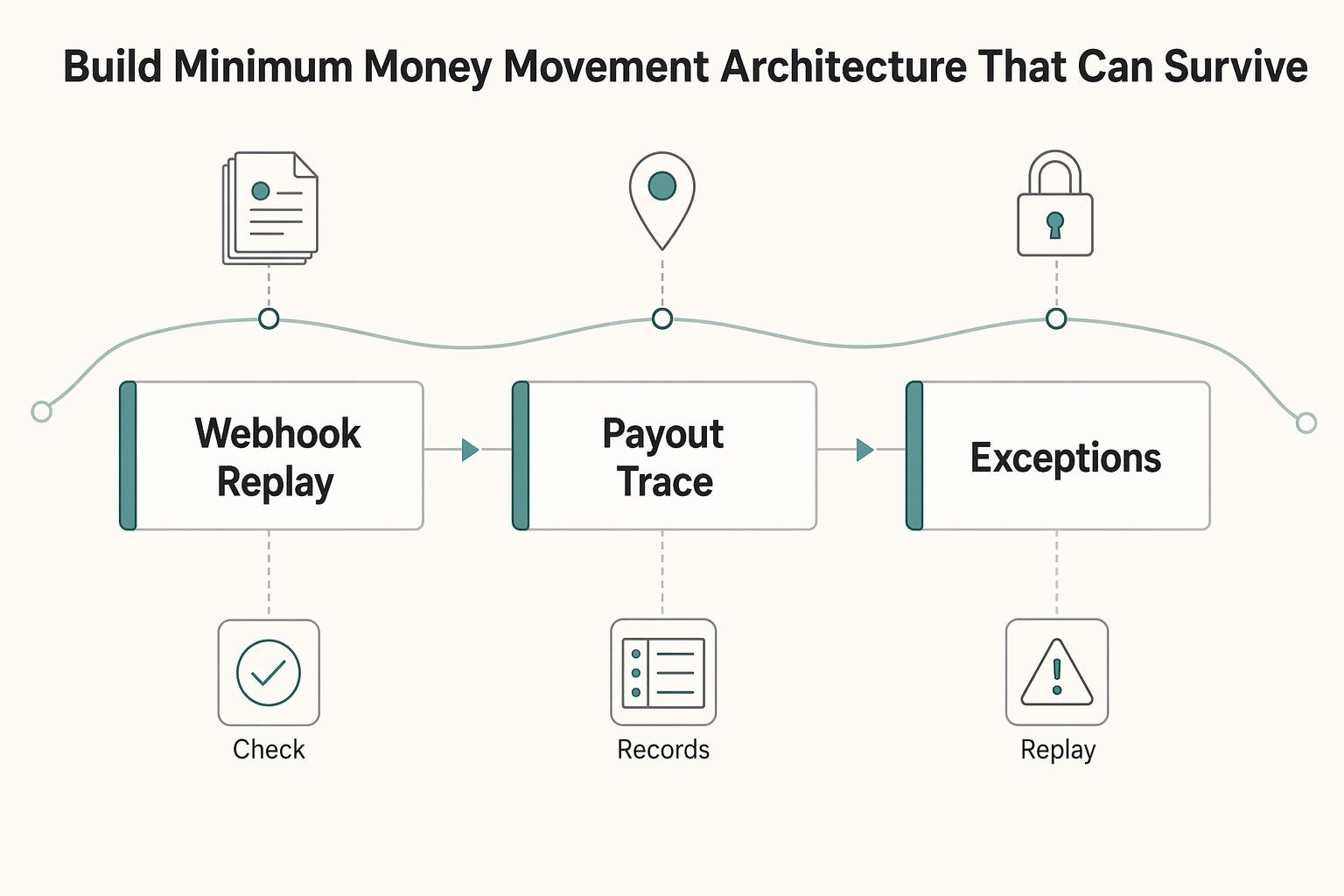
Earned Wage Access Architecture: How to Build EWA Into Your Gig Platform
EWA is an operating-model decision before it is a product feature. Earned Wage Access lets workers access pay they have already earned before payday. For a gig platform, it also changes earnings verification, fund movement, repayment handling, exception operations, and launch risk.
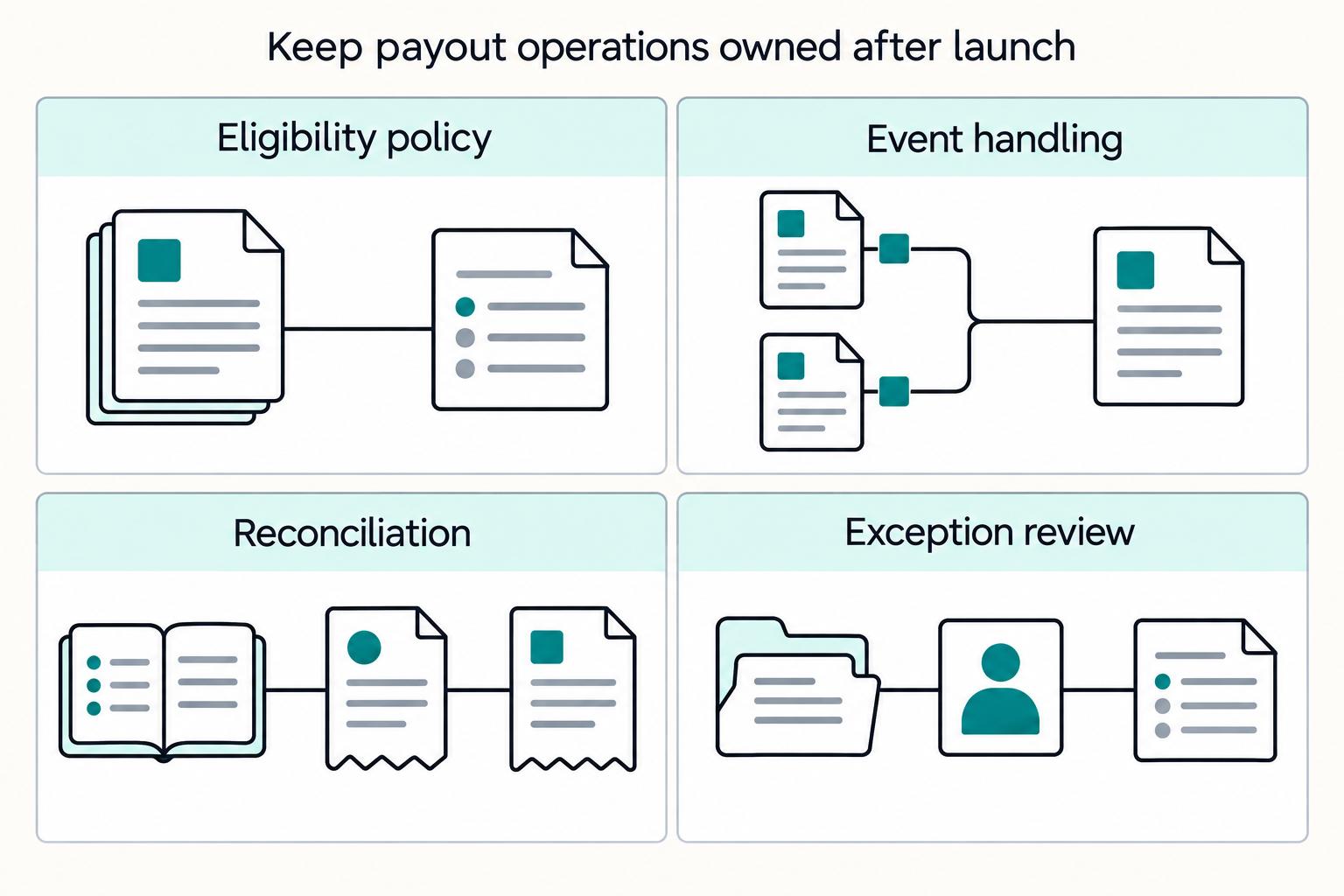
When Instant Payout Matters for Gig Platform Payments
Instant payout is a tool, not the goal. The real operating decision is where instant timing creates measurable value, where batch timing is enough, and where both should run side by side.
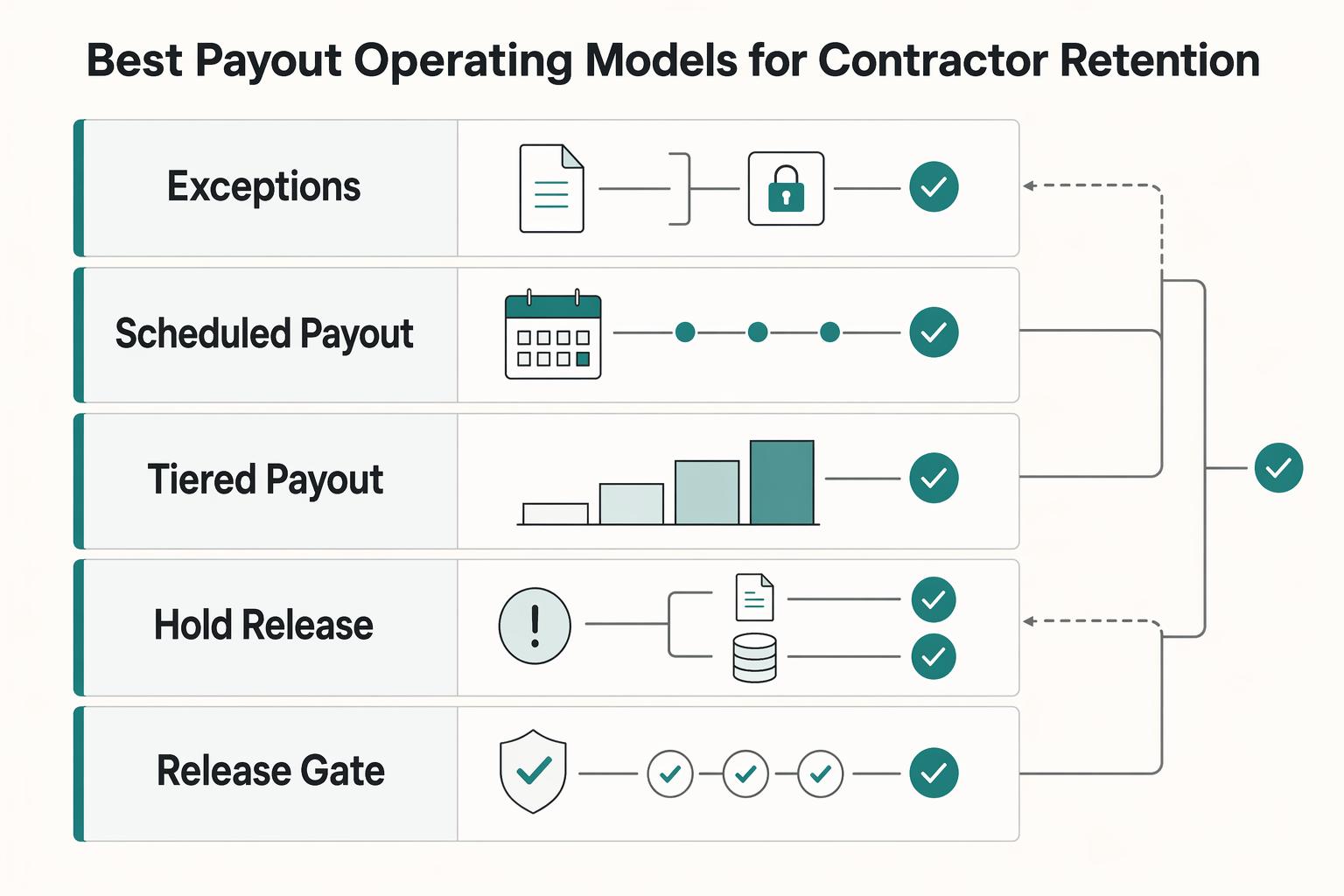
Bad Payouts Are Costing Your Supply in Two-Sided Platforms
Payout issues are not just an accounts payable cleanup task if you run a two-sided marketplace. They shape supply-side trust, repeat participation, and fill reliability. They can also blur the revenue and margin signals teams rely on.