
Quick Answer
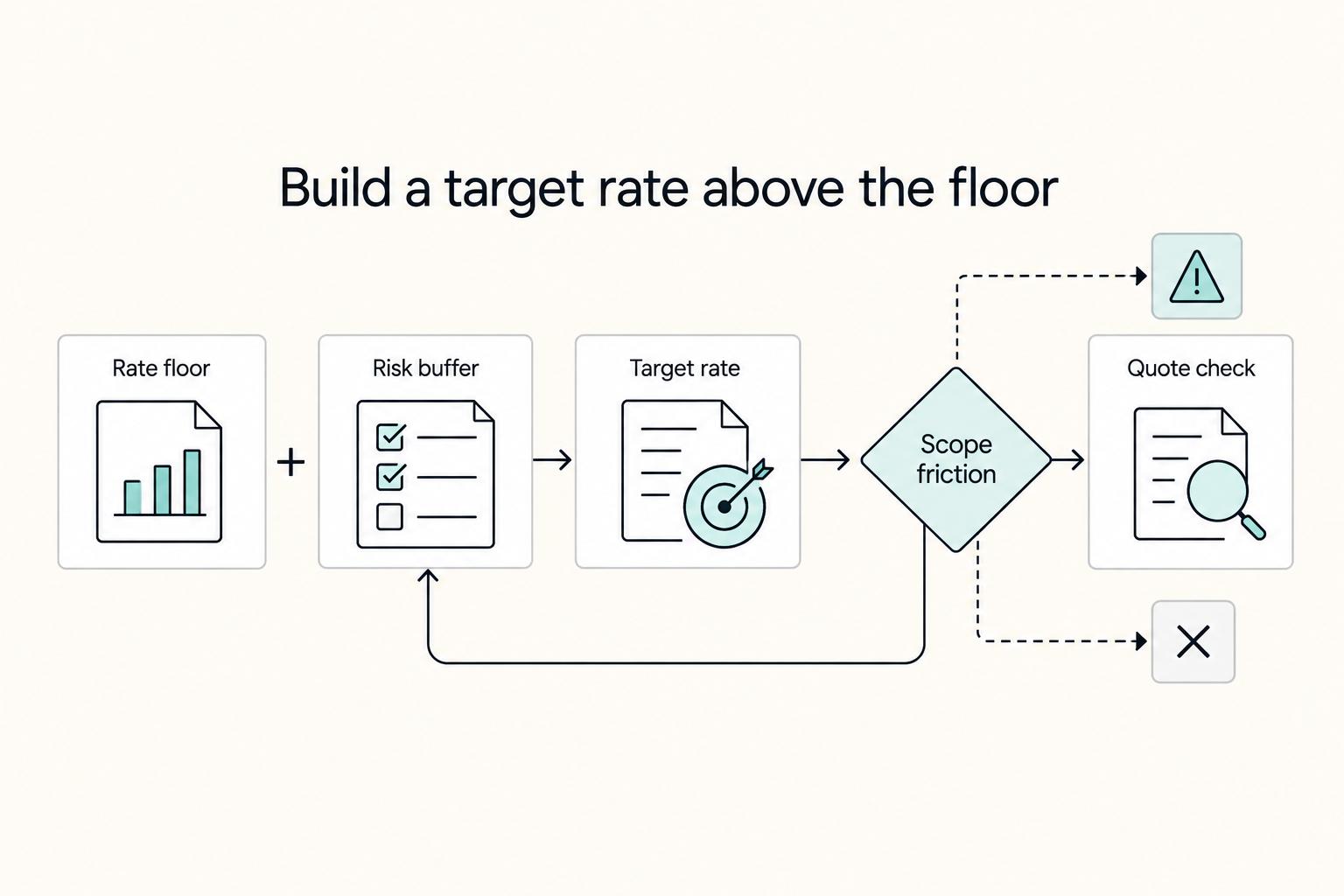
Calculate your floor first: annual required gross income divided by annual billable hours. Then set a target that includes delay risk, dispute risk, and non-billable load, and choose hourly, project, or value-based format based on scope clarity. Before sending, run a delayed-payment scenario and confirm your effective hourly result still clears the floor.
Calculate a rate you can actually get paid on#
A workable rate is not the neat number a calculator produces. It is the number that still works after you account for real billable capacity, non-client time, scope drift, and the gap between sending an invoice and receiving cleared cash. Start with hourly math even if you do not plan to bill hourly, then turn that number into a quote with clear payment terms.
Keep these three numbers separate from the start:
- Survival floor: the minimum hourly figure that covers living costs and business overhead.
- Target rate: your floor plus room for taxes, non-billable time, and profit.
- Client-facing quote: what the client sees, often hourly when scope is moving, or a
project rateorvalue-based pricingsetup when scope and outcomes are clear.
Do not blend them into one number. Each one does a different job. The floor tells you whether the work is viable at all. The target protects margin when delivery takes longer or payment arrives later than expected. The client-facing quote is the format the buyer reacts to and negotiates against. Once you separate those roles, pricing gets simpler. You stop asking one number to solve every problem.
Most calculators use the same few inputs: desired annual income, billable hours, and non-client time. That makes the output look objective even when the assumptions are weak. Precision on the screen can hide bad inputs. If the billable-hours assumption is wrong, the result can still look tidy and still fail in practice.
One common mistake is dividing salary by 2,080 hours and stopping there. Freelance billable capacity is usually lower than that. If you work 40 hours and bill 25, your effective rate drops by about 40%. That is why the math has to reflect your actual delivery pattern, not a full-utilization payroll assumption.
The pricing model matters too. Hourly can be the cleanest choice when scope is still moving, but it can cap upside once you get faster. Project or value-based pricing can improve upside when scope or outcomes are clear, but only if the quote also covers hidden time, approvals, and payment timing. In any model, the number only works if the terms match how and when money is supposed to land.
The sequence here is deliberate. First get the math right. Then pick the right pricing model. Then translate it into terms and payment operations you can actually run. Finally, pressure-test the whole thing against one real client scenario before it leaves your inbox.
Decision checkpoint before send#
- Recheck that the quote stays above your survival floor with your current billable-hours assumption.
- Match the pricing model to scope clarity. Moving scope can stay hourly, stable scope can move to project or value-based pricing.
- Put payment timing and triggers in writing inside the quote.
- Stress-test one bad month. If cash arrives later than planned, confirm you can still cover core obligations.
What to prepare before you run any calculator#
Most pricing mistakes start before the calculator opens. Weak inputs create weak quotes, and no polished proposal will rescue bad assumptions. If the prep is loose, the rate will be loose too.
The fix is simple. Build one reusable input sheet and keep it current. That sheet should hold your annual expenses, expected working time, billable capacity, and a short note on when each number was last updated. Then, when a quote feels aggressive or too thin, you can inspect the assumptions instead of guessing where the problem is.
This prep work also gives you a stable baseline across clients. Without it, every quote turns into a fresh debate with yourself about how much time you really have, how much unpaid work you absorb, and whether last month was normal. With it, you can price faster and revise with more confidence when conditions change.
Use this setup before you touch any rate calculator:
- Set your annual expenses baseline. Combine living and business costs into one yearly number. If the estimate feels shaky, track actual expenses for a month or two and annualize from there. The point is not perfect forecasting. It is to get close enough that your floor reflects the business you actually run.
- Estimate realistic work weeks per year. Use your own calendar history for holidays, sick days, vacation, and slow periods instead of assuming 52 full weeks. The more your work comes in waves, the more important this step becomes.
- Define weekly hours and measure utilization from tracked time. For recent weeks, tag hours as billable and non-billable, including admin and marketing. That gives you a view of billable capacity based on observed time, not hope.
- Use those inputs consistently in one calculator or template. Keep annual expenses, work weeks, work hours, and utilization together. If the output looks too high or too low, audit the inputs before you change the quote.
Capture the assumptions in one place before you price a deal. Add a short note on when each input was last updated and what changed. That one habit makes later corrections much easier, especially when your workload shifts and the old numbers stop matching reality.
Overestimating available hours is one of the fastest ways to underprice yourself into burnout. Use tracked data, not optimism, and treat the sheet as a living tool rather than a one-time exercise.
Step 1 set your survival floor rate#
Set the floor from your own costs first, not from competitor headlines or a client's budget. Your minimum hourly rate should come from annual costs and realistic billable hours, because that is what tells you whether the work supports the business.
Use this formula and save the result in your quote sheet as Floor rate:
Annual required gross income ÷ Annual billable hours = Minimum hourly floor
This is not your sales pitch. It is your viability line. If a quote falls below it, the issue is not persuasion or negotiation technique. The issue is that the work does not support the business as currently structured.
Keep the floor calm and mechanical. You are not trying to justify yourself to the market here. You are answering a simpler question: what is the minimum rate that keeps the business standing if the work is delivered as planned?
Build the floor in four actions#
- Sum your annual required income. Add personal and business expenses, then add a tax buffer that fits your filing context. One example uses $48,000 plus $8,000, then a 30% buffer, for $88,400 required gross income. Use the example to understand the method, not as your default.
- Set billable capacity conservatively. Do not assume every work hour is billable. In the same example, 2,000 work hours at a 0.65 billable ratio gives 1,300 annual
billable hours. That assumption matters as much as the expense total, because even a good cost estimate will fail if the hours are inflated. - Run the math and save the number. With those inputs, $88,400 ÷ 1,300 = $68 per hour minimum. Save it as an internal number in your quote sheet so you can compare every draft against it.
- Cross-check arithmetic in a rate calculator. Use a calculator to sanity-check the numbers, then keep your own sheet as the working version. The calculator helps catch errors. Your sheet holds the assumptions you need to revisit later.
Keep the worksheet practical by separating must-pay costs from less urgent items. That makes downside checks faster, especially when you need to answer a hard question like whether one delayed payment threatens core obligations or just slows discretionary spending.
If your floor comes out above what your current market usually accepts, resist the reflex to cut it immediately. Recheck the assumptions first. A weak billable-hours estimate, an outdated expense number, or an unrealistic work-weeks figure can distort the result. If the math still holds, the answer may be to change scope, client mix, or pricing model, not to quote below viability.
Before you move on, pressure-test a weak month. If delayed payment would break core obligations even at this floor, revise the inputs now rather than discovering the gap after a client has already said yes. Once the floor is credible, the next variable is whether your billable-hours assumption is credible too.
Step 2 set billable hours you can sustain#
Sustainable billable hours are the variable that breaks most quote math. If the floor is built on hours you cannot actually deliver, it is not a floor. It is a fiction with a spreadsheet attached.
A lot of underpricing starts here because this error is easy to hide. The rate can look healthy on paper while the capacity behind it is impossible to repeat. In practice, this is why freelancers can feel busy all week and still end up earning less than planned. The hours were real. The billable share was not.
Start from available weeks, then subtract non-billable load#
Start with the work time you truly have, then remove the time that never makes it onto an invoice. Plans built on 2,080 hours per year or 160 hours per month usually assume full utilization, and any plan that depends on billing 160 hours every month is fragile.
Build the assumption in order:
- Mark available work weeks.
- Set total working hours across those weeks.
- Subtract non-billable time explicitly. Admin, invoicing, and bookkeeping alone can take 10-15%.
- Use the remainder as planning
billable hours, not your best-month output.
A practical range is often 25-35 billable hours per week, or about 60-70% of total worked time. That is not a universal rule. It is simply a more useful starting point than pretending every working hour is billable.
The real value of this step is not the range itself. It is the discipline of making non-billable work visible. Admin, follow-up, proposal work, and the basic maintenance of the business still consume hours, whether you name them or not. If you leave them out, they do not disappear. They just show up later as unpaid labor.
Use a conservative assumption when utilization is inconsistent#
When utilization swings, price from the month you can repeat without overload, not from the month that only looked great on paper. The lower end of your normal billable-hours assumption is usually the safer planning input.
A simple test helps. Compare a recent normal month with a recent peak month. If the quote only works when you perform at peak capacity, the assumption is too optimistic. Build the rate around the month you can sustain, then treat peak months as upside instead of the minimum needed to survive.
This is where many freelancers quietly undercut themselves. They remember the weeks when work was full and admin felt invisible, then they price as if that rhythm will continue all year. It rarely does. A conservative utilization assumption is not pessimism. It is what keeps a decent rate from collapsing as soon as you hit a slower week, a sick day, or a burst of unpaid coordination.
Protect your project rate from hidden time#
Hidden time is what turns a fixed fee into a weak deal. Quoting from full-time assumptions and then absorbing non-billable work after kickoff compresses your effective rate. If you work 40 hours and bill 25, your effective rate drops by about 40%.
Before you send a fixed quote, run a short hidden-time check:
- Compare planned
billable hourswith recent tracked time. - If utilization is unusually high without evidence, lower the hours assumption.
- Recalculate and confirm the price still clears your floor.
- If it does not, adjust scope, timeline, or price before negotiating terms.
That last step is where the real decision sits. If the math no longer works, do not try to save the quote with confidence alone. Fix the math or the scope first. Once you have a floor built on hours you can actually sustain, you can add a target buffer for risk instead of guessing at one.
Step 3 build your target rate with a risk buffer#
Your floor keeps you viable. Your target keeps you stable when normal project friction shows up. That is why the target should sit above the floor for reasons you can explain, not just because a higher number feels safer.
Think of it this way: the floor answers, "Can I survive this work?" The target answers, "Can I deliver this work, absorb predictable friction, and still end up where I meant to?" Those are different questions, and they deserve different numbers.
Convert floor into a target you can defend#
Treat the floor as a checkpoint, not your outward-facing quote. Add a separate risk buffer for known uncertainty, delivery risk, and the routine drag of real projects.
Do not just repeat your last pricing setup. Reassess risk for each engagement. If you quote a fixed project rate in a high-uncertainty engagement, you need enough buffer or your effective hourly rate will be squeezed by unplanned work.
Write down why the buffer exists in this quote. A short note tied to identified risk gives you a basis during negotiation and helps you avoid dropping the buffer under pressure while leaving the risk unchanged. It also keeps the target from turning into a vague markup you cannot defend.
That note matters. A buffer linked to scope uncertainty, approval drag, or payment timing is much easier to hold than a vague markup with no stated purpose.
Adjust for client friction before you quote#
Price known friction before it hits your calendar.
- If project risk is above baseline, raise the target or tighten
payment terms. - If scope or approval flow is unclear, raise the target or narrow scope.
- If uncertainty is low and terms are clear, keep the buffer lean but explicit.
When multiple flags appear together, do both. Raise the target and tighten the terms. A higher number alone will not solve approval delays or scope ambiguity, and better terms alone will not protect margin if the work is likely to expand.
The point is simple: friction is part of the job, so price it as part of the job. Do not wait for the client to prove that approvals are slow or that requests will sprawl. If the risk is already visible, it belongs in the quote.
Run a delayed-payment checkpoint before sending#
Payment timing is part of pricing, even when the rate itself looks fine. Before you send the quote, test whether the target still works if one payment slips.
- Build the quote at your current target.
- Move one expected payment into a delay scenario.
- Recalculate your effective
hourly ratefor that period. - Confirm it still clears your floor.
- If it does not, raise the target, tighten terms, or both before sending.
This checkpoint is worth doing because payment problems rarely announce themselves in advance. A target rate that only works when every invoice lands exactly on time is thinner than it looks. Better to find that out in your draft than in the middle of delivery.
Step 4 choose hourly project or value based pricing for this scope#
Now choose the pricing model for this deal. The same underlying rate behaves differently depending on whether scope is moving, fixed, or tied to a client outcome. Good pricing is not only about the number. It is also about choosing the format that fits the work.
| Model | Core logic | Practical consideration |
|---|---|---|
hourly rate | Price is tied to time. | Most common and usually easy for clients to understand. |
project rate | Price is tied to a defined scope of work. | Use it intentionally for this engagement, not by default. |
value-based pricing | Price is tied to value created for the client. | Shifts the conversation from time spent to client value. |
Use a practical tie-breaker when two models seem equally viable. Choose the one that best fits this client and scope, and do it on purpose rather than by habit.
A common failure mode is defaulting to the last model you used. Compare options for this scope before you quote, including hourly, fixed price or fixed scope, and value-based. If you bill hourly today and are not ready to switch, even a modest increase can be a reasonable interim move while you tighten your process elsewhere.
The right choice is usually less glamorous than people expect. If scope is moving, hourly may be the cleaner choice because it absorbs change without forcing constant renegotiation. If scope is stable, a project rate may protect upside and make approval simpler. If the value created is the clearest part of the deal, value-based pricing may fit better. What matters is not sophistication. What matters is whether you can manage the risks the model creates.
That is the operator view of pricing model choice. Every model comes with a different failure mode. Hourly can punish speed. Fixed pricing can hide extra work until it is too late. Value-based structures can get vague if the scope is fuzzy. Pick the one whose tradeoffs match the shape of the engagement, then carry that choice into terms the client can actually approve and you can actually run.
Expected outcome for Step 4: you can name the chosen model and explain why it fits this client and scope.
Step 5 turn your rate into terms clients can agree to and you can enforce#
A good rate can unravel quickly when payment timing, pause rights, or dispute handling are vague. Once you choose the model, the next job is to package it into terms the client can understand and you can actually manage.
This is where pricing stops being arithmetic and becomes operations. The client needs to know what they are buying, when they will be billed, what changes trigger more cost, and what happens if payment or approvals stall. You need the same clarity to protect delivery, margin, and cashflow once the work starts.
Convert the quote into concrete payment terms#
If your billing logic is unclear, the client will fill in the blanks. That usually creates avoidable friction later, so turn the rate into payment mechanics the client can review in one pass.
Start from the rate you need to earn, then shape the client-facing terms around the model you chose.
For an hourly pricing model (time & materials / cost plus), make the billing logic easy to follow. For fixed price, fixed scope (flat fee), keep the commercial structure tied to the defined work. For value based, keep the logic clear enough that the client can understand what they are paying for and how the price relates to the engagement.
That does not mean reopening the model decision. It means translating the model into something concrete enough to review, approve, and operate against. The best rate in the world still creates friction if the client cannot tell when they will be billed, what triggers payment, or how changes are handled.
A useful test is whether someone outside the sales conversation could read your quote and understand the money flow without a call. If not, the terms probably need another pass.
Add a late payment fee clause and a pause trigger#
Many quotes get too casual here. If late payment or non-payment would disrupt delivery, address it before kickoff.
The exact clause mechanics depend on your contract and legal review, so do not assume tough-sounding wording is automatically enforceable. The practical move is to make the business intent clear without overstating the legal effect.
Use this as a working check:
- Confirm the pricing model is intentional for this project.
- Check the model against risk, earnings, and positioning goals.
- Make sure the client can quickly understand how price works.
- Do not assume late-fee or pause-work wording is automatically enforceable.
The goal is not to sound aggressive. It is to avoid discovering, mid-project, that everyone interpreted payment consequences differently. A clear pause trigger is often less about confrontation and more about preserving a shared operating rule when things go sideways.
Set dispute boundaries before kickoff#
Disputes get expensive when no one defines the edges early. Set those edges before work starts.
Define scope, approvals, and change handling clearly, and avoid assuming any single wording is universally enforceable. For chargeback events, define an internal process for notification and documentation without promising a specific outcome.
This section is less about legal theory and more about operational clarity. If you know who approves work, how changes are raised, and how payment issues are documented, you reduce the chance that a small problem turns into a stalled project.
It also keeps your team, or just you, from improvising under pressure. When a dispute appears, you should already know what gets documented, who responds, whether work pauses, and what needs to happen before delivery resumes. That clarity belongs in the setup, not in the scramble after an invoice goes bad.
Expected outcome for Step 5: your rate is packaged into a project-specific pricing model clients can review quickly, with enforcement-sensitive details flagged for legal review.
Step 6 choose payment operations that reduce delays and fee leakage#
Terms decide what should happen. Collection mechanics decide what actually happens. Once pricing and quote terms are set, choose payment operations based on client context, not habit.
This step is easy to ignore because it feels separate from pricing, but it is not. Fee leakage, reconciliation confusion, delayed settlement, and reversal risk all change what you really keep. If the commercial terms are strong but the collection method is sloppy, the rate on paper will still underperform.
Match collection rails to client type in India#
Start with a default rail for each client segment, then compare options against the same criteria: fee exposure, settlement certainty, reversal risk, and documentation workload.
| Client situation | Start with | Validate before finalizing |
|---|---|---|
| New client, smaller invoice, wants fast checkout | Card payment or payment link | Fee impact, reversal handling, and how clearly payment status can be tracked |
| Established repeat client, larger invoices | Bank transfer | Reconciliation clarity, payer instructions, and dispute handling |
| Mixed client base with different invoice patterns | Split rails by segment | Whether either rail creates avoidable delay or fee drag in that segment |
The comparison context here is India-focused. Keep the decision logic, then recheck local payment and documentation realities before applying it in other markets.
You are not looking for one perfect rail. You are trying to stop using the same collection method for every client out of convenience. New clients, repeat clients, small invoices, and large invoices often create different tradeoffs. Choose intentionally.
Assess compliance and documentation fit before changing rails#
Treat rail changes as a fit decision, not an automatic upgrade. A faster-looking option is not always better if it adds recordkeeping or tax-document work you are not prepared to absorb.
Document three checks before deciding:
- Who owns invoicing and payment records.
- Who handles compliance and tax-document work in the current setup versus the new one.
- Whether the speed, certainty, and fee tradeoffs justify added complexity.
If those answers are still fuzzy, keep the simpler setup until volume or complexity makes the tradeoff clearer. Complexity should earn its place.
This is a good place to stay a little conservative. Faster checkout means very little if you lose visibility into payment status or create documentation work you cannot maintain cleanly at month end.
Map cash commitments to cleared cash#
This is a plain cashflow rule, and it saves a lot of pain: base internal cash commitments on cleared client cash, not expected cash.
Committing funds before related payments settle creates avoidable pressure, especially when settlement timing varies or reversal risk exists. Use one consistent operating rule and stick to it: confirm settlement status before releasing funds tied to that revenue.
That may feel cautious, but it is easier to explain a short internal delay than to unwind a commitment made against money that has not really arrived. This is especially important when payment status can look complete before the funds are fully settled.
Run a pre-scale visibility checkpoint#
Before you scale volume on any rail, make sure you can see each payment state clearly and pull usable history when something goes wrong.
- Invoice issued
- Payment initiated
- Payment settled
- Reversal or dispute state
If any of those states is hard to verify, fix that gap before scaling. Otherwise delay risk and fee leakage compound quietly.
After your first few invoices on a new rail, compare expected fees and settlement timing against what actually happened. If reality is worse than planned, adjust the rail choice or the pricing assumptions before the drift becomes recurring margin loss. Strong terms help, but clean visibility is what lets you prove whether the money path is working the way you expected.
Step 7 add compliance and tax checks before sending the final quote#
A quote can be commercially sound and still stall at signature if compliance and tax ownership are unclear. Lock that path before the final version goes out.
This is not busywork. It is part of quote readiness. If verification, tax forms, or cross-border checks surface after the client has approved the commercial terms, the deal can slow down for reasons that have nothing to do with your price. That is frustrating for the client and dangerous for your forecast. A clean front-door process prevents that kind of avoidable delay.
Add front-door KYC, KYB, and AML checks#
If KYC, KYB, or AML checks apply, capture them during intake and reflect them in your timeline. This is a front-door task, not a cleanup task.
Use this pre-quote check:
- Who is being verified, individual, business, or both.
- Which documents are required for that path.
- Who reviews submissions.
- What marks verification as complete.
- What happens to kickoff timing if review is still pending.
That keeps verification from becoming an invisible dependency that suddenly blocks the project after the commercial terms are already agreed. It also makes the client experience smoother, because you are not asking for important documents in a rush after they thought the deal was basically done.
Lock the tax-document path before signature#
Do not leave tax-document ownership vague. Confirm the tax-document path before quote delivery with your tax or finance owner.
This section is not where you decide when W-8 versus W-9 applies, or whether Form 1099 reporting is required, because those decisions depend on the specific arrangement. For cross-border work, add a short VAT note with one owner and one timing checkpoint to confirm treatment.
The goal is simple: one person owns the path, and that path is known before signature. Even when the final answer depends on the arrangement, ownership should not. That is the piece that prevents last-minute confusion.
Capture FEIE and FBAR considerations with exact thresholds#
If FEIE is relevant to your planning, record the constraints clearly: the physical presence test applies to both U.S. citizens and U.S. residents, and one test uses at least 330 full days in a 12 consecutive month period; a full day is a 24-hour period from midnight to midnight. If you miss the required days, you fail this test regardless of reason, and time in a foreign country while in violation of U.S. law does not count as qualifying presence. Excluded foreign earned income is still reported on a U.S. tax return, and FEIE is claimed on Form 2555.
For FBAR, document the trigger exactly: if the maximum value of one foreign account, or the aggregate maximum across foreign accounts, exceeds $10,000 at any time in the year, an FBAR must be filed. If the maximum never reaches $10,000, an FBAR is not required. Use a reasonable approximation of each account's greatest yearly value; periodic account statements can be used when they fairly reflect the yearly maximum.
These are not details to reconstruct under deadline pressure. If they matter to your situation, capture them once in a form you can actually use. The threshold, the form, and the owner should all be visible without another research loop.
Keep one document pack for these checks so nothing has to be rebuilt late in the process. The pack should show required forms, owner, status, and proof of completion in one place. That single view reduces last-minute blockers at signature and makes it easier to see whether the quote can move without operational surprises.
Run the final compliance checkpoint before send#
- If applicable,
KYCorKYBorAMLscope, owners, and completion evidence are defined. - The tax-document path is assigned and validated for the specific engagement.
- Cross-border
VATownership and timing are documented where relevant. FEIEandFBARnotes include thresholds and filing references.- Quote timing accounts for any unresolved compliance items.
If you want a deeper dive, read The Silent Profit Killer: How to Stop Margin Erosion in Your Freelance Business.
Step 8 pressure test one real client scenario before you quote#
Clean pricing math can hide a lot. Running one real client scenario usually shows what the spreadsheet missed. Approve a quote only if pricing, terms, and delivery still hold together under normal friction.
Use a live prospect or a recent deal, not a clean hypothetical. Put your floor, target, chosen model (hourly rate or project rate), payment method, and draft terms on one sheet. Include payment processing costs in the math, because per-payment fees such as 2.9% + $0.30 can erode margin even when the headline rate looks fine.
Then test scope and terms together, not separately. Scope creep is undocumented expansion without matching changes to timeline, budget, or resources, and it often starts with vague SOW language or weak change control. If your draft cannot clearly separate a billable contract variation from a casual request, the quote is not ready.
| Red flag trigger | What it usually signals | Tighten before sending |
|---|---|---|
| Approvals are slow or ownership is unclear | Weak project governance can let small, unapproved requests accumulate | Name one approver, set response windows, and define what happens if feedback stalls |
| SOW language is vague | Misinterpretation risk rises and scope can expand informally | Define deliverables, exclusions, and acceptance criteria in plain language |
| Small additions are requested without timeline, budget, or resource changes | Scope creep instead of a formal, billable contract variation | Require a documented change request before adding work |
| Payment processing fees are missing from quote math | Net revenue can drop from per-payment charges | Add expected fees before finalizing price |
Set an internal escalation gate: if multiple flags appear, tighten terms first. If the client resists basic scope and change-control protections, consider declining instead of discounting.
That last point matters because discounting the price does not solve the underlying risk. If approvals are slow, scope is fuzzy, and payment handling is unclear, a lower number usually makes the deal worse, not easier. Pressure testing is where you decide whether the commercial structure matches the actual behavior of the client.
Capture each pressure-test result in a short deal note: which lane failed, what changed, and whether the revision fixed it. Over a few cycles, those notes show whether margin problems come from math, scope control, payment terms, or client fit. That record also makes later pricing changes smarter, because you can see which type of issue is recurring instead of treating every difficult project as a one-off.
The final checkpoint is binary: approve only when math, terms, and operations all pass in one review. If any lane fails, revise before sending.
Common pricing mistakes and how to recover fast#
Most pricing mistakes are not theory problems. They are process problems. The fastest recoveries usually come from fixing assumptions, model choice, or terms before you start cutting the headline number.
- Copying calculator output straight into the proposal.
Calculator output is a starting point, not a final quote. Rework the number using your actual expenses and realistic working days, then sanity-check take-home rather than just gross. If you work in a U.S. tax context, account for self-employment tax and decide upfront how quarterly estimated tax payments will be covered.
- Treating hourly billing as the default for every project.
Hourly billing can create incentive problems because getting faster can reduce billable time, and over time it can cap upside. At the same time, hourly or daily billing are standard options and can be the cleanest fit in the right situation. The fix is not to ban hourly pricing. It is to choose the model case by case and make the tradeoff explicit before you quote.
- Optimizing for headline rate instead of net income.
A higher posted rate does not guarantee better take-home pay. Build the quote around what you keep after taxes and business costs, then adjust the rate or workload assumptions until the net number works. This is especially important when fees, unpaid time, or tax handling quietly reduce what looks like a strong rate.
- Taking online pricing advice at face value.
Generic advice can miss your actual context. Use it as input, then pressure-test it against your own expenses, working days, tax plan, and target take-home before sending a proposal. Advice is useful when it sharpens your numbers, not when it replaces them.
When you spot one of these mistakes, fix that lane before you touch the rate. Most recoveries come from cleaner assumptions and better model selection, not reflexive discounting. If you lower the number before you correct the setup, you usually end up preserving the mistake and reducing the margin at the same time.
Final check before sending: net math works, your pricing model matches the incentive you want, estimated-tax handling is planned, and key assumptions were validated instead of copied.
Copy and paste pre client rate checklist#
Use this right before sending a quote. If any item is unclear, pause and fix it first. The point of a checklist is not bureaucracy. It is to catch the quiet problems that show up only after the client has already accepted.
- Confirm numbers before client-facing pricing.
Keep your floor hourly rate, target rate, and pricing model (project rate or value-based pricing) in one place. Pressure-test your effective hourly rate by including unpaid work such as admin and payment follow-up. If discovery is incomplete, use a rate range first and lock final pricing only after the missing details are clear. If you raise prices, expect to lose some deals.
- Confirm scope controls before fixed pricing.
Define deliverables, revision cap, acceptance criteria, and out-of-scope handling in writing. For added requests, include a written change-order trigger so extra work becomes billable. Add a time buffer, for example 20%, before finalizing effort-based pricing.
- Confirm terms before kickoff commitments.
Include payment terms, such as deposit language, milestone timing, and late-fee language where appropriate, in the same version the client reviews. Add a dispute path for payment issues and assign ownership for responses and work pauses during disputes. Keep these as clarity and process controls, not guaranteed legal outcomes.
- Confirm operations and compliance dependencies.
Document how payments will be collected and handled, especially for international transfers and tax-compliance support. Assign each dependency to an owner and deadline before kickoff. If anything depends on verification, tax documents, or a rail change, make that visible before the quote becomes a promise.
Print this checklist or pin it beside your quote sheet so you actually use it every time, not only on high-stakes deals. Consistency is what turns pricing quality into repeatable margin. You want the routine quote to be as disciplined as the big one.
Final send check: numbers still work after unpaid time, scope boundaries are explicit, terms are written, and operational dependencies are assigned.
Before sending the quote, turn your checklist into a client-ready scope and terms draft with the freelance contract generator.
Make your rate defensible before you make it higher#
Raise pricing only when your assumptions still hold under real delivery conditions. Do not chase one perfect number. Build a defensible range, then verify that the price, terms, and delivery approach still work when projects get messy.
That is the thread through this whole process. First get the floor from your real costs. Then set billable hours you can actually sustain. Add a target buffer for normal friction. Choose the model that fits the scope. Turn it into terms and payment operations you can run. Lock the compliance and tax path. Then pressure-test the whole thing against one real deal. By the time you raise the number, you should know exactly what is supporting it.
Use the same pre-send sequence for every client so you test engagement fit, not just price sensitivity.
- Stress-test the math before you pitch. Include taxes, non-billable time, expenses, and planned time off. Review billable-hours assumptions directly, because planning on 40 billable hours every week creates underpricing risk.
- Choose a setup you can defend when conditions change. Check whether the price and terms still fit the project, client, and deadline. If assumptions move, update them before you send the quote.
- Filter client fit before you raise price. A defensible rate needs a defensible engagement. If a client pushes only for lowest cost and resists clear scope or terms, treat that as a risk signal. Tighten boundaries first, hold your number, and walk away when the deal no longer supports your assumptions.
Run this sequence on every quote and log where deals fail: math, assumptions, or fit. That pattern helps you spot margin and cashflow pressure over time. If you want to diagnose leakage before your next rate change, review related pieces on margin erosion and raising rates without losing clients.
Related: Raising Your Rates: How to Do It Without Losing Clients.
Frequently Asked Questions
How do I calculate my freelance rate if my workload changes month to month?
Start with a rate that still works in lower-capacity periods, not just your busiest month. Include unpaid business work such as proposals and intro calls, and leave room for sick time or burnout recovery. Then sense-check against market research by industry, project type, qualifications, experience, and location, without treating benchmarks as hard rules.
What is the difference between a minimum hourly rate and a target rate?
There is no universal formula for this split, so treat both as internal planning thresholds. One practical framing is that a minimum rate is your floor to avoid underpricing, while a target rate is a higher number you aim for when possible.
How many billable hours should I assume as a solo freelancer?
There is no universal billable-hours number for solo freelancers. Build your assumption from your own calendar, then subtract non-billable operations time before pricing. If assumptions drift from reality, update them.
When should I use hourly pricing instead of a project rate?
No single rule decides this every time. Compare models in part by admin burden: day-rate pricing can reduce constant hour tracking for some freelancers. In some markets, buyers offer set rates, so your pricing options can be constrained.
What should I include besides salary when setting my rate?
Include unpaid operations time and coverage for non-working periods such as illness or burnout recovery. These costs are part of delivering consistent client work even when they are not directly billable. Ignoring them can contribute to underpricing.
How do I protect cashflow if clients pay late or dispute invoices?
Keep rate assumptions conservative enough that unpaid operations time does not push you into underpricing.
Can I use value-based pricing without taking on unlimited scope risk?
If scope is unclear, use a pricing approach you can revisit once details are firm.
Watch
Calculate Your Freelance Rate the Strategic Way
Try a related tool
Researched and edited by the Gruv editorial team. Gruv builds cross-border billing, payouts, and finance-operations software for global businesses.
Sources
Includes 2 external sources outside the trusted-domain allowlist.
- bls.gov/oestrusted
- federalregister.gov/documents/2026/02/27/2026-03962/employee-or-...trusted
- fincen.gov/reporting-maximum-account-valuetrusted
- irs.gov/businesses/small-businesses-self-employed/es...trusted
- irs.gov/instructions/i1040ssetrusted
- upwork.com/tools/freelance-rate-calculatorexternal
- upwork.com/resources/upwork-hourly-ratesexternal
Educational content only. Not legal, tax, or financial advice.
Related Posts

Stop Freelance Profit Margin Erosion Before It Hits Cashflow
Revenue can hold steady while the business underneath it gets weaker. What comes in matters, but what you keep after the work is delivered is the clearer signal of health.

Raising Your Rates: How to Do It Without Losing Clients
Before finalizing execution decisions, validate wording against guidance from [pon.harvard.edu](https://www.pon.harvard.edu/daily/negotiation-skills-daily/principled-negotiation-focus-interests-create-value/), [law.cornell.edu](https://www.law.cornell.edu/wex/mutual_assent), [hbr.org](https://hbr.org/2021/06/if-youre-going-to-raise-prices-tell-customers-why).

The Freelance Payment Penalty: A Modeled Audit of Platform Fees, FX Spreads, and Payout Delays
The money rarely disappears through a single, easy-to-spot fee. The real loss is stacked. A marketplace takes its commission, a processor adds a charge for international cards, a bank or payment company converts the currency at a spread, a platform holds the funds before release, and a wire sheds a little to intermediaries on the way in. Each layer looks defensible on its own, but the worker feels the combined result as a smaller deposit and a later payday.