
Quick Answer
Authorization can reserve card funds; capture submits the amount for processing; settlement and payout are later movements with distinct evidence. KYC verifies customer identity while AML covers broader financial-crime controls. Use the 200 definitions below to identify the terms your flow uses, then assign an owner and link each consequential term to a provider field, policy, contract or reporting record.
200 platform payment terms and how to use them#
Authorization can reserve card funds; capture starts the next payment step; a payout sends an available amount to a destination account. Confusing those events produces bad cash forecasts and premature 'paid' messages. The 200 numbered entries below define payment terms and give an operator check for each, followed by guidance on ownership, system labels and verification.
| Team | Need from glossary |
|---|---|
| Founders | separate real launch blockers from items that can wait |
| Product | labels that match user-visible states |
| Engineering | terms tied to actual integration points |
| Finance and ops | definitions that still make sense when payments fail, payouts delay, or reports do not match what support sees |
These are plain-language definitions for orientation. Provider fields, accounting policies, contracts and applicable law can add specific meanings or requirements. Use the definition to ask a precise implementation question, then attach the source and example from your own stack when the answer affects money movement.
For example, a founder deciding whether to promise same-day seller payment needs the payout rail and usable balance, not just a successful card authorization. Product can display 'payment authorized' while finance tracks the uncaptured amount and engineering records its expiry. That shared record is more useful than renaming every stage 'success.'
The promise each entry should keep#
Each term should answer three things quickly:
- what it is
- where it appears in your flow
- what breaks if you get it wrong
Read the terms that your flow uses first#
Forty entries are marked 'Start' as a suggested first pass for a marketplace accepting cards and paying sellers. The other 160 are marked 'Scope': review them whenever your actual rail, country, billing model or risk program uses them. This is an editorial reading order, not a claim that only 40 terms can block launch.
It also has boundaries. Coverage depends on what is enabled in your stack and the programs or markets you operate in. Terms related to Open Banking, Virtual Accounts, or some tax workflows may be central in one implementation and irrelevant in another.
The operator checkpoint before release#
If your flow uses a term that is missing from the glossary, record a draft definition and ask the responsible domain owner to validate it against the relevant source. Escalate legal interpretation to counsel when necessary; ordinary API vocabulary does not need a legal approval queue.
The glossary: 200 terms by workflow#
Each numbered entry has a definition and an operator check. 'Start' marks 40 suggested first-pass terms; 'Scope' marks 160 further entries to review whenever your product uses them. The checks are practical suggestions. They do not change contract, regulatory, provider or accounting requirements.
1–20: Card acceptance#
PCI SSC payment terminology, Stripe authorization/capture guidance and CPMI terminology. Checks below are suggested operating actions, not universal provider rules.
| Term | Meaning | Operator check | Reading order |
|---|---|---|---|
| 1. Authorization | Issuer approval that can reserve card funds. | Check expiry before scheduling fulfillment. | Start |
| 2. Capture | Submission of an authorized amount for payment processing. | Separate capture success from bank receipt. | Start |
| 3. Clearing | Exchange and calculation of payment obligations. | Map clearing records to the later settlement. | Start |
| 4. Settlement | Transfer of funds to discharge payment obligations. | Identify which parties and accounts have settled. | Start |
| 5. Refund | Merchant-initiated return of an earlier payment. | Link the refund to its original charge. | Start |
| 6. Chargeback | Card dispute that can reverse a payment. | Assign an evidence owner and response deadline. | Start |
| 7. Issuer | Institution that provides the customer's payment card. | Record issuer declines separately from gateway errors. | Start |
| 8. Acquirer | Institution responsible for merchant card acceptance. | Name the contracted entity and incident contact. | Start |
| 9. Acquirer processor | Service processing transactions for an acquirer. | Trace technical routing to the acquiring relationship. | Scope |
| 10. Card network | System connecting issuers and acquirers under network rules. | Check network-specific transaction requirements. | Scope |
| 11. Payment gateway | Interface transmitting payment data to processing services. | Keep gateway acceptance distinct from issuer approval. | Scope |
| 12. Payment service provider (PSP) | Business supplying payment-processing or related services. | Verify the services and regulated entities contracted. | Scope |
| 13. Merchant ID (MID) | Identifier assigned to a merchant processing relationship. | Use the correct MID when retrieving transactions. | Scope |
| 14. Merchant category code (MCC) | Classification of a merchant's business activity. | Check that the classification matches actual activity. | Scope |
| 15. Card-not-present (CNP) | Card transaction without physical card presentation. | Apply controls suited to remote purchases. | Scope |
| 16. Card-present | Transaction using a physically presented card or device. | Keep its rules separate from online checkout. | Scope |
| 17. Customer-initiated transaction (CIT) | Payment actively initiated by the cardholder. | Record the customer's participation and consent. | Scope |
| 18. Merchant-initiated transaction (MIT) | Merchant payment initiated under an existing agreement. | Retain the mandate and relevant transaction linkage. | Scope |
| 19. Authorization reversal | Instruction releasing an earlier authorization hold. | Confirm the issuer/provider handling of released funds. | Scope |
| 20. Partial capture | Capture for less than the authorized amount. | Check whether another capture is actually supported. | Scope |
21–40: Bank rails and transfers#
Nacha's ACH developer guide, RTP network information and FedNow overview. Bank support, rail rules and provider cutoffs determine your actual flow.
| Term | Meaning | Operator check | Reading order |
|---|---|---|---|
| 21. ACH | U.S. network for electronic bank-account credits and debits. | Plan processing windows and return handling. | Start |
| 22. ACH credit | ACH entry pushing funds to a receiving account. | Verify beneficiary details before submission. | Start |
| 23. ACH debit | ACH entry collecting funds from another account. | Retain authorization and handle debit returns. | Start |
| 24. RTP | The Clearing House's U.S. instant-payment network. | Check participant reach and recipient support. | Start |
| 25. FedNow | Federal Reserve instant-payment service for participating institutions. | Confirm the provider offers the needed capability. | Start |
| 26. Wire transfer | Bank transfer through a wire-payment system. | Verify instructions before an irreversible submission. | Start |
| 27. Same Day ACH | ACH service with same-day processing windows. | Check eligibility, cutoffs and actual availability. | Scope |
| 28. ODFI | Originating Depository Financial Institution in an ACH flow. | Identify the institution originating your entries. | Scope |
| 29. RDFI | Receiving Depository Financial Institution in an ACH flow. | Route recipient-side exceptions to the appropriate contact. | Scope |
| 30. Originator | Party initiating an ACH entry. | Identify who is authorized to originate payments. | Scope |
| 31. Receiver | Party whose account is affected by an authorized ACH entry. | Keep account ownership evidence with the instruction. | Scope |
| 32. ACH return | Entry sent back under ACH return rules. | Use the reason code to choose the next action. | Scope |
| 33. ACH reversal | Correction of an eligible erroneous ACH entry. | Do not treat it as a general cancellation right. | Scope |
| 34. Return code | Code identifying why a bank payment was returned. | Preserve the code instead of a generic failure label. | Scope |
| 35. SEC code | ACH Standard Entry Class identifying an entry category. | Match the payment context and authorization method. | Scope |
| 36. Prenotification | Non-monetary ACH entry used to check account details. | Handle returned prenotes before using those details. | Scope |
| 37. Microdeposit verification | Account check using small deposits and confirmation. | Track verification separately from payout eligibility. | Scope |
| 38. Mandate | Recorded authority for a payment or collection. | Check scope, revocation and required notices. | Scope |
| 39. Request for payment | Message asking a payer to initiate payment. | Do not record the request itself as collected funds. | Scope |
| 40. Cutoff time | Deadline for a provider's processing window. | Record timezone, banking calendar and submission buffer. | Scope |
41–60: Accounts, cross-border payments and FX#
Swift's explanation of messaging and the FCA's AIS/PIS definitions. Account structures and conversion terms require the selected provider's contract.
| Term | Meaning | Operator check | Reading order |
|---|---|---|---|
| 41. Virtual account | Account identifier used to attribute or route funds. | Verify whether it represents a separate bank account. | Start |
| 42. Beneficiary | Person or entity intended to receive funds. | Validate the recipient independently of a display name. | Start |
| 43. IBAN | International Bank Account Number used in participating countries. | Validate country format without assuming ownership. | Scope |
| 44. BIC | Business Identifier Code identifying an institution or entity. | Check the code required for the chosen transfer. | Scope |
| 45. ABA routing number | Nine-digit U.S. bank-routing identifier. | Use the routing number supported for that rail. | Scope |
| 46. Account number | Identifier for an account at an institution. | Protect it and verify changes before paying. | Scope |
| 47. Correspondent bank | Bank providing services to another bank. | Track intermediary fees and transfer references. | Scope |
| 48. Intermediary bank | Bank between sending and receiving institutions. | Identify its role when investigating a delayed payment. | Scope |
| 49. SWIFT | Network for secure financial messages; it does not move funds. | Distinguish message delivery from beneficiary credit. | Scope |
| 50. Nostro account | A bank's account held with another bank. | Identify whose books and balance are being discussed. | Scope |
| 51. AISP | Account Information Service Provider offering consolidated account information. | Verify consent, permissions and applicable regulatory status. | Scope |
| 52. PISP | Payment Initiation Service Provider initiating an account payment order. | Separate initiation permission from account-information access. | Scope |
| 53. Foreign exchange (FX) | Conversion between currencies. | Record both amounts and the applied exchange rate. | Scope |
| 54. FX quote | Proposed conversion rate and associated terms. | Check expiry, fees and guaranteed recipient amount. | Scope |
| 55. FX spread | Difference between a quoted rate and a reference rate. | State the reference used when comparing providers. | Scope |
| 56. Basis point (bp) | One hundredth of one percentage point. | Calculate 50 bp as 0.5%, not 50%. | Scope |
| 57. Presentment currency | Currency used to charge the customer. | Display it before the customer authorizes payment. | Scope |
| 58. Settlement currency | Currency used for the relevant settlement balance. | Reconcile conversion separately from the original charge. | Scope |
| 59. Open Banking | Framework for authorized access to bank information or payment services. | Specify jurisdiction, consent scope and the actual service. | Scope |
| 60. Remittance information | Information identifying what a payment covers. | Carry invoice references through to finance matching. | Scope |
61–80: Marketplace funds and obligations#
Stripe's marketplace refund/dispute guidance illustrates why charge, transfer, payout and liability must be distinguished. The definitions here describe concepts; they do not establish that your provider supplies escrow or safeguarding.
| Term | Meaning | Operator check | Reading order |
|---|---|---|---|
| 61. Split payment | Allocation of one payment among multiple recipients. | Define allocation and liability before choosing API calls. | Start |
| 62. Transfer | Movement between specified accounts or provider balances. | Do not label every transfer as a bank payout. | Start |
| 63. Payout | Disbursement to a recipient or external account. | State which destination and completion evidence apply. | Start |
| 64. Platform fee | Amount earned by the platform under its agreement. | Separate it from seller proceeds and taxes. | Start |
| 65. Seller payable | Amount the platform owes a seller. | Track the obligation even before payout eligibility. | Start |
| 66. Reserve | Funds withheld under defined risk or settlement terms. | Record calculation, ownership and release conditions. | Start |
| 67. Rolling reserve | Reserve accumulated from transactions and released over time. | Track each cohort's release date and adjustments. | Scope |
| 68. Payout schedule | Rule determining when disbursements are initiated. | Separate schedule from bank-arrival guarantees. | Scope |
| 69. Payout batch | Group of payout instructions processed together. | Keep individual outcomes when a batch partly fails. | Scope |
| 70. Escrow | Arrangement holding assets subject to defined release conditions. | Verify legal structure; a delayed payout is not automatically escrow. | Scope |
| 71. Safeguarding | Protection of relevant customer funds under applicable rules. | Confirm the regime and provider's actual arrangement. | Scope |
| 72. Merchant of Record (MoR) | Entity responsible for the customer sale in the applicable model. | Confirm contractual role, refunds, tax and dispute duties. | Scope |
| 73. Payment facilitator (PayFac) | Model enabling submerchant payment acceptance through acquiring arrangements. | Verify sponsor, onboarding duties and liability. | Scope |
| 74. Connected account | Provider account associated with a platform integration. | Map permissions and balances for that account type. | Scope |
| 75. Submerchant | Merchant participating through an intermediary acceptance model. | Keep its identity and applicable onboarding records. | Scope |
| 76. Application fee | Provider-specific fee mechanism used by some platform APIs. | Check fee ownership and refund behavior. | Scope |
| 77. Transfer reversal | Movement reversing an earlier provider transfer. | Check available balance and original-transfer linkage. | Scope |
| 78. Negative balance | Balance below zero after charges or adjustments. | Identify who must fund it under the agreement. | Scope |
| 79. Prefunding | Providing funds before payment execution. | Check usable liquidity without treating it as extra cash. | Scope |
| 80. Netting | Offsetting eligible obligations to produce a net amount. | Retain gross entries and authority for the offset. | Scope |
81–100: Compliance and risk review#
FATF's Recommendations and OFAC's Sanctions List Service provide primary context. Actual obligations follow the applicable regime and obliged entity. FinCEN's CDD framework is a U.S. covered-financial-institution example, not a mandate for every marketplace.
| Term | Meaning | Operator check | Reading order |
|---|---|---|---|
| 81. KYC | Know Your Customer: identity-related customer checks. | Record verified facts, outstanding requirements and review dates. | Start |
| 82. KYB | Know Your Business: checks concerning a business customer. | Link entity details, ownership and authorized representatives. | Start |
| 83. AML | Anti-money-laundering controls against illicit financial activity. | Keep onboarding, monitoring and case handling connected. | Start |
| 84. CDD | Customer due diligence assessing identity and relationship risk. | Document the risk assessment and required evidence. | Start |
| 85. EDD | Enhanced due diligence for higher-risk circumstances. | Name the additional checks and approving reviewer. | Start |
| 86. Beneficial owner | Natural person ultimately owning or controlling a legal entity. | Apply the actual regime's ownership/control criteria. | Start |
| 87. Sanctions screening | Checking parties against applicable sanctions restrictions. | Use current lists and a documented review procedure. | Scope |
| 88. PEP | Politically exposed person requiring context-sensitive risk assessment. | Do not equate PEP status with wrongdoing. | Scope |
| 89. Transaction monitoring | Review of transactions for suspicious or prohibited patterns. | Track alerts through investigation and disposition. | Scope |
| 90. SAR | Suspicious Activity Report under the applicable U.S. regime. | Restrict access and follow confidentiality requirements. | Scope |
| 91. STR | Suspicious Transaction Report under applicable local rules. | Assign jurisdiction-specific filing responsibility. | Scope |
| 92. Risk-based approach | Controls scaled to assessed financial-crime risk. | Record why the selected controls fit the relationship. | Scope |
| 93. Risk score | Model output representing assessed risk. | Document inputs, limits and human override authority. | Scope |
| 94. False positive | Alert that review determines does not indicate the target risk. | Measure review outcomes rather than suppressing unexplained alerts. | Scope |
| 95. Compliance hold | Restriction based on a defined compliance requirement. | Record the basis, scope, owner and release criteria. | Scope |
| 96. Case disposition | Recorded outcome of a review or investigation. | Preserve reasoning, evidence and authorized decision-maker. | Scope |
| 97. Source of funds | Origin of funds used in a transaction. | Request evidence appropriate to the assessed risk. | Scope |
| 98. Source of wealth | How a person accumulated their overall wealth. | Avoid substituting it for a transaction-specific funds check. | Scope |
| 99. AMLD5 | EU's fifth anti-money-laundering directive, 2018/843. | Check applicable national law and subsequent regime changes. | Scope |
| 100. Regulatory reporting | Submission of required information to an authority. | Identify the obliged entity, deadline and report format. | Scope |
101–120: Authentication and payment-data security#
PCI SSC terminology and EMVCo's 3DS overview distinguish data protection from authentication. Check the current standard and your actual assessment scope.
| Term | Meaning | Operator check | Reading order |
|---|---|---|---|
| 101. 3-D Secure (3DS) | Protocol for authenticating consumers in online card payments. | Record authentication outcome separately from payment approval. | Start |
| 102. PCI DSS | Payment Card Industry Data Security Standard. | Determine actual data scope and assessment obligations. | Start |
| 103. Frictionless flow | 3DS authentication without an interactive cardholder challenge. | Do not count every 3DS attempt as an extra checkout step. | Scope |
| 104. Challenge flow | 3DS interaction requesting additional cardholder authentication. | Track completion and abandonment separately. | Scope |
| 105. Access Control Server (ACS) | Issuer-domain3DS component handling authentication decisions. | Keep authentication records linked to the payment attempt. | Scope |
| 106. AVS | Address Verification Service comparing submitted billing-address details. | Treat the result as a signal, not proof of identity. | Scope |
| 107. CVC/CVV | Card verification value/code used in relevant card checks. | Do not retain sensitive authentication data after authorization. | Scope |
| 108. PAN | Primary Account Number identifying the payment card. | Avoid logging full card numbers. | Scope |
| 109. BIN/IIN | Leading card-number identifier associated with an issuing institution. | Do not confuse it with bank-account routing. | Scope |
| 110. Tokenization | Replacement of card data with a substitute token. | Verify token type and remaining security scope. | Scope |
| 111. Network token | Payment token used within a card-network token system. | Check lifecycle updates and permitted usage. | Scope |
| 112. Cardholder data | Card data whose minimum core is the full PAN. | Inventory where it is stored, processed or transmitted. | Scope |
| 113. Sensitive authentication data | Security data such as verification codes and full track data. | Apply storage prohibitions and handling requirements. | Scope |
| 114. Cardholder data environment (CDE) | Systems storing, processing or transmitting cardholder data. | Include connected systems that can affect its security. | Scope |
| 115. SAQ | Self-Assessment Questionnaire for eligible PCI DSS validation. | Choose eligibility from the actual integration, not preference. | Scope |
| 116. AOC | Attestation of Compliance documenting a PCI assessment result. | Check entity, service scope and assessment date. | Scope |
| 117. QSA | Qualified Security Assessor recognized by PCI SSC. | Use an assessor qualified for the required review. | Scope |
| 118. Encryption | Transformation protecting readable data with cryptographic keys. | Manage key access separately from encrypted storage. | Scope |
| 119. MFA | Authentication using multiple distinct factor types. | Do not count two passwords as two independent factors. | Scope |
| 120. Account takeover | Unauthorized control of a legitimate user's account. | Review login, profile changes and payout-destination changes together. | Scope |
121–140: APIs, events and reliable execution#
Stripe webhook guidance, idempotency documentation and the ISO 20022 framework. General engineering concepts below need a specific implementation contract.
| Term | Meaning | Operator check | Reading order |
|---|---|---|---|
| 121. API | Application Programming Interface exposing defined software operations. | Pin the supported contract and version. | Start |
| 122. Webhook | HTTP notification sent to an application when an event occurs. | Verify origin and durably record it before acknowledging. | Start |
| 123. Idempotency | Repeated equivalent requests avoid repeating an operation's effect. | Check endpoint support and key lifetime. | Start |
| 124. Idempotency key | Identifier used to associate retries with one operation. | Preserve an internal operation record beyond provider retention. | Start |
| 125. Event ID | Identifier for an emitted event. | Use it to detect repeated deliveries. | Scope |
| 126. Request ID | Identifier for an individual API request or trace. | Link it to the durable payment-operation ID. | Scope |
| 127. Correlation ID | Identifier joining related work across systems. | Carry it through logs, approvals and reconciliation. | Scope |
| 128. Retry | Another attempt following failure or an unclear response. | Recover original status before initiating a new payment. | Scope |
| 129. Exponential backoff | Retry delay increasing across successive attempts. | Add limits and jitter to avoid retry storms. | Scope |
| 130. Rate limit | Restriction on request frequency or volume. | Queue work and handle throttling explicitly. | Scope |
| 131. Timeout | Client stops waiting before a result is received. | Treat the result as unknown, not automatically failed. | Scope |
| 132. At-least-once delivery | Delivery model allowing an event more than once. | Make consumers tolerate duplicates. | Scope |
| 133. Deduplication | Detection and suppression of repeated processing. | Use durable identities, not payload timing alone. | Scope |
| 134. Out-of-order event | Event arriving after a later event for the same object. | Check version/current state before applying a stale update. | Scope |
| 135. Webhook signature | Cryptographic check of notification integrity and origin. | Validate using the required raw payload and secret. | Scope |
| 136. Replay | Processing an earlier request or event again. | Control side effects and preserve original references. | Scope |
| 137. State machine | Defined states and allowed transitions for an object. | Specify pending, failed, unknown and terminal outcomes. | Scope |
| 138. Eventual consistency | Related systems converge after updates propagate. | Track reconciliation gaps during that interval. | Scope |
| 139. Dead-letter queue | Storage for messages needing intervention after processing failure. | Assign an owner and a safe reprocessing path. | Scope |
| 140. ISO 20022 | Standardization framework for financial business messages. | Validate the actual message version and implementation guide. | Scope |
141–160: Ledgers, cash and reconciliation#
These are basic accounting concepts, followed by suggested reconciliation checks. Stripe's balance report is a concrete provider example, not the authority for every entity's accounting policy.
| Term | Meaning | Operator check | Reading order |
|---|---|---|---|
| 141. Ledger | Record of financial entries and balances. | Identify the ledger authoritative for each obligation. | Start |
| 142. Double-entry bookkeeping | Recording transactions with equal debits and credits. | Check balance by currency and accounting entity. | Start |
| 143. Reconciliation | Comparison and resolution of differences between records. | Match provider, bank and internal evidence. | Start |
| 144. Cash balance | Money recorded in an account at a point in time. | Distinguish available, restricted and pending amounts. | Start |
| 145. Journal entry | Dated accounting entry recording a financial transaction. | Retain source references and approval where needed. | Scope |
| 146. Debit | Left-side accounting entry; normally increases assets/expenses and decreases liabilities/equity/revenue. | Do not assume a debit always means cash leaving. | Scope |
| 147. Credit | Right-side accounting entry; normally increases liabilities/equity/revenue and decreases assets/expenses. | Interpret it using the account type. | Scope |
| 148. Chart of accounts | Structured list of an entity's accounting accounts. | Separate platform revenue, seller liabilities and cash. | Scope |
| 149. Subledger | Detailed supporting record for a general-ledger account. | Reconcile its total to the controlling account. | Scope |
| 150. Accounts receivable | Amounts customers owe the entity. | Track due dates without counting invoices as cash. | Scope |
| 151. Accounts payable | Amounts the entity owes suppliers or other counterparties. | Keep liabilities visible until discharged or validly adjusted. | Scope |
| 152. Accrued revenue | Revenue earned but not yet billed, distinguished from billed, unpaid receivables. | Apply the accounting policy for recognizing and reclassifying the accrued amount. | Scope |
| 153. Deferred revenue | Liability for consideration received before revenue is earned. | Separate collection date from performance timing. | Scope |
| 154. Gross amount | Amount before specified deductions. | State which refunds, fees and taxes are excluded. | Scope |
| 155. Net amount | Amount remaining after specified deductions. | Publish the exact gross-to-net calculation. | Scope |
| 156. Processing fee | Cost charged for payment processing. | Record provider fees separately from platform fees. | Scope |
| 157. Settlement report | Report describing settlement entries for its defined scope. | Check currency, period and what its totals include. | Scope |
| 158. Unmatched transaction | Entry without a corresponding expected record. | Assign an investigation owner and aging threshold. | Scope |
| 159. Suspense account | Temporary accounting account for unresolved classification. | Clear items with evidence; do not use it to hide losses. | Scope |
| 160. Liquidity | Ability to meet obligations with available funds. | Model timing gaps and avoid counting restricted balances. | Scope |
161–180: Billing and operating metrics#
Metric definitions depend on the reported population and policy. Stripe Billing analytics demonstrates configurable definitions; document yours instead of assuming all dashboards calculate the same number.
| Term | Meaning | Operator check | Reading order |
|---|---|---|---|
| 161. Invoice | Document requesting payment for specified goods or services. | Keep issued, due and paid statuses separate. | Start |
| 162. Subscription | Agreement for recurring provision and associated billing. | Define renewal, access and cancellation terms. | Start |
| 163. Billing period | Interval used to calculate recurring charges. | Record boundaries, timezone and service dates. | Scope |
| 164. Proration | Adjustment for a partial period or changed service. | Preview credits and charges before confirming a change. | Scope |
| 165. Credit note | Document reducing a previously invoiced amount. | Link it to the invoice and applicable tax treatment. | Scope |
| 166. Dunning | Process pursuing collection of overdue or failed payments. | Respect payment permissions and cancellation choices. | Scope |
| 167. Payment retry schedule | Policy for later attempts to collect a payment. | Track attempts without duplicating the debt. | Scope |
| 168. Usage-based billing | Charges calculated from measured consumption. | Preserve meter events and the applicable rate. | Scope |
| 169. Billing meter | Defined measurement of billable usage. | Specify units, aggregation and correction rules. | Scope |
| 170. MRR | Monthly recurring revenue normalized under a stated policy. | Exclude one-off amounts and define paused/unpaid treatment. | Scope |
| 171. ARR | Annualized recurring revenue under a stated policy. | Do not present annualization as guaranteed future collections. | Scope |
| 172. ARPU | Average revenue per user for a specified population and period. | State whether users means paying, active or eligible accounts. | Scope |
| 173. Churn | Loss of customers or revenue over a defined period. | Name the population, denominator and measurement window. | Scope |
| 174. Net revenue retention (NRR) | Retained cohort revenue including expansion and contraction. | Compare the same starting cohort and exclude new customers. | Scope |
| 175. Gross revenue retention (GRR) | Retained cohort revenue excluding expansion. | Separate contraction and churn from upsell. | Scope |
| 176. GMV | Gross merchandise value transacted under a stated definition. | Specify refunds, taxes and excluded transactions. | Scope |
| 177. Take rate | Platform revenue divided by the defined transaction-value base. | Use compatible amounts and the same period. | Scope |
| 178. Authorization rate | Approved authorizations divided by relevant authorization attempts. | Define deduplicated attempts and excluded errors. | Scope |
| 179. Dispute rate | Disputes divided by a specified payment count or value. | Use the provider/network denominator and timing rules. | Scope |
| 180. Contribution margin | Revenue less the defined variable costs. | Include losses, support and incentives consistently. | Scope |
181–200: Tax documents and reporting#
Use current IRS forms/instructions, the FinCEN FBAR guidance and EU DAC7 guidance. These entries explain terms, not universal filing or payout requirements.
| Term | Meaning | Operator check | Reading order |
|---|---|---|---|
| 181. Form W-9 | U.S. taxpayer-identification and certification form. | Collect it for the appropriate payee/reporting context. | Scope |
| 182. Form W-8BEN | Foreign-individual status and beneficial-owner certificate. | Do not substitute it for every U.S.-service treaty claim. | Scope |
| 183. Form W-8BEN-E | Foreign-entity status and beneficial-owner certificate. | Use entity classification rather than an individual's form. | Scope |
| 184. Form W-8ECI | Certificate concerning effectively connected income. | Have tax review confirm that this treatment applies. | Scope |
| 185. Form W-8IMY | Certificate for intermediaries and certain flow-through recipients. | Check supporting allocations and documentation. | Scope |
| 186. TIN | Taxpayer Identification Number. | Protect the identifier and verify the appropriate type. | Scope |
| 187. EIN | Employer Identification Number for a U.S. tax account. | Keep it distinct from a person's SSN or ITIN. | Scope |
| 188. Form 1099-NEC | Information return for reportable nonemployee compensation. | Check tax-year rules, exceptions and payment method. | Scope |
| 189. Form 1099-K | Information return for reportable payment-card/network transactions. | Do not equate reported payments with taxable profit. | Scope |
| 190. Form 1042-S | Return for reportable foreign-person U.S.-source income. | Review source, income code, rate and exemptions. | Scope |
| 191. Backup withholding | Required withholding on specified reportable payments/conditions. | Calculate required withholding and pay/remit the respective amounts. | Scope |
| 192. Form 8233 | Nonresident individual's qualifying personal-service treaty withholding claim. | Follow review and submission procedures before exemption. | Scope |
| 193. Tax treaty | Agreement allocating specified taxing rights between countries. | Check residence, income article and eligibility facts. | Scope |
| 194. Tax residency | Status determining tax connections under relevant law or treaty. | Do not infer it solely from a payout-bank country. | Scope |
| 195. FATCA | U.S. foreign-account tax reporting and withholding framework. | Determine whether institutional or individual duties apply. | Scope |
| 196. Form 8938 | Statement of specified foreign financial assets for covered taxpayers. | Do not confuse it with FBAR or routine payee onboarding. | Scope |
| 197. FBAR | FinCEN report concerning reportable foreign financial accounts. | Assess taxpayer/account facts separately from payout eligibility. | Scope |
| 198. Schedule SE | U.S. schedule calculating self-employment tax. | Keep a payee's personal filing separate from platform reporting. | Scope |
| 199. FEIE | Foreign earned income exclusion for qualifying individuals. | It does not remove all reporting or self-employment tax. | Scope |
| 200. DAC7 | EU platform-operator seller due-diligence/reporting framework. | Check covered operator/activity/seller scope and reporting deadlines. | Scope |
How to use this glossary without slowing your launch#
Use the numbered tables as a reference while reviewing your payment flow. Pick one transaction or seller account and identify the terms its records actually use. Add provider-specific field names and statuses to your internal glossary rather than reading all 200 entries as a launch checklist.
Map terms to real workflow surfaces#
Group terms by workflow category instead of keeping one undifferentiated list. That makes them faster to find and easier to apply. For each launch-critical term, identify where it appears in practice: an onboarding step, an API field, a provider dashboard label, a finance export column, or a support queue status.
Treat disputed terms as decisions, not wordsmithing#
When a definition changes a response, document the decision. AVS compares billing-address data with issuer-held information; a mismatch is a fraud signal, not conclusive evidence of fraud. Risk should decide how that signal affects the relevant checkout, while product and support use wording that accurately describes the result.
Keep approved wording in a dedicated definitions or methodology appendix so teams know where the canonical version lives.
Record source context and escalation rules before go-live#
High-impact terms need more than a shared phrase. Keep a lightweight evidence pack for key terms that includes the approved definition, where it appears, and an example record.
A suggested 40-term first pass, with 160 further terms by scope#
A term is launch-critical when a current dependency needs it. A bank-only marketplace can prioritize ACH and its return handling over card capture; a regulated open-banking product may need AISP/PISP scope immediately. Promote any 'Scope' entry your actual flow depends on.
| Workflow | Resolve before launch when used | Decision to verify |
|---|---|---|
| Card acceptance | Authorization, capture, refund, chargeback, issuer and acquirer | Which event permits fulfillment, when funds become available, and who owns disputes |
| Seller disbursement | Transfer, payout, platform fee, seller payable and reserve | Which amounts are owed, eligible and actually received |
| Bank payments | ACH credit/debit, RTP, FedNow or wire transfer | Authorization, reach, cutoffs, finality and exception handling |
| Onboarding and risk | KYC, KYB, AML, CDD, EDD and beneficial owner | Which facts and policies permit activity; who resolves an exception |
| Reliable execution | API, webhook, idempotency and idempotency key | How duplicate requests/events and unknown results are recovered |
| Finance | Ledger, double-entry bookkeeping, reconciliation and cash balance | Which record proves the obligation, provider movement and bank receipt |
A practical triage rule#
Put a term into first-pass launch review when it can change a legal reading, a contract duty, or a go-live decision gate. Defer it when it mainly improves optimization or reporting and no current artifact depends on it.
A practical triage rule#
Prioritize a term when misunderstanding it can change a current amount, recipient, authorization, deadline or incident response. Terms that have no present dependency can wait, but tax, security and regulatory obligations do not become optional because a reading-order label says 'Scope.'
For each term, keep a small evidence pack with:
- approved internal wording
- controlling source context, statutory and contract where applicable
- one real artifact where the term is used, such as a field label, template, or contract clause
That keeps plain-language guidance usable while staying aligned to the definitions that control real decisions.
Payment flow terms that break launches when misunderstood#
A plain-language definition is the starting point. Keep the source, example field, owner and decision alongside it so the team can explain how it applies in this implementation.
Payment-flow labels are not interchangeable. Before go-live, lock Authorization, Capture, Chargeback, Acquirer, and Acquirer Processor to one approved internal wording, then map each one to the exact provider document, contract language, webhook or event name, and finance field your team actually uses.
Do not reuse a success label from one step as proof that every later step is complete. Keep each state label tied to its own event and report context, and document where that label is authoritative in your stack.
Keep state labels separate#
Keep payment-state language separate from nearby terms such as ACH, 3-D Secure (3DS), AVS, BIN, and PCI DSS. Once those categories get mixed into payment-state naming, triage gets noisy and ownership gets blurry.
For Acquirer and Acquirer Processor, keep one internal map that answers three practical questions:
- which counterparty owns the label
- which dashboard, report, or file shows it first
- who escalates when card acceptance fails
What to verify before go live#
Before launch, run one terminology check across the artifacts teams actually rely on:
- user-facing product copy after pay, fail, refund, and dispute outcomes
- webhook or event names engineering consumes
- finance report columns used for cash, fees, and exceptions
- the controlling provider or contract wording when meaning is disputed
If labels differ across those artifacts, keep the difference only when it is deliberate and documented.
Use the official source when wording affects legal interpretation#
If a term depends on a regulation, retain the applicable official text and effective-date context rather than relying on an article's citation alone. Record the interpretation your program actually follows and who reviewed it. A historical rule number does not establish that the same rule is in force for your current product.
Bank rails and account infrastructure terms that change settlement behavior#
Rail labels should map to real settlement evidence, not generic status text. Keep ACH, RTP, and SWIFT separate in your product, ops, and finance views so your team can tell users what actually happened.
A payment rail carries instructions and funds under its own participation and processing rules. Institutions can connect through operators, correspondent banks or service providers; both customer banks need not be direct members of one network. Record the route your provider uses and the evidence available for each stage.
Compare rails by grounded behavior and explicit unknowns#
| Rail | Grounded in this section | What to verify in your stack before go live |
|---|---|---|
| ACH | U.S. batch-oriented credits and debits, including eligible same-day processing | Submission windows, authorization, return rules and when funds are actually available |
| RTP/FedNow | Distinct U.S. instant-payment networks/services operating around the clock | Your provider's sending/receiving support, destination reach, finality and exception process |
| SWIFT-based transfer | Secure financial messages supporting bank-to-bank instructions; Swift itself does not move funds | Message acceptance, intermediary handling and beneficiary credit are different milestones |
Keep account primitives separate in implementation#
Use account identifiers for their actual purpose: ABA routing numbers identify U.S. bank routing, IBAN identifies an account in participating countries, and BIC identifies an institution or entity. BIN/IIN belongs to card issuing, not bank-account routing. Format validation does not prove that an account belongs to the intended payee.
Treat Virtual Accounts as a reconciliation test, not a promise#
A virtual account can help attribute incoming payments, but its legal/account structure depends on the provider. Follow one payment from the assigned identifier through the provider entry, invoice match and ledger posting. Verify account ownership, permitted use and protection of funds before describing it to customers as their bank account.
Risk and authentication terms that control approval and fraud exposure#
In card-not-present checkout, 3-D Secure (3DS) and Address Verification Service (AVS) are controls you tune, not badges you enable and forget. They can reduce fraud exposure, but they can also add checkout friction.
What each term is doing in a card-not-present flow#
A card-not-present transaction is one where the physical card is not shown and card data is sent remotely, for example online. In that context, a transaction can still become a chargeback after approval, so approval alone does not remove post-approval loss risk.
| Term | What it does | Important note |
|---|---|---|
| 3DS | Protocol authenticating consumers in online card transactions | Can be frictionless or involve a challenge; authentication is separate from authorization |
| AVS | Comparison of submitted billing-address details with issuer data | A signal for review, with availability and results varying by issuer/provider |
| ACS | Issuer-domain Access Control Server in a 3DS flow | Map its authentication outcome to the subsequent payment attempt |
EMV 3DS supports authentication in online card payments. A frictionless flow can complete without an interactive challenge; a challenge flow asks for additional authentication, such as a one-time code or biometric confirmation. A successful result does not guarantee approval or remove every kind of dispute.
The ACS is the issuer-domain component involved in deciding or performing 3DS authentication. Use your provider's exposed result and reference fields to link authentication to the payment attempt. Do not infer bank settlement from an authentication success.
Approval, fraud, and friction move together#
Separate the effect of authentication from the effect of an interactive challenge. Review completion, abandonment, approval and later fraud outcomes for the relevant cohort before changing the configuration. A payment may use 3DS without adding a visible customer step.
When fraud pressure rises, review where losses are concentrated and tighten controls in those paths first. When approvals fall without clear fraud improvement, review your current 3DS and AVS configuration and checkout experience before adding more friction.
For any single transaction, support, ops, and finance should be able to see the same facts: whether 3DS was invoked, whether authentication was completed, what AVS returned, and whether a later chargeback occurred.
Incident checklist for triage#
- False declines: Sample recent declines, verify whether 3DS and AVS outcomes are present in gateway responses, and check for checkout abandonment around extra authentication steps.
- Account takeover signals: Look for patterns where legitimate users fail authentication or where billing details change in suspicious ways, then confirm which 3DS events your provider exposes.
- Post-authorization fraud review: Sample approved transactions that later became chargebacks and compare authorization records with available 3DS and AVS outcomes to find repeat patterns.
Compliance terms that trigger policy gates and onboarding delays#
Do not collapse compliance into a generic "passed compliance" badge. These states can gate onboarding and payouts, so they need to stay separate and evidence-backed.
KYC identifies and verifies customers; KYB describes checks on a business, its ownership and representatives. AML is the broader program of controls against money laundering and related financial crime, including due diligence, monitoring and case handling. The FATF Recommendations are international standards implemented through jurisdiction-specific measures, not a single universal platform policy.
Do not collapse KYC, KYB, and AML into one status#
Keep separate machine-readable states for KYC, KYB, and AML so a hold can be explained and resolved quickly. If your admin only shows "compliance pending," teams cannot tell what changed, who owns the next action, or what evidence is missing.
If payouts are compliance-gated, do not promise external timeline SLAs until those states are visible and consistent across ops, support, and finance surfaces.
Jurisdiction and program setup can change obligations#
Do not treat shorthand labels like 5th Anti-Money Laundering Directive (AML5) as self-executing policy. AML5 obligations, thresholds, and market applicability require official legal text and counsel-approved program interpretation.
If a policy restricts money movement, record the actual obligation, scoped restriction and authorized review process. A screening hit may need investigation; it is not automatically a confirmed sanctioned person. Keep the evidence needed to explain the decision without exposing confidential reporting details to unauthorized teams.
Map each gate term to retrievable evidence#
If a term can block money movement, map it to auditable artifacts your team can retrieve quickly.
| Term in ops tooling | Required visible state | Evidence to retrieve |
|---|---|---|
| KYC | current KYC status | verification result, review notes, approval or hold status, timestamp |
| KYB | current KYB status | review result, linked documents, reviewer notes, approval or hold status |
| AML | current AML case status | screening or alert result, disposition, hold or release decision, audit trail |
Use named checkpoints, not vague compliance language#
Name the actual checkpoints in your program: identity verified, ownership reviewed, screening disposition recorded, monitoring case open or payout restriction imposed. Record the evidence, reviewer and next action for each.
Tax and reporting terms finance teams must map before first payout#
Separate platform payee-document and reporting obligations from a payee's personal tax return. W-9, appropriate W-8 forms, reportable 1099/1042-S payments and DAC7 may affect platform operations when their scope applies. FEIE, Schedule SE, FBAR and Form 8938 concern taxpayer-specific duties; they are not universal prerequisites for releasing a seller payout.
Treat tax terms as collection and reporting triggers#
These terms affect what your team may need to collect, retain, mask, export, and review before or after payout. They also affect onboarding copy, admin permissions, payout eligibility logic, and whether finance can produce a defensible record later.
Map each applicable tax term to the obligated party, tax year, required document, collection or filing event, protected storage and owner. Use current instructions for thresholds and exceptions. Missing documentation can require a withholding branch; it does not invariably authorize holding the full gross amount.
FEIE is the clearest example of why loose tax language causes trouble#
FEIE concerns qualifying individuals with foreign earned income, a foreign tax home and the required residence or physical-presence conditions. It does not mean 'no U.S. reporting' and does not reduce self-employment tax on excluded self-employment income. The claim uses Form 2555; it is a taxpayer filing matter rather than a standard platform onboarding document.
| FEIE checkpoint | Grounded detail |
|---|---|
| Reporting artifact | Current claim form: Form 2555; do not present an old 2555-EZ reference as the current form. |
| Physical presence test | 330 full days during any period of 12 consecutive months |
| Full day definition | 24 consecutive hours from midnight to midnight |
| Tax home | The physical presence test is tied to having a foreign tax home |
| Maximum exclusion for 2025 | $130,000 |
| Maximum exclusion for 2026 | $132,900 |
| Timing | Income is tied to when the work was performed, even if paid later, while cash-basis reporting still requires reporting income in the year received |
| Scope | A qualifying individual's exclusion; not blanket platform withholding clearance or relief from self-employment tax |
The physical-presence route generally requires 330 full days in foreign countries during 12 consecutive months, alongside the other eligibility conditions. Full-day and travel-day treatment needs the current IRS instructions. The IRS exclusion calculation guide lists maximum amounts of USD 130,000 for 2025 and USD 132,900 for 2026; partial-year qualification adjusts the limit. Those caps do not determine a platform's payout eligibility.
Retain service periods, payment dates and payee-document versions for the reporting your platform actually owes. They can also help the payee explain income timing: cash-basis reporting and the exclusion's earned-year allocation are different questions. Do not tell payees that residence abroad removes reporting duties or treat their personal FEIE claim as a withholding exemption.
Product and finance handoff checklist#
Before first payout, agree on this for each tax-related term your program uses:
- which tax profile fields or documents are collected in product versus reviewed offline
- which values are required before payout versus allowed to remain pending
- which values are masked in support and ops tools, and who can unmask or edit them
- which records finance can export, including status, timestamps, version history, and linked payout account
- which tax terms appear in user-facing copy, help content, and payout hold reasons
Run a live verification pass with sample accounts before launch. Finance should be able to retrieve tax status, linked form or document records, who changed them, when they changed, and whether payout was released or held without engineering intervention.
Confirm actual collection, withholding and reporting duties by program, jurisdiction, payee status, income source and tax year. Foreign-payee forms are a family with different purposes, not an interchangeable 'W-8 passed' state. Restrict personal tax data to authorized users and avoid collecting a payee's unrelated personal-return documents without a justified purpose.
Data and messaging standards your engineers need early#
Treat engineering terms as controlled definitions before implementation. If ISO 20022, ACH, RTP, or Open Banking appears in a spec, pin it to a controlling source, document version, and owner before your team finalizes internal labels.
A standard defines message structure or semantics; your provider's implementation guide defines which version, fields and behaviors it supports. ISO 20022 is a financial-message standardization framework, not a payment rail or a promise that differently implemented messages will interoperate automatically.
Keep a compact evidence pack for each external messaging dependency:
- controlling source and owner
- whether the full source is actually accessible to your team
- document version and date
- internal plain-language definition approved for product, engineering, and finance
- change-approval path when wording changes
For a message dependency, record the schema/version, required fields, code lists and provider's supported interpretation. If the full document is inaccessible, ask for the requirements needed to implement the flow. Document metadata alone cannot establish the behavior of a payment API.
Use a real event example in the glossary record. A Stripe webhook can be retried or delivered out of order; verify its signature, retain a durable event record and avoid repeating side effects. Its documentation and your handler's contract are relevant evidence. An unrelated vendor's certification checkpoint is not proof of your event semantics.
Who owns each term inside your team#
Assign an owner for each high-impact term before go-live, and record that ownership in writing. The goal is practical: one person can answer what the term means in your product, which source controls it, and who decides when that meaning changes.
A lightweight ownership pattern usually works best:
- one primary owner for the internal definition
- one approving partner for edge cases
- one escalation path for changes that affect eligibility, reporting, or money movement
A public glossary gives orientation; your internal record explains actual usage. An accounting definition may depend on policy, an API status on the provider version, and a regulatory term on applicable law. Keep those authorities distinct and resolve conflicts through the relevant domain owner.
A practical ownership matrix#
Use this as an internal assignment model, not a universal rule:
| Team role | Terms they can primary-own internally | What ownership means in practice | Verification checkpoint |
|---|---|---|---|
| Product | user-facing payment states, onboarding copy, payout eligibility labels | Keeps app language aligned with approved internal definitions | Compare product copy with provider or internal event labels and finance outputs for the same state |
| Engineering | idempotency, webhook or event names, status contracts, ledger posting labels | Maintains stable contract names and state transitions in code and docs | For each critical event, identify controlling source, current version, and approved internal term without guessing |
| Payments ops | Payout Batches, exception queues, return or retry labels | Owns resolution flow when money movement does not complete cleanly | Validate that common exception states map to named resolution paths |
| Finance | Form W-8, Form W-9, information returns, payee statements | Owns collection readiness, retention, and reporting exportability | Retrieve current forms or instructions via IRS.gov/Forms and log version and date in the evidence pack |
| Compliance | KYC, AML, KYB, policy hold states, approval gates | Owns policy wording, review states, and release criteria | Confirm each hold or approval state maps to a documented policy source and review record |
Shared ownership needs a named decider#
Some terms cross team boundaries and need explicit decision rights. Chargeback often spans ops, finance, product, and sometimes compliance. KYB plus risk review often spans compliance, ops, and product.
For shared terms, define:
- the primary decider for definition changes
- the approver for customer-facing wording
- the owner of the evidence pack and audit trail
Without that, split-brain terminology is common. Different teams end up using different labels for states that carry different operational consequences.
Keep terms aligned with real system behavior#
Review definitions when a provider version, policy or reporting method changes, and consider a recurring review for critical terms. Check three surfaces: user-facing language, provider/internal events and finance/compliance exports. Monthly can be a useful internal cadence; it is not an industry requirement.
For a changed term, retain the prior definition and effective date alongside the new wording. Confirm whether existing reports or customer promises need correction. A document version or publication date identifies a source; it does not by itself prove that your implementation follows it.
The glossary only helps if each term still matches how your product, code, operations, and reporting actually behave.
Red flag term confusion and the fixes to apply this week#
If a term drives money movement, compliance state, or incident routing, treat this week as a terminology-control sprint. Give it one dated internal definition and one owner.
| Red flag | Fix to apply this week | Quick verification |
|---|---|---|
Authorization is used as if it means settled cash | Split your internal labels so approval-state wording and cash or reporting-state wording are not merged. Map each label to the exact system field your team uses. | One sampled transaction reads consistently across UI text, event history, and finance export labels. |
KYC is treated as full compliance clearance | Keep KYC as its own tracked requirement state, and show any separate review state independently rather than under one generic "complete" label. | Your onboarding view shows distinct status fields with owner and last-updated metadata. |
ACH and RTP are treated as interchangeable "speed choices" | Document each rail separately in your internal evidence pack, including the controlling document and the exact operational labels your team uses. | Ops can point to one current source per rail and one named owner for exceptions. |
Acquirer and Acquirer Processor accountability is unclear in incidents | Publish one escalation map that names contract party, operational contact path, and internal decider. | During a test incident, the team follows one path without role ambiguity. |
For example, KYC verified can coexist with an AML investigation or a separate restriction. Show the actionable reason and owner to authorized operators; expose only appropriate information in customer messaging.
Build your glossary evidence pack before go live#
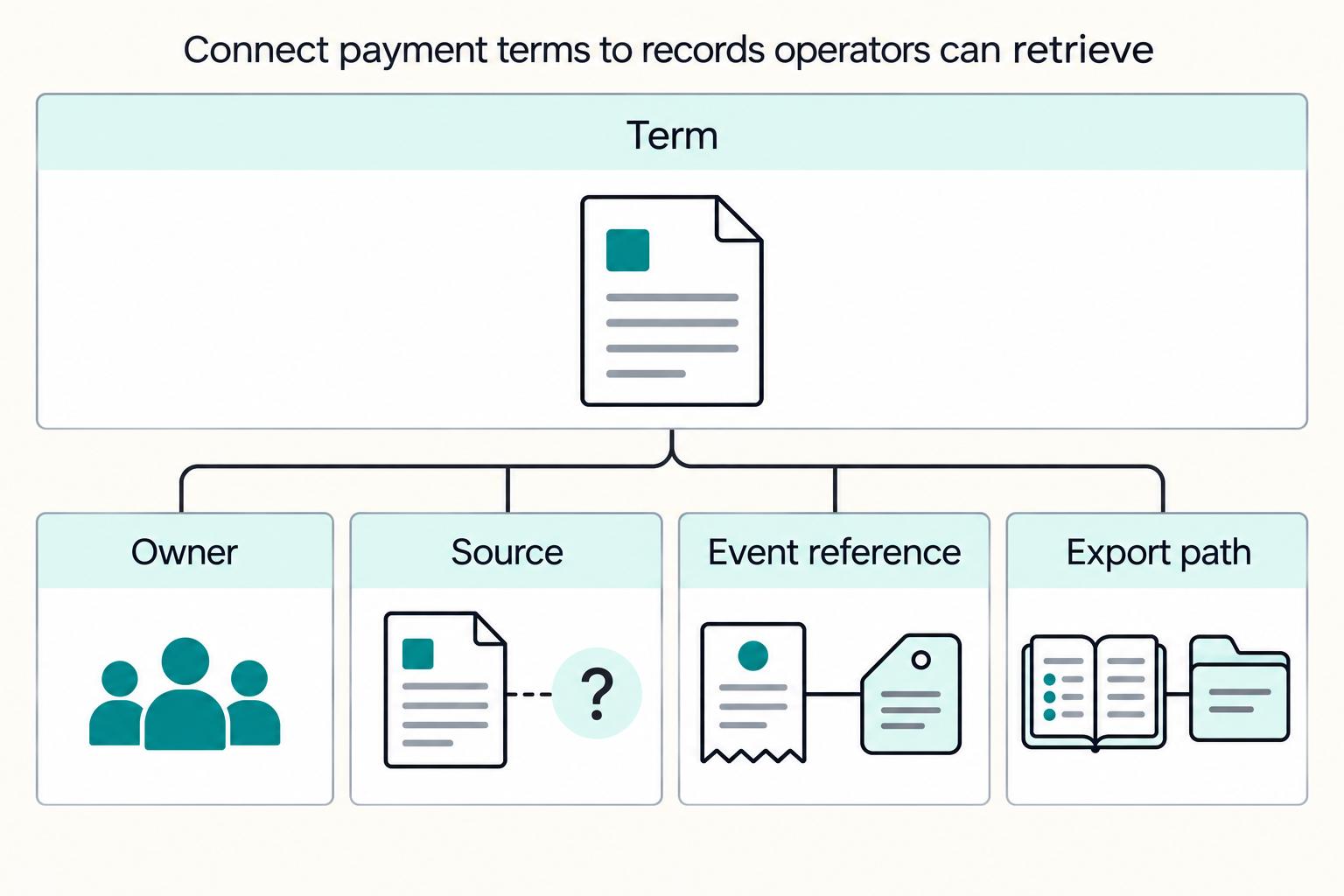
Before go-live, make the glossary operational. Each high-impact term should have an owner, a source of truth, a traceable system reference, and a clear conflict rule when definitions differ.
| Item | What to record | Why it matters |
|---|---|---|
| Term entry | Plain-language definition, plus a note that contract or statutory meaning may differ | Definitions can vary by context, contract, or law |
| Owner | Named person or function | Someone is accountable when wording or labels drift |
| Source of truth | Contract, statute or rule, provider document, system field, or export | Teams move faster when one source is explicit |
| Event/reference trail | Operational handles you use to trace the term, for example request, provider, batch, or dispute references | Terms stay trustworthy when they map to real events |
| Audit export path | The report, file, or table used during review | Evidence is usable only if it is retrievable quickly |
Document precedence explicitly in your glossary. If documents conflict, state the hierarchy your team follows. For example, contract materials may define an order of precedence, and applicable statute, rule, or regulation can control when in conflict.
Validate terms with a sampled transaction trace, not a meeting. Follow a sample from request to provider reference to internal record to reconciliation export, and confirm that the labels stay consistent end to end.
In an illustrative card flow, USD 100 authorized and USD 80 captured leaves USD 20 uncaptured; the released balance depends on the payment method and provider's rules. If the provider deducts a hypothetical USD 3 fee from the captured amount, USD 77 may become available before a later payout. None of those events proves bank receipt or removes later refund/dispute risk. Record the actual amounts and outcomes rather than copying this example's fee into your pricing model.
Require explicit sign-off for the clusters where language errors are expensive: card flow, compliance gating, payout operations, and tax-document readiness. Treat any term with no linked source, no source field, or no retrieval path as unresolved.
For adjacent build decisions, pair this pack with The Complete Guide to Platform Payments: Everything a Marketplace Operator Needs to Know, State of Platform Payments: Benchmark Report for B2B Marketplace Operators, and Platform-to-Platform Payments: How to Build B2B Settlement Between Two Marketplace Operators.
The takeaway for marketplace operators#
A useful definition helps someone take the next correct action. Product should label an authorization accurately, finance should distinguish seller liabilities from platform revenue, and ops should recover an unknown payout before initiating a replacement. The glossary should make those choices easier.
Treat terms as operating controls#
Separate a general definition from an unresolved implementation question. You can explain what a webhook is while marking your provider's delivery guarantees as unverified. Resolve the actual dependency before making a production promise, rather than leaving every ordinary term undefined.
Launch critical first#
Prioritize terms that affect live outcomes now, then stage the rest. A simple sequence is:
- assign immediate ownership and a go-live check to terms that can block or permit activity
- queue terms used mainly for optimization, reporting, or later expansion
- keep any term with no source, owner, or retrieval path out of policy commitments and external promises
For a new market or product, review which terms now have a live dependency: a new rail can introduce mandate/return rules, and a new seller jurisdiction can introduce reporting duties. Update owners and evidence at the same time.
Verify terms against real flow evidence#
Keep the source version and the original relevant document where it supports a material decision. Confirm current applicability rather than assuming that a historical paper, source-conversion warning or rule citation controls your payment flow.
The main failure mode#
The practical failure is a label that drives the wrong action: paying twice after a timeout, counting authorized funds as cash, or treating identity verification as every compliance approval. Find that mismatch in a transaction trace, correct the definition and update the affected workflow.
Frequently Asked Questions
What is the difference between authorization and capture, and why does it change cash forecasting?
Authorization is issuer approval that can reserve card funds; capture submits the authorized amount for payment processing. An authorization may expire without capture, and captured funds still have a settlement/availability path before payout or bank receipt. Forecast from the relevant state, amount and expected timing rather than treating authorization as collected cash.
What is the difference between an acquirer and an acquirer processor?
An acquirer is the institution responsible for merchant card acceptance under the card-network relationship. An acquirer processor provides processing services for that relationship; one business can perform multiple roles. Name the contracted legal entity, technical operator and escalation contact in your own acceptance model so an outage reaches the responsible party.
When should a marketplace choose ACH versus RTP for payouts or collections?
ACH supports credits and debits through scheduled processing, including eligible Same Day ACH; RTP provides instant credit transfers through its participating institutions. Choose using the actual collection/payout need, reach, authorization, cost, timing and exception/finality rules. An RTP request-for-payment message is not an ACH-style debit or proof of collected funds. Confirm the provider's sending support and the recipient's reach before promising speed.
How is KYC different from AML in day-to-day operations?
KYC focuses on identifying and verifying a customer. AML includes the broader controls for money-laundering risk, such as due diligence, ongoing monitoring, investigations and required reporting. Passing an identity check does not clear every AML requirement. Keep the relevant review states and owners visible instead of one 'fully compliant' badge.
What is an AISP in open banking, and when does it matter for a platform?
An AISP provides account-information services: consolidated information on a user's payment accounts held with other providers. In the UK, the FCA describes this as a regulated service with the user's explicit consent. A PISP initiates a payment order instead; information access alone does not grant payment-initiation authority. Check your jurisdiction, provider permissions and actual consent scope.
Which payment terms are truly required before launch versus safe to defer?
Resolve terms before launch when your current flow relies on their meaning for amounts, recipients, authorization, deadlines or incident response. The 40 'Start' labels are a suggested first pass, not a universal blocker list. Any other entry becomes launch-critical when a live dependency uses it; defer only terms with no current requirement.
Where Gruv fits
Gruv for marketplaces
Carry each seller’s approved payable amount, source reference, payout state, and exception context through one reviewed batch.
See reconciliation and mismatch review
Compare ledger entries, provider payment records, and statement rows to see what matches and what finance needs to review.
Researched and edited by the Gruv editorial team. Gruv builds cross-border billing, payouts, and finance-operations software for global businesses.
Sources
- bis.org/committees/cpmi/glossarytrusted
- docs.stripe.com/payments/place-a-hold-on-a-payment-methodtrusted
- docs.stripe.com/connect/marketplace/tasks/refunds-disputestrusted
- federalreserve.gov/paymentsystems/fednow_about.htmtrusted
- fincen.gov/report-foreign-bank-and-financial-accountstrusted
- fincen.gov/resources/statutes-and-regulations/cdd-final...trusted
- irs.gov/forms-instructionstrusted
- irs.gov/businesses/small-businesses-self-employed/ba...trusted
Educational content only. Not legal, tax, or financial advice.
Related Posts

The Freelance Payment Penalty: A Modeled Audit of Platform Fees, FX Spreads, and Payout Delays
The money rarely disappears through a single, easy-to-spot fee. The real loss is stacked. A marketplace takes its commission, a processor adds a charge for international cards, a bank or payment company converts the currency at a spread, a platform holds the funds before release, and a wire sheds a little to intermediaries on the way in. Each layer looks defensible on its own, but the worker feels the combined result as a smaller deposit and a later payday.

How to Respond to a Subpoena for Business Records
Move fast, but do not produce records on instinct. If you need to **respond to a subpoena for business records**, your immediate job is to control deadlines, preserve records, and make any later production defensible.

A US Expat's Guide to Investing in UCITS ETFs to Avoid PFIC Issues
The real problem is a two-system conflict. U.S. tax treatment can punish the wrong fund choice, while local product-access constraints can block the funds you want to buy in the first place. For **us expat ucits etfs**, the practical question is not "Which product is best?" It is "What can I access, report, and keep doing every year without guessing?" Use this four-part filter before any trade: