
Quick Answer
Separate contractual terms from true lateness, then test expansion decisions with a controlled 90-day pilot. Anchor the clock to due date and funds-received timestamps using the Directive 2011/7/EU definition, and score each market for method quality and segment fit before launch. Move from monitor to tighten, phase, or defer based on post-due-date behavior, while requiring KYC/KYB status, payout-batch controls, and traceable invoice-to-ledger evidence.
Why Late-Payment Triage Starts Before Market Entry#
Late payments are a market-entry risk for platform operators, not just a collections issue. In B2B and G2B transactions, delayed payment strains liquidity, complicates financial management, and can weaken competitiveness when creditors need outside financing. If you expand before your team can trace where delay starts, you can scale a working-capital problem faster than you fix it.
The scale matters in the EU. The European Commission has described late payment as a major SME risk and reported that one out of two invoices in EU commercial transactions are paid late or not at all. It has also warned of a domino effect where one delay triggers another. For expansion planning, payment behavior can materially shape rollout viability.
The first step is to separate payment terms from true delay. Under Directive 2011/7/EU (16 February 2011), a late payment is one made after the contractual or statutory period. Contractual payment terms are the agreed window to pay, whether set in a contract, shown on the invoice, or laid down by law. Long terms are not automatically a late-payment problem. Slippage beyond the due date is the risk your platform has to manage.
That distinction is where market comparisons can break down. Evidence is mixed. EU observatory analysis reports longer terms are associated with longer payment periods in 87% of cases, while a large commercial dataset from Sidetrade reports contractual terms do not determine when companies get paid. So the operational question is not just how long the cycle is. It is how much of it is agreed timing versus actual lateness.
Before comparing countries or verticals, align one due-date logic across invoice records, aging views, funds-received timestamps, and payout-release rules. Then make explicit go, phase, or defer decisions. Enter where payment behavior is clear and controls are ready. Phase where exposure can be capped. Defer where data quality or control readiness is weak. If you cannot align those records, your team will misclassify agreed timing as delay. We recommend treating that alignment check as a launch gate.
That only works if your controls are reliable. KYC- and KYB-aligned checks are part of market readiness, not a back-office afterthought. FATF guidance states that knowing your customer is essential to ensure funds are not linked to crime and terrorism, and legal-entity programs can require identifying and verifying beneficial owners. Without those controls, payment-delay signals can be harder to trust. Your compliance gate should be visible before finance relies on any delay trend. We would rather hold a corridor than expand on weak verification evidence.
Define the payment delay problem before you compare markets#
Start by drawing the line correctly: contractual payment terms are the agreed payment window for invoice settlement, and payment delay is only the time after the due date. If you blend those together, cross-market comparisons become less comparable.
Under Directive 2011/7/EU, late payment is tied to payment outside the contractual or statutory period, and interest runs from the day after the due date. Operationally, that means your clock should anchor to a verified due-date field from contract terms or an applicable payment rule, then match it to when funds are received.
Treat late payment as a distribution problem, not just an average. In one 2025 dataset, total days-to-pay is split into 32 days of contractual terms + 19 days of delay, with 37% of the cycle happening after the due date. Allianz Trade also reports 59 days average DSO while 1 in 5 companies regularly wait more than 90 days. The mean alone can hide the working-capital risk sitting in the slow-pay tail.
Use one internal definition of late payments across product, finance, and go-to-market. Keep these fields aligned:
- invoice date
- contractual due date
- due-date source (for example, contract clause or invoice term)
- funds-received date and time
- delay days counted only after due date
Before you compare countries or verticals, run the same invoice sample through your ledger, aging, and payout-release logic. If one system marks an invoice current and another marks it late, fix the definition before you make expansion decisions.
Build a country scoring sheet when the data is incomplete#
Do not wait for perfect rankings. Make uncertainty visible, then decide rollout scope based on confidence. If evidence is thin, dated, or not marketplace-specific, still score the market, lower confidence, and tighten the launch plan.
Public late-payment data is directional rather than marketplace-grade proof on its own. A scoring sheet keeps your team honest about what is known, what is inferred, and what is missing. We recommend keeping that sheet visible to finance, ops, and GTM so your rollout decision stays tied to evidence.
What your sheet should capture#
Use one row per country with clear fields:
| Country | Public signal snapshot | Source quality and recency | Segment relevance to B2B marketplaces | Confidence | Recommended next move |
|---|---|---|---|---|---|
| United States | Atradius reports around half of invoices in North American B2B trade are overdue (regional signal, not a US-only measure) | Survey-based, not census; North America fieldwork ran from end of Q2 to beginning of Q3 2024, so it is time-bound for 2026 planning | Broad B2B trade, not marketplace-only | Medium-Low | Pilot limited buyer and seller cohorts before wider launch |
| Mexico | Atradius reports 49% of surveyed businesses, mainly in Mexico, expect no deterioration in insolvency conditions | Same survey and timing limits; outlook signal, not direct marketplace delay measure | Broad B2B trade, not marketplace-only | Low | Validate with local pilot data and payment-behavior sampling |
| Canada | Atradius reports 48% of surveyed companies, primarily in Canada, anticipate increased insolvencies | Same survey and timing limits; insolvency outlook is a risk signal, not a direct delay ranking | Broad B2B trade, not marketplace-only | Low | Start with tighter exposure limits and short review cycles |
| Any added target market | Add only signals with visible fieldwork dates, sample notes, and delay definition | Lower score if method is gated, opinion-led, or undated | Lower score if source blends SMB, enterprise, and non-platform trade | Unknown until reviewed | No full launch until confidence is upgraded |
This sheet is not proof that one country is definitively safer than another. It is a structured way to show where confidence is strong, weak, or missing.
How to score source quality without fooling yourself#
Use three checks for each source: method visibility, segment fit, and recency for your decision window.
| Source | What the article says | Main limitation |
|---|---|---|
| Atradius | Explicit about annual B2B survey coverage and fieldwork timing | Still a survey, not a 2026 marketplace operating dataset |
| PYMNTS | Can flag issues | Form-gated access can limit method review |
| Forbes Council | Author opinion and membership content | Not a neutral primary dataset |
| SAP Taulia | November 2024; 9,368 businesses; 9,734 responses; 129 countries | Not marketplace-specific or country-comparable by vertical |
Atradius is useful because it is explicit about annual B2B survey coverage and fieldwork timing, but it is still a survey, not a 2026 marketplace operating dataset. PYMNTS can flag issues, yet form-gated access can limit method review. Forbes Council content is author opinion and membership content, not a neutral primary dataset. SAP Taulia provides broad coverage (November 2024; 9,368 businesses; 9,734 responses; 129 countries), but that does not make it marketplace-specific or country-comparable by vertical.
Before you add any source to the sheet, capture these details and lower confidence immediately if any are missing:
- publication date and fieldwork window
- sample frame and sample size
- whether contractual terms are separated from post-due-date delay
- whether methodology is fully visible or gated
- whether the population matches B2B marketplaces or only broader B2B trade
Segment relevance matters more than headline scale#
Big samples can still miss your operating model. Coverage like 7,500 businesses across 35 markets, or 10,854 suppliers across 129 countries, is useful context but not a substitute for marketplace-specific evidence. Keep segment relevance as its own column so sample size does not get mistaken for fit. International monitoring still reports data gaps, so mark unknowns directly instead of smoothing them away.
Decision rule when confidence is low#
When confidence is low and risk signals are non-trivial, run a limited pilot before full launch. Keep cohorts narrow, cap exposure, and collect your own payment-behavior data before scaling GTM spend.
Avoid treating PYMNTS, Atradius, Credit Connect, Forbes, and SAP signals as directly comparable. Your scoring sheet should stop that by forcing explicit confidence flags and staged-entry decisions.
Related: Platform-to-Platform Payments: How to Build B2B Settlement Between Two Marketplace Operators.
Map delay severity to operating response#
Set the response matrix before volume scales. You want each risk band to trigger a clear operating action, not a debate after losses or delays appear. Keep it market-specific, and scale controls with risk instead of forcing one global rule. We recommend deciding that action before you open volume so your team is not improvising under pressure.
A useful matrix should do two things:
- separate contractual terms from realized delay on supplier invoices
- escalate controls as risk increases
Build bands around realized behavior, not invoice terms#
Assign severity from realized delay behavior, not headline terms alone. One 2025 breakdown split days-to-pay into 32 days of contractual terms and 19 days of delay beyond due date, so the operational risk sits in the slippage.
Use three inputs for banding:
- delay beyond due date on supplier invoices
- trend direction across recent review cycles
- confidence in country and vertical data quality
| Severity band | What you are seeing | Default operating response | Controls to pre-assign |
|---|---|---|---|
| Monitor | Post-due-date delay is stable and confidence is acceptable | Keep scope controlled and review on schedule | Standard KYC/AML checks, normal payout cadence, reserve policy defined but limited use |
| Tighten controls | Delay is elevated, worsening, or confidence is weak | Keep market open with lower exposure | Stricter KYC/KYB refresh, beneficial ownership verification checkpoints where required, manual review triggers, selective reserves, tighter payout release conditions |
| Phase rollout | Delay is materially worse or variance is widening quickly | Limit cohorts and slow expansion | Enhanced due diligence where warranted, broader manual review, reserve use on higher-risk cohorts, shorter review cycles |
| Defer entry | Delay risk is high and controls or evidence are not ready | Pause broad GTM until controls are ready | No wide launch until gating, monitoring, and reserve rules are implemented and tested |
Do not force universal cutoffs for these bands. Set thresholds by country program and vertical context.
Tie each band to controls in advance#
The matrix only works if band changes trigger operating changes immediately.
For onboarding and permissions, predefine when stronger identity and entity checks apply, including beneficial ownership verification in written AML procedures for legal-entity customers where applicable. For payouts, predefine when reserves become mandatory, which cohorts they cover, and who can approve overrides. For monitoring, predefine manual-review triggers and keep an audit trail for each hold or release decision. Include invoice status, due date, delay days, KYC/KYB status, beneficial ownership status, and payout decision.
Add trend rules so the matrix can move#
Use trend rules, not just snapshots. One internal trigger you can use is repeated worsening across consecutive review cycles: reduce exposure and tighten payout conditions for that market or cohort. Treat this as an operating rule, not an external standard.
In practice, reducing exposure can mean slower payout release, smaller initial limits, narrower cohorts, or more manual approval on borderline cases.
Avoid one-size-fits-all global matrices. Country differences can be wider than sector differences, and headline averages can hide severe pockets inside a market. If data is weak, delays are rising, and controls are still immature, treat the case as phase or defer until evidence and gating improve.
If rail choice is part of the risk, our guide to choosing global contractor payment rails in 2026 breaks down the tradeoffs across cost, speed, and operational fit: Choosing Global Contractor Payment Rails in 2026 Without False Precision.
Pick an entry model that matches your delay risk tolerance#
Choose your entry model based on who should control exceptions and who should carry exposure when payments slip. If delay risk is high or still unclear, favor the structure that gives your platform tighter control over payout timing and issue handling, even if launch is slower.
Compare the three entry paths before you commit#
| Entry model | What it means in practice | When it fits | Main tradeoff |
|---|---|---|---|
| Platform-led MoR or indirect charges | Your platform is legally responsible for the transaction, or charges first and transfers later | Early entry where you need tighter control over release timing, refunds, disputes, and exposure | More liability and operational load sit with the platform |
| Direct settlement | In direct charges, the connected account is the merchant of record | Lower-risk markets where sellers can own more transaction responsibility | Less central control; more dependence on connected accounts to handle issues well |
| Hybrid | You run different patterns by market, segment, or cohort | Mixed portfolios where one structure does not fit every corridor | Complexity can rise because you maintain two monetization paths |
The distinction is operational, not cosmetic. In direct charges, connected accounts are MoR and can handle their own refunds and disputes. In separate charges and transfers, the platform charge is decoupled from transfers. Stripe recommends this model only when your platform is prepared to take negative-balance responsibility.
Use Virtual Accounts for visibility before payout release#
Use Virtual Accounts to improve tracking and reconciliation, not as a standalone risk control. They are sub-ledger accounts with unique identifiers linked to a physical account, and transactions post to the linked physical account.
In early cohorts, use those identifiers to verify receipts and match them to expected invoices before releasing payouts. If receipt-to-invoice mapping is weak, treat that as a control gap and hold release decisions until matching is clear. We would rather hold one payout cohort than let your team release funds against weak matching.
Use controlled payout batches to manage early exposure#
In early rollout, controlled payout batches create a practical release gate. Batch processing groups transactions at set intervals, and ACH file design already supports one or more batches per file.
What matters is your release logic around each batch. Only release when your required checks pass. When they do not, keep items out of the batch and log the hold reason. Faster entry with looser controls may still be the right commercial call, but it can shift more work into exception handling and reconciliation. So narrow cohorts and shorten review cycles while you validate real payment behavior.
Related reading: Foreign Exchange Risk for Platform Operators and the Decisions That Cut FX Exposure.
Put compliance gates in front of money movement#
Do not allow payouts until required verification checks pass. Treat entity checks, identity checks, and AML review as payout-release conditions, not post-launch cleanup. We recommend enforcing that gate in your payout workflow, not in a side checklist.
A practical operating order is onboarding intake, KYB for the business entity, then KYC and AML gating before payout permissions are enabled. That is an operating recommendation, not a claim that every jurisdiction uses the same sequence. What is clear is the baseline requirement to verify the customer and beneficial owner before establishing the business relationship, including reasonable measures to verify beneficial ownership.
Make payout permission depend on verified status#
Set a hard rule: no verified account, no payout permission. Provider guidance is explicit that payouts depend on completing required verification, and payouts can be disabled when required information is not provided.
Implement that rule in payout-release logic, not only at onboarding. Before each payout batch, check current verification status and log the exact blocker for held payouts, such as unresolved legal-entity verification, unresolved beneficial-owner verification, or missing required information. If the blocker code is vague, your ops team will burn time chasing the wrong queue. We recommend making that blocker readable before release.
Treat KYB as more than a business name check#
For legal entities, KYB should cover ownership and control, not just registration details. If onboarding only captures company basics without ownership and control information, the gate is incomplete.
To keep holds diagnosable, keep an evidence trail for each payout decision: onboarding submission timing, verification status changes, requests for additional information, and the hold reason.
Add VAT validation where invoice treatment depends on it#
When EU invoice treatment depends on VAT status, include VAT number validation in the same control set. VIES is designed to confirm VAT ID validity for intra-Community supplies, and HMRC guidance ties valid VAT numbers to zero-rating conditions for certain EC goods supplies.
Use VAT checks to catch invoice-treatment issues earlier and reduce rework risk. Validate before invoice approval or first payout release, then store the result on the customer record.
Build escalations that isolate the hold#
Failed checks should create targeted holds, not a broad freeze. Route unresolved KYB or KYC issues to compliance, route VAT mismatches to tax or invoicing ops, and allow unrelated verified accounts to continue through controlled payout batches.
Do not scale broad rollout in high-delay corridors until these gates are live, tested, and audited. In audits, sample both released and held payouts and confirm you can show exactly why each payout moved or did not move. We recommend sampling both released and held payouts so your team sees whether the gate is working the way policy says it should.
Design an invoice to payout chain that is traceable end to end#
Once compliance gates are in place, traceability becomes the next control. You should be able to show exactly how a supplier invoice became an approved obligation, how funds were attributed, and why payout was released or held. If your reviewer cannot trace that path quickly, your control is not ready for scale.
Standardize the invoice object before you automate release#
Use one invoice record shape and make approval evidence-based. Where your model includes purchase and receipt documents, use three-way matching so the supplier invoice is validated against the purchase order and order receipt before it becomes payout-eligible.
This is a practical release rule: no approved invoice record, no payout path. Release logic should only evaluate invoices that passed approval and still meet current policy status.
| Handoff | Minimum record to keep | Verification checkpoint | Common red flag |
|---|---|---|---|
| Invoice intake | Supplier invoice ID, supplier entity, amount, currency, due date | Invoice is complete and mapped to the correct counterparty | Duplicate or unmatched invoice reference |
| Approval | Approval event and linked purchase/receipt docs (where used) | Three-way match passes before approval | Approved invoice missing underlying support |
| Funds receipt | Payment receipt tied to payer reference | Receipt is attributable to the correct obligation | Funds received but not linked to invoice or buyer |
| Payout release | Batch ID, release decision, payout status history | Policy status still allows release at batch time | Approved invoice paid after status changed |
To reduce reconciliation breaks, standardize payment-instruction data as well. Richer standardized payment data is linked to better automation and reconciliation outcomes.
Use Virtual Accounts for attribution, then post ledger events as they happen#
Virtual Accounts are useful for attribution because each has a unique identifier, while funds remain in the linked physical account. They help you map incoming funds to the right obligation. They are not a substitute ledger.
Pair that identifier with event-driven ledger posting. Record each funds-related state change as posting events arrive. That can provide near real-time visibility and reduce manual reconciliation work.
A simple control is that every funds-received event should clearly answer which invoice, or invoice set, it maps to, and whether those funds are available for payout.
Run Payout batches as controlled release events#
Execute payouts in controlled Payout batches, not ad hoc sends. This aligns with ACH batch structure and creates a clear release boundary for approved, funded, policy-cleared obligations.
Make retries idempotent. Payment integrity depends on idempotent processing, and APIs commonly support this with idempotency keys. For example, Stripe supports keys up to 255 characters and returns the same result for repeated requests with the same key. Keep the same key for retries of the same logical payout request.
Then monitor post-submission states explicitly: processing, posted, failed, returned, or canceled. Review failed and returned items through a defined path, including timeline history and return reasons. In Stripe Global Payouts, payouts are typically returned within 2 to 3 business days.
Make the evidence pack easy to audit#
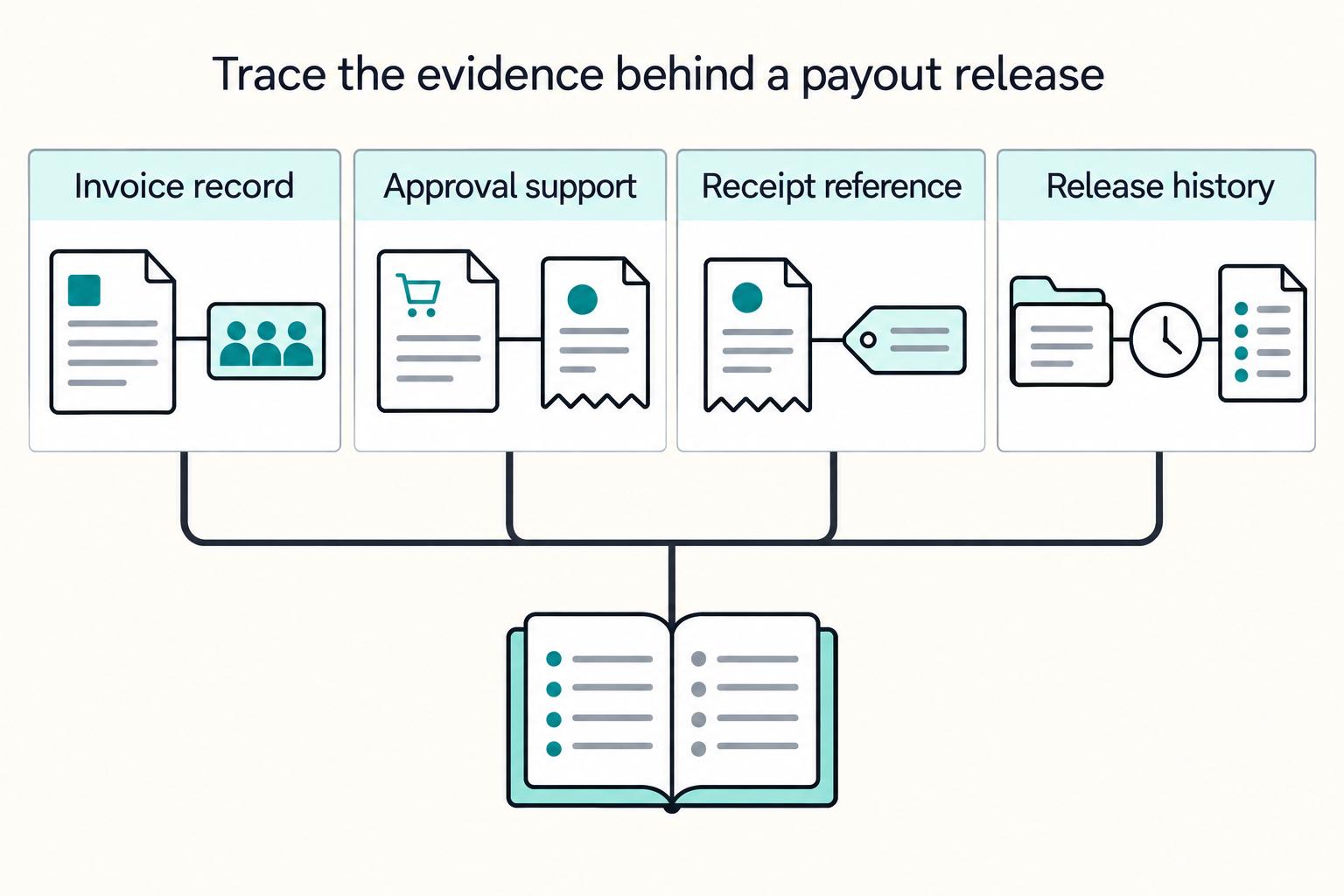
For any payout, someone should be able to move from request to ledger to payout without interpretation. Keep an evidence pack with the invoice record, approval support, virtual account identifier or receipt reference, ledger event IDs, payout batch ID, and payout status history. For failed or returned transfers, include the return reason and intervention taken. Your reviewer should be able to walk that chain without calling engineering or finance for translation. We recommend keeping that pack in one review path your team can retrieve quickly.
This helps separate external payment delays from internal operating defects. If each handoff is provable, you can better distinguish external factors from preventable breakdowns in your own invoice-to-payout chain.
For a step-by-step walkthrough, see How B2B Platform Operators Design Free Trials That Convert Profitably.
Handle tax documentation dependencies before they block payouts#
Unresolved tax status should block release when your program creates U.S. withholding or information-return obligations. Treat tax documentation as an early payout control, not a year-end cleanup step.
Use a clear rule by program: if a supplier cannot yet be classified for the required reporting path, hold release until the required tax record is complete. That does not make W-8 or W-9 universally mandatory for every payout in every country. It means defining when Form W-9 is required to provide a U.S. taxpayer identification number, and when Form W-8BEN is required to document foreign status for U.S. withholding and reporting. IRS guidance is explicit that Form W-8BEN is submitted when requested by the withholding agent or payer, so do not treat it as optional backfill after funds are sent.
Put tax forms into the same release checklist as payout eligibility#
Keep tax checks in the same release checklist as approval status, beneficiary status, and payout permissions. For suppliers on a U.S. information-return path, verify form type, legal entity match, collection date, and stored copy before an invoice becomes payout-eligible.
| Tax or registration check | When it should affect release | Downstream dependency | Evidence to store |
|---|---|---|---|
| Form W-9 | When your program needs a U.S. taxpayer identification number for information returns | 1099 workflow for applicable U.S. payees | Form copy, requester/payer context, linked supplier record |
| Form W-8BEN | When requested by the withholding agent or payer for foreign-status documentation | U.S. withholding or reporting classification | Form copy, linked payee identity, request date |
| 1099-NEC vs 1042-S classification | Before first reportable payout type is released | Correct year-end filing path | Classification decision, basis for decision, filed return reference |
| VAT validation through VIES or UK VAT check | Before release where VAT status affects invoice acceptance or tax handling | Consistent tax handling and audit traceability | Validation result, date checked, number checked, matched entity details where available |
| FBAR tracking | Do not use as a transaction release gate | Internal foreign-account reporting | Account inventory, threshold monitoring, retained records |
Keep reporting logic separate from execution logic#
Separate payout controls from year-end reporting obligations. Form 1099-NEC reports nonemployee compensation, but nonemployee compensation paid to nonresident aliens is reported on Form 1042-S, not 1099-NEC. If that classification is missed at onboarding, teams can pay first and then scramble for documents when filing starts.
At scale, design for filing operations early: once you file 10 or more covered information returns, including Form 1099 series, Form 1042-S, and Form W-2, IRS rules require electronic filing. Store form images, supplier profile data, and reporting classification so finance can retrieve them directly instead of rebuilding evidence from tickets.
Do not let FBAR and VAT checks distort payout decisions#
FBAR is a reporting obligation, not a payout execution control. It applies when the aggregate value of foreign financial accounts exceeds $10,000 at any point during the calendar year reported. So it should sit with finance or treasury controls, not batch-release logic. Required FBAR records generally must be retained for five years from the FBAR due date.
Apply VAT checks where relevant, but keep them scoped to tax validation rather than unrelated release logic. In the EU, VIES can verify whether VAT information exists for a number in national databases. In the UK, the VAT check can confirm validity plus the registered business name and address. A practical control is to store validation results at onboarding and recheck when key supplier tax details change.
Fix the failure modes competitors gloss over#
Fast rails do not solve late payments by themselves. They can speed the final transfer leg, but they do not automatically fix upstream approval, compliance, or beneficiary-readiness issues.
Faster rails do not remove process delay#
In many cases, delay risk sits upstream of money movement. U.S. B2B survey data says the main reason for late payments is administrative inefficiencies in customer payment processes, and overdue invoices are converted to cash on average 20 days past due. Separate data also points to approval chains and order-to-cash operations as core drivers of cash conversion speed.
Use a simple rule: if incidents cluster before funds are actually release-ready, rail selection is not your primary fix. Prioritize approval flow, invoice-readiness checks, and compliance queue performance first. Otherwise, you get faster last-mile transfers attached to the same slow internal handling. If most failures happen before release readiness, faster rails will not save your team from the same bottleneck.
Blended averages hide the risk you are actually buying#
A blended average is often not enough for a market-entry decision. Sidetrade notes that a 25-day average hides the United States story, and the same issue can apply in B2B marketplaces: one average can flatten important differences by segment.
U.S. sector evidence shows why segmentation matters. Atradius cites invoice disputes as common in chemicals, while customer cashflow issues appear in electronics/ICT. Those are different failure modes, so they need different controls.
Before you label a market as "slow," review delays across multiple cuts, for example:
| Cut to review | What it helps you separate |
|---|---|
| Vertical | Disputes versus liquidity patterns |
| Buyer type | Approval friction patterns |
| Contract behavior | Long agreed terms versus true past-due slippage |
If you cannot segment this way yet, treat the conclusion as provisional.
Hidden blockers often look like market behavior until you inspect them#
Incomplete KYB can look like external payment delay when it is really internal readiness debt. FATF guidance emphasizes adequate, accurate, and up-to-date beneficial ownership information, and 31 CFR § 1010.230 requires covered U.S. financial institutions to verify identified beneficial owners.
Screening operations can create the same confusion. The ABA notes that transaction screening can generate high false-positive volume, increasing workload and processing time. In that state, delay metrics can reflect queue debt instead of buyer behavior.
Use a short evidence pack for each material incident so classification is defensible:
- invoice date, due date, approval timestamps, and funds-receipt timestamp
- KYB status, beneficial-owner verification result where relevant, and screening or hold reason
- beneficiary record snapshot, payout batch ID, transfer outcome, and exception resolver
This makes the key question answerable: where did the clock actually slip? If the slip starts after approval but before release because of KYB or screening holds, fix controls and staffing. If buyers consistently pay beyond agreed terms, you are seeing true market payment behavior.
For a broader view of payouts, compliance, and embedded finance decisions, see Gruv Platform Payments: The Complete B2B Guide to Global Payouts Compliance and Embedded Finance.
Run a 90 day expansion pilot with hard checkpoints#
Run the expansion as a phased, time-limited pilot before full launch, so you learn on limited exposure instead of scaling unknown risk. A 90-day structure is a practical operating cadence, not an industry standard: baseline first, limited cohorts second, then a market-by-market decision based on observed production outcomes.
| Pilot window | Focus | Checks or outputs |
|---|---|---|
| Days 1-30 | Lock definitions and build a segmented baseline | Require invoice date, due date, approval timestamp, funds-receipt timestamp, and market or segment tags |
| Days 31-60 | Launch limited cohorts and evaluate before widening exposure | Use controlled Payout batches; review unresolved holds, suspicious-activity monitoring flags, failed or returned payouts, and records that do not reconcile to a batch |
| Days 61-90 | Make an explicit decision per market: expand, hold, or defer | Judge on distribution and repeatability, not a single average |
Days 1-30#
Start by locking definitions and building a segmented baseline you can trust. Define Contractual payment terms as the agreed invoice due date, and Payment delay as days after that due date. This distinction matters because contractual terms alone do not determine when companies get paid, and recent data indicates that a meaningful share of days-to-pay can occur after the due date.
Baseline by market, sector, and business-size segment before comparing markets. Evidence on late payments shows practices vary by sector and business size, so blended averages can hide the risk you are actually buying.
Use a strict data-readiness checkpoint before accounts enter the pilot: invoice date, due date, approval timestamp, funds-receipt timestamp, and market or segment tags should all be present.
Days 31-60#
Launch limited cohorts, then evaluate before widening exposure. This follows canary logic: partial, time-limited rollout first, then proceed only if results hold up.
Use controlled Payout batches instead of ad hoc releases, so failures and reconciliation gaps can be inspected by release window. Keep policy gating risk-based: apply tighter controls where market, corridor, or buyer patterns show higher risk. In covered contexts, beneficial-owner identification at account opening under 31 CFR § 1010.230 remains required.
If you run this window on a regular rhythm, review unresolved holds, suspicious-activity monitoring flags, failed or returned payouts, and invoice-to-payout records that do not reconcile to a batch.
Days 61-90#
Use the final window to make an explicit decision per market: expand, hold, or defer. Judge on distribution and repeatability, not a single average.
If post-due-date slippage is manageable and controls stay stable, expansion may be justified. If delay clusters around policy holds, missing entity data, or unresolved exceptions, hold and fix operations first. If both buyer payment behavior and internal exception load are weak, defer.
Artifacts before scale#
Before you increase volume, use internal sign-off artifacts from the teams that own operational outcomes:
- Payments ops: approved invoices, payout batch IDs, failure or retry counts, unresolved exceptions
- Compliance: CDD/KYB status where applicable, beneficial-owner checks where relevant, monitoring or hold summaries
- Finance: reconciliation samples showing invoice, receipt, ledger, and payout amounts tie out for the pilot cohort
This final package answers one question before scale: are you scaling a market, or scaling an unresolved classification problem?
Before expanding cohort size, map your control gates and exception rules to a payouts workflow that supports batch-level visibility and retries in Gruv Payouts.
Track the few metrics that change decisions#
After the pilot phase, do not widen rollout on headline averages. Focus on three signals. First, where post-due-date delay sits in the distribution. Second, where KYC, KYB, and AML controls create friction. Third, whether each supplier invoice still ties cleanly to a Payout batch outcome.
| Signal | What to track | Decision use |
|---|---|---|
| Terms vs true delay | Overdue-invoice share, DSO, post-due-date delay by cohort, and tail concentration in internal aging buckets | If terms are stable but post-due-date slippage worsens, treat it as a late-payment problem |
| Compliance friction | Pass, hold, reject, and manual-review rates; hold-clear times; share of accounts needing customer-information refresh | A growing backlog in those workflows is an expansion constraint |
| Reconciliation drift | Unmatched records, failed or returned payouts, and invoice-to-batch mismatches | Hold expansion until the process debt is reduced |
Separate terms from true delay#
Track cohorts by market and segment, and split Contractual payment terms from Payment delay. They are different operational signals: Sidetrade's 2025 decomposition shows 51 days total (32 days of terms + 19 days of delay), with 37% of the cycle occurring after the due date.
Track at least these items:
- overdue-invoice share
- DSO
- post-due-date delay by cohort, not only overall mean
- tail concentration in internal aging buckets
If terms are stable but post-due-date slippage worsens, treat it as a late-payment problem rather than a terms-setting issue.
Keep compliance friction proportionate#
Use KYC, KYB, and AML metrics to confirm controls are risk-based, not blunt. Monitor pass, hold, reject, and manual-review rates by cohort, plus hold-clear times and the share of accounts needing customer-information refresh.
In U.S. covered contexts, beneficial-owner verification under 31 CFR § 1010.230 and risk-based ongoing monitoring continue after onboarding. A growing backlog in those workflows is an expansion constraint.
If payout delay is rising alongside stale entity data or monitoring exceptions, fix onboarding and remediation quality before broadly tightening payout rules.
Treat reconciliation drift as expansion debt#
Track whether invoice operations stay clean from approval to payout-batch outcome. Review unmatched records, failed or returned payouts, and invoice-to-batch mismatches as core expansion metrics, not back-office noise.
This is decision-relevant risk: UK research reports administrative errors as a documented driver of late payments (24% in the surveyed sample). If reconciliation exceptions rise while top-line payment performance looks flat, hold expansion until the process debt is reduced.
Conclusion#
The better move is not to chase headline averages. It is to match expansion speed to what your controls, evidence, and payout operations can support in each market. We recommend expanding only at the pace your evidence pack can support.
For platform operators, the key distinction is between contractual payment terms and actual payment delay. A market can look acceptable on paper and still create a cash problem if delays show up in internal approval or release steps. Treat late payment as an operating signal, not just a country statistic.
That matters because the data is uneven. Cross-country payment behavior does vary, but the safer read is directional, not absolute. Even large multi-country datasets need comparability checks, and payment practices vary by sector and company size. Do not let one average number decide a launch. If source quality is weak and delay signals are concerning, run a limited pilot before committing GTM spend.
A strong final check is whether you can show where delay enters the chain. For each cohort, verify the invoice due date, actual payment date, and exception outcome in one traceable record. If you cannot show that sequence without reconstruction, you may be seeing process friction rather than market behavior. If you have to reconstruct it by hand, your rollout is still carrying internal execution risk.
Control maturity is where useful caution separates from overreaction. A risk-based approach means tightening mitigation in line with risk, not treating every delay as a fraud or AML event. A common risk is blaming the market too early when the blocker may be internal execution.
Use legal baselines and benchmark numbers as anchors, not shortcuts. In the EU, late payment is payment made after the statutory or contractual period, and payment deadlines help frame the operating context. Benchmark averages can help you calibrate questions, but they are not enough on their own to justify scale in a specific vertical or country.
So the next step is concrete. Build your country score sheet and severity matrix first, then require proof before rollout on source confidence, segment relevance, pilot delay distribution, and due-date-to-paid-date traceability. Move from pilot to scale only when those items line up. If they do not, hold the market and fix the weak control first. We would rather see your team pause the market than explain avoidable delay after launch.
If your country scorecard points to stricter control needs, compare whether a modular or merchant-of-record approach fits your rollout plan in Gruv Merchant of Record.
Frequently Asked Questions
What is the practical difference between contractual payment terms and payment delay for platform operators?
Contractual payment terms set the due date, while payment delay is what happens after that date. Under the EU definition, a late payment is one not made within the contractual or statutory payment period. For operators, terms show what was agreed, but delay shows when cash actually arrives, which is why both should be tracked separately.
How should B2B marketplaces compare countries when source data quality is uneven?
Compare countries only with indicators measured consistently across places and time. If methodology, samples, or definitions changed, treat trend and ranking comparisons as limited rather than cleanly comparable. Small rank gaps can be noise, so use them as directional signals unless measurement quality is clear.
Which delay patterns should trigger tighter KYC and AML controls?
Delay alone is not an AML finding, so overdue invoices should not be treated as automatically suspicious. Escalate when delay appears with higher-risk jurisdiction exposure or repeated operational red flags that warrant additional scrutiny. Also keep context in view: activity near the $10,000 CTR threshold by itself is not enough to require a SAR.
Do fast payments infrastructure upgrades reduce late B2B payments by themselves?
No. Faster rails may speed settlement after approval, but they do not remove invoice, approval, or reconciliation bottlenecks on their own. If most delay happens before approval or release, infrastructure speed will not fix the core problem.
What are the minimum controls a platform should have before entering a high-delay market?
Start with a risk-based KYC and AML approach, clear escalation for higher-risk jurisdiction exposure, and additional scrutiny for repeated red flags. Then track where delay occurs across invoice handling, approvals, and settlement so controls can be tightened at the actual bottleneck.
When should an operator choose Merchant of Record instead of direct settlement?
Choose Merchant of Record when you want one legal seller entity to hold responsibility for payment processing, tax handling, compliance, and disputes. This can simplify operating responsibility in markets where those burdens are hard to distribute across suppliers. Direct settlement can still fit better when suppliers remain the seller and you are prepared to manage those obligations in that structure.
Which documents are usually needed to keep cross-border payouts compliant and audit-ready?
For U.S.-linked payout programs, common tax documentation includes Form W-9 and Form W-8BEN, with 1099-NEC reporting workflows when nonemployee compensation rules apply. Keep those forms aligned with payout records so documentation and money movement stay reconcilable. FBAR is a separate annual reporting obligation when foreign accounts exceed an aggregate $10,000, not a payout-release document.
Try a related tool
Researched and edited by the Gruv editorial team. Gruv builds cross-border billing, payouts, and finance-operations software for global businesses.
Sources
- assets.publishing.service.gov.uk/government/uploads/system/uploads/attachment...trusted
- bsaaml.ffiec.gov/docs/manual/06_AssessingComplianceWithBSAReg...trusted
- bsaaml.ffiec.gov/manual/Appendices/07trusted
- ecfr.gov/current/title-31/subtitle-B/chapter-X/part-1...trusted
- eur-lex.europa.eu/EN/legal-content/summary/combating-late-paym...trusted
- federalregister.gov/documents/2016/05/11/2016-10567/customer-due...trusted
- federalreserve.gov/paymentsystems/fedach_about.htmtrusted
- federalreserve.gov/supervisionreg/srletters/SR2504a1.pdftrusted
Educational content only. Not legal, tax, or financial advice.
Related Posts

The Freelance Payment Penalty: A Modeled Audit of Platform Fees, FX Spreads, and Payout Delays
The money rarely disappears through a single, easy-to-spot fee. The real loss is stacked. A marketplace takes its commission, a processor adds a charge for international cards, a bank or payment company converts the currency at a spread, a platform holds the funds before release, and a wire sheds a little to intermediaries on the way in. Each layer looks defensible on its own, but the worker feels the combined result as a smaller deposit and a later payday.

How to Respond to a Subpoena for Business Records
Move fast, but do not produce records on instinct. If you need to **respond to a subpoena for business records**, your immediate job is to control deadlines, preserve records, and make any later production defensible.
A US Expat's Guide to Investing in UCITS ETFs to Avoid PFIC Issues
The real problem is a two-system conflict. U.S. tax treatment can punish the wrong fund choice, while local product-access constraints can block the funds you want to buy in the first place. For **us expat ucits etfs**, the practical question is not "Which product is best?" It is "What can I access, report, and keep doing every year without guessing?" Use this four-part filter before any trade: