
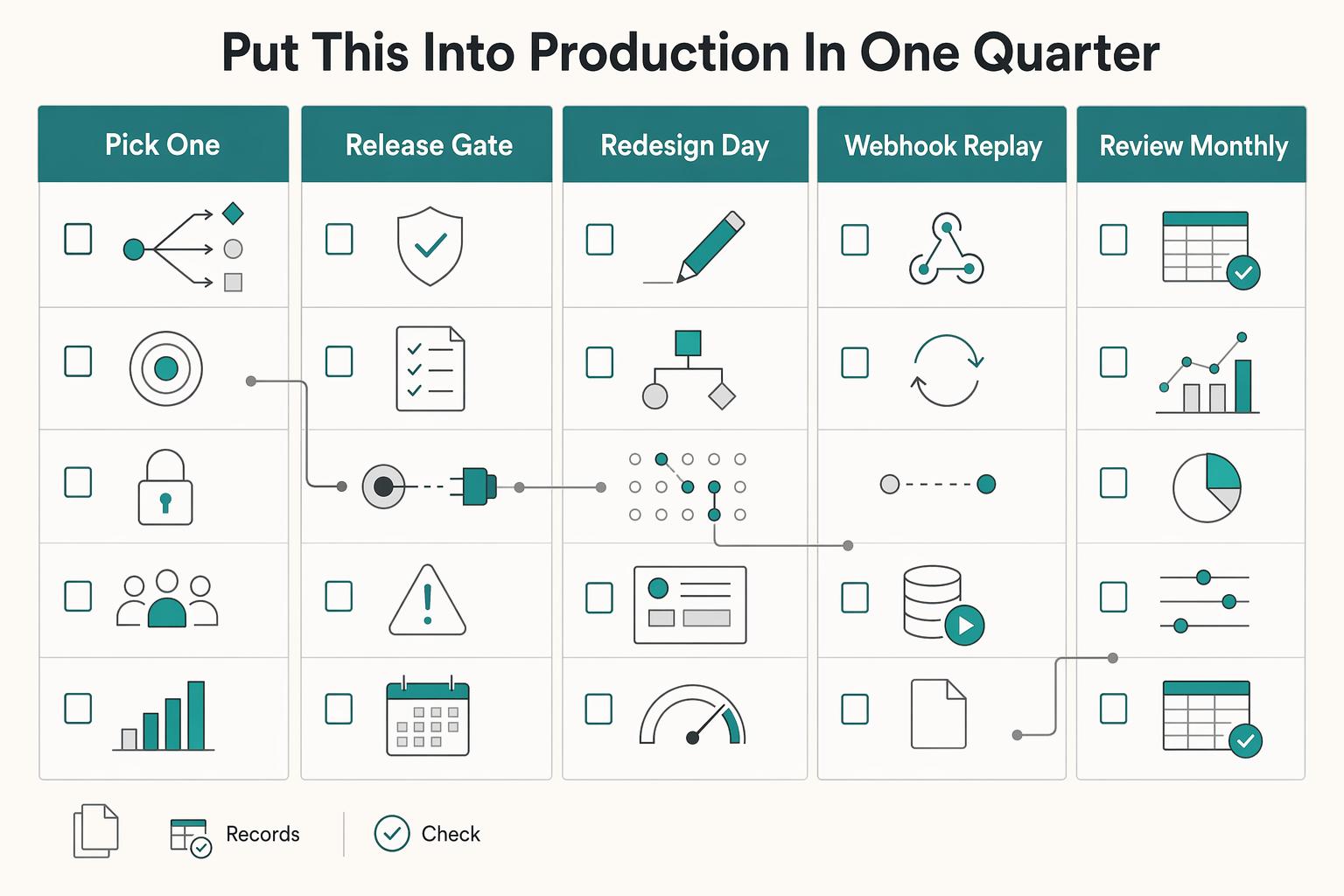
Quick Answer
Choose one default path first: trial for low-friction onboarding, POC when feasibility proof is the blocker, and pilot for limited real-world rollout. Gate activation with ICP fit and readiness checks, then drive the first 48 hours around one Day 1 value event and a Day 2 return signal. Treat trial conversion as valid only when upgrade acceptance, payment/invoice outcome via webhook, ledger posting, and reconciliation all align for the same account.
Why most B2B free trials under-convert even with strong products#
Step 1 Set the target around paid outcomes, not trial volume#
The main mistake is simple: teams often optimize for more starts when they should optimize for more profitable paid customers. In B2B SaaS, trial-to-paid conversion rate is the share of trial users that become active paying customers in a defined period. That number only matters if the customers who convert are the right ones for your business.
A free trial can reduce buyer uncertainty and help an internal champion prove the product works. That is useful. It is not the same as saying every extra signup is good. If your trial design starts with top-of-funnel volume, you can end up celebrating growth that raises support cost and does little for paid outcomes.
A practical checkpoint is to review trial cohorts by segment and by annual contract value, not just in aggregate. ACV is the annualized recurring revenue per customer contract, and it is the first lens that tells you whether the trial is feeding the customer mix you actually want.
Step 2 Acknowledge the real tension in trial design#
Strong products can still under-convert when the trial motion ignores operating cost and buying reality. The same free trial that removes friction can also absorb support time, mask lack of urgency, and drag out decisions.
That is why there is no standard B2B trial shape that works everywhere. A self-serve path may improve conversion and retention with less human involvement for one segment, while the same path may not fit another.
A red flag to watch early is simple: trial starts go up, but first meaningful outcomes do not. That can mean the trial is easy to enter but poorly matched to readiness, product complexity, or buyer intent.
Step 3 Use a narrower method than "make the trial better"#
The fix is not to open access and hope. You need to choose the right motion for the deal, qualify who gets in, shorten time to value (TTV), and measure outcomes with evidence finance will trust. TTV is the time from the start of the experience to the first meaningful user outcome in product, and it is often a more useful operating signal than trial length alone.
If implementation burden is low and value can be proven quickly, a self-serve trial may work. In either case, verify the same things: did the account reach first value, how much support did it consume, and did it convert within the period you defined?
That lens guides the rest of this guide. The goal is not more free trials. It is more paid conversion that still looks good when you examine ACV mix, cost to serve, and margin.
If you want a deeper dive, read Reverse Trials for B2B Platforms: Why Giving Full Access First Converts More Paid Accounts.
What to prepare before you change trial design#
Do not change your free trial until you can show what improved, for which cohort, and at what cost. This prep keeps you from confusing more starts with better paid outcomes.
Step 1 Build a cohort baseline you can trust#
Start with current trial-to-paid conversion by cohort, then split it by ACV band and segment. Keep the cohort logic consistent before and after the change, using shared attributes such as acquisition date, product type, or behavior.
Your first checkpoint is straightforward: can you show which accounts convert today by segment and contract size, not just in aggregate? ACV is used across forecasting, pricing, and sales planning, so your baseline should match how the business already evaluates account quality.
Step 2 Create a minimum evidence pack from product and handoffs#
Build a minimum evidence pack with three elements: activation events, first-value events, and webhook handoff logs. Webhook streams can push real-time event data to a single endpoint that handles multiple event types, which makes centralized checkpoint evidence practical.
Verification is the point. You should be able to trace an account from trial start to activation to first value from system events, not only from manual commentary.
Step 3 Lock owners and decision rights before launch#
Assign one owner for each checkpoint across product, sales, and finance before launch. In B2B, buying and renewal decisions often involve multiple decision makers, so unclear ownership quickly creates disputes over definitions and outcomes.
Keep decision rights explicit at each checkpoint so conflicts are resolved up front, not after results come in.
Step 4 Set success criteria that finance will respect#
Use conversion rate, but do not stop there. Add CAC payback period, cost to serve, and expansion quality by ideal customer profile (ICP) fit.
CAC payback period measures how long it takes to recover acquisition spend. Keep one hard rule: if conversion rises but payback worsens, cost to serve increases, or expansion quality drifts outside your ICP, treat the redesign as a miss.
Related: Freemium vs. Free Trial vs. Reverse Trial: Which Acquisition Model Works for Payment Platforms.
Choose the trial motion that fits your deal and product#
Pick one default motion, then route exceptions with explicit rules. The right choice depends on your offering and the team resources you can actually support across product, sales, and finance.
Step 1 Pick a default motion based on setup burden and buying friction#
If onboarding is light and fast value is likely, start with a trial. If the first job is proving feasibility before a larger commitment, start with a proof of concept (POC). If feasibility is already clear and you need a limited real-world test before broader rollout, use a pilot program.
| Motion | Setup friction | Sales effort | Monetization risk | Best fit |
|---|---|---|---|---|
| Opt-in free trial | Low to moderate | Moderate | Lower missed-cancellation charge risk than opt-out | Accounts likely to reach value quickly |
| Opt-out free trial | Low to moderate | Lower at signup, possible cleanup later | Higher if cancellation is missed and charges follow | Only when charge path is explicit and value is likely fast |
| Limited free trial | Moderate | Moderate to high | Lower giveaway risk; can hide value if key capabilities are gated | When access limits are operationally necessary |
| Unlimited free trial | Varies by product | Varies by product | Varies by support load and buying behavior | When full access helps prove value quickly |
If you use opt-out, make end date, cancellation path, and charge behavior obvious.
Step 2 Route higher-complexity accounts to POC or pilot#
Use a POC when feasibility evidence is the gating question. A POC is an evidence-focused exercise to validate feasibility before larger time and resource commitments. Use a pilot when the goal is a small-scale test with a limited group before broader rollout; pilots are usually more customized and operationally heavier than standard trials.
A practical routing rule is simple: if implementation burden is high and ACV is enterprise, default to POC; if onboarding is light and fast value is likely, default to trial.
Step 3 Define entry, exit, and handoff rules so teams stop improvising#
Publish rule-based routing in your CRM so ownership changes without manual intervention. For each motion (trial, POC, pilot), define:
- Entry criteria: what must be true before the account starts this motion
- Exit criteria: what counts as pass, fail, or next step
- Handoff trigger: the event that moves ownership to the next team
Then spot-check recent accounts for three basics: the motion is recorded, the owner is clear, and the evidence matches the selected motion.
Set qualification gates before activation#
Do not activate every signup. You get a cleaner trial signal when you qualify for fit first, then route by readiness, so you can tell the difference between weak targeting and weak onboarding.
Step 1 Gate on ideal customer profile fit#
Start with company-level fit before activation. Your first gate should confirm three things: the account matches your ICP, there is a real use case, and there is a viable path to pay.
Keep this enforceable: required fields plus a pass/fail decision. Avoid forcing a single universal score across segments. Store an ICP status and a reason code for rejects or manual approvals so low-fit intake does not blur conversion quality.
Step 2 Require onboarding readiness, not just interest#
A qualified account is not always activation-ready. If first value depends on CRM data, confirm data access permissions and a named admin or operator who can complete the import or connection.
This prevents a common reporting error: setup blockers being logged as product failure. Record readiness status, blocker type, and owner in the same record as the activation decision.
Step 3 Route by readiness and code fallout separately#
Route accounts based on what they can do next. High-readiness accounts can go self-serve with strict activation and first-value milestones; low-readiness accounts should move to assisted onboarding or wait until blockers are cleared.
Use CRM assignment rules so routing follows defined criteria, not rep discretion. Then track fallout in separate buckets:
- Qualification fallout: poor ICP match, weak use case, no viable buyer
- Onboarding fallout: good fit, but data access missing, admin unavailable, setup incomplete, or first-value milestone missed
If both sit in one generic "lost trial" field, targeting and onboarding failures get mixed and decisions drift.
Design Day 0 to Day 2 for fast proof of value#
Design the first 48 hours around one real in-product outcome, not setup completeness. The operating rule is simple: reduce time to value so the account experiences promised value quickly and has a reason to come back.
Step 1 Strip Day 0 down to the shortest path to value#
Use onboarding to guide the opening steps, but do not force every setup task before first proof of value. If users can reach a meaningful outcome with partial data, sample data, or a narrower use case, start there and defer non-critical CRM work.
The test is practical: can a qualified account reach first value without waiting on admin-heavy work like full mapping, cleanup, or broad permission reviews? If not, Day 0 is measuring setup tolerance instead of product value.
A quick audit helps: map recent trial event order (signup -> first session -> integration started -> first-value event). If first value usually comes only after long CRM work, redesign Day 0.
Step 2 Define one Day 1 milestone and one Day 2 return checkpoint#
Set one Day 1 milestone tied to activation: the first moment the product delivers promised value. Do not treat checklist completion or connection steps as the milestone.
Keep it narrow and auditable: did the account experience the core benefit at least once? Then set one Day 2 checkpoint for early return behavior (for example, a second session), since early repeat usage is a useful retention signal.
Instrument both events with explicit names and timestamps (for example, first_value_achieved and day2_returned). Without that instrumentation, stalled trials are hard to diagnose.
Step 3 Add recovery paths before integration failures happen#
Assume some integrations will fail, and design recovery before launch. The goal is to avoid dead ends and keep users moving toward first value.
| Recovery option | Use |
|---|---|
fallback import | When a direct connection fails |
manual seed data | To prove value without full production readiness |
guided next-best action | Tells the user exactly what to do next |
Also log successful and failed integration requests with account context and error detail so stalled trials can be reviewed with evidence.
Step 4 Gate upgrade prompts behind meaningful value#
Trigger upgrade prompts only after the account reaches meaningful in-product value. This aligns sales or paywall timing with Product Qualified Lead logic, where outreach follows experienced value rather than signup alone.
In high-touch motions, apply the same rule: prioritize outreach after first value, and use Day 2 return as added confidence when relevant. Validate timing by auditing recent accounts for signup, first-value, and first upgrade prompt timestamps.
For a step-by-step walkthrough, see Best Lead Generation Tools for B2B SaaS Operators.
Run intervention rules across product, sales, and customer success#
After you define Day 1 and Day 2 milestones, treat interventions as operating rules, not ad hoc follow-up: each key signal needs one owner, one SLA, and one channel so product, sales, and success do not collide.
Keep intervention states small enough to run#
For most B2B SaaS motions, start with four states: setup stalled, second login missed, high-intent usage, and expansion signals. Define each state as a trigger tied to a specific action that either rescues first value or advances a buying conversation.
| State | Definition |
|---|---|
setup stalled | Blocked before first_value_achieved, not just slow |
second login missed | Did not reach day2_returned |
high-intent usage | A Product Qualified Lead signal, screened for ICP fit before sales outreach |
expansion signals | Later-motion usage that suggests broader adoption or a larger use case |
Use a blunt test: if you cannot show the event definition, trigger/query, and alert destination, it is not an operating rule yet.
Give each signal one owner, one SLA, and one channel#
Assign one primary owner and one written response expectation per signal. SLAs set clear response and accountability expectations.
A practical pattern is:
- High-fit account stalled before first value: human response target (for example, within 24 hours)
- Lower-value missed second login: automated in-app or lifecycle nudge
Be explicit on channel ownership:
- Product/lifecycle marketing for lower-cost nudges in lower-value segments
- Sales for strong-fit, high-intent usage
- Customer success/solutions/implementation for POC or pilot motions where setup complexity and handoffs are higher
Escalate by ACV band and route#
Escalate by ACV band and route, not gut feel. High ARR or high-potential ARR segments can justify early high-touch intervention; lower-value segments are usually better served with lower-cost models.
Apply clear rules:
- High-fit ICP account stalls before first value: trigger human assist
- Low-fit inactive account stalls: suppress expensive outreach
- High-intent usage appears: prioritize quickly, but treat benchmark PQL conversion ranges (for example, 15-30%) as directional until your own segmented cohorts validate impact
Tie intervention outcomes to route:
free trial: recover activation efficientlyproof of concept (POC): unblock technical proofpilot program: support stakeholder adoption and test expansion potential
Control abuse and compliance risk without killing conversion#
Put compliance friction at the moment risk starts, not at the first click. Keep early trial access light when users are only evaluating features, and move gates forward when the trial can open accounts, enable payouts, or move money.
Put KYC, KYB, and AML checks at the exposure event#
Define one product event that triggers KYC, KYB, and AML controls, then enforce checks there. KYC is risk-based identity verification, and customer identification procedures are part of the AML compliance program. KYB applies when onboarding legal entities, where beneficial owners are identified and verified at new account opening.
If the trial is only for evaluation, avoid collecting beneficial-owner details on Day 0. If the trial activates a financial capability, treat that activation as the account-opening gate and run checks at that point.
Run a simple control test: can you show the trigger event, required fields, and the owner for exceptions?
Time tax and jurisdiction documents to payout or tax-sensitive events#
Collect tax and jurisdiction documents when payout or tax-sensitive billing begins. For U.S. payees, use Form W-9 to collect taxpayer identification information. For foreign beneficial owners, request Form W-8BEN from the withholding-agent/payer flow. If you support EU cross-border trade, validate VAT numbers with VIES before relying on them.
| Item | Use when | Note |
|---|---|---|
Form W-9 | For U.S. payees | Collect taxpayer identification information |
Form W-8BEN | For foreign beneficial owners | Request from the withholding-agent/payer flow |
VIES | If you support EU cross-border trade | Validate VAT numbers before relying on them |
Form 1099-NEC | Before payouts start | Used to report nonemployee compensation |
FBAR | Fact-dependent review item | Aggregate foreign-account value above $10,000; due April 15 with an automatic extension to October 15 |
Plan reporting data early in payout-enabled trials. Form 1099-NEC is used to report nonemployee compensation, so capture what your reporting process needs before payouts start. Treat FBAR as a fact-dependent review item, not a default trial step; the trigger is an aggregate foreign-account value above $10,000, due April 15 with an automatic extension to October 15.
Audit this in practice by sampling payout-enabled trial accounts and confirming required tax validation completed before first payout.
Make financial actions idempotent and auditable#
Require an idempotency key for payout, refund, credit, or funding actions so retries do not duplicate side effects. Store webhook payloads and link them to account records, but do not treat receipt alone as sufficient evidence. Add signature checks, retention rules, and reconciliation against your internal action state.
Keep a short abuse checklist with explicit recovery actions:
- repeated trial signups tied to the same business, tax ID, bank destination, or payout details
- repeated verification failures or mismatched identity and business data
- unusual retry patterns on payment or payout endpoints after successful responses
- attempts to unlock payout features before core onboarding is complete
When a red flag appears, freeze the financial capability, preserve event history, route to manual review, and return the account to a non-financial trial path where possible. For deeper patterns and response options, see Subscription Fraud Trends for Platforms: How to Detect Free-Trial Abuse and Card Testing.
Measure conversion economics so finance trusts the outcome#
Finance will only trust conversion if each reported win can be traced from product behavior to accounting records and cash reconciliation. Use one shared chain across teams: webhooks for event evidence, ledger entries for accounting evidence, and reconciliation outputs for cash evidence.
Define one account-level chain from trial behavior to booked revenue#
Map one account-level chain from trial behavior to booked revenue: trial started, first-value event reached, upgrade accepted, payment or invoice outcome received by webhook, ledger entry created, then reconciliation completed against the underlying financial record. Webhooks are useful for asynchronous payment outcomes because they arrive as HTTPS JSON event payloads, but a webhook alone is not booked revenue.
Make joinability the checkpoint. For any converted account, you should be able to follow one account ID or contract ID across product events, billing events, ledger postings, and reconciliation outputs without manual reconstruction. A common failure mode is counting upgrade clicks as conversion even when payment fails later, retries create duplicates, or ledger posting never lands.
Break out module effects when MoR, Virtual Accounts, or payout batches appear#
When Merchant of Record (MoR), Virtual Accounts, or payout batches appear in trial, report them separately instead of blending them into one conversion rate.
MoR needs its own slice because the MoR is the legally responsible payment entity, including obligations such as KYC, AML, and indirect tax handling. Virtual Accounts need their own slice because each has a unique identifier for tracking and reconciliation, while funds remain in a linked physical account. Payout batches need their own slice because payout reconciliation matches bank deposits to grouped settled transactions, and that timing can skew a simple paid count.
Store and freeze the feature-enabled timestamp for each module in trial reporting. Without that, finance ends up explaining margin or cash-timing shifts that were really module-mix effects.
Review the same four cuts every month#
Run the same four cuts monthly by segment and ACV so you can separate targeting issues, onboarding issues, and accounting timing effects from real conversion movement.
| Review cut | What to look for | Verification detail |
|---|---|---|
| Qualification mix | Whether low-fit accounts are flooding the funnel | Share of trials by ICP, route, and ACV band |
| First-value rate | Whether users reached the core outcome early | Completion of the defined Day 1 or Day 2 value event |
| Intervention yield | Whether sales or success touches changed outcomes | Assisted vs unassisted lift by segment |
| Paid conversion | Whether trial wins became finance-valid wins | Ledger posting present and reconciliation status complete |
Use external benchmarks as directional context, not targets. The ICONIQ State of Go-to-Market report notes roughly 50% (2026) vs 36% (2025) for free-trial and POC paths, compared with 30-40% for traditional SQL or demo paths, and ICONIQ Compass states it is for general information purposes only, with data last refreshed Q3 2025. Set targets from your own segmented cohorts, especially as module mix and ACV shift.
Put this into production in one quarter#
One quarter (3 months) is typically enough to tighten one acquisition motion, instrument it, and start a monthly economics review. Keep scope narrow: pick one default path first, then make routing, handoffs, and measurement explicit.
- [ ] Pick one primary motion and publish routing rules.
Set one default for net-new accounts: free trial, proof of concept (POC), or pilot program. Route to trial when setup is light and value can be reached quickly; route to POC or pilot when buyers need proof in their own environment or multi-stakeholder sign-off. Early PLG teams often start with one main model, so avoid mixing motions before you can measure each one cleanly.
- [ ] Set
ideal customer profile (ICP)gates and readiness checks before activation.
Use your ICP to control who gets trial capacity, not just who submits a form. Check fit and readiness separately: fit for account value, readiness for practical start conditions (for example, owner, access, and implementation readiness). Tag rejected or assisted accounts with reason codes so qualification fallout is not confused with onboarding fallout.
- [ ] Redesign Day 0 to Day 2 around measurable
time-to-value (TTV)milestones.
Define one Day 1 value milestone and one Day 2 retention checkpoint tied to commercial outcomes. If data setup blocks value, provide a fallback path (sample data, seeded data, or guided import) so first value is still reachable. Confirm milestones in the event log with account ID and timestamp before tuning pricing or lifecycle messaging.
- [ ] Implement intervention SLAs and verify signal capture through
webhooks.
Assign an owner and response expectation for key states (stalled setup, missed second login, high-intent usage, expansion signals). Validate webhook payloads end to end: event type, account identifier, timestamp, and downstream update. Use idempotency key controls for retry safety on financial actions instead of assuming exactly-once delivery.
- [ ] Review monthly economics by
ACVand module usage and adjust.
Run a monthly review segmented by ACV band and actual in-trial module usage. If Merchant of Record (MoR) is used, make legal payment responsibility and compliance cost explicit; if Virtual Accounts or payout batches are used, break them out because account structure and batch cadence affect support load, reconciliation effort, and margin. Use payout reconciliation where relevant so finance can tie trial activity to settlement batches.
Frequently Asked Questions
Which model should we start with: `opt-in free trial`, `opt-out free trial`, or `limited free trial`?
Start with the model that matches your setup friction and risk tolerance, not the one that sounds more aggressive. An opt-in free trial lowers signup friction because users do not need to enter payment details, while an opt-out free trial requires card details up front and changes trial quality and conversion mechanics. A limited free trial can be a practical middle ground when you need users to reach value without exposing your full product.
When should we route an account to a `proof of concept (POC)` instead of a trial?
Route to a proof of concept (POC) when the buyer needs specific proof in their own context before a longer trial. A POC is useful in context, not universally better. Define success in advance with a clear exit criterion so the POC stays bounded.
What must happen in the first 24 hours to improve `trial-to-paid conversion`?
The account needs to hit one meaningful product outcome quickly, because users have to experience value before they convert to paying customers. Keep Day 1 focused on the shortest path to that value event. If the first day is mostly setup with no clear value outcome, conversion risk usually rises.
Is a longer trial usually better for `B2B SaaS`, or does it delay buying decisions?
Longer is not automatically better. A short window such as a 14-day trial can work when time to value is quick. If users are not reaching first value early, fix onboarding before adding days.
How much `customer relationship management (CRM)` setup should happen before first value?
Only the minimum needed to unlock the first useful outcome should happen before first value. Do not force full customer relationship management (CRM) setup if a lighter import, sample data, or manual seed can prove usefulness first.
Can we trust industry conversion benchmarks without segmenting by `ACV` and customer type?
No. Benchmark data can be useful directional context, even when drawn from large samples such as 10,000+ SaaS companies analyzed and 2.5 million trial users tracked, but you should not treat one headline number as your target. Segment by ACV, company size, industry, and trial model.
How do we add `KYC` or `AML` checks without crushing activation?
Use risk-based sequencing. Know Your Customer / Know Your Business (KYC/KYB) is mandatory in regulated financial contexts, and AML programs require ongoing risk-based customer due diligence. Sequence checks by risk and by where regulated activity begins in your flow, then monitor drop-off points so compliance friction is measured rather than guessed.
Try a related tool
Researched and edited by the Gruv editorial team. Gruv builds cross-border billing, payouts, and finance-operations software for global businesses.
Sources
- consumer.ftc.gov/node/77481trusted
- docs.stripe.com/webhookstrusted
- docs.stripe.com/reports/payout-reconciliationtrusted
- ecfr.gov/current/title-31/subtitle-B/chapter-X/part-1...trusted
- ecfr.gov/current/title-31/subtitle-B/chapter-X/part-1...trusted
- europa.eu/youreurope/business/taxation/vat/check-vat-n...trusted
- irs.gov/businesses/small-businesses-self-employed/re...trusted
- irs.gov/forms-pubs/about-form-w-9trusted
Educational content only. Not legal, tax, or financial advice.
Related Posts
Reverse Trials for B2B Platforms That Convert More Paid Accounts
Treat a reverse trial as a monetization decision, not a short-term growth play. If your B2B platform cannot support a clean downgrade, clear plan boundaries, and reliable billing and entitlement changes, more full-access signups may not help much.
How Platforms Detect Free-Trial Abuse and Card Testing in Subscription Fraud
If your platform sells subscriptions while also handling contractor, seller, or creator payouts across markets, this is not just a signup filter issue. It is a control design issue that cuts across risk, finance, legal, compliance, and product. The damage often shows up later in the customer lifecycle, not only at account creation.
Freemium vs. Free Trial vs. Reverse Trial: Which Acquisition Model Works for Payment Platforms
If you are choosing between **freemium, free trial, and reverse trial** for a payment platform, signup lift is easy to measure and easy to overvalue. The better choice comes from conversion quality, retained revenue, downgrade behavior, abuse exposure, and the operating load your team can actually support.