
Quick Answer
Choose based on value path and month-2 durability: use freemium for broad utility discovery, card-required trial for stronger buyer intent, and reverse trial when paid capabilities must be experienced before a fair decision. In freemium vs free trial vs reverse trial payment platforms, lock expiry outcomes before launch, set no-card end rules, and enforce idempotent webhook-to-ledger transitions so charge, downgrade, and support states stay consistent.
How These Models Differ in Practice#
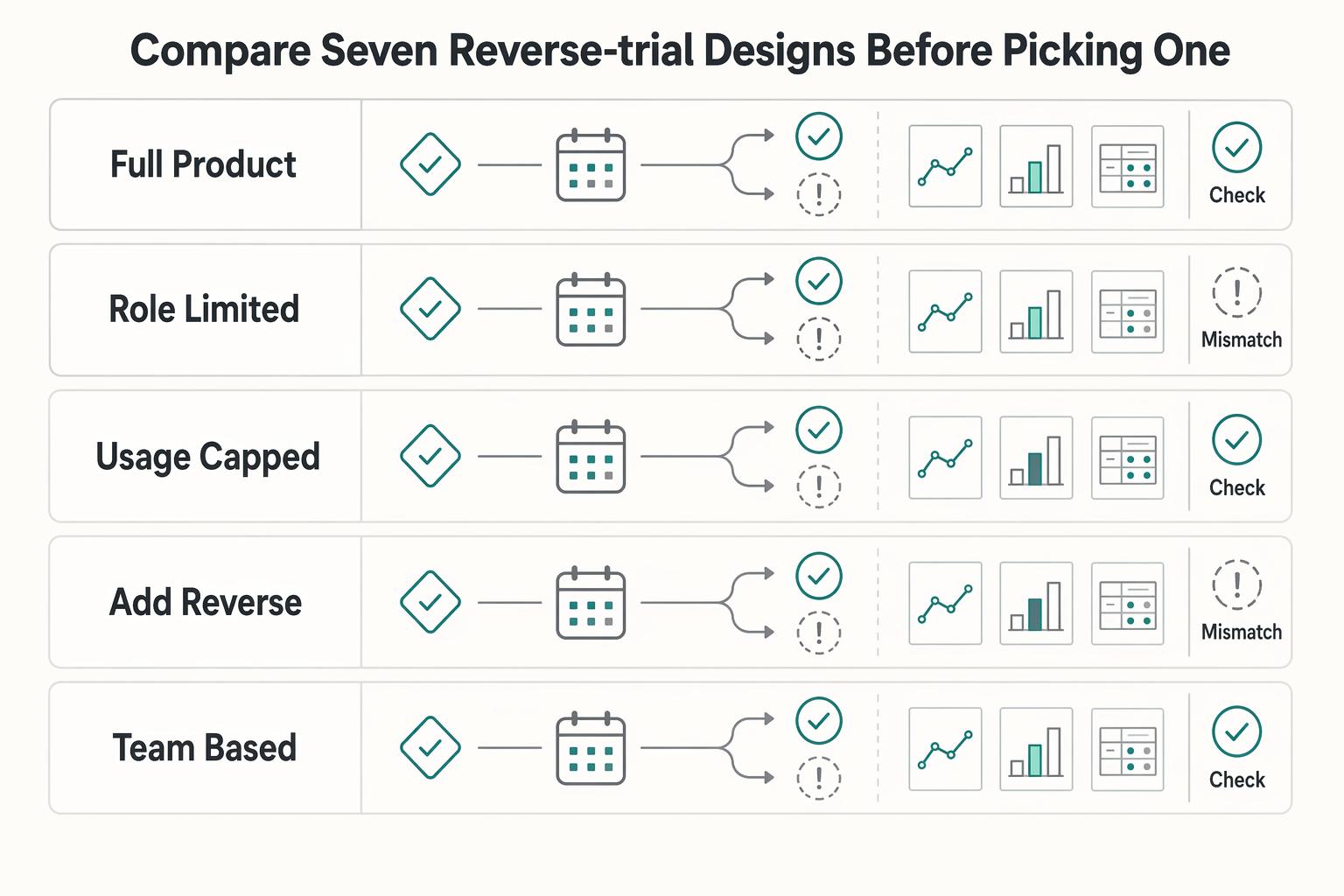
If you are choosing between freemium, free trial, and reverse trial for a payment platform, signup lift is easy to measure and easy to overvalue. The better choice comes from conversion quality, retained revenue, downgrade behavior, abuse exposure, and the operating load your team can actually support.
The model definitions are simple. Freemium gives ongoing free access with feature or usage limits. Free trial gives full access for a fixed window, typically 14 or 30 days. Reverse trial starts users on paid features, then moves them to freemium if they do not upgrade.
The tradeoff is straightforward, even if the execution is not. Trials usually bias toward conversion. Freemium usually biases toward usage. Freemium can increase usage but weaken monetization awareness and paid conversion. Reverse trial aims to combine product usage with paid conversion.
Card gating sharpens that tradeoff. Requiring a card can improve paid conversion, but one estimate says as many as 80% of users drop at the card screen. No-card flows usually increase volume, but they also bring lower-intent users and more activation work.
In payments, no-card flows can also expand the abuse surface. Card testers use setup and payment attempts to validate stolen or enumerated cards. Stripe reported detecting 6.2x more abusive free trials from November 2025 to February 2026.
Retention and unit economics are the real filter. A model can look strong on early conversion and still fail if customers churn quickly. You are managing two outcomes at once: acquiring customers and keeping them long enough to support acquisition and servicing costs.
For payment platforms, compliance and risk operations shape what is viable. In the U.S., money transmitters are treated as MSBs, and BSA recordkeeping and reporting plus AML program obligations apply. KYC onboarding helps, but it does not remove the need for ongoing fraud monitoring. The practical question is not which model sounds best in theory. It is which one still holds up when product, finance, and risk review the same cohort outcomes.
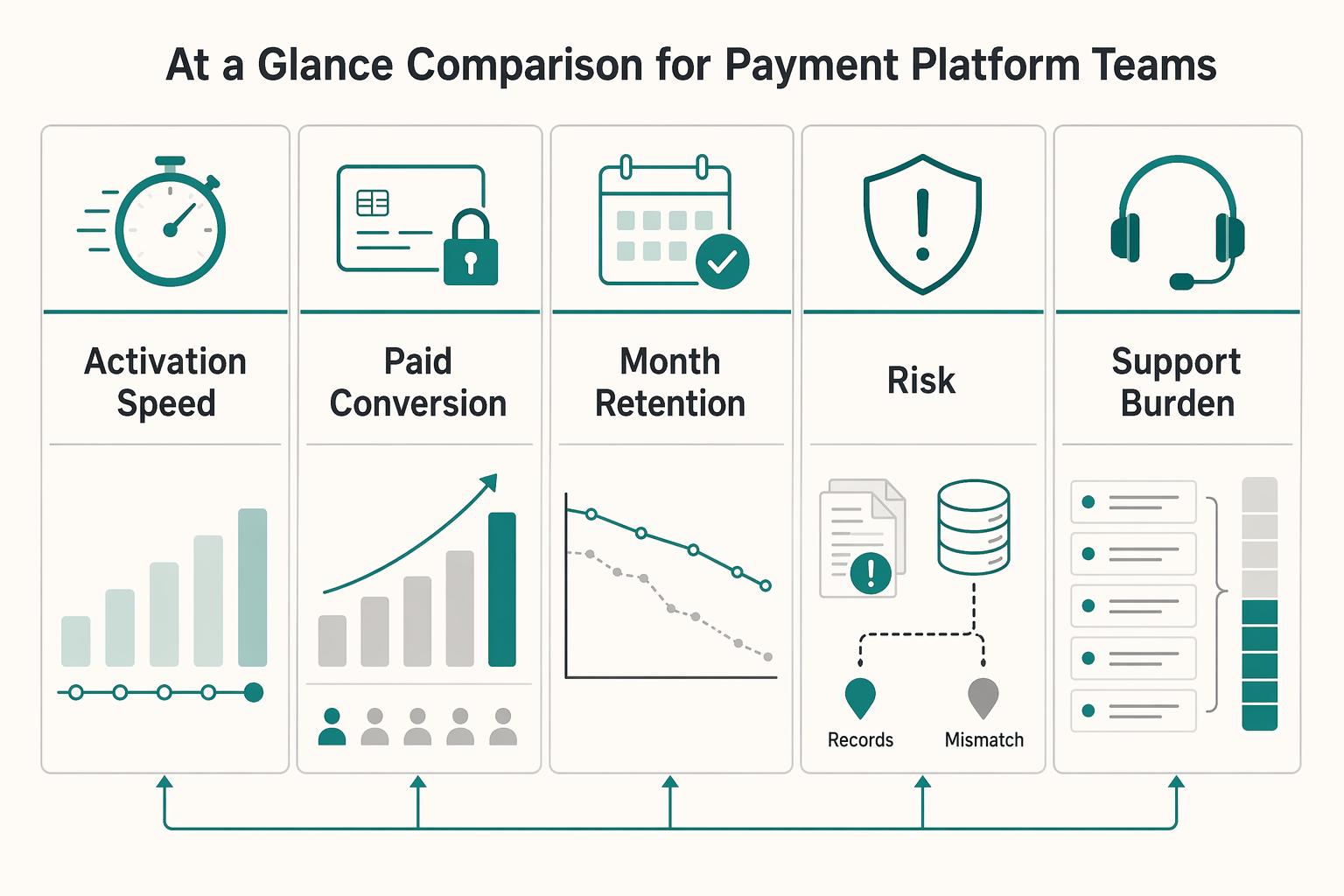
At a glance comparison for payment platform teams#
Do not treat "trial" as one model. For payment platforms, it helps to keep four lanes in view: Freemium, a card-required trial, a no-card trial, and Reverse Trial. Each one changes intent signals, ops load, and failure modes.
| Criteria | Freemium | Card-required trial | No-card trial | Reverse Trial |
|---|---|---|---|---|
| Activation speed | Depends: can start quickly because there is no upfront payment step. | Depends: card entry can add friction at start. | Depends: no upfront card step can reduce start friction. | Depends: start speed hinges on how clearly downgrade state is designed. |
| Paid conversion quality | Depends (one benchmark): free trials convert slightly better than freemium, but signup-rate differences can erase that gap. | Advantage (one benchmark): 30% free-to-paid, more than 5x no-card trials. | Risk (one benchmark): materially lower free-to-paid than card-required trials. | Depends: can fit full-feature evaluation flows, but evidence here is mostly cross-SaaS. |
| Month-2 retention | Depends: no payment-platform benchmark here supports a universal winner by model. | Depends: outcome follows fit and onboarding quality more than trial label alone. | Depends: outcome follows fit and onboarding quality more than trial label alone. | Depends: outcome follows fit and onboarding quality more than trial label alone. |
| Abuse risk | Depends: no model-level abuse ranking is established here. | Depends: no model-level abuse ranking is established here. | Depends: no model-level abuse ranking is established here. | Depends: no model-level abuse ranking is established here. |
| Support burden | Depends: no universal support-burden ranking by model is established here. | Depends: no universal support-burden ranking by model is established here. | Depends: no universal support-burden ranking by model is established here. | Depends: no universal support-burden ranking by model is established here. |
| Implementation complexity | Depends: no universal complexity ranking by model is established here. | Depends: no universal complexity ranking by model is established here. | Depends: no universal complexity ranking by model is established here. | Depends: no universal complexity ranking by model is established here. |
| Ledger traceability | Depends: lower burden if no money movement in free tier; higher if users can create payment states. | Risk: trial-end charge and entitlement changes must reconcile to the same record chain. | Depends: complexity rises if trial actions create payable or refund-sensitive states. | Risk: downgrade must preserve historical money-movement visibility. |
| Webhooks reliability | Depends: fewer billing events, but reliability still matters. | Risk: duplicate or out-of-order events can desync billing and access. | Risk: expiry and provisioning events can be duplicated or delayed. | Risk: duplicate upgrade and downgrade events can desync entitlements. |
| Merchant of Record (MoR) or Virtual Accounts handoff | Depends: can be simpler if introduced after upgrade. | Risk: recurring-charge disclosure, consent logging, and seller-liability handling apply early. | Depends: lighter start, but complexity rises if setup begins during trial. | Depends: complexity rises when tax, seller, or bank-transfer setup starts before upgrade. |
The trial split is where teams can misread signal. In a ChartMogul benchmark of 200 B2B software products, card-required trials showed 30% free-to-paid conversion, more than 5x no-card trials. The same report also says free trials convert only slightly better than freemium overall, and that difference can disappear once signup rates are included.
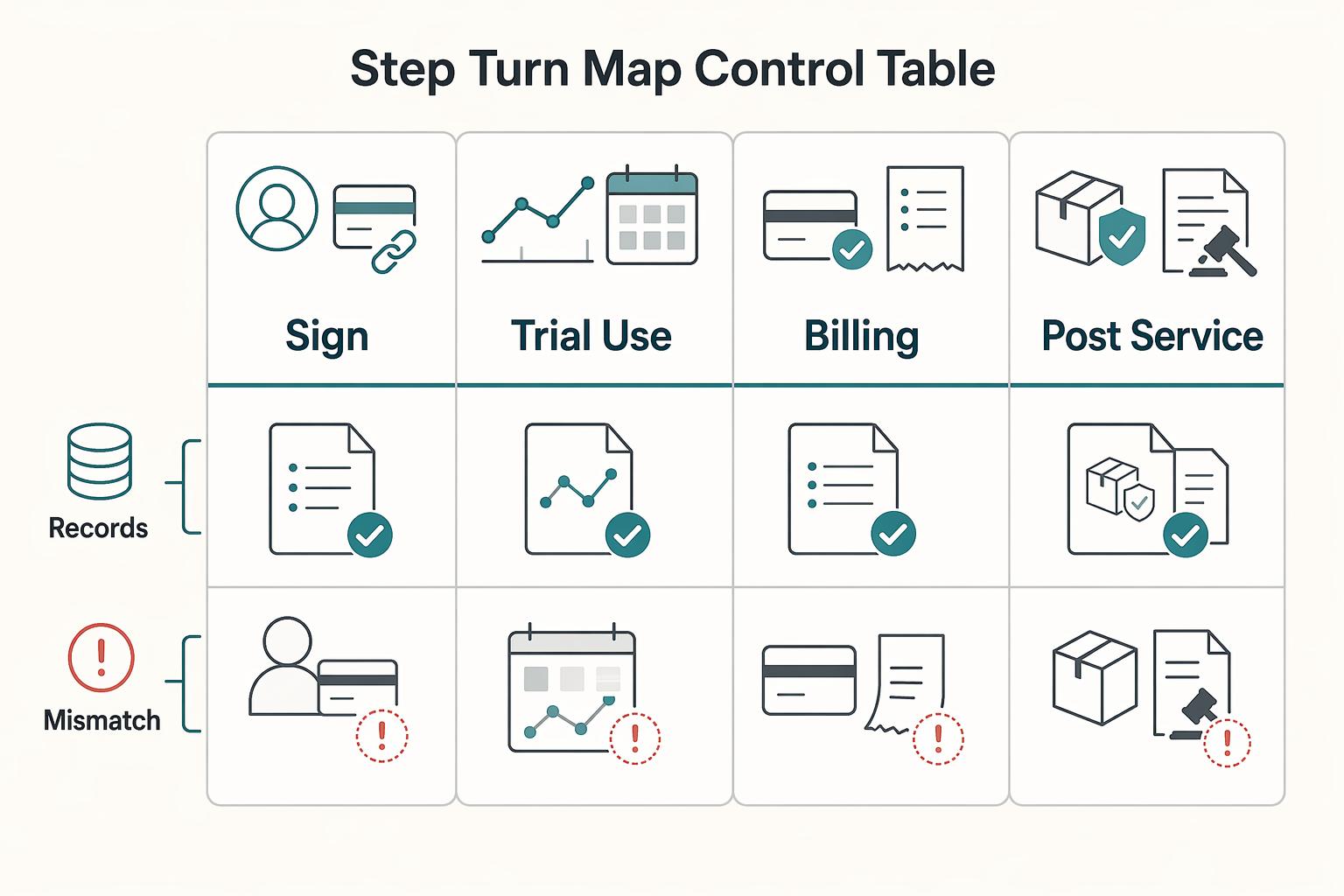
The operational rows deserve the same weight as the conversion rows. If users can trigger balance movement or bank-transfer flows during trial or free use, you need a traceable ledger path and clean reconciliation, including virtual account flows where relevant. Finance should be able to reconstruct trial start, upgrade, downgrade, charge, and refund from a consistent record chain. We recommend mapping that record chain the way your finance and risk reviewers will test it later.
Webhook behavior also needs to be designed as retry-safe. Stripe notes that webhook endpoints can receive duplicates, and payloads can arrive outdated, partial, or out of order. Idempotent upgrade, downgrade, and provisioning handling is a baseline requirement.
If a Merchant of Record sits in the flow, treat disclosure and renewal handling as product requirements, not legal cleanup. An MoR is the legal seller and takes key payment and compliance liabilities. The FTC's June 16, 2025 announcement tied to a $5 million Paddle settlement is a practical reminder that recurring-charge clarity and renewal handling need upfront design review.
If you want a deeper dive, read Reverse Trials for B2B Platforms: Why Giving Full Access First Converts More Paid Accounts.
What each model actually means in a payment platform#
In a payment platform, the model label describes the offer. The real design work sits in trial-end behavior, entitlement changes, webhook handling, and verification responsibilities.
| Model | Plain meaning | What you still have to define |
|---|---|---|
| Freemium | A basic offering stays free, with paid upgrades for more capability. | What stays free, what unlocks on paid, and which actions are excluded from the free tier. |
| Free Trial | A product or service is free for a short, time-limited period. | Trial length, whether payment details are collected at signup, and what state follows at trial end. |
| Reverse Trial | Users start with paid-feature access, then move to freemium if they do not upgrade. | Which paid features are removed at expiry, what remains visible, and how downgrade is enforced clearly. |
Card-required and no-card setups are trial configurations, not separate model families. In Stripe Checkout, collecting a payment method at trial start is the default, and no-upfront-card signup is also supported when configured with payment_method_collection=if_required. The label may be the same, but implementation details and operational outcomes can differ.
Post-trial behavior matters as much as the signup flow. Stripe documents that, without a payment method at trial end, a subscription can be configured to cancel immediately or pause. Before launch, lock three decisions: the event that marks trial expiry, the entitlement state that should follow, and the customer record state after the transition. We recommend writing those three states into your launch checklist before you run acquisition tests. Because subscription lifecycle activity is asynchronous, webhook-driven state handling is part of the model, not a later integration task.
This is also where product-led language can hide platform constraints. In custom onboarding flows, Stripe states that the platform is responsible for account interactions, collecting required verification information, and collecting updates on an ongoing basis at least once every six months. So this is not only a funnel choice. If users begin account setup or money-related actions before paying, define verification checkpoints and downgrade behavior first, then choose the acquisition model. For a broader pricing comparison, see Freemium vs. Paid Tiers: Which Pricing Model Works for Payment Platforms?.
Choose the model by motion not by trend#
Choose the model for the motion you need, not the one that happens to be popular. Freemium fits usage breadth. A card-required trial fits paid-intent filtering. Reverse Trial is often worth testing when users need full-feature exposure before they can judge value.
Popularity is only context. In a January 2026 dataset of 200 software products, 57% used free trial as their primary model, 26% used freemium, and 7% used reverse trial. That tells you what is common, not what fits your onboarding shape or GTM mix.
| Model | Best fit motion | What it optimizes first | Choose it when | Main tradeoff |
|---|---|---|---|---|
| Freemium | Self-serve expansion | Usage volume and discovery | You want broad usage signal and growth-loop learning before pushing monetization | Monetization intent is weaker, so paid boundaries must be clear |
| Card-required trial | Fast paid-intent validation | Conversion quality over signup volume | You want to filter for buyers early and can absorb funnel loss | Top-of-funnel volume drops |
| Reverse Trial | Product-led assisted or sales-led follow-through | Full-feature exposure with downgrade path | Users need paid capabilities to evaluate fit before deciding | Downgrade experience becomes core product design |
Start with value exposure first#
If users only understand value after they use advanced capabilities, a standard trial window can underexpose the product. That is usually a strong reason to test Reverse Trial. The practical test is simple: can users reach a credible "this works for us" moment during the trial period, or will most of that time be spent setting up?
Match the model to the handoff you expect#
The best model usually follows the handoff you expect after signup. Freemium is strongest when you expect self-serve expansion and repeat product usage. A card-required trial is strongest when you need a faster read on paid intent and accept fewer starts. Reverse Trial can be strongest when you expect self-serve entry followed by assisted or sales-led conversion after users see real value.
Use a simple contrast rule#
If you need broad usage signal and growth-loop learning, start with Freemium. If you need early paid-intent filtering, bias to a card-required trial. If users must experience paid capabilities before they can evaluate fit, test Reverse Trial before defaulting to a narrow trial.
As a final check, define the first value moment, the capability users must see before buying, and the exact post-trial state if they do not convert. If those are unclear, the model choice is still a guess.
Decide card gating and abuse controls before launch#
Card gating is not just a conversion choice. It sets both your intent filter and your fraud surface. If you want stronger paid-intent filtering and a cleaner path to automatic conversion, start from a card-required trial. If you want more trial starts, a no-card setup can work, but only if you define abuse controls and the end-of-trial payment rule before launch. We recommend settling that rule before you tune signup copy, so your acquisition promise and your risk controls stay aligned.
For payment platforms, signup lift by itself is not enough. Trial abuse includes users cycling free trials with no intent to pay, and multiaccount abuse can spread stolen-card activity across accounts for longer.
| Decision point | Card-required trial | No-card trial |
|---|---|---|
| Signup friction | Higher. Customers may hesitate to enter payment details up front, so signup rate usually drops. | Lower. Cardless trials can increase trial starts by removing upfront card friction. |
| Conversion quality | Stronger intent filter and better setup for automatic conversion. | Weaker intent signal at signup; you need a separate payment-collection step before trial end. |
| Abuse surface | Can reduce serial-trial abuse at signup, but still exposed to card misuse and low-value card testing attempts. | Higher exposure to repeated trial cycling and multiaccount abuse if identity and velocity controls are weak. |
| Critical implementation detail | Define when post-trial charging starts. | Define the payment-collection checkpoint before expiry. In Paddle's cardless flow, if payment details are not added before trial end, the subscription is automatically canceled. |
Put anti-abuse controls in the product before traffic arrives#
Set controls before launch, not after abuse spikes. At minimum, cover:
| Control | What it targets | Article note |
|---|---|---|
| Velocity checks | Repeated activity in short windows | Used to catch bursts of trial starts, repeated low-value attempts, and rapid retries around conversion |
| Identity steps tied to KYC | Onboarding flow and verification requests | Choose the right onboarding flow and actively monitor verification requests |
| Policy triggers aligned to AML | Risk-based identity verification for in-scope entities | CIP sits inside the AML program |
Card testing often uses many low-value attempts, so velocity checks should be one control, not the only one.
Before launch, confirm who reviews verification requests, who can restrict access, and which events move an account to manual review.
Define suspicious behavior and escalation ownership#
Write detection and routing rules before your first campaign. At minimum, flag:
- repeated trial creation or re-entry patterns that suggest free-trial cycling
- clusters of low-value card attempts that look like testing, not normal conversion
- unresolved verification requests that are not being handled in time
Make ownership explicit. Product owns gating logic and in-app behavior during review, risk owns thresholds and restriction policy, and ops owns queue handling, evidence capture, and customer communication.
If you launch a no-card trial, treat abuse rules as launch-blocking requirements. For deeper controls on serial trial abuse and card testing patterns, see Subscription Fraud Trends for Platforms: How to Detect Free-Trial Abuse and Card Testing.
You might also find this useful: Free Trial Abuse Prevention for Platforms Blocking Serial Trial Exploiters.
Design activation and downgrade paths as one system#
Design activation, upgrade, and downgrade as one lifecycle, with one source of truth from Webhook to Ledger to entitlement. If access changes before the payment event is confirmed and recorded, you can create avoidable reconciliation and access errors.
Your app can guide the user, but subscription state should be decided by webhook events because key subscription activity is asynchronous. A redirect or success screen should not be your only signal, and duplicate webhook deliveries are possible, so transition logic must handle retries safely.
Map checkpoints from signup to first value#
Map the full path from signup to first value before launch, then enforce it consistently. For payment platforms, that path can include a trialing subscription, setup records, optional Virtual Accounts setup, payout setup, and then a move to paid or downgraded access. Use four checkpoints you can audit later:
| Checkpoint | What to record | Why it matters |
|---|---|---|
| Provider event | Subscription state created or changed | Marks the source event in the lifecycle |
| Entitlement change | Access change applied in product | Shows when product access changed |
| Ledger entry | State change recorded in the Ledger | Creates the record finance can trace |
| Funds movement record | Transition record such as a balance transaction | Reconciliation anchor if money moved |
The fourth checkpoint matters for finance and support because, if money moved, balance transactions are the reconciliation anchor, not just UI logs.
Make reverse-trial downgrade rules explicit#
Define downgrade behavior before launch: what persists, what is locked, and what remains exportable. Vague downgrade rules create a cliff for users and exception handling for your team.
A practical split is to preserve historical records and prior work, keep read-only reconciliation and export access, and lock new forward money actions until upgrade. In practice, that often means history and exports stay visible while new live payment actions, payout releases, or paid-only controls are blocked.
This lines up with documented trial-end behavior: no-payment-method trials require an explicit cancel-or-pause choice, and paused subscriptions do not generate invoices. Paddle also documents preserving trial work through a pause pattern and supports plan changes while a subscription is still trialing.
Set payment boundaries before the trial starts#
Before you decide how generous the trial should be, set the money boundaries. Separate the rules for selling entity, account structure, and money movement. These are distinct systems, not one generic "trial rule."
| Area | During trial | After upgrade or downgrade | Why this boundary matters |
|---|---|---|---|
Merchant of Record (MoR) | Decide whether paid checkout is routed through the MoR during trial or only at conversion. | At activation or downgrade, keep legal seller and payment path explicit. | MoR is the processor-recognized seller and typically carries payment-processing, tax (including VAT), compliance, and dispute responsibilities, with exact scope varying by provider and contract. |
Virtual Accounts | Decide whether users can view or configure only, or use live identifiers. | On downgrade, keep needed identifiers and history visible for control and reconciliation; define whether new live usage is blocked. | Virtual accounts are sub-ledgers under a core account, with unique account numbers. |
Payout Batches | Decide whether trial users can draft, schedule, or release payouts (provider-dependent). | On downgrade, define whether payouts continue, pause for review, or stop until paid status returns. | Payout behavior can vary by schedule interval and provider capabilities, including manual or batch-style operations. |
If first value depends on Virtual Accounts or Payout Batches, do not remove reconciliation visibility at trial end. Keep history and export access clear, even when new actions are locked.
Build for delayed callbacks and duplicate retries#
Assume async mismatches will happen, and design recovery up front. Webhook delivery can retry for up to three days in live mode, and there is a documented process for manually handling undelivered events.
Use idempotency for outbound API calls and deduplication for inbound events. Idempotency keys can be up to 255 characters and may be pruned after at least 24 hours, so retry and retention policies need to match that reality.
When product state and provider state conflict, restrict higher-risk actions until resolved, especially where trial expiry touches payouts or live funds movement. If you cannot trace how a Webhook becomes a Ledger entry and then an access change, the flow is not launch-ready.
Need the full breakdown? Read What Is a Subscription Lifecycle? How Platforms Manage Trial Active Paused and Churned States.
Measure outcomes that survive month two#
Conversion alone is not enough to choose a model. Track acquisition and durability together: trial-to-paid, month-2 retention, downgrade-to-reactivation, and a clearly documented internal definition of net revenue quality by cohort.
That reporting should connect directly to your downgrade design. When users move from trial to paid, or from full access to freemium, the numbers should show whether those transitions produced durable revenue or just a short-lived spike.
Use paired metrics, not single wins#
Use one cohort anchor across models, typically first-subscription start month. That cohort method is valid for subscription analytics and lets you compare conversion timing, retention by interval, and reactivation in one view.
Trial conversion rate is the percentage of trial subscriptions started in a period that convert to paid in that period. Pair it with month-2 retention, the share of that cohort still holding one or more active subscriptions in month two.
| Cohort view | Primary metric | Paired metric | What it exposes |
|---|---|---|---|
Free Trial | Trial conversion rate | Month-2 retention | Whether conversion survives past first billing |
Reverse Trial | Upgrade rate before downgrade | Downgrade-to-reactivation rate | Whether downgrade paths preserve future revenue |
Freemium | Free-to-paid rate | Month-2 retention | Whether upgrades come from durable usage |
| Any variant | Time to conversion | Cancellation timing after conversion | Whether fast wins are durable or brittle |
If one model is measured by trial start month and another by invoice month, the comparison is already distorted.
Look at when cancellations happen#
A model can show strong conversion and still fail right after trial end. Cohort analysis helps you see where churn peaks in the subscription lifecycle, not just total churn in aggregate.
Track conversion velocity as well as conversion count. A slower-converting variant can still be commercially stronger if those accounts remain active in month two. Interval-level retention checks, for example week-2 drop-offs, are a useful lens for post-trial cliffs.
Also label reactivation correctly. Retention cohorts can include reactivated subscriptions. Use that signal carefully so reactivated paid is not double-counted as new paid.
Break out the cohorts that actually change intent#
Do not pool all trials. Split by model variant (Freemium, Free Trial, Reverse Trial) and by gating choice (card-required vs no-card). Public guidance frames the tradeoff: card-required trials may convert at 70-80% of starters, while as many as 80% can drop at the card screen. Use those figures as context, not forecasts.
Treat figures from Amplitude, Inflection, and Elena Verna as directional only. Build the decision on your own cohort data: start-month cohorts, month-2 retention, downgrade-to-reactivation, cancellation timing, and your internal net-revenue-quality definition.
Add finance and compliance guardrails to monetization design#
A monetization model is only durable if finance and compliance can run it without constant exceptions and rework. If unverified accounts can reach money movement or tax-sensitive states too early, the apparent conversion win will not hold.
Set the pre-verification boundary first#
Define what users can do before KYC, KYB, and AML checks where those controls are enabled, and keep that boundary consistent across freemium, trial, and downgrade states. Where AML/CIP rules apply for covered banks, identity verification should be risk-based, and CIP procedures require verification to the extent reasonable and practicable.
If you are in a covered-bank AML regime, map these gates to internal controls, independent testing, compliance ownership, and training, not just product settings. In practice, allow low-risk setup first, block settlement-critical actions until checks pass, and log the reason for every hold.
Treat beneficial-owner checks for legal entities as policy-configurable, not static copy. Baseline CDD text for covered financial institutions requires identifying and verifying beneficial owners at account opening, but application details changed for covered institutions after FinCEN's exceptive-relief order on February 13, 2026.
Put tax and documentation into the conversion path#
Tax documentation should be part of onboarding flow design, not a cleanup step. If U.S. information reporting may apply, use Form W-9 to collect a correct TIN; foreign entities may need Form W-8BEN-E to document status for chapters 3 and 4. For reportable payment transactions, route reporting to Form 1099-K, not Form 1099-MISC or Form 1099-NEC for card and third-party network payments.
| Reference | Relates to | Key note |
|---|---|---|
| Form W-9 | A correct TIN | Use when U.S. information reporting may apply |
| Form W-8BEN-E | Foreign entity status for chapters 3 and 4 | May be needed for foreign entities |
| Form 1099-K | Reportable payment transactions | Not Form 1099-MISC or Form 1099-NEC for card and third-party network payments |
| VIES | Whether a business is registered to trade cross-border | A search engine, not a database |
| FEIE / Form 2555 | Individual exclusion | Keep separate from platform tax-document logic; 2026 maximum: $132,900 per person |
| FBAR | Aggregate foreign-account value | Keep separate from platform tax-document logic; above $10,000 during the calendar year |
For EU cross-border checks, VIES can confirm whether a business is registered to trade cross-border, but treat it correctly: it is a search engine, not a database. Route exceptions to review instead of using a single failed lookup as a hard final decision.
Keep FEIE and FBAR separate from platform tax-document logic. FEIE is an individual exclusion claimed via Form 2555 (2026 maximum: $132,900 per person), and FBAR ties to aggregate foreign-account value above $10,000 during the calendar year.
Make every transition auditable in the Ledger#
Every monetization transition should be traceable in your Ledger and reconciliation outputs. Finance should be able to verify when access changed, what charge or credit followed, what tax-document state applied, and which source event triggered the entry.
| Transition point | Guardrail that often matters | Evidence finance should be able to pull |
|---|---|---|
| Free to paid | Verification status where enabled, W-9 or W-8BEN-E collection if needed | Ledger entry for plan change, timestamped status snapshot, reconciliation line to charge |
| Trial to paid | 1099-K reporting path where applicable, VAT check (for example via VIES) for EU cross-border scope | Trial-end event, charge record, tax-status snapshot, reconciliation output |
| Reverse-trial downgrade | Proof of access reduction and billing stop or adjustment logic | Downgrade event, Ledger impact, customer notice timestamp, no-charge or adjustment reconciliation |
When product state and finance records diverge, trust in the experiment drops and support inherits the cleanup.
Qualify copy by market and module#
Use explicit qualifiers in pricing and in-product copy: availability varies by market, region, and enabled modules, and additional verification or documentation may apply. That reflects real delivery constraints, since features and payment-method support can vary by country, currency, product, and API option.
Do not hard-code tax thresholds in evergreen copy. Reporting details can change, including the Form 1099-K threshold reversion to $20,000 noted on 17-NOV-2025. Before launch, confirm each access stage has a defined pre-verification boundary, tax-document step, and Ledger evidence path.
Run a pilot that can prove or kill the model quickly#
Pilot one segment first, and judge it on predefined business outcomes rather than top-of-funnel activity alone.
Keep the experiment design clean. If you are comparing Freemium, Free Trial, and Reverse Trial, test one model change at a time and hold the rest as constant as possible. In A/B-style testing, cleaner single-variable changes make outcomes easier to trust.
Before launch, define pass and fail rules in writing against predetermined business metrics. Keep them practical:
- success metrics tied to business outcomes
- failure conditions tied to operational feasibility
- implementation-quality checks, so you can separate model weakness from execution problems
Treat implementation quality as part of the result, not a side note. A pilot can underperform because execution drifted or barriers appeared, not because the model itself is wrong.
Set review governance before launch, alongside pilot design. Use named checkpoints, ongoing monitoring, and a fixed review cadence so you can correct issues before any broader rollout.
The costly mistakes teams repeat with these models#
The biggest mistakes come from treating early signup activity as proof of durable paid demand, then discovering the real costs in conversion quality, trial-end experience, and operations.
- Treating no-card trial volume as paid intent
- Launching
Reverse Trialwithout a defined downgrade state - Underestimating
Webhooksand reconciliation workload as trial volume grows - Copying SaaS trial benchmarks directly into payment-platform forecasts
A no-card trial can grow starts because signup friction is lower, but those accounts are not automatically buyer-equivalent. The tradeoff is clear: no-card access brings in more lower-intent users, while requiring payment details up front can improve paid conversion and reduce entry volume.
Even where card-gated trials are described as strong for conversion, the same source warns that card-entry drop-off can be as high as 80%. So top-of-funnel growth should not be forecast as near-term booked revenue without retained paid-cohort proof.
Reverse Trial without a real downgrade path#
Reverse Trial includes an end-of-trial access change by design, so post-trial state design is part of the model, not a cleanup task. If you have not defined what stays visible, what locks, and what data remains accessible after expiry, users can hit a hard transition at trial end. Test day-0, trial-end, and post-expiry states before launch, and verify access still resolves correctly when billing or status events arrive late.
Webhooks and reconciliation are not side work#
As trial volume grows, webhook-driven billing state changes are not strictly happy-path. Payloads can arrive out of order, with partial data, and duplicates can occur; retries can continue for up to 3 days in live mode. Review delivered, pending, and failed delivery states, confirm duplicate handling, and make sure stale-event logic cannot incorrectly remove access during key state transitions.
Payout operations need the same discipline. Reconciliation exists to match bank payouts to underlying transaction batches, and for instant payouts the platform is responsible for reconciling against transaction history. If trial users touch payout-related features, finance and ops need a clean audit trail through post-trial state changes.
Generic SaaS benchmarks can point you the wrong way#
SaaS benchmarks can be directional, but they are weak as direct targets for payment platforms. One cited dataset covers 86 SaaS companies and counts conversion as even a single paid month, which does not prove durable revenue quality. In payment flows, paid outcomes also depend on KYC completion, payout readiness, and ongoing compliance requirements, so importing SaaS percentages into board forecasts without those filters can overstate expected performance.
For a related compliance angle, see Continuous KYC Monitoring for Payment Platforms Beyond One-Time Checks.
Recommendations by platform scenario#
Choose the model based on what users must complete before value is credible: product evaluation, intent qualification, or payments onboarding.
Longer evaluation cycles#
Use a Reverse Trial when users need paid-feature context before they can decide. The model gives full access first, then downgrades at expiry, so define the downgrade state before launch and verify post-expiry access behavior. Amplitude positions reverse trials as a way to combine trial-style conversion with freemium-style usage outcomes.
Strict intent filtering#
Use a card-required trial when you prioritize higher free-to-paid conversion and can accept fewer trial starts. In a January 2026 sample of 200 software products, card-required trials showed 30% free-to-paid conversion and more than 5x no-card trials. Cardless trials typically increase signup volume versus card-required trials. This is B2B software evidence, not payment-platform-only proof.
Treat abuse controls as part of launch: CAPTCHA, IP-based rate limits on customer creation, and behavior-specific rules for suspicious payment attempts. For deeper controls, see Subscription Fraud Trends for Platforms: How to Detect Free-Trial Abuse and Card Testing.
Broad utility and expansion#
Use Freemium when time-to-value varies across customers and the free tier can deliver standalone utility. Keep free usage genuinely useful, then gate clearly advanced capabilities in paid tiers.
Cross-border setup complexity#
When activation depends on country, business model, transaction type, or KYC checks, prioritize clear model rules over aggressive trial-length claims. Requirements can vary by market, and some users must be verified before payments or payouts can be processed.
For a step-by-step walkthrough, see Freemium Architecture for Platforms Without Frustrating Power Users.
Decision checklist before you commit#
Do not commit to freemium, free trial, or reverse trial until these five checks are approved in writing. If one is weak, failure usually shows up as low-quality conversions, broken downgrade behavior, or downstream finance and compliance cleanup.
| Check | Approve if | Delay if |
|---|---|---|
| Primary objective | You have one first-order goal: pipeline volume, paid conversion quality, or retained margin | Teams are optimizing different outcomes from the same launch |
| Core systems | Ledger and Webhooks are tested across signup, activation, expiry, upgrade, downgrade, and retries | You cannot prove event order, idempotency, or payout reconciliation behavior |
| Risk and compliance | KYC, entity verification, and AML controls are mapped to what users can do before and after verification | Users can enter payment or payout flows that should be blocked by verification state |
| Customer communication | Pricing page, in-product prompts, consent language, and expiry notices match actual billing logic | UI and billing or downgrade behavior conflict |
| Post-launch review pack | Cohorts, cancellation analysis, and model-switch triggers are defined before launch | Success is being judged on raw signup or trial-start counts alone |
Start with objective clarity. Trials are generally conversion-oriented, while freemium is generally usage-oriented. If leadership wants volume while finance expects near-term paid quality, resolve that conflict before debating mechanics.
Treat systems readiness as a hard gate. Webhooks are asynchronous, undelivered events can be retried for up to three days, and recovery flows only return events from the last 30 days, so handlers should be idempotent and replay-safe. Trace one account end to end, from trial start to upgrade or expiry to downgrade, into the Ledger, then confirm payout or subscription state matches what support can see. If reconciliation quality matters, automatic payouts preserve transaction-to-payout linkage, while manual payouts reduce that transaction-level detail.
Make compliance gates explicit before launch. Connected accounts must satisfy KYC requirements before accepting payments and sending payouts, and verification scope varies by country, capabilities, and business type. For legal entities, beneficial owner identification is part of due diligence at account opening; in covered U.S. financial-institution contexts, AML programs require internal controls and independent testing. Define which actions are blocked pre-verification, which are allowed with limits, and which volume levels trigger additional checks.
Treat customer communication as a control, not a polish step. If you run a no-card trial in Stripe Checkout (payment_method_collection=if_required), decide upfront whether subscriptions cancel or pause when no payment method is added by trial end. For California consumers, free-trial-to-paid offers fall under automatic-renewal rules that require express affirmative consent and clear cancellation pathways. For trials longer than 31 days, notice timing is at least 3 days and no more than 21 days before expiry.
Define your post-launch review pack before launch. Break cohorts by model variant and card gate, then evaluate cancellation timing, downgrade-to-reactivation behavior, and support contacts around expiry. Set plain-language switch triggers in advance so you can scale with confidence or pause early when quality, support load, verification exceptions, or reconciliation gaps trend the wrong way.
If your team needs to pressure-test webhook reliability, ledger traceability, and downgrade states before rollout, use the implementation references in Gruv Docs.
Conclusion#
For payment platforms weighing freemium, free trial, and reverse trial, the winning model is the one that still works after the signup spike. It supports retained revenue quality, handles real downgrade events, and helps reduce compliance or reconciliation risk.
A free tier, a time-boxed trial, and a reverse trial can each work, but the label does not prove operational readiness. If entitlement changes depend on subscription state, design for asynchronous webhook flows from day one. In live mode, Stripe can retry webhook delivery for up to 3 days, so downgrade logic that assumes instant entitlement updates is fragile.
Lock the end state before launch:
- for reverse trial, define what becomes read-only, what stays available, and what users can still export at trial end
- for free trial, define the exact end state if no payment method is added
- for freemium, define clear free-state boundaries your team can support consistently
Keep compliance and finance in the same decision. Connected accounts must satisfy KYC before they can accept payments and receive payouts, and merchant-of-record setup determines who is legally responsible for processing customer payments. If a trial exposes capabilities users cannot legally or operationally complete, activation can look strong while the path to value is weak.
Use a finance-proof measurement standard. Track cohorts by model variant, for example Day 1, Day 7, and Day 30, not just aggregate signups, and confirm transaction-to-payout traceability for reconciliation.
Run a controlled pilot, keep implementation constant except for the model being tested, and scale only when cohort retention, downgrade behavior, and finance evidence tell the same story.
When you are ready to validate your model choice against real payout and compliance constraints, explore Gruv Merchant of Record.
Frequently Asked Questions
What is the difference between `Freemium`, `Free Trial`, and `Reverse Trial` for payment platforms?
Freemium is a permanent free tier with limited features and no expiry. A Free Trial gives near-complete access for a limited period, then the user must pay or lose paid access. A Reverse Trial starts users on paid capabilities for a limited period, then moves non-buyers to a free state.
Is a `No-Credit-Card Trial` basically the same as `Freemium`?
No. A no-card trial still has a defined end date, while freemium does not expire. At trial end, you need explicit behavior if no payment method is added, such as canceling immediately or pausing until resumed.
When should a platform choose `Reverse Trial` instead of `Freemium`?
Consider reverse trial when users need to experience paid capabilities first and you want acquisition and conversion in the same motion. Freemium can be a fit when the limited free experience can stand on its own without a forced time boundary.
Which metric matters more for decision-making, trial conversion or month-2 retention?
Do not treat trial conversion as sufficient on its own. Read conversion alongside month-2 retention and gross churn, since lost customers or recurring revenue must be replaced just to stay even.
Should a platform run a shorter or longer trial window?
There is no universal best length. Stripe Checkout supports up to 2 years (730 days), while many businesses use shorter windows such as 30 days. Longer trials can create practical downsides, including payment methods expiring before first charge and lower conversion rates.
What should happen at downgrade to avoid churn spikes?
Downgrade behavior should be explicit before launch, not improvised at expiry. If a trial ends without a payment method, define whether access cancels or pauses and apply that rule consistently. Clear end-state rules help avoid ambiguous access states at trial end.
Can `Reverse Trial` improve activation and paid conversion at the same time?
It can. Reverse trials are explicitly framed as a way to drive product usage and paid conversion together. Results are not guaranteed, so teams should validate outcomes in their own cohorts.
Try a related tool
Researched and edited by the Gruv editorial team. Gruv builds cross-border billing, payouts, and finance-operations software for global businesses.
Sources
- advocacy.sba.gov/2026/02/18/fincen-issues-exceptive-relief-to...trusted
- ecfr.gov/current/title-31/subtitle-B/chapter-X/part-1...trusted
- ecfr.gov/current/title-31/subtitle-B/chapter-X/part-1...trusted
- ftc.gov/news-events/news/press-releases/2025/06/padd...trusted
- irs.gov/businesses/small-businesses-self-employed/mo...trusted
- irs.gov/forms-pubs/about-form-w-9trusted
- oag.ca.gov/news/press-releases/attorney-general-bonta-i...trusted
- ppsni.gov.uk/files/ppsni/2024-09/PSNI%20PPS%20No%20File%2...trusted
Educational content only. Not legal, tax, or financial advice.
Related Posts
How Platforms Detect Free-Trial Abuse and Card Testing in Subscription Fraud
If your platform sells subscriptions while also handling contractor, seller, or creator payouts across markets, this is not just a signup filter issue. It is a control design issue that cuts across risk, finance, legal, compliance, and product. The damage often shows up later in the customer lifecycle, not only at account creation.
Reverse Trials for B2B Platforms That Convert More Paid Accounts
Treat a reverse trial as a monetization decision, not a short-term growth play. If your B2B platform cannot support a clean downgrade, clear plan boundaries, and reliable billing and entitlement changes, more full-access signups may not help much.
Freemium vs Paid Tiers for Payment Platforms
For a payment platform, this is not an abstract free versus paid debate. The real question is whether freemium or paid tiers create the customer mix you want at a cost and revenue pace your business can sustain. In practice, the choice comes down to growth quality, support load, and when monetization starts.