
Quick Answer
Monitor trial behavior and payment probing in separate lanes. Use multiple account and usage signals before restricting trial access. For active card testing, promptly protect the affected card-setup and payment endpoints under your incident plan, then monitor effectiveness. Weekly reviews help tune policy after containment.
Detect trial abuse and card testing across the subscription lifecycle#
Trial abuse consumes product benefits; card testing probes payment credentials. They can appear in the same signup flow but need different responses. Track account behavior and payment attempts separately, then give each response an owner.
Step 1 Define the operating scope#
Markets, customer types and payment paths can have different normal behavior. Compare a suspected cluster with the relevant cohort before interpreting a shared device, payment identifier or address as abuse.
Step 2 Pair free-trial abuse and card testing under one fraud lens#
Stripe’s first-party fraud analysis describes account, trial and refund abuse across the customer lifecycle. Use those categories to locate the loss, then investigate the behavior in your own accounts.
Card testing can target card setup as well as payments. Monitor sudden increases in failed or blocked attempts and suspicious small payments. An active attack needs prompt payment-endpoint mitigation, rather than waiting for the next weekly review or for disputes to arrive.
Step 3 Aim for a lean control and escalation sequence#
Keep the program practical, not maximal. You want a sequence for controls, reporting, and escalation that reduces operational surprises without layering on friction or approvals your team cannot maintain.
Changes to trial access, renewal handling or refunds can affect legitimate customers. Involve the owner of those terms when the proposed response changes customer treatment; keep routine incident containment within a pre-approved response plan.
Related: What Is a Subscription Lifecycle? How Platforms Manage Trial Active Paused and Churned States.
Free-trial abuse and card testing are different threats that collide operationally#
Treat these as two lanes from the start, even when they appear in the same signup spike. Free-trial abuse is first-party behavior abuse across the customer lifecycle, including trial cycling, account abuse, and multi-account abuse. Card testing is payment-instrument validation abuse on checkout or billing rails, and it can appear inside free-trial signup flows.
Step 1 Define free-trial abuse as lifecycle behavior abuse#
Start with behavior links across accounts. A common pattern is repeated account creation to keep accessing a benefit intended for one account, including trial cycling without intent to convert.
Use shared customer identifiers, for example card, email, or shipping address, as triage signals for multi-account risk. Treat those links as review evidence, not standalone proof.
Step 2 Define card testing as credential-validation pressure#
Card testing attempts to validate payment credentials through card setup or payments, often using automated requests. Low amounts can be a signal, but a card-setup attack may not create a visible charge.
If authorization attempts cluster abnormally on cards, treat that first as card-testing pressure rather than ordinary trial-abuse behavior.
Step 3 Triage by signal, and keep the evidence boundary explicit#
Use a simple if/then rule:
- If repeated new accounts share payment identifiers, start with multi-account trial-abuse triage.
- If abnormal authorization clustering is the primary signal, start with card-testing triage.
Compare account creation, product usage and payment activity together when the signal is mixed. Classify the response by what is being exploited rather than forcing every anomaly into a trial-abuse rule.
If you want a deeper dive, read Free Trial Abuse Prevention: How Platforms Detect and Block Serial Trial Exploiters.
Prepare the minimum evidence and owners before changing controls#
Step 1 Assign named owners for detection, approval, and escalation#
Start with single accountability for each decision, even when multiple teams contribute. You should be able to name, without debate, who owns detection, who approves friction changes, and who handles escalation.
What matters before rollout is delegated authority and clear reporting lines. If a rule blocks signups or adds identity checks, define in advance who can launch it, reverse it, and respond when complaints or dispute spikes appear.
Step 2 Build a baseline pack before you add friction#
Build your baseline from normal operating data, not only the week that triggered concern. At minimum, include:
| Baseline item | Use in review | Grounded note |
|---|---|---|
| Current signup funnel by SaaS segment | Baseline from normal operating data | Keep segment definitions stable so before/after comparisons are valid |
| Dispute trends | Include even when the trigger is signup abuse | First-party fraud pressure can surface later in disputes |
| Trial-to-paid conversion quality by cohort | Baseline from normal operating data | Keep cohort definitions stable so before/after comparisons are valid |
Keep segment and cohort definitions stable for comparisons. Include dispute trends and refund outcomes, but monitor payment attempts directly so a delayed dispute is not your first incident signal.
Step 3 Normalize link data and define false positives up front#
Capture the account and event identifiers needed to review a cluster, along with matched attributes and timing. Payment fingerprints can help when available; they are neither required for a cardless trial nor proof that accounts belong to one person.
Count confirmed legitimate users affected by a control separately from abusive accounts stopped. Include unnecessary review, declined access and drop-off after added friction in the impact assessment; a hard decline alone does not tell you whether a fraud rule was wrong.
Map abuse points across the customer lifecycle and decide where to intervene first#
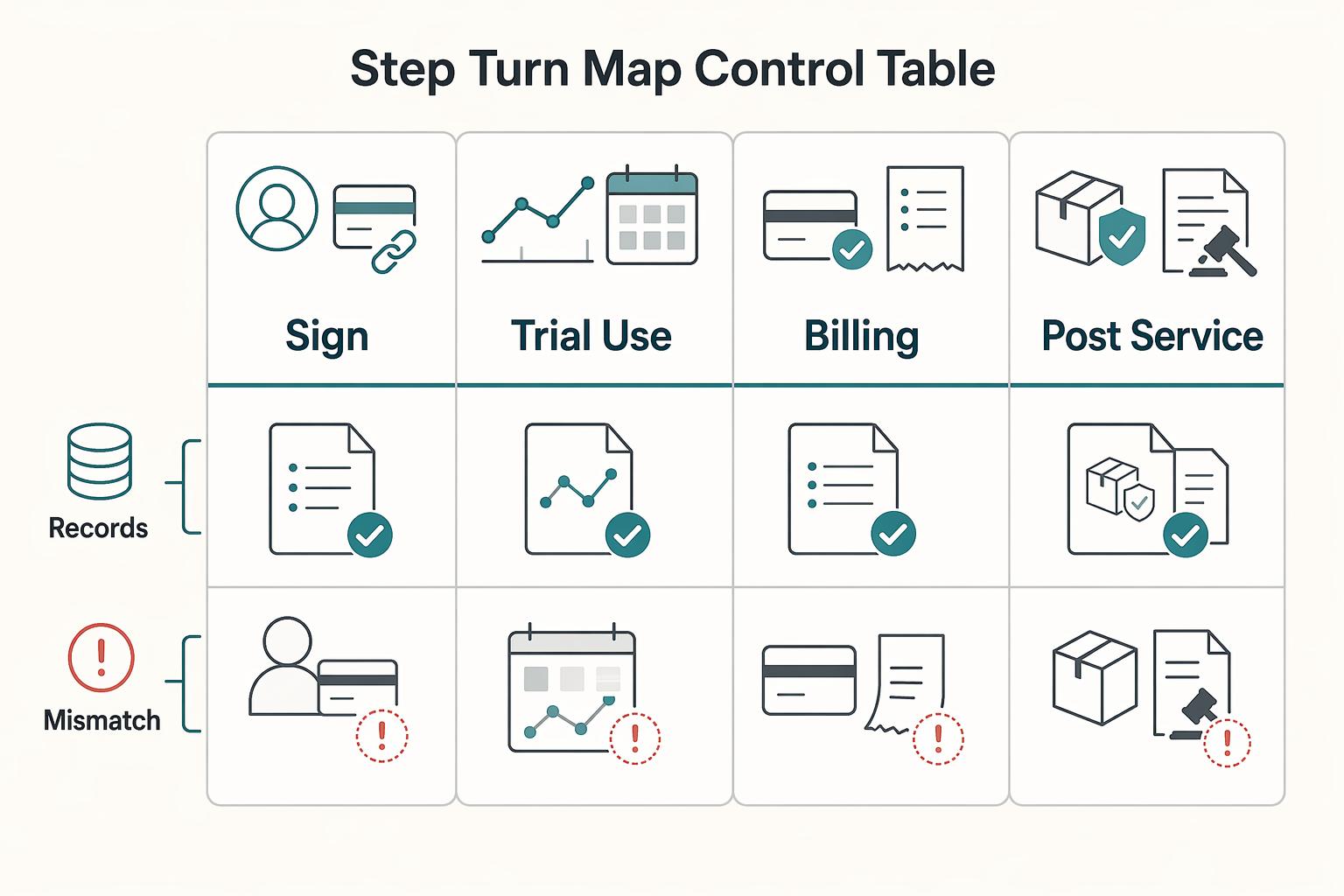
Intervene at the earliest lifecycle stage where abuse creates real cost or where evidence becomes hard to defend later. In practice, that usually means mapping sign-up, trial use, billing, and post-service refunds first, then placing the first control where it is both effective and reviewable, not defaulting all friction to sign-up.
Step 1 Map the lifecycle before you rank controls#
Put four stages on one page: sign-up, trial use, billing, and post-service refunds. Stripe's lifecycle framing separates account abuse at sign-up, free-trial abuse during product evaluation, and refund fraud after a customer has already received goods or services, which helps you avoid treating all abuse as one problem.
For each stage, define the main failure mode in plain language. At sign-up, map account abuse and linked-account creation. During trial use, map trial cycling or repeated access expansion across related accounts. At billing, keep payment-rail issues like card testing in a separate lane, since Stripe recommends monitoring card testing and notes dispute impact can worsen over time. After service delivery, map refund or policy abuse, including false non-receipt or manipulated claims.
Step 2 Turn the map into a control table#
Convert the lifecycle map into one compact control table with named owners, and prioritize controls that leave an audit-ready record chain.
| Lifecycle stage | Signal | Risk hypothesis | Control action | Control owner | Escalation trigger |
|---|---|---|---|---|---|
| Sign-up | Reused identity details, linked account attributes, repeated payment identifiers | Account abuse or multi-account setup | Limit initial entitlement, queue review, retain link evidence and timestamp | Risk, with product approval for friction changes | Linked clusters grow or activation quality drops materially |
| Trial use | Rapid consumption across new accounts, repeated trial starts, expansion requests from related entities | Trial cycling or costly account abuse | Cap usage, require stronger verification before more access, preserve usage logs | Risk and product | Same entity reappears or variable-cost exposure starts mounting |
| Billing | Abnormal scripted or clustered authorization attempts | Card testing pressure on billing rails | Promptly protect targeted card-setup/payment endpoints and retain event evidence | Payments or risk | Active spike in suspicious failed or blocked attempts |
| Post-service refunds | Repeat non-receipt or refund claims after value was delivered | Refund fraud or policy abuse | Require claim evidence, document delivery or service use, route exceptions to finance or legal | Finance, with legal input when needed | Repeated claims by linked entity or dispute trend changes |
Step 3 Choose the earliest sensible intervention point#
Choose intervention timing based on your cost curve. Stripe notes account abuse is especially costly for AI companies when compute costs are tied directly to usage, so earlier controls can make sense there. For lower-marginal-cost trials, lighter sign-up gates with stronger checks later, for entitlement expansion, upgrade, or refunds, are often more proportionate.
If your map shows immediate variable cost, intervene earlier. If losses cluster in disputes or refunds, invest more in later-stage evidence and escalation.
Step 1 instrument detection so alerts are actionable, not noisy#
For trial-abuse investigations, link entities and events so reviewers can distinguish repeated benefit use from benign shared attributes. Keep payment-attack alerts separate so an active card-testing spike gets prompt incident response.
1 Track linked entities at account creation#
Use device, account, timing and usage signals that your product is permitted to collect for the investigation. A shared device or IP can represent a household or workplace. Corroborate it with behavior before changing trial entitlements.
Stripe’s card object provides a fingerprint for a card number. Tokenized wallets can supply a different number, and India Connect can produce two fingerprints for one card. Treat a fingerprint as a payment-link signal within the documented context, rather than a universal person identifier.
Alert on clusters, not isolated attributes. A single shared signal can be benign; a pattern of shared device fingerprint, reused payment identifier, and repeated trial starts across new accounts is a stronger multi-account abuse case.
2 Split monitoring lanes for trial abuse and card testing#
Keep trial-abuse alerts and payment-rail alerts separate, even during the same traffic spike. Trial abuse is typically first-party behavior to extend trial value. Card testing is payment-fraud activity that probes card validity through repeated authorization attempts.
| Monitoring lane | What should trigger it | First response |
|---|---|---|
| Trial abuse | Linked accounts across email, IP, device, and payment identifiers; repeated trial starts; trial cycling | Limit initial entitlement, queue review, and prepare step-up identity verification before more access |
| Card testing | Spike in failed or blocked card-setup/payment attempts; suspicious small payments | Protect the targeted endpoints promptly under the incident plan |
| Mixed or unclear | Reused payment identifier plus unusual authorization behavior across new accounts | Classify the mixed signal while protecting payment endpoints promptly if an active attack is present; preserve both event sets |
3 Review alert precision weekly and define escalation before volume rises#
Review top alert types weekly for precision, not just volume. Sample high-volume alerts, document false-positive reasons in plain language, and require named owner sign-off before rule changes. That is an internal consistency control, not a regulator-mandated format here.
Document each review as an investigation record: procedures performed, evidence obtained, and conclusions reached. For linked-account cases, retain matched attributes, account IDs, timestamps, reviewer decision, and downstream outcome. For card-testing cases, retain payment event history, failure pattern, and the classification rationale.
Set escalation logic in advance. If linked-account clusters grow while conversion quality drops, tighten trial entitlements and step up identity verification before additional credits or higher-cost access. If conversion quality is stable but repeated failed attempts across cards increase, prioritize payment-rail controls instead of broad trial friction.
Step 2 apply graduated controls that protect conversion quality#
For trial entitlements, add proportionate friction as corroborated evidence strengthens, and measure the effect on legitimate users. Active card testing follows the payment-incident plan rather than waiting for this policy-testing sequence.
Evaluate control impact on the affected cohort before widening it. Review payment blocks and trial-access decisions separately; payment risk settings do not validate an entitlement rule.
| Abuse signal confidence | First control | When to step up | What to verify |
|---|---|---|---|
| Low | Monitor and keep initial access narrow | Signals repeat across linked accounts | Conversion quality in the affected cohort remains stable |
| Medium | Add stepped friction, such as stronger identity verification or review before more access | Signals persist after the first control | Reviewers can explain why the case moved from monitoring to friction |
| High | Stop access expansion; block for clearly automated abuse when your vendor returns a block verdict | Pattern is consistent and validated by rule testing | The block logic matches the historical cases you intended to catch |
For trial access, lower confidence calls for monitoring or proportionate limits; stronger corroborated evidence can justify review or restriction under your policy. Active automated payment probing needs immediate endpoint controls under the incident plan.
Test the control before you expose the funnel#
Replay trial-control proposals against known legitimate and abusive cases. For payment rules, use your provider’s available testing tools and check the integration-specific impact. Keep incident containment distinct from a broader trial-policy rollout.
For risk and legal review, attach a short evidence pack to each control change: trigger signals, expected customer impact, affected segment, and why you chose review or added friction instead of immediate hard blocking.
Define rollback before launch#
Define rollback criteria before rollout so control changes stay reversible. You do not need one universal threshold, but you do need named metrics and a clear owner.
If activation drops in a segment without a matching reduction in linked-account abuse, roll back and document why. Record the rollback trigger, approver, and post-launch evidence check to avoid policy drift across product, risk, and support.
Step 3 set escalation thresholds and reporting cadence for legal and finance#
Make escalation predictable: route issues to legal and finance when patterns are repeatable, materiality is at risk, or a control change could alter customer treatment, refunds, or enforcement options.
Track dispute volume and reasons over time for finance review. Separately escalate an active card-testing spike to the payments incident owner immediately; waiting for a recurring pattern or dispute growth can allow more unauthorized attempts.
Use a simple triage rule:
- Handle routine isolated events within the assigned risk workflow; escalate active payment attacks immediately.
- Escalate when patterns repeat across linked accounts, payment identifiers, or dispute reason codes.
- Score incidents with a repeatable method so decisions are consistent.
- Set thresholds to your risk profile instead of copying a generic number.
Run a weekly governance pack#
Use a weekly pack for policy review and follow-up, while active incidents stay on their own response cadence. The pack should answer:
| Pack item | What it should answer |
|---|---|
| Top abuse modes this week | trial abuse, account abuse, refund abuse, dispute pressure |
| Open investigations | who owns them, and what evidence is missing |
| Control changes | what went live, and which customer segments were affected |
| Exceptions | including accounts allowed through despite risk signals |
| Cross-functional decisions | what was made, and what still needs legal or finance sign-off |
If finance cannot see dispute reason-code movement, or legal cannot see which decision changed customer treatment, the pack is not ready.
Preserve the record chain and tag specialist review early#
For each major decision, keep one audit-ready record with rationale, approver, date, evidence reviewed, expected customer impact, and review date. Keep investigation notes, dispute reason-code trends, linked-entity findings, and impact checks with that record so the decision trail is complete.
Add a clear specialist advice required flag when jurisdiction or contract terms could change enforcement options. This is especially important in cross-market programs where obligations can differ. If a response could affect renewal handling, cancellation treatment, refunds, or enforcement under your terms, pause for specialist input before rollout.
Common implementation mistakes and how to recover quickly#
| Mistake | Recover by | Detail |
|---|---|---|
| Treating all anomalies as one fraud type | Split queues for free-trial abuse and card testing, with distinct response owners | Report separate volumes, actions, and outcomes for each lane |
| Restricting trial access from one shared attribute | Corroborate linked accounts with behavior | Use payment identifiers when available; account for benign shared cards/devices |
| Optimizing only for blocked abuse | Pair abuse KPIs with conversion-quality KPIs | Track legitimate trial activation, trial-to-paid quality, and dispute movement by cohort |
| Undocumented control changes | Log every rule change with date, approver, signals reviewed, expected customer impact, and rollback criteria | Documented change decisions are easier to defend with legal, finance, and audit |
Avoid linking people from one shared attribute. Corroborate account, timing and usage patterns, with a payment fingerprint when available. Shared devices, household cards and wallet tokenization can complicate interpretation.
You might also find this useful: How to Offer Free Trials That Convert: Design Rules for B2B Platform Operators.
Build controls your teams can run every week#
Step 1: Split operating lanes before tuning controls. Treat free-trial abuse and card testing as separate lanes, even when both appear near signup. Free-trial abuse is one actor creating multiple accounts to claim more trial value. Card testing is often automated, high-velocity payment probing. The response should follow the lane: free-trial controls on account/trial access, and card-testing controls at checkout (CAPTCHA, rate limits, and access controls).
Use recurring review to assess control effectiveness, exceptions and customer impact. Separately monitor payment attempts during an active attack. For network-program decisions, confirm current rules and scope with your acquirer rather than treating a historical threshold date as universal.
Frequently Asked Questions
What is the practical difference between free-trial abuse and card testing for platform risk teams?
Free-trial abuse is usually first-party policy abuse. One actor creates multiple accounts, cycles trials, or exploits refunds to extract value. Card testing is different because attackers use card setup or small payments to learn whether stolen or enumerated card data is valid. If your cluster is centered on repeated account creation and entitlement use, treat it as account abuse. If it is centered on abnormal authorization attempts and later Early Fraud Warnings, treat it as payment-rail probing.
What are the earliest reliable signals of multi-account abuse at signup?
Look for linked account attributes and repeated timing or usage patterns, with payment identifiers when available. Cardless trials need other corroborating signals. A single overlap can be benign, so review its context before restricting access.
What minimum controls can a platform deploy in the first 30 days?
Start with separate alerts for account/trial behavior and payment probing, named owners, and recorded control changes. Use corroborated signals before restricting trial access. For an active card-testing attack, have engineering promptly protect the affected card-setup and payment endpoints; review the result continuously.
When should free-trial abuse be escalated to legal or compliance instead of handled in product ops?
Escalate when a proposed response changes contract terms, renewal or refund treatment, or raises market-specific or external reporting questions. Routine entitlement review can remain with product operations, and active payment attacks follow the approved incident plan.
How do you reduce abuse without overblocking legitimate trial users?
Use stepped friction. Start by capping entitlement or monitoring closely when confidence is low, then require stronger checks only when linked-account evidence is stronger. That matches the grounded goal for free-trial defense: reduce wasted trial resources without hurting real users, so review abuse metrics beside activation and trial-to-paid quality.
What evidence should be retained to support an external audit or regulatory question?
Retain the signals and linked events reviewed, action, owner, date, customer impact and rollback criteria. Set access and retention according to the applicable policy and obligations. The record should explain the decision without preserving unnecessary personal data.
How should risk controls differ for AI companies versus lower-cost SaaS trials?
AI trials can consume material compute before payment, making usage caps and review before additional credits useful. Lower-cost SaaS trials may tolerate lighter entitlement limits. In both cases, measure legitimate conversion impact; active card testing requires payment controls regardless of the product’s trial cost.
Researched and edited by the Gruv editorial team. Gruv builds cross-border billing, payouts, and finance-operations software for global businesses.
Sources
Educational content only. Not legal, tax, or financial advice.
Related Posts
Free Trial Abuse Prevention for Platforms Blocking Serial Trial Exploiters
If you own fraud, compliance, legal, or finance, the goal is straightforward. Stop repeat trial abuse without hurting legitimate conversion, and do it in a way you can explain later. That matters most when the same account path can eventually touch payment processing, payouts, or entity onboarding across multiple markets.
What Is a Subscription Lifecycle? How Platforms Manage Trial Active Paused and Churned States
A subscription lifecycle describes how a subscription moves through setup, trial, service, payment recovery and exit. Each state should tell finance, billing ops and product what changes in charges, access, edits and reconciliation. Business labels such as paused or churned need a mapping to the actual provider behavior.
How B2B Platform Operators Design Free Trials That Convert Profitably
The main mistake is simple: teams often optimize for more starts when they should optimize for more profitable paid customers. In B2B SaaS, **trial-to-paid conversion rate** is the share of trial users that become active paying customers in a defined period. That number only matters if the customers who convert are the right ones for your business.