
Quick Answer
Define trial abuse in your terms, test controls against observed patterns, and corroborate weak signals before restricting users. Use payment evidence when available, preserve a challenge or appeal path, and track confirmed abuse and false positives by cohort. Keep payout permissions and applicable onboarding checks separate from ordinary trial access.
Detect repeated trial abuse without blocking legitimate users#
If you own fraud, compliance, legal, or finance, the goal is straightforward. Stop repeat trial abuse without hurting legitimate conversion, and do it in a way you can explain later. That matters most when the same account path can eventually touch payment processing, payouts, or entity onboarding across multiple markets.
- Start with the real promise
Repeated account creation can consume credits and support capacity. Define the abusive behavior in your trial terms, then measure whether controls reduce it while keeping legitimate prospects able to evaluate the product.
- Keep the scope tight
This guide covers trial access in SaaS and marketplaces. Some products also enable payments or payouts; those capabilities need their own applicable verification and provider controls. Ordinary trial registration does not itself create a universal KYC or AML obligation.
- Be clear about what this is not
Choose controls that produce an explainable decision, a named owner, and an exception path. Keep the rule version, case notes, and override reason so the team can investigate a challenged signup.
- Aim for an evidence-backed control set
Build a control comparison, outcome scorecard, and escalation path. Keep any regulated onboarding review separate and link it only when relevant to the actual account capability. See Subscription Fraud Trends for Platforms.
How to choose controls that cut abuse without creating compliance drag#
Choose controls that measurably reduce repeat trial abuse, keep false-positive impact manageable, and leave evidence your team can defend later. If a rule adds friction but does not show a measurable drop in account-creation abuse in a limited test, do not roll it out broadly.
- Detection lift
Prioritize controls that target behavior you are already seeing, not controls that only sound strict. For repeated signup patterns, velocity rules can block, detect, or add friction across related accounts. Key differentiator: backtest before rollout, then compare test results against a baseline so you can show the lift came from the rule.
- False-positive cost
Treat false positives as a core cost, not a side metric. Where tooling supports it, use rule-level estimated false positive rate instead of guessing. Key differentiator: when risk is high but the cost of a wrong block is also high, use challenge or review paths instead of defaulting to hard blocks.
- Implementation burden
Verify that your chosen provider and plan expose the required signals, rules, and review controls. Assign an owner, exception path, and rollback step before rollout.
- Decision auditability
Keep the rule version, trigger evidence, case decision, and override outcome. Choose review frequency from local risk and policy; there is no universal trial-abuse testing interval.
Related: How to Offer Free Trials That Convert: Design Rules for B2B Platform Operators.
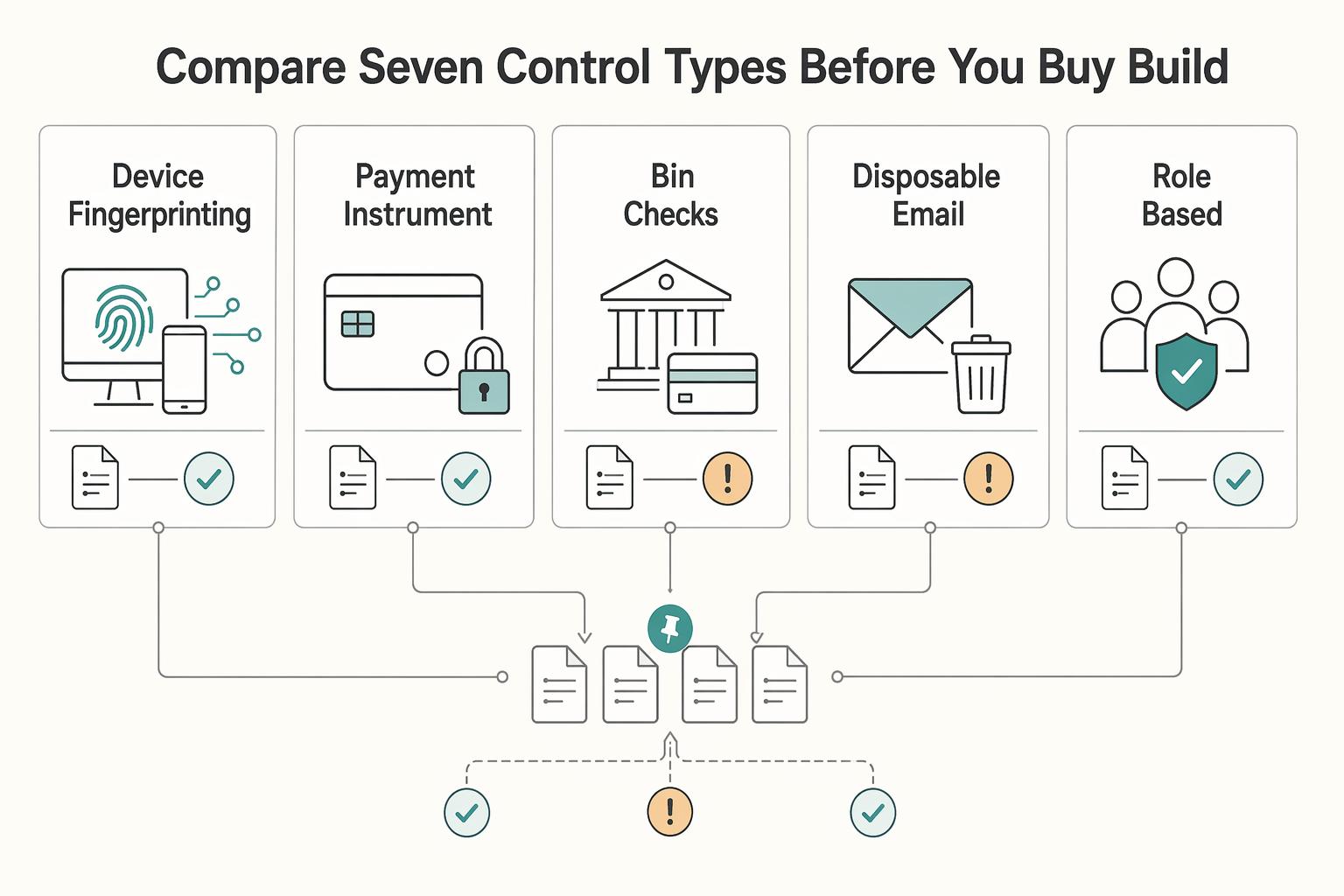
Compare the seven control types before you buy or build#
Corroborate weak signals before restricting a trial. Use payment evidence when available; cardless trials can be assessed with account and behavioral evidence. Do not require a payment instrument solely to complete a three-signal checklist.
| Control type | Best for | Key pros | Key cons | Concrete use-case | Owner team | Evidence artifact retained |
|---|---|---|---|---|---|---|
| Device fingerprinting | Early repeat-session detection in self-serve trials | Can link device observations and expose provider verdicts where supported | Legitimate shared environments can look risky; needs tuning | AI self-serve: challenge or block when one device appears across many new trial accounts | Risk or fraud with product engineering | Fingerprint verdict, action taken, warning flags, metadata, linked case note |
| Payment instrument reputation | Card-backed trials and trial-to-paid flows | Adds payment-layer evidence where a supported risk evaluation exists | Weaker when payment details are collected late; misses earlier non-paying abuse | AI self-serve or marketplace: flag reused high-risk cards and repeated failed authorizations tied to serial trials | Payments risk or fraud ops | Risk score, payment ID, decision outcome, failed auth history, override note |
| BIN checks | Fast routing when card data is collected up front | Cheap, interpretable routing signal from the first six or eight digits | Low precision alone; easy to overinterpret patterns and create false positives | Route higher-risk BIN patterns to review or challenge before provisioning credits or capabilities | Payments team with fraud support | BIN/IIN result, rule ID, route taken, reviewer note |
| Disposable email domain filtering | Low-cost front-door filtering for obvious burner-email abuse | Useful early screen when fraudsters use disposable or tumbling addresses for repeat signups | Easy to evade; can catch legitimate privacy-focused users | AI self-serve: block or challenge known disposable domains at signup | Growth ops or risk | Matched domain, domain-list version, action taken, appeal or override record |
| Role-based email filtering | B2B signup and marketplace onboarding that needs an accountable person | Flags generic prefixes that do not identify a specific person | Many legitimate teams use shared inboxes; weak as a standalone block signal | Marketplace/KYB context: route role-mailbox signups to added verification before full control | Product ops with compliance input | Prefix rule hit, verification result, override reason |
| Velocity and session anomaly rules | Signup floods, API key bursts, repeated trial attempts from clustered traffic | Direct response to suspicious traffic; intelligent rate limiting can use device risk | Ongoing tuning required; legitimate spikes can look suspicious | AI self-serve: throttle or challenge high-velocity clusters across related sessions/devices | Fraud engineering or SRE | Rule version, threshold/condition, trigger count, session log excerpt |
| Stepped verification | Medium-risk events where false-positive cost is high | Better conversion tradeoff than universal hard blocks; payment example: Adaptive 3D Secure on high-risk payments | Adds support load and drop-off; not every challenge stops repeat abuse | Marketplace/KYB context: escalate ambiguous cases to verification instead of immediate denial | Risk, compliance, and ops | Challenge type, outcome, reviewer note, linked KYC/KYB result |
Choose signals that fit your signup flow and actual abuse patterns. Apply KYC or KYB requirements only to the relevant product capability, entity role, jurisdiction, and provider contract.
For supported Stripe Connect arrangements, manual payouts can delay eligible balance disbursement within country-specific holding limits. They are not escrow or a general authority to withhold funds. Check the account configuration, contract, applicable law, and current provider limits before using a hold.
BIN and email-domain matches are weak corroboration, not person identifiers. Reserve sustained restrictions for strong documented evidence and provide an appeal path. Promptly protect an endpoint under active automated attack while ambiguous user cases are reviewed.
Identity and account integrity controls that catch repeat signups early#
Use layered identity signals early: combine Stytch Device Fingerprinting with email checks, and do not let email checks decide alone.
- Stytch Device Fingerprinting
Device fingerprinting can help link repeat sessions, but a device is not a person and a changing fingerprint does not prove a new person. Shared devices, browser changes, and evasion affect confidence. Validate the provider's signals locally and use corroboration before restricting legitimate users.
- Disposable email domains
Use this as a low-cost front-door filter. Blocking known burner domains at signup can stop obvious abuse before provisioning. Keep this in context: it is a fast routing control, not a complete defense. If you rely on domain checks alone, repeat actors can still pass with clean-looking domains while reusing stable devices.
- Role-based emails
Treat addresses like admin@, info@, or sales@ as routing signals, not standalone block signals. Many legitimate B2B users start from shared inboxes. A practical path is to allow corporate domains with added verification, request a named owner, or keep the account in a limited state until review is complete. Preserve an override path for legitimate teams that do not use person-named mailboxes.
Treat device and email matches as imperfect evidence. Challenge or review conflicting cases, record the decision, and measure how often legitimate users are affected.
Payment and instrument controls that separate trial interest from nonpayment intent#
Payment and instrument signals work best as corroborating evidence, not a standalone decision. Use them to strengthen or challenge what you already see in identity and account-integrity checks.
| Signal | What to review | Handling note |
|---|---|---|
| Payment instrument history | Supported payment-risk outcomes and instrument references where available | Weigh the instrument history against identity signals before deciding on access, challenge, or restriction |
| BIN patterns | Issuer-context clusters based on the first six to eight digits of the card number | Treat BIN as a pattern signal, not proof, and keep the BIN observed, timing pattern, related accounts, and action taken |
| Card outcome and decline signals | Unique declines, excluding failed retries; issuer outcomes like insufficient funds or credit | Escalate when decline behavior repeats across linked accounts and aligns with other payment or identity risk indicators |
- Payment instrument history
Use the payment provider's risk outcome when available. Stripe documents a 0–99 score on supported Radar plans, and its recurring Billing model does not score every renewal. A payment-risk score is not a universal trial-abuse or person-identity score.
- Bank identification number (BIN) patterns
A BIN is the first six to eight digits of the card number, and it helps you group activity by issuer context. This is useful for spotting clusters that span multiple cards but follow the same issuer pattern. Treat BIN as a pattern signal, not proof. Keep an evidence trail (BIN observed, timing pattern, related accounts, and action taken) so decisions are explainable and reviewable.
- Card outcome and decline signals
Decline data is useful when you read it correctly: analyze unique declines and exclude failed retries. Issuer outcomes like insufficient funds or credit are valid signals, but they do not prove abuse intent on their own. Escalate when decline behavior repeats across linked accounts and aligns with other payment or identity risk indicators. When signals conflict, route to added verification or limited access and document the decision logic.
Access and payout gating rules that prevent abuse from reaching money movement rails#
If a trial can reach payment rails, separate product access from money movement and gate it in stages. Apply stricter controls as users move toward accepting payments, withdrawing funds, or entering payout batches, because that is where trial abuse can become compliance exposure.
| Gate | Purpose | Key check or record |
|---|---|---|
| Signup gate | Stop obvious repeat-account abuse early with blocking or added friction | Record the corroborating account and behavioral evidence, and payment evidence when available |
| Feature gate | Allow low-risk trial usage while keeping payment-enabled or balance-like features behind separate permissions | Keep sensitive actions locked, including bank-transfer setup details such as a virtual bank account number |
| Payout gate | Apply current provider and jurisdiction requirements for the payout capability | Retain the actual restriction, required review, decision, and release outcome |
A Merchant of Record arrangement assigns responsibilities through its service scope and contract; it is not a universal payment-processing or AML license. Map seller-of-record, processor, and platform duties separately before enabling money movement.
- Signup gate
Use signup controls to stop obvious repeat-account abuse early, with either blocking or added friction. Keep this gate focused on low-cost signals, and record why the user was blocked, challenged, or allowed using the same identity and payment evidence from prior checks.
- Feature gate
Allow low-risk trial usage, but keep payment-enabled or balance-like features behind separate permissions. This staged middle step is useful when risk signals are mixed: the user can evaluate the product, while sensitive actions stay locked, including bank-transfer setup details such as a virtual bank account number.
- Payout gate
For payment-enabled accounts, inspect the provider's capability and verification requirements applicable to that account. Resolve currently blocking requirements before enabling the affected capability; a missing future requirement is not automatically a current payout prohibition.
A clean trial signup does not approve every money-movement capability. Record the actual restriction, responsible reviewer, and required resolution. Manage review promptly within provider, contract, and legal limits rather than imposing indefinite trial-related holds.
Monitoring and evidence packs your risk and finance teams should review monthly#
Your monthly pack should make one judgment easy to defend: controls are reducing repeat abuse, and exceptions are documented well enough for finance, legal, and compliance review. If it is only a dashboard, it is incomplete; include monitoring, testing, and outcomes analysis, not just alert totals.
| Measure | Denominator or definition | Review evidence |
|---|---|---|
| Confirmed repeat abuse rate | Confirmed abusive trials per trial signup cohort | Reviewed cases and policy version |
| Confirmed false-positive rate | Wrongly restricted legitimate users divided by evaluated legitimate users | Appeals and sample review; document sampling and estimation limits |
| Challenge completion | Completed challenges per challenged trial cohort | Outcome and drop-off |
| Resource loss | Credits or service cost consumed by confirmed abuse | Usage records and bounded cost assumptions |
- Metric table with attached artifacts
Use a scorecard where every number maps to evidence.
| Metric | What to review | Evidence to attach |
|---|---|---|
| Blocked trials | Volume, trend, top rules firing | Case notes, rule ID and version, sample decision logs |
| Challenged trials | Pass rate, drop-off rate, rule mix | Challenge outcomes, analyst notes, device or payment evidence used |
| Overrides | Who approved, why, downstream result | Override memo, approver name, linked account history |
| False-positive cases | Legitimate users wrongly blocked or subjected to an unnecessary challenge; track all challenge friction separately | Reversal notes, customer evidence, remediation time |
| Repeat-actor recurrence | Same actor returning after block or challenge | Corroborated account patterns, instrument references where available, and device observations |
- Case files mapped to policy versions and onboarding outcomes
For material decisions, retain the rule version and evidence available at the time. Link regulated onboarding or payout outcomes only where they apply. Restrict access to sensitive records, define a retention period, and keep identifiers necessary for permitted reconciliation.
Separate trial-risk reporting from tax-document operations#
Applicable tax-document exceptions belong in the payer's tax workflow with its own owner and deadlines. Personal FEIE eligibility and foreign-account filings are not evidence of serial trial abuse and should not become signup or payout prerequisites.
- Rule-change checkpoint with pre/post impact
Treat high-impact rule changes as governed decisions. The packet should show the old rule, new rule, expected effect, same-window pre/post results, and false-positive movement, plus documented sign-off from risk and legal/compliance. That sign-off is governance discipline, not a universal legal requirement, and it prevents silent control shifts with no rollback path or shared tradeoff record.
Escalation triggers and ownership map across risk legal finance and ops#
Define escalation before the next abuse spike so decisions stay defensible and consistent under pressure. For each trigger, pre-name the owner and the evidence required for review.
- Trigger events that merit cross-team review
Predefine escalation for material changes in repeat-abuse rate, confirmed false positives, queue age, complaints, or provider incidents. Attach affected cohorts, rules, case samples, and the decision owner.
- Owners by decision type, not org chart
Risk tunes controls and proposes threshold changes. Legal/compliance sets policy boundaries and reporting posture. Finance validates loss and reconciliation impact. Ops runs queue handling and customer communication. This aligns with three-lines-of-defence role separation, but your exact map should fit your operating model rather than assume one fixed legal template.
- Escalation rule when overrides rise but loss does not
Treat rising overrides with flat abuse loss as a warning signal that hard blocks may be too blunt. In that case, pause new hard-block expansions, keep challenge controls active, and re-tune thresholds before tightening further. Validate the decision against your monthly evidence pack: policy version, override rationale, false-positive outcomes, and complaint trends.
The takeaway for teams that need fewer surprises and cleaner decisions#
Cleaner outcomes come from better decisioning, not from adding more controls. The approach that holds up is tiered, explainable, and documented.
- Layered signals beat single checks
Correlate account and behavior evidence, with payment evidence where available. Repeated patterns can strengthen a case, but shared infrastructure can link unrelated people. Validate the link before treating it as confirmed repeat abuse.
- Explainability matters more than tool count
Do not treat a vendor accuracy claim as your local performance. Keep enough decision evidence to reconstruct a case, then compare confirmed abuse, legitimate-user impact, and exception resolution after each material rule change.
- Roll out in stages, then tune on outcomes
Apply staged gates instead of broad friction for everyone at signup. Start lighter, tighten where risk or cost is higher, and expand stricter blocks only after your own results show the change is helping. One-click controls can speed execution, but teams still need exception handling, monthly review, and clear ownership across risk, legal/compliance, and finance.
Start with one observed abuse pattern and a bounded rule test. Add corroborating evidence where available, provide challenge or review for ambiguous cases, and scale only after legitimate-user impact and abuse reduction are understood.
Frequently Asked Questions
What is free trial abuse in payment-enabled SaaS platforms?
Free trial abuse is account-creation abuse where one actor opens multiple accounts to keep claiming trial credits. In a payment-enabled SaaS product, the impact is not just conversion; it can also consume operational resources before the pattern is obvious. The practical distinction is repeat behavior by the same actor, not a single messy signup.
Is blocking disposable email domains enough to prevent serial trial exploitation?
No. A disposable-domain list is easy to evade and can affect privacy-conscious legitimate users. Combine it with account and behavior evidence, keep an exception path, and measure whether it improves outcomes.
When should we auto-block, step up verification, or allow with monitoring?
Use allow, limit, challenge, review, and block actions according to documented confidence and impact. BIN, shared-device, or email matches alone rarely identify an actor. Payment authentication such as 3DS applies to supported card flows; it does not verify every trial account. Contain active automated attacks promptly.
How can we reduce false positives without opening a loophole for repeat abusers?
Validate rules on known legitimate and confirmed abusive cases, track challenge completion and appeal reversals, and test changes on a bounded cohort. Shared devices and team inboxes need particular care; keep a practical way to resolve wrong decisions.
What should risk, legal, and finance review every month to prove control effectiveness?
Review blocked, reviewed, and allowed-with-monitoring volumes together, not in isolation. Include dispute-rate tracking and watch for shifts after major policy changes. Risk, legal, and finance should align on whether controls are reducing abuse while keeping dispute exposure manageable.
Which records should we retain to defend block decisions during audits or disputes?
Retain the rule version, reason, time, evidence used, action, and any appeal or override. Limit personal data to what the review needs, restrict access, and follow the applicable retention policy. Payment-dispute evidence is a separate workflow.
Try a related tool
Researched and edited by the Gruv editorial team. Gruv builds cross-border billing, payouts, and finance-operations software for global businesses.
Sources
Includes 1 external source outside the trusted-domain allowlist.
Educational content only. Not legal, tax, or financial advice.
Related Posts
How Platforms Detect Free-Trial Abuse and Card Testing in Subscription Fraud
Trial abuse consumes product benefits; card testing probes payment credentials. They can appear in the same signup flow but need different responses. Track account behavior and payment attempts separately, then give each response an owner.
How B2B Platform Operators Design Free Trials That Convert Profitably
The main mistake is simple: teams often optimize for more starts when they should optimize for more profitable paid customers. In B2B SaaS, **trial-to-paid conversion rate** is the share of trial users that become active paying customers in a defined period. That number only matters if the customers who convert are the right ones for your business.

The Freelance Payment Penalty: A Modeled Audit of Platform Fees, FX Spreads, and Payout Delays
The money rarely disappears through a single, easy-to-spot fee. The real loss is stacked. A marketplace takes its commission, a processor adds a charge for international cards, a bank or payment company converts the currency at a spread, a platform holds the funds before release, and a wire sheds a little to intermediaries on the way in. Each layer looks defensible on its own, but the worker feels the combined result as a smaller deposit and a later payday.