
Quick Answer
Price a clinical trial data analysis project by comparing risk adjusted cost, not the lowest fee. Shortlist vendors based on evidence such as comparable work, independent QC, traceable documentation, and reliable communication. Then lock start conditions, deliverables, acceptance rules, and change order triggers in the SOW, and judge the budget against the decision value and timeline the work supports.
Why "Price" Is the Wrong Metric: Calculating the True Cost of Failure#
Step 1 Reframe the decision around risk adjusted cost#
If you choose on fee alone, you are optimizing the smallest visible number, not the full cost of the decision. A better test is simple: risk adjusted cost = expected project fee + probable rework cost + operational delay impact + the cost of switching vendors midstream.
That follows the same logic used in cost effectiveness analysis: compare total benefit and total cost across options, not price in isolation. In practice, a lower quote may still become the more expensive choice if weak documentation, avoidable revisions, or a bad handoff creates extra internal work and burns time while your team fixes it.
Step 2 Compare bids on evidence, not confidence#
A proposal should show how a vendor reduces risk in ways you can verify. Use a simple screen like this:
| Evidence signal | Lowest Bid | Lowest Risk Adjusted Cost |
|---|---|---|
| Regulatory fit | General claims, few comparable examples | Clear examples of similar analysis work and review expectations |
| QC maturity | QC mentioned but not shown | QC steps documented and easy to explain |
| Documentation quality | Thin methods notes, unclear versioning | Traceable assumptions, revision history, and deliverable structure |
| Communication reliability | Slow or inconsistent replies during sales | Fast answers, clear owners, and predictable review cadence |
Step 3 Verify the proof before you shortlist#
Before you shortlist anyone, ask each vendor for the same evidence pack: a redacted sample deliverable, a documented review or QC check, and source references for any standards they cite. When you check those references, treat secure .gov pages, HTTPS, and downloadable PDFs as stronger review points, and remember that PMC or NLM inclusion alone is not endorsement.
| Evidence item | Requested proof | Note |
|---|---|---|
| Sample deliverable | Redacted sample deliverable | Ask each vendor for the same evidence pack before you shortlist |
| Review/QC check | Documented review or QC check | Ask each vendor for the same evidence pack before you shortlist |
| Standards references | Source references for any standards they cite | Treat secure .gov pages, HTTPS, and downloadable PDFs as stronger review points |
A common failure mode is overpaying for work that does not deliver meaningful benefit. In vendor selection, that can look like unclear documentation, avoidable rework, delayed decisions, or a painful vendor switch after your team is already committed. Practical rule: if a cheaper bidder cannot show traceable documents and reliable communication before kickoff, the lower fee may not be your lower total cost.
For a related pricing lens, see How to Price a Data Science Project based on 'Model Performance'. If you want a quick next step on pricing, try the free invoice generator.
Pillar 1: De-Risk Your Investment by Vetting the Right Partner#
Treat partner selection as a risk-control decision first, then a pricing decision. Before commercial talks, shortlist only vendors who can show relevant regulatory judgment, independent QC, and documentation that stays usable under audit and inspectional-readiness pressure.
Send every bidder the same evidence request before interviews: one redacted deliverable, one QC artifact, one validation or traceability artifact, and a short summary of comparable therapeutic-area work. If the answers stay generic, treat that as a weak signal.
Step 1 Ask for submission-relevant proof#
Start with relevance, not reputation. Ask what role they played in comparable submission-oriented work, how close that work is to your therapeutic area and study reality, and how they handle high-pressure review questions and late changes.
Use your own program as the filter. If examples are broad but not comparable to your context, risk is still high even when the pitch sounds confident.
Step 2 Inspect QC artifacts, not QC claims#
A QC promise is not enough. Ask who performs QC, how checks are documented, how issues are logged and closed, and what records remain audit-ready after delivery.
| QC item | Pass condition |
|---|---|
| QC independence | QC is independently performed, not only by the original programmer |
| Validation traceability | Documented and understandable by a third party |
| Audit-ready records | Version history, issue logs, and signoff records are available in audit-ready form |
| Documentation flow alignment | They can explain how these records align with your broader documentation flow, including eTMF-facing records when relevant |
Use this as a pass/fail screen for your shortlist. If those artifacts are missing, low price usually turns into rework risk.
Step 3 Gate CDISC execution before price talks#
When your program requires CDISC, treat it as a gate, not a preference. Ask for their SDTM-to-ADaM traceability approach, how they align to sponsor standards, and how they keep programming reproducible across revisions.
| Area | Strong signal | Weak signal |
|---|---|---|
| Regulatory experience | Comparable work explained with clear decision logic under pressure | Broad claims with no concrete comparable example |
| QC maturity | Independent QC workflow, traceability, issue logs, audit-ready records | "We double-check everything" without artifacts |
| CDISC execution | Clear, explainable SDTM-to-ADaM traceability and standards alignment approach | General CDISC familiarity with no demonstrable approach |
Run this screen before negotiation so you are pricing credible options, not cheap unknowns. We covered this in detail in How to Price a 'Productized' Consulting Service.
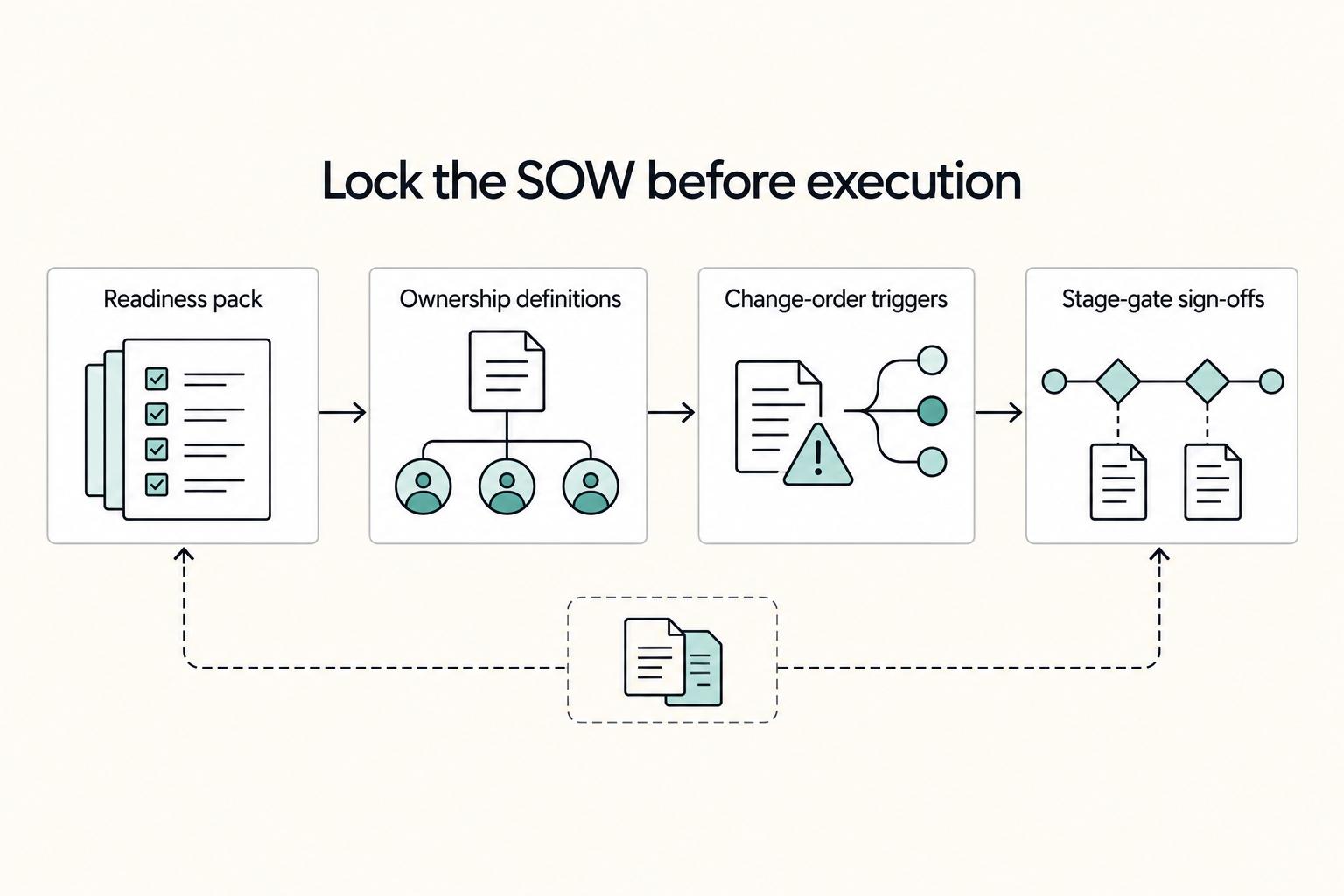
Pillar 2: Control Your Costs by Locking the SOW Before Execution#
Cost control starts before analysis work begins. If you lock start conditions, ownership, acceptance rules, and change control in the SOW, you reduce avoidable rework billing. That is critical in clinical data work, where datasets can contain defects and missing expected values.
| Control point | Included items |
|---|---|
| Readiness pack | Input transfer inventory; known-issues log; data quality report and/or visualization showing open defects and status |
| Ownership definitions | SAP responsibilities; TLF shell ownership; ADaM package expectations; CSR support boundaries |
| Change-order triggers | New data versions; changed analysis populations; added review cycles; new outputs; dependency changes from other parties |
| Stage-gate sign-offs | Readiness sign-off; SAP and shell baseline sign-off; ADaM/programming package sign-off; final outputs and agreed CSR-support sign-off |
Step 1: Lock start conditions before execution billing starts. Treat data readiness as a commercial gate, not a mid-project surprise. Your SOW should state what must be in place before execution work starts, and what evidence is required to show readiness.
Use a compact readiness pack so both sides are working from the same baseline:
- Input transfer inventory
- Known-issues log
- Data quality report and/or visualization showing open defects and status
Without agreed standards and metrics, data-quality work can become ad hoc and nontransparent, which is where budget drift usually begins.
Step 2: Build the SOW in decision order. Write scope boundaries first, then deliverables, then acceptance criteria, then dependencies, then explicit out-of-scope items. This order prevents hidden assumptions from surfacing after work is underway.
For deliverables, name ownership explicitly so there is no ambiguity later:
- SAP responsibilities (who drafts, who reviews, who approves)
- TLF shell ownership (who maintains the master set and baseline version)
- ADaM package expectations (what handoff materials are included)
- CSR support boundaries (what is included vs excluded)
| SOW style | Budget predictability | Timeline risk | Dispute risk |
|---|---|---|---|
| Vague SOW | Low: undefined inputs and ownership often become paid rework. | High: defects and dependency gaps appear late. | High: review/support expectations are interpreted differently. |
| Decision-ready SOW | Higher: assumptions and ownership are priced upfront. | Lower: blockers are visible earlier. | Lower: out-of-scope work has a defined approval path. |
Step 3: Define acceptance and change-order triggers in plain language. For each major deliverable, specify how approval happens, who signs off, and how many revision rounds are included. Then define formal change-order triggers before kickoff, such as new data versions, changed analysis populations, added review cycles, new outputs, or dependency changes from other parties.
If you want a percent, dollar, or hour trigger, add it only after internal verification and approval rather than assuming a universal threshold.
Step 4: Tie payment to stage gates, not vague effort. Link payments to sign-off checkpoints and a documented schedule based on anticipated study spending patterns. In direct-payment setups, schedule terms are negotiable, so capture them early and in writing.
A practical sequence is:
- Readiness sign-off
- SAP and shell baseline sign-off
- ADaM/programming package sign-off
- Final outputs and agreed CSR-support sign-off
If third parties are involved, state their boundaries and dependencies explicitly. In outsourced models, some providers may be limited to specific operational roles, so your SOW should also define what pauses timeline commitments and what reopens pricing.
For a step-by-step walkthrough, see How to price a 'Day Rate' vs. a 'Project Rate' for a consulting engagement.
Pillar 3: Maximize Your ROI by Creating Strategic Value#
After scope is locked, your pricing decision should optimize for return, not output volume. Treat this work as an ROI choice: what financial return you expect from the analysis versus what you invest.
Step 1 Tie budget to a decision checkpoint#
Use projected ROI before kickoff to test whether the planned work is worth funding at the level proposed. Then use actual ROI after delivery to evaluate what the project produced and improve your next buying decision.
Ask each provider to map deliverables to a concrete decision checkpoint. Keep it simple: decision question, required output, business use, owner, and needed-by point. If a bid is detailed on hours but unclear on decision use, you are likely buying activity instead of return.
Step 2 Use the SAP to prioritize decision-critical work#
Use the SAP process to rank what must be answered versus what is optional exploration. This is where you decide which endpoints, subgroup questions, and evidence narrative priorities get senior review before build starts.
Explicit prioritization and ownership are what make this work. If priorities stay vague, those questions often return later as rework and change requests.
Step 3 Scope communication outputs only when they support a named use#
Add communication assets to scope when they directly support a downstream decision or handoff. Typical examples are decision-ready slides, agreed figure sets, and concise summaries tied to a specific review need.
If those assets will be needed, price and govern them upfront with owners, review rounds, and acceptance criteria. If you leave them implicit, they tend to reappear later as unplanned iterations.
Step 4 Buy for execution flow, not just final delivery#
Price for earlier decision points and cleaner handoffs across workstreams, not only for the last file drop. That framing helps reduce avoidable waiting and rework loops.
That is consistent with trial barrier evidence highlighting factors that can delay, hinder, or lead to unsuccessful completion, and with mitigation themes such as protocol simplification and fewer amendments. Treat delay risk as part of the economic decision, not a separate problem.
| Buying behavior | Expected project outcome | Cashflow or delay implication |
|---|---|---|
| Buy on lowest rate and defer priority decisions | More mid-project clarification and add-on requests | Lower invoice predictability and higher delay exposure |
| Buy against explicit decision checkpoints and SAP priorities | Outputs are easier to use in follow-on decisions | Better spend visibility and fewer avoidable change cycles |
| Scope communication and handoff artifacts upfront when needed | Smoother transitions into downstream reviews | Fewer surprise scope expansions and less handoff lag |
If an output can influence a go/no-go call or the next funded phase, scope and price it as value-creating work now, not as a late add-on.
For a deeper pricing foundation, see How to Calculate Your Billable Rate as a Freelancer.
Price the Work in Sequence Before Commercial Terms#
Price this work in sequence: qualify the partner, lock the scope, then evaluate value before final commercial terms. If you start with the lowest quote, you usually accept more uncertainty, more rework risk, and less predictable spend.
Step 1 Qualify the partner#
Start with evidence, not positioning. You need a team that can explain how it validates outputs and how the work supports your actual decision timeline.
What good looks like:
- Documented QC/review steps, not just "senior oversight"
- Relevant examples tied to comparable decision moments
- Clear ownership for who reviews what, and when
Red flag: the proposal stays generic or leans on broad market consensus instead of your decision horizon.
Step 2 Lock the scope#
Use your SOW and SAP to prevent ambiguity before work starts. Every deliverable, assumption, review round, owner, and handoff date should be explicit.
What good looks like:
- Outputs mapped to named users and decision dates
- Assumptions and exclusions written into the SOW
- SAP priorities split into must-answer questions vs. exploratory items
Red flag: vague subgroup requests or late communication asks that become change orders.
Step 3 Evaluate value before terms#
Assess the proposal by the decision it helps you make, and by when. The analysis scope should match the time horizon of the decision it supports.
What good looks like:
- Decision-first framing, not output-volume framing
- Near-term and longer-horizon needs separated clearly
- Commercial terms reviewed after fit, scope, and decision utility are clear
| Reactive buying | Strategic buying |
|---|---|
| Buyer behavior | Rates first, decision fit later |
| Risk exposure | Gaps surface late as rework |
| Budget predictability | More add-ons and surprise rounds |
Before vendor calls and proposal review, prepare three inputs: your decision timeline, a draft SOW/deliverables list, and a short SAP-priority sheet. That makes it easier to separate teams that can execute from teams that are only quoting. Related: Value-Based Pricing for Strategic Consultants: A How-To Guide.
Frequently Asked Questions
Should you use hourly or fixed fee for clinical trial data analysis?
Choose based on who should carry ambiguity. Hourly is usually easier when SAP questions, review rounds, and handoff dates are still moving. Fixed fee can give cleaner budget control only when the SOW is tight and assumptions, deliverables, review owners, revision limits, and validation responsibility are explicit.
What is a realistic rate in 2026?
Do not anchor on a generic market number. Keep the rate band marked as pending in your budget draft until you confirm the provider's submission experience, QC approach, programming depth, and included review cycles. A higher quote can still be cheaper if the handoff is clean and your team does not need to recheck every table.
Should you hire a freelancer or a CRO?
Pick the model that matches the oversight you can provide. A strong freelancer can work well when your internal team can manage scope, review timing, and adjacent functions. A CRO can make more sense when you need broader coordination and a single commercial counterparty. If roles like programming QC, submission formatting, or cross functional coordination are not assigned, lower fees can turn into rework.
How do you keep submission risk from sneaking into the budget?
Tie the work to the exact submission context before you sign. If results may go to ClinicalTrials.gov, require the team to map outputs and data fields against the Data Element Definitions. Also ask how review timing affects edits, because results submissions enter a QC stage where the study record cannot be modified until QC review is completed unless the submission is canceled.
How can you reduce cost without cutting the wrong things?
Use a pre-sign checklist and do not skip the controls that prevent rework. Confirm data readiness, write an assumptions log, cap revision cycles, assign validation responsibility, and set an escalation path for scope drift. Simpler study design can reduce cost only if scientific and regulatory validity still hold.
How much should safety-monitoring structure affect analysis scope and cost?
It should affect scope and cost more than many buyers expect. Monitoring intensity should be commensurate with participant risk and study size or complexity, which changes analysis support, review expectations, and documentation burden. If the study uses a Data and Safety Monitoring Plan or expects a Data and Safety Monitoring Board, define the extra review, interim-output handling, and handoff discipline upfront. A lower-risk single-site study may use a local safety monitor, while a higher-risk multi-site study may require a DSMB, and the scope should reflect that.
Try a related tool
Researched and edited by the Gruv editorial team. Gruv builds cross-border billing, payouts, and finance-operations software for global businesses.
Sources
- ahrq.gov/sites/default/files/wysiwyg/professionals/sy...trusted
- aspe.hhs.gov/reports/examination-clinical-trial-costs-bar...trusted
- clinicaltrials.gov/policy/faqtrusted
- comptroller.texas.gov/purchasing/docs/96-1809-4.0.pdftrusted
- dgs.ca.gov/-/media/Divisions/PD/PTCS/PAU/FISCAL-Financi...trusted
- icts-precisionhealth.wustl.edu/files/2020/07/National-Academy-Return-of-Res...trusted
- ncbi.nlm.nih.gov/books/NBK591441trusted
- nia.nih.gov/research/grants-funding/ocr/clinical-researc...trusted
Educational content only. Not legal, tax, or financial advice.
Related Posts
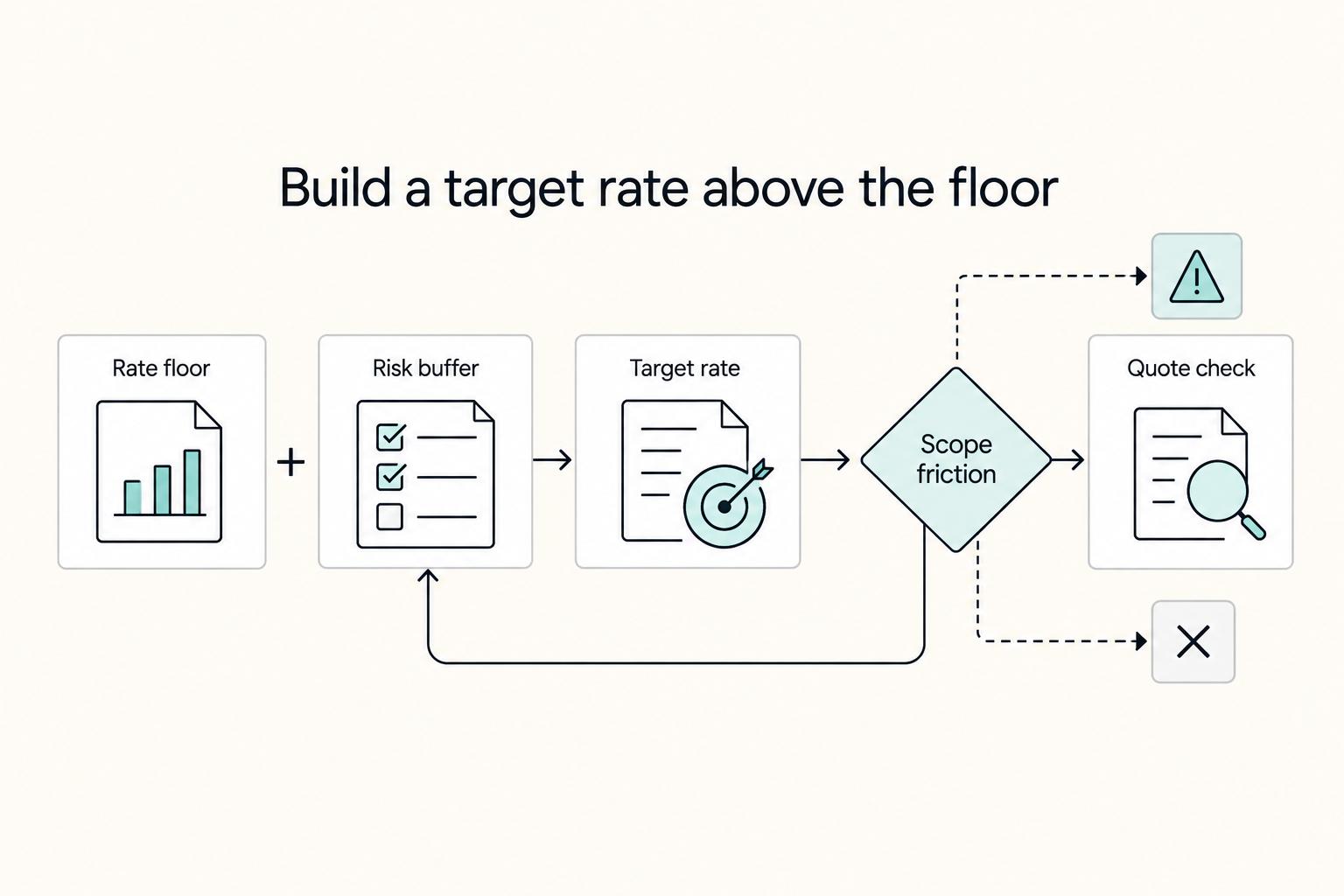
How to Calculate a Freelance Rate You Can Actually Get Paid On
A workable rate is not the neat number a calculator produces. It is the number that still works after you account for real billable capacity, non-client time, scope drift, and the gap between sending an invoice and receiving cleared cash. Start with hourly math even if you do not plan to bill hourly, then turn that number into a quote with clear `payment terms`.

Value-Based Pricing for Strategic Consultants Under Real Payment Risk
Undercharging usually starts before the invoice: when you send one attractive number without clear pricing logic, ownership, or controls for scope or rate changes. In value-based consulting, your price and payment structure are one decision, so you need to build them that way.

The Freelance Payment Penalty: A Modeled Audit of Platform Fees, FX Spreads, and Payout Delays
The money rarely disappears through a single, easy-to-spot fee. The real loss is stacked. A marketplace takes its commission, a processor adds a charge for international cards, a bank or payment company converts the currency at a spread, a platform holds the funds before release, and a wire sheds a little to intermediaries on the way in. Each layer looks defensible on its own, but the worker feels the combined result as a smaller deposit and a later payday.