
Quick Answer
Use a three-step screen before you accept a waiver of jury trial clause: assess enforceability and project exposure, negotiate for mutual or narrower terms, then mitigate with tighter records if it remains. Read choice-of-law and forum language together, and confirm whether the contract is setting a bench-trial path or a binding arbitration path before you redline. For larger or cross-border risk, get jurisdiction-specific legal confirmation before signing.
A waiver of jury trial clause in a high-value contract is not a reason to panic. It is a reason to slow down and make a deliberate risk decision. For experienced operators, this is not just legal boilerplate. It is a checkpoint that tells you to stop reacting to the other side's paper and start managing your own risk.
This guide gives you a practical three-step approach to assess, negotiate, and mitigate a clause that shows up often and matters more than many people think. The goal is simple. Turn a legal provision into a disciplined business decision.
The Foundational Distinction: Jury Trial Waiver vs. Arbitration Clause#
An enforceable jury waiver leaves covered claims in court, with a judge deciding issues that would otherwise go to a jury. An enforceable arbitration clause sends covered disputes to an arbitrator instead. Read the scope and exceptions before assuming either clause controls the dispute.
The wording matters more than the heading. If the contract says a party waives the right to a jury trial in legal proceedings, you are usually still in court. If it says disputes must be resolved by binding arbitration, you are on a different track. Using that track can block the same claim from being brought in traditional court.
Start with these checks:
- Read operative language, not just headings. "Jury waiver" changes who decides the case. "Binding arbitration" changes where the case is heard.
- Confirm forum mechanics. For court, check governing law and forum selection terms. For arbitration, check the forum, rules, seat, and confidentiality wording. Confidentiality is not automatic.
| Decision factor | Jury waiver and bench trial | Arbitration |
|---|---|---|
| Where the dispute goes | Court; without a proper jury demand a bench trial is usual, subject to available discretionary relief | Covered arbitration agreements subject to applicable contract defenses and statutory exceptions |
| Decision-maker | Judge | Arbitrator or panel |
| Speed expectations | Depends on docket, motion practice, and procedure. | Depends on forum rules and arbitrator availability. |
| Privacy level | Lower. Most courtroom proceedings are public, and most federal case files are viewable through PACER. | Variable. Confidentiality depends on contract terms, rules, and law; some forums publish awards. |
| Appeal flexibility | Court procedures govern review. | Judicial review is narrow, with vacatur limited to specific statutory grounds, for example corruption, fraud, or undue means. |
| Cost-control levers | Procedure and case-management choices affect cost. | Clause drafting, forum rules, and case-management choices affect cost. |
| Precedent visibility | Higher. Court decisions and stare decisis can matter. | Variable. Visibility depends on the forum and confidentiality setup. |
| Cross-border coordination | Different path from arbitral award recognition and enforcement. | The 1958 New York Convention provides a recognition and enforcement framework, and U.S. law enforces it through 9 U.S.C. chapter 2. |
For your risk analysis, the distinction is practical. If the client controls forum terms, arbitration can narrow review options and make forum and rule choices more consequential. A bench-trial path keeps you in court, with public records and court procedures.
In practice, one clause changes the decider inside court, and the other changes the forum itself. Once that is clear, you can assess how risky the specific wording is. Related: How to Write an Arbitration Clause for a Freelance Contract.
Step 1: ASSESS - Read the Clause Like Corporate Counsel#
Treat this as a real risk call, not a piece of standard paper. Before you negotiate, answer two questions: is the waiver likely to be enforced, and would a judge deciding on the record help or hurt your position?
Treat the screen below as preparation for a forum-specific enforceability check. A clear, mutual clause can still fail under the law that applies; project records cannot make an invalid waiver enforceable.
1. Screen the clause itself#
Work through the clause in this order:
| Screen item | What to check |
|---|---|
| Conspicuousness | Whether the waiver is easy to find and read or buried in dense contract text |
| Mutuality/commercial balance | Whether it is framed as a two-way waiver or effectively one-way |
| Clarity | Whether it clearly states that jury-trial rights are being waived and whether claim scope is understandable |
| Linked terms | Whether governing law, forum or venue, and jurisdiction clauses create conflicts in where enforceability might be tested |
Preserve negotiability evidence while you do this. Your redlines, email comments, and change requests can matter later when bargaining power, sophistication, and actual negotiability are evaluated.
2. Match the clause to your project risk profile#
Use this as internal triage, not as a legal rule. If the work is subjective and the record is thin, pressure-test how comfortable you are with a judge deciding the dispute.
| Project profile | Evidence quality | Bench-trial pressure-test question |
|---|---|---|
| Subjective deliverables (strategy, creative direction, advisory judgment) | Thin or inconsistent record | Can you prove scope and performance from written evidence alone? |
| Mixed deliverables (some measurable outputs, some judgment calls) | Partial approvals and uneven scope trail | Where could judgment-call disputes outrun what the record clearly shows? |
| Objective deliverables (defined specs, tests, sign-offs) | Strong written record | Are tests, sign-offs, and acceptance criteria complete and dated? |
| Evolving work without disciplined change control | Fragmented written trail | Can you reconstruct approvals and change history without ambiguity? |
Use the table as triage, not as a legal conclusion. If your project shows higher concern, push harder in Step 2 on wording, mutuality, and scope control.
3. Follow governing law and venue as a decision flow#
In cross-border deals, assumptions break easily. Run the dispute terms in sequence before you rely on any single clause. Step 1 should leave you with four checks before negotiation:
- Identify dispute anchors: governing law, forum or venue, and jurisdiction language.
- Check logistics and legal fit: party locations, governing law and venue can differ legitimately; check whether the combination is workable.
- Check the federal-court path: federal civil jury-demand rules may apply if litigation reaches a US district court.
- Verify the named forum: ask counsel to assess waiver enforceability and any burden of proof under the current law governing that court.
What you should have after Step 1#
You should leave Step 1 with three working outputs for negotiation:
- Non-negotiables: terms you need fixed, such as one-way structure, unclear wording, or a venue and law mismatch.
- Fallback positions: what you can accept if your first ask is rejected, such as mutual language or narrower scope.
- Counsel-review flags: enforceability questions local counsel should confirm before you price and sign the risk.
Step 2: NEGOTIATE - Rebalance the Power Dynamic#
Negotiate the dispute package in a set order, not as a pile of disconnected edits. Use this sequence: mutuality, ADR alternative, then jurisdiction trade. If the jury waiver stays, accept it only after the rest of the dispute framework makes sense.
| Move | Email ask | Fallback ask |
|---|---|---|
| Lead with reciprocity (mutuality) | I can accept a jury waiver only if it applies equally to both sides and uses the same dispute scope as the rest of the dispute terms. | If full mutuality is not available, narrow the waiver so it is not broader than the governing law, venue, and ADR provisions. |
| Then propose an ADR path | Add mediation before litigation, with a time limit and exceptions for urgent relief or filing deadlines; mediation leaves the jury-waiver question in place. | If you want a binding forum, we can move to arbitration with clear rules, seat, and arbitrator-selection process. |
| Use forum or jurisdiction trade only if the first two fail | If the waiver remains, I need forum terms that are workable for both parties, including service and language logistics. | At minimum, align governing law, venue or forum, and service terms so I am not taking cross-border friction that could have been avoided. |
Start with the easiest fairness point, then move to process. Deal with location and logistics only if you have to.
- Lead with reciprocity (mutuality).
Email ask: "I can accept a jury waiver only if it applies equally to both sides and uses the same dispute scope as the rest of the dispute terms." Fallback ask: "If full mutuality is not available, narrow the waiver so it is not broader than the governing law, venue, and ADR provisions."
- Then propose an ADR path.
Email ask: “Add mediation before litigation, with a defined time limit and protection for urgent relief and filing deadlines.” Mediation does not restore jury rights or replace the court path. Binding arbitration is a separate proposed change requiring agreed rules, seat and arbitrator selection.
- Use forum or jurisdiction trade only if the first two fail.
Email ask: "If the waiver remains, I need forum terms that are workable for both parties, including service and language logistics." Fallback ask: "At minimum, align governing law, venue or forum, and service terms so I am not taking cross-border friction that could have been avoided."
Your redline goal is straightforward. Make the clause reciprocal, keep its claim scope aligned with related dispute terms, and remove one-way carveouts unless there is a clear business reason to keep them.
| Path | Party control | Privacy | Enforceability friction | Relationship impact |
|---|---|---|---|---|
| Mediation-first | High (party-driven outcome) | Privacy depends on agreed rules and applicable law | Settlement enforceability still needs a separate legal check, especially cross-border | Often less adversarial |
| Arbitration | Medium (parties can have input on arbitrator selection) | Privacy depends on agreed rules; related court proceedings may be public | Written arbitration agreements are generally enforceable; cross-border enforcement can be more structured where the New York Convention applies | Mixed |
| Bench trial | Low after filing | Court proceedings are generally public | Cross-border court enforcement may involve more friction; Hague Choice of Court applies only to certain exclusive court agreements in civil/commercial matters | Often more adversarial |
Before you concede the waiver, run one last cross-border coherence check:
- Governing law and forum or venue point to the same dispute strategy.
- Service abroad is workable, including possible Hague Service Convention translation requirements.
- If relying on a treaty for service or enforcement, confirm the relevant countries participate and this dispute meets its scope and conditions.
- Contract language terms and forum terms do not conflict.
If the other side will not revise the term, decide whether the full dispute package is acceptable after the enforceability and cost checks. You can accept the documented risk, renegotiate the commercial scope or decline. Better records support a case; they do not cure an unworkable forum or invalid waiver.
For a step-by-step walkthrough, see A deep dive into the 'governing law' clause for a contract between a US freelancer and an Asian client. Before you redline client language, build a clean baseline you can compare against using the Freelance Contract Generator.
Step 3: MITIGATE - Operate Defensively When the Clause is Non-Negotiable#
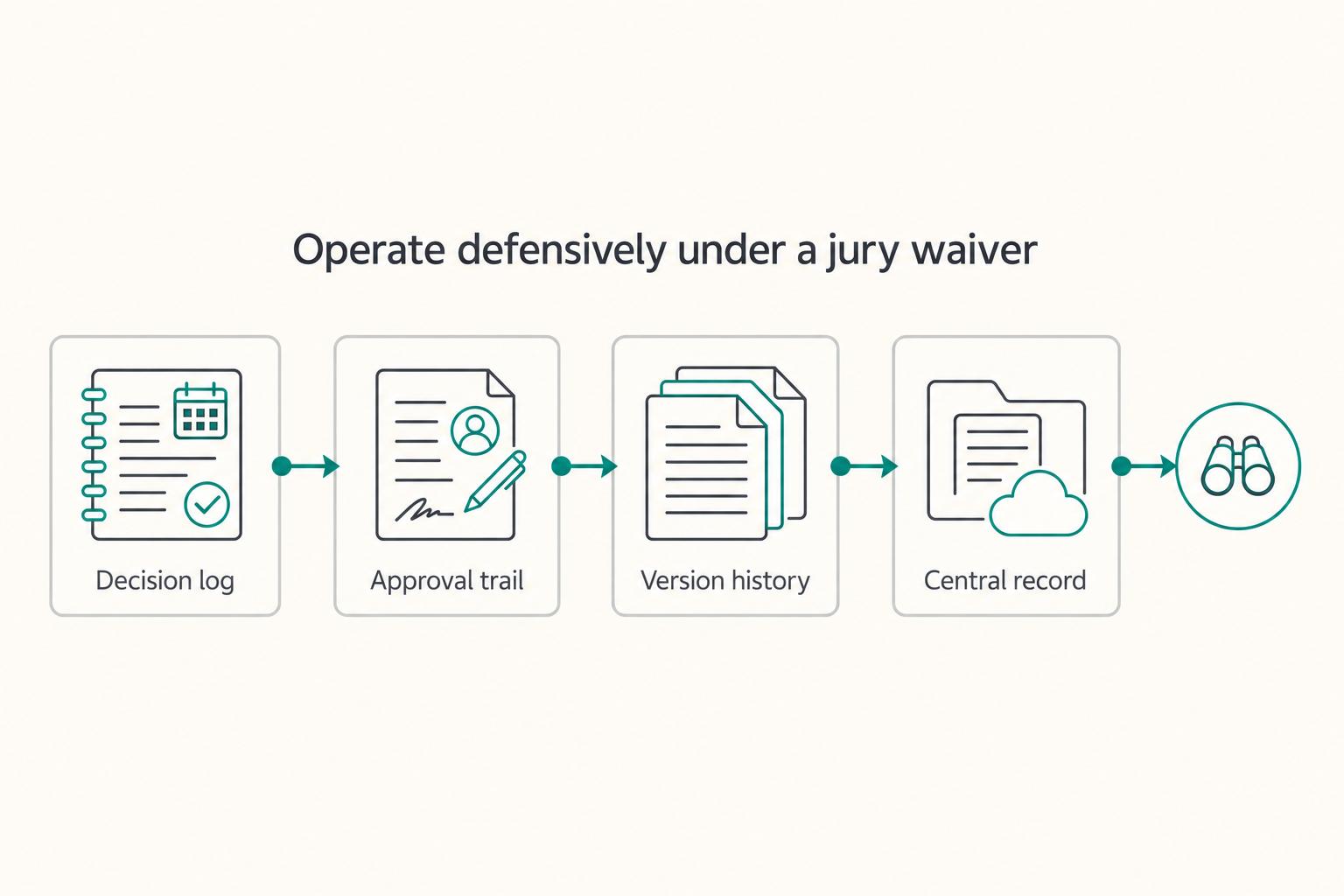
If you decide to accept the dispute package, build the record you would want later. Keep decisions, changes, delivery and approval connected to exact versions. This helps in court or arbitration without guaranteeing the outcome.
A useful project record links each decision to the scope and version it changed. Keep the same discipline whether the eventual decision-maker is a judge, jury or arbitrator.
The workflow below is an operating practice, not a legal requirement specific to jury waivers.
Build a chain of proof, not a pile of messages#
A practical approach is a repeatable documentation loop that ties decision, version, approval, and next step together. What matters is not volume. It is linkage.
| Record element | What it should capture |
|---|---|
| Decision log | One dated entry per key decision, including the issue, decision, approver, and effect |
| Approval trail | Each approval should point to an exact item, such as a named file or version and date |
| Version history | Keep file naming or document history unambiguous, such as SOW_v1, SOW_v2-client-comments, and SOW_v3-final |
| Central record | Keep final instructions, approvals, and deliverables in one agreed location |
A message that says "approved" is weak unless it clearly maps to a specific version and scope item. If comments are split across chat, email, calls, and portals, consolidate them into one written summary and get confirmation before you move forward.
Tighten scope so disputes have fewer entry points#
When terms are non-negotiable, vague scope can become a direct risk multiplier. Write scope so acceptance criteria, revision limits, change triggers, and out-of-scope boundaries are explicit.
| Risky wording | Defensible wording |
|---|---|
| "Provide branding support." | "Deliver brand direction memo, logo concepts, one selected logo package, and brand guide PDF. Includes the agreed revision round(s) on the selected concept only." |
| "Build the client website." | "Design and build the agreed website on the agreed platform. Includes launch to client-provided hosting after written acceptance of staging site. Ongoing maintenance and post-launch edits are out of scope." Preserve any agreed post-launch correction, warranty or maintenance obligations. |
| "Help with monthly marketing." | "Create the agreed email campaign(s) and ad variations per month. New landing pages, strategy resets, and channel expansion require a signed change order." |
| "Revise until approved." | Client may request included revisions in the agreed review window. Check later requests against continuing correction or warranty obligations; genuinely additional work requires an agreed change order. |
Check a request against the agreed scope, included revisions and continuing correction duties. If it adds work beyond those obligations, document its price and timing before starting; a changed dependency or missed requirement is not automatically an extra.
Sequence payment risk behind verified acceptance#
Do not tie invoices to vague progress language if you can avoid it. Tie them to verifiable deliverables and clear checkpoints, such as kickoff, named milestones, and final handoff. Keep the numbers contract-specific and verified.
When you bill a milestone, include the deliverable, send date, relevant acceptance criteria, and written approval status. If approval is still pending, send a dated review notice so the record shows what is under review and what happens next. If scope expands but invoicing still points to old milestones, clarify the change in writing before more work continues.
Use this mitigation checklist#
Use this before kickoff and again at each checkpoint. If the waiver stays, this discipline can help keep the engagement manageable and your position documented.
- Confirm the signed contract, SOW, and latest approved version are stored together.
- Confirm each active deliverable has acceptance criteria, a review window, and a named approver.
- Consolidate recent decisions into one written record.
- Label the current working version and archive prior versions.
- Pause new requests that change scope until you send a written change summary.
- Invoice against the agreed trigger, including kickoff deposits where provided; identify the deliverable and approval status for delivery-based milestones.
You might also find this useful: A Deep Dive into the 'Assignment' Clause in a Freelance Contract.
Conclusion: From Legal Clause to Strategic Checkpoint#
Treat the waiver as a signing decision. Assess enforceability, cost and exposure, negotiate workable terms and decide whether to accept or decline. If you accept, clear scope and records support performance and later evidence; they do not replace that decision.
Before you sign, run this quick checklist:
- Assess: Consider whether the project's value, ambiguity, and downside fit your risk tolerance.
- Negotiate: Consider asking for mutual terms first. If that does not move, propose a practical fallback both sides can accept.
- Confirm: Check that the final wording is consistent in the redline, signature version, and controlling project documents.
- Mitigate after accepting: If the dispute package is workable and you choose to accept it, define scope and acceptance, preserve included corrections and keep versioned approvals. Decline or renegotiate an unacceptable package.
This is a practical risk-management workflow, not a substitute for legal advice. Make specific requests, offer workable alternatives, and document the final deal clearly.
For related context, see A deep dive into the 'choice of law' and 'jurisdiction' clauses for international freelance contracts.
Frequently Asked Questions
Should you sign a contract with a waiver of jury trial clause?
Review the waiver, governing law and forum together, then decide whether the cost and legal position are acceptable. Get forum-specific advice for meaningful exposure. Ask for mutuality; if terms remain unworkable you can decline. Use the documentation controls only after choosing to accept the package.
How should you negotiate it without slowing the deal?
Ask for mutuality, then a time-limited mediation step that protects urgent relief and filing deadlines. Mediation leaves jury-waiver rights unchanged. If the waiver remains, negotiate a forum you can practically use and get advice on its enforceability. Keep requests in writing and decline a package whose exposure remains unacceptable.
What is the difference between a jury waiver and arbitration?
An enforceable jury waiver keeps covered claims in court and changes the decision-maker. Arbitration changes the forum for covered disputes. FAA §2 supports covered written arbitration agreements subject to contract defenses and statutory exceptions; award review is limited under §10, with other provisions addressing modification or correction.
Are these waivers enforceable?
Enforceability depends on the court, applicable law, clause and circumstances. In US district-court litigation, Rule 38 generally requires serving a written jury demand within 14 days after service of the last pleading directed to the issue, and filing it under Rule 5(d). Rule 39 allows the court, on motion, to order a jury trial in some cases without a proper demand. Removal and local procedure need separate checks; get litigation advice promptly rather than assuming the contract settles jury rights.
Where do you see non-enforcement or limits most clearly?
California illustrates why forum matters. Grafton rejected a predispute jury waiver in California court. In EpicentRx on July 21, 2025, the California Supreme Court held that selecting a forum without the same civil jury right is not automatically unenforceable for that reason alone. Other objections to forum selection remain possible; read the waiver and forum terms together.
Why do companies want this clause?
A company may seek a bench trial for predictability or expected cost savings, but those benefits are not guaranteed. Negotiate mutuality, claim scope and a forum you can practically use rather than assuming the clause will save either party money.
Try a related tool
Researched and edited by the Gruv editorial team. Gruv builds cross-border billing, payouts, and finance-operations software for global businesses.
Sources
Includes 1 external source outside the trusted-domain allowlist.
Educational content only. Not legal, tax, or financial advice.
Related Posts

Germany Freelance Visa Application Path for Freiberufler and Gewerbe
Choose your track before you collect documents. That first decision determines what your file needs to prove and which label should appear everywhere: `Freiberufler` for liberal-profession services, or `Selbständiger/Gewerbetreibender` for business and trade activity.

How to Write an Arbitration Clause for a Freelance Contract
A useful dispute clause tells both sides where to send notice, how long to try settlement, who can decide the dispute and what it may cost. Start with the acceptance and payment problem you want to resolve, then choose a process proportionate to the contract. Arbitration produces a binding decision, but it does not guarantee quick payment or remove the need for court enforcement.

The Freelance Payment Penalty: A Modeled Audit of Platform Fees, FX Spreads, and Payout Delays
The money rarely disappears through a single, easy-to-spot fee. The real loss is stacked. A marketplace takes its commission, a processor adds a charge for international cards, a bank or payment company converts the currency at a spread, a platform holds the funds before release, and a wire sheds a little to intermediaries on the way in. Each layer looks defensible on its own, but the worker feels the combined result as a smaller deposit and a later payday.