
Quick Answer
To overcome writer's block, identify the first visible failure point in the draft and classify it as strategy, process, resource, or confidence. Then use one matching action only: clarify the goal, draft the easiest middle section, list missing inputs, or freewrite rough copy without editing. Judge progress by the artifact you produce, not by whether you feel better.
The Assessment: Find the Point of Failure in the Work#
Treat a stall as a delivery risk, not a personality verdict. Your first job is to find the point of failure in the work, because the fix only helps if you route the problem to the right SOP.
At the page level, writer's block is a temporary state: you are unsure what to write or how to continue. It sounds minor until you look at the operational signal. You might keep rewriting the first paragraph, keep changing the outline, or stop because a key input is missing. Those are not just vague feelings. They are observable signs that the work is stuck at a specific point, whether the issue is strategy, process, resources, or confidence.
Gather the evidence in front of you#
Start with the draft, brief, notes, source material, and deadline in view before you diagnose anything. If you are writing for a client or publication, include the assignment language, decision-maker comments, and any source links you plan to cite. You are not trying to feel better first. You are trying to see exactly where progress stopped.
| Material | When | Action |
|---|---|---|
| Draft | Before you diagnose anything | Keep in view |
| Brief | Before you diagnose anything | Keep in view |
| Notes | Before you diagnose anything | Keep in view |
| Source material | Before you diagnose anything | Keep in view |
| Deadline | Before you diagnose anything | Keep in view |
| Assignment language | If you are writing for a client or publication | Include |
| Decision-maker comments | If you are writing for a client or publication | Include |
| Source links you plan to cite | If you are writing for a client or publication | Include |
That matters because unclear requirements create real delivery risk. PMI reported on 30 September 2014 that, in a survey of more than 2,000 practitioners and business analysts, nearly half of unsuccessful projects failed to meet goals because of poor requirements management. Writing is smaller in scope, but the logic is the same. When the outcome is fuzzy, delay and waste follow.
Use a simple checkpoint: can you point to the exact stop point in the draft? If yes, move on. If no, you are still dealing in mood language, and that will slow the diagnosis.
Classify the stall by what you can observe#
Do not overcomplicate this. Use four working labels to speed triage, not to build a formal taxonomy. Evidence across work-related problem types is uneven, so do not assume one fix works for everyone.
| Pattern | Observable behavior | Probable workflow failure | Immediate validation check |
|---|---|---|---|
| Strategy | You keep changing the angle, reader, promise, or title. The outline churns because the piece still feels "wrong." | The objective is unclear. You have not defined what the draft must deliver. | Write one sentence that names the audience, the decision, and the outcome. Pass if it stays stable for 5 minutes. |
| Process | You may rewrite the opening repeatedly, edit while drafting, or freeze when moving from one section to the next. | The drafting sequence is broken. You are trying to draft and judge at the same time. | Skip the intro and draft the easiest section for 10 minutes. Pass if new copy appears without backtracking every sentence. |
| Resource | You stop to open tabs, chase examples, or leave notes like "need source" and "confirm with client." | A needed input is missing or unresolved. | Make a Missing inputs list and mark each gap as internal or external. Pass if every gap has a next step or owner. |
| Confidence | You have enough material but still avoid the draft, polish notes instead, or procrastinate with visible anxiety. | Expectation overload or inner-editor pressure is preventing a rough first pass. | Write 150 rough words that no one will see. Pass if you can keep moving without cleaning each line. |
One red flag matters here: if you call the problem "motivation" before checking the page, you can choose the wrong fix.
Ask one blunt question and force a branch#
Once you have a working label, force a decision by answering one question in writing, not in your head.
| Lane | Question | Pass when |
|---|---|---|
| Strategy | Am I missing the decision this draft must support, or am I still inventing the assignment? | The objective is one stable sentence. |
| Process | Do I actually not know the next step, or am I trying to edit before a draft exists? | You can name the next three sections and start with one. |
| Resource | Can I continue with the material on hand, or is a missing input blocking a claim? | Your Missing inputs list is complete and separated into controllable and external items. |
| Confidence | Is the draft underprepared, or am I refusing to write something imperfect? | You can produce rough copy without repairing sentence one. |
If none of the branches pass, do not keep circling. Run the closest test for 15 minutes, then recheck. Once one branch passes, stop diagnosing and move to the matching SOP in the next section.
Related: The 'Flow State' and how to achieve it as a creative professional.
The COO's Action Plan: Standard Operating Procedures for Every Block#
If you need a practical way to overcome writer's block under deadline, run one lane at a time. Diagnose the first visible failure point, complete one full SOP cycle, and judge progress by the artifact you produce.
Keep your draft, brief, notes, source material, and deadline in view. Do not stack tactics. Choose one lane, run it to completion, then hand off directly into drafting.
Step 1: Lock one lane. Use the same four labels from the assessment section: strategy, process, resource, confidence. Classify by what is happening on the page, not by mood.
Step 2: Run the matched SOP.
| Lane | Trigger | Immediate action | Artifact produced | Evidence of progress | When to re-diagnose |
|---|---|---|---|---|---|
| Strategy | You keep changing the assignment meaning, audience, or angle | Pull the assignment verbs and evidence expectations (analyse, discuss, argue, compare, provide evidence), then write a one-sentence brief and one narrow research question | Clarified brief statement + narrow research question | The brief stays stable long enough to draft from it | You are still rewriting purpose instead of drafting |
| Process | You have ideas but no usable order, or the opening keeps stalling | List primary ideas, convert them into a draft spine, and start in the middle | Draft spine with next sections named | A middle section gets rough copy without constant backtracking | After 10-15 minutes, you are still only rearranging structure |
| Resource | You stop because a fact, source, example, or approval is missing | Build a Missing inputs tracker and tag each item by type, then gather only what unlocks the next section | Missing inputs tracker + focused evidence notes | The next blocked claim has a source, owner, or clear hold note | Research keeps expanding and no section unlocks |
| Confidence | You have enough material but keep delaying or judging every line | Freewrite for five minutes or 10-15 minutes without editing, then move usable lines into the draft immediately | Micro-win output moved into the working draft | New draft text exists and you can continue before editing | Timer ends and you still produced notes about writing, not draft text |
Step 3: Force the handoff back to drafting. Use the artifact immediately. Draft from the clarified brief, draft the easiest middle section from the spine, draft around verified material while marking unresolved claims, or convert freewrite lines into rough copy now. If there is no artifact, the SOP cycle is not complete.
Step 4: Escalate after one failed cycle. If one full cycle produces no artifact or no draft handoff, switch classification and run one more cycle. If you are still stuck, stop repeating the same tactic and get writing support from a tutor, instructor, editor, or trusted reviewer.
Keep these artifacts. In the next section, you will turn them into documented controls to catch stalls earlier and handle them consistently.
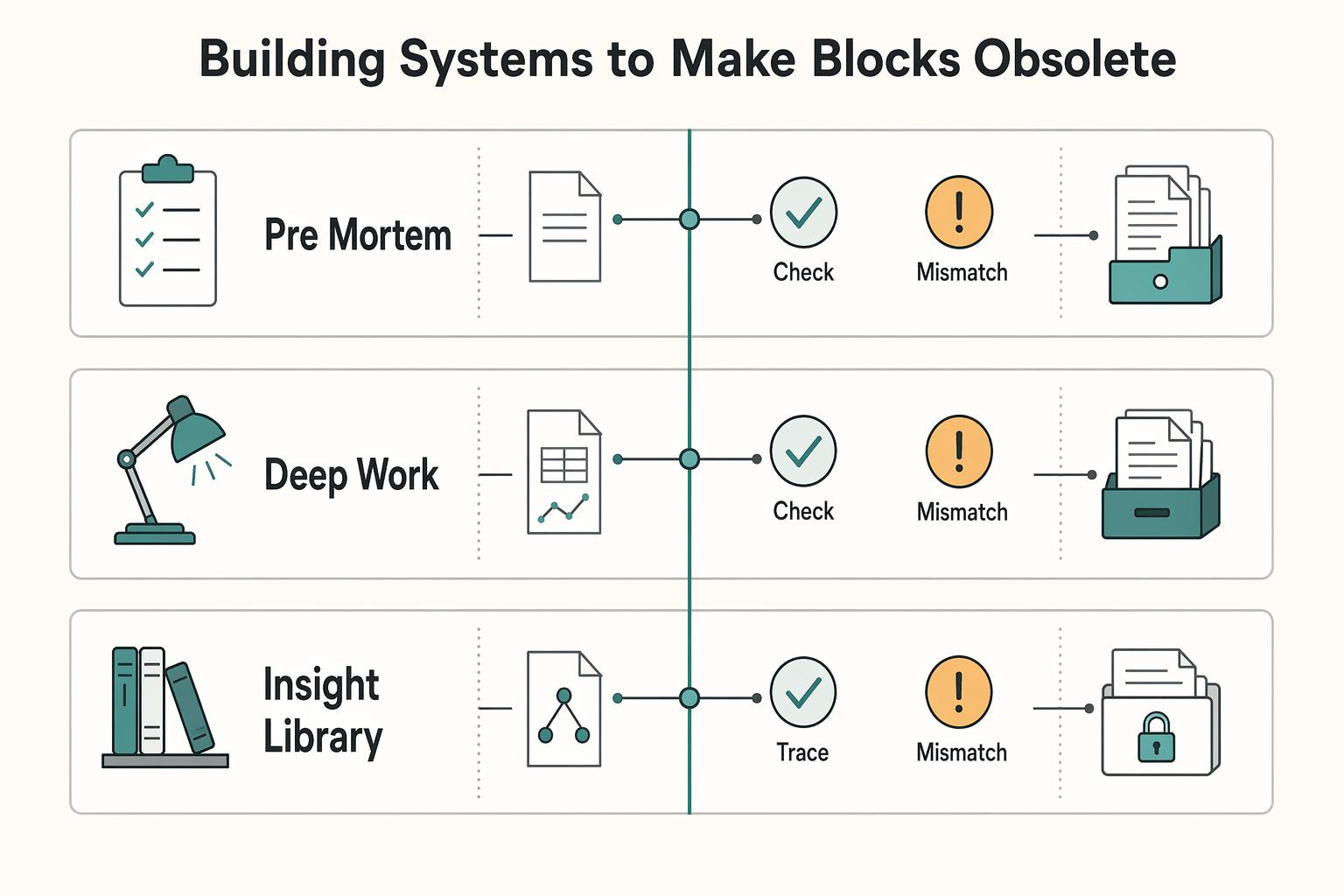
Risk Management: Three Controls You Review Every Week#
If stalls keep repeating, treat them as a control problem, not a motivation problem. Your minimum viable system is three controls you can review every week, each with a clear owner, artifact, failure signal, and recovery trigger.
| Control | Risk type | Control owner | Artifact to produce | Failure signal | Preventive action | Recovery trigger |
|---|---|---|---|---|---|---|
| Pre-mortem kickoff | Strategy, resource | You or project lead | Kickoff brief (outcome, decision owner, approval path, missing inputs) | You cannot state the outcome in one sentence, or no approver is named | Assume the draft failed, list plausible causes, and surface reservations before writing starts | Scope, approvals, or dependencies change mid-project |
| Deep-work protection | Process, confidence | You | Calendar block + written interruption rule | Sessions keep breaking for messages, admin, or tab switching | Protect writing blocks and define what can interrupt them | Two or more sessions fail the same way and stress rises even when output looks acceptable |
| Insight library | Resource, slow starts | You | Verified-notes log (claim, source, status, open question) | You open the draft and drift into unfocused research | Keep one searchable notes system with verified vs. unverified material separated | You cannot trace a claim to a source or status |
- Run the pre-mortem kickoff before draft day. Create the kickoff brief first. If your outcome sentence does not survive contact with drafting, fix scope before you write more.
- Protect deep work with an explicit rule. Schedule the writing block, place the interruption rule beside it, and treat fragmentation as a risk signal to correct, not as a normal part of the process.
- Maintain one verified-notes log. Record each claim with source and status in one place so you stop re-solving the same resource gaps every session.
- Close the governance loop. Review the three artifacts and their failure signals each week. If stalls persist, add a monthly review cadence. When a stall repeats, escalate to the person who can change scope, approvals, or availability, then adjust the control itself (brief template, interruption rule, or notes-log hygiene) so the next cycle starts cleaner.
You might also find this useful: How to Find Reliable Wi-Fi Anywhere in the World.
Conclusion: Diagnose the Block, Act, Then Check the Result#
The practical takeaway is simple: do not wait to feel ready. Decide what kind of problem is in front of you, take the next controllable action, and check the result.
| Step | Action | Checkpoint |
|---|---|---|
| Diagnose the block | Name the stall as strategy, process, resource, or confidence. | If you cannot state the draft goal, the next section, the missing input, or the fear in one plain sentence, you are still diagnosing and should not pretend you are drafting yet. |
| Act on the matching constraint | Fix one thing only: restate the immediate goal, start the next manageable chunk, make a Missing inputs list, or do 10 to 15 minutes of freewriting without editing. | End the block with one visible artifact, not a better mood. |
| Systematize what works repeatedly | Write it down as a repeatable rule with an output. | If the stall depends on someone else, switch to a task you can control instead of waiting. |
| Review on a schedule | Take inventory at the end of each work session, then set incremental, weekly goals and identify your top 3 for the next session. | Your next work session should already have a start point, not a vague intention. |
- Diagnose the block. Name the stall using the working labels from this article: strategy, process, resource, or confidence. Checkpoint: if you cannot state the draft goal, the next section, the missing input, or the fear in one plain sentence, you are still diagnosing and should not pretend you are drafting yet.
- Act on the matching constraint. Fix one thing only: restate the immediate goal, start the next manageable chunk, make a
Missing inputslist, or do 10 to 15 minutes of freewriting without editing. Checkpoint: end the block with one visible artifact, not a better mood. That means a clarified brief, rough paragraphs, a short source list, or an ugly but usable page of text. - Systematize what works repeatedly. If the same move gets you unstuck across separate assignments, make it part of your process. Checkpoint: write it down as a repeatable rule with an output, such as "start with headings" or "end each session by logging missing inputs." If the stall depends on someone else, switch to a task you can control instead of waiting.
- Review on a schedule. Take inventory at the end of each work session, then set incremental, weekly goals and identify your top 3 for the next session. Checkpoint: your next work session should already have a start point, not a vague intention.
For your next work session, open your kickoff brief, pick the current diagnosis, set one output target, and decide your review point before you begin. Professional writing improves when you hold yourself accountable to process, evidence, and follow-through.
Frequently Asked Questions
How do you get unstuck right now?
Name what is happening instead of arguing with the label. Set a 20 minute timer and do one matching action only, then check yourself around minute 17. If interest is returning, keep going; if not, switch tactics instead of rerunning the same sprint.
How do you pick the first move?
Use what you can observe on the page, not what sounds productive. Pick one immediate move that matches the blocker, such as drafting badly without editing, writing one small section anyway, switching to headings or bullets, or listing exact missing inputs. Then check for proof that it worked and set a clear point to switch tactics if it did not.
What if the timer does not work?
Treat the timer as a test, not a cure. If a full 20 minutes stays flat, do adjacent writing work for one short block, such as headings, questions, source checks, or the easiest section. If that still fails, stop forcing output and fix the constraint first.
What do you say to a client when you're stuck?
This article does not give you a validated client script. Keep the update professional and narrow: state what is blocked, the one decision or missing input you need, and your next delivery time. A practical format is to name the deliverable and goal, request the one decision or input, state the next step, and promise a specific output by a specific date or time.
Is this a sign of burnout?
This article does not diagnose burnout. One bad session can come from boredom, fear, or feeling self conscious. If the same flatness keeps repeating, stop forcing output and get support instead of pushing harder.
What routine helps next week?
Once a week, review what blocked you, which first move you tried, and whether the 20 minute sprint helped. If one blocker keeps repeating, change tactics earlier instead of rerunning the same sprint. If your calendar keeps collapsing into admin, protect writing blocks and define what can interrupt them.
Try a related tool
Researched and edited by the Gruv editorial team. Gruv builds cross-border billing, payouts, and finance-operations software for global businesses.
Sources
- csrc.nist.gov/projects/risk-management/about-rmf/monitor-steptrusted
- ecfr.gov/current/title-21/chapter-I/subchapter-F/part...trusted
- epa.gov/quality/guidance-preparing-standard-operatin...trusted
- epa.gov/sites/default/files/2015-06/documents/g6-fin...trusted
- fedramp.gov/resources/documents/Continuous_Monitoring_Pl...trusted
- ics.uci.edu/~gmark/chi08-mark.pdftrusted
- informatics.uci.edu/regaining-focus-in-a-world-of-digital-distra...trusted
- owl.purdue.edu/owl/general_writing/the_writing_process/writ...trusted
Educational content only. Not legal, tax, or financial advice.
Related Posts
How to Manage Your Time Effectively as a Freelancer
Most freelancers struggle not because they work too few hours, but because they misallocate the hours they have—treating time as an infinite resource rather than a finite business asset with a real cost per unit. The solution is a three-layer operating system: a Time Budget Framework that commits hours to four categories before any client work is booked, a Weekly Operating Template that assigns those categories to specific calendar windows, and a monthly Admin Audit Checklist that reconciles invoicing, bookkeeping, and compliance records. Multi-client orchestration requires a WIP limit, dedicated client windows, and a capacity decision rule run before accepting new engagements. Together, these systems replace reactive decision-making with a repeatable structure that keeps delivery quality consistent, records audit-ready, and the freelance practice operationally durable.

A Digital Detox Routine for Freelancers Who Need to Stay Reachable
Use your devices as operating tools, not open doors to constant interruption. The goal is not to quit screens. It is to control when they get to interrupt your work.

The Freelance Payment Penalty: A Modeled Audit of Platform Fees, FX Spreads, and Payout Delays
The money rarely disappears through a single, easy-to-spot fee. The real loss is stacked. A marketplace takes its commission, a processor adds a charge for international cards, a bank or payment company converts the currency at a spread, a platform holds the funds before release, and a wire sheds a little to intermediaries on the way in. Each layer looks defensible on its own, but the worker feels the combined result as a smaller deposit and a later payday.