
Quick Answer
Marketplace operators in 2026 should prioritize payment changes by bottleneck, country, and corridor rather than by headline trend. Real-time rails usually come first when payout speed, settlement reliability, or seller liquidity are the constraint; embedded checkout, tokenisation, or BNPL fit conversion problems; stablecoins deserve roadmap space only for tightly scoped cross-border cases with clear compliance and reporting readiness.
How to Set Payment Priorities in 2026#
Payments headlines in 2026 are loud, but marketplace roadmap decisions should start with sequence, not trend volume. The useful move is not building a longer list of themes. It is filtering for changes that improve settlement reliability, compliance clarity, or measurable conversion in a specific market. The signals are mixed, which is why headline-led planning can fail:
- J.P. Morgan (March 06, 2026) frames 2026 as a multi-theme year spanning innovation, changing customer expectations, and fraud risk.
- Visa (12/15/2025) takes a much more bullish view, including AI-supported shopping and agentic commerce.
- Forrester (Nov 14 2025) argues for steady, fundamental shifts rather than headline disruption.
For operators, the practical question is simpler: which change removes your biggest constraint first? A services marketplace dealing with payout delays has a different priority from a retail marketplace losing buyers at checkout. A cross-border B2B platform may care more about settlement predictability and treasury handling than about adding another consumer payment option.
These are not the same kind of change. Instant payments are infrastructure capabilities where funds move in near real time and are available continuously. BNPL is a consumer installment credit product at checkout, and Richmond Fed estimates it reached about $70 billion in 2025, or roughly 1.1 percent of total credit card spending. Dynamic payment methods can improve checkout relevance and conversion, but they do not automatically fix payout failures, reconciliation gaps, or cross-border settlement friction.
Apply the same discipline to stablecoins. FATF reports over 250 stablecoins in circulation by mid-2025 with market capitalisation exceeding USD 300 billion, but Forrester says they will remain niche for retail payments in 2026. FATF also flags AML/CFT obligations for participants in stablecoin arrangements under Recommendation 15. If you cannot define the corridor benefit, custody and routing design, and finance reporting path, you do not have a launch case yet.
This article stays narrow on purpose. It separates signal from noise across stablecoins, real-time rails, embedded checkout, BNPL, AI-enabled payments, and dynamic payment tools using operational impact as the filter. The goal is clear go or no-go checkpoints for vertical, country, and launch timing decisions.
Start with terms so decisions are comparable#
Use one shared vocabulary before you rank options. If product hears "trend," risk hears "compliance exposure," and finance hears "operational overhead," you can end up prioritizing the wrong project for the wrong reason.
Treat payment infrastructure as a planning label for the payment system and the operating steps around it. BIS defines a payment system as the rules, procedures, participants, and operator used to transfer funds. For marketplace planning, you can include collection, allocation, conversion, and payout flows, but keep that as your internal scope rather than a universal definition.
| Term | Working meaning for roadmap decisions | What to verify |
|---|---|---|
| Payment infrastructure | The payment system plus your marketplace's money-movement steps | Which providers, jurisdictions, and payout paths are actually in scope |
| Trend signal | A change that affects speed, transparency, access, or cost outcomes | Baseline metrics before and after, not just UX changes |
| Market readiness | A rail or model is available in the target market and fits local compliance obligations | Jurisdiction, provider coverage, CDD path, and beneficial-owner checks where required |
| Cross-border payment | Payment flow where payer and payee are in different jurisdictions | Corridor-level speed, transparency, access, and cost outcomes |
Keep the readiness test strict: "available somewhere" is not "ready for your market." For instant payments, the ECB definition is explicit: funds available within ten seconds. U.S. instant-rail readiness includes FedNow, which went live on July 20, 2023 and is available to U.S. depository institutions. In the EU, Regulation 2024/886 requires PSPs that offer regular euro credit transfers to also offer instant credit transfers. The UK Faster Payment System is available 365 days per year.
Apply the same discipline to stablecoins and onboarding. Stablecoins are digital assets designed to maintain stable value relative to a reference asset, but in the EU, issuance of ARTs and EMTs under MiCA is authorization-gated. CDD requires identifying and verifying customer identity using reliable, independent sources, and beneficial-owner verification can extend beyond the first contracting party. If a planning document cannot name the jurisdiction, rail, and verification obligation, treat it as unproven rather than roadmap-ready.
Separate true infrastructure shifts from feature-level upgrades#
In many marketplaces, fixing settlement reliability, payout timing, or compliance clarity creates more operational value than adding checkout polish. Reducing payout orchestration failures and improving cross-border settlement predictability can create more durable value than adding another buyer-facing payment feature.
Use a simple test: a trend is infrastructure-grade if it changes how money moves, when funds are available, or which controls you must run. If it mainly changes acceptance, messaging, or payment choice at checkout, it can still help, but it should not outrank unresolved settlement and reconciliation issues.
| Trend | Operational impact | Dependencies | Compliance surface | Reversibility | Confidence (evidence quality) |
|---|---|---|---|---|---|
| Real-time rails | Directly affects fund availability, payout speed, and seller liquidity | Country and PSP rail access, payout-flow redesign, reconciliation updates | High. EU Instant Payments Regulation covers euro credit transfers and adds pricing parity, verification of payee, and at least daily sanctions checks | Medium. Product choices can change, but payout operations and finance processes usually need rework | High |
| Stablecoins | May improve cross-border speed and cost in some corridors, but evidence is mixed | Corridor support, custody or routing design, counterparty acceptance, treasury operations | High. FATF Recommendation 15 expectations apply; EU ART or EMT issuance is authorization-gated under MiCA | Medium to low. Treasury, reporting, and controls are not trivial to unwind | Medium |
| Tokenisation | Infrastructure-level only when it changes asset representation or settlement design | Issuer, network, and ledger design choices | Medium to high, especially where token type or issuance model triggers specific rules | Medium | Medium |
| BNPL | Can expand payment choice and affect checkout economics, while adding credit-like servicing and dispute or refund handling | Provider coverage, merchant economics, checkout integration | High. CFPB describes BNPL as combining payment processing and credit services, with protections similar to conventional credit cards | Medium | High |
| AI-enabled payments | Often improves routing, fraud review, support, or authorization decisions more than settlement itself, depending on implementation | Data quality, model governance, provider tooling, human review paths | Medium. Control and explainability expectations matter, but vary by use case | High to medium | Low |
| Embedded checkout and dynamic payment tools | Can improve acceptance or completion, but usually does not resolve payout timing or cross-border exceptions | Front-end integration, provider orchestration, analytics | Low to medium, depending on methods offered | High | Medium |
Do not confuse conversion work with infrastructure work. Embedded checkout and dynamic payment tools can improve top-of-funnel performance while delayed payouts and reconciliation exceptions remain unresolved.
Real-time rails are the clearest infrastructure shift because they change operations, treasury, support, and compliance together. In the EU, PSPs that offer regular euro credit transfers must also offer instant credit transfers, with euro-area deadlines of 9 January 2025 for receiving and 9 October 2025 for sending. The same regime includes verification of payee, charges not higher than standard transfers, and sanctions checks at least daily. A "real-time" rollout is not ready until those items are confirmed in the target country and provider setup.
Treat confidence as a gate, not a formatting detail. The FSB reports that current quantitative data is still insufficient for a complete global picture. It also says satisfactory global improvements are unlikely in line with the 2027 roadmap timetable. Use market claims as directional unless your own corridor evidence shows lower payout failures, faster fund availability, and fewer reconciliation exceptions.
For a related comparison, see Future Subscription Commerce Predictions for Platform Operators Through 2027.
Prioritize by marketplace model and country constraints#
The right priority is marketplace model + country corridor + current bottleneck, not trend label. If faster seller liquidity is the constraint, move payout orchestration and real-time rails first. If conversion is the constraint, test embedded checkout, tokenisation, or BNPL first, but only where country and program coverage are confirmed.
Use the corridor-model pair as the planning unit. The same capability can matter very differently across e-commerce, services, and B2B platforms in the same market.
| Marketplace model | Corridor pattern | Usually prioritize first | Why | Verify before GTM spend |
|---|---|---|---|---|
| E-commerce marketplace | Often domestic-heavy buyer or seller flows | Embedded checkout, tokenisation, BNPL (where supported) | Conversion gains may matter more when payouts are already predictable | Country payment-method coverage, program availability, refund or dispute operations |
| Services marketplace | Often domestic or regional payouts to many individuals | Payout orchestration, real-time rails | Liquidity and payout predictability can affect supply reliability and support load | Rail participation, payout account type support, in-country payout readiness |
| B2B platform | Cross-border settlements, larger supplier payouts | Payout orchestration first; corridor-specific rail improvements next; stablecoins only as scoped pilots | Settlement timing, reconciliation friction, and treasury impact can dominate | AML due diligence path, beneficial ownership data readiness, counterparty acceptance, finance reporting path |
Hard constraints before approval#
Before you approve a launch, clear the hard constraints that actually block execution:
- Coverage check: Payment methods and payout rails vary by country, region, and payout account setup. Do not assume one global method set.
- Compliance check: Confirm your AML/KYC operating path per market. FATF's baseline is risk-based, and EU rules adopted on 30 May 2024 tightened due-diligence and beneficial-ownership obligations.
- Settlement check: Model real corridor behavior. Cross-border friction remains material: for nearly one-quarter of global corridors, costs still exceed 3%, and in 2024, one-third of retail cross-border payments took more than one business day to settle.
For real-time rails, verify country and participant reality, not just product messaging. In the US, FedNow supports transactions within seconds, 24/7, for participating institutions. Participant or routing coverage is updated over time and listed as updated 3/23/26.
Uber's expansion framing is a useful operating lens: rapid international rollout includes "many payments-related challenges." Country-level rail, compliance, and settlement constraints should inform rollout order.
Define "not now" rules up front#
Set explicit pause rules so teams do not ship into obvious gaps.
- Not now on real-time payouts when participation or payout-account support creates inconsistent experiences.
- Not now on BNPL or localized checkout methods when coverage is uneven across target buyers or servicing ownership is unclear.
- Not now on stablecoin lanes when corridor value is unproven or AML, beneficial-ownership, or finance controls are not operationally ready.
- Not now on a new market when KYC or AML ownership, payout fallback, and reconciliation ownership are not clearly assigned.
Decide if stablecoins deserve roadmap space now#
Stablecoins deserve roadmap space only when they solve a specific cross-border settlement problem you already have. In most cases, that means a tightly scoped pilot in one corridor or a watchlist entry, not a platform-wide rollout. Use a three-part gate: customer pull, corridor fit, and compliance feasibility. If any gate fails, keep stablecoins on the watchlist.
Customer pull#
Start with demand you can name, not market momentum. FATF reported on 3 March 2026 that stablecoins had grown to over 250 in circulation by mid-2025, with market capitalisation above USD 300 billion. That growth alone does not prove that your sellers, suppliers, or treasury team need this rail.
Look for pull from at least one concrete source. Counterparties may already be asking to settle this way. Treasury may be showing a measurable timing or liquidity benefit. Or you may have a corridor where your current bank route is slow or operationally noisy. If none applies, do not prioritize it.
Corridor fit#
A strong stablecoin case is usually narrow and corridor-specific. Prioritize only where settlement speed, cut-off constraints, or prefunding friction are materially worse than alternatives, and where the receive side can accept and use funds without creating new conversion or reconciliation issues.
Verify the full path, not just the send leg. Confirm who receives the asset, how it is converted or held, what fallback route is used if transfer fails, and whether settlement state maps cleanly into payout records. If benefits are theoretical or the flow depends on manual intervention, do not launch.
BIS provides a clear caution marker. Properly designed and regulated arrangements could enhance cross-border payments, but no stablecoin arrangements have yet met the full bar of being properly designed, regulated, and fully compliant. A faster route on paper can still be an operational downgrade if exceptions grow faster than settlement gains.
Compliance feasibility#
Compliance is often the hardest gate in a stablecoin plan. Existing AML controls are your starting point, not proof of readiness. FATF Recommendation 15 applies AML/CFT measures to virtual assets. FATF also says stablecoin network participants should be under clear AML/CFT obligations. It reports insufficient Travel Rule implementation across jurisdictions, with 75% of jurisdictions only partially or not compliant with FATF requirements for virtual assets and VASPs.
Use a hard decision rule: if your controls cannot support jurisdiction-specific screening, counterparty due diligence, and required information exchange for the route, do not launch. In the EU, this becomes more specific under MiCA. If your design touches an e-money token (EMT) or an asset-referenced token (ART), you need clear legal and operational treatment of that classification. ART and EMT issuer provisions applied from 30 June 2024, and the MiCA regime entered into force from 30 December 2024.
The artifacts you should require before launch#
Before any pilot, require operating artifacts that finance, risk, and ops can use:
- A custody and routing design showing who holds funds or assets at each step, who can move them, and the fallback rail if the preferred route fails.
- An exception-handling map covering rejected transfers, delayed settlement, missing compliance data, and counterparty non-acceptance.
- A reporting path for finance and audit showing how transactions are recorded, valued, reconciled, and reviewed.
One common failure mode is technical transfer capability without a clean compliance or reporting path. Ops ends up handling exceptions manually while finance cannot close with confidence. If this artifact pack is not ready, the pilot is not ready.
Treat stablecoins as optional rails where supported, not a platform-wide mandate. Keep your primary bank or real-time rails path intact, test one corridor with explicit success criteria, and expand only if settlement and control gains show up in operations.
Choose between real-time rails, BNPL, and embedded checkout with explicit tradeoffs#
Choose the option that addresses your largest measured loss point first: payout speed and availability, or checkout completion. BNPL should sit in a market-specific credit and operations lane, not be treated as a default conversion fix.
Start from the bottleneck, not the feature list#
Real-time rails are the priority when funds availability is the core pain. The Federal Reserve defines instant payments as funds received immediately, at any time, with near real-time interbank settlement. In the U.S., FedNow supports transactions within seconds, 24/7, and RTP reports provider-reported reach to 71% of U.S. demand deposit accounts.
Embedded checkout is the priority when users drop off before payment completion. Embedded checkout means customers pay through an embedded form on your site. Checkout friction remains measurable: Baymard reports 18% of U.S. online shoppers abandoned an order in the past quarter, and its documented average cart abandonment rate is 70.22%. Stripe's holdback test reported average uplift when at least one additional relevant payment method was shown, 12% revenue and 7.4% conversion. That is useful directional evidence, but it is context-specific.
BNPL belongs in a separate lane. It may help in specific segments, but it also adds refund and dispute handling complexity plus country-specific compliance timing. The CFPB has continued to report consumer complaints related to BNPL refunds and disputed transactions, and U.S. enforcement posture has shifted, increasing policy uncertainty.
Compare downside risk before you prioritize#
| Option | Best-fit signal | Verify first | Main downside |
|---|---|---|---|
| Real-time rails | Payout delays, cutoff issues, split-payout exception load | Market and provider coverage, and clean ledger mapping | Settlement finality means routing or beneficiary errors are harder to unwind |
| Embedded checkout | Checkout abandonment, payment-method mismatch, form friction | Step-level drop-off and payment-method fit | Better checkout completion can still leave payout or reconciliation problems unresolved |
| BNPL | Clear affordability demand in a defined market or segment | Dispute or refund ownership, liability split, and local rules | Higher dispute or refund operational load and changing regulatory expectations |
Do not use a checkout initiative to mask a payout problem, and do not use a payout initiative to avoid fixing checkout friction.
Country timing can change sequencing#
Country timing can change implementation order even when the product case looks obvious. In the EU, the Instant Payments Regulation adopted on 13 March 2024 requires PSPs that offer regular credit transfers to also offer sending and receiving instant credit transfers. BNPL timing is less uniform: the FCA states UK Deferred Payment Credit regulation starts on 15 July 2026, while ASIC referenced Australian laws effective 10 June 2025.
Sequence one change at a time#
Run one major change per verification window. For real-time rails, track pre-send and post-send exceptions, especially given RTP settlement finality. For embedded checkout, review abandonment by step and payment method, not only headline conversion. For BNPL, define ownership for disputes, refunds, and support before launch.
Bundling all three at once makes outcomes hard to attribute. Sequence by the bottleneck you can measure clearly, then expand only when operational results hold.
For a step-by-step walkthrough, see State of Subscriptions 2026 Benchmarks for Platform Operators.
Build compliance gates before scaling volume#
Once you choose the next payment change, put control ahead of volume. If onboarding and payout paths cannot show who the parties are, which checks passed, and why a payout was allowed or stopped, delay new rails or dynamic payment tools.
For AML/CFT, use a risk-based approach before deciding where automation can run straight through. In the U.S., for covered financial institutions and money services businesses, concrete anchors include beneficial ownership due diligence under 31 CFR 1010.230 and written AML program duties under 31 CFR Part 1022. In the UK, the FCA expectation under the Money Laundering Regulations is to carry out a risk assessment, maintain appropriate systems and controls, and perform due diligence.
Put KYC and AML checks in the actual money path#
Multi-party KYC should not live in a checklist that the payout engine ignores. Payment and payout capability should depend on verification state. Adyen states users must be verified before payments can be processed or funds paid out, and Stripe Connect exposes held states through capability fields like charges_enabled and payouts_enabled returning false.
Use a simple operating rule: map each account state to an allowed action. If verification is incomplete, account actions should follow provider and regulatory constraints, such as blocking payouts or both payments and payouts. If beneficial ownership data is missing for a legal entity, route the case to a named owner with a timer instead of letting it sit in manual queues. A practical checkpoint is a daily report of pending, restricted, and payout-disabled accounts, with aging by reason code.
Define failure modes before they become support incidents#
Name the early failure modes before they turn into support debt. If these decisions are not assigned up front, they become expensive exception handling.
- Held payouts: capability paused or due diligence incomplete; typically compliance operations owns the decision, product owns user messaging, and finance tracks balance impact.
- Incomplete KYC states: missing documents or beneficial owner details; onboarding or risk teams own resubmission and timeout handling.
- Cross-border settlement rejections or suspensions: missing required originator or beneficiary data; FATF Recommendation 16 guidance requires procedures on when to execute, reject, or suspend.
Make every payout decision traceable#
Every payout decision needs a traceable record chain from request to final outcome. That chain should include the order or invoice ID, connected account ID, verification state at decision time, document status, capability status, route used, approval or rejection reason, and settlement outcome. That is how finance explains why one seller was paid while another was held.
In the EU AMLD context, customer due diligence information, documents, and related transaction records must be retained for five years from the end of the business relationship. Treat that retention period as a design constraint and keep the audit trail consistent across providers and corridors.
Delayed remediation also carries a cost. From 1 January 2026, EU-level AML/CFT responsibilities moved from the EBA to AMLA. Separately, the FCA's Nationwide case resulted in a £44,078,500 fine tied to delayed fixes for weak financial-crime controls. The practical test before scaling is straightforward: if you cannot show request, review, decision, and payout outcome in one traceable record, controls are not ready for growth.
Related: State of Platform Payments: Benchmark Report for B2B Marketplace Operators.
Design payout architecture that survives real-world exceptions#
If your payout architecture cannot survive retries, out-of-order events, and failed cross-border transfer attempts, it is not ready to scale. The core design question is not whether the happy path works. It is whether the system can tell a new payout from a retried message and recover cleanly when the route fails.
Map the money movement before you automate it#
Document the order of operations for each route you support, even when flows differ by provider or country. Define when funds are collected, when balances are allocated, when split payouts are triggered, which service orchestrates payouts, and which event counts as final settlement.
Keep provider acceptance separate from seller settlement in your state model. In Stripe Connect's separate charges and transfers model, the charge is decoupled from transfers, and one payment can fund transfers to multiple connected accounts where supported. Track charge success, transfer initiation, payout creation, and final payout outcome as separate states.
Use one trace record per payout decision, at minimum:
- internal order or invoice ID
- seller or connected account ID
- route or provider used
- idempotency key used for create or retry calls
- provider event ID and event timestamp
- verification state at decision time
- transfer or payout object IDs
- final settlement state, including failed or returned payouts
Make retries safe before you need them#
Use idempotency for payout-creating requests. Stripe states the same idempotency key returns the same result, including 500 responses, and PayPal documents that omitting idempotency on qualifying POST flows can duplicate requests.
Generate the idempotency key from the business action, not the HTTP attempt. If one payout request is retried multiple times, every retry should reuse the same key. Stripe notes keys can be pruned after they are at least 24 hours old, so your retry-correlation window should not be shorter than that.
Apply the same discipline to webhooks. Stripe warns webhook payloads can be stale, partial, out of order, and duplicated. Adyen instructs you to acknowledge with 2xx, store the message, and process it, and documents immediate retries plus queued retries at 2, 5, and 10 minutes, continuing for up to 30 days.
Treat webhook events as state candidates, not automatic truth. Match on provider event ID, check event recency against current state, and fetch fresh object state when payloads look incomplete or inconsistent.
Set checkpoints for aging, queues, and corridor deltas#
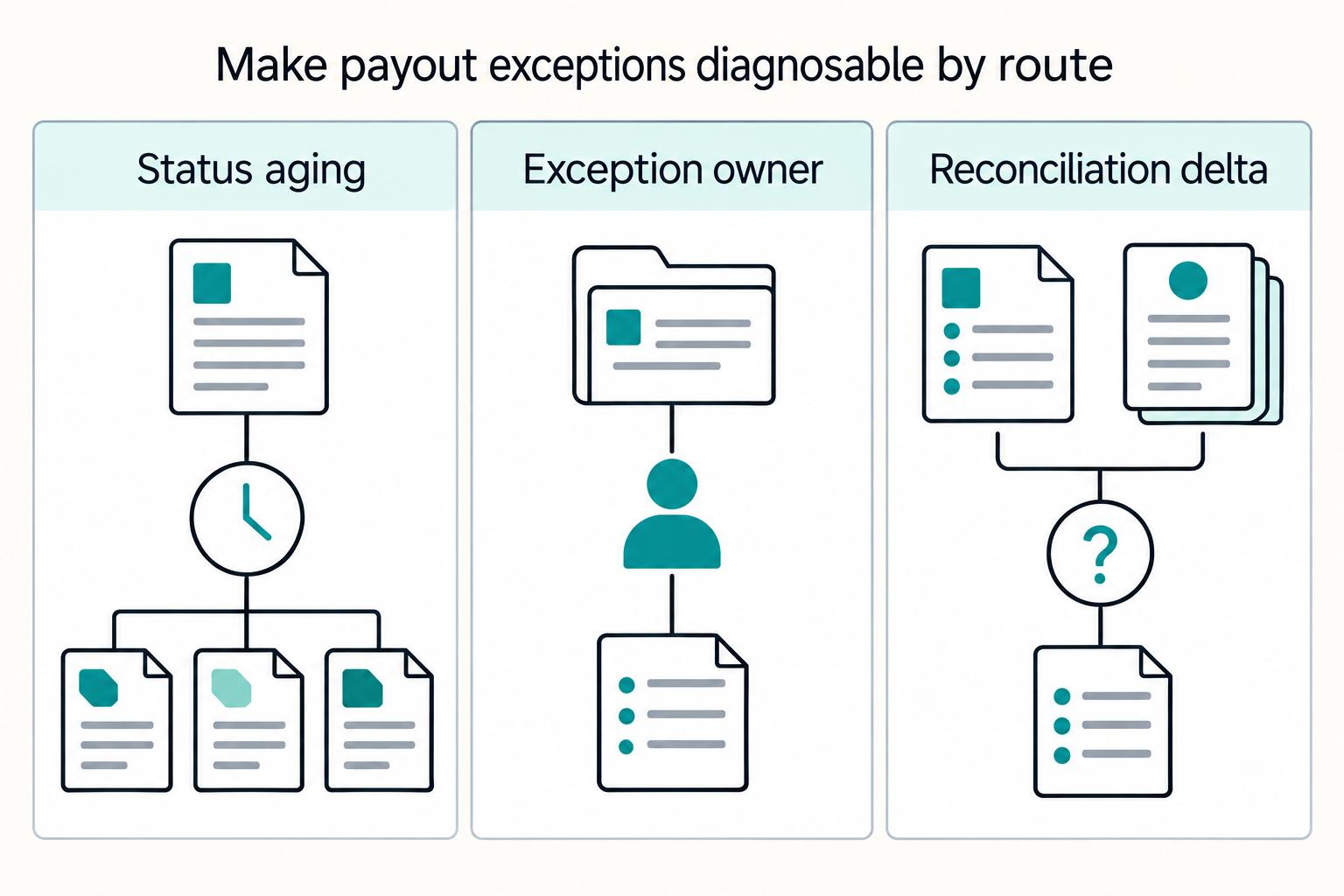
Once retries are safe, you need operating checkpoints that catch trouble early. Set explicit checkpoints for status aging, exception queues, and reconciliation deltas by route or corridor based on your own settlement behavior.
Cross-border routes need tighter visibility, not looser assumptions. BIS says the end-2027 G20 targets are unlikely to be fully met on time, and the FSB roadmap still centers on cost, speed, access, and transparency gaps.
| Checkpoint | What to monitor | Red flag |
|---|---|---|
| Status aging | Payouts stuck in pending, in transit, or review by route | Aging rises in one corridor while volume stays flat |
| Exception queue | Failed payouts, returned transfers, missing payout data, unsupported-border errors | No named owner or no defined re-drive vs cancel path |
| Reconciliation delta | Gap between expected internal settlement and provider payout-batch outcome | Repeating corridor-specific deltas across batches |
Use payout-batch reconciliation as the operating model. Reconcile the transactions included in each payout batch, and review failed payouts separately.
Choose routing based on recoverability, not only approval#
Route choice should not be driven by front-end approval alone. Compare routes on four criteria together: observed success rates, settlement consistency, operational overhead, and failure-recovery speed. Provider optimization tools can inform decisions, but Stripe is explicit that outcomes are not guaranteed.
Prefer routes that are easier to diagnose and recover when payouts fail or return, not just routes with stronger front-end approval signals. For cross-border settlement, also favor explicit failure behavior. Stripe documents unsupported border or balance transfers return an error.
Launch only when finance can tie payout requests to settlement batches and operations can explain duplicates, retries, failures, and re-drives from the audit trail alone.
Build an evidence pack before market entry decisions#
Market entry should be treated as a proof decision, not a momentum decision. As an internal gate, require a one-page evidence pack for each target market, and do not approve entry unless it shows verifiable rail coverage, localized compliance obligations, expected payout-orchestration complexity, and a named operational owner.
What the pack must prove#
Start with rail reality before product assumptions. Use market-level evidence such as the World Bank's Global Payment Systems Survey (GPSS), which collects input from central banks and monetary authorities. Fast payments reach households and businesses in over 100 jurisdictions, but that does not confirm your corridor, participant type, or use case is workable.
Document three rail checks for each market:
- which rails are available for your use case
- who can access those rails, including non-bank participation where relevant
- whether cross-border execution depends on interoperability, local legal and supervisory frameworks, or data and message-standard constraints
On compliance, anchor to the FATF Recommendations and the risk-based approach, then localize to the jurisdiction. Capture the market's KYC and AML obligations for your model, including any multi-party verification requirements where applicable, plus explicit unknowns. If ownership is unclear for onboarding exceptions, held payouts, or enhanced review, the market is not entry-ready.
Set a minimum proof standard for trend claims#
Use trend claims only when method quality is visible. At minimum, require disclosed scope, geography, timing, and sample or interview detail. If method details are missing, treat the claim as directional, not planning-grade.
| Evidence tier | Minimum standard |
|---|---|
| Planning-grade | Primary regulator or central bank material, provider documentation, or research with disclosed methodology |
| Directional only | Headlines, vendor trend roundups, or articles without clear scope and sampling details |
Write unknowns and revisit triggers directly into the pack:
- stablecoins: revisit when relevant regulatory rules change, since adoption is regulatory-path dependent
- AML assumptions: revisit when FATF standards change, including the 25 February 2025 amendments and the Recommendations last updated in October 2025
- real-time rails: revisit when non-bank access, use-case breadth, or cross-border links change
- AI-enabled payments: keep off the approval path unless you can map the jurisdiction-specific compliance surface and assign a clear operational owner
Before approving a new corridor, map each evidence-pack requirement to concrete integration and ops checks in Gruv Docs.
Execute a 90-day rollout with hard checkpoints#
Use the evidence pack to earn a pilot, not to justify a broad launch. A 90-day cadence can keep execution evidence-driven: baseline first, run one limited pilot second, and expand only if the same metrics hold under real usage.
Payment changes can look strong in planning and still fail in exception handling. Small-scale releases surface real user behavior and operational pain points early, so carry the same proof standard from the previous section into rollout.
Days 0 to 30#
Start by baselining the current state with one consistent metric set, and choose one primary bottleneck per market. Do not try to optimize settlement speed, checkout conversion, and compliance friction at the same time.
For most marketplace operators, track:
- payout orchestration reliability
- compliance exception rate, including held payouts and manual reviews
- support burden tied to payment events
Match the baseline to the bottleneck. If liquidity is the issue, center settlement timing and payout failures. If conversion is the issue, center checkout completion and post-payment support contacts. If compliance drag is the issue, track incomplete KYC states, review time, and payout holds.
Before pilot launch, recheck market-specific rail and rule timing. For euro instant payments, the EU Instant Payments Regulation was adopted on 13 March 2024, with euro area deadlines of 9 January 2025 for receiving and 9 October 2025 for sending. Do not assume all markets or entity types follow one timeline.
Days 31 to 60#
Run one controlled pilot, closer to a private beta than a public rollout. A limited user group gives cleaner signal and preserves rollback options if new failure modes appear.
Choose the pilot based on the bottleneck. Real-time rails can fit settlement issues, and embedded checkout can fit conversion issues, but neither is universally right. Define success, failure, and rollback before launch, and keep the legacy path running until the new path is proven in live conditions.
Set explicit readiness gates. FedNow launch preparation used formal certification and then production validation before go-live. Apply the same discipline with your team and providers: passed test cases, confirmed reconciliation, trained support, and named owners for known exceptions. If speed improves but compliance handling load rises beyond team capacity, pause instead of scaling.
Days 61 to 90#
Expand only if checkpoint metrics stay stable after the first real-usage wave. The gate is not feature performance alone. Scale only when payout orchestration remains reliable, compliance exceptions stay manageable, and support staff can absorb added users and edge cases.
Use global targets as context, not proof of local readiness. Targets such as 75% of retail cross-border payments within one hour and average cost at 1%, with no corridor above 3% by end-2027, are useful benchmarks. They do not confirm your corridor is ready now, and global progress is not yet on track to meet all end-2027 goals.
Close each market with a short decision memo that states:
- what scales now
- what pauses and why
- what stays on the watchlist
- the next revisit trigger
- the named operational owner
Conclusion#
In 2026, the practical move is to sequence payment infrastructure changes by market reality, not trend visibility. A change should move up your roadmap only if it improves settlement reliability, compliance clarity, or measurable conversion in a market you actually plan to serve.
That discipline matters because infrastructure still varies by jurisdiction. BIS reports fast-payment adoption is rising, while approaches still differ, and designing, implementing, and operating an FPS remains complex. So when you evaluate real-time rails, stablecoins, BNPL, or embedded checkout, ask a harder question: does this remove your current bottleneck in this corridor without creating a worse operations burden?
Keep the country lens front and center. The IMF and World Bank position cross-border payments work at the country and project level, which is the right posture for marketplace rollout decisions. If rail coverage, compliance execution, and reconciliation paths are clear, you may have a case to test. If those basics are still uncertain, front-end feature expansion should wait.
Stablecoins are the clearest case for corridor-by-corridor sequencing. FATF's 26 June 2025 update warns that mass stablecoin or broader virtual-asset adoption can amplify illicit-finance risk when standards are unevenly implemented. FATF also notes that 99 jurisdictions have passed or are in the process of passing Travel Rule legislation, which signals progress but not uniform execution.
Apply the same logic to faster rails. U.S. momentum is real, with FedNow reporting more than 1,400 participants and pointing to stronger small-business and online-marketplace use cases over the next 12 to 18 months. But that is still a forecast window, not proof that your provider stack and payout operations are launch-ready.
Your next move should stay small and evidence-led:
- Pick one target market or corridor.
- Complete the evidence pack before approval: rail coverage, onboarding and compliance states, AML obligations, payout hold reasons, reconciliation path, and escalation owners.
- Run one pilot with explicit go or no-go checkpoints for payout traceability, exception handling, finance-confirmed reconciliation, and support impact.
Use accountability, not hype, as the benchmark. Public cross-border progress is tracked against 11 quantitative targets. Your rollout should be held to similarly measurable checkpoints before you scale.
If your pilot confirms payout reliability is the bottleneck, use Gruv Payouts as a reference point for routing, status visibility, and batch operations.
Frequently Asked Questions
What payment trends matter most for marketplace operators in 2026?
Focus on trends that change operations before checkout polish. Fast payments matter where immediate funds availability and 24/7 operation can improve payout timing and seller liquidity. Stablecoins fit only in corridors where settlement friction is real and compliance is workable, so many operators should fix payout orchestration and settlement reliability before adding more front-end payment options.
Are stablecoins and agentic commerce ready for every platform?
No. Stablecoins face uneven oversight across jurisdictions, so rollout should be corridor by corridor rather than a default. Apply the same caution to agentic payment flows: the Bank of England's 2024 UK financial-services survey found 75% of firms using AI, but only 2% of use cases were fully autonomous.
What are the table-stakes capabilities before entering a new market?
You need documented rail coverage by country and provider, a workable multi-party KYC path, AML controls aligned to local requirements, cross-border settlement handling, and split payouts that reconcile cleanly. Keep a market-entry pack with the rail matrix, onboarding states, payout hold reasons, and named escalation owners. FATF provides a common framework, but implementation is not identical across countries.
How should teams prioritize AI-enabled payments, BNPL, tokenisation, and real-time rails?
Prioritize by the measured bottleneck, not by trend visibility. If seller liquidity and settlement timing are the problem, real-time rails are often the first lever to test. If checkout abandonment is the problem, test tokenisation or BNPL first, with BNPL treated as an operating and compliance decision, and keep AI-enabled payments off the approval path unless the compliance surface and ownership are clear.
How much should we trust market-size headlines?
Use market-size headlines as context, not planning-grade proof. Test them against your corridor, user mix, and operating constraints, because FSB reporting says KPI improvement has been slight and full end-2027 goals are unlikely. If methodology, geography, payment type, and compliance burden are unclear, the headline should not drive the roadmap.
What is the biggest execution mistake operators make?
The biggest mistake is launching new rails or checkout features before compliance gates and reconciliation are production-ready. The minimum bar is clear test-case passes, traceable payout decisions, managed exception queues, and finance-confirmed split-payout matching without manual forensics. Teams should also account for phased legal timing before rollout.
Researched and edited by the Gruv editorial team. Gruv builds cross-border billing, payouts, and finance-operations software for global businesses.
Sources
- bis.org/cpmi/cross_border.htmtrusted
- bis.org/publ/qtrpdf/r_qt2003c.pdftrusted
- consumerfinance.gov/about-us/newsroom/cfpb-takes-action-to-ensur...trusted
- consumerfinance.gov/ask-cfpb/what-is-a-buy-now-pay-later-bnpl-lo...trusted
- ecfr.gov/current/title-31/subtitle-B/chapter-X/part-1...trusted
- ecfr.gov/current/title-31/subtitle-B/chapter-X/part-1022trusted
- federalregister.gov/documents/2024/05/31/2024-11800/truth-in-len...trusted
- federalreserve.gov/paymentsystems/fednow_about.htmtrusted
Educational content only. Not legal, tax, or financial advice.
Related Posts

The Freelance Payment Penalty: A Modeled Audit of Platform Fees, FX Spreads, and Payout Delays
The money rarely disappears through a single, easy-to-spot fee. The real loss is stacked. A marketplace takes its commission, a processor adds a charge for international cards, a bank or payment company converts the currency at a spread, a platform holds the funds before release, and a wire sheds a little to intermediaries on the way in. Each layer looks defensible on its own, but the worker feels the combined result as a smaller deposit and a later payday.

How to Respond to a Subpoena for Business Records
Move fast, but do not produce records on instinct. If you need to **respond to a subpoena for business records**, your immediate job is to control deadlines, preserve records, and make any later production defensible.

A US Expat's Guide to Investing in UCITS ETFs to Avoid PFIC Issues
The real problem is a two-system conflict. U.S. tax treatment can punish the wrong fund choice, while local product-access constraints can block the funds you want to buy in the first place. For **us expat ucits etfs**, the practical question is not "Which product is best?" It is "What can I access, report, and keep doing every year without guessing?" Use this four-part filter before any trade: