
Quick Answer
Yes, accepting crypto payments can work for freelancers when terms are fixed before invoicing and enforced every time. Choose the rail first, define who carries volatility exposure, and set one clear paid-confirmation standard. Then verify exact asset and network details in writing and log settlement proof immediately. The main benefit is potential fee and speed improvement in the right setup, while the main risks are irreversible transfer mistakes and added tax-reporting review. Record service receipt income and later disposal separately under applicable rules.
How to Decide Whether Crypto Fits Your Payment Workflow#
Accepting crypto payments works when you set the terms before you send the invoice: how payment is received, which asset is sent, and your settlement policy. If those terms are vague, you are taking on avoidable cash-flow and tax risk.
In practice, this is not one decision. It is three:
- Receipt method: processor or gateway, or direct wallet transfer.
- Asset choice: the specific asset the client will send.
- Settlement policy: whether you convert on receipt or hold.
The tradeoffs come from that combination, not from the label "crypto."
When the upside is real#
The upside is real when crypto solves a specific payment problem and you can clearly explain how funds turn into usable cash.
- Proceed when total cost savings are verified. Compare current provider, network, conversion and withdrawal fees with the alternative payment route for the actual amount.
- Proceed when speed helps operations. Some transactions can process in a matter of minutes. Treat that as possible, not guaranteed, and test before you depend on it.
- Proceed when finality and recovery fit. Apply the selected network’s confirmation policy and provider refund/hold terms; a finalized on-chain transfer usually cannot be unilaterally undone.
- Proceed only if wallet readiness is already in place. You need a compatible wallet, or a processor that handles receipt, before you invoice this way.
Where teams get hurt#
Most problems start with vague terms and missing controls. Define policy before accepting a client's preferred asset.
- Pause if value can move before conversion. Price volatility can change transaction value between purchase and payment approval.
- Pause if address or network instructions are unclear. Irreversible payments make routing errors costly to fix.
- Pause if records are weak. Service receipt income and later asset disposal can have different tax consequences. Preserve receipt valuation and disposal records under the applicable jurisdiction’s rules.
- Pause if wallet setup is incomplete. You need a compatible wallet, or a processor that can receive on your behalf, before invoicing this way.
Decision checklist and what you control#
| Decision area | What to define before invoicing |
|---|---|
| Fee tradeoff | Confirm provider fees, network costs, and conversion costs for this payment. |
| Settlement finality | Confirm actual receipt and the selected network/provider finality policy |
| Volatility exposure | Decide whether you convert on receipt or hold, since value can move before payment approval. |
| Wallet readiness | Verify a compatible wallet is ready, or use a processor that handles receipt. |
| Tax handling | Capture receipt valuation and later disposal records; apply the relevant jurisdiction’s income and gain/loss rules |
For most invoice-based freelancers, the practical starting point is the setup that minimizes manual handling and keeps settlement rules explicit. Put the asset, wallet details, and paid trigger on the invoice so both sides are working from the same terms.
That is the lens for the rest of this guide: not whether crypto is "good" or "bad," but whether your setup protects cash flow, records, and margin. If you want the risk-first version of that decision, see Freelance Crypto Payments That Protect Cashflow and Reduce Disputes.
How the payment workflow fits together#
This guide follows the order you actually need in practice. Start where you are blocked, then keep moving until you have a repeatable payment protocol. The article is organized around execution, not debate.
First, you make five up-front decisions. Then you choose the rail. Then you map risks before you spend energy on upside. After that, you lock invoice mechanics, records, and hard decline rules. The final checklist is the piece you keep using.
| # | Section | What It Answers |
|---|---|---|
| 1 | A Client Wants to Pay You in ETH. Here Are the Five Decisions You Need to Make First. | Which decisions to lock before sending payment instructions |
| 2 | What Does "Accepting Crypto" Actually Mean? | The operating difference between gateway, direct wallet, and stablecoin rails |
| 3 | What Are the Real Risks Before You See the Benefits? | The downside inventory to map before rollout |
| 4 | Stablecoin or Volatile Asset: The Decision That Changes Everything | How asset type changes risk and policy |
| 5 | The Genuine Upsides for Invoice-Based Freelancers | Where the upside is real for service invoices |
| 6 | How Do You Invoice a Client in Crypto? | Invoice fields and execution standards |
| 7 | What Records Do You Need to Keep When You Accept Crypto Payments? | What to capture for reconciliation and tax prep |
| 8 | When Should You Not Accept Crypto? | Five conditions where declining is the right move |
| 9 | Frequently Asked Questions | Fast answers to common blockers |
| 10 | Your Pre-Payment Checklist: A Reusable Framework for Every Crypto Invoice | A reusable control list for each invoice |
Two sequencing choices matter. First, risk comes before benefits. That is deliberate. If you cannot define exposure, conversion timing, and record standards, upside claims are noise.
Second, gateway and self-managed flows are handled separately. A gateway can route payment through invoice tooling or a hosted checkout and may offer auto-conversion, while self-managed wallet flows usually leave more of the operational process with you. Both can work, but the right choice depends on your process discipline, not optimism.
Use the structure as a decision map. If you are unsure whether to say yes at all, start with Section 3. If you already said yes and need clean execution, jump to Section 6 and Section 7 first.
A Client Wants to Pay You in ETH. Here Are the Five Decisions You Need to Make First.#
Do not answer an ETH payment request with a casual yes. Treat it as five gates with pass or fail criteria. Each one affects invoice handling, reconciliation quality, or policy readiness.
Start by making the request precise. ETH is the asset. The payment rail is how funds move, for example through a gateway flow or direct wallet transfer. The custody model is who controls the receiving wallet and records after settlement. Keep those as separate decisions, because blending them creates avoidable errors.
ETH is Ethereum’s native asset. For direct transfer, confirm compatible wallet access and the exact supported network on both sides. A gateway may handle receiving custody or conversion instead. Wallet-address format alone does not prove that the chosen asset/network is supported.
The five gates#
| Gate | Pass only if | Fail if |
|---|---|---|
| Asset gate | You are willing to receive ETH specifically and define your conversion plan before you accept | You cannot say whether you will convert or hold |
| Rail gate | The payment path is explicit before invoicing: gateway flow or direct wallet transfer | The rail is undefined |
| Custody gate | One owner is clearly accountable for wallet access, backups, and record retention | Ownership or access control is unclear |
| Terms gate | The invoice states the fiat amount owed, the asset, the network, the receiving address or payment link, and what event counts as paid on your side | Any of those items are missing |
| Evidence gate | At settlement, you can capture the invoice number, client name, asset, amount received, wallet or gateway reference, transaction hash where available, and timestamp | You cannot capture that set immediately |
- Asset gate
Pass only if you are willing to receive ETH specifically, not just "crypto" in general. If your priority is protecting invoice value in fiat terms, define your conversion plan before you accept. If you cannot say whether you will convert or hold, fail this gate.
- Rail gate
Pass only if the payment path is explicit before invoicing: gateway flow or direct wallet transfer. If the rail is undefined, your payment terms and proof trail are undefined too.
- Custody gate
Pass only if one owner is clearly accountable for wallet access, backups, and record retention. If ownership or access control is unclear, do not proceed.
- Terms gate
Pass only if the invoice states the fiat amount owed, the asset, the network, the receiving address or payment link, and what event counts as paid on your side. If any of those are missing, this gate fails.
- Evidence gate
Pass only if, at settlement, you can capture the invoice number, client name, asset, amount received, wallet or gateway reference, transaction hash where available, and timestamp. If you cannot capture that set immediately, the workflow is not production-ready.
Execution rule#
Before you send payment instructions, send a short confirmation note. Ask the client to confirm the asset, network, rail, and exact wallet or hosted link they will use. Then verify that the address on the invoice matches the address in your receiving tool before any funds are sent.
If you want a tighter template for terms and documentation controls, use How to Get Paid in Crypto as a Freelancer (and Manage the Risks) as a companion.
Related reading: The Best Ways for Freelancers to Accept Payments on a Website.
What Does "Accepting Crypto" Actually Mean?#
"Accepting crypto" is an operating-model decision, not just an asset choice. You are choosing the payment rail and deciding how custody and conversion to fiat or another asset are handled.
Two teams can both say they accept crypto and still run very different risk. One might use a third-party gateway with auto-conversion to fiat. Another might receive assets directly to a wallet they control and decide later whether to hold or convert.
The four terms to separate before you invoice#
Before you send payment instructions, separate these four labels and write them down:
- Payment rail: the payment path, usually a gateway or direct wallet transfer. A crypto payment gateway is a third-party processor for digital-asset transactions.
- Asset type: what is being sent, for example ETH, BTC, or a stablecoin. This affects price-movement risk during the payment flow.
- Custody owner: who controls wallet or account access, backups, permissions, and records.
- Conversion owner: who decides whether and when crypto is converted into fiat.
Decision table#
This is a make-or-buy decision. Choose based on your technical capacity, compliance maturity, and expected transaction volume.
| Model | Best fit use case | Main risk owner | Required controls before first invoice |
|---|---|---|---|
| Crypto payment gateway with auto-conversion to fiat | You want settlement to bank or virtual account without holding volatile assets | You still own invoice terms, reconciliation, and tax implications. The provider adds counterparty risk. | Define paid event, fee allocation, exportable records, and a provider fallback plan |
| Direct wallet acceptance (for example BTC/ETH) | You want more control and can run custody and conversion operations | You own custody risk and price movement until conversion | Written confirmation of asset, network, receiving address, conversion policy, and settlement records |
| Stablecoin transfer (gateway or direct wallet) | You want crypto rails with potentially lower volatility than typical volatile assets | You still own settlement checks and custody or provider risk based on setup | Confirm exact stablecoin plus network, hold vs convert policy, and paid-event definition |
Gateway acceptance is outsourced processing, not outsourced responsibility#
A gateway can reduce implementation effort and auto-convert to fiat, so you do not have to hold volatile assets. But it does not make your policy decisions for you.
You still need clear rules for the paid event, fee handling, record retention, and exception review. You also need to define which compliance duties sit with the provider and which stay with you, for example onboarding and transaction controls. If third parties handle client or payment data, apply the same contract controls you use elsewhere. Gruv's guide to Using a Data Processing Agreement (DPA) with Subcontractors can be a starting point.
Before your first live invoice, confirm:
- Paid-event rule: when the invoice is treated as paid.
- Fee-allocation rule: who covers shortfalls from network or processor deductions.
- Exportable-records rule: whether you can export invoice mapping, timestamps, asset amount, settlement details, and references.
- Counterparty fallback plan: investigate unavailable providers and resolve any original payment outcome before requesting a replacement or switching route.
Separate settlement risk from custody risk on direct-wallet and stablecoin rails#
Direct wallet transfers give you more control, which also means more operational burden. Check settlement risk and custody risk separately. Settlement risk is whether the client sends the correct asset on the correct network under your paid-event rule. Custody risk is who controls wallet access, backups, and records after funds arrive.
Stablecoins can reduce price movement relative to more volatile assets, but they do not remove the need for controls. In both direct-wallet and stablecoin flows, require written confirmation of the asset, network, and conversion policy before you send payment instructions.
What Are the Real Risks Before You See the Benefits?#
Start with control, not upside. If you cannot reliably map a single invoice from payment instructions to a transaction record to your books, do not proceed.
The core question is operational: can your process absorb mistakes, price movement, and reporting work without hurting cash flow?
Triage risk before you evaluate benefits#
Some risks are mostly controllable through process. Others are exposure risks you can only reduce, not remove.
| Risk area | Control level | First action |
|---|---|---|
| Payment instructions, invoice terms, recordkeeping | High | Standardize asset, wallet public address, paid-event rule, and evidence capture before the first live invoice |
| Conversion timing | High | Decide in advance whether you convert immediately or hold, and who owns that decision |
| Asset price exposure | Partial | Reduce exposure with faster conversion or provider-settled acceptance when near-term cash needs are strict |
| Provider or wallet exposure | Partial | Decide in advance whether to accept direct crypto or use provider-settled payout in your default currency |
That distinction matters. Incorrect destination addresses or unclear paid-event rules are preventable operating errors. Price movement and provider-related exposure can still happen even with clean documentation.
Volatility and payment finality need explicit stop rules#
Treat volatility as planned risk, not accidental risk. A cryptocurrency's value can change constantly and dramatically, so a fixed-price invoice can lose value before conversion. If you need the funds for near-term obligations, require immediate conversion or use a provider that settles in your default currency.
A confirmed on-chain transfer usually has no card-style chargeback or unilateral undo. Distinguish pending inclusion from your network’s confirmation/finality policy. Custodians, token issuers and gateways can have separate holds or refund processes; a refund is often a new transfer. Define recovery for the selected setup rather than assuming every crypto payment has identical finality.
Use simple internal stop rules before you issue instructions:
- Pause if the client has not confirmed the agreed asset and receiving wallet public address in writing.
- Pause if the receiving wallet public address changes after instructions are issued.
- Pause if invoice terms and payment-thread terms do not match.
- Pause until corrected if key payment details are still unresolved.
Keep one evidence bundle per invoice: invoice ID, invoice currency, agreed asset, receiving wallet public address, written confirmation, transaction amount, and wallet details where available. Blockchain records can include transaction amount plus sender and recipient wallet addresses, which helps reconciliation, but transaction and wallet data can sometimes identify the people involved.
Stablecoin risk is still risk, not no-risk exposure#
Stablecoins are not a guarantee. If timing or certainty matters, convert promptly under a predefined rule instead of assuming stable value. Also remember that holdings in online wallets do not have the same government insurance protection as U.S. bank deposits.
Tax and reporting risk starts with records, not assumptions#
Tax and reporting obligations depend on jurisdiction, entity setup, account location, and whether you hold or convert. Do not hardcode stale thresholds into policy. Keep any threshold field pending until it is verified with a qualified advisor before filing cycles.
What you can control now is the audit trail. Keep records that tie invoice to transaction to accounting entry, with exportable data from gateways or exchanges when you use them. Risk gate: if invoice-to-transaction-to-books mapping is not reliable, do not proceed.
For a step-by-step walkthrough, see The Pros and Cons of a C-Corp for a Freelance Business.
Stablecoin or Volatile Asset: The Decision That Changes Everything#
Make this call before you send the invoice. Once terms are drafted, it is no longer just a client preference. It is your policy choice for price exposure, conversion timing, and settlement clarity.
A stablecoin aims to track a reference value, such as a fiat currency, but its reserve, redemption and issuer arrangements vary. It can depeg or face operational restrictions. BTC and ETH have market-price exposure without that peg. Convert-on-receipt uses the asset as a transport choice; holding after receipt adds a treasury decision and does not remove receipt-time accounting or tax duties.
If this policy is not written, pause and write it first. Use a payment-terms check from Freelance Crypto Payments That Protect Cashflow and Reduce Disputes before accepting crypto payments at scale.
Use a yes-or-no filter, not a preference debate#
| Decision question | If yes | If no |
|---|---|---|
| Do you need value close to invoice currency on receipt? | Default to stablecoin or convert on receipt | You may tolerate volatile-asset exposure |
| Can you reliably convert on receipt with your wallet, exchange, or provider? | A volatile asset can work as a transport rail | Do not use a volatile asset for fixed-price invoices tied to near-term cash needs |
| Is the invoice denominated in fiat? | Define rate timing and what event counts as paid | If invoicing in crypto units, both sides accept unit-price exposure |
| Can you reconcile invoice, transaction record, and books without guesswork? | Proceed under the chosen policy | Decline until evidence capture is reliable |
Default action: if cash-flow certainty matters, choose lower-volatility rails or immediate conversion.
Stablecoin path#
For many invoice-based teams, stablecoins are the cleaner path because they aim for lower volatility while preserving crypto-rail convenience. But this is still not a risk-free route. You still carry technology-failure risk, possible value instability, and issuer-related risk.
Check the actual asset, issuer/provider terms and applicable rules for your jurisdiction. A general label such as stablecoin does not establish redemption eligibility, regulatory status or protected bank-deposit treatment.
Put the specifics in writing: exact asset, exact network, who pays transaction fees, and the valid receiving address for that invoice. Keep the invoice evidence bundle plus the conversion record when conversion happens on receipt.
Volatile-asset path#
Once you accept a volatile crypto asset, split the path immediately:
- Immediate conversion: treat the asset as a transport rail and minimize hold time.
- Intentional hold: treat this as a treasury decision layered on top of a payment decision.
For immediate conversion, make two points unambiguous: what event marks the invoice as paid, and which timestamp or rate reference controls the fiat-to-crypto calculation.
For intentional hold, proceed only if the business can absorb post-receipt price movement and the added reconciliation load. Include the transaction record, rate reference used, settlement timestamp, and accounting entry showing whether funds were converted or held.
The Genuine Upsides for Invoice-Based Freelancers#
The upside is most reliable when your payment policy is written before you invoice. Treat crypto as a payment rail, not a speculation choice. Keep pricing in fiat, define the asset and network, set the conversion path, and document what counts as paid.
Use this as a pre-invoice decision aid, not a guarantee:
| Payment rail | Cost check before invoice | Settlement check before promising a due date |
|---|---|---|
| Credit card processor | Confirm the current processor fee range with the processor before invoicing | Confirm the current settlement window with the processor before promising a due date |
| International wire | Confirm the current bank fee and FX cost with the bank before invoicing | Confirm the current settlement window with the bank before promising a due date |
| Crypto rail or gateway | Confirm the current network fee, provider fee, and conversion spread with the provider before invoicing | Confirm the current settlement window with the provider before promising a due date |
Encode the rail decision in your invoice terms and records before funds move. State the asset, network, receiving address, rate timing, and paid-event definition, then keep matching evidence with this payment-terms check.
Margin retention: Price in an agreed invoice currency and compare total landed value with your usual rails. Specify the rate source and quote expiry instead of assuming invoice-time equivalence holds until payment. Count network fees, provider spread, withdrawal charges and conversion delays before claiming savings.
Authorization-path shift: Peer-to-peer settlement can reduce dependence on bank-led authorization steps because the client sends funds from their wallet to your wallet address. It holds when destination-address checks and invoice-to-transaction mapping are exact. It weakens when address or network validation, or record capture, is inconsistent.
Cross-border continuity: Direct network transfer can support payment continuity outside bank-hour constraints, including 24/7 availability in the cited model. It holds when both sides can execute the chosen rail cleanly. It weakens when wallet security or transaction controls are weak, or when clients cannot complete wallet-based payment steps.
Buyer fit: Wallet-based payment can suit a client who already uses the supported asset and network. Confirm that behavior and the finance workflow directly; an unspecified example of crypto-holding companies is not proof of a benefit for your customer.
Need the full breakdown? Read The Best Crypto Wallets for Freelancers.
How Do You Invoice a Client in Crypto?#
A usable crypto invoice should work as a control document. Before you send it, a client finance contact should be able to follow every payment instruction without interpretation.
A six-field checklist to standardize#
Use these six fields as a practical checklist on your invoice template, and verify each one before sending:
| Field | What to include | Note |
|---|---|---|
| Base amount in fiat | The commercial amount owed in your working currency first | This is the anchor for scope, value, and conversion checks |
| Accepted asset and network | The exact asset and network, not just "crypto" | If you accept USDT on one network only, say so directly |
| Exchange-rate policy | Rate source, timing event, and fallback | Example timing events: invoice issue, payment initiation, or receipt |
| Destination details | Either a gateway payment link or the exact receiving address | Treat the address or payment page as the controlling instruction |
| Paid confirmation rule | The exact event that marks the invoice paid | "Sent" is not a paid event |
| Invoice ID and settlement mapping key | A clear invoice ID and the same reference in payment records | If your provider supports it, label addresses by project, client, or channel |
- Base amount in fiat
List the commercial amount owed in your working currency first. This is the anchor for scope, value, and conversion checks.
- Accepted asset and network
Specify the exact asset and network, not just "crypto." If you accept USDT on one network only, say so directly.
- Exchange-rate policy
State rate source, timing event, quote expiry and delayed-payment review in advance. Record invoice issue, initiation and receipt separately. If a transfer is delayed, determine its original outcome before a replacement or route switch; do not reinterpret an agreed payment unilaterally or ask the client to pay twice while receipt remains uncertain.
- Destination details
Provide either a gateway payment link or the exact receiving address. If your flow also shows a wallet address and QR code, treat the address or payment page as the controlling instruction.
- Paid confirmation rule
Define the exact event that marks the invoice paid. "Sent" is not a paid event.
- Invoice ID and settlement mapping key
Assign a clear invoice ID and use the same reference in payment records. If your provider supports labeling addresses by project, client, or channel, use it so reconciliation stays deterministic.
Also show payment terms directly on the invoice, for example Due on Receipt, Net 15, or Net 30.
A quick acceptance check#
Before sending, verify that a client finance contact can answer all four points without follow-up:
- exact amount owed in fiat
- exact asset and network to use
- exact destination for the funds
- exact event that marks the invoice paid
If any answer needs interpretation, revise the invoice before funds move.
Write the rate rule and paid rule like policies#
Exchange-rate handling should be explicit. Non-stable assets can move significantly within hours, so avoid vague "fair market rate" language. State the rate source, timing event, and delayed-settlement fallback.
Set paid-confirmation evidence by flow:
- Gateway flow: store invoice, documented provider status history and completed-payment evidence under that flow’s semantics, amount credited, conversion details and any later bank payout record. Do not assume every gateway uses the same on-chain confirmation trigger.
- Direct-wallet flow: store the invoice, receiving address used, confirmed on-chain payment record, asset amount, timestamp, and internal mapping note to the invoice ID.
For the mapping step and record detail, use this records guide.
Choose one primary collection method#
Pick one primary method and document exceptions. For recurring invoice volume, a crypto payment gateway can be a practical default. It can convert to fiat, support bank withdrawal, and in supported flows give you a clear pending-to-completed status checkpoint.
Direct-wallet acceptance can suit clients already operating compatible wallets, with greater custody, confirmation and refund responsibility on your side. Apply the agreed network-finality policy and record a refund as a distinct movement rather than assuming the original transfer can be canceled.
What Records Do You Need to Keep When You Accept Crypto Payments?#
Capture evidence at settlement, not later during reconciliation. If you wait until month end, paid dates, conversion values, and invoice mappings are harder to verify.
Treat records as a payment control, not just bookkeeping. Each payment should create a receipt packet that someone else can review without asking what happened.
The minimum receipt packet per payment#
Use one packet per payment event, even if multiple payments apply to one invoice.
| Record field | What it should capture |
|---|---|
| Paid-rule timestamp | The exact date and time your documented paid rule is met, not invoice issue time and not later withdrawal time |
| Asset and amount received | The asset and quantity actually received or credited at settlement |
| Transaction reference | On-chain transaction hash for direct-wallet payments, or provider payment reference for gateway flows |
| Sender or payer reference | Sender wallet address when available, or the customer or payment reference from the gateway |
| Invoice mapping | The exact invoice ID this payment satisfies, marked as full, partial, or one of multiple transfers |
| Fiat valuation records | Commercial invoice quote and receipt-time accounting/tax valuation, with source/timestamps; U.S. tax FMV can differ from the agreed commercial rate |
| Conversion record | If conversion happens, record conversion date and time, asset sold, amount converted, fiat proceeds, and payout or destination account reference |
Keep these definitions strict:
- Paid-rule timestamp: when your paid condition is actually met.
- Invoice mapping: the key that ties payment to the invoice ID.
- Conversion record: a separate event unless your provider records receipt and conversion as one event.
Align these fields with your invoicing rules so your evidence matches your invoice terms. For a field-by-field mapping example, use this records guide.
Evidence hierarchy for gateway vs direct wallet#
A gateway can simplify hosted payment, conversion and bank withdrawal where supported. Compare its status semantics and exports with direct-wallet evidence; neither model removes invoice reconciliation or guarantees immediate access to fiat.
- Gateway path (core artifacts)
Store: invoice, hosted payment or invoice reference, provider status history, amount credited, conversion details if any, payout or bank-settlement reference, and export row.
- Direct wallet path (core artifacts to adapt as needed)
Store: invoice, receiving address used, transaction hash, confirmed on-chain record, asset amount, paid-rule timestamp, and invoice-mapping note.
- Provider account setup artifacts
Store: onboarding and verification records and provider terms tied to processing, settlement timing, and compliance or risk.
Store both rails in one structure: one folder per invoice, one subfolder per payment event.
Separate receipt income from later disposal records#
For U.S. federal tax purposes, a self-employed person receiving digital assets for services generally includes their fair market value in U.S. dollars at receipt in income; self-employment tax can also apply. For an arm’s-length service receipt, that value establishes the asset’s tax basis.
Record the receipt-time USD fair market value and its valuation source separately from the commercial invoice quote. If you later sell, exchange or spend the asset, compare disposal proceeds/value with basis to determine gain or loss under the applicable rules; capital treatment depends on whether it is a capital asset.
Retain lot, receipt and disposal records so tax preparation can distinguish service income, conversion proceeds, fees and later gain/loss. Other jurisdictions and special facts require their applicable rules rather than a U.S. default.
Make exports tax-ready with enforceable data checks#
Use one row per payment event with a stable column schema and one consistent paid-rule timestamp definition.
- One row = one payment event and keep partial payments separate.
- Stable column names all year.
- Consistent paid-rule timestamp logic across all rows.
- No row without mapping key such as invoice ID or documented exception.
- Conversion rows must point back to the original payment event.
If you enforce these checks at settlement time, year-end becomes review instead of reconstruction.
When Should You Not Accept Crypto?#
Treat this as a hard policy gate, not a judgment call. If any stop below is true, decline or pause until it is resolved in writing. That is how you protect margin and avoid preventable payment errors before funds move.
The five hard stops#
| Hard stop | Proceed only if |
|---|---|
| Fixed-price invoice, volatile asset, no conversion plan | Value protection is explicit before payment, usually a stablecoin you agree to accept or a gateway flow that settles to fiat |
| Any ambiguity about asset, network, or destination details | You have written confirmation of the exact asset, exact network, and exact destination details, and only then issue payment instructions |
| Regulatory footing is unclear for your facts | You verify current requirements for your business location, tax residence, client profile, payment rail, and provider terms |
| No accounting path from invoice to settlement evidence | Each payment event can be mapped to invoice ID, payment timestamp, asset amount, and transaction or provider reference at settlement |
| The operational burden is bigger than the invoice | The extra controls are proportionate to invoice size and client value, and onboarding or verification, fees, settlement times, redundancy, and compliance controls are vetted |
- Fixed-price invoice, volatile asset, no conversion plan
Proceed only if value protection is explicit before payment. In practice, that usually means a stablecoin you agree to accept or a gateway flow that settles to fiat to reduce volatility and accounting complexity. If the client wants payment in a volatile asset and conversion timing or method is undefined, decline.
- Any ambiguity about asset, network, or destination details
Proceed only after written confirmation of the exact asset, exact network, and exact destination details, and only then issue payment instructions. "Send USDC" is not enough. Save that confirmation in the invoice file.
- Regulatory footing is unclear for your facts
Proceed only after you verify current requirements for your business location, tax residence, client profile, payment rail, and provider terms. If any filing trigger, reporting threshold, sanctions or AML exposure, or provider restriction is still unclear, pause and verify first. Use a file note that names the unresolved trigger or threshold and the source you still need to check before proceeding.
- No accounting path from invoice to settlement evidence
Proceed only if each payment event can be mapped to invoice ID, payment timestamp, asset amount, and transaction or provider reference at settlement. If that mapping is missing, pause. Build the documentation process first using Freelance Crypto Payments That Protect Cashflow and Reduce Disputes.
- The operational burden is bigger than the invoice
Proceed only when the extra controls are proportionate to the invoice size and client value. If onboarding or verification is unfinished, or fees, settlement times, redundancy, and compliance controls are not vetted, decline and use a simpler rail.
If this section points to a non-crypto fallback, validate your pricing and margin impact before you lock terms with the payment fee comparison tool.
Your Pre-Payment Checklist: A Reusable Framework for Every Crypto Invoice#
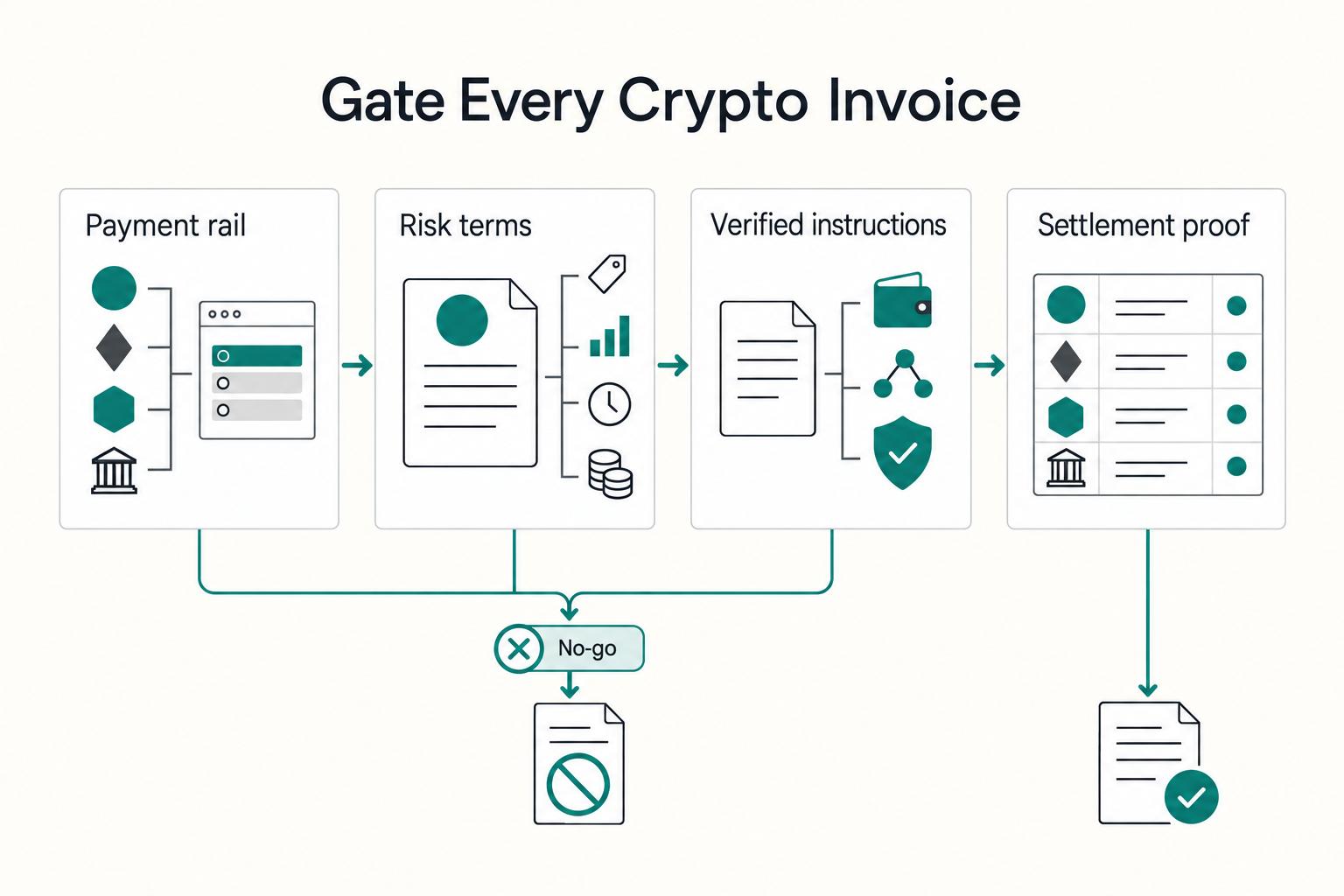
Use this checklist as a mandatory pre-invoice control. If any checkpoint fails, it is a no-go, and you do not send payment instructions.
- Classify the payment rail (go or no-go).
Select the exact gateway payment flow or direct transfer route before invoicing. Record its supported asset/network, confirmation semantics and provider version rather than relying on product names that can change. No-go: the client only says crypto or cannot confirm the supported route.
- Lock commercial risk terms in one step (go or no-go).
Before you send the invoice, confirm in writing: pricing basis, who owns price movement, conversion timing, and who pays provider or transaction fees. If the invoice is in your home currency, define exactly when the exchange rate is set and how shortfalls are handled. No-go: any of these are left to "we'll sort it out later."
- Verify instructions and legal-source reliability (go or no-go).
Confirm instructions through a trusted channel and independently verify changes to the receiving destination. Check the actual asset/provider restrictions and applicable legal rules for your facts; a proposed rule or legislative screenshot does not establish a current obligation or permission. No-go: the payment depends on unresolved destination or consequential legal claims.
- Define "paid" status and capture settlement proof promptly (go or no-go).
Set the paid-confirmation rule before invoicing. For a gateway, use its documented completed-payment evidence with verified event handling; a webhook arrival alone is not proof of payment. For a direct transfer, verify asset/network, receipt amount and the agreed confirmation/finality condition. Capture invoice ID, amount, timestamp, transaction/provider reference and any conversion record.
Keep this checklist in your repeat-client process. If any step fails, escalate to the decline criteria in When Should You Not Accept Crypto? and keep records aligned with What Records Do You Need to Keep When You Accept Crypto Payments?
If you want a more repeatable get-paid setup with invoicing, status visibility, and audit-ready records where supported, review Gruv's freelancer flow.
Frequently Asked Questions
Do I pay taxes on crypto I receive as a freelancer?
For U.S. federal tax purposes, receipt of digital assets for freelance services generally creates income at their fair market value in USD when received, and self-employment tax can apply. In an arm’s-length service transaction, that receipt value is the asset’s basis. A later sale, exchange or spending is a separate disposal that can create gain or loss relative to basis. Preserve receipt valuation, lot and disposal evidence; a price drop after receipt does not simply erase service income.
How do I invoice a client in crypto?
Use your normal invoice and add the payment details that remove ambiguity. Do not send payment instructions until the exact asset, exact network, destination address or gateway link, exchange-rate timing rule, and paid confirmation rule are agreed in writing. Save that confirmation with the invoice file and complete invoice-to-transaction mapping on settlement day. For a worked flow, see How to Get Paid in Crypto as a Freelancer (and Manage the Risks).
What happens if the crypto price drops after my client pays?
That is volatility risk. If you hold the asset after settlement, you still carry price-movement exposure. If the invoice is fixed in your home currency and you cannot absorb price movement, use a stablecoin option or a gateway that supports automatic crypto-to-fiat conversion instead of holding a volatile asset. Set the conversion timing rule before you send the invoice and keep settlement evidence showing what was received and when.
Is it safer than a card or wire?
It changes failure modes. Confirm the counterparty, supported asset/network and destination through a trusted channel; a correctly formatted address alone cannot prove the network or owner. Apply confirmation/finality rules and recovery terms for your setup. Investigate potential sanctions matches and follow applicable blocking/rejection requirements where relevant; an internal review closure cannot authorize a prohibited transfer.
What is a crypto payment gateway?
A crypto payment gateway is a third-party provider that processes digital-asset transactions, and some support automatic crypto-to-fiat conversion. Choose this rail when you want a third party to process transactions, but only after reviewing onboarding and verification, fees and rates, and supported assets and networks. Open the account early, complete verification, and run a low-value test invoice before larger payments.
Do I need to file extra forms because I accepted crypto?
Maybe, but that depends on your facts, jurisdiction, account setup, and cross-border elements, not on a single payment by itself. If you are a U.S. filer or use non-domestic providers, wallets, or entities, do not rely on a generic checklist. Maintain invoice-to-transaction mapping first, check current thresholds and rules after verification, and confirm any filing obligation with a qualified professional before filing decisions.
Watch
Accepting Crypto Payments: Pros, Cons, and Risks
Try a related tool
Researched and edited by the Gruv editorial team. Gruv builds cross-border billing, payouts, and finance-operations software for global businesses.
Sources
Educational content only. Not legal, tax, or financial advice.
Related Posts

Using a Data Processing Agreement with Subcontractors
Put your data processing agreement in place before a processor or sub-processor gets access to personal data. If you use a processor, UK GDPR guidance requires a [written contract or other legal act](https://ico.org.uk/for-organisations/uk-gdpr-guidance-and-resources/accountability-and-governance/contracts-and-liabilities-between-controllers-and-processors-multi/when-is-a-contract-needed-and-why-is-it-important). Set that contract boundary before support logins, shared folders, or troubleshooting access turn into live processing.

The Freelance Payment Penalty: A Modeled Audit of Platform Fees, FX Spreads, and Payout Delays
The money rarely disappears through a single, easy-to-spot fee. The real loss is stacked. A marketplace takes its commission, a processor adds a charge for international cards, a bank or payment company converts the currency at a spread, a platform holds the funds before release, and a wire sheds a little to intermediaries on the way in. Each layer looks defensible on its own, but the worker feels the combined result as a smaller deposit and a later payday.

How to Respond to a Subpoena for Business Records
Move fast, but do not produce records on instinct. If you need to **respond to a subpoena for business records**, your immediate job is to control deadlines, preserve records, and make any later production defensible.