
Quick Answer
European creators can manage cross-border client work by separating company setup from personal tax residency, verifying VAT treatment before every invoice, and standardizing US tax forms, multi-currency payments, contracts, and records. To scale, keep B2B and B2C flows separate, review compliance and cash controls regularly, and verify local rules before acting.
Three things your cross-border setup needs to do#
If you work with clients across borders, your setup needs to do three things at once. It should support clear compliance decisions, reduce invoicing and payment mistakes, and keep working as your client base grows.
Who this is for: independent creators, freelancers, and small online service businesses serving clients in multiple countries. Who this is not for: purely local operators whose clients, invoicing, and tax exposure all stay in one country.
Start with the terms you will use throughout this guide. Estonian e-Residency is a government-issued digital identity for accessing Estonian e-services and running an EU company remotely. It is not citizenship, physical residency, or your personal tax residency. Your Estonian company is treated as an Estonian tax resident while your personal tax residency stays elsewhere, so keep those two tracks separate from the start.
You will also run into VAT reverse charge and multi-currency invoicing. For many EU B2B service transactions, you generally do not charge VAT and the customer accounts for it. But the invoice still has to be right. Invoices are required for most EU B2B supplies, and where reverse charge applies, include the words "Reverse charge" on the invoice. As a practical control, check the client VAT number in VIES before invoicing. Also remember that invoice amounts can be shown in a foreign currency, while VAT may still have national-currency requirements.
The rest of this guide is split into three parts:
- Part 1: Compliance. Set up company, tax-residency, and invoicing foundations without mixing immigration, personal tax, and company rules.
- Part 2: Financial control. Tighten invoicing, payment handling, and currency workflows to improve cash-collection reliability.
- Part 3: Scalable operations. Build practical operating habits that continue to work as volume and complexity increase.
Keep this tradeoff in mind. e-Residency can be a strong tool for cross-border online work, but it does not by itself resolve your personal tax position or guarantee banking access.
If you want a deeper dive, read Mercury vs. RelayFi: Which is the Best US Bank Account for a Non-Resident LLC?.
Part 1: Document your compliance reasoning before you file#
Your first compliance decision is not the jurisdiction. It is whether you can document your reasoning, keep records current, and separate company decisions from your personal position before you file anything. Do not assume Estonia/entity, tax residency, VAT, or PE specifics for creators are already established. Treat route-specific items below as verification checkpoints, not conclusions.
Choose the entity only after you can explain the reason#
If you are considering options like an Estonian OÜ via e-Residency and a local entity, treat them as choices to verify, not shortcuts. The right next step is a short written decision note that states why you are choosing the route, who will handle ongoing compliance, and which personal tax questions are still open. Before filing, confirm these points with current official or professional guidance:
- eligibility for the route you plan to use
- provider scope and responsibility, if you use one
- ongoing obligations after setup, including accounting, filings, and record keeping
Keep dated notes, provider messages, and supporting screenshots in one folder. Also check source quality. If a page is labeled as press-release content, treat it as marketing until you verify the underlying rule elsewhere.
Track residency, immigration, and social security as three separate questions#
Do not collapse these into one broad "residency" assumption. Keep three separate trackers:
- tax residency
- immigration/work status
- social-security exposure
Country-specific thresholds, tie-breaker rules, immigration rights, and social-security trigger tests need local verification before you act. Use a monthly log with country, arrival and departure dates, work activity, and evidence such as travel records, accommodation, and calendar notes. That gives you an audit trail when rules depend on presence and documented activity.
| Rule model to verify locally | What to confirm | What to track now |
|---|---|---|
| Presence-based test (if applicable) | Confirm the current threshold before relying on this test | Entry/exit dates, travel proof, workdays |
| Lookback test (if applicable) | Confirm the current lookback period and counting method before relying on this test | Continuous 12-month day log |
| Multi-factor test (if applicable) | Confirm the current factors and evidence standard before relying on this test | Home/family indicators, banking, client concentration, registrations |
Use a decision path for VAT, not assumptions#
For VAT, the mistake is usually not complexity. It is treating a repeated pattern as if it never needs checking. Start each invoice flow with verification, confirm the treatment, then issue the invoice. If you plan to apply a specific path, including reverse-charge treatment or OSS, verify the current rule first and save what you relied on. Do not treat one prior invoice as proof of place-of-supply outcomes, reverse-charge wording requirements, OSS eligibility, or filing cadence.
| Situation | Your next step | Keep on file |
|---|---|---|
| Client states they are a business | Verify business status before invoicing | Verification result, client legal details, dated proof |
| Customer appears to be a consumer sale | Verify whether a special reporting path is relevant | Customer location evidence, transaction record, treatment note |
| Treatment is unclear | Pause and confirm before final invoice | Advisor guidance or official reference, draft invoice, customer tax details |
Invoice wording and required fields can vary, so do not rely on copied template language without verification.
Handle PE uncertainty through working controls, not labels alone#
PE outcomes are fact-specific. Contract wording helps, but your agreement and day-to-day behavior still need to line up. Use this control list before onboarding or renewing a client:
| Control | What to document |
|---|---|
| Authority | What you can and cannot approve or negotiate |
| Independence | Clear external-contractor signals in process and communication |
| Scope | Deliverables, decision rights, and review points to prevent silent role expansion |
| Evidence | The signed contract version, role description, and review notes |
Treat these as documentation controls, not legal safe-harbor tests. Run a short pre-client check each time. Make sure the entity decision file is current, personal trackers are updated, the VAT path is verified, engagement controls are documented, and the records folder is created. That gives you a clean handoff into Part 2.
For a step-by-step walkthrough, see The 'Mental Game' of Freelancing Blueprint: From Imposter Syndrome to Confident CEO.
Part 2: Align invoice logic, payment flow, and contract terms#
Once your compliance basics are in place, revenue control comes down to three things. Your invoice logic should match the tax treatment, your payment flow should avoid friction, and your contract terms should protect margin.
Build invoice logic around client market, not one template#
One invoice template will not cover every cross-border case. Use Article 226 as your EU VAT baseline, then verify the exact treatment before issuing. It requires core invoice details, including a unique sequential invoice number and supplier VAT identification data within scope.
| Client market | Verify first | Core invoice fields | Tax-label logic | Document dependencies |
|---|---|---|---|---|
| EU B2B | Confirm the customer is a taxable person acting as such; record legal details and VAT status | Your legal name/address, client legal name/address, your VAT ID (where applicable), unique sequential invoice number, issue date, date of supply (if relevant), service description, taxable amount, payment terms | For general B2B services, Article 44 places supply where the customer is established. If you are not established in that Member State, Article 196 can shift VAT liability to the recipient. Use the required invoice wording for the applicable country only after checking any local reverse-charge reference | Client VAT check result, dated treatment note, engagement details, invoice copy |
| EU B2C (where relevant) | Confirm service category first; do not assume one B2C rule for all creator services | Same baseline fields, plus any local requirements for that supply type | For specified electronically supplied/TBE services, Article 58 places supply where the consumer is established, resident, or usually resides. Cross-border B2C e-commerce VAT rules changed on 1 July 2021, so verify whether OSS or another path applies | Customer location evidence, service classification note, tax treatment note, invoice copy |
| US company | Confirm payment rail, onboarding requirements, and whether payer expects individual or entity withholding form | Legal names, addresses, invoice number, issue date, service description, amount due, currency, due date, banking details aligned with payee name | No EU VAT label logic on the invoice itself; align tax-form handling with payer onboarding requirements. Use W-8BEN for a foreign individual and W-8BEN-E for a foreign entity | Completed W-8 form, onboarding emails, signed contract, invoice copy |
If you use the Article 44 and 196 path, keep proof of why you applied it. Missing evidence for the treatment used can create issues even when invoice formatting is correct.
Get US tax forms accepted before first payment#
When a US payer requests tax forms, submit them during onboarding or before your first payment request, not after an invoice is overdue. W-8BEN is for foreign individuals, W-8BEN-E is for foreign entities, and both go to the withholding agent or payer, not the IRS. A correct W-8 does not automatically remove withholding in every case, and some US-source payments can still face 30% withholding depending on payment type and facts. Use this pre-invoice checklist for US clients:
| Check | Requirement |
|---|---|
| Payee name | Payee name on the invoice matches the bank beneficiary name |
| Form type | Form type matches the contracting party, individual or entity |
| Signed W-8 | Signed W-8 is already on file with the payer |
| Invoice details | Invoice currency, bank details, and contract counterparty are consistent |
Also set a renewal reminder. Forms W-8 are generally valid through the last day of the third succeeding calendar year unless circumstances change earlier.
Treat multi-currency as a policy, not a tool choice#
Multi-currency handling gets messy when each invoice follows a different rule. Set one policy so the same sequence applies every time.
| Policy area | What to set |
|---|---|
| Account setup criteria | Local receiving details for billed currencies, downloadable statements, transparent fees, exportable transaction references, and controlled bookkeeper access |
| Settlement path | Receive in the invoice currency, such as EUR, USD, or GBP, before converting so you avoid forced conversion on receipt |
| Conversion timing policy | Define when you convert and what reference you use. Article 230 allows invoice amounts in any currency, but VAT payable or adjusted must be in the Member State national currency. Article 91 allows Member States to accept the latest ECB rate when tax becomes chargeable |
| Reconciliation workflow | Match each receipt to the invoice number, gross billed amount, fees, net received, and any FX entry. If references are weak, store remittance evidence with the invoice file |
Put scope control in the contract, then enforce it#
Margin usually leaks through scope, not pricing. You protect revenue by defining financial boundaries before work starts.
| Contract control | Define clearly |
|---|---|
| Deliverables | Countable outputs, acceptance point, and what is excluded |
| Revision boundaries | Included revision rounds and what triggers extra billing |
| Change-order process | Written approval requirement before out-of-scope work begins |
| Cancellation/pause terms | What is owed for completed or in-progress work and how restart is handled |
| Payment terms | Due date, late-payment handling, and enforcement path under governing law |
For EU B2B terms, keep the directive baseline in mind. Payment periods should not exceed 60 calendar days unless expressly agreed and not grossly unfair. Statutory late-payment interest is the reference rate plus at least eight percentage points, but verify local implementing law before inserting specific numbers into your template. Do the same for the enforceability of revision and cancellation clauses. Before kickoff, make sure these controls are in place:
- Invoice treatment verified and treatment note saved.
- Any required US payer form submitted before first payment.
- Receiving currency and reconciliation workflow set.
- Signed contract covering deliverables, revisions, change orders, and cancellation.
We covered this in detail in The Client Onboarding Blueprint: From Proposal to Project Kickoff.
Before you send your next cross-border invoice, draft it with Gruv's invoice workflow and then localize the final wording for your jurisdiction.
Part 3: Designing a Scalable Operation#
Scaling works best when it follows your compliance capacity. Keep the operation simple while you grow, and only add complexity when your process can carry it.
Choose your audience model by compliance load#
B2B versus B2C is not just a sales choice. It changes your admin load, your VAT handling, and the way you scale.
- If you want lower operational load, start with mostly B2B accounts and repeatable invoicing workflows.
- If you sell covered cross-border B2C supplies, build VAT tracking and filing discipline before you scale volume.
- If you run a hybrid model, separate B2B and B2C records from day one so each supply is routed correctly.
Since 1 July 2021, EU VAT rules for cross-border B2C e-commerce changed. OSS is an optional simplification route for covered supplies, but it comes with process commitments.
| Audience model | VAT handling | Admin burden | Cash-flow predictability | Reporting complexity |
|---|---|---|---|---|
| Mostly B2B clients | Verify treatment per supply before invoicing; the OSS mechanics below are for covered cross-border B2C supplies. | Lower when your client mix is concentrated and treatment notes are saved per invoice. | Can be steadier with contracted milestones or retainers. | Can be lower with a concentrated client mix, but still tied to domestic VAT obligations and your client profile. |
| Cross-border B2C sales | For covered supplies, customer-country VAT can apply. Confirm the applicable threshold before relying on the EU-wide reference in this context: EUR 10 000. OSS is optional, but if you opt in, you must report all supplies that fall under that scheme via OSS. | Higher due to classification, country logic, and filing controls. | Can be less predictable with higher transaction count and checkout or platform data cleanup. | Higher. OSS returns are additional and do not replace domestic VAT returns. |
| Hybrid model | Keep a strict split between B2B and B2C flows so supplies land in the correct process. | Medium to high; the main risk is mixed records, not volume alone. | Mixed; contracted work can stabilize consumer volatility. | Medium to high due to dual controls and tighter reconciliation. |
If you use OSS, register in one Member State of identification and submit OSS VAT returns electronically for eligible supplies. Filing cadence is quarterly for Union and non-Union schemes, and monthly for the import scheme. Keep a single mapping file that shows why each sales stream is inside or outside a scheme and which return it belongs to.
For complex cross-border fact patterns that are hard to classify, assess whether a VAT Cross-border Ruling, or CBR, request is worth it. CBR is for advance rulings on complex cross-border VAT transactions and must follow national ruling conditions in a participating country where you are VAT-registered.
Build your safety net by profile, not generic templates#
This section covers VAT scaling mechanics, not insurance or retirement product rules. Use the profile notes below as inputs for country- and profile-specific checks before choosing products.
| Profile | What to document before choosing products |
|---|---|
| EU-based creator | Your jurisdiction and business setup, then confirm insurance and retirement requirements locally before choosing products. |
| Non-EU creator in Europe | Residence status, business setup, and working footprint, then confirm local insurance and retirement requirements before choosing products. |
| US person abroad | Which planning inputs come from your local setup versus your home-country profile, then confirm applicable rules in both contexts before choosing products. |
If you need a US retirement comparison, use a focused guide like SEP IRA vs. Solo 401(k): Which is Better for You? instead of forcing that analysis into this section.
Standardize the work that repeats every week#
Scaling usually breaks where work depends on memory. It gets easier when finance and delivery run on checklists:
- Weekly finance review: check overdue invoices, unmatched receipts, pending FX entries, and upcoming domestic or OSS filing dates. If a sale is routed to OSS, verify tagging before period-end.
- Proposal standardization: keep one base proposal format with fixed scope, exclusions, pricing basis, currency, billing trigger, and client legal entity.
- Kickoff capture: start work only after you have the signed contract, client legal details, billing contact, payment method, required tax-form status, and the approval that authorizes first invoicing.
- Record control: store kickoff approvals with invoice treatment notes so records remain usable across staff or tool changes.
That is what makes this setup durable. You get fewer ad hoc judgment calls, cleaner records, and faster recovery when tax or payment issues appear.
You might also find this useful: The Agency Scaling Blueprint: From Solo Freelancer to Hiring Your First 5 Global Contractors.
Track the details, check critical items, and document decisions#
A resilient setup is not about knowing every rule from memory. It is about tracking the right details as you work, checking critical items before you act, and documenting decisions the same way each time.
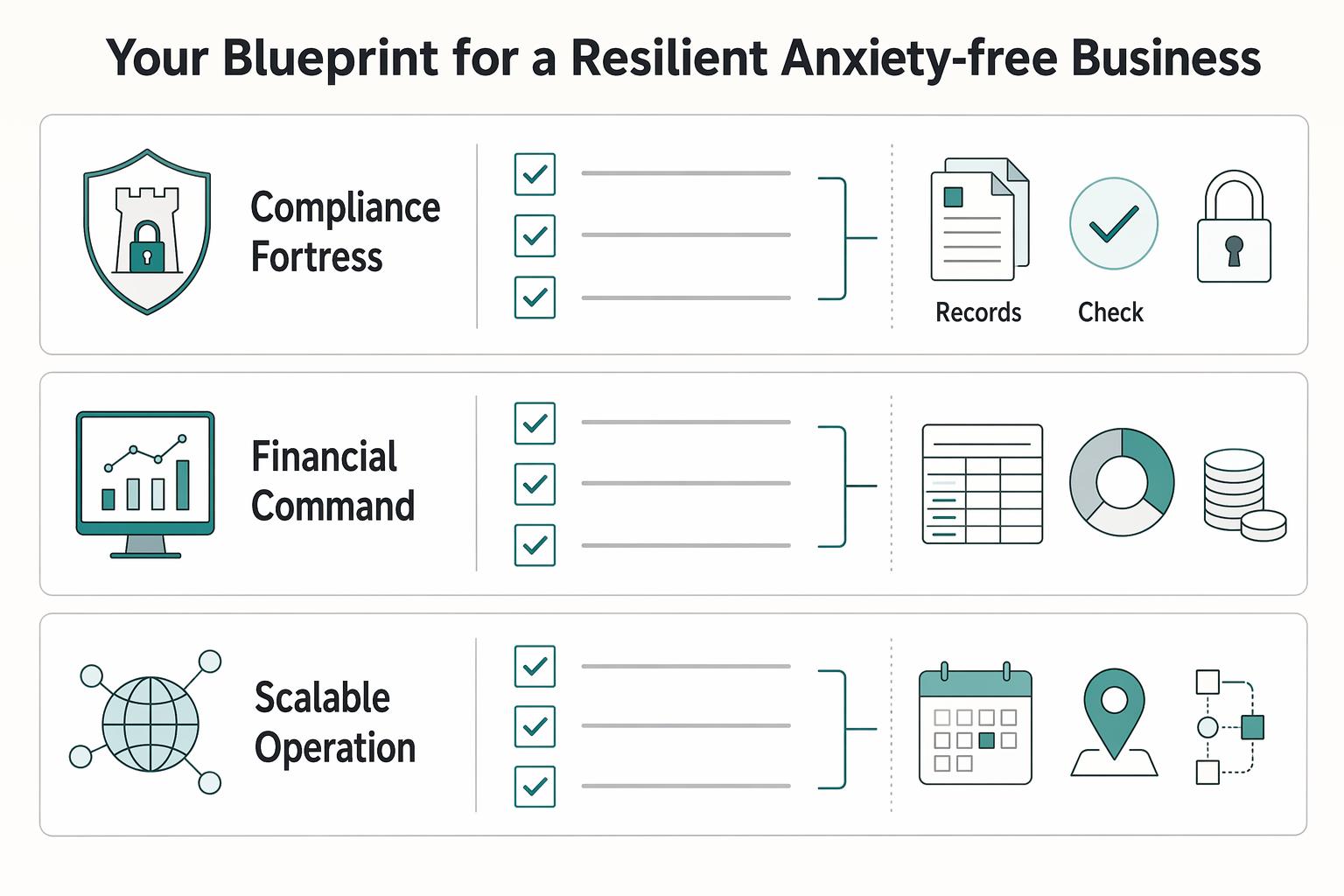
| Framework Pillar | Reactive state | Early state | What you do now |
|---|---|---|---|
| Compliance Fortress | You notice a compliance problem only when a client asks or a deadline hits. | You track location, client type, and recordkeeping notes as work happens. | Keep one live log for travel days, address changes, client country, and compliance notes. Store dated evidence in one place each month so you can explain decisions later. |
| Financial Command Center | You rebuild invoices each time, miss payment details, and lose visibility on overdue balances. | You issue invoices from a standard setup, match payments to invoices, and review receivables on a schedule. | Use one invoice template, one numbering sequence, and one payment-tracking tool or sheet. Before sending, verify billing details, currency, due date, and any supporting paperwork you depend on, then store the invoice and payment confirmation together. |
| Scalable Operation | Scope expands in chats and calls, and delivery slips as requirements drift. | You define deliverables, revision limits, and approval points before work starts, then record changes. | Put scope, revision rounds, timeline, and handoff format in writing. If the request changes, send a written change note before doing extra work. |
Use a repeatable review cadence:
- Weekly: check unpaid invoices, upcoming delivery dates, and pending client approvals.
- Monthly: reconcile your records folder: invoices, payment confirmations, signed agreements, scope changes, and location or address notes.
- Quarterly: confirm your setup still matches where you live, where you work, and how clients buy from you.
Keep ownership simple: one owner for the calendar, one system of record for documents, and one process for legal or tax-sensitive actions. Verify the current rule before acting, because requirements may vary over time and by country. For decisions with legal or tax impact, rely on current official guidance or a qualified adviser, and save what you checked. If a source is labeled as distributed press-release content or notes editorial non-involvement, treat it as a starting point and verify before acting.
Related: The Solo Creator's Financial Blueprint: From Side Hustle to Sustainable Business. When you want a single workflow to collect client payments and handle global money movement with clearer operational control, review Merchant of Record for freelancers.
Frequently Asked Questions
How do you invoice a US client from Europe?
First confirm whether you are invoicing as an individual or through an entity, because that determines whether the payer needs Form W-8BEN or Form W-8BEN-E. Submit the correct signed form to the payer during onboarding or before your first payment request, and keep it with the contract and invoice. A correct W-8 does not automatically remove withholding in every case, so confirm the payer's requirements before finalizing the invoice.
Do you need a VAT number as a freelancer in Europe?
If you sell B2B services to VAT-registered clients in other EU countries, you need to handle VAT setup and invoicing rules correctly, and in many cases that includes having a VAT number. Before issuing a no-VAT B2B invoice, validate the client VAT number in VIES and keep the evidence with your invoice records. If the client does not have a valid EU VAT number, you should usually charge VAT at the rate applicable in your country, then verify local requirements before invoicing.
What is the VAT reverse-charge mechanism for freelancers?
For many EU cross-border B2B services, VAT liability can shift to the customer under Article 196 instead of being charged by you. Confirm that the supply qualifies, validate the client VAT number, issue the required B2B invoice, and use the applicable reverse-charge wording only after checking the relevant country rules. Keep a short treatment note and the VIES result with the invoice file.
How do Spain and Portugal differ on tax residency?
Use a country-specific tracking log, not a single 183-day shortcut. Spain uses more than 183 days in the calendar year, while Portugal uses more than 183 days in any 12-month period or a habitual-home condition, so the tracking method differs. Keep travel, residency, lease, and address evidence because resident status can expose worldwide income to local tax rules.
Is Estonian e-Residency a good fit for a content creator business?
It can fit if you want digital access to manage an Estonian company online, but e-Residency is not tax residency and it does not grant entry or residence rights in Estonia. Treat it as an administration and company-operations choice, then document where you live and where work is actually performed for tax analysis. Do not assume it changes your personal tax residence or immigration status.
How do you handle GDPR as a solo content creator?
If you process personal data in your business, assume GDPR applies unless the activity is purely personal or household. For each processing activity, define a lawful basis, collect only the data you need, and explain the purpose clearly. Keep documentation aligned with your actual forms, tools, and data flows, plus a process for access and deletion requests.
Try a related tool
Researched and edited by the Gruv editorial team. Gruv builds cross-border billing, payouts, and finance-operations software for global businesses.
Sources
- e-resident.gov.eetrusted
- europa.eu/youreurope/business/taxation/vat/cross-borde...trusted
- europa.eu/youreurope/business/taxation/vat/check-vat-n...trusted
- europarl.europa.eu/RegData/etudes/STUD/2025/774670/EPRS_STU(202...trusted
- irs.gov/individuals/international-taxpayers/nra-with...trusted
- irs.gov/individuals/international-taxpayers/forms-fo...trusted
- learn.e-resident.gov.ee/hc/en-gb/articles/360001518878-Responsibilit...trusted
- legislation.gov.uk/eudr/2006/112/article/226/adoptedtrusted
Educational content only. Not legal, tax, or financial advice.
Related Posts

Sole Proprietorship vs LLC for Global Freelancers in 2026
For most freelancers in 2026, the practical default is still simple: use the simplest structure you can run cleanly, then formalize when risk actually rises. If your work is still in validation mode and the downside is contained, a sole proprietorship is often the practical starting point. When contract exposure, delivery stakes, or dispute risk starts climbing, forming an LLC deserves earlier attention.

SEP IRA vs Solo 401(k) for Freelancers With Uneven Cash Flow
Pick the plan you can keep funding in weak months, not the one that looks best in a strong quarter. That is the real decision.

Mercury vs RelayFi for Non-Resident LLC Banking
Pick the setup that keeps money moving under pressure, then worry about nicer features.