
Quick Answer
Build it by defining your target segment, buyer problem, proof, and launch conditions before choosing channels or partners. Then pick one primary distribution motion, give each channel a single funnel job, score partners by buyer overlap and execution role, and launch only when product, compliance, sales, and finance pass clear readiness gates.
What a Strong Go-to-Market Strategy Looks Like#
For payment platforms, go-to-market decisions should start with clear commercial logic and execution constraints, not just channel tactics. Teams can jump to partner lists, channel tests, or messaging before they agree on the logic they need to protect, and that can lead to fragmented execution.
A Go-to-Market (GTM) strategy is broader than a marketing plan. It is the plan for bringing a product to market. It aligns product, marketing, sales, and customer success around one launch objective, and clarifies who you are targeting, what problem you solve, and how you will reach customers.
That distinction matters. In Stripe's GTM framing, sales, marketing, distribution, risk, governance, and compliance are core build components. For payment teams, that keeps growth choices tied to operating reality.
Use this guide with four questions first:
- Who are you targeting?
- What problem are you solving?
- How will you reach them?
- What conditions must be true for launch to work?
If those answers are unclear, do not add spend or recruit partners yet. Weak GTM can fail in a predictable way: the product reaches the wrong people with the wrong message at the wrong time.
The goal here is practical execution, not a universal "best" channel. You will work through decision checkpoints, evidence requirements, and a launch checklist so product, revenue, and finance can make channel, partner, and positioning choices from the same operating logic.
What to prepare before you pick channels or partners#
Before you shortlist Google Ads, LinkedIn, or referral partners, lock the commercial and operating facts you will build around. If this prep is vague, channel tests can look promising while hiding poor fit.
| Prep step | What to lock | Why it matters |
|---|---|---|
| Write a short GTM brief | commercial goal; first segment; distribution channels to test; risk, governance, and compliance | Do not compare channels until teams align on target and launch conditions |
| Define the ICP by segment signals, not just company type | user type; payment behavior; regional preferences; buyer role | Avoid broad targeting and keep channel targeting tied to fit |
| Document partner and compliance boundaries early | partner profiles; how collaboration will work; risk, governance, and compliance boundaries; who owns the compliance answer | Define before you scale outreach |
| Gather an evidence pack | market research; messaging assumptions; early campaign data | Use a baseline to track, measure, and optimize channel and partner decisions over time |
Step 1 Write a short GTM brief#
Start with a concise GTM brief that states your commercial goal, the first segment you want to win, and the distribution channels you plan to test. Be explicit about risk, governance, and compliance so product, revenue, and finance are working from the same launch logic.
Checkpoint: if those teams cannot give the same answer to "who is this for, and what must be true for launch to work?", do not compare channels yet.
Step 2 Define the ICP by segment signals, not just company type#
Define your Ideal Customer Profile (ICP) with concrete segment signals, not just firmographics. Use practical filters such as user type, payment behavior, regional preferences, and buyer role.
This keeps channel targeting tied to fit and helps you avoid broad targeting.
Step 3 Document partner and compliance boundaries early#
Define the partner profiles that align with your goals and how collaboration will work before you scale outreach. In parallel, set risk, governance, and compliance boundaries, and define who owns the compliance answer when sales asks whether a target profile is supportable.
Step 4 Gather an evidence pack#
Pull together the evidence you already have from market research, messaging assumptions, and early campaign data. Use this baseline to track, measure, and optimize channel and partner decisions over time, not just react to early demand signals. With that prep done, you can make channel and partner choices on something sturdier than intuition.
For operator benchmarks and market context, see our State of Platform Payments: Benchmark Report for B2B Marketplace Operators.
Step 1 Define your monetization thesis and ICP before choosing channels#
Before you allocate channel budget, define who you are targeting, what problem you are solving, why they should choose you, and how you will reach them. If those decisions are unclear, even strong products can reach the wrong people with the wrong message at the wrong time.
Step 1 Write a GTM hypothesis for each segment#
Use a separate hypothesis for each segment rather than one blended story. Keep it to three lines:
- who you are targeting
- what problem you are solving
- why they should choose you and how you will reach them
Readiness check: product, revenue, sales, and finance should give the same answer for that segment, and the strategy should be documented. If they do not, do not compare channels yet.
Step 2 Split your Ideal Customer Profile by buying behavior#
Define ICPs by buying motion, not firmographics alone. If one segment depends on finance or procurement approval and another moves through a product-led flow, treat them as different ICPs for channel planning.
Document four points for each ICP: who initiates, who approves, what proof is required, and what must happen before value is visible. In product-led motions, sales often enters after product-readiness signals, which changes how you sequence channels.
Step 3 Match channel intent to buying friction#
Avoid one-size-fits-all channel rules. Start with the ICP's buying motion and test channels where buyers already signal an active problem before you layer in broader awareness.
If the path is lighter and product activation carries more of the journey, test broader acquisition earlier. Use closed-won quality, not lead volume alone, as your first scaling signal.
Step 4 Set exclusion criteria before spend starts#
Write explicit exclusion criteria before campaigns launch so spend does not subsidize poor-fit accounts. At minimum, exclude accounts whose buying motion, approval burden, or delivery needs do not match what your team can support reliably today. This keeps targeting disciplined, enables earlier disqualification, and gives finance a cleaner read on whether segment economics are working by design.
Related: Payments Orchestration: What It Is and Why Every Platform Needs a Multi-Gateway Strategy.
Step 2 Map product modules to buyer pain and compliance scope#
Map each module label to one ICP pain, the proof required, and the review steps that may affect launch timing before you scale messaging. If you skip this work, teams can describe the offer differently, positioning weakens, and campaigns underperform.
Step 2.1 Turn module names into testable buyer claims#
Treat labels like Merchant of Record (MoR), Virtual Accounts (VBA), and Payout Batches as hypotheses, not value on their own. For each label, define the buyer problem you believe it solves, what evidence you can show today, and what assumptions still need to be validated.
A quick competitor check helps keep this grounded in research. Tools like SEMrush, SimilarWeb, or Crayon can help identify competing messages; if similar labels appear across competitors, differentiation needs to come from the problem statement and proof, not the label.
| Module label | Buyer pain hypothesis to test | Evidence to bring | Compliance/review scope to map |
|---|---|---|---|
| Merchant of Record (MoR) | Which ICP pain is this label meant to address? | Current demo or workflow, ownership boundaries, and rollout plan | Approvals, documents, and handoffs to confirm |
| Virtual Accounts (VBA) | Which ICP pain is this label meant to address? | Current demo or workflow, observable outputs, and exception ownership | Verification steps and dependencies to confirm |
| Payout Batches | Which ICP pain is this label meant to address? | Current demo or workflow, operational handling, and support model | Review checkpoints and remaining manual work |
Step 2.2 Replace feature promises with proof your team can show now#
Do not scale messaging on promises your team cannot demonstrate. Translate each promise into observable proof: what the buyer will see, what your team can verify now, and what remains conditional.
Use one internal checkpoint: ask product, sales, and finance the same question, "What proof does this buyer need to move forward?" If the answers differ, tighten the claim before you expand channel spend.
Step 2.3 Mark compliance scope where it changes conversion path#
Map where verification, documentation, legal, or partner review steps may enter the path to launch, and who owns each step. This keeps timeline expectations realistic and keeps messaging tied to what is validated.
Keep the output to a one-page matrix per ICP: module label, pain hypothesis, proof required, open assumptions, review scope, and owner. That keeps product, messaging, audience, and channel decisions anchored to the same baseline.
Step 3 Choose your primary distribution motion first, then add channels#
Pick one primary distribution motion for phase one, then layer in other channels after that path is working in practice. This keeps execution focused and reduces silo risk across marketing, sales, and enablement.
Step 3.1 Match the motion to how the buyer actually buys#
Start with options like sales-led, product-led, or channel-led. You can use more than one over time, but the first phase should keep one clear primary path tied to how your buyers evaluate and adopt.
Choose the initial motion by mapping the buyer path and clarifying team handoffs before you add more channels.
Step 3.2 Verify the motion before adding spend#
Before scaling, make the first customer path explicit across teams. As a planning checkpoint, make sure your GTM work answers four key questions and that marketing, sales, and enablement describe the same path.
If those answers do not align, treat that as a readiness gap and fix the motion first. GTM launches are resource-intensive, so channel expansion before alignment can add cost and execution risk.
Step 3.3 Keep secondary motions as support layers#
Treat secondary motions as support, not equal priorities, until the primary path is clear and consistently executed across teams. Running sales-led, product-led, and channel-led as co-equal bets too early can increase siloed execution risk.
If you start with one motion, use other channels to support that path rather than compete with it. Add channel breadth after ownership, messaging, and handoffs are aligned.
Step 4 Build your channel mix by funnel job and evidence quality#
Once your primary motion is set, assign each channel one job and one proof standard before you scale spend. If a channel cannot show that it reaches the right accounts and helps the next stage move, treat volume as noise, not progress.
Step 4.1 Assign one job to each channel before you buy more reach#
Give each channel a distinct funnel job so performance is diagnosable. If every channel is judged only on "pipeline," you get activity without clear decision value.
Use this as a first-test setup, not a universal default. Operating rule: one channel, one job, one owner.
| Channel | Practical first-test job (hypothesis) | Better fit when | Evidence to scale |
|---|---|---|---|
| Google Ads | Test intent capture | You can verify relevant search behavior in your ICP | Account-fit and stage-progression signals, not click volume alone |
| Test persona/account reach | Buyer roles and target accounts are clearly defined | Qualified engagement from target accounts plus downstream movement | |
| Content | Test education and trust-building | Buyers need comparison, proof, or internal justification | Evidence that content-assisted accounts progress to later stages |
| Partner referrals | Test qualified introductions | Partners can route opportunities with clear context | Lead quality and conversion evidence after handoff |
Step 4.2 Validate message overlap and channel pressure before scaling spend#
Scale only after you confirm your message matches real buyer language and a valid ICP. A common GTM failure mode is building execution on unvalidated market selection, ICP definition, and positioning.
Start with internal evidence: win-loss notes, sales talk tracks, and account research. For enterprise motions, require detailed account research and account mapping, not broad persona assumptions.
Use external overlap and competitive-pressure tools as secondary signals, not proof of buyer intent or fit.
A practical 90-day checkpoint is clarity on three points: who you sell to, how you reach them, and what you must prove.
Step 4.3 Build a scorecard that separates signal from noise#
Use a scorecard that compares channels on early signal and downstream outcomes in one view. Include funnel job, ICP or account segment, leading indicator, lagging indicator, owner, review cadence, and a keep/change/pause decision.
Match review timing to the motion. If your motion is enterprise, a 3-week evaluation cadence is usually too short for 12-18 month cycles that may involve 5+ buying committee members. Some long-cycle playbooks cite hundreds of touchpoints across extended buying periods. The core risk is dropping accounts too early when immediate responses do not appear.
Make decisions on signal quality, not raw lead count. Pause or redesign channels that cannot show a believable link between their assigned job and downstream progress, and keep lower-volume channels when evidence quality is stronger for your chosen motion.
For a walkthrough, see How to Build a Finance Tech Stack for a Payment Platform: Accounts Payable, Billing, Treasury, and Reporting.
Step 5 Design your partner model with clear economics and operating rules#
Design your partner model around measurable pipeline influence and clear execution ownership, not partner logo value. Split roles first, then set incentives and operating rules so contribution stays measurable.
Step 5.1 Separate partner roles before you set incentives#
Use role definitions as an operating tool, not a universal standard. The goal is to match incentives and accountability to where each partner actually influences the outcome.
| Partner role (example) | Typical influence point | Ownership boundary | Incentive principle |
|---|---|---|---|
| Referral | Intro and context | Mostly pre-handoff | Reward qualified buyer access |
| Implementation | Delivery support | Extends into execution | Tie rewards to agreed execution progress |
| Platform integration | Technical fit and connection | Shared with your product/engineering teams | Tie rewards to validated integration progress |
| Co-sell | Joint evaluation and deal movement | Shared with your sales team | Tie rewards to qualified pipeline and stage progression |
Step 5.2 Score buyer overlap before brand appeal#
Choose partners based on shared buyers, not fame. Start with overlap on industry, company size, geography, and buying-committee roles, then score candidates on audience match, brand fit, and channel strength.
Add one execution field to the scorecard: where the partner can influence the funnel. Judge the program on qualified conversations, conversion rates, and deal velocity, not logo count.
Step 5.3 Write the minimum operating package before launch#
Partner strategy turns into execution only when ownership and timing are explicit. Before the first handoff, define:
- Named owners for each handoff and post-handoff stage
- Qualification rules for ICP slice and use-case fit
- Expected timing for follow-up at each stage
- Where the partner is expected to influence the funnel
- Review cadence tied to funnel-stage conversion, not sourced volume alone
Step 5.4 Keep onboarding ownership where partner influence ends#
If partner influence ends before implementation success, align incentives to that stage and keep onboarding ownership explicit. Reward sourced pipeline, but keep outcome-critical stages with teams accountable after signature. Track partner performance with the same funnel discipline as other channels: qualified conversations, stage conversion, and deal velocity.
Step 5.5 Align the partner story to product reality#
Give each partner a narrow, accurate narrative tied to validated use cases. Keep claims bounded to what your team can support in real delivery, and tailor enablement depth by role.
Use one operating rule across this section: pay for the influence a partner actually has, and keep direct control over the stages that determine customer success.
Related reading: How to Expand Your Subscription Platform to Europe for Payment and VAT Readiness.
Step 6 Position around buyer outcomes and proof not feature lists#
Lead with the buyer outcome first, then support it with proof your team can stand behind. For finance-led buyers, feature lists can help later in diligence, but they are often weak as the opening argument.
Step 6.1 Lead with one operational outcome per ICP slice#
Use one primary outcome per audience, not a bundle of promises. For finance and operations buyers, common themes include clear ownership, milestone accountability, and tighter cross-functional coordination. Each claim should map to one ICP and one use case.
Keep a simple alignment test: if sales, product, and finance cannot describe the same outcome in one sentence, the message is still too broad. Tight positioning is easier for buying committees to repeat internally than capability-heavy language.
Red flag: if your homepage or deck opens with internal infrastructure terms, the buyer has to translate your story before they can evaluate it. Rewrite until the outcome is clear in buyer language.
Step 6.2 Attach proof that survives diligence#
Every outcome claim should have clear ownership, a source artifact, and a review date in your 90-day GTM plan. Launch execution is resource-intensive, and coordination breaks down when teams operate in silos, so positioning needs the same cross-functional discipline as launch planning.
Use a minimum proof check before scaling any claim:
- Who owns the claim across product, marketing, sales, customer success, finance, and operations?
- What internal artifact supports it today?
- What is the escalation path if delivery does not match the promise?
If you use terms like "audit-ready" or "traceable," define them internally and align on what evidence your team can actually provide. Small, defensible claims build more trust than broad claims that collapse under review.
Step 6.3 Stress-test your message against alternatives#
Positioning is not ready until it is clearly distinct from nearby alternatives. If you use third-party competitive tools, treat them as directional signal checks, not as final proof.
Run a practical test: place your headline, subhead, and three proof bullets next to three competitor versions. If they can be swapped without sounding wrong, narrow the message until the difference is obvious.
When overlap is high, drop generic adjectives and return to one specific operational outcome per ICP, backed by named ownership and current evidence.
Step 7 Set launch readiness gates across product revenue and finance#
Do not launch on confidence alone. Set explicit cross-functional gates and hold go-live until each gate has an owner, evidence, and a clear pass or hold status. This is a practical stage-based checkpoint, not process theater. It helps you avoid both failure modes: shipping into the wrong problem or debating readiness until momentum fades. Treat it as the bridge from limited market testing to full commercialization.
Step 7.1 Define the gate order before the launch date#
Set the sequence up front. One workable order is product capability readiness, compliance readiness, sales enablement readiness, then finance operations readiness, but the exact sequence should match your operating model.
For each gate, require:
- named owner
pass,hold, orpartialstatus- evidence artifact
- open risk if status is partial
Prioritize artifacts over meeting notes. Use concrete proof that each function can execute its part of launch.
Step 7.2 Require explicit tax and document checks where enabled#
If tax or document workflows are in scope, track them as explicit checks rather than burying them in a broad compliance bucket. The goal is operational clarity: confirm the flow exists, ownership is clear, and exceptions are visible.
If your program includes items like VAT validation or tax forms (for example W-8, W-9, or 1099 workflows), treat those as explicit gate inputs and note that detailed requirements vary by market and program.
Step 7.3 Confirm escalation paths for blocked reviews#
If compliance reviews can block launch-critical flows (for example KYC, KYB, or AML checks), define how blockers are surfaced and reviewed before go-live. Keep exact ownership and timing aligned to your program requirements.
The risk is silent stalling: onboarding appears active while work is actually frozen. A documented escalation route and shared blocker visibility are minimum controls.
Step 7.4 Publish one go-live decision memo#
Publish one go-live memo as the decision record. Keep it short and specific:
- launch scope and excluded cases
- gate status by function
- owners for open risks
- known blocked flows and escalation contacts
- rollback conditions
- next review checkpoint after launch
If any team reports "mostly ready," translate that into either a bounded, owned risk or a launch blocker. That keeps execution grounded in delivery reality. Before go-live, pressure-test each gate against your real integration and control flow in the Gruv docs.
Common mistakes that leak margin and how to recover#
Margin leakage is usually not one dramatic mistake. It is a series of small GTM decisions that compound into lower margins, billing disputes, irregular revenue patterns, and growing receivables. Recovery is a cross-functional job, not a marketing-only fix.
| Leak source | Recovery | Checkpoint |
|---|---|---|
| Channels picked before ICP was clear | Pause scaling and reset by segment; rerun channel-to-job mapping | Can sales, product, and finance classify the same account as fit or non-fit with the same language? |
| Partner-sourced pipeline treated as free | Include onboarding effort, implementation dependencies, support time, and handoff quality in the economics | Compare partner-sourced and direct deals on total delivery load, not just top-of-funnel contribution |
| Coverage presented as universal when support varies | Use qualifier language such as where supported; maintain one shared coverage matrix | Require commercial teams to use it consistently |
| Compliance checkpoints surfaced after close | Set expectation before the deal closes; mirror checkpoints across pre-sales, onboarding, and finance records | Run recurring cross-team audits for the first ninety days after launch or channel expansion |
Step 1 Reset channels around ICP clarity#
If you picked channels before your ICP was clear, pause scaling and reset by segment, especially where buying motions differ. Then rerun channel-to-job mapping so each channel has a named segment, buyer problem, qualification rule, and exclusion rule.
Use one checkpoint across teams: can sales, product, and finance classify the same account as fit or non-fit with the same language? If not, your channel signal is already noisy. This matters because buyer journeys are often non-linear, and early activity can look like traction before real fit is proven.
Step 2 Cost partner-sourced pipeline as real operating work#
Partner pipeline is not automatically bad, but it is not automatically free. Include post-sale load in your economics: onboarding effort, implementation dependencies, support time, and handoff quality.
Recover by adding a standard review pack for partner-sourced deals:
- onboarding owner and handoff timing
- implementation requirements and dependency risks
- support themes seen after close
- implementation status, not just signed status
The test is simple: compare partner-sourced and direct deals on total delivery load, not just top-of-funnel contribution.
Step 3 Tighten coverage claims with explicit qualifiers#
Do not present coverage as universal if support varies by segment, feature, or market context. Use clear qualifier language such as "where supported" across decks, proposals, partner collateral, demos, and onboarding communication.
Recovery is operational: maintain one shared coverage matrix and require commercial teams to use it consistently. If scope language changes by team, expect avoidable disputes and margin pressure from weak communication.
Step 4 Surface compliance checkpoints before close#
If compliance reviews may affect activation timing, set that expectation before the deal closes. You do not need speculative timelines, but you do need a clear sequence, ownership, and escalation path that customers can understand.
To recover, mirror the same compliance checkpoints across pre-sales, onboarding, and finance records so blockers are visible early. For the first ninety days after launch or channel expansion, run recurring cross-team audits so small leakages are caught before they compound.
If marketplace supply and demand shape your payout model, read Two-Sided Marketplace Dynamics: How Platform Supply and Demand Affect Payout Strategy.
Run a 30 day execution loop with weekly decision checkpoints#
Use this 30 day loop as an operating template to force weekly decisions, not just more activity. The goal is a repeatable GTM motion with clear owners, shared evidence, and faster course correction when fit is weak.
| Week | Focus | Shared artifact or decision |
|---|---|---|
| Week 1 | lock hypotheses, ICP tiers, and owners | Confirm marketing, sales, product, and engineering describe the same test in the same terms |
| Week 2 | launch controlled tests and track one shared view | Keep one shared operating view with ICP tier, funnel stage, conversion notes, and onboarding or handoff signals |
| Week 3 | review quality, not just volume | Use a scored checkpoint diagnostic across content, outbound, lead qualification, distribution, operations, team capacity, and ICP clarity |
| Week 4 | reallocate and stop low-quality sources | Move effort toward better-fit movement and keep a visible stop-doing list |
In Week 1, lock hypotheses, ICP tiers, and owners#
Define each test in a short working sheet. Include ICP tier, buyer problem, channel, owner, and what proof you expect in this cycle within a broader 90-day proof horizon.
Before launch, confirm marketing, sales, product, and engineering can describe the same test in the same terms. If ownership is unclear or team language does not match, treat it as drift and fix it before Week 2.
In Week 2, launch controlled tests and track one shared view#
Launch tests with clear audience boundaries and a shared definition of success for each one.
Keep one shared operating view across marketing, sales, product, and engineering with ICP tier, funnel stage, conversion notes, and onboarding or handoff signals. Weekly funnel-stage conversion tracking is the core checkpoint artifact.
In Week 3, review quality, not just volume#
Judge performance on fit and stage progression, not raw lead count.
Use a scored checkpoint diagnostic to identify execution gaps across content, outbound, lead qualification, distribution, operations, team capacity, and ICP clarity.
In Week 4, reallocate and stop low-quality sources#
Move effort toward tests showing better-fit movement, not just more top-of-funnel noise.
Maintain a visible stop-doing list so low-quality pipeline sources are paused quickly, especially when ICP or positioning signals weaken.
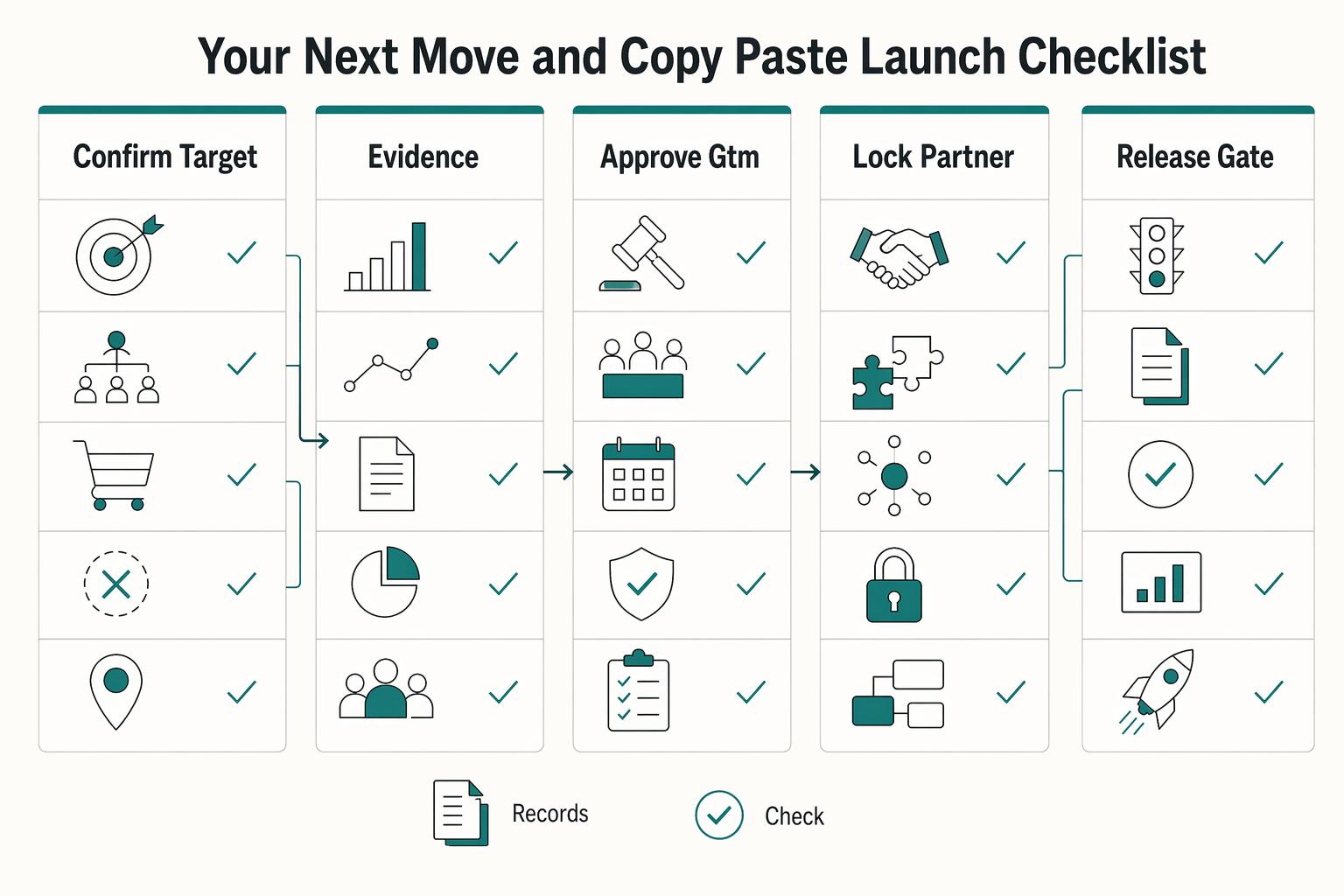
Your next move and copy paste launch checklist#
Launch with ownership and reporting, not more planning. Convert decisions into named owners, explicit governance, and evidence checkpoints. If AWS Marketplace is part of your route, set this up for the path you actually have. The Seller GTM Program is invitation-only, and sellers not in that program use the 180-day GTM Academy self-service path.
- Confirm target segments, primary motion, and exclusion criteria for your team.
Write who you are targeting first, how they buy, and who is out of scope. Treat this as an internal alignment decision, since the AWS GTM guide does not prescribe your ICP or motion.
- Document product-to-outcome messaging with explicit scope notes.
Keep wording consistent across sales, product, and finance, and mark what is supported now versus later. Specific module-to-outcome prescriptions (for example MoR, VBA, or Payout Batches) should come from your own product documentation, not this AWS GTM guidance.
- Approve GTM ownership and reporting design.
The core decision is ownership plus reporting, not a fixed channel list. If AWS Marketplace is in motion, define required data, role ownership, and reporting systems up front, including how you will use Seller Management Portal surfaces like the marketing analytics dashboard, referral tags, and standard reports.
- Lock partner operating rules and handoff paths in your own docs.
Document who can source opportunities, what qualifies, and where handoff occurs. API and Webhooks escalation ownership is not defined in these AWS GTM excerpts, so keep those rules anchored to your internal product and support documentation.
- Sign off compliance and tax launch gates required for your market/program.
Confirm owners for blocked cases and approval paths before go-live. Specific KYC, KYB, AML, VAT, or tax-form workflow requirements are outside the provided AWS GTM excerpts and should come from your compliance and tax teams.
- Publish the first review cadence and decision rules for reallocating spend and effort.
Set a dated review with named attendees and clear keep, cut, or change triggers. For AWS Marketplace motions, use the same reporting surfaces every time so decisions are evidence-based rather than anecdotal.
Once your checklist is complete, confirm market/program fit and operational ownership with Gruv.
Frequently Asked Questions
What is the practical difference between a Go-to-Market (GTM) strategy and a marketing strategy for a payment platform?
A GTM strategy is the broader plan for bringing a product to market. It aligns product, marketing, sales, and customer success around who you target, what problem you solve, and how you will reach customers. A marketing strategy covers the marketing work inside that broader plan.
Which channels should a payment platform prioritize first if resources are limited?
If resources are limited, start with one focused primary channel instead of spreading effort across many routes. Add supporting channels only after that path shows measurable signal. Use conversion rate, customer acquisition cost, and cost per dollar of sales expense to judge expansion.
How should partner channels differ from owned channels in targets and governance?
Partner channels need clearer role definition because execution is shared rather than fully controlled by your team. Define the partner's role, ownership boundaries, and where they influence the funnel. Judge them on measurable contribution and efficiency, not just top-of-funnel volume.
What does strong positioning look like for a payment platform selling to finance operators?
Strong positioning is concrete, problem-led, and clear about the alternatives the buyer is weighing. It should stay consistent across marketing, enablement, and sales, and map to specific buyer outcomes. If it relies on broad slogans instead of specific value and proof, it is likely weak.
What must be validated before launch across product, compliance, and commercial teams?
Before launch, align on the target customer, channel mix, partner role, success metrics, and execution process. Set cross-functional readiness gates with a named owner, evidence, and a clear pass, hold, or partial status. A concise launch brief and review checkpoints help keep execution consistent.
How do you know when to scale a channel versus cut it?
Scale a channel when performance is repeatable on core GTM metrics across multiple checkpoints. Look at conversion rate, customer acquisition cost, and cost per dollar of sales expense rather than busy activity alone. Pause or cut when volume rises but conversion weakens or acquisition efficiency worsens.
Researched and edited by the Gruv editorial team. Gruv builds cross-border billing, payouts, and finance-operations software for global businesses.
Sources
Includes 2 external sources outside the trusted-domain allowlist.
- casperwy.gov/Documents/Government/City%20Council/Agendas%...trusted
- cob.unt.edu/_files/mktg/marketing_advisory_board_booklet...trusted
- online.hbs.edu/blog/post/go-to-market-strategy-frameworktrusted
- sec.gov/Archives/edgar/data/1839439/0001193125242269...trusted
- som.yale.edu/sites/default/files/2025-05/SCOTT-MORTON_Dig...trusted
- stripe.com/resources/more/what-is-a-go-to-market-strate...trusted
- ainna.ai/resources/faq/go-to-market-strategy-faqexternal
- asana.com/resources/go-to-market-gtm-strategyexternal
Educational content only. Not legal, tax, or financial advice.
Related Posts

The Freelance Payment Penalty: A Modeled Audit of Platform Fees, FX Spreads, and Payout Delays
The money rarely disappears through a single, easy-to-spot fee. The real loss is stacked. A marketplace takes its commission, a processor adds a charge for international cards, a bank or payment company converts the currency at a spread, a platform holds the funds before release, and a wire sheds a little to intermediaries on the way in. Each layer looks defensible on its own, but the worker feels the combined result as a smaller deposit and a later payday.

How to Respond to a Subpoena for Business Records
Move fast, but do not produce records on instinct. If you need to **respond to a subpoena for business records**, your immediate job is to control deadlines, preserve records, and make any later production defensible.

A US Expat's Guide to Investing in UCITS ETFs to Avoid PFIC Issues
The real problem is a two-system conflict. U.S. tax treatment can punish the wrong fund choice, while local product-access constraints can block the funds you want to buy in the first place. For **us expat ucits etfs**, the practical question is not "Which product is best?" It is "What can I access, report, and keep doing every year without guessing?" Use this four-part filter before any trade: