
Quick Answer
AML for platform operators is an operating control system, not just signup verification. It combines KYC or KYB, sanctions and PEP screening, transaction monitoring, documented holds, and a clear SAR escalation owner tied to FinCEN. Place stricter gates where payout reversibility is lowest, allow lower-risk activity with monitoring, and keep records that show trigger, evidence reviewed, reviewer, and final disposition for every exception.
AML is a control system, not a signup check#
Here, AML means Anti-Money Laundering: the controls used to keep criminal profits from being concealed in the financial system.
For platform operators, that matters only when it changes operating decisions in embedded-payments workflows. It affects who you onboard, what you verify before funds move, what gets reviewed, and what records explain why a payout was approved, delayed, or blocked.
A practical starting point is to separate identity checks from broader money-movement risk. KYC helps verify customer identity and whether funds appear to come from a legitimate source, but risk-based compliance also looks at products, services, customers, entities, transactions, and geographic locations. A passed onboarding check is not proof that later activity is low risk.
This is where sanctions controls enter the picture. In the U.S., OFAC administers and enforces economic and trade sanctions, and its guidance explains how enforcement responses are determined for apparent violations. The downside can be material. Some civil penalties can reach $250,000 per violation or twice the amount of a transaction, whichever is greater.
So the practical question is not just "what is AML." It is also "where can our payment flow be misused, and how will we show our decisions were reasonable?" A defensible review trail usually captures what triggered the check, what data was reviewed, what decision was made, and who approved an escalation or exception.
This article stays focused on execution. It covers which controls to prioritize first, which decisions need clear ownership, and what evidence to preserve when an auditor, partner, or internal reviewer retraces a case. The goal is specific, defensible controls that reduce risk without freezing growth.
For platform operators, AML is not a single pass or fail check at signup. It is a control system designed to prevent criminal profits from being concealed in payment flows and to detect and report suspicious activity when risk appears later.
A practical baseline is KYC plus CDD. Verify customer identity, assess whether funds appear to come from legitimate sources, and apply due diligence before expanding access to payment activity. That gives you an entry control, not full coverage.
Coverage has to continue after onboarding. Modern AML practice includes ongoing monitoring and reporting of suspicious activity, because risky behavior can emerge over time, and structured transactions can be harder to spot at scale.
For platform payments, that matters even more in fast-moving flows where there is little margin for error once funds move. In operational terms, AML works best as a sequence of controls across onboarding and money movement, not a one-time check.
Where AML sits in your money flow#
In a platform flow, AML works as a control layer across every step where money access expands, not as a one-time signup check.
Use two control types together: policy gates and passive checks. Gates pause or limit an action until a condition is met. Passive checks let activity continue but create alerts and review paths when patterns look suspicious. That split matters because onboarding risk shows up early, while laundering risk can appear later as behavior changes.
| Money-flow step | Typical AML control | Gate or passive check | What to capture in the audit trail |
|---|---|---|---|
| Account creation | KYC and initial CDD | Usually a gate before broader access | Verification outcome, inputs used, rule/provider outcome, manual-review notes |
| Funding | Transaction monitoring on incoming activity | Often passive first; can become a gate when rules trigger | Funding event, alert trigger, matched rule/threshold, disposition |
| Balance movement | Ongoing monitoring of internal transaction patterns | Commonly passive unless restricted pending review | Movement history, related balances/accounts, triggered rule, hold/approval decision |
| Payout | Risk check before funds leave | Often a gate because reversibility is lower after release | Payout details, current risk status, hold/release reason, timestamped decision |
Put the hardest gate where reversibility is lowest#
Account opening matters, but payout is often where strict gating matters most. KYC and CDD establish the initial control point, then ongoing monitoring handles risk that appears after activity starts. For each event, define one clear rule: can it proceed while review is pending, or not?
Treat alerts and provider responses as asynchronous#
Do not assume a clean result is final at event time. In embedded-payments workflows, provider updates and monitoring alerts can arrive later. Product and ops flows should support explicit states such as pending review, allowed with monitoring, held, released, or escalated.
Poorly tuned controls create visible friction: delayed onboarding, repeated document requests, and blocked transactions. Weak execution in the other direction raises enforcement and legal risk. The goal is controlled friction at the points where mistakes are hardest to unwind.
Make every decision explainable later#
Your audit trail is what lets finance, ops, and engineering reconstruct outcomes. For every gate or alert, record the event, the rule or provider result, whether the action proceeded, who reviewed it when applicable, and why the final disposition was chosen. A practical baseline rule is simple: no AML hold or release without a traceable reason and linked event history.
Who owns AML decisions inside the company#
AML decisions need named owners, or outcomes become inconsistent. Tasks can be distributed across teams, but accountability still has to stay clear in your program and operating model.
| Team | Owns |
|---|---|
| Product | Experience |
| Compliance or risk | Policy and escalation criteria |
| Engineering | Controls and audit logging |
| Ops | Case management |
A workable split is straightforward: product owns experience, compliance or risk owns policy and escalation criteria, engineering implements controls and audit logging, and ops runs case management. That is an internal design choice, not a universal regulatory template.
Separate implementation from decision authority#
Write down who can maintain or release a restriction, and who can escalate a case toward a Suspicious Activity Report (SAR) decision when your regulatory setup requires one. Input can come from multiple teams, but final authority should be explicit and reviewable.
Use the written program as the anchor#
For FINRA member firms, FINRA Rule 3310 sets concrete governance checkpoints. The AML program must be approved in writing by a senior manager, independently tested, and supported by ongoing training for appropriate personnel. FINRA also requires each member firm to submit contact information for its AML Compliance Officer.
In the insurance-specific AML context, brokers and agents do not have independent obligations under those insurance regulations, while the insurance company remains responsible for AML program conduct and effectiveness, including agent and broker activity. The operational takeaway is simple: delegation does not remove accountability.
Make handoffs explicit and reviewable#
Use the case record as the system of record for escalations and restrictions. For each escalated item, record at least:
- current restriction status
- named owner for the next decision
- evidence requested or reviewed
- escalation path if the reviewer cannot clear the case
If ownership is unclear today, start with one clearly named release authority until decisions are consistent and auditable. Expand only after that consistency holds.
The minimum control set before your first scaled payout#
Before you scale payout volume, your controls should work as a bundle, not as isolated checks. A practical minimum is KYC, KYB where relevant, sanctions screening, PEP checks, and basic transaction monitoring, with evidence for each pass, fail, and exception.
Use this readiness test for each control: clear purpose, named day-to-day owner, and known failure mode. If any of those are unclear, scaling will expose the gap.
| Control | Purpose | Primary day-to-day owner | Common failure mode |
|---|---|---|---|
| Know Your Customer (KYC) | Verify the person receiving or controlling payouts is who they claim to be | Ops, with compliance policy oversight | Accounts are approved, but pass/fail reasons are not explainable later, or pass rates are unknown by cohort |
| Know Your Business (KYB) | Verify the entity behind a business payout flow and who is allowed to act for it | Ops, with compliance policy oversight | Business payouts launch with person-only checks, so entity and ownership evidence is inconsistent |
| Sanctions screening | Stop or escalate activity involving restricted parties before funds move | Compliance or risk, with engineering implementing screening | Matches are generated but not reviewed promptly, or dispositions are not recorded |
| Politically Exposed Person (PEP) checks | Identify higher-risk customers or controllers who may need enhanced handling | Compliance or risk | PEP alerts are cleared without documented rationale |
| Basic transaction monitoring | Flag payout activity that does not fit expected behavior or policy after onboarding | Ops for review, with compliance setting escalation criteria | Alerts are noisy, unmanaged, or not linked back to payout decisions |
The launch rule that matters most#
If your KYC and KYB pass rates are unknown, do not scale payout volume yet. You do not need a universal threshold, but you do need operating visibility by market and program: how many passed, failed, are pending review, common failure reasons, and exception aging. If you cannot answer those from records, you are still learning, not scaling.
Where teams usually fail#
The first break is often uneven coverage across payout types. KYC may be handled, while business flows lack consistent KYB evidence and representative handling. Another common gap is weak evidence and audit trails, where decisions are hard to reconstruct later.
Basic transaction monitoring also fails in two predictable ways: it is missing, or it exists without disciplined review. In both cases, auditability becomes a risk.
Market and program variance is real#
Do not assume one control setup works everywhere. Requirements can differ materially by jurisdiction and program terms. What satisfies one state can fall short in another, and some multi-state operators face many parallel frameworks.
Before go-live in a new market or processing setup, confirm obligations with counsel and local program terms, including whether active compliant licenses for payment processing are required. Treat that as a release gate.
If this is wrong, the consequences are not theoretical: major financial penalties, license suspension or revocation, and payment processor termination are all documented outcomes. Scale only when these controls are present, owned, and evidenced.
Related: What is a Politically Exposed Person (PEP)? A Compliance Guide. If you are turning this checklist into launch gates, align each control owner to payout state transitions and exception handling in Gruv Payouts.
Designing KYC and KYB without crushing conversion#
Design KYC and KYB around who the customer relationship is actually with, then stage verification to match risk. Use Know Your Customer (KYC) for person-based flows, and treat Know Your Business (KYB) as required when payouts involve a legal entity or someone acting on its behalf.
When KYC is enough and when KYB starts#
KYC answers the individual identity question, while KYB covers the entity, its ownership, and representative authority. If the relationship is with a legal entity, risk-based Customer Due Diligence should support ongoing maintenance of beneficial owner information, not just a one-time check at signup.
In practice, KYC may be enough when funds move for an individual in their own name. When funds move for a legal entity, person-only checks leave a gap: a representative can pass KYC while entity ownership or authority evidence remains unclear.
Progressive onboarding versus full upfront verification#
Use a risk-based model and collect what is needed for the next action the user can take. Progressive onboarding can help conversion by deferring heavier checks until higher-risk actions. It also adds pending states, exception handling, and potential mid-journey drop-off if step-up points are poorly designed.
Full upfront verification is often cleaner when users can move funds early or act for a legal entity from day one. It can reduce front-door conversion, but it lowers the chance that sanctions, ownership, or due-diligence gaps appear only after money movement begins.
Step-up triggers that deserve a human look#
Define explicit step-up triggers and record why each case was escalated. Common examples include:
| Trigger | Article wording |
|---|---|
| A Politically Exposed Person (PEP) or sanctions screening hit | Cannot be confidently auto-cleared |
| Conflicts between individual and entity records | Conflicts between individual and entity records |
| Beneficial-ownership or representative-authority information | Missing, inconsistent, or stale |
| Activity including transaction-monitoring flags | Does not match the stated nature and purpose captured during due diligence |
If false positives rise, tighten data quality and matching logic before adding more manual reviewers. Cleaner inputs and clearer matching rules usually improve review quality faster than expanding headcount alone.
For KYB, keep one defensible evidence pack per decision: the business record used, beneficial-owner details, representative-authority evidence, and disposition notes for PEP and sanctions outcomes.
When entity verification is the weak spot, What Is KYB? Know Your Business Verification for Marketplace Onboarding covers the evidence pack and approval logic in more detail.
Making transaction monitoring useful instead of noisy#
Transaction monitoring is useful only when alerts are high-signal and decisions are defensible. The goal is not more alerts. It is trigger logic that fits your payment patterns, plus a case path that lets analysts decide quickly with enough context to justify the outcome.
Rules will drift if you do not tune them. Business activity changes, criminals adapt, and thresholds that worked at launch can become noisy or miss what matters. That makes tuning an operating discipline, not a cleanup task.
Start with trigger logic that fits your payment pattern#
An AML alert should fire when behavior is unusual for that segment, not just when a generic threshold is crossed. Set thresholds inside risk-based criteria tied to your customer mix, payout model, and corridors.
| Trigger family | What can trigger an alert | Context to check before escalating |
|---|---|---|
| Velocity spikes | Sudden changes in count or value, including rapid inflow/outflow | Customer segment, account age, normal baseline |
| Unusual routing patterns | New corridors, unexpected counterparties, cross-border movement outside normal behavior | Typical routes, counterparties, recent profile changes |
| Payout anomalies | Timing, size, or destination shifts from normal behavior | KYC/KYB profile context, payout history, recent account changes |
If analysts cannot see both why the rule fired and what normal looks like for that segment, alerts will trend toward harmless clears.
Run alerts through case management, not an inbox#
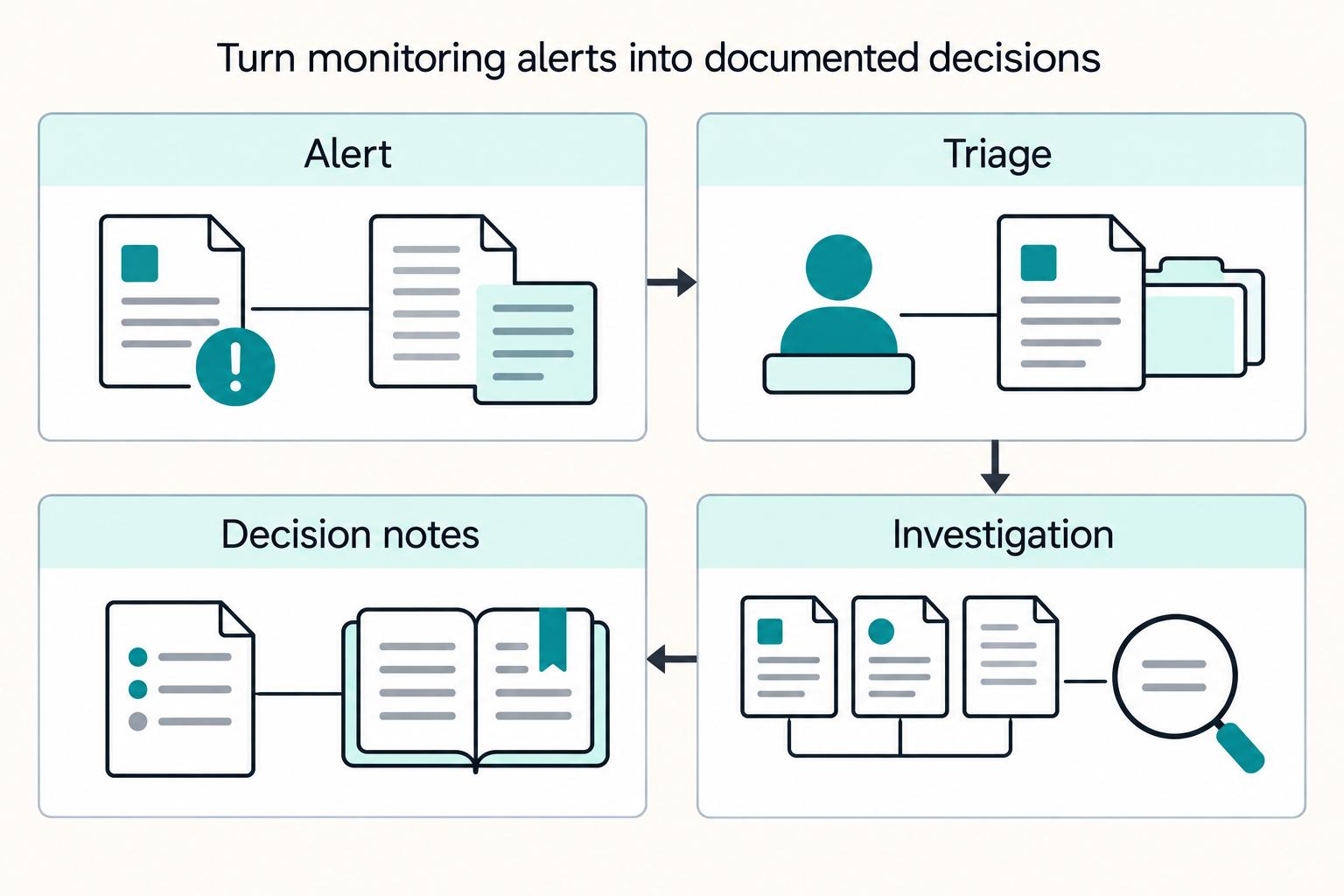
Detection should feed a consistent case-management flow from alert creation to disposition. Keep the path simple and repeatable: detect, triage, investigate, disposition, and close with decision notes.
Set SLA expectations by risk and payment timing, not as one blanket timer. When settlement happens in seconds, decision windows shrink. If analysts cannot decide in time, teams may delay or cancel payments by default.
Tune for signal, not volume#
When noise is high, adding rules or lowering thresholds is usually the wrong first move. The better loop is to review closed alerts by rule and segment, keep high-signal rules, redesign low-value rules, and track override reasons in a structured way.
If analysts clear most alerts as harmless, retune thresholds and segmentation before adding more rules. Use tools like simulation or shadow rules to test changes before broad rollout, then keep iterating as behavior changes.
Handling AML holds and SAR escalation cleanly#
AML holds need to be narrow, evidence-based, and easy for another reviewer to follow. Release should depend on a complete case record, not memory or chat history: what triggered the hold, what was reviewed, what changed, who approved release, and when.
Place holds for unresolved risk, not queue management#
A hold is a risk control action, not a backlog tool. If your team cannot state the hold reason clearly in one sentence and tie it to the case evidence, the basis is not ready.
Keep the case file defensible before release. Under the Bank Secrecy Act, recordkeeping supports a transaction paper trail, so the file should show event sequence, evidence reviewed, decision, approver, and timestamp. Before releasing, confirm the record answers both questions:
- What specific concern caused the hold?
- What evidence resolved or narrowed that concern enough to move funds?
Make SAR escalation ownership explicit#
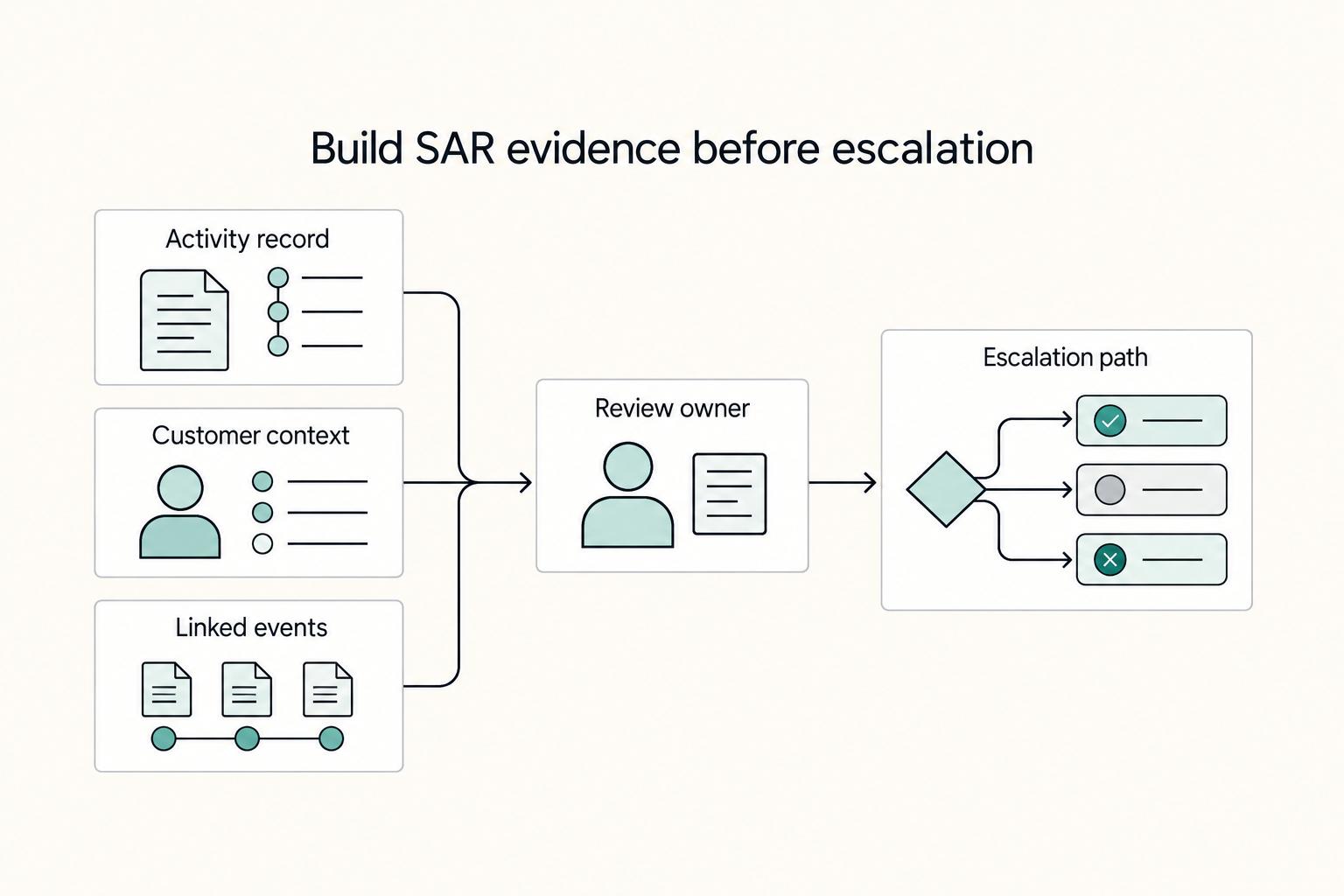
If concern remains after review, move from internal review to a documented Suspicious Activity Report (SAR) escalation path. Because FinCEN is the designated administrator of the Bank Secrecy Act, your written process should clearly map who owns FinCEN-related filing responsibility in your program. It should also show how the case package is transferred and tracked.
At minimum, define:
- who can place and maintain an AML hold
- who can approve release
- who can escalate a case for SAR consideration
- who owns transferring facts, records, and decision notes to the filing owner
Ambiguity here is a control failure, because cases stall when ownership is unclear.
Keep customer updates narrow and factual#
Customer updates should explain status and next steps without over-disclosing internal suspicion logic. Keep messages short, neutral, and consistent, and request only the information needed to move review forward. Log what you requested, what was received, and when. That evidence trail matters for both release decisions and later review.
Choosing build vs buy vs hybrid for AML operations#
For most early-stage teams, hybrid is the practical starting point: buy screening and monitoring tooling to launch faster, and keep policy decisions, case management, and accountability in-house.
This choice is strategic because it affects launch speed, control, and execution under scrutiny. Full internal builds can offer the most control, but long cycles can become a risk when delivery lags market changes.
| Model | Control depth | Speed to launch | Staffing burden | Audit readiness |
|---|---|---|---|---|
| Build | Highest control over rules, data model, and review logic | Slowest if you are building screening, monitoring, and reviewer tooling from scratch | Highest internal burden across engineering, compliance, and ops | Strong only if you also build disciplined evidence capture, versioning, and exportable records |
| Buy | Lower control over core system behavior | Fastest path to working screening and tooling | Lower tooling burden, but internal reviewers and vendor oversight still required | Can be solid if records and history are usable outside day-to-day workflows |
| Hybrid | High control where judgment matters, with vendor support for commodity checks | Faster than full build, slower than pure buy | Moderate, because policy and review quality stay internal | Often the best balance when internal case records and exports are clearly defined |
Where vendors help most vs what stays internal#
Vendors are strongest on repetitive, data-heavy functions: transaction monitoring, sanctions screening, PEP screening, adverse media screening, and related tooling. Some also advertise continuous operational coverage.
What should stay internal is the judgment layer: risk appetite, policy thresholds, escalation criteria, release authority, and case management standards. Use vendors for detection and workflow support, but keep decision rights over why an alert was cleared, held, escalated, or moved to [SAR] consideration.
What outsourcing does not change#
Outsourcing AML operations does not transfer final accountability away from your company. If a provider runs parts of screening, monitoring, or suspicious activity reporting support, you still own oversight and outcomes.
This is where operating models often fail in practice: alerts in one system, approvals in email, and customer communications in chat. Controls may exist, but the audit trail becomes hard to defend.
Lock-in checkpoint before commit#
Treat vendor lock-in as an evidence risk, not just a pricing risk. Before signing, verify that you can export alerts, dispositions, and audit-trail history in a usable format. Check for:
- sample exports with alert records, reviewer dispositions, timestamps, and linked case notes
- clear history of rule changes, reviewer actions, and status transitions
- ability to retain records outside the vendor platform without losing review context
A practical way to decide is to score build, buy, and hybrid against your own scalability and compliance capacity. Start hybrid, then insource selective components after alert quality and ownership are stable.
If your AML rollout also touches EU platform reporting, What Is DAC7? EU Platform Reporting Directive Explained covers that reporting lane separately.
Rolling out AML in the first 90 days#
Treat the first 90 days as a practical rollout frame, not a universal legal deadline. Start by defining risk scope and ownership, then implement core controls, then embed monitoring with supervision.
| Period | Focus | Key actions |
|---|---|---|
| Days 1-30 | Scope, obligations, and ownership | Document the AML obligations that apply to your model; complete a risk assessment across customer, product, channel, and jurisdiction; define policy gates and explicit outcomes at each gate; confirm who owns release authority and policy changes |
| Days 31-60 | Baseline controls before expanding complexity | Make baseline screening and verification controls reliable and auditable; keep clean records for each decision, including what triggered review, which policy version applied, and the final disposition; keep month-two scope tight |
| Days 61-90 | Embed monitoring with supervision and feedback loops | Turn on transaction monitoring in a narrow, staged way tied to your real money flows; run a fixed operating cadence for rule review, backlog triage, and policy updates; use a formal go or no-go check for new corridors |
Start with scope, obligations, and ownership#
Use Days 1-30 to lay the foundation. Document the AML obligations that apply to your model, and complete a risk assessment you can operate from across customer, product, channel, and jurisdiction.
Then define policy gates at key points in your money flow and make outcomes explicit at each gate: proceed, escalate for review, hold, or block. Confirm who owns release authority and policy changes before expanding scope. Early programs stall when accountability is unclear.
Implement baseline controls before expanding complexity#
Use Days 31-60 to make baseline screening and verification controls reliable and auditable. Focus on clean records for each decision, including what triggered review, which policy version applied, and the final disposition.
Keep month-two scope tight. Trying to launch every control and workflow at once usually creates backlog and weak execution rather than stronger coverage.
Embed monitoring with supervision and feedback loops#
Use Days 61-90 as the embedding phase. Turn on transaction monitoring in a narrow, staged way tied to your real money flows, and expand only after outcomes are stable.
Run a fixed operating cadence for rule review, backlog triage, and policy updates, and include supervision through file reviews, feedback loops, and repeat audit activity. For new corridors, use a formal go or no-go check: revalidate jurisdiction obligations, confirm control coverage, and update policies before launch.
ACH adds its own timing and return-risk patterns to AML reviews. What Is ACH? The Automated Clearing House Explained for Platform Operators is useful if U.S. bank-transfer flows are in scope.
Building the evidence pack auditors and partners will ask for#
Your evidence pack should let an auditor or partner reconstruct any decision end to end without interviews or guesswork. Keep it exportable on demand, and include:
- a control inventory with each control, owner, trigger point, and current status
- decision logs for onboarding, alert, hold, release, and escalation outcomes
- case management records with timestamps, reviewer identity, evidence reviewed, and final disposition
- audit trail exports that show full event history, not only the latest state
Do not rely on screenshots, chat threads, or inbox searches as the primary record. Test this by pulling one closed case and checking whether you can trace what happened, who decided, and which policy or rule version applied at the time. If that version link is missing, treat it as a real control gap.
Track policy and rule changes with a version number, effective date, and reason for change, then stamp that version into each alert or case decision record. This is what makes past decisions defensible when current logic is different.
For FinCEN-facing matters, keep filing evidence and support materials together in a restricted location. FinCEN administers the BSA, and that framework emphasizes maintaining a transaction paper trail, so your internal escalation record, filing evidence, and follow-up correspondence should stay organized for clean response handling.
If your company or a related filer also has an FBAR obligation, keep amendment and submission records precise. FinCEN Form 114 is due April 15th, with an automatic extension to October 15th; corrections require a new complete FBAR marked as an amendment and the Prior Report BSA Identifier. A common failure is saving the corrected form but not the identifier or the technical acceptance or rejection message.
For the U.S. filing and enforcement side of AML, What is FinCEN? A Guide for Freelancers and FinTech Users explains FinCEN's role.
The practical takeaway for platform operators#
Treat AML as a live operating discipline, not a one-time onboarding checkbox. If your policy gates, case management, and audit trail cannot hold up under partner review or audit, you are not ready to scale payout volume.
- Run controls as one connected program: Signup checks alone are not enough. Onboarding, transaction review, escalation, and recordkeeping need to work together, especially because payout flows are also scrutinized and illicit funds can exit as seemingly legitimate disbursements.
- Build a minimum viable control set, then tune it: Start with clear, consistently applied controls for onboarding, activity review, alert handling, and suspicious-activity escalation when needed. Then tune based on alert outcomes and operational friction instead of adding rules before the decision path is reliable.
- Move fast only after evidence is defensible: In bank-fintech partnerships, banks retain AML/BSA accountability and often have audit rights over partner compliance procedures. Keep evidence complete and easy to reconstruct: policy and version history, customer and beneficial ownership details where relevant, alert and case records, and exportable decision logs. Where the applicable regime requires it, design retention and retrieval for at least five years.
If you cannot explain a decision end to end without improvising, do not scale that flow yet. Related reading: Platform Payout Volume: What Counts?. Before expanding into new corridors, confirm market-specific compliance coverage and operating constraints with Gruv.
Frequently Asked Questions
What is AML in fintech and platform payments?
If you searched what is AML, it means Anti-Money Laundering: rules and controls designed to prevent illicit funds from being concealed in the financial system. In platform payments, that usually means a written program plus customer checks, ongoing due diligence, monitoring, escalation, and reporting where required. AML is not a one-time onboarding task. It is an operating discipline that has to support suspicious-activity detection and defensible records for audits and partner reviews.
Is AML the same as KYC?
No. KYC is part of AML, not a substitute for it. KYC focuses on identifying the customer and assessing whether funds come from legitimate sources, while AML also includes the broader compliance program, ongoing due diligence, monitoring, training, and suspicious-activity reporting controls.
When does a platform need KYB in addition to KYC?
It depends on your product, jurisdiction, and partner program requirements. A practical signal is when legal-entity customers are in scope, because risk-based monitoring includes maintaining and updating customer information, including beneficial ownership information for legal entities. Use your written program and legal guidance to define the exact trigger instead of treating KYB as always required.
What typically triggers an AML alert or AML hold?
There is no universal threshold set that fits every platform. AML controls should be tailored to your business risk profile, with procedures that can detect potentially suspicious activity and route it for review. Your alert and hold criteria should be documented in policy and applied consistently, not improvised case by case.
What is a Suspicious Activity Report and who files it?
A Suspicious Activity Report (SAR) is used when suspicious activity must be reported by the obligated regulated entity. U.S. regulators, including FINRA and the OCC, publish SAR-related guidance, but the filing owner depends on your legal and program structure. For platform teams, the key is a clear escalation path to the party with filing responsibility. For more detail, see What is a Suspicious Activity Report (SAR) and When to File One.
What data should we retain for AML audits and partner reviews?
Keep enough information for another reviewer to reconstruct each decision end to end. That typically includes customer identifying information, beneficial ownership information for legal entities where applicable, your written AML program and version history, control inventory, alert and case records, and full audit-trail exports. A quick check is to sample a closed case and confirm you can trace the trigger, evidence reviewed, decision, and policy version in force at that time.
Try a related tool
Researched and edited by the Gruv editorial team. Gruv builds cross-border billing, payouts, and finance-operations software for global businesses.
Sources
- archive.ics.uci.edu/ml/machine-learning-databases/bag-of-words/v...trusted
- bsaaml.ffiec.gov/manual/OfficeOfForeignAssetsControl/01trusted
- bsaaml.ffiec.gov/manual/RisksAssociatedWithMoneyLaunderingAnd...trusted
- bsaefiling.fincen.gov/docs/XMLUserGuide_FinCENFBAR.pdftrusted
- congress.gov/crs-product/R47255trusted
- cs.princeton.edu/courses/archive/spring18/cos226/assignments/...trusted
- fdic.gov/banker-resource-center/bank-secrecy-act-anti...trusted
- ferc.gov/news-events/events/increasing-real-time-and-...trusted
Educational content only. Not legal, tax, or financial advice.
Related Posts
What is a Suspicious Activity Report (SAR) and When to File One
When activity looks off, the next move is to capture facts and escalate through the right channel without making accusations. The goal is a response that is proportionate, traceable, and easy for a regulated reviewer to follow.

What Is FinCEN for Freelancers and FinTech Users
If you are asking **what is fincen**, focus first on the decision in front of you. FinCEN, the Financial Crimes Enforcement Network, is tied to FBAR filing through FinCEN Form 114 when foreign financial accounts create reporting duties. By the end, you should know whether to act now, gather records, or escalate.

What Is a Politically Exposed Person and How to Decide Next Steps
Use this guide to make one clear onboarding call each time: proceed with standard checks or escalate before funds move. The goal is simple: cleaner onboarding, fewer payout surprises, and AML records you can defend later.