
Quick Answer
ACH is a U.S. electronic bank-transfer network that moves money between banks and credit unions in batches of credits and debits. For platform operators, it is often a fit for payouts, recurring debits, and account-to-account transfers that can tolerate business-day timing, but it is not a guarantee of immediate finality. Limits, fees, processing windows, and same-day availability can vary by institution and program.
ACH Basics for Platform Operators#
Platform teams usually ask what ACH is when they are choosing a U.S. bank transfer rail for payouts, recurring debits, or account-to-account movement. The useful answer is not a dictionary definition. It is whether ACH fits the promise your product makes on timing, certainty, and operational effort.
At its core, the Automated Clearing House is a network for electronic money transfers between banks and credit unions in the United States. The Federal Reserve describes it as a nationwide batch network through which depository institutions send each other electronic credit and debit transfers, with two national operators. The practical takeaway is simple: this is a bank-to-bank rail with batch processing, not a guarantee of immediate finality.
The first mistake is assuming fast entry means a finished payment. Consumer-facing guidance from the CFPB says ACH payments may clear on the same business day they are entered. Same Day ACH has existed since 2016, with settlement occurring four times a day and a Nacha-stated per-payment limit of $1 million in the cited material. Even so, that same guidance also says payments can take days to complete. If your checkout, payout, or ledger treats "submitted" as "done," you will create avoidable support and reconciliation pain.
The next trap is treating ACH as uniform across every bank or provider. It is not. Banks and credit unions may apply their own transfer limits and per-transaction fees. One of your first launch checks should be to confirm processing windows, amount limits, fee treatment, and whether same-day options are actually enabled in your program. Do not let product copy imply a universal speed or limit that your institution has not agreed to support.
Return risk is the other reality to budget for early. An ACH transaction can be returned for nonpayment if there is not enough money in the account. So the launch decision is not just "can we send or collect funds?" It is also "how will we handle a payment that looks posted and later fails?" You need to know who owns the exception and what state the customer sees while that is unresolved.
By the end of this article, you should have a practical checklist for four decisions that often get split across teams and then collide in production: timing assumptions, return handling, fee and limit constraints, and reconciliation. If finance, ops, and engineering agree on those before launch, ACH becomes a manageable rail instead of a quiet source of risk.
What ACH is and what it is not#
ACH is a U.S. electronic bank-transfer network for moving money between depository financial institutions in batches of credits and debits. Operationally, that means ACH is bank-to-bank, electronic, and batch-based.
ACH is also not a synonym for every electronic transfer. It is one type of Electronic Funds Transfer (EFT), and common ACH transaction labels are ACH Direct Deposit and ACH Direct Payment. If your onboarding says "EFT" when you specifically mean ACH, users can misread timing, fees, and processing expectations.
Most importantly, ACH is not a guaranteed instant rail, and it is not a wire transfer. ACH is batch-based with cited one- to three-day settlement expectations, and same-day entry does not guarantee same-day completion. If your product promise depends on immediate availability, your copy needs to name the rail accurately.
A practical line for product copy and support is: "ACH is a U.S. bank transfer method between bank accounts; delivery time, limits, and fees may vary by institution and program." Before publishing that language, confirm your program terms for cutoffs, same-day availability, amount caps, and fee treatment.
How an ACH payment actually moves from request to settlement#
Submission is not settlement. An ACH payment moves through distinct handoffs, so your product statuses should reflect where the payment actually is instead of collapsing everything into one "success" state.
The handoffs#
A typical ACH flow is:
| Step | Handoff | Detail |
|---|---|---|
| 1 | Payer authorization | One-time or recurring for debits |
| 2 | Bank detail capture | Routing number and account number |
| 3 | Origination | ODFI (Originating Depository Financial Institution) |
| 4 | Routing | ACH Operator (the Federal Reserve or The Clearing House) |
| 5 | Posting | RDFI (Receiving Depository Financial Institution) |
If authorization records or bank details are weak, avoidable exceptions usually show up later in ops and support.
Who sets the rules#
Nacha (the Electronic Payments Association) sets the operating rules used across participating institutions. Your actual timing, limits, and fee treatment can still vary by bank or program, so verify those before product copy implies guaranteed outcomes.
Also keep authorization evidence tied to the exact bank details and transaction request submitted. That record matters when a payment is questioned or returned.
Statuses your teams should not blur#
Use a status map that separates customer action, network movement, and bank posting. This is an internal control, not a universal ACH taxonomy.
| Internal status | What it should mean |
|---|---|
| requested | Authorization captured; bank details collected; not yet sent |
| submitted | Sent by you or your provider to the ODFI for origination |
| pending | In processing through the ACH path and not yet posted |
| posted | The RDFI has posted the entry |
| returned | The transaction was returned, including possible nonpayment such as insufficient funds |
| under review | Held for risk, fraud, AML, or operational investigation |
Do not mark a payment "completed" just because it was entered or even cleared the same day. ACH transactions can still take days to complete due to processing and fraud/AML safeguards, so in your UX, treat "submitted" as movement and "posted" as receipt.
Related: What Is Positive Pay? How Platforms Protect Against Check Fraud and Unauthorized ACH Debits.
Want a quick next step? Try the free invoice generator.
ACH compared with wire transfer and instant payments#
Choose the rail based on the promise you make to users. If urgency is high and the cost of delay is severe, wire is usually the better fit. If you need lower-cost, repeatable recurring flow, ACH is often the default candidate. If your promise is immediate availability, evaluate instant payments first and keep ACH as a fallback where coverage is limited.
ACH and wire are both EFTs, but they differ in timing, cost, and operational risk. Instant payments are a different operating model again, with near-instant movement and continuous processing instead of business-day batching.
| Rail | Speed expectations | Reversibility risk | Cost pattern | Operational overhead |
|---|---|---|---|---|
| ACH payment | Often one to two business days; Same Day ACH exists, and some transfers can still take a few days | Do not treat submission as final; returns and exceptions can follow | Generally free or inexpensive relative to wire | Lower unit cost, but requires strong status handling, reconciliation, and return ops |
| Wire transfer | Domestic wires initiated early often settle the same day | Generally more definitive and harder to unwind, but not absolutely irrevocable in every scenario | Higher cost than ACH | More front-end verification because errors are expensive |
| Instant payments | Immediate or near-instant availability with 24/7/365 processing | Recall/exception handling varies by rail and provider | Fee treatment varies by institution and program | Requires coverage checks and support readiness for always-on promises |
Where ACH wins#
ACH usually wins when cost control and predictable bank movement matter more than immediate availability. It is often the practical choice for recurring debits, scheduled payouts, and account-to-account flows that can tolerate business-day timing. Same Day ACH can reduce delay, but it is still not the same operating experience as RTP or FedNow.
When to step up to wire or instant payments#
Use wire when timing and failure cost outweigh unit economics. Evaluate instant payments first when your product promise is immediate access to funds, especially outside business hours. In both cases, confirm actual program behavior before launch.
Your key checkpoint is contractual: verify your institution's cutoffs, supported rails, program-specific fees, and return/exception windows in your bank or provider agreement. If any of that is unclear, treat it as unknown and set customer-facing timelines to the slowest verified case.
Where ACH fits in a platform payments architecture#
Place ACH at the bank-transfer layer, and keep your ledger as the system that determines balance state. ACH moves funds bank-to-bank; your internal records decide when that movement is pending, posted, reversed, payable, or available.
In a platform stack, an ACH payment typically shows up in four operational points:
- Collection and invoicing to pull funds from a customer bank account after an invoice or scheduled charge
- Wallet ledger posting to record balance effects as asynchronous bank events arrive
- Payout initiation to send outbound disbursements (for example, direct deposit-style credits)
- Exception handling to process returns, duplicate event delivery, missing bank details, and late status updates
This placement matters because ACH is a U.S. bank-to-bank EFT processed in batches through the ACH network and operates separately from card networks. Your invoicing layer creates intent, your ACH API submits and tracks, and your ledger records state changes over time.
Connect ACH to the right modules#
For inbound bank transfers, connect ACH to your collection layer and, where supported, to Virtual Accounts for routing incoming transfer activity. For outbound flows, connect ACH to payout orchestration so it can run alongside wire transfer and instant-payment options when supported.
| Flow | Module | Use |
|---|---|---|
| Inbound bank transfers | Collection layer | Connect ACH to your collection layer |
| Inbound bank transfers | Virtual Accounts | Routing incoming transfer activity, where supported |
| Outbound flows | Payout orchestration | Run alongside wire transfer and instant-payment options when supported |
Before you submit anything, validate required ACH fields: receiving institution, account type, ABA routing number, and recipient account number. If this data is wrong or stale, exceptions can surface later, so your flow should hold funds in a pending path and return clear errors to ops.
Build vs buy where reconciliation gets painful#
Treat build-vs-buy as an operations decision, not just an API decision. Manual CSV uploads to bank portals are slow and error-prone, so automation is usually the baseline. The real question is whether your team owns webhook intake, idempotent retries, replay handling, and audit evidence, or relies on provider surfaces for more of that workflow.
Treat the ledger as the source of truth, and reconcile provider references to internal journal events before you release funds or close payouts. Keep traceable records for each payment leg so support and finance can match request, provider event, and ledger outcome when exceptions appear.
Failure modes that break ACH programs and how to contain them#
ACH programs usually fail in exception handling, not in submission. If you treat a submitted item as settled, ignore returns, or allow payout eligibility before risk checks clear, losses show up late and are harder to unwind.
Returns can come from simple human error or more complex issues, and they create real operational cost through fees and rework. Nacha oversees the ACH Network, so poor return handling is a program-risk issue, not just a support issue.
The failures that show up most often#
| Failure mode | What it looks like operationally | Containment move |
|---|---|---|
| Returned ACH transaction (including insufficient funds) | Transaction is submitted, then comes back unpaid | Keep ledger state pending until posted; retry only under a written rule |
| Account or routing mismatch | Item fails because account or routing details are wrong or stale | Verify bank details before first debit or payout |
| Fraud or unauthorized activity flag | Bank or provider rejects or reviews the item | Stop retries, hold movement, escalate to risk/compliance |
| Delayed posting | Product or support treats funds as available before posting completes | Separate submitted, pending, and posted states in product and ops workflows |
Use one retry rule across teams: retry only when the return reason supports retry. For insufficient funds, a controlled reattempt may be appropriate under policy; for bad account details or fraud flags, repeated retries usually add fees and noise.
Map controls to owners before volume arrives#
Do pre-debit verification before the first pull or payout. Return-code handling should have explicit ownership across teams:
- Payments ops: daily return review, outreach, manual holds, retry decisions within policy
- Engineering: status mapping, event reliability controls, and guardrails so returned items are never shown as complete
- Risk/compliance: escalation decisions when returns indicate fraud, policy abuse, or identity risk
Keep one evidence trail per item: original request, bank details used, provider reference, return/review reason, and linked ledger entries.
Governance gates before payout eligibility#
Do not treat "bank account added" as payout-ready. Put policy gates before the first outbound movement: KYC (identity verification and risk assessment), plus AML/KYB checks where your program requires them.
Positive Pay can help reduce unauthorized debit and check risk, but it does not replace ACH return-handling discipline. You still need pre-debit verification, return-code triage, retry rules, and clear ops-engineering escalation.
For a step-by-step walkthrough, see Confidentiality vs. NDA: What's the Difference for Freelancers?.
Implementation checklist before you turn ACH on at scale#
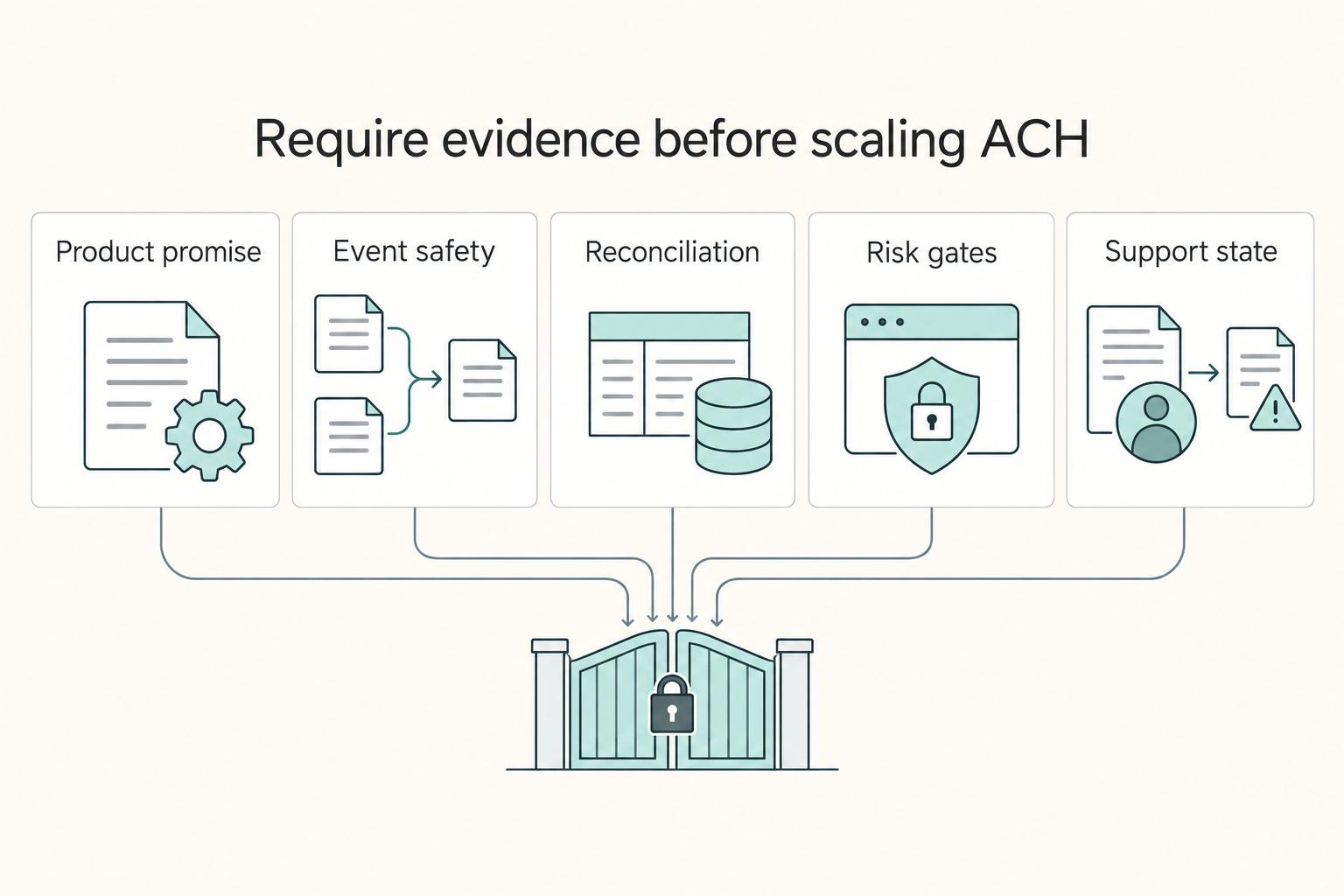
Do not launch ACH at scale until each function can show evidence for its role, exceptions, and reconciliation path.
| Owner | Required sign-off | Evidence to collect before launch |
|---|---|---|
| Product | Customer promises match real payment-state behavior | Clear status definitions; customer disclosure language that timing can vary by institution and program; documented limits and cutoff assumptions |
| Engineering | Event handling is repeatable and state-safe | Test artifacts for idempotent retries, webhook replay safety, status-transition integrity, and traceability from provider reference to ledger journal |
| Finance | Money movement is explainable end to end | Reconciliation proof for sample ACH flows, exception-queue visibility, and evidence that returned items reverse or hold the correct ledger entries |
| Risk | Eligibility and exceptions have named ownership | Written payout-gating rules, documented return-handling SLA, escalation path for suspicious activity, and sign-off on sanctions-screening assumptions (OFAC prohibitions vary by program) |
| Support | Frontline responses are accurate and consistent | Macros/scripts for delayed posting, returns, and reattempts; alerting path; evidence support can view payment state and provider reference |
Require a test packet, not verbal confirmation:
- One test where the same webhook is delivered twice without double-posting
- One test where a retry does not create duplicate ledger movement
- One test where an invalid status transition is blocked
- One test where finance can trace provider reference to the exact journal entry
Keep policy artifacts in one shared location: documented limits, cutoff assumptions, return-handling SLA, and customer disclosure language. Also confirm whether ACH onboarding collects or retains personal information in ways that change your incident-response obligations; for example, Maryland says businesses collecting and retaining personal information about Maryland residents must notify residents if that information is compromised.
Run one operations drill before go-live by simulating a returned ACH payment and confirming:
- Alerts route to the right owner
- Customer messaging reflects the actual state
- Reattempt logic follows written rules
Do not launch until exception ownership is named and reconciliation evidence is complete.
Related reading: What Is FinCEN for Freelancers and FinTech Users.
Compliance and tax boundaries platform operators should confirm early#
Set this boundary early: document exactly what your payout program supports, and keep product language aligned with what your provider and bank documentation actually confirms. Do not promise broader coverage before ops has verified supported countries, account formats, and settlement behavior.
Keep payout eligibility and tax reporting as separate states in your system. A payee can be eligible for payout while tax intake, storage, and reporting are still pending. If those states collapse into one "verified" label, support and finance errors usually follow.
Use a simple ownership matrix and evidence pack:
- who owns payee onboarding and eligibility checks
- who owns tax form intake and record retention
- who owns year-end reporting and recipient delivery timelines
For marketplaces and payment apps, Form 1099-K is a concrete planning anchor. The IRS states that payment card companies, payment apps, and online marketplaces are required to file Form 1099-K and send the recipient copy by January 31. The same IRS guidance says Form 1099-K should be used with other records to determine and report taxable income, so finance exports should preserve usable transaction detail.
If you support globally distributed payees, plan for adjacent tax-reporting questions even if you are not giving tax advice. For example, the IRS says the physical presence test applies to U.S. citizens and U.S. residents, and uses 330 full days during 12 consecutive months; the 2026 maximum foreign earned income exclusion is $132,900 per person. Operationally, that means clean payout histories, country fields, and date-based reporting matter.
What to do next if ACH is on your roadmap#
Start by defining the job ACH needs to do: lower cost, broader U.S. bank coverage, or less ops burden. ACH is common for U.S. account transfers, but it should be a deliberate rail choice, not your automatic default.
If cost control is the main goal, ACH is often a strong candidate for recurring collections, direct deposit, and similar flows. One vendor source says ACH can be up to 75% cheaper than card interchange, but treat that as directional and model your own economics. If your product promise depends on immediate availability, evaluate faster rails first; if timing certainty matters more than price, keep a wire option.
Pick success metrics before the pilot#
Run a controlled pilot and judge the full path from initiation to posting, not just submission. Modern ACH processing may run in multiple settlement windows per day, while posting still varies by institution and program.
| Metric | How to measure |
|---|---|
| Posting time | Median and p95 from submitted to posted |
| Return rate | By count and dollar value |
| Reconciliation effort | Manual touches per 100 payments or unmatched provider references |
If finance cannot reconcile provider references to your ledger without manual work, the rollout is not operationally ready.
Get constraints in writing before rollout#
Confirm program terms in writing so product promises match real behavior. Capture cutoff times, transaction caps, fees, same-day eligibility, posting behavior, and return/exception responsibilities, then keep that with contract terms, implementation notes, and support escalation paths.
Watch for avoidable gaps: marketing promises "same day" while receiving-bank posting is slower, or teams assume all ACH/direct-deposit flows behave the same across providers. If legal or compliance language depends on regulatory text, verify against an official edition rather than an informational prototype page.
Design ACH as one rail in a broader strategy#
Use mixed rails when the use case demands it. Demand for faster and instant payments is rising, so ACH should sit inside routing rules as one managed option, not a universal answer.
A practical approach: route ACH where U.S. bank coverage and lower cost are the priority, route urgent or promise-sensitive flows to faster rails, and reserve wire transfer for cases where timing certainty is critical. That usually creates clearer user promises and fewer support escalations.
Frequently Asked Questions
Is ACH the same as EFT?
No. ACH is a type of Electronic Funds Transfer, not a synonym for every EFT rail. If your product says bank transfer, it helps to name whether you mean ACH, wire transfer, or an instant payment rail because timing and cost can differ.
How long does an ACH payment usually take in real operations?
A practical expectation is 1 to 3 business days for many ACH transfers, but timing is not uniform across every bank and program. Same Day ACH can settle in as little as a few hours for eligible payments, but you still need to verify your bank's cutoffs and posting behavior. If a payment seems missing, the bank, credit union, or payment initiator is the right place to check, not Nacha.
Can ACH be same-day and still not be fully completed?
Yes. Same-day refers to eligible processing and settlement timing, not a blanket promise that every downstream step is finished. A pending direct deposit can mean the bank has notice but has not yet received the funds, so submitted, pending, and posted should stay separate in your status model.
Can an ACH payment be returned after it looks successful?
Yes. Return risk can continue after initial success signals. A transfer can look successful in your app because it was submitted or posted, while unauthorized issues may still be reported within limited time windows. Keep the provider reference, timestamps, and bank response data so finance and support can trace what happened.
Do ACH limits and fees come from Nacha or from each bank/program?
Both matter, but they do different jobs. Nacha rules govern ACH processing roles and responsibilities, and Nacha states Same Day ACH allows payments of up to $1 million. Your actual fees, lower caps, cutoff times, and account-level controls usually come from your bank or provider program, so confirm those in contracts.
Is ACH appropriate for international payouts?
Usually not as a default answer. The ACH Network is a U.S. electronic payments network that reaches U.S. bank and credit union accounts, so it is best treated as a U.S. bank rail unless your provider documents a specific cross-border program. If payees need funds to non-U.S. accounts, get the supported countries, account formats, and settlement path in writing before launch or marketing that capability.
Try a related tool
Researched and edited by the Gruv editorial team. Gruv builds cross-border billing, payouts, and finance-operations software for global businesses.
Sources
Includes 1 external source outside the trusted-domain allowlist.
Educational content only. Not legal, tax, or financial advice.
Related Posts
What Is Negative Churn? How Platform Operators Achieve Revenue Expansion Without New Customers
Growth can flatten long before demand does. When customer losses and plan step-downs keep compounding across a growing subscription base, new sales have to work harder each month just to hold your ground. That is why revenue retention matters so much to founders, revenue leaders, product teams, and finance operators. It shapes medium- and long-term growth, not just this quarter's headline number.
What Is Positive Pay? How Platforms Protect Against Check Fraud and Unauthorized ACH Debits
Positive Pay works best when you treat it as a control process, not a feature you turn on in a bank portal. For platform teams, the real question is not "do we have it?" It is "can we show who reviewed each exception, who approved or rejected it, and whether that happened before cutoff?"
What is Cyber Liability Insurance and Do Freelancers Need It?
**Treat cyber coverage as part of your system, not a checkout decision.**