
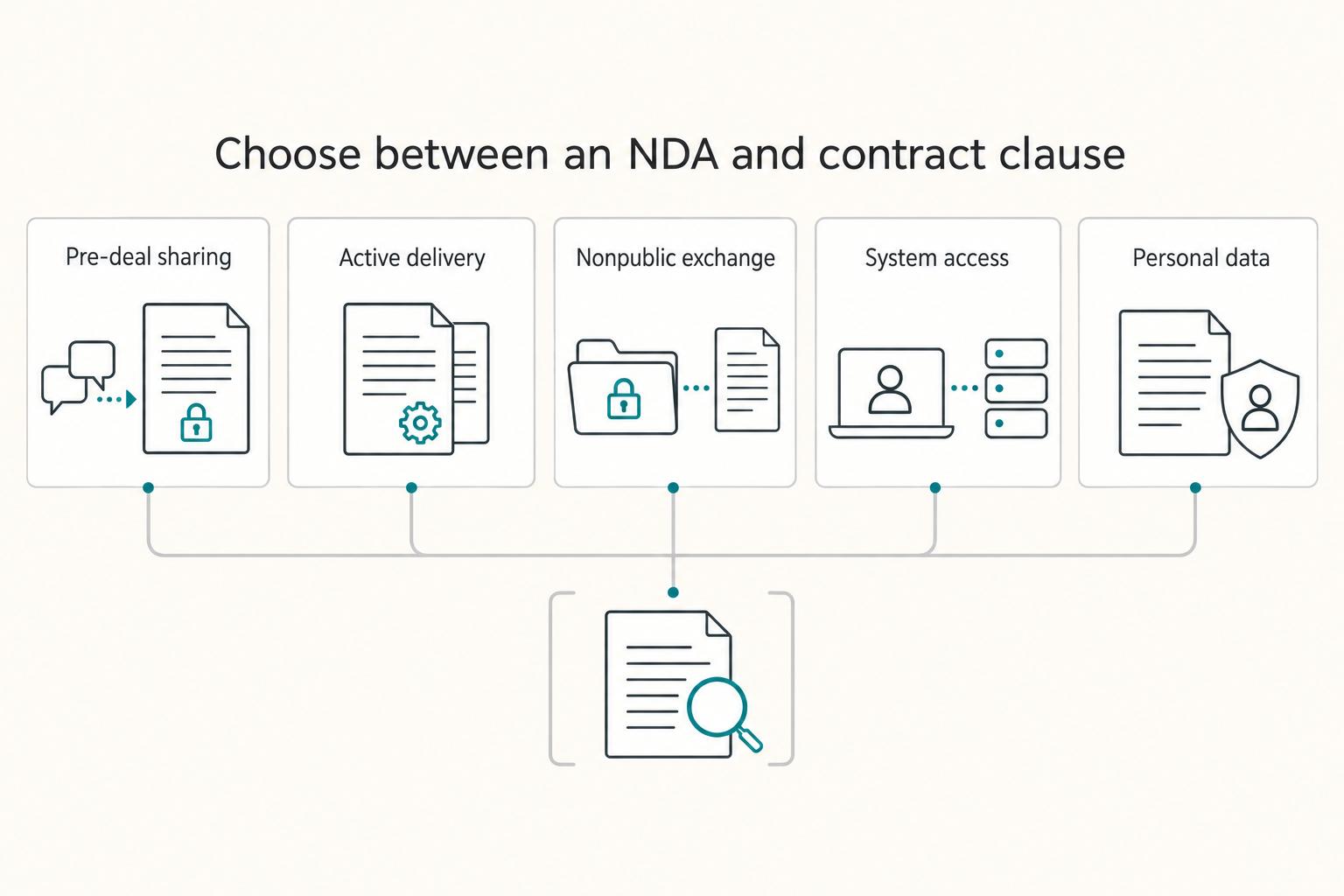
Quick Answer
A confidentiality clause is part of a broader contract; an NDA is usually a separate confidentiality agreement. Choose the format that covers the information, purpose and timing of your work. An NDA does not automatically end when a services contract starts. If you process personal data on a client’s behalf under GDPR or UK GDPR, include the required Article 28 terms, either in the contract or an addendum.
Confidentiality clause vs NDA: choose structure and timing for the phase of work#
A client wants to send unreleased product screens before you have agreed the project. A standalone NDA can cover that exchange. Once a services agreement exists, its confidentiality clause can govern handling during delivery. The useful choice is which signed terms cover each disclosure, rather than which document has the better label.
An NDA and a confidentiality clause can impose similar contractual obligations to protect information and limit its use. Their enforceability depends on the wording, formation and applicable law. Neither format automatically transfers IP ownership or authorises all uses of the disclosed material.
Practical framing: phase, scope, workflow#
Use this as a simple filter to match the document to the moment you're in.
| Decision point | Standalone NDA (or Confidentiality Agreement) | Confidentiality clause inside your services contract |
|---|---|---|
| Best time to use | Early - including the early stages of exploring a potential business relationship, when nonpublic info starts flowing | Later - once you're operating under a broader services relationship |
| Primary job | Protects nonpublic info shared while exploring the relationship | Protects confidential info inside the delivery relationship |
| What it covers | Confidential Information is defined in the agreement (often including things like proprietary information and trade secrets) | Confidential information is handled within the broader contract terms |
| Paperwork impact | A separate agreement focused on confidentiality | Confidentiality handled as one part of the main deal |
At-a-glance: what to use (and when) - NDA vs confidentiality clause vs both#
Use a standalone NDA when confidential discussions begin before the services agreement. For delivery, use appropriate confidentiality terms in the services agreement or a continuing NDA. Where GDPR or UK GDPR applies and you act as the client’s processor, include the required controller-processor terms in a binding written arrangement.
Compare the coverage and workflow before adding another document:
| Criteria | Standalone Non-Disclosure Agreement (NDA) | Confidentiality clause inside MSA/SOW | Both (NDA + clause) | Article 28 processing terms (contract or DPA) |
|---|---|---|---|---|
| Best timing | Pre-deal (discovery, evaluation) | Active engagement (delivery) | When pre-deal sharing continues into delivery and you want continuity | When applicable GDPR or UK GDPR covers you as a processor for a controller |
| What it is | A standalone contract that defines what stays confidential | A section inside a broader services contract | Two layers that must align | A controller-processor contract that explains what personal data is processed, why, and how |
| What you're protecting | Nonpublic business info shared during evaluation | Client data, systems access, and project info during services | Both phases, if you keep terms consistent | Personal data processing requirements and roles |
| Operational fit | Works even before you agree on price or scope | Ties obligations to deliverables, access, return or deletion on exit | Works if you avoid duplication and confusion | Requires you to define processing details (subject matter, duration, nature, purpose, data types, data subjects) |
| Main risk to manage | Overbroad definition of Confidential Information and missing exclusions | Misalignment with how you actually operate (tools, subcontractors, handoff) | Potential conflicting obligations across documents if you do not harmonize | Real compliance duties once you act as a processor |
| Safe default | Choose unilateral or mutual terms according to which parties disclose information | Put delivery rules in the governing agreement and state how any earlier NDA interacts | Use only when the extra layer adds clarity, not clutter | Include required terms in the contract or an addendum when applicable law and your processor role require them |
Use it like a gate (operator checklist)#
Treat this as a workflow decision, not a paperwork preference:
| Gate | When it applies | What to do |
|---|---|---|
| Gate 1 (pre-deal) | The client wants to share nonpublic details before you have a freelance contract | Sign a tight NDA (or confidentiality agreement) that defines confidential information and includes customary exclusions. |
| Gate 2 (delivery) | You start work under the MSA/SOW | Use the confidentiality clause to control day-to-day handling of client data, access, and offboarding, including return or destruction where applicable. |
| Gate 3 (personal data) | Applicable GDPR or UK GDPR covers you processing personal data on the client-controller’s behalf | Use a binding controller-processor contract / DPA with the specific processing details required under GDPR Article 28 and UK GDPR guidance. |
Verdict#
A practical structure is an NDA for early sharing, delivery confidentiality terms that cover actual access, and Article 28 processing terms when required. You do not need duplicate secrecy promises if one effective agreement already covers the exchange.
Do you need a standalone NDA or just a confidentiality clause in your contract?#
Check whether a signed agreement already covers the planned disclosure. If it does, a second NDA may add no protection. If it does not, put suitable confidentiality terms in place before sensitive information is exchanged.
The practical rule: match the document to the moment#
Treat confidentiality like two operating modes:
- Pre-deal sharing (no MSA yet): sign an NDA. An NDA is a complete, standalone contract focused on secrecy. Use it when you need to review nonpublic info during discovery, evaluation, or due diligence, before you've agreed the full scope of the engagement.
- Active delivery: use confidentiality terms that cover tools, permitted recipients, secure handling and offboarding. They can sit in the MSA/SOW or a continuing NDA; identify the controlling document and resolve overlap.
Here's a clean comparison you can apply to any freelance contract:
| Decision point | Standalone NDA | Confidentiality Clause in Service Agreement/MSA/SOW |
|---|---|---|
| Best time to use | Before the engagement exists | Once work starts and operations matter |
| What it controls | Information shared during discussions | Ongoing handling of client information during services |
| Operational detail | Often lighter | Should include access expectations and offboarding steps |
| Failure mode | Overbroad definitions, missing exclusions | Misalignment with how the work actually happens |
High-risk override + a quick decision pass#
Both documents can be useful when early disclosures and delivery have different requirements. State whether the later agreement supplements or replaces the NDA, what happens to earlier disclosures, and which clause controls if terms conflict.
Run this quick decision pass:
- Are we exchanging anything nonpublic today? If yes, put an NDA (or another written confidentiality agreement) in place first.
- Will I need system access to deliver? If yes, make your Confidentiality Clause in the MSA/SOW do the heavy lifting (access control, secure handling, offboarding).
- Will applicable GDPR or UK GDPR cover me as a processor? If yes, include the required Article 28 terms in the contract or a DPA. They cover processing instructions, confidentiality, security, sub-processors, assistance, audits and end-of-services deletion or return, subject to legally required storage.
Before accessing client data, check permitted recipients, tools, use and retention. Legally required records should have a narrow retention exception and continuing protection. If a subcontractor will process personal data, confidentiality permission alone is insufficient: applicable Article 28 authorisation and downstream terms also matter.
What goes where in the document stack (so you don't sign contradictions)?#
Give each document a defined job and an agreed precedence rule. This prevents a project attachment from silently changing confidentiality, and prevents an earlier NDA from leaving unexpected obligations outside the services liability framework.
The mental model is simple. Relationship rules live in the umbrella agreement. Project details live in the project attachment. Privacy terms can live in the main contract or in an addendum when personal data enters the picture. In plain terms, an MSA sets the long-term rules of the relationship, and an SOW defines the details of each project.
Use a modular stack (and keep each module in its lane)#
| Module | Purpose in plain English | What it should cover | Typical contradiction risk |
|---|---|---|---|
| NDA / CDA | Safe pre-deal sharing so you can evaluate fit | Who can receive info, permitted use, exclusions, term, remedies | Later service contract confidentiality differs (definitions, duration, return duties) |
| MSA (or Service Agreement) | The system for the relationship | Payment mechanics, IP, confidentiality clause, dispute mechanics, liability framework | MSA confidentiality conflicts with earlier NDA, or leaves gaps for real delivery |
| SOW | The what-we-are-doing document | Deliverables, timeline, acceptance, change control, access needs, tools | SOW adds extra confidentiality duties by accident, or introduces data access not covered elsewhere |
| DPA | The personal data rulebook (GDPR contexts) | Controller-processor terms (and other required data processing terms), plus the mechanics the parties need to operate them | DPA obligations do not match confidentiality language, or nobody knows which one controls |
Later service terms can replace an earlier NDA if the agreed wording makes that transition effective. Check the supersession and entire-agreement clauses and preserve coverage for earlier disclosures; do not assume signing the MSA terminates the NDA.
Create one source of truth for confidentiality (and control the handoff)#
Pick the main home for delivery confidentiality and make other documents reference it where appropriate. A DPA can contain additional or mandatory processing terms, so its relationship to the MSA also needs an explicit precedence rule.
| Situation | What to do | Goal |
|---|---|---|
| NDA signed first | Add a clear handoff later so the services documents state whether the MSA confidentiality clause supplements or replaces the NDA. | Avoid conflicts between early and later documents. |
| Drafting the SOW | Reference the MSA confidentiality section instead of expanding definitions or adding new confidentiality obligations. | Keep one authoritative set of terms. |
| You act as a processor under applicable GDPR or UK GDPR | Include the required Article 28 terms in the contract or a DPA; align document precedence. | Make required processing obligations explicit. |
Operational checklist to prevent a confidentiality clause vs NDA mess:
- When you sign an NDA first: add a clear handoff later so your services documents clearly state how the MSA confidentiality clause relates to the NDA (for example, whether it supplements it or replaces it).
- When you draft the SOW: reference the MSA confidentiality section rather than expanding definitions or inventing new confidentiality obligations.
- When applicable GDPR or UK GDPR covers you as a processor: include the required Article 28 terms in the contract or a DPA. Choose a manageable format, map the processing details and align document precedence.
Verdict: Build a modular stack. Consolidate confidentiality into one authoritative set of terms, then make every other document reference it. That is how you keep protection strong without signing contradictions.
Check earlier disclosures during the handoff#
Hypothetical example: you receive an unreleased product brief under an NDA in March and sign an MSA in April. The NDA protects disclosures for three years, while the MSA covers only information received during the services. Simply saying the MSA replaces all earlier agreements could leave the March brief outside the new definition. State whether the NDA survives for earlier disclosures or the MSA expressly includes them, and align recipients, duration, remedies and the cap.
Keep lawful compelled disclosure and protected reporting distinct from portfolio permission. Agree notice and minimum necessary disclosure where legally permitted; do not require client consent that would obstruct a protected report. In the U.S., 18 USC 1833(b) provides specified trade-secret immunity for confidential reporting to an official or attorney, or sealed filings, and its notice provision includes contractors and consultants. Its conditions are limited; it does not authorise public leaks or unlawful access.
What should your freelancer confidentiality terms include (the non-negotiables)?#
Lock in five things: definition, exclusions, permitted use, security, and term. With the stack under control, you now need terms that protect client data without trapping your business.
The must-have clauses (with freelancer-safe defaults)#
Define the protected categories and how information is identified, including disclosures through system access or meetings. A marking requirement can be workable if it fits the exchange; it is not automatically defective. For oral disclosures, agree how they are identified or confirmed. Avoid treating everything you learn as the client’s confidential property.
Next, write your exclusions like you mean them. Standard carve-outs include information you already knew, publicly available information, information lawfully received from others, and independently developed information. Put those exclusions in both the NDA (pre-deal) and the MSA (delivery), so one document does not silently remove your defenses.
Define the permitted purpose for each phase: evaluating the proposed project during discovery, then delivering agreed services. Preserve independently developed materials and general skills without authorising use of the client’s secrets. Confidentiality exclusions and ownership or licensing of pre-existing IP are separate questions.
Security comes next. If personal data enters the workflow, route security and confidentiality through a DPA where required. In UK GDPR contexts, controller-processor contracts call for a duty of confidence and appropriate security measures. Translate that into specific, workable commitments you can actually meet, rather than vague industry best practices.
Separate the agreement’s disclosure period from how long information remains protected. Negotiate a fixed period for ordinary business information where appropriate; two or three years can be a proposal rather than a universal safe term. Trade-secret obligations may continue while the information meets the applicable secrecy, value and protection requirements. Personal-data duties can continue independently of an NDA’s expiry.
| Term element | Possible drafting position | Red flag to edit |
|---|---|---|
| Definition | Clearly identified categories, including access or oral disclosures where needed | Unclear marking rules or an unlimited claim over everything learned |
| Exclusions | Includes prior knowledge, public, third-party lawful receipt, independent development | Missing carve-outs |
| Permitted use | Use only for evaluation or delivery as expressly agreed | Tries to restrict future work beyond not using confidential information |
| Security | Specific measures you can operationalize, aligned with any DPA | Open-ended best practices with no scope |
| Term | Fixed term for most info, trade secret duration handled separately | Confidential forever for all info |
Check each term against how you will actually deliver: which files you receive, which systems you use, who needs access and what remains after offboarding.
Can you show the work in your portfolio if you signed an NDA?#
Sometimes - but only if you have a clear, written permission path (a portfolio carve-out, or explicit client approval). Without that, a Non-Disclosure Agreement (NDA) or confidentiality terms can limit what you share publicly even when you did the work. Once the confidentiality basics are solid, you need a clean path to show outcomes without leaking client data or breaching a separate restriction.
Start with the baseline risk: the heart of an NDA is a prohibition on disclosing the other party's confidential information to third parties. That can cover obvious artifacts (designs, code, dashboards). Some agreements also treat the contents and existence of the agreement as confidential. Translation: even listing the client's name can trigger a breach if you never show a single file.
Build a portfolio path (pick one safe lane and write it down)#
Negotiate a portfolio-use clause or written approval covering exact assets, captions, audience and timing. Anonymized and private versions also need to fit the governing permissions:
| Option | What you can show | What you must avoid | Best for | Operational checklist |
|---|---|---|---|---|
| A: Permission-based | Specific deliverables, screenshots, outcomes, client name (only as approved) | Anything not explicitly approved in writing | High-stakes work, recognizable brands | Ask for written permission. Get exact approved assets, captions, and timing. Store approval with the project folder. |
| B: Anonymized case study | Your process and results without identifying the client | Identifying or confidential material, or use outside agreed permission | Most freelance contract work with tight confidentiality | Obtain approval or an express allowance. Strip identifiers, use mock data and recreated visuals, and check that results remain nonconfidential. |
| C: Controlled, private share | A gated portfolio or private walkthrough for serious prospects | Unapproved disclosure, onward sharing or copying | When you need proof but cannot publish | Obtain permission for the audience and material. Password-protect the approved version and limit onward access. |
If you feel tempted to just post it, stop. Get written permission. Do not assume.
Put the permission in the right documents (and align "publicity")#
Put portfolio rules in writing in whichever document(s) govern the relationship (your service agreement and SOW, and/or the NDA). The key is making sure the language is clear and doesn't conflict across documents.
Finally, scan for a separate no-publicity clause. A clause can bar any public announcement or disclosure regarding this agreement, including its terms and existence, unless required by law. Make sure confidentiality, publicity, and portfolio permissions don't collide so one paragraph doesn't silently override what you thought you could share.
Keep approval with the project file. Anonymization and password protection reduce exposure, but neither automatically makes disclosure permissible.
Want a quick next step for "confidentiality clause vs nda"? Try the SOW generator.
Review remedies, indemnity and liability together#
The cost of a breach depends on the remedies and liability terms as well as the secrecy promise. Review damages, indemnity, legal costs and court remedies together so a cap in one document is not defeated by an exclusion or separate NDA.
A remedies clause matters because it specifies what happens when someone breaches the confidentiality obligations. That outcome typically hides in three places: injunctive relief, liquidated damages, and who pays the lawyers.
Remedies that quietly raise the stakes#
Negotiate scope and costs before signing. A higher fee may compensate for some commercial exposure, but it does not make an unlawful disclosure acceptable or cure obligations you cannot meet.
| Lever | What it is (plain English) | Why it bites freelancers | Safer counter-position you can propose |
|---|---|---|---|
| Injunctive Relief | Court orders to stop an ongoing or threatened disclosure | If your Confidential Information definition is vague, you risk disputes over normal workflow (tools, backups, subcontractors) | Clarify the definition, permitted disclosures and purpose; retain lawful urgent court relief without promising an automatic injunction |
| Liquidated Damages | An agreed damages amount for a specified breach, subject to applicable law | A pre-set payout can override the nuance of harm and context | Remove or narrow the provision; check enforceability and whether any damages cap covers it |
| Fee shifting (attorney's fees) | A contract can award attorney's fees and costs when it explicitly provides for it | A small dispute can turn into a large bill even if the damage stays small | Make it mutual, or limit fee recovery to a final court decision and a prevailing-party standard |
Don't sign one-way financial exposure by accident#
Indemnification clauses (hold harmless) shift risks or potential costs from one party to another. When a confidentiality breach triggers indemnification plus fee shifting, you can end up funding the client's entire defense posture, not just fixing the leak.
If you propose a damages cap, check which claims it covers and which exclusions remain. Confidentiality, indemnity and legal costs may sit outside it unless expressly included. A private cap does not automatically bind regulators or affected third parties, and does not by itself prevent a court injunction.
In practice, you want the confidentiality rules inside the MSA where your liability cap (if any) already lives, or you add a cap directly into the NDA. Use this as your reference point: A Deep Dive into the 'Limitation of Liability' Clause for Freelance Software Developers.
For ordinary contractual audits, propose a proportionate process: notice, frequency, scope, protection of unrelated client records and reasonable use of existing assurance. If Article 28 applies, the processor must provide compliance information and allow and contribute to audits and inspections by the controller or its appointed auditor. A security summary can support that process; it cannot simply replace the mandatory audit right.
Record the cap, exclusions, indemnity triggers, defence control and costs you can actually support. If key risks remain unmanageable, seek revised terms or decline before receiving the information.
Is an NDA enforceable across borders? (Governing Law, Jurisdiction, and dispute design that you can actually use)#
A cross-border NDA can be enforceable, but its effectiveness depends on formation, substantive terms, applicable law and the available enforcement route. Governing-law and forum clauses improve clarity; they do not guarantee a judgment or its recognition abroad.
Cross-border enforcement gets messy because jurisdictions apply different legal standards and interpret contracts differently. You counter that uncertainty with two clauses you should never leave vague: Governing Law (which country's laws apply) and Jurisdiction/Venue (where you fight about it). Those decisions shape whether you can practically act when a client mishandles your work, or when they accuse you of misusing client data.
Pick the dispute design that matches the project size#
Use the same operator logic you used for liability caps. Match process to deal size, and keep the path to enforcement predictable.
| Decision point | Court litigation (chosen jurisdiction and venue) | Arbitration (dispute resolution clause) |
|---|---|---|
| Possible fit | A court with jurisdiction that the parties can realistically access | An agreed arbitration process suited to the dispute, cost and enforceability needs |
| What to negotiate | Governing law, jurisdiction, venue, and whether each side bears its own attorney's fees | Seat of arbitration, rules, number of arbitrators, language, and who pays fees and costs |
| Real cost risk | You may need counsel familiar with the forum you chose | Administrative, tribunal and legal fees can be disproportionate to a small claim; obtain the applicable fee schedule |
| Operator default | Push for your home jurisdiction, or a mutually workable neutral forum | Consider a single arbitrator, proportionate procedure and clear cost allocation; verify mandatory rules and enforcement needs |
Add cross-border "damage control" clauses that reduce chaos#
Agree notice and response procedures while preserving urgent relief and mandatory reporting:
| Clause | What to add | Purpose |
|---|---|---|
| Written notice | Define written notice of an alleged breach and a contact address, without blocking urgent court relief or required reporting. | Adds a defined notice process. |
| Cure language | Specify remediation such as deleting links, rotating credentials and contacting recipients. A cure does not undo every disclosure or remove legal notification duties. | Sets clear remediation steps. |
| Injunctive relief discipline | Identify protected material and the lawful grounds for relief; a contractual recital does not make an injunction automatic. | Prevents everything from qualifying by default. |
A processor arrangement under applicable GDPR or UK GDPR needs the required processing details and obligations, including documented instructions, confidentiality, security, sub-processors, assistance, deletion or return and audits. The terms can be in a contract or addendum. Where a restricted international transfer occurs, instructions and an NDA alone do not supply the necessary transfer mechanism.
If the forum is impractical, request a workable amendment and assess enforceability before accepting. Moving the same wording into an MSA does not cure the problem by itself. For arbitration, check the seat, rules, language, number of arbitrators, costs and availability of urgent relief.
What do I say to the client? (scripts + concessions ladder that preserves the relationship)#
Agree to appropriate confidentiality in principle, then review scope, duration, recipients, portfolio use and remedies before signing. The negotiation order below helps prioritise changes; a successful early concession does not remove the need to check the remaining terms.
The concessions ladder (negotiate top to bottom)#
Start with the information you actually need to receive and disclose. Use this order to prepare a focused request:
| Rank | Ask (what you change) | Why it protects you | What you can offer in return |
|---|---|---|---|
| 1 | Exclusions + permitted use limits in the NDA/MSA | Exclusions prevent accidental capture of your pre-existing materials and general know-how. Common carve-outs include info that is already public, previously known to you, independently developed, or disclosed by a third party without restriction. | Confirm you will restrict use to the project and limit access internally. |
| 2 | Realistic term + survival | NDA term (how long parties can share new info) differs from the confidentiality period (how long disclosed info stays protected). Ask for a time-boxed confidentiality period for general business info. | Agree to longer protection for truly sensitive categories. |
| 3 | Subcontractor permission + confidentiality coverage | Need-to-know recipients require agreed permission and confidentiality duties. Sub-processors also require applicable controller authorisation and processing terms. | Commit to need-to-know access and a clear process for who gets access. |
| 4 | Portfolio Carve-Out (or anonymized case-study allowance) | You need a path to prove work. A practical compliance pattern is a separate, password-protected portfolio section shared only with trusted individuals (a safer workflow, not legal clearance on its own). | Offer client approval rights or timing (post-launch). |
| 5 | Remedies aligned to liability; avoid uncapped indemnity | Injunctive relief means a court order to do or stop doing something. Indemnification can pull in legal defense costs (attorney fees, court costs, experts). Keep both disciplined so one mistake does not become unlimited exposure. | Offer prompt notice, cooperation, and cure steps for accidental disclosure. |
Copy/paste scripts you can send today#
- Happy to sign the NDA. Can we add standard exclusions (publicly known, independently developed, already known, third-party without restriction) so it doesn't accidentally cover my pre-existing materials?
- To keep delivery smooth, can we put the operational confidentiality rules in the MSA/SOW and keep the NDA limited to pre-deal discussions?
- I can agree to confidentiality long-term for Trade Secret material. For general business info, can we set a time-limited confidentiality period (for example, 2-3 years)?
- I don't share client confidential info, but I do need a portfolio path. Can we add a Portfolio Carve-Out for post-launch, or an anonymized case study, or a password-protected private portfolio view?
Micro-checklist (print this before you sign)
- Do the NDA and MSA define Confidential Information the same way?
- Did you include exclusions (public, independent, third-party, already known)?
- Did you separate NDA term from confidentiality period, with a realistic survival period (not forever for everything)?
- Did you review how Indemnification and Injunctive Relief interact with your Limitation of Liability (no stealth uncapped exposure)? See: A Deep Dive into the 'Limitation of Liability' Clause for Freelance Software Developers
- Do Governing Law, Jurisdiction, and dispute resolution still work cross-border?
Keep the request concrete: identify the clause, explain the workflow it blocks and propose wording you can meet. Review the complete revised agreement before accepting it.
Choose coverage you can use throughout the project#
Choose the document that matches when and how information moves, then harden it with liability, data, and enforcement rails. Your job is to deploy the documents in the right order so you protect client data without slowing the deal.
Use the right tool at the right moment (then consolidate)#
For early sensitive discussions, use suitable standalone confidentiality terms if no existing agreement covers them. During delivery, agree how the services confidentiality terms and any NDA interact, including earlier disclosures.
Use this as your operator default:
| Workflow need | Standalone NDA | Confidentiality Clause (MSA/SOW) | Article 28 terms (contract or DPA when required) |
|---|---|---|---|
| Timing | Pre-deal, evaluation, early access | Active delivery, ongoing relationship | When applicable GDPR or UK GDPR covers your processor role |
| What it controls | Disclosure and non-disclosure | Use limits during the work, and return/deletion hooks where agreed | Processing terms (including documented instructions) and end-of-services delete/return terms |
| Best outcome | Covers early sharing without waiting on the full contract | Covers delivery under an explicit supplement or replacement rule, preserving earlier disclosures | Meets the "processor must be governed by a contract" requirement in a GDPR/UK GDPR context |
| Common failure mode | Overbroad definition that captures your pre-existing know-how | Conflicts with the NDA, or no clear exclusions | People treat it as optional and rely on confidentiality alone |
Your freelancer-safe default: safety rails you can defend#
Confidentiality helps, but it does not manage the full risk surface. Build a stack you can run repeatedly:
- Definitions + exclusions: Define Confidential Information tightly, with clear exclusions where appropriate.
- Realistic term: Set a duration you can operationalize, and separate trade secrets from ordinary business info if needed.
- Portfolio path: If you want to show work, negotiate written permission or a carve-out. Do not assume anonymity equals permission.
- Defined downside: Negotiate the damages cap, carve-outs, indemnity and legal costs together. Check statutory exposure and court remedies separately. See Limitation of Liability for Freelance Software Developers.
- Cross-border enforcement: Specify governing law and a workable court or arbitration route, with cost and urgent-relief procedures suited to the project.
When you act as a processor under applicable GDPR or UK GDPR, include the required processing terms and run the corresponding controls. At the end of services, delete or return personal data at the controller’s choice and delete copies unless applicable law requires storage. Agree how protected backups and lawful retention are handled rather than promising deletion you cannot complete.
Finally, systematize it. Keep a one-page contract-gates checklist (NDA, then MSA/SOW, then DPA when needed) so you move fast without signing silent risk.
Frequently Asked Questions
Is a confidentiality clause the same as an NDA?
Not exactly. Usually, the difference is packaging, not purpose. An NDA (Non-Disclosure Agreement) is commonly a standalone agreement, while a confidentiality clause is usually a section inside a broader contract (like an MSA/SOW). In practice, labels vary, so treat both as confidentiality contracts and check the definitions, exclusions, term, and remedies.
Do freelancers need an NDA or is a contract confidentiality clause enough?
It depends on when and how information gets shared. A contract confidentiality clause can cover the work once you're under a broader agreement, and an NDA can be useful when you need a clean standalone for pre-contract sharing. If you already have an MSA/SOW with strong confidentiality terms, you may not need a second document - but avoid contradictions.
Which is better for freelancers: a mutual NDA or unilateral NDA?
Pick the structure that matches the direction of information flow. A unilateral NDA binds only the recipient (often you, when the client discloses). A mutual NDA fits when both sides share confidential information (for example, you share your proprietary methods, templates, pricing model, or pre-existing code).
What should a freelancer's confidentiality clause include?
Include defined protected information, ordinary exclusions, phase-specific permitted purposes, authorised recipients, workable security and retention, and clear duration. Check remedies and document precedence too. Protecting independently developed know-how does not by itself settle ownership or licensing of project IP.
How long should an NDA last?
Distinguish the period for new disclosures from the survival period for information already disclosed. A fixed period can suit ordinary business information; propose a duration matched to the project. Trade secrets may require protection while their legal criteria remain satisfied. An NDA’s expiry does not cancel separate personal-data duties.
Can I put client work in my portfolio if I signed an NDA?
Not by default. Get permission in writing. A practical path: ask for an explicit portfolio carve-out, or request written approval to show specific screens, excerpts, or outcomes. You can reduce risk with anonymization or a password-protected portfolio, but treat those as workflow controls, not legal clearance.
Do I need a DPA as well as an NDA if I handle personal data under GDPR/UK GDPR?
If applicable GDPR or UK GDPR covers a controller using you as a processor, the processing must be governed by the required Article 28 terms. These can sit in the services contract or a DPA; a second standalone document is not always necessary. Map your role first: handling personal data does not automatically make you a processor.
Try a related tool
Researched and edited by the Gruv editorial team. Gruv builds cross-border billing, payouts, and finance-operations software for global businesses.
Sources
Includes 3 external sources outside the trusted-domain allowlist.
- govinfo.gov/content/pkg/USCODE-2024-title18/html/USCODE-...trusted
- govinfo.gov/content/pkg/USCODE-2024-title18/html/USCODE-...trusted
- legal.slac.stanford.edu/resources/ndatrusted
- gov.uk/government/publications/non-disclosure-agree...external
- ico.org.uk/for-organisations/uk-gdpr-guidance-and-resou...external
- ico.org.uk/for-organisations/uk-gdpr-guidance-and-resou...external
Educational content only. Not legal, tax, or financial advice.
Related Posts

Limitation of Liability Clause for Freelance Software Developers
A liability clause sets which losses can be recovered and how much can be claimed. For a freelance developer, the useful starting point is the project risk: a failed acceptance test, an IP complaint, a data incident, or an unpaid invoice. Agree which risks the contract covers before choosing a cap number.

The Freelance Payment Penalty: A Modeled Audit of Platform Fees, FX Spreads, and Payout Delays
The money rarely disappears through a single, easy-to-spot fee. The real loss is stacked. A marketplace takes its commission, a processor adds a charge for international cards, a bank or payment company converts the currency at a spread, a platform holds the funds before release, and a wire sheds a little to intermediaries on the way in. Each layer looks defensible on its own, but the worker feels the combined result as a smaller deposit and a later payday.

How to Respond to a Subpoena for Business Records
Move fast, but do not produce records on instinct. If you need to **respond to a subpoena for business records**, your immediate job is to control deadlines, preserve records, and make any later production defensible.