
Quick Answer
Write a one-page program brief, assign approval and payout owners, set affordable commission and attribution terms, and choose compatible affiliate software. Integrate referral and billing records, test success/refund/duplicate paths without fictitious live transactions, then onboard a small approved pilot. Review partner disclosures, lawful tracking, customer quality and a reconciled payout ledger before broad recruitment.
Set up a SaaS affiliate program from terms through payout#
An affiliate program creates a channel that touches customer acquisition, attribution, payouts and margin. It can start as a small pilot, provided partners understand the terms and you can track what they earn.
This matters early, not after you have a growing partner list and a payout backlog. SaaS attribution is rarely a straight click-to-sale path. Trials, upgrades, downgrades, and multi-user signups can play out over weeks or months, so a casual setup breaks fast. Programs without clear ownership usually stall. Treat this like revenue operations from day one.
Before you look at software or start inviting partners, make one decision: this channel gets the same discipline you already give billing and support.
| Operating area | Side project execution | Operating channel execution |
|---|---|---|
| Ownership | One person makes ad hoc calls when issues appear | Each decision has a named owner, even if that owner is you wearing a specific hat |
| Payout controls | Commissions are approved whenever someone remembers | Payouts follow a schedule with clear qualify, hold, release, and reject states |
| Documentation | Terms live in email threads or DMs | Rules, commission terms, and exception notes live in one current record |
| Disclosure workflow | You assume partners will disclose properly | You set a disclosure expectation, review it, and keep proof when needed |
| Escalation handling | Complaints sit until they become urgent | Disputes have an owner, a review path, and a defined response window you can keep |
Step 1. Assign ownership by decision, not by title#
Start by naming the decisions this channel creates: partner approval, commission approval, payout release, and escalation handling. If you are a solo operator, that does not mean one undifferentiated inbox called "me." It means defining when you are acting as growth owner, finance owner, or final approver.
Use a simple checkpoint. You should be able to answer these questions in under a minute: Who approves a new partner? Who can place a commission on hold? Who clears exceptions? Who closes a dispute? If any answer is vague, you are still in side-project mode.
Step 2. Set the payout logic from your unit economics. Commission design should come from LTV, CAC, and retention, not from what looks generous on a signup page. The tradeoff is straightforward. Too low and good partners ignore you. Too high and you damage profitability.
Hypothetical: contribution LTV is $2,000 after service costs but before acquisition costs, and target total CAC is $400. Expected qualifying first-year revenue is $1,200. At 20% commission for the first 12 months, commission is $240. With $100 of other per-customer acquisition costs, total CAC is $340. A 25% tier for affiliates generating at least 10 qualifying customers per month would cost $300 plus $100 = $400 if the same revenue and costs hold; state whether the tier applies prospectively and to which customers. These are illustrative terms, not market benchmarks. A 20% lifetime commission on $2,000 of revenue would already cost $400 before other CAC, and contribution LTV is not interchangeable with revenue. Model churn, refunds and actual collection before choosing a rate or promising lifetime commissions.
Prioritize quality over raw partner count. One consultant sending ten qualified leads a month can outperform a large pool of generic affiliates sending weak traffic.
Step 3. Complete the before-you-start checks. Before launch, make sure the core controls exist and live in one place.
- Growth owner: write partner approval criteria, rejection reasons, and the channels or claim types you will not accept.
- Finance owner: define when a conversion qualifies for payout and what can trigger a hold or rejection.
- Policy owner: write your disclosure expectation and save the current partner terms in one version-controlled document.
- Operations owner: verify which countries, currencies, and payout rails you can actually support before inviting partners in those markets.
- Founder: set one recurring monthly review to check signup volume, customer quality, churn, and expansion revenue.
A practical evidence pack helps more than a polished dashboard. Keep the current terms, partner approval notes, commission exceptions, and payout decisions together. When something feels off, you need records, not memory.
A failure mode that can show up early: a strong partner sends a wave of new trials, your dashboard shows promising conversions, and then commissions go on hold because your payout rule only counts accounts after the qualifying paid event. The recovery path should already be clear. Wait for the billing state to settle, reconcile the credited accounts against your written rule, then release or reject on the next payout cycle with a note the partner can understand. Writing that hold reason in advance prevents avoidable disputes later.
What should you prepare before launching your SaaS affiliate program?#
Finalize your operating controls before you touch any platform settings. You should be able to say, in plain language, who gets approved, what counts as a payable conversion, and which records are required before payout. If any of that is unclear, pause launch.
| Pre-launch step | What to define |
|---|---|
| Write a one-page launch brief | Offer scope, target partner types, commission approach (one-time or recurring), and launch KPIs |
| Assign named decision owners | Partner approvals, payout approvals, and disputes or exceptions |
| Map policy and compliance gates | Disclosure expectations, promotion rules, payout-threshold logic, hold triggers, and attribution basics |
| Define intake rules by partner type and market | Required profile data, payout details, and tax or identity documents by partner segment and supported market |
Step 1. Write a one-page launch brief. Define offer scope, target partner types, one-time or recurring commission and launch KPIs: affiliate-driven signups, incremental paid revenue/MRR, total affiliate-channel CAC and referral-to-paid conversion. If economics or tracking are uncertain, use a limited pilot with explicit terms instead of wide recruitment.
Step 2. Assign named decision owners. Set clear owners for partner approvals, payout approvals, and disputes or exceptions. If you run this solo, still split these as explicit roles so decisions stay consistent. Your quick test: can you answer who can approve a partner, hold a commission, reject a payout, and close an escalation?
Step 3. Define promotion and attribution rules. State allowed ads, brand bidding and coupons; payout timing, threshold and hold triggers. Choose and document the attribution model, window, link-versus-coupon priority, existing-customer rules and trial-to-paid event. A 60–90-day window is only an illustrative choice, not a verified universal norm.
Step 4. Define intake rules by partner type and market. Decide required profile data, payout details, and tax or identity documents by partner segment and supported market before live onboarding. The goal is not a universal template. It is a written intake map your team can apply the same way every time.
| Readiness area | Pre-launch deliverable | Who verifies |
|---|---|---|
| Partner data and payout records | Required profile, payment, and tax/identity fields by partner type and market | Approval owner + finance owner |
| Event schema | Event list, trigger point, and required fields for attribution and payout decisions (including trial-to-paid logic) | Growth owner + payout owner |
| Webhook replay handling | Written process for retries, duplicate deliveries, failed sync review, and deduplication checks | Operations owner |
| Commercial policy | Commission model (one-time vs recurring), payout-threshold logic, and promotion restrictions | Founder or channel owner |
Recurring commissions can align affiliates with retention, but they are more complex to run and can increase total payout over customer lifetime. Use a hard launch gate: if ownership, policy logic, or required records are incomplete, do not onboard partners yet. Related: How to Create a Marketing Plan for Your Freelance Business.
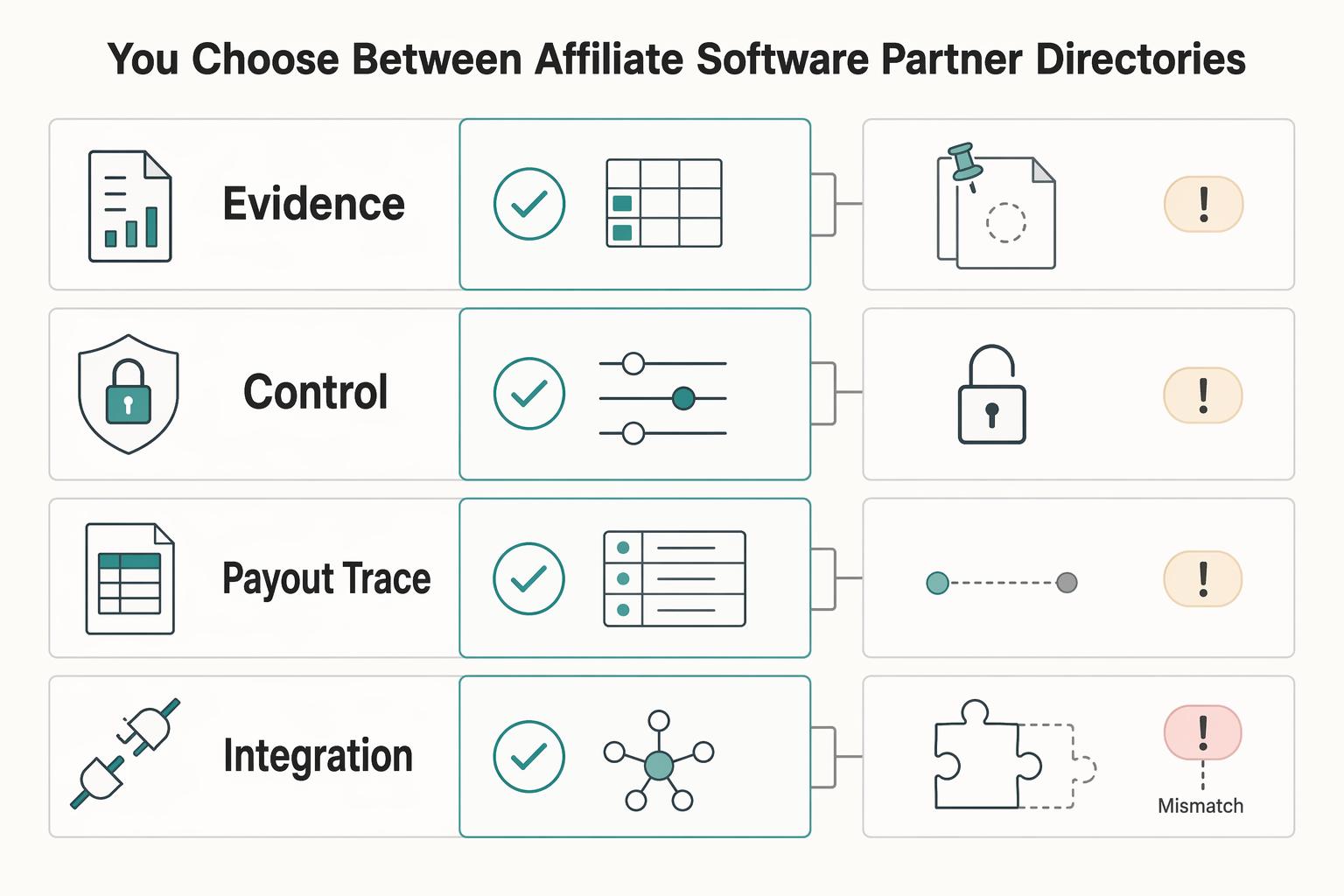
How do you choose between affiliate software and partner directories?#
Pick your primary operating platform first, then decide whether to add a directory for discovery. That sequence keeps your launch decisions tied to your growth constraints, operational capacity, and market reality instead of tool hype.
Rewardful’s setup guide describes connecting Stripe, configuring a campaign and integrating the website, with commissions associated with paid invoices. PartnerStack’s commission guide distinguishes program approval, pending payment, funds available and withdrawal. Check your actual billing integration, plan and payout coverage before choosing either. A directory can help discovery; it does not replace your program’s approval, attribution and payout records.
Use this decision matrix before you commit:
| Evaluation point | What to confirm for a primary platform | What to confirm for an optional directory | Launch check |
|---|---|---|---|
| System-of-record ownership | Your team can clearly name where final partner status, terms, and payout decisions are managed | Discovery does not replace your operating workflow | Everyone gives the same answer on where final decisions happen |
| Workflow control depth | You can run onboarding, approvals, and exception handling with a documented process | Directory intake does not force process workarounds | You can explain the path from application to payout without ad hoc patches |
| Dispute traceability | You can reconstruct how a referral was credited and why a payout decision was made | Directory role is limited to source visibility | You can review one disputed case end to end |
| Integration fit with payout/compliance flow | The tool fits your existing payout and compliance gates in practice | Directory is optional to that flow | A test partner can move through your process without manual gaps |
Use reviews and communities to build a shortlist, then verify each option with your own workflow test. Social proof can help you find options, but your final choice should come from what your team can actually operate with clear controls.
Pressure-test quality before launch. A known failure mode in affiliate programs is clicks that do not convert, so your monitoring and partner-mix optimization need to be ready before you add more discovery volume. Also confirm your partner basics are in place: branded assets, a partner hub with FAQs, and a clear commission structure.
Do not launch until you can state three things in one line: your primary platform, your optional directory channel (if any), and the owner for term governance and exception decisions.
Build your program rules before you invite a single partner#
Before you recruit anyone, lock your rulebook so each partner decision resolves the same way. Clear terms reduce disputes and help you avoid downstream operating problems.
Step 1. Set eligibility and traffic boundaries in yes-or-no language. Define who can join, which promotion methods are allowed, and what leads to Hold or Reject. Your terms should explicitly cover commission type, payout thresholds, and promotion rules (including paid ads, coupons, and branded search). If you offer recurring commissions, state which subscription period qualifies and when commission eligibility ends.
Step 2. Anchor commission qualification to an explicit event and evidence. For example, use a successfully collected first invoice after trial, then define which renewals qualify. Record the attribution model/window and precedence for competing links/coupons. Separate registered, approved, active, accrued, held, approved-for-payment and paid states: approving a partner or commission does not complete a payout. Test the referral-to-paid path in the platform’s sandbox/test facilities and verify the separate live configuration.
| Rule domain | Trigger | Required evidence | Decision owner | Resulting state |
|---|---|---|---|---|
| Eligibility and traffic | Application submitted or traffic method reviewed | Application record, channel URLs, accepted terms version, declared promotion method | Program owner | Approve, Hold, Reject |
| Payout qualification | Conversion reaches qualifying event | Trial-to-paid record, cookie-window match, affiliate link or coupon record, billing status | Finance or payout approver | Accrued, Hold, Approved for payment; Paid only after payout confirmation |
| Compliance and disclosures | Initial review, policy breach, or pre-payout exception | Required identity/business details, disclosure confirmation, breach notes (if any) | Compliance reviewer or delegate | Approve, Hold, Reject |
| Tax and VAT path | Onboarding complete or before first payout | Applicable tax/provider documentation and billing/tax treatment for the actual partner, payer and service | Finance or tax reviewer | Review, Hold where justified, Approved for payment |
Step 3. Resolve applicable tax and provider requirements before release. Do not treat every affiliate program as a bank subject to the same KYC/AML duties, or classify all commissions as VAT-exempt/zero-rated. Establish the payer, partner status, service location and provider’s documented requirements. For U.S. tax documentation, W-9 is for a U.S. person; W-8BEN generally documents a foreign individual, while foreign entities generally use the applicable W-8 such as W-8BEN-E. Other situations need different forms; W-8BEN is not the treaty-exemption form for personal services performed in the U.S. Collect required forms through restricted channels, not a public partner profile. Personal-service income is generally sourced where services are performed, not simply where the SaaS company or payer is located.
Step 4. Scenario-test hold and release before launch. Run at least three edge cases through your workflow: missing identity data, disputed attribution within the cookie window, and incomplete tax records before payout. Each case should end with a documented state change (Approve, Hold, Reject, or Paid) and an evidence trail. If any case ends in "we'll sort it out later," do not invite partners yet.
Give partners disclosure instructions and check them#
For U.S.-facing endorsements, the FTC guidance calls for clear, conspicuous disclosure of a material connection when needed. Give plain wording beside the recommendation/link, such as “I earn a commission if you buy through this link,” adapted to the actual relationship. “Affiliate link” alone may not communicate that payment connection. Train partners, sample their promotions and address missing disclosures or unsupported product claims; delegating promotion does not remove the advertiser’s responsibilities. Check other markets’ rules separately.
A cookie window is a commercial attribution setting, not permission to track. Under current UK ICO guidance, storage/access technologies for online advertising and associated tracking require consent. Check the actual technology and jurisdictions, respect rejection/withdrawal and explain involved parties/purposes. A first-party cookie or server-side event is not an automatic exemption. Define how legitimate claims will be handled when consent or browser limitations leave an attribution gap, without silently bypassing the user’s choice.
For a step-by-step walkthrough, see How to Create a Referral Program for Your SaaS Product.
Set up tracking payouts and compliance gates step by step#
Once your rules are written, your next job is to make the workflow consistent from intake through approval, partner activation, and payout prep.
| Step | Key action |
|---|---|
| Use affiliate sign-up as intake plus screening | Collect channel, partner type, country and payout preference; request applicable sensitive documents through a restricted flow |
| Segment partners early so payout prep stays clean | Group partners by geography, and keep currency and payment preference visible in the same record |
| Configure activation assets so intent is clear | Include product information and links, provide destination-specific text links, and preload common banner sizes |
| Map every hold reason to required remediation evidence | Keep hold reasons directly on the partner record |
| Run an end-to-end dry run and keep artifacts together | Save the application record, approval decision, welcome message copy, active link list, and payout export draft |
Step 1. Use affiliate sign-up as intake plus screening. Collect channel/website, country, partner type and supported payment preference. Identify which tax/identity records are actually required; request them securely at the appropriate stage. Test missing required fields and ensure registration does not silently activate commission earning.
Step 2. Segment partners early so payout prep stays clean. Group partners by geography from day one, and keep currency and payment preference visible in the same record. Regional payment preferences and tax requirements vary, so this segmentation should happen before your payout cycle starts. For cross-border partners, document one clear handling path and assign ownership so your team can support and reconcile it consistently.
Step 3. Configure activation assets so intent is clear. Your welcome message should include product information and links to resources, not just an approval notice. Provide destination-specific text links, for example product pages, campaign landing pages, and blog pages, so traffic routing is explicit. If you use banners, preload common sizes: 300×250, 250×250, 160×600, 300×600, and 125×125.
Step 4. Map every hold reason to required remediation evidence. Keep hold reasons directly on the partner record so approvals and payout prep are traceable.
| Hold reason | What you require to release |
|---|---|
| Missing website details | Updated website or channel URL in the partner profile |
| Missing country | Country field completed |
| Missing tax information | Applicable documentation verified through the restricted tax/provider workflow, with status recorded in the profile |
| Missing preferred payment method | Payment method selected and saved |
| Unclear routing links | Partner switches to approved destination-specific links |
Step 5. Run an end-to-end dry run and retain the artifacts. Use supported sandbox/test facilities for one incomplete and one complete application, welcome message, link, simulated paid event, refund/void and payout-export draft. Do not create fictitious live customer transactions to test. Keep approval, accepted terms, message, active links and reconciliation evidence together; separately verify live settings before the real pilot.
How do you prevent abuse and handle disputes without slowing growth?#
Prevent abuse without slowing growth by running one consistent triage workflow: intake every trigger, build a case file, then close each case as review, hold, or clear with a named owner.
Step 1. Route every trigger into one intake queue. Keep ownership explicit: affiliate manager for intake, ops for record checks, finance for payout release only after clearance, and a brand/legal owner for escalations tied to brand impersonation, trademark misuse, or branded PPC issues. Use dedicated monitoring where possible, because these violations are easy to miss without it. Require four fields before anyone starts discussing a case: partner ID, trigger source, first-seen time, and current payout status.
| Control option | Use case | What to verify | False-positive check | Evidence | Operating effort |
|---|---|---|---|---|---|
| Manual spot checks | Small pilot or selected cases | Coverage and review cadence match the volume | Review a flagged case against actual terms | Timestamped observation and decision log | Staff time for each check |
| Rules-based monitoring | Repeated promotion or attribution patterns | Alerts reflect documented rules and reach the owner | Validate alerts before blocking valid commissions | Rule version, alert, supporting records and action | Configuration and ongoing review |
| Journey/attribution reports | Disputes about competing touchpoints | Reports available in the selected tool, with known tracking gaps | A longer journey is context, not proof of wrongdoing | Referral/billing IDs and report context | Interpretation and reconciliation |
Step 2. Build a complete case file before deciding. Store an ordered timeline, source-of-truth system records, screenshots or destination-link evidence, payout state, and the full communication log. Map each fact to the relevant policy clause, promo rule, or payout rule. Run a quick consistency check before closure: would this same evidence have produced the same outcome in a similar recent case?
Step 3. Record the decision and next action. Clear a case when evidence and terms align, hold an affected item when a documented issue needs resolution, or escalate for deeper review. Give the partner a reason and review date. Verify actual tax/withholding and platform dispute rules instead of leaving every payout indefinitely pending. Preserve the version that applied when a commission was earned; do not apply a new rule retroactively without the applicable agreed/legal basis.
Run a monthly operating cadence that keeps the program audit-ready#
Use a monthly close to keep your program auditable, but do not treat it as a monthly-only control. Keep faster checks between closes, because traffic quality can shift daily and fraud patterns can shift weekly.
Step 1. Build one month-end review pack and assign one owner. Use the same pack format every month so you can trace decisions quickly. If your workflow uses an internal ledger, payout batch record, provider confirmation, and exception log, link them in one place so payout questions do not get lost across tools.
Step 2. Review the same three lanes in the same order. This keeps you from overreacting to one loud metric while missing a weaker risk signal.
| Lane | Primary signal | Escalation trigger | Decision outcome |
|---|---|---|---|
| Partner engagement | Active affiliate rate, partner churn, affiliate-base diversity | Activity concentrated in too few partners, or many approved partners with little real activity | Keep source mix, coach partners, or reweight partner acquisition channels |
| Financial performance | CAC, conversion rate, AOV, affiliate-driven LTV | Growth while acquisition efficiency weakens or conversion quality drops | Keep commission structure, review partner mix, or reduce spend on weak sources |
| Operational efficiency | Fraud rate, tracking accuracy, manual workload | Exceptions rising, tracking issues, or heavy manual cleanup before payout | Resolve issue, hold affected payouts, or escalate for deeper review |
Step 3. Reconcile payouts before the next cycle. Link qualifying billing events to commission calculation, holds/adjustments, approval, funded batch and provider outcome. Approval or export is not proof the partner received funds. Keep pending/failed items open; check the original transfer status and identifiers before any retry so one commission is not paid twice.
Step 4. Assign an owner and follow-up action for recurring issues. Track repeat holds, resolution quality, and false-positive patterns that create avoidable work. For each recurring pattern, log the owner, next action, and next review date so the same issue does not roll forward unowned.
Step 5. Treat channel mix and onboarding as risk controls. If low-quality partners are draining budget, reweight the sources that send them. If unresolved exceptions keep rolling month to month, pause new approvals, clear the backlog, update approval criteria, and reopen only when queue quality is stable.
Copy and paste launch checklist#
Do not invite partners until each control below passes. Treat this as a go-live gate: if one step fails, pause and fix it before you scale.
| Checkpoint | Pass or go condition | If not |
|---|---|---|
| Assign decision rights before launch | Every decision right has one owner, one backup, and one timestamped log location | Pause and fix it before you scale |
| Confirm readiness and economics before recruitment | Measured or explicit pilot economics, clear paid-event tracking and a commission plan you can fund; require stronger cohort evidence before broad recruitment | Pause and fix it before you scale |
| Lock terms and compliance gates before approvals open | Every case resolves cleanly to approve, hold, or reject | Pause and fix it before you scale |
| Validate tracking and payout flow end to end before go-live | Run one controlled test and keep the log as launch evidence | Pause and fix it before you scale |
| Run a controlled pilot and make a strict go/no-go call | Go only when exceptions are explainable and stable | No-go when the same hold reasons repeat, attribution needs manual fixes, or retention breaks your commission economics |
| Scale only after the first monthly close is clean | Explain every payout, hold, and dispute from one evidence pack | Hold growth until the backlog stops growing |
- Assign decision rights before launch.
You should name one primary owner and one backup for each decision: approve partner, release payout, clear hold, escalate dispute. Document where each decision is logged, who can override it, and who is notified when a case changes state. Pass when every decision right has one owner, one backup, and one timestamped log location.
- Confirm readiness and economics before recruitment.
Check expected qualifying revenue, contribution LTV, total CAC, commission duration, refunds and retention before recruitment. State whether churn means customers or revenue and over which period; a bare “5–10% churn” band is not a usable launch standard. Use the worked commission example as a worksheet, not a prescribed rate.
- Lock terms and compliance gates before approvals open.
Publish versioned terms with commission base/rate/duration, attribution/window, coupon priority, allowed promotion, disclosures, payout timing/threshold, refund/hold and dispute rules. Record applicable provider/tax requirements for accepted markets and resolve uncertainty before the affected release. Keep earning, approval, payment pending and paid distinct.
- Validate tracking and payout flow end to end before go-live.
Run supported sandbox tests for signup, conversion, renewal, refund/void, denied tracking consent and duplicate events; inspect live settings separately. Record simulated results without fictitious live charges or claiming a sandbox proves bank receipt.
| Control area | What you validate | Pass condition | Fallback action |
|---|---|---|---|
| Attribution | Trial-to-paid event flow | One qualifying event produces one commission under the chosen rules; refunds and renewals receive the correct adjustment | Pause launch, fix event mapping, rerun test |
| Cookie setting | Stored attribution window | Chosen window is saved; rejection/withdrawal of required tracking consent is respected | Recheck platform settings and retest |
| Links or coupons | Partner link/coupon attribution | Test conversion credits the correct partner | Disable the broken path and use one method until fixed |
| Payment integration | Stripe or API payment event handling | Successful billing event credited once; repeated delivery does not create another commission or payout | Stop invites, inspect retries, rerun full test |
If you see duplicate credits, missing paid events, or untracked payouts, do not use manual cleanup as your launch plan.
- Run a controlled pilot and make a strict go/no-go call.
Start with a small approved group whose traffic sources you understand. Review conversion quality, dispute reasons, and payout exceptions before expanding. Go only when exceptions are explainable and stable. No-go when the same hold reasons repeat, attribution needs manual fixes, or retention breaks your commission economics.
- Scale only after the first monthly close is clean.
Reconcile platform records, payout records, current partner terms, and your exception register in one review. Then decide to scale, hold pilot size, or pause approvals. Pass when you can explain every payout, hold, and dispute from one evidence pack. If unresolved exceptions roll forward, hold growth until the backlog stops growing.
Launch with control then scale with confidence#
Do not scale on signup volume alone. Expand only when your pilot, first payout, and monthly close all show the same pattern: partner quality is reliable, exceptions are stable, and payout decisions are fully traceable.
Step 1. Run a controlled pilot and score quality before reach. Start with a small group of partners whose traffic sources you understand. Review referred signups, paid conversions, churn signals, hold reasons, and payout exceptions as one picture. Your go signal is explainable partner behavior, stable exceptions, and clear payout evidence, not raw click growth. If one segment keeps generating unclear conversions or repeated holds, pause that segment before expanding.
Step 2. Operate from one system of record and one rulebook. Use one platform to record approval status, attribution, commission state, hold reason, dispute notes, and payout release. Keep one current version of partner terms, and log each approval-to-release decision with owner and date. If you cannot trace a payout to the partner record, conversion record, and release rule, fix that first. Otherwise, manual management becomes your bottleneck as volume rises.
Step 3. Verify workflow coverage before widening channels. Before you add channels or partner types, confirm your setup supports integrated tracking and order-status triggers so invalid payouts are blocked and reconciliation gaps are reduced. Document any uncertain capability as pending product, platform, or policy verification.
| Signal | What good looks like | Escalation trigger | Required action |
|---|---|---|---|
| Partner quality | Referred customers are consistently aligned with your target profile | Fast volume with repeated holds or weak retention signals | Pause that segment and tighten approval rules |
| Exception stability | Holds and disputes stay explainable over time | The same exception keeps repeating month to month | Fix root cause before adding new approvals |
| Payout clarity | Each release has matching conversion and approval evidence | Missing notes, duplicate credits, or unclear release basis | Stop release, reconcile records, and retest |
Step 4. Use monthly close as your final scale gate. Review the same evidence pack each month: platform records, payout records, current terms, and the exception log. Scale only channels and partner segments that pass every gate above, and defer expansion while unresolved exceptions keep rolling forward.
Frequently Asked Questions
What is a SaaS affiliate program?
A SaaS affiliate program rewards outside partners for generating tracked leads or conversions. Keep written partner terms in place before launch so commission and promotion rules are clear.
How is that different from a referral program?
For this operating distinction, an affiliate program recruits external promoters under tracked commission terms; a customer-referral program rewards existing users for introductions. The terms can overlap and names vary. Define eligible participants, earning events and rewards rather than assuming the label determines them.
Should you use affiliate software or a directory first?
A practical approach is to launch and run the affiliate network on a single platform first. Whatever discovery channels you use, visibility alone should not replace tracking and payout controls.
Are you ready to launch, or should you wait?
Use a small pilot when the offer, retention assumptions, commission economics and tracking are clear enough to honor the terms. Wait on broad recruitment if you cannot measure paid outcomes, fund earned commissions or explain attribution. Review signups, incremental MRR, total CAC, conversion and retention together.
What tracking setup matters most before you invite partners?
Track the referral, trial/signup, successful paid event, renewals and refunds against the chosen model/window. Define coupon-versus-link precedence and existing-customer treatment. Test lawful consent rejection and browser/tracking limitations as well as the happy path; a saved cookie window does not guarantee every conversion can be attributed.
Can you approve everyone first and clean up quality later?
Review brand fit, target-customer alignment, declared traffic methods and acceptance of the program terms before activation. Registration alone should not activate commission earning. Keep reviewed and activated states separate so approvals are explicit.
Which terms are non-negotiable?
State the qualifying event, commission base/rate/term, attribution and coupon precedence, payout schedule/threshold, refund/hold rules, promotion/disclosure duties and dispute path. Resolve applicable provider/tax requirements for the intended markets before release. Separate approval from completed payout, and identify who can change terms and when changes apply.
What records should you keep for disputes, fraud checks, and audits?
Retain the applicable terms version, partner approval, referral and billing IDs, commission calculation/adjustments, hold reason, decision owner and payout confirmation. Include relevant disclosure or promotion evidence and communications. Set retention from applicable law and documented need, restrict sensitive records and avoid keeping every browsing/identity detail indefinitely.
Try a related tool
Researched and edited by the Gruv editorial team. Gruv builds cross-border billing, payouts, and finance-operations software for global businesses.
Sources
Includes 4 external sources outside the trusted-domain allowlist.
- ftc.gov/business-guidance/resources/ftcs-endorsement...trusted
- irs.gov/forms-pubs/about-form-w-9trusted
- irs.gov/instructions/iw8bentrusted
- help.rewardful.com/en/articles/2044650-what-is-rewardfulexternal
- ico.org.uk/for-organisations/direct-marketing-and-priva...external
- rewardful.com/guides/affiliate-onboardingexternal
- support.partnerstack.com/hc/en-us/articles/360009501113-How-do-I-get-...external
Educational content only. Not legal, tax, or financial advice.
Related Posts

LinkedIn for Freelancers Who Want a Predictable Client Pipeline
Treat LinkedIn as two jobs you run at the same time: a credibility check and a conversation engine. If you only chase attention, you can get noise. If you only send messages, prospects may click through to a thin profile and hesitate.

Build a Freelance Marketing Plan You Can Run Every Week
A usable **freelance marketing plan** starts with one business result, not a pile of activity. If a task cannot be tied to pipeline movement, client acquisition, or revenue, cut it before it takes up calendar space.

How to Create Your Own Online Course
If you want this to become a real revenue line, treat it like a product decision, not a content project. This guide helps you make the important calls in the right order: define the offer, choose the platform that fits it, and move from outline to published course without avoidable rework.