
Quick Answer
Define who earns each payment and how fees, tax, reserves and refunds affect their shares. Keep one obligation and separate execution attempts, resolve unknown submissions before rerouting, and reconcile creator balances against provider movements and recipient evidence. Launch one supported monetization mode and expand after the controls hold.
Why Creator Platforms Need 1-to-Many Payment Architecture#
A creator platform can collect one customer payment and owe several creators, an agency and the platform itself. Design the charge, allocation and bank payout as separate stages: a valid split is not proof that recipients received money, and a completed payout does not eliminate later refund or dispute exposure.
Start with the first monetization mode and approved market rather than a global market forecast. Define the commercial seller, fee payer, creator entitlements and who funds reversals before selecting a provider integration.
When you combine multiple monetization streams, payments stop being a back-office detail. Secure transaction handling becomes the foundation, and that foundation has to hold as your platform changes.
Creator income can depend on subscriptions, tips, sales or pooled revenue. Keep the event that earns an entitlement separate from when the funds become available and when a bank payout is permitted. A provider or content-policy restriction can affect one of those stages without changing the others.
Demand evidence helps size the first cohort. Payment readiness needs different evidence: approved recipient eligibility, funded obligations, tested exceptions and matching financial records.
Follow this sequence.
- Define monetization obligations. Write down who gets paid, when, and why for each revenue event.
- Set market-readiness criteria. If you plan a multi-country rollout, make explicit go or no-go decisions using your own operating signals, not surface demand.
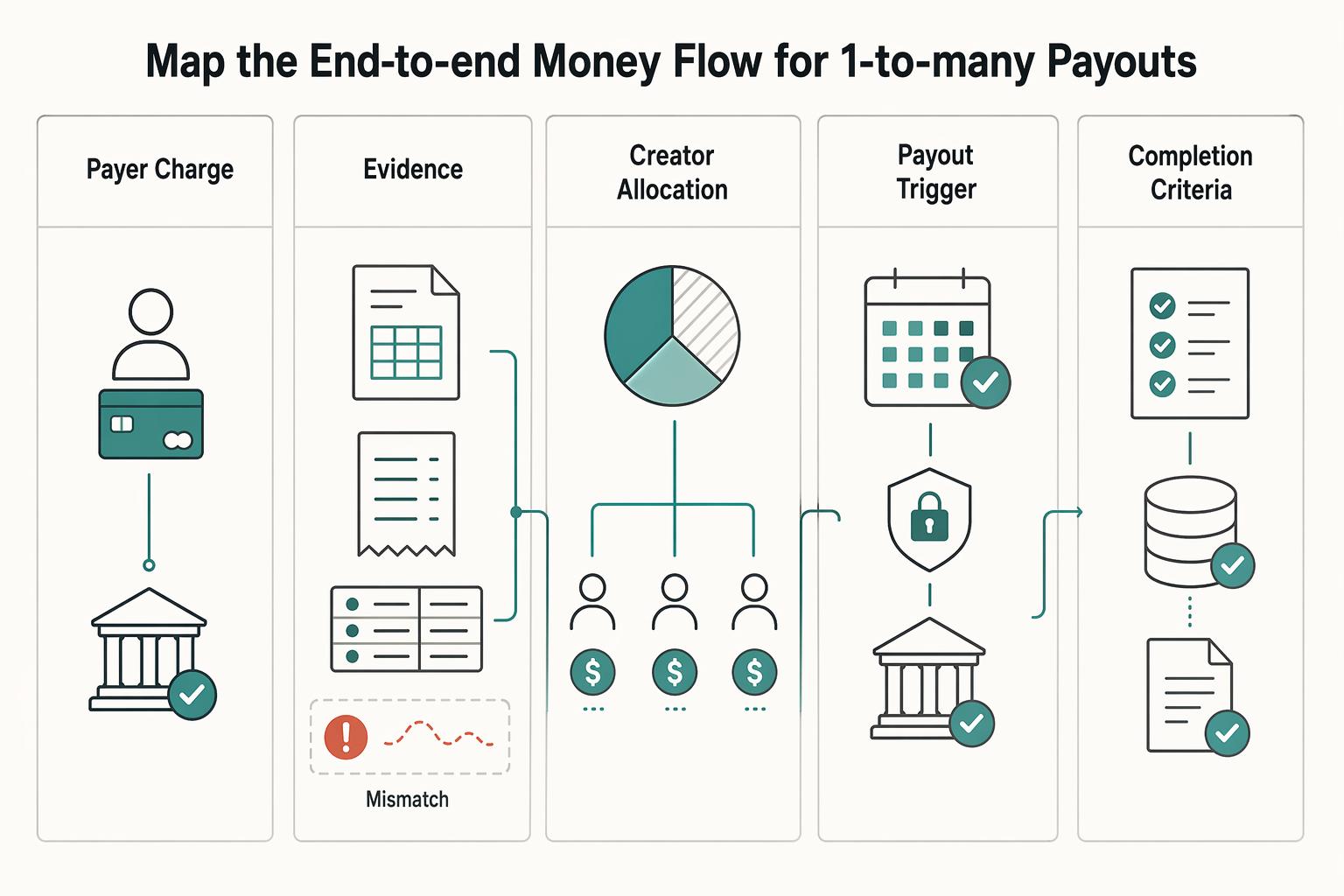
- Map the 1-to-many money flow. Trace the path from customer charge to allocation, payout trigger, and final status.
- Validate controls before launch. Test edge cases first, including retries, disputes, and post-sale adjustments.
The following design sequence connects product terms to allocation, payment execution and reconciliation.
Prepare the inputs before you design anything#
Do this work first. If scope and operating constraints are fuzzy, architecture decisions drift toward copied features instead of your actual operating model.
| Input | What to capture | Key note |
|---|---|---|
| One-page scope | Target creator segment, launch scope, and v1 monetization model | State the unit you monetize |
| Operating input pack | Core operating-model assumptions and launch-critical dependencies | Keep known unknowns visible as TBDs |
| Non-negotiables | Controls and payout capabilities that are mandatory at launch versus optional for v1 | Define before vendor conversations |
| v1 acceptance criteria | What "ready" means for operations, reconciliation, and payout outcomes | Keep in the same scope document |
Start with a one-page scope. Define your target creator segment, launch scope, and v1 monetization model. State the unit you monetize, because that choice changes payout and policy assumptions. Different monetization units do not create the same downstream requirements.
Use this checkpoint. Someone outside your team should be able to read the page and clearly answer who pays, who gets paid, and what the platform is optimized for.
Build a first-pass operating input pack. Start with operating inputs, not TAM slides. Capture core operating-model assumptions and launch-critical dependencies, and keep known unknowns visible as TBDs.
Treat this pack as an unknowns detector, not an expansion pitch. If a launch-critical requirement is still TBD, pause design for that scope.
Define non-negotiables before vendor conversations. Document which controls and payout capabilities are mandatory at launch versus optional for v1. This narrows the field quickly and keeps tradeoffs explicit.
Set v1 acceptance criteria in plain language. Agree on what "ready" means for operations, reconciliation, and payout outcomes. Put those criteria in the same scope document so product, payments, support, and finance evaluate launch readiness against one standard.
With those inputs in place, you can define what the platform actually owes before you choose how money moves.
For a step-by-step walkthrough, see Earned Wage Access Architecture: How to Build EWA Into Your Gig Platform.
Define monetization obligations before you pick rails#
Define the obligation first, then choose rails that can execute it. That order keeps your payment architecture aligned to what your product promises, instead of whatever a vendor happens to support by default.
Name each monetization event in plain language. Start with the unit of value: what is sold or billed. If the unit is unclear, billing decisions will be unclear too.
| Monetization mode | Earning event | Allocation rule to record | Adjustment case |
|---|---|---|---|
| Subscription | Paid billing period under access terms | Creator entitlement, platform fee and any pooled allocation basis | Failed renewal, cancellation or partial-period refund |
| Tip | Confirmed tip for named beneficiary | Recipient, fee payer and net amount | Refund or chargeback after credit |
| Direct sale / PPV | Sale and fulfillment/access condition | Seller and collaborators, fixed or percentage shares | Partial refund and affected recipients |
| Pooled revenue | Closed measurement period | Eligible creators, measured units, exclusions and rounding | Late event, corrected metric or invalid activity |
| Agency-managed creator | Underlying creator earning event | Authorized agency share, creator share and beneficiary identities | Authority change or disputed share |
Quick check: for one sample event per line, a reviewer should be able to answer what happened, who pays, what the amount is based on, and whether an amount is due.
Turn each event into a short obligation record your billing logic can enforce.
For each event type, document:
- trigger condition
- amount basis (fixed, tiered, usage-based, or outcome-based)
- who pays
- expected billing timing
- reversal or adjustment conditions
Use exact wording so product, support, and finance interpret the event the same way.
Keep revenue-capture models separate when they behave differently. Define subscription, usage-based, pay-per-outcome, and marketplace patterns explicitly instead of blending them into one vague rule set.
This matters in practice. Model choice affects behavior, observability, billing logic, API limits, uptime, and profitability. If any line depends on measured consumption, set usage tracking instrumentation before launch so billing stays auditable, and track accuracy so manual overrides stay limited.
Treat timing as part of the obligation. Do not leave it as a rail choice for later. Document when billing should occur for each event and what timing expectations apply.
Before you choose rails, validate the obligation set with a small evidence pack: pricing terms, fee policy, sample event payloads, and one worked example per monetization line. If those artifacts conflict, the obligations are not ready yet.
Related: A guide to 'Network Effects' for community-based products.
Score market readiness by country before committing GTM#
Prioritize countries where you can meet onboarding and payout obligations with sustainable operations. If compliance feasibility or payout reliability is not credible, defer launch even when demand looks strong.
The previous section defined what you owe. This section decides where you can deliver those obligations with acceptable risk.
Build a country-by-country Market-Readiness Scorecard before you rank by TAM. Use one row per country and the same columns each time.
| Scorecard column | What to check | Why it matters |
|---|---|---|
| Compliance burden | Whether your model requires identity checks, eligibility checks, centralized resolution controls, or added review before payout | Withdrawal or cash-out capability adds a compliance stack, not just a product toggle |
| Operational integrity readiness | Whether accounting, resolution, anti-manipulation, and liquidity operations are defined for this market | Reliability depends on operational integrity, not demand alone |
| Payout path reliability | Whether payout routes are available and whether a fallback path exists | Inaccurate or late payouts are a real business risk |
| Expected support load | Likely onboarding questions, payout-status follow-ups, and exception-handling volume | Creator platforms often operate a long-tail workforce with small, frequent payments that strain legacy finance operations |
| Dispute and reversal handling | How exceptions could affect adjustments or payout timing | Unclear exception handling increases support pressure and payout risk |
| Timing reliability | Any requirement that changes onboarding flow or payout release timing | Timing breakdowns raise the risk of late or inaccurate payouts |
Assess regulated roles from the actual money and value flow, including redemption, custody, transfer authority and contractual liability. Removing withdrawals does not by itself establish a licensing exemption. Record the conclusion and conditions for each legal entity and market.
Use compliance feasibility as the first real gate. The practical question is whether you can onboard the right entities, run required checks, and release payouts without creating a manual back office you cannot sustain.
Use a simple friction scale of low, medium, or high, and record the reasons in writing. Require a small evidence pack before you green-light a country:
- one sample creator onboarding path
- one sample onboarding path for entities you expect to pay, if applicable
- expected payout release conditions
- known hold or review scenarios
- named compliance owner
If that pack is missing, treat the country as not launch-ready.
Do not confuse payout coverage with payout reliability. A country can be "supported" and still be a poor first-wave launch if payout outcomes are hard to predict or exceptions are slow to resolve.
Trace a test from the creator obligation through provider execution to the defined recipient outcome. Document recovery for rejection, unknown execution and confirmed returns. A fallback route may be used only after the first attempt is known not to have executed or the returned funds are evidenced; missing confirmation alone is not permission to pay again.
Add the legal and operational friction that will drive day-to-day support load. Then rank countries by launch fit rather than demand alone. Where countries are close, prefer the one with cleaner payout execution and lower manual review pressure.
Use a hard rule for wave inclusion:
- Compliance feasibility is credible for your monetization model.
- Payout reliability supports accurate, on-time payouts without unsustainable manual effort.
If either fails, defer launch.
For monetization model tradeoffs, see Choosing Creator Platform Monetization Models for Real-World Operations.
Map the end-to-end money flow for 1-to-many payouts#
Treat this as a launch gate. If your team cannot explain the full money path end to end, your payment architecture is likely not ready.
| Checkpoint | What to define | Control note |
|---|---|---|
| Payer charge | Include it in one continuous flow | Show every handoff where value or liability changes |
| Internal financial record | Include it in one continuous flow | Tie payout statuses back to internal financial records |
| Creator allocation | Mark it separately | Do not hide allocation logic inside a generic processing box |
| Payout trigger | Make the checkpoint explicit | Use a stable internal reference at payout-creation boundaries |
| Completion criteria | Make the checkpoint explicit | Resolve unclear ownership before you add payout complexity |
Draw one continuous flow that combines product and finance. Do not keep separate views. In platform models, value moves in multiple directions between payer, creator, and platform, so your map should show every handoff where value or liability changes.
For your proposed design, define checkpoints such as payer charge, internal financial record, creator allocation, payout trigger, and completion criteria. The exact payout state machine depends on your implementation, so make your chosen checkpoints explicit. If ownership is unclear at any checkpoint, resolve that before you add payout complexity.
Make 1-to-Many Monetization decisions explicit in the diagram. Mark separately where Payout Orchestration runs. Do not hide allocation logic inside a generic processing box.
Keeping allocation and payout stages distinct makes post-sale adjustments easier to reason about. Your team should be able to see where changes apply when balances move after the initial allocation.
Add control points for stale states, retries, and duplicate-risk handling before implementation. At each retry boundary, define what prior record should exist before another attempt is allowed.
Assign one stable obligation ID and a separate ID for each execution attempt. Reserve the payable amount before submission and use the provider’s supported idempotency mechanism. After a timeout, query and resolve the original attempt before rerouting; an internal key or another provider cannot prevent a duplicate that has already executed.
Set a verification requirement for payout statuses where possible. Status labels that live only in an external dashboard may be insufficient for operational control unless they can be tied back to internal financial records.
This is where API-first design matters. Front-end states such as pending, paid, or failed should align with event-level records in your financial systems so financial governance can hold as payout complexity grows.
For the ledger side of this architecture, see How to Build a Deterministic Ledger for a Payment Platform.
Design the split engine and sub-ledgers so audits are easy#
Make split outcomes explainable from records you already hold. If your team cannot trace a balance change through the method and version used at the time, audit review gets harder.
Make the allocation reproducible: record the sale or earnings-pool ID, recipients, currency, gross/net base, fee and tax treatment, percentage or fixed shares, rounding rule and policy version. Reject missing recipients or shares that do not reconcile to the allocable amount. Keep input versions so historical calculations can be reproduced without executing payments again.
Avoid hidden mutation across profile, policy or product fields. Document precedence between defaults and per-transaction rules. For example, Adyen split instructions supplied in an API request override configured profiles; absent instructions can book the full amount and fees to the liable account. Test omission and override cases for your provider instead of assuming the internal split is executed automatically.
Use explicit pending, available, reserved, payout-in-flight and paid states. A state change needs an identified financial event or approved policy action. An internal entitlement can precede cash availability, so release requires both a payable balance and adequate permitted funding; never treat all pending earnings as bank cash.
Record immutable movements or an equivalent auditable change history. Preserve movement ID, source event, affected creator, amount/currency, booking time, original rule version and linked adjustment. Maintain financial-movement deduplication separately from webhook-delivery deduplication.
Decide reversal handling before launch, including how refunds and chargebacks are applied in your own policy. The goal is consistency and clear ownership, not policy complexity.
Test partial refunds, full refunds, disputes, creator changes, currency rounding and adjustments after payout. Define the contractual recovery order and reserve authority. A financial correction creates a linked adjustment; it does not rewrite the original sale or silently delete the creator’s paid history.
For a hypothetical 100-unit allocable pool, assume tax and processor fees have already been handled separately. A 10% platform fee leaves 90 for two creators split 70/30: 63 to A and 27 to B. If policy reserves 10% of creator earnings, hold 6.3 and 2.7, leaving 56.7 and 24.3 available. These are example contract rules, not universal provider requirements.
Suppose 20 units from that same pool are refunded before payout and the contract reverses the fee and creator shares proportionally. Reverse platform fee 2, A entitlement 12.6 and B entitlement 5.4. Remaining entitlements are 50.4 and 21.6, with platform fee 8: 20 refunded + 72 creators + 8 platform = 100. If the existing 9-unit reserve stays held pending review, only 63 of the creator balance is available. After a payout has already executed, use the agreed recovery process and confirmed financial movements instead of assuming the bank payout can be undone.
Set compliance and tax gates at the action level#
Map required checks to the actual action. Depending on the model, verification restrictions can block payment acceptance or earning as well as payout. Do not promise creators they can continue collecting money while verification is incomplete unless the provider and applicable rules permit that state.
Map checks to actions, not to one broad account status. Treating "verified" as a permanent yes or no across your payment architecture can hide differences in risk and reporting exposure.
Attach decision points to each action that moves or reroutes funds, and document a clear owner and outcome for each gate. A practical baseline is one policy table that answers four questions per action: what is attempted, what check applies, what can still proceed if incomplete, and what status appears in the ledger and payout flow while it is pending.
Define failure outcomes before launch so blockers are explicit, not silent. If a check fails or remains incomplete, show a specific operational state instead of a vague pending label.
Scope restrictions to what is actually permitted. Test acceptance, transfer and payout capability failures in nonproduction, along with remediation, expiry and periodic review. Record whether a failed check blocks only disbursement or also earlier activity.
Separate tax-profile documentation, withholding and reporting decisions. The seller role, payer, payee status, income source and payment channel can change the outcome. Use the tax owner’s approved rules for the flow; a missing form is not a universal legal prohibition on every payment.
For each blocked action, keep an evidence pack with the trigger event, affected action, unresolved dependency, owner, and next allowed action. Treat this as a versioned governance artifact that remains reviewable and explainable.
Expose holds so support and finance can explain them from one screen. Support should see gate type, triggering action, open time, owner, requested remediation, and scope of impact. Finance should see the linked ledger state and payout state.
If teams cannot explain a hold quickly, creators can end up in repeated tickets and workarounds. In a multi-platform environment where creators spread activity to stabilize income, opaque holds can increase switching risk.
For training and readiness, see How to Build a Payment Compliance Training Program for Your Platform Operations Team.
Choose rails and settlement strategy for your first launch wave#
Once funds are eligible to move, keep your first launch wave narrow. Start with the payout rail your team can trace, explain, and recover when it fails, then add Instant Payouts only where expectations, coverage, and economics are already validated.
Anchor v1 on the rail with the clearest operational story. The launch test is simple: support and finance should be able to explain each payout status and the next action from one view.
| Option | Best use in first wave | Verification checkpoint | Main red flag |
|---|---|---|---|
| Primary payout rail | Default method for broad launch coverage | Each payout maps cleanly from ledger event to payout attempt to final outcome | Long-lived generic statuses with no practical reason |
| Instant Payouts | Selective add-on where faster access is a clear need | Coverage, fee impact, and downgrade path are documented before launch | Fast route fails and leaves ownership of resolution unclear |
| Experimental crypto-native settlement | Narrow pilot, separate from core payouts | Isolated cohort, explicit operating boundary, and separate monitoring | Experimental path becomes a hidden dependency for general payouts |
Offer a faster rail only after eligibility, amount/currency limits, fee payer and recipient timing are established. Keep a baseline method, but downgrade or reroute only when the first attempt is safely resolved. A timeout on the fast method is an unknown-execution case, not a confirmed failure.
For example, Stripe Connect Instant Payouts requires supported platform/account scope, local payout currency and an eligible external account. Inspect destination eligibility and the available balance for the actual account. Faster access changes payout timing and costs; it does not determine the creator’s allocation or refund liability.
Assign identity, business, screening and tax responsibilities to the actual entity and provider arrangement before release. Track requirements and payment capabilities separately from one broad verified flag. Confirm who handles restrictions, remediation and the evidence trail.
A crypto payout is a separate product path. Define the funder and beneficiary, token and chain, source/destination countries, conversion and final receiving method, custody responsibilities and recovery limits. A blockchain transfer is not evidence of fiat bank credit.
Keep new settlement products in a scoped pilot until their funding, recipient outcome and exception handling can be traced. Do not use protocol-level speed claims as an end-to-end creator payout promise.
Related reading: How to Build a Finance Tech Stack for a Payment Platform: Accounts Payable, Billing, Treasury, and Reporting.
Build reconciliation operations before you scale volume#
Build reconciliation before you scale. If your team cannot consistently explain why balances and payout statuses do or do not match, adding markets or payout options only increases operational risk.
| Record layer | Match keys | Evidence |
|---|---|---|
| Customer payment/adjustment | Source event and provider movement IDs | Charge, refund, fee and dispute report records |
| Creator allocation | Earnings event, recipient and rule version | Reproducible shares and linked adjustments |
| Execution | Obligation and attempt IDs, provider references | Submission, unknown/failed/success state and movement evidence |
| Receiving outcome | Payout reference, account and amount/currency | Defined recipient confirmation or investigation status |
Reconcile at three levels: customer payment and adjustments, creator entitlement and available balance, and provider payout movement to recipient evidence. A successful payment event can fund several allocations; a bank payout can combine several earnings. Preserve the many-to-many references rather than forcing every record into a one-charge/one-payout match.
Document a repeatable reconciliation method. Capture provider reports by account, currency and reporting cutoff. Match charge, refund and dispute movements to source events, then compare each creator’s opening balance plus credited earnings minus adjustments and confirmed payouts to closing balance. Keep reserves and in-flight amounts visible; treat late reports as pending evidence.
Classify exceptions before correcting them. Separate missing source events, wrong recipient/share, rounding or fee differences, unavailable funds, unknown execution and confirmed returns. Assign an owner, age, amount/currency and next action. Correct source or rule defects and use linked adjustments for financial effects; do not manufacture a balancing payout.
Define handoffs. Finance owns balance and cash reconciliation; payments operations owns execution investigations; engineering owns event ingestion and mapping defects; compliance/tax owns restricted-action decisions. Adapt the roles to your team while retaining one accountable owner per unresolved case.
Compare the internal sub-ledger with provider activity and balances, then bridge confirmed payouts to receiving evidence. Stripe balance reporting is one provider’s source for account activity; use the corresponding reports for each integrated provider. A webhook stream alone is not a complete account statement.
For staffing and workflow design at scale, see How to Build a Compliance Operations Team for a Scaling Payment Platform.
Plan failure handling for disputes and payout exceptions#
Plan failure handling before you scale so retries and manual recovery do not create duplicate liabilities. In payout operations, each dispute, refund, and payout failure should follow a defined state path with one consistent balance outcome across creator, support, and finance views.
Use clear state models for disputes, refunds, and payout failures. Tie each state to operator actions and customer-facing messaging. Do not collapse them into one generic exception type.
Keep event intake separate from payout logic, and process recovery through asynchronous handlers. This keeps state transitions clearer during failures and aligns with event-driven implementation guidance. As a practical check, each case should be traceable from records alone: what happened, what balance changed, and what the creator was told.
Make restart paths idempotent and auditable. If a payout retry runs more than once, it should not create a second financial effect.
Make replayable data handlers return or recognize the existing financial result. Authenticate events, persist deliveries and tolerate out-of-order notifications. Query current provider state where needed. Separate delivery IDs from movement IDs so two event notifications about one payout do not create two postings. Never replay settled payment instructions to repair a data pipeline.
If you run an exception queue, order it by operational risk. Prioritize payout-critical and dispute-related failures ahead of cosmetic mismatches so financial exposure is handled before presentation cleanup.
Make dispute management and payment monitoring visible in the same operational flow so teams can quickly distinguish review blockers from delivery failures.
Record the dispute debit, fee, recovery attempt and final outcome separately. Determine who funds the customer adjustment and what the creator contract permits. Provider charge type matters: Stripe Connect charge types assign refund and dispute debits differently. An internal negative balance is a claim to recover, not proof that funds were returned.
If customer and finance views diverge during a dispute, trust drops and recovery work gets harder. This is where weak backend handling turns into lost revenue, strained creator relationships, and avoidable technical debt.
Decide what to build and what to buy#
Use a Build vs. Buy matrix before implementation so you only build capabilities that materially shape your platform's value. Platform companies do not need to internalize every capability, and lower barriers to entry increase pressure to focus internal effort where differentiation is real.
Score each capability in one view using four questions. Check integration complexity, governance burden, capability coverage, and speed to market. If you do not compare those tradeoffs side by side, teams can overbuild work that feels strategic but does not change outcomes.
| Capability | Build when | Buy when | Verification checkpoint |
|---|---|---|---|
| Allocation rules logic | Your allocation logic is a core product behavior and changes with your monetization model | Your rules are relatively stable and not a major product differentiator | Run sample sale, refund, and dispute paths and confirm one consistent balance outcome |
| Payout execution | Execution behavior is central to your product promise | You prioritize faster access to established operational coverage | Confirm payout ownership, final-status visibility, and retry behavior are explicit |
| Compliance checks | Decision logic is part of your market or risk strategy | Reviews are mostly standardized and operational | Confirm where decisions, remediation records, and hold/release history are tracked |
| Reconciliation evidence | Finance needs custom evidence tied to your internal views | Standard exports are sufficient for close and audit workflows | Request a failed-case evidence pack before launch |
Treat this as a living decision document, not a one-time workshop artifact.
Build first where ownership is likely to change customer outcomes or risk profile in a meaningful way. Buy first where the capability is necessary but not differentiating. In many platform contexts, that can mean keeping tighter control over monetization logic while using external infrastructure for more standardized operations.
Keep flexibility in mind as you scale. Platforms often need to reconfigure their value proposition to stay competitive, and overbuilding commodity components early can make later changes harder. One common failure mode is staying tied to legacy methods while faster competitors adapt.
Set integration boundaries explicitly before launch and treat them as governance decisions, not assumptions. Define who is accountable for key payout, compliance, and reconciliation actions so exception handling remains clear under load.
Run one tabletop case end to end: payout triggered, held for review, released, then questioned by finance. Then answer three questions clearly: who executed the payout action, who made or recorded the compliance decision, and who can produce the evidence tying ledger event, payout status, and support explanation together?
If ownership is overlapping or unclear, resolve it before go-live. For a deeper comparison, see Payments Infrastructure for Creator Platforms: A Complete Build vs. Buy Guide.
For an adjacent example, read How to Build a Rent Collection Platform: Payment Architecture for PropTech Marketplaces.
If your build-vs-buy matrix favors outsourcing rail execution while keeping your own allocation logic, review Gruv Payouts to pressure-test operational fit.
Make the launch decision and copy-paste checklist#
Use one rule for go or no-go: launch only when your own readiness checklist, policy-gated dependencies, and release evidence all pass together. If any one is still based on assumption, treat launch as no-go.
Approval should cover the monetization mode, seller and payer roles, recipient eligibility, funding and reversal liability for the proposed scope. Capture provider or partner restrictions as explicit dependencies with an owner and a permitted fallback.
Version the release packet with the exact split-policy version, event samples, ledger mappings, provider configuration, reconciliation reports and exception test results. Sign-off should identify the reviewed version and unresolved items, so a later change cannot silently inherit the approval.
Resolve launch-critical unknowns before allowing live money movement. Account-specific limits, required documents and recovery commitments belong in the approved scope and runbooks, with evidence from the provider and responsible owners.
Copy/paste checklist. Assign one owner per line.
- Seller, payer, fee and reversal responsibilities documented for v1 monetization
- Approved countries, currencies, beneficiary types, methods and actual restrictions evidenced
- Split-policy inputs, version, rounding and refund/dispute cases tested
- Signed documentation and action-specific restrictions retained
- Funding and available/reserved/in-flight balances reconciled
- Unknown-execution recovery tested before any alternate route is enabled
- Recipient timing and fees supported by the actual provider/product scope
- Financial movements deduplicated independently from event deliveries
- Release packet versioned with owners, reviewed artifacts and open risks
Final decision rule: if a checklist item cannot be evidenced, it is not complete.
Before launch, align product, ops, and engineering on one implementation path and edge-case handling in Gruv Docs.
Frequently Asked Questions
What does 1-to-Many Monetization actually mean in payment operations?
It means one platform has to allocate and pay out funds across a large creator base, often hundreds or even thousands of counterparties. In practice, this is a long-tail payments pattern with many small, frequent transactions, which can strain legacy accounts-payable and procurement processes. The risk is not just operational: late or inaccurate payments can disrupt creator work, and missed day-of-production payments can halt work.
What are the minimum components of a launch-ready Payment Architecture?
The minimum is a supported monetization mode with clear obligations, collection, reproducible allocation, eligibility and funding gates, safe execution, reconciled balances and failure handling. A platform can launch with one mode. Add multi-currency or faster payouts only where their actual scope, costs and recovery behavior are proven.
How do Tiered Subscriptions, tips, and Direct Sales change split and payout design?
Subscriptions need billing-period and entitlement rules; tips need a defined beneficiary and fee policy; direct sales need sale, acceptance and refund references. Collaborations or pooled revenue need recipient shares and a versioned allocation basis. Keep each model’s triggers distinct while sharing the ledger and execution controls.
How should we compare countries before expanding Cross-border Payout Rails?
Use the same scorecard for each proposed country: legal/provider eligibility, onboarding, recipient methods, currencies and limits, funding/FX, dispute liability and support effort. Attach current evidence to each rating. Require a traceable test and safe recovery path before approving the market; supported-country marketing alone does not prove reliable delivery.
When do we require KYC, KYB, or AML before payout release?
Determine checks from the actual regulated role, country and provider capabilities. Document which actions require which evidence and whether restrictions affect acceptance, transfers or payouts. Keep an owner, remediation steps and effective status. An account verified once is not permanently eligible for every action.
How do we handle Chargebacks and Refunds without corrupting creator balances?
Post linked adjustment movements using the original allocation rules and the applicable contract. Distinguish a customer refund from provider transfer reversal and recipient-bank recovery. Keep paid history intact; a payout already received may need a reserve, recovery claim or later offset that the contract permits. Reconcile each actual movement once.
Try a related tool
Where Gruv fits
Gruv for creator platforms
Turn approved creator earnings into payable rows with source references, clear item status, and a finance-ready export.
See reconciliation and mismatch review
Compare ledger entries, provider payment records, and statement rows to see what matches and what finance needs to review.
Researched and edited by the Gruv editorial team. Gruv builds cross-border billing, payouts, and finance-operations software for global businesses.
Sources
Includes 1 external source outside the trusted-domain allowlist.
Educational content only. Not legal, tax, or financial advice.
Related Posts
Payments Infrastructure for Creator Platforms: A Complete Build vs. Buy Guide
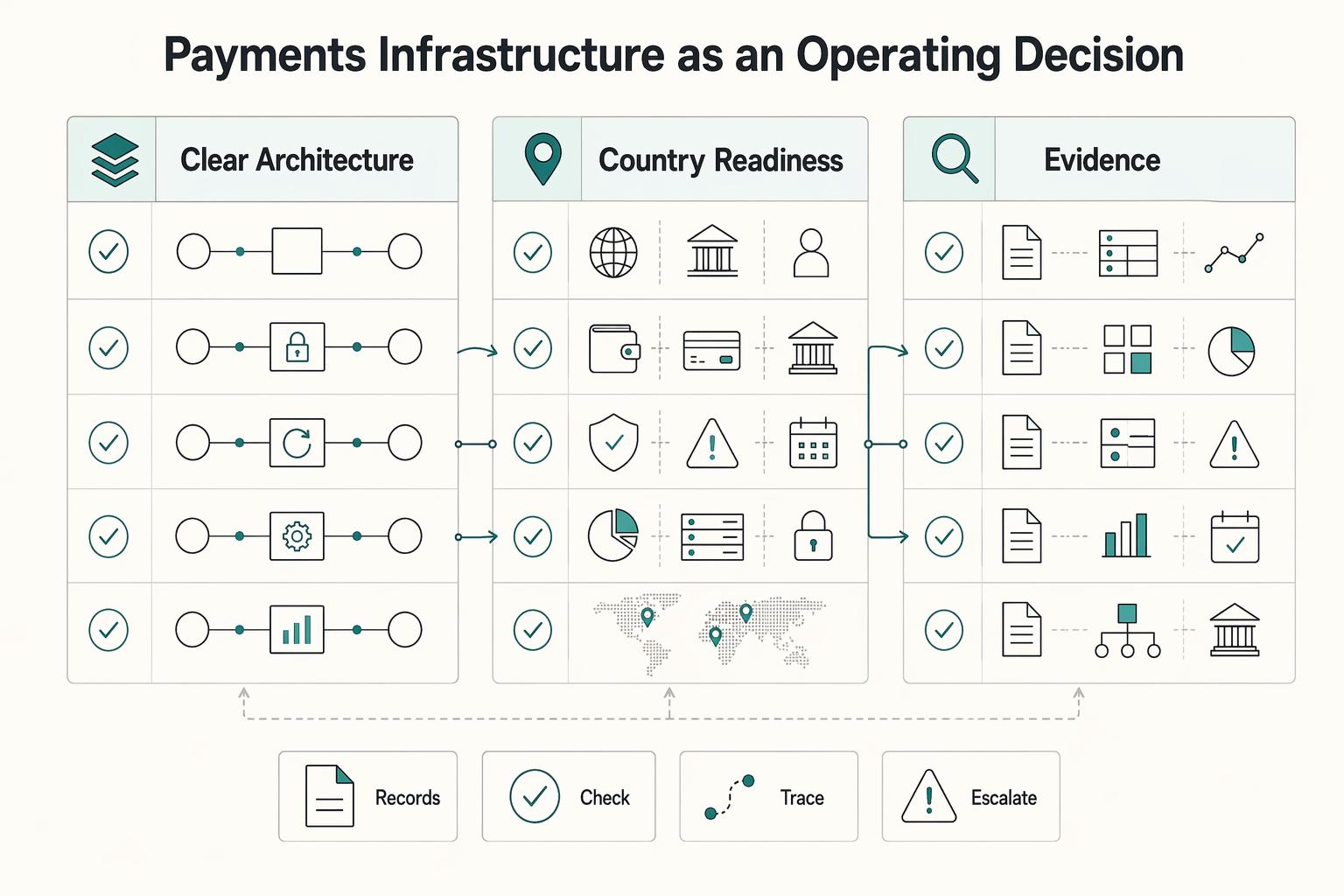
Treat this as an operating decision, not a branding exercise. This guide helps founders and ops teams choose build, buy, or hybrid for creator payment infrastructure. The goal is to avoid committing roadmap, compliance effort, and go-to-market spend in the wrong markets.
Building Rent Collection Payment Architecture for PropTech Marketplaces
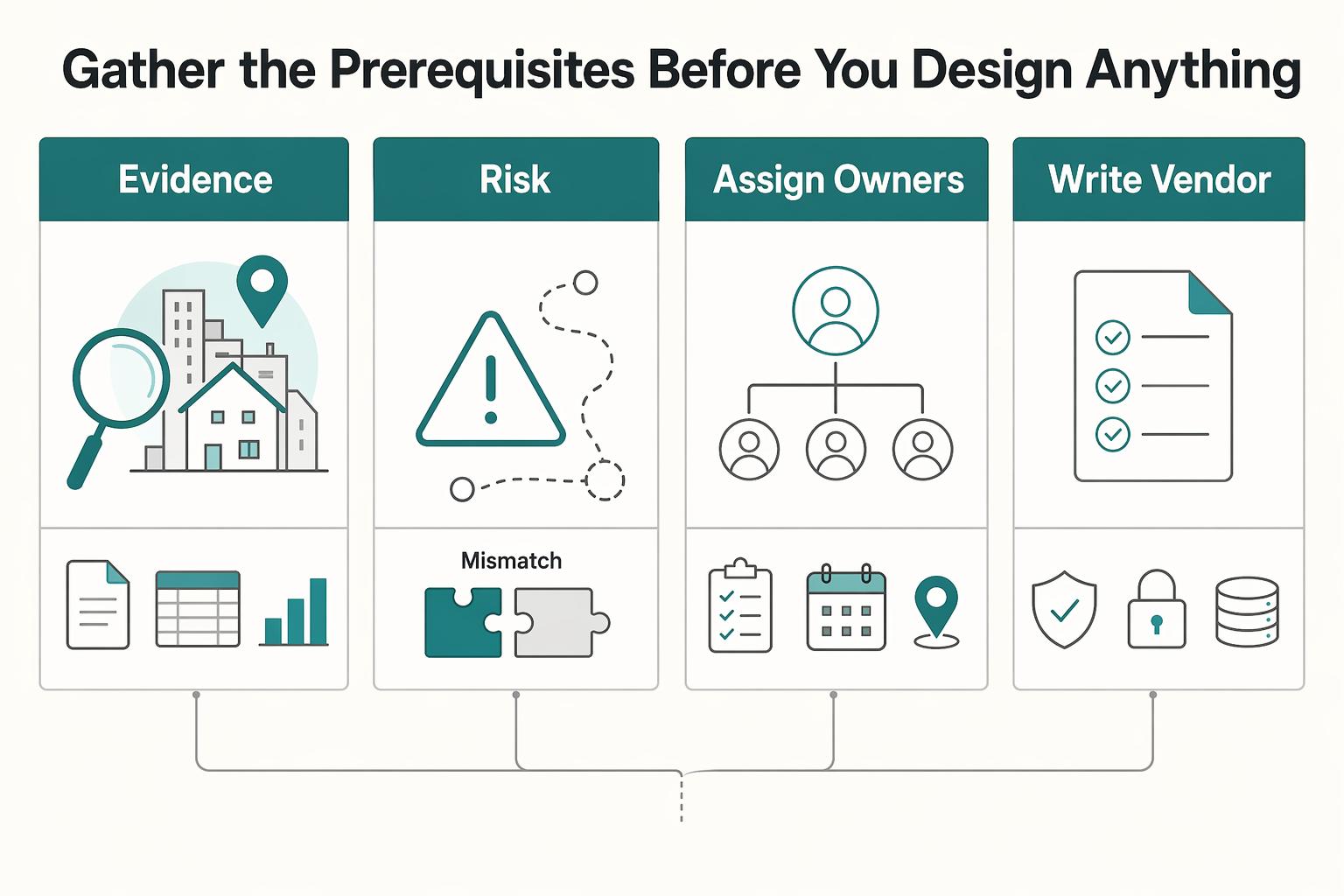
The hard part is not launching a rent payment button. It is choosing a payment architecture your team can operate, reconcile, and defend as volume, markets, and exceptions grow.
Network Effects for Community-Based Products as a Professional Moat
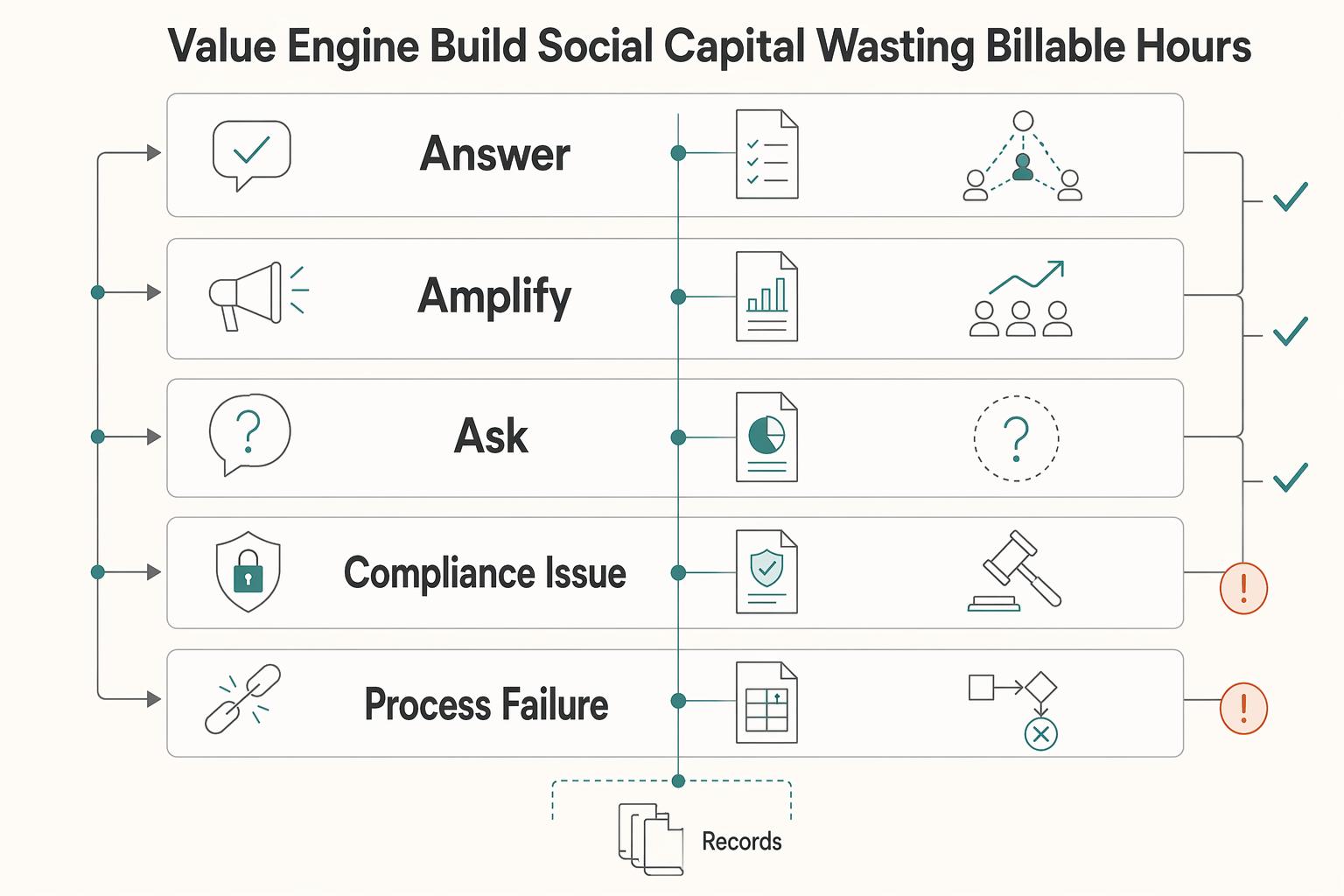
You've heard the advice everywhere: join communities, network, stay active. For a global professional running a business of one, that advice is too vague to be useful and loose enough to be costly. It assumes your time is unlimited. Worse, it misses the real issue: **risk**.