
Quick Answer
Use network effects for communities as a risk-control system, not a visibility tactic. Start by selecting rooms with enforceable rules, useful archives, and acceptable response speed, then focus your effort with one core community and a few satellites. Contribute with the Answer, Amplify, Ask pattern only when it improves a live decision. Before proposals or pricing, classify signals as first-hand, observable, or hearsay so you can proceed, tighten terms, or pause with a clear checkpoint.
You've heard the advice everywhere: join communities, network, stay active. For a global professional running a business of one, that advice is too vague to be useful and loose enough to be costly. It assumes your time is unlimited. Worse, it misses the real issue: risk.
The problem is not missing one conversation in a noisy Slack group. It is spending dozens of billable hours in low-signal rooms for little return. It is taking well-meaning but bad advice that creates compliance problems. It is tying your reputation to a poorly moderated environment. For an independent operator, those are not small annoyances. They are business risks.
This guide reframes the job. Instead of trying to participate everywhere, use a three-phase approach to build a Professional Moat: a defensible asset that protects your business and supports growth.
Done well, this approach creates three practical outcomes. It helps you find vetted clients more predictably. It gives you trusted peer input before cross-border decisions get expensive. And it reduces the isolation that comes with working independently. The goal is not more networking. It is better information, stronger reputation, and more control.
Phase 1: The Portfolio Strategy - How to Vet Communities Like a Venture Capitalist#
Treat community selection like capital allocation. You are spending scarce attention, reputation, and risk budget, so the question is not whether a group feels active. It is whether it earns a place in your portfolio and keeps earning it over time.
The appeal is real: value can rise as more useful people join. But user count is only a rough signal, and Metcalfe-style thinking is debated for good reason. A bigger room is not automatically a better room if it responds slowly, tolerates bad behavior, or cannot help you solve a live operating problem.
Run a fast pass or fail check#
Before you join, and again during review, use four checks:
- Rules with teeth
Pass if you can see a Code of Conduct or equivalent rules that clearly apply to members and moderators, plus evidence that enforcement happens. Public moderator notes, investigation language, or platform transparency pages are useful proof points. Fail if the rules look polished but spam, harassment, or obvious rule-breaking sits untouched.
- Response speed
Pass if questions that need attention get a real first response in a timeframe that fits the room. "Time to First Response" is a legitimate health signal, and a long delay can indicate low engagement. If you need a starting benchmark, use two business days, then adjust based on the community's purpose.
- Peer quality
Use this as a secondary heuristic. Pass if replies include reasoning, tradeoffs, and limits. Fail if most answers are "DM me," vague agreement, or recycled beginner advice. If you cannot tell what the responder has actually observed, treat the thread as low-confidence input.
- Archive usefulness
Search two or three current problems before you commit. Pass if older threads still help you make decisions now. Fail if search results are thin, repetitive, or impossible to revisit later.
One useful verification detail here is moderation evidence. If the platform publishes transparency data, read it. Reddit's January through June 2025 transparency report, for example, disclosed close to 6 billion pieces of content and about 2.66% removals (1.41% by mods and 1.25% by admins). That does not prove any single subreddit is well run, but it does show what visible enforcement evidence looks like.
| Surface signal | Underlying quality signal | Decision action |
|---|---|---|
| Large member count | Recent threads show practitioners solving specific problems, not just introductions | Watch until quality is confirmed |
| Busy feed | Posts needing attention get substantive replies within your benchmark | Stay if consistent, watch if uneven |
| Strong rules page | Enforcement is visible through moderator actions, investigation language, or transparency reporting | Stay if active, exit if decorative |
| Recognizable names | Searchable archive helps with real operating questions | Stay if repeatedly useful |
| Constant self-promotion | Most threads push DMs, audience farming, or off-topic selling | Exit |
Make return on time visible#
Do not review on vibes. Keep a lightweight log for each community with these fields:
| Field | Capture |
|---|---|
| Date and community name | date and community name |
| Thread or event link | one thread or event link you actually used |
| Decision influenced | the decision it influenced |
| First response time | observed first response time |
| Follow-up person | one person worth following up with |
| Red flag | one red flag |
| Current action | stay, watch, or exit |
Set the review interval based on your workload. If your calendar changes week to week, tie the review to an existing business checkpoint such as pipeline review or invoicing, not an arbitrary monthly promise you will ignore.
Keep one primary lane and a few satellites#
Most groups do not deserve equal effort. Concentrating on one primary community plus a few satellites is usually easier to sustain. Put most of your contribution into a primary community where buyer overlap is highest and the archive keeps helping with current work. Keep satellites for specialist questions, adjacent markets, or weak-signal monitoring.
Rebalance when the mix stops matching reality. If buyer overlap drops, moderation quality slips, or the archive stops answering the problems you actually face, reduce attention. If a satellite starts producing better peer judgment, faster responses, or more relevant buyer conversations than your primary, shift time toward it. Rebalancing is not disloyalty. It is how you keep your allocation aligned with what your business needs now.
Once you know which rooms deserve your attention, the next step is not showing up more. It is contributing in a way that compounds trust without eating your week.
If you want a deeper dive, read The Best Community Platforms for SaaS Businesses.
Phase 2: The Value Engine - How to Build Social Capital Without Wasting Billable Hours#
To build social capital without wasting billable time, post less often and make each contribution decision-useful. Research on online communities points in the same direction: quality and quantity both matter, and self-governance participation has been associated with fewer, higher-quality contributions.
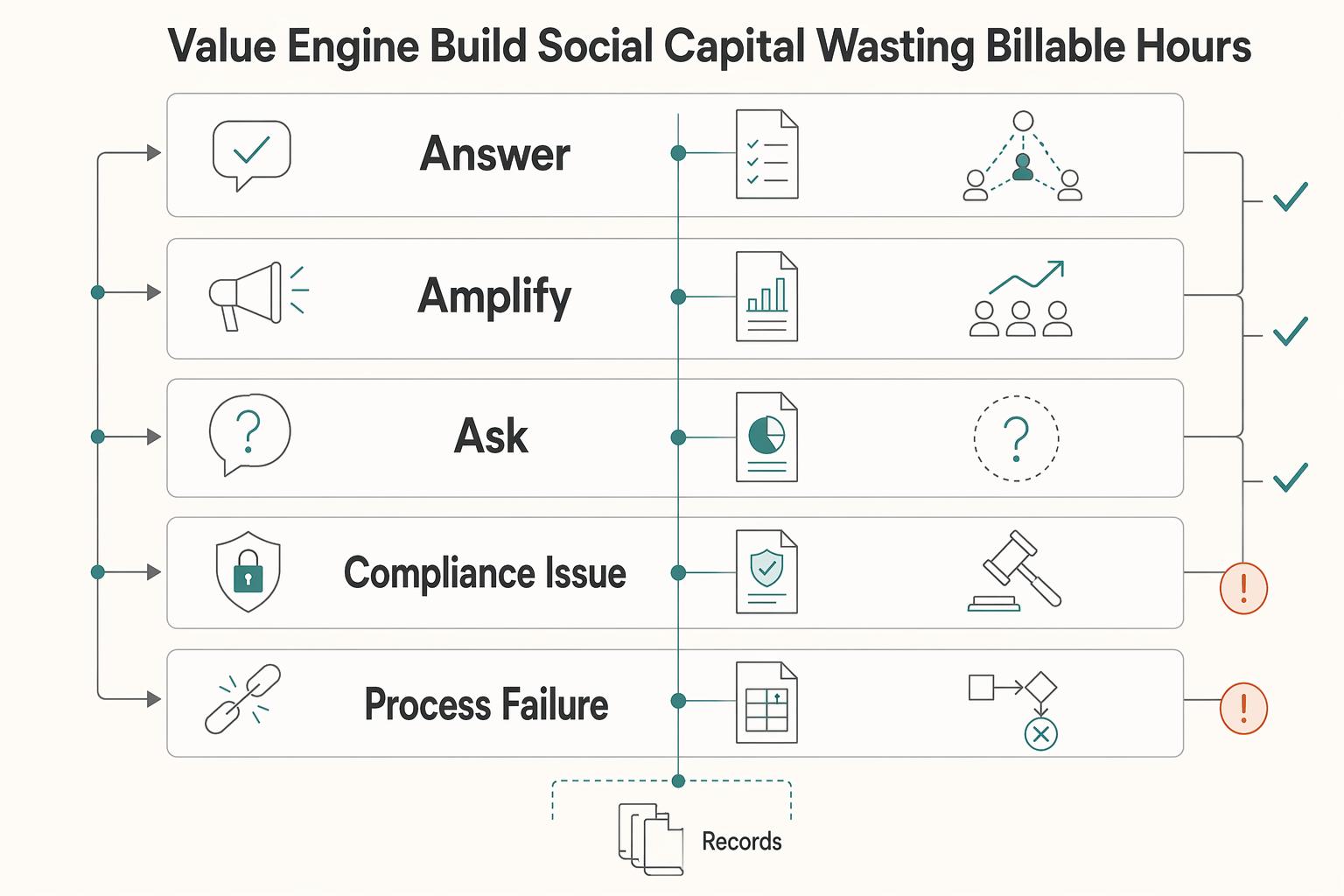
Use Answer, Amplify, Ask only when the trigger is real:
| Action | Trigger | Output (use this format) | Skip if | Practical outcome |
|---|---|---|---|---|
| Answer | You have handled the exact problem directly. | One judgment, one verification checkpoint, one clear limit. | You only have theory, or you cannot name what to check next. | Compounds trust. |
| Amplify | Someone is directionally right, but decision context is missing. | Why it matters, who it fits, what could break it. | You are only restating agreement. | Improves signal clarity. |
| Ask | A real decision is blocked. | Narrow question, constraints, what you already tested, and the decision options. | Search would resolve it faster. | Improves referral quality by showing your actual work scope. |
Before posting, run one mini-check: judgment + verification checkpoint + limit. If one part is missing, revise or skip the post.
Treat confidentiality as an operating rule, not etiquette. PII can identify or help identify a person. Disclosure is still processing under GDPR, and sharing personal data needs a lawful basis before sharing starts. Also, pseudonymized detail can still be identifiable.
| Situation | Unsafe sharing | Safer sharing |
|---|---|---|
| Compliance issue | "A London client failed their review because named staff skipped approvals." | "When approvals fail, I check ownership, records, and escalation before changing tools." |
| Process failure | "My healthcare client's handoff exposed patient record mistakes." | "In regulated handoffs, I review exception handling and audit-trail quality first." |
| Pricing or dispute | "A SaaS founder in Berlin refused revised payment terms." | "If scope shifts after approval, I document the change trigger before repricing." |
For warm intros, use a short execution sequence: consent, context, relevance, opt-out. Get explicit consent from both sides, give one sentence of context for each person, state why the match is relevant now, and make it easy to decline. Weak ties can create real opportunity, but they lose value when they become too weak and low-context.
If you handle EU or UK client data, use this as your next step: GDPR for Freelancers: A Step-by-Step Compliance Checklist for EU Clients.
Phase 3: The Capital Extraction System - Turning Your Moat into Vetted Clients and Mitigated Risk#
Use community signal to make better decisions, not faster guesses. Before you scope, call, or price, classify each claim as first-hand, observable, or hearsay, then choose one output: proceed, tighten terms, or pause pending verification.
Before proposals#
Run this screen before you draft scope, timeline, or price.
| Evidence type | What it means | Proceed | Tighten terms | Pause pending verification |
|---|---|---|---|---|
| First-hand | The person directly did, saw, or approved the item | Core deal points are clear: legal entity, decision owner, buying process, payment path, and funded problem | One risk is open but containable with milestones, deposit terms, or narrower scope | Authority, payment reliability, compliance exposure, or scope stability is still unclear |
| Observable | You can inspect concrete artifacts (email thread, intake form, redline, portal requirement, public company page) | Documents match the verbal story | Documents are partial, outdated, or inconsistent | Paper trail conflicts with what you were told |
| Hearsay | Second-hand statements offered as truth | Only if the point is peripheral | It hints at risk but does not drive the deal | It affects approvals, budget, sign-off, or prior nonpayment |
If you cannot name the checkpoint that clears the risk, you are not ready to draft.
Before calls#
Move from public to private in steps. This protects your positioning, prevents premature discovery, and keeps data collection limited to what the next decision actually needs.
| Path | Use it when | Main risk | Guardrail |
|---|---|---|---|
| Public reply | You can answer a narrow question safely in-thread | Looking promotional or exposing sensitive facts in public | Give one judgment, one limit, and one next step. Do not request internal docs, budget, or sensitive details publicly. |
| Direct message | They asked follow-ups or invited contact | Sounding sales-led too early | Anchor to the public thread, state why you are reaching out, and ask for only one or two fit details (for example, decision owner and timing). |
| Off-platform call | Mutual fit looks plausible and specifics now matter | Free discovery before basic qualification | Confirm agenda, attendees, and decision context first. If basic context is withheld, pause. |
Before final pricing#
Use peers for framing quality, not for setting your number.
| Peer review topic | Action |
|---|---|
| Scope clarity | Ask for feedback |
| Risk allocation | Ask for feedback |
| Positioning | Ask for feedback |
| What others would charge | Do not ask |
| What range "the market" is using | Do not ask |
For compliance unknowns, ask for written authorization evidence, not reassurance. If someone says a filing, approval, exemption, or license covers the work, ask what document exists, who issued it, and whether it was granted before the planned activity. Treat any requirement as pending until you verify it against current authorization, filing, approval, license, official records, or source records before the planned activity or use. In some regimes, later approval does not validate earlier action, so timing still matters.
For peer review, remove client identifiers and ask for feedback only on scope clarity, risk allocation, and positioning. Do not ask what others would charge or what range "the market" is using. Competitors are expected to set prices independently, and coordination risk is not limited to written agreements. Let peers improve framing, then keep final pricing accountability with you.
If discovery starts touching EU or UK personal data, run this before sharing more: GDPR checklist.
Your Community Isn't a Social Club; It's Your Most Defensible Asset#
Treat your community portfolio like a system for better pre-contract decisions, not a place to stay busy. If a room does not improve how you scope, qualify, or price, it is not an asset.
| Self-audit | Good looks like | Checkpoint |
|---|---|---|
| Signal quality | clear sorting of inputs into direct observation, visible evidence, or rumor before you act | Can you point to one recent scope, terms, or fit decision that changed because of evidence from that community? |
| Trust capital | public contributions that show judgment without exposing client details | Can someone reference your answer or guidance as evidence that you are careful and useful? |
| Client safety | peer input that strengthens pre-proposal and pre-pricing decisions | Before sending a proposal or price, can you verify at least one material risk using first-hand input or observable evidence? |
Use those three self-audits to decide whether a room is still earning its place.
| Phase | Business upside | Risk prevented | Failure signal if ignored |
|---|---|---|---|
| Vetting | Higher decision-useful signal | Billable-time loss and reputation drag in weak rooms | Busy feed, thin advice, no visible moderation artifacts |
| Building | Stronger trust capital from consistent, useful contributions | Oversharing and low-credibility participation | Engagement happens, but your contributions do not affect decisions |
| Extracting | Cleaner proposals and safer client selection | Pricing, contract, or compliance calls based on rumor | You act on hearsay and cannot name the checkpoint that clears risk |
Keep the 1-Core, 3-Satellite model as a discipline, not a loyalty pledge. Downgrade a community when moderation reliability drops (fewer moderator notes, removed posts, or pinned guidance), when evidence quality slides toward rumor, or when threads stop changing real decisions. Exit when decision usefulness is consistently low.
This week, review each community against this lens and keep only the ones that improve pre-contract outcomes. Next, tighten your defensibility criteria with How Data Network Effects Create a Competitive Advantage.
Frequently Asked Questions
What is the difference between an audience and a community?
Treat them as different tools. Your audience is mostly one-to-many and helps with reach, while your community is where peers with a shared interest give you usable signal back. If your current bottleneck is awareness, prioritize reach channels. If your bottleneck is better decisions on scope, pricing, referrals, or risk, prioritize peer signal channels and use Phases 1 through 3 to vet, contribute, and keep the rooms that improve pre-contract judgment.
How do you measure the value of a professional community?
Measure return on time, not activity. Ask what business decision changed because of this room and what you did next because of that change. Use a simple log like this: | Vanity metric | Decision outcome to log instead | Follow-up action | | --- | --- | --- | | Likes, views, follower growth | A qualified introduction or a clearer positioning decision | Keep the channel only if it helps you reach the right buyers or referrers | | Comment volume | A faster answer that replaced research time | Save the thread, update your checklist, and reuse the decision rule | | Your posting frequency | A proposal, pricing, or client-screening choice changed before contract | Record what changed and repeat that type of contribution | | Member count | Access to a trusted specialist referral when you needed escalation | Keep a short referral list and downgrade the room if referral quality slips | If you cannot point to a recent decision, warning, or referral that changed your next move, keep that group as a satellite or exit it.
What is the cold-start problem for a personal brand in a community?
Treat cold start as a sequencing problem. First listen, map who gives specific answers with visible evidence, and note which threads lead to real follow-through. Then add one small, reusable contribution such as a checklist, comparison, or decision rule. Avoid leading with hot takes, asks, or client anecdotes, because an early failure mode is looking noisy before anyone knows whether you are careful.
Are paid communities inherently better than free ones?
No. A fee may filter some noise, but it does not prove strong moderation, good archives, or reliable member judgment. In Phase 1, verify that rules are enforced, old threads are searchable, and members help each other without constant rescue from the host. One extra check matters here: if you received free access, a discount, or perks and then praise the room or a product inside it, that may count as a material connection and may need clear disclosure, depending on context.
How do you avoid damaging your professional reputation in an online community?
Write like every post could be screenshotted, and give your reasoning, your limits, and the next thing you would verify. Avoid sounding certain on legal, tax, privacy, or compliance questions when facts are incomplete. Strip out names, dates, rare facts, screenshots, and documents that could identify a client, and if personal data is involved, use data minimisation and work from GDPR for Freelancers: A Step-by-Step Compliance Checklist for EU Clients as a starting point. If a thread turns hostile, leave early rather than trying to win it in public, and if you want to confirm what’s supported for your specific country/program, Talk to Gruv.
Try a related tool
Researched and edited by the Gruv editorial team. Gruv builds cross-border billing, payouts, and finance-operations software for global businesses.
Sources
- assets.publishing.service.gov.uk/government/uploads/system/uploads/attachment...trusted
- assets.publishing.service.gov.uk/media/61d6cef9d3bf7f054798bbe5/Compendium_of...trusted
- csrc.nist.gov/glossary/term/personally_identifiable_inform...trusted
- ecfr.gov/current/title-31/subtitle-B/chapter-V/part-5...trusted
- ftc.gov/advice-guidance/competition-guidance/guide-a...trusted
- hhs.gov/hipaa/for-professionals/special-topics/de-id...trusted
- legislation.gov.uk/ukpga/2024/13/notes/division/3/index.htmtrusted
Educational content only. Not legal, tax, or financial advice.
Related Posts

GDPR Compliance Checklist for Freelancers Working With EU Clients
Start by separating the decisions you are actually making. For a workable **GDPR setup**, run three distinct tracks and record each one in writing before the first invoice goes out: VAT treatment, GDPR scope and role, and daily privacy operations.
The Best Community Platforms for SaaS Businesses
Start by classifying the job. If you want access to other people's audience, ideas, or conversations, you are choosing a community to join. If you want a place your customers or members use under your brand, with your rules and structure, you are choosing software you will need to operate every week.
Build a Creator Community You Can Run Like a Business
For creators, community starts with ownership. You need an environment you control, a repeatable way to deliver value, clear rules, and a path that moves the right members toward meaningful business outcomes.