
Quick Answer
To pay CPAs and bookkeepers at scale, separate bookkeeping, CPA, and payroll work first, then build payout operations around clear records, compliance checkpoints, reconciliation, and exception ownership. Prepare a market evidence pack before coding, centralize approval policy and ledger controls, stage onboarding and tax collection, keep payout statuses traceable, and add batching when manual handling starts creating reconciliation risk.
Why paying CPAs and bookkeepers at scale is a different problem than picking accounting software#
Most guidance in this area focuses on bookkeeper-vs-CPA roles and when to hire each. Designing how you pay those roles repeatedly as volume grows is a different operations decision, not just a software choice.
Bookkeepers and CPAs do different work. A bookkeeper handles day-to-day records such as recording transactions, reconciling bank statements, and managing payables and receivables. A CPA is a licensed professional with broader tax and advisory scope. Payroll providers are different again, focused on paying employees and filing taxes. The next layer is how your platform pays those roles repeatedly as volume grows.
Match the agreed service to the right expertise, then record who is legally owed payment. A hypothetical USD 200/hour advisory rate is not a general CPA price benchmark. For a payout platform, the important distinction is whether the payee is the individual, their firm or an employee paid through payroll.
The goal here is to help you make rollout decisions with clear checkpoints instead of shopping features in the abstract. Define success before you scale:
- clear role boundaries between bookkeeping, CPA, and payroll work
- routine transaction work assigned to bookkeeping, not CPA-level advisory capacity
- a repeatable way to pay each role as volume grows
Before you expand, pressure-test one question: are you consistently matching each task to the right role before you scale payment operations?
If you want a deeper dive, read Accounting Platform Payments: How Bookkeeping and Tax Platforms Pay Their Expert Network.
Define the payable before choosing payout software#
An expert network needs an obligation record that explains the work, acceptance, rate and legal payee. Accounting software may record that obligation, while a payout provider executes the transfer. Agree which system calculates what is owed so a paid bank transaction does not become the only evidence of a liability.
Record the commercial calculation#
For an illustrative engagement, 10 accepted bookkeeping hours at USD 40 create USD 400 gross compensation. If the contract permits a USD 20 platform deduction, the expert entitlement is USD 380. Retain the accepted time record, rate version and deduction basis; track processing fees separately according to who bears them.
A client refund does not automatically reverse expert compensation already earned or paid. Apply the contract’s adjustment rule, record the approved credit or recovery, and preserve the original service and payout history. Do not recreate the obligation when a payment attempt is retried.
Separate table stakes from launch blockers#
Do not confuse table stakes with launch blockers. Feature coverage can support software selection, but on its own it does not prove operational readiness.
Compare subscription, provider, conversion and operating costs using your payout pattern. A low software subscription may leave beneficiary verification and exception work manual; a broader suite may add implementation work without replacing the payment provider. Price the complete workflow rather than using accounting-software price bands as a payout budget.
Move from listicles to operator evidence#
Move from listicles to operator evidence early. Use comparisons to map the surrounding finance stack, then make rollout decisions from direct operational evidence.
If a source does not help you verify operational readiness, keep it in research notes and out of the final rollout decision. Related reading: Mass Payments for Research Panels: How to Pay Survey Participants and Clinical Trial Subjects at Scale.
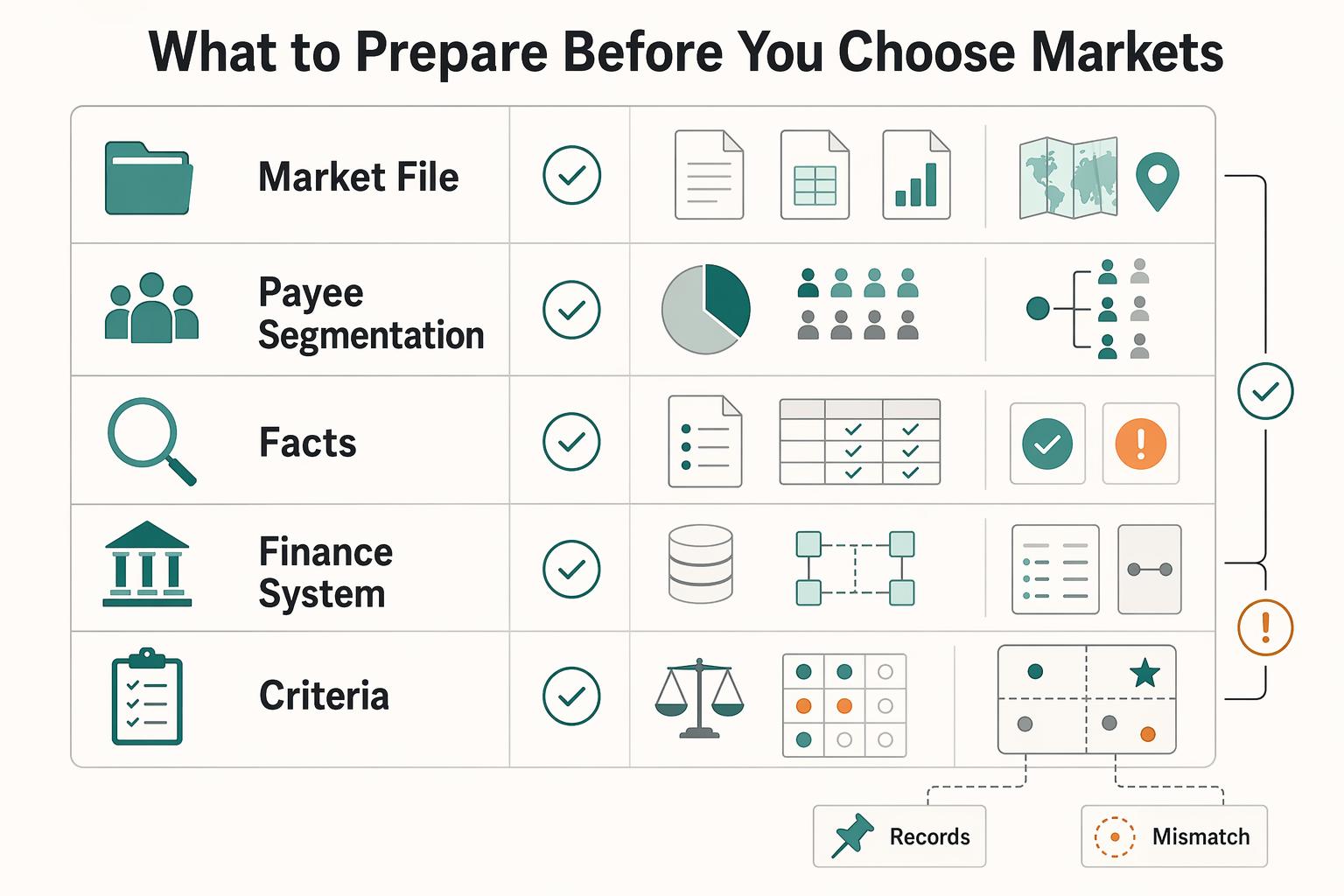
What to prepare before you choose markets#
Prepare a market file before enabling live payments. Identify legal payer, payee types, services and currencies, required provider approval, tax treatment and exception owners. Commercial research can guide positioning; an arbitrary competitor count is not a payment release control.
| Prep area | What to capture | Launch note |
|---|---|---|
| Market file per target country | Current understanding of payout and compliance workflows; unresolved items labeled explicitly; owner assigned | If a market does not have clear artifacts, open questions, and owners, treat it as not ready |
| Payee segmentation | Payout size, payout frequency, expected split between invoice collection and disbursement; monthly payee count, payment cadence, individual-versus-entity mix | If these cannot be estimated, the market plan is too vague for a build decision |
| Tax artifacts | US/foreign status and individual/entity documentation, service location and applicable reporting treatment | Track validity and annual rules separately from payment status |
| Finance-system touchpoints | Source records, imports and exports, sync direction, data ownership; note whether a system creates payout instruction, creates ledger event, or stores tax and compliance evidence | This exposes gaps before rollout planning starts |
| Go or no-go criteria | Compliance checkpoints, reconciliation expectations, exception ownership | If ownership is unclear or critical artifacts are unresolved, keep that market out of the first launch wave |
Create one market file per target country#
Create one market file per target country, including unknowns. Track your current understanding of payout and compliance workflows, label unresolved items explicitly, and assign an owner.
Use a simple readiness view for each market: source of truth, open questions, and approver. Do not mark a market as launch-ready while key compliance or payout-handling decisions are still unresolved.
Segment payees before you segment markets#
Segment payees before you segment markets. Separate cohorts, then estimate payout size, payout frequency, and the expected split between invoice collection and disbursement.
Keep this operational, not just persona-based. If you cannot estimate monthly payee count, payment cadence, and the individual-versus-entity mix, the market plan is still too vague for a build decision.
Define tax artifacts early#
For US tax documentation, distinguish a US person from a foreign payee and an individual from an entity. A W-9 documents US status and taxpayer details where required; applicable W-8 forms depend on the foreign payee and income facts. Retain forms with restricted access and track replacement when relevant circumstances change.
Configure reporting by payer, payee classification, payment category and tax year. Do not hard-code a historic USD 600 threshold as a universal current rule. IRS reporting guidance ties reporting to specific conditions and the applicable annual threshold; exemptions and payment methods also affect the outcome.
Map current finance-system touchpoints#
Map current finance-system touchpoints so the handoff scope is explicit. If accounting, AP, or payout systems are already in your flow, document what each system does now: source records, imports and exports, sync direction, and data ownership.
A practical label set helps here: creates payout instruction, creates ledger event, or stores tax and compliance evidence. That will expose gaps before rollout planning starts.
Set go or no-go criteria before build starts#
Set go or no-go criteria before build starts. Define compliance checkpoints, reconciliation expectations, and exception ownership up front. If ownership is unclear or critical artifacts are unresolved, keep that market out of the first launch wave until those gaps are closed.
How to score market readiness before committing engineering#
Score readiness with an operations-first market scorecard, not a demand-first ranking. If compliance, payout handling, or reconciliation is still unclear, mark readiness as uncertain until those evidence gaps are closed.
Build one scorecard per market#
Build one scorecard per market from your evidence pack, and use fields that can delay launch. Start with explicit checkpoints such as compliance alignment, integration depth, implementation complexity, and exception handling and edge cases. Add a confidence column for each so unknowns stay visible.
Keep the scoring simple. A low/medium/high scale or a small point range is enough if each score has an owner and a short rationale.
Add operational load signals early#
Add operational load signals early, even if the estimates are directional. Track investigation workload and reconciliation effort where you have evidence, and mark payout-rate assumptions as unknown when evidence is missing.
Require evidence behind each assumption. If a value is based on an open question rather than test results, prior patterns, or a named finance estimate, mark it as unknown instead of scoring it optimistically.
Estimate operating load from your own cohort: expected held payments, endpoint corrections, return investigations and time to resolve them. These estimates should influence rollout capacity without becoming invented country-risk rankings.
Evaluate each market by launch shape#
Evaluate each market with a launch-shape dependency map, not just a country label. If you are considering payouts-only, VBAs plus payouts, or Merchant of Record, list what each option depends on in that market before you rank it.
For each option, confirm ownership and process coverage for onboarding and screening, payment execution, reconciliation, and evidence handling. Keep integration depth visible as a first-order cost. More side tools, manual exports, or disconnected records can increase implementation complexity and operating drag.
Produce a prioritized launch sequence#
Produce a prioritized launch sequence with explicit internal statuses. Status should follow score, confidence, and dependency closure, not revenue ambition alone.
Use a sandbox to test unresolved integration behavior; required legal, tax and provider eligibility checks must be complete before live release. A low-value live pilot can validate approved payment paths, not bypass required controls.
For any high-priority launch decision, require a named approver, a chosen launch shape, clear investigation and reconciliation owners, and no unresolved blockers on compliance alignment or core integrations. If those are missing, lower the launch priority. Related: Airline Delay Compensation Payments: How Aviation Platforms Disburse Refunds at Scale.
Choose the payout operating model for each market cluster#
For launchable markets, centralize approval policy and ledger controls first, then localize payout routing only where payment-method mix or market process requires it. This can help you avoid familiar AP and AR failure patterns such as inbox approvals, portal hopping, and disconnected spreadsheets.
Decide where control lives before execution#
Decide where control lives before execution. Set that first, then decide where execution lives.
| Decision area | Centralize first | Localize only when needed |
|---|---|---|
| Approval policy | Keep one policy owner so approvals stay consistent | Apply documented market-specific authority and release rules where required |
| Ledger controls | Keep one accounting logic and reconciliation standard | Retain required local posting/reporting differences with mapped shared interfaces |
| Payout routing | Start with shared routing rules | Localize when payment-method mix or market process requires it |
Keep shared policy definitions and accounting interfaces, with explicit market-specific overrides where required. Local rules may change release checks, approvals or reporting. Retain the applicable policy version on each decision so centralization does not erase those differences.
Pick the simpler launch shape when evidence is thin#
Separate customer collection from expert compensation. A Merchant of Record arrangement may change who sells to the customer and handles collection obligations; it does not automatically take responsibility for paying your expert network. Choose the payout operating model by the payer contract, provider eligibility and who owns release and recovery.
Confirm responsibility in the actual contract: who owes the expert, who holds funds, who verifies the payee and who handles a failed or returned transfer? A simpler collection setup cannot compensate for an undefined expert-payment obligation.
Set a hard system boundary#
Set a hard system boundary: AP and AR plus core accounting own the payable or receivable record, approval state, and ledger outcome. The payout layer owns execution, provider references, status updates, and return or retry handling.
A practical checkpoint is AP or AR software linked to QBO or Xero so close operations do not turn into a fire drill. If both systems can independently define approval state or payout completion, finance and product may end up reconciling against different records.
Standardize operating artifacts before local exceptions#
Standardize operating artifacts before local exceptions. That reduces training friction and cuts down on misunderstandings as you scale across clusters. Use one shared artifact set across markets:
- approval matrix and escalation path
- reason codes for held, returned, and rejected payouts
- payout-method map by cluster
- reconciliation handoff fields across product, finance, and support
- evidence requirements for exception closure
Roll out changes in phases, not all at once. Start with one or two high-impact tools and expand only after the boundary between accounting and payout execution is working cleanly.
Design onboarding and compliance gates that do not break conversion#
Onboarding should gate payout activation behind clear internal checks and traceable records. That reduces risk without creating avoidable drop-off.
Collect only the data needed for the next decision#
Use staged progression: basic profile and entity data first, then internal verification checks, then payout method activation. This keeps you from collecting sensitive payout details before a payee is ready to move forward.
Treat state management as a control, not a UI detail. Distinguish states like profile created, verification in review, and payout-ready so partially screened payees do not leak into payout setup.
Collect tax profiles early and track them separately#
Start tax-profile collection during onboarding and track it separately from identity and compliance review. For W-9 workflows, keep the basics tight: request forms, track submission status, and store signed forms by client.
Track tax-document validity and annual reportable amounts separately from identity checks and payout status. Evaluate the applicable reporting rule for each tax year and category, and flag missing documentation for its actual withholding or release consequence. A reporting threshold alone is not permission to ignore required intake.
Route risk signals into review queues#
Send higher-risk patterns into an enhanced review queue with a named owner. Avoid opaque holds that support and finance cannot explain.
Use explicit status states so users know what is happening, for example pending, approved, held, and action required.
Enforce payout readiness with complete compliance state and audit trace#
Set an internal payout-readiness rule that depends on a complete compliance state plus audit history. Keep source-linked import records, and log what changed over time rather than silently overwriting data.
Keep provider onboarding requirements distinct from accounting imports. An API feed or SFTP file may supply transaction records, but neither proves a payee is verified or a payout account is enabled. Use provider requirement states and your recorded review decision for release eligibility.
Execute payouts with idempotent controls and observable status states#
The practical goal at execution time is simple: keep the payout process traceable from payment action to bank reconciliation, so operations and finance can explain what happened without guesswork.
Assign a stable payout operation to an approved obligation, and persist amount, currency, beneficiary version and provider idempotency key before submission. Attach the provider payout ID when returned. Recover an unknown response through retrieval or reconciliation before creating another attempt.
Separate internal states for approved liability, attempted transfer, pending outcome, delivered funds, failed attempt and return. For example, Stripe’s payout documentation distinguishes pending, in-transit, paid, failed and canceled states. Map the provider’s actual definitions and late failure behavior rather than treating acceptance as recipient receipt.
Deduplicate status events and serialize release decisions for the same obligation. When a confirmed failed attempt is corrected, create an authorized new attempt linked to that obligation. A repeated webhook must not reduce the payable again; a timeout must not trigger payment through a second rail.
Add payout batches when manual operations start creating risk#
Move from one-by-one payout handling to controlled batches when manual work starts creating reconciliation risk, not just when the team feels busy. The clearest trigger is repeated evidence that volume and tool complexity are outpacing your ability to explain transaction status and close cleanly. Use a short risk check from recent cycles:
| Risk signal | Grounded example | What it suggests |
|---|---|---|
| Status blind spots | Payout or transaction status is unclear without checking multiple systems | Volume and tool complexity are outpacing your ability to explain transaction status and close cleanly |
| Close impact | Unreconciled items are carrying into close, especially after migration or tooling changes | Set an internal switch point tied to your reconciliation process |
| Volume step-up | Measured submission or review work exceeds staffed capacity | Compare a controlled batch pilot against the existing workflow |
| Long-lived unresolved items | Unresolved items are persisting for months, not days | Stop a temporary lag from turning into an entrenched backlog |
Set a batching decision from tested capacity, not a universal transaction count. Batching can reduce submission work, but it does not repair missing identifiers or unresolved status. Clear those defects and measure whether controlled batches actually reduce manual effort.
If the recurring risk is missed items, status blind spots, and close delays, batching may be worth adopting. If your payout set is mostly one-off exceptions, keep case-by-case handling where needed.
Before you scale batch volume, make reconciliation ownership and records clear so finance can still trace and close with confidence:
- Keep both the batch envelope and per-item obligation, instruction, provider reference and outcome. For a hypothetical USD 1,000 batch of five USD 200 obligations, four delivered and one failed leave USD 200 unpaid. Retry only the failed item after correcting it; replaying the whole batch could pay the other four twice.
Compare the authorized batch total, provider funding movement, individual outcomes and remaining payables. Record fees and returned funds separately. A successful batch-upload response does not establish that every item settled.
Reconcile fast with an audit trail finance can defend#
In batch operations, treat reconciliation as a traceability job. Finance should be able to move from a payout outcome back to the original request without guesswork.
Step 1. Map the chain from request to settlement. Start with a current-state workflow map before you add more tooling. For each payout, keep core identifiers linked end to end, for example request ID, batch ID, provider reference, payout status, settlement record, and ledger journal reference. If a payment cannot be traced clearly, period close gets harder at scale.
Test this on one settled payout and one failed or held payout. You should be able to explain the full path and final financial outcome without relying on inbox searches or memory.
Step 2. Define one retrieval-ready evidence pack. Set the evidence pack before audit pressure starts. Keep it tied to the payout or batch anchor record, with the provider reference, status history, and any internal review artifacts your program uses.
The goal is one lookup, not reconstruction across chat, email, and screenshots. A complete pack makes the reconciliation story easier to defend under deadline.
Step 3. Give each tool one clear role and integrate deliberately. If you use multiple systems, define exactly which record each system owns and what passes downstream. Each tool should serve a specific purpose and integrate cleanly. Otherwise, you can end up with conflicting statuses and duplicate edits.
Roll out in phases, not all at once. Application sprawl can become a control risk. Add one or two high-impact integrations, then verify results before expanding.
Step 4. Use an internal exception-close checkpoint. Before period close, set an internal checkpoint so each exception has a reason, a clear owner, and a closure note in your process. This helps keep temporary exceptions from turning into a permanent reconciling bucket. Use close metrics to confirm it is working: closing speed, time savings, and error reduction.
Common failure modes and how to recover without a full rollback#
A full rollback is not always necessary when one control fails. Isolate the failure mode, narrow the impact, and resume only when your records are consistent.
Separate document defects from verification issues#
When a payee is blocked, first distinguish a document-quality defect from missing or unresolved verification details. Keep corrected documents in the same client record, and log the original mismatch, what was replaced, and the final review decision.
Your checkpoint is one record that clearly shows request status, submission status, and outcome. If fixes live across email and screenshots, tracking can drift.
Treat clustered issues as a local signal#
If issues cluster in one segment, investigate that cluster first instead of treating it as a platform-wide failure. Review cases from the same tracking record so each one is traceable and comparable.
Focus on patterns you can verify from recorded outcomes and document-status details. Resume broader volume only after the pattern stops repeating in reviewed cases.
Close tax-document gaps before volume gets ahead#
Close missing tax-document cases by their actual consequence: incomplete tax status, required withholding, provider restriction or reporting correction. Track the applicable tax year and category instead of applying a historic threshold to every payee.
Retain document request, submission, review and replacement history under the legal payee and payer relationship. Restrict access to tax identifiers and export only the fields needed by the reporting process; an accounting tool’s marketing feature list does not establish coverage.
Validate workflow records before raising throughput#
When records drift, treat it as a control-check issue before increasing throughput. Confirm one case end to end and make sure request history, document status, and outcome tell one consistent story.
If one case cannot be explained cleanly from system records, keep throughput changes on hold while you resolve the inconsistency. For a step-by-step walkthrough, see Gaming Platform Payments: How to Pay Game Developers Studios and Tournament Players at Scale.
Copy and use this launch checklist for the first rollout wave#
For the first wave, launch only what you can verify from records with clear history, not from setup notes alone.
Sequence the wave with a dated checklist#
Use an illustrative planning cadence: before launch, complete eligibility and beneficiary checks, approve mapping and recovery tests, then run a constrained approved cycle. In the first post-launch reviews, reconcile outcomes and assign corrections before expansion. Actual dates depend on provider onboarding and your evidence, not a universal six-week implementation promise.
Document connector choices and expected behavior#
If you import financial data, document whether each flow uses API aggregators or SFTP. Treat that as an explicit tradeoff decision, then verify outcomes from actual records before scaling volume.
Require audit-ready history on imported data#
Confirm imported records retain source details and logged changes. If changes are not traceable in-system, treat the control as not ready for rollout.
Reconcile balance-sheet accounts first#
Reconcile payout clearing, cash and expert liabilities with the approved chart of accounts. Do not force a provider status to mean revenue or expense recognition; finance defines the posting policy and retains the journal reference for each movement.
Close the wave with review, corrections, and a final reporting package#
End the first wave with a formal review-and-corrections pass, then produce a final reporting package. That gives you a consistent, repeatable baseline for the next rollout wave.
Before your first rollout wave, pressure-test your controls checklist against Gruv Payouts for idempotent retries, status visibility, and batch workflows where enabled.
Make expansion decisions from operations, not feature lists#
Launch based on operating control, not software comparisons. A feature list can help with tool selection, but it is not proof that a market is ready to run.
Set the go or no-go bar around predictable records#
Accounting software replaces manual spreadsheets and paper ledgers with automated recording, categorization, and reporting. That is necessary infrastructure, but software choice alone is not an expansion decision.
Use a stricter bar: records stay current, data stays trustworthy, and bank reconciliation works in normal operations. If your team cannot consistently match internal records to bank statements to catch errors, expansion is likely premature. Poor tool and process choices can lead to rework, wasted spend, and data people stop trusting.
Roll out in phases with explicit checkpoints#
Use phased rollout with explicit checkpoints, rather than a broad launch driven by generic comparisons of top platforms:
- Set a sync cadence that supports payout and close decisions; retain source timestamps and detect missing records.
- Match approved obligations, provider outcomes and cash records, including pending and returned items.
- Keep workarounds owned and tested; resolve control failures before scaling.
This tradeoff can mean fewer launches now and less cleanup later. The key question is not which tool has the longest feature list, but whether the market can run with records that stay accurate, current, and reviewable.
Validate one target market before expanding#
Start with one target market and run it through the scorecard and checklist from earlier sections. Expand only after one clean operating cycle shows that records stayed current, reconciliation worked, and the team did not depend on heavy workaround effort.
If any checkpoint fails, pause expansion, fix the gap, and rerun the same market before opening another. Expansion should follow operational proof, not feature-list comparisons.
If you are validating one pilot market before broader expansion, use the docs to map requirements to your operating model.
Frequently Asked Questions
What is the difference between accounting software and a payout platform for CPA and Bookkeeper networks?
Accounting software records liabilities, cash movements and financial reports. A payout layer submits transfers, retains provider references and handles statuses and returns. Link both through the approved expert obligation; a connected accounting tool alone does not prove the payout route is ready.
What are the minimum capabilities required before paying experts across multiple countries?
Before live cross-border payouts, establish legal payer and payee identity, applicable tax documentation, provider eligibility, verified beneficiary details, amount and currency rules, release authority, duplicate protection and outcome reconciliation. Test the enabled route and name owners for held, failed and returned payments.
What should we evaluate before entering a new market for payouts?
Evaluate the actual payer-to-payee corridor: provider approval, currencies and funding, recipient endpoints, applicable tax treatment, required local controls, status retrieval and fees. Record unresolved mandatory requirements as release blockers; use a sandbox for integration work until those are resolved.
When should we switch from single payouts to payout batches?
Use batching when tested submission and review capacity justify it and item-level status recovery is reliable. Do not use a fixed transaction count. Preserve each obligation and attempt within the batch, and retry only eligible failed items after reconciling original outcomes.
What are the most common failure points when scaling payouts to CPAs and bookkeepers?
Concrete failure points include paying the wrong legal entity, missing required tax or provider checks, resending an unresolved attempt, treating batch acceptance as full delivery, and posting duplicate status events. Prevent each with versioned beneficiary records, release gates, stable operations and item-level reconciliation.
How should we prioritize rollout order across countries and vertical segments?
Prioritize corridors where mandatory checks are complete and your cohort’s endpoint, funding and recovery paths are proven. Estimate exception capacity and cost from representative tests. A required compliance gap remains a live-release blocker even for a small pilot.
Researched and edited by the Gruv editorial team. Gruv builds cross-border billing, payouts, and finance-operations software for global businesses.
Sources
Educational content only. Not legal, tax, or financial advice.
Related Posts

The Freelance Payment Penalty: A Modeled Audit of Platform Fees, FX Spreads, and Payout Delays
The money rarely disappears through a single, easy-to-spot fee. The real loss is stacked. A marketplace takes its commission, a processor adds a charge for international cards, a bank or payment company converts the currency at a spread, a platform holds the funds before release, and a wire sheds a little to intermediaries on the way in. Each layer looks defensible on its own, but the worker feels the combined result as a smaller deposit and a later payday.

How to Respond to a Subpoena for Business Records
Move fast, but do not produce records on instinct. If you need to **respond to a subpoena for business records**, your immediate job is to control deadlines, preserve records, and make any later production defensible.
A US Expat's Guide to Investing in UCITS ETFs to Avoid PFIC Issues
The real problem is a two-system conflict. U.S. tax treatment can punish the wrong fund choice, while local product-access constraints can block the funds you want to buy in the first place. For **us expat ucits etfs**, the practical question is not "Which product is best?" It is "What can I access, report, and keep doing every year without guessing?" Use this four-part filter before any trade: