
Quick Answer
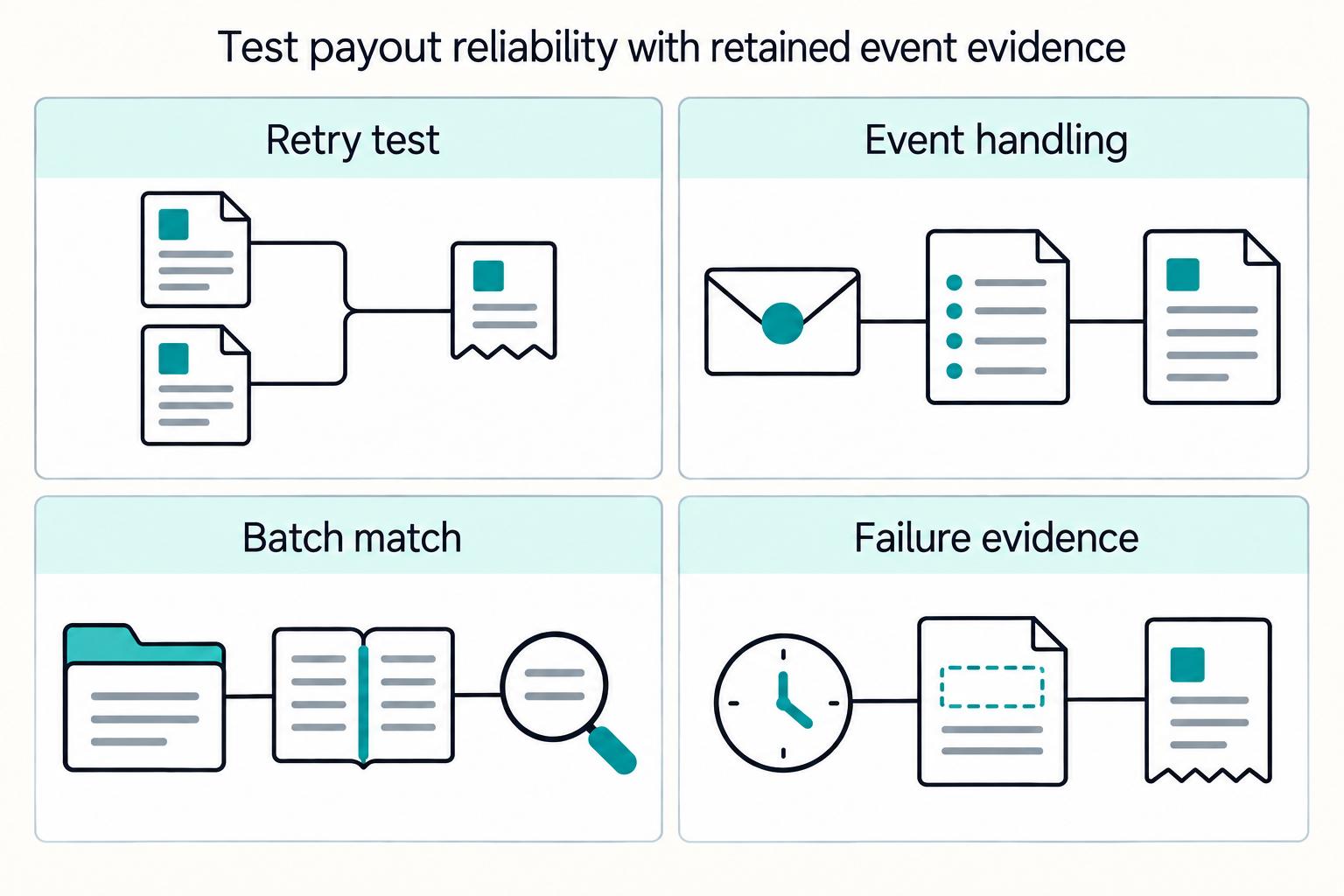
To pay game developers, studios, and tournament players at scale, treat collection, FX conversion, and payouts as one money movement system. Launch only in markets where local payment method fit and recipient payout paths are proven end to end, define payee-specific onboarding and release rules, and make identity checks, risk gating, idempotency, webhook handling, and reconciliation live before you scale volume.
Why gaming payment scale fails earlier than most founders expect#
Payment operations can start breaking before growth does. If you collect from players, convert funds across borders, and pay studios, developers, or tournament winners, you are not running separate payment tasks. You are running one connected money movement model. Weakness in any leg can show up as margin pressure, cash delays, or trust damage.
Step 1. Treat collection, conversion, and payouts as one scope#
Treat collection, conversion, and payouts as one scope from day one. A player payment approval is not a clean win if settlement is slow, conversion is costly, or the outbound payout later fails.
Keep that full scope in view: player collection, cross-border conversion, and outbound payouts in one operating model. If you are evaluating Brazil, Indonesia, or Nigeria, include inbound coverage and outbound payout feasibility in the first market discussion.
Step 2. Assume margin can erode even while topline rises#
Assume margin can erode even while topline rises. In gaming, poor payment execution can cost you players, revenue, and trust, and dispute risk is higher because digital delivery is harder to prove.
The risk stack builds quietly across chargebacks, settlement timing, and FX friction. Settlement speed affects cash availability, and cross-border payouts add conversion plus multi-institution movement before the recipient is paid. As a friction proxy, the World Bank remittance dataset showed a 6.49% global average sending cost as of August 18, 2025. It is not a gaming benchmark, but it is a useful warning against treating cross-border costs as negligible.
Step 3. Shape questions with outside sources, commit on your own data#
Use public narratives to shape questions, not approve markets. PhotonPay and Tipalti content can be useful for directional context, but it is still vendor marketing. LinkedIn and Reddit can surface signals, but they are member- or community-generated and not audited operating data.
Before you commit to any market, require internal checks on your expected lanes: approval rate, payout success, settlement time, and FX spread. If you cannot measure those in your own flow, external confidence is still narrative, not evidence.
Step 4. Set the operating outcome and the verification gate before launch#
Set the operating outcome now. By the end of this guide, you should have a draft launch order, a minimum control set, and expansion criteria specific enough to execute.
Use this verification gate before launch: which two markets go first, which payment and payout paths are testable end to end, which controls must be live before opening volume, and which metric failure pauses expansion. If those answers are not backed by internal data and named checks, you are still in the narrative stage.
For more on monetizing game assets and structuring developer payouts, read Gaming Platform Payments: How to Monetize Game Assets, Pay Developers, and Manage In-Game Economy.
What to prepare before you pick markets or providers#
Do not shortlist markets or Payment Service Providers on narrative alone. Before you choose either, build a minimum evidence pack for each target region and one shared metrics sheet so you can compare method fit, payout readiness, and cost in one view.
Step 1. Start with a region-level evidence pack of four inputs#
Start with a region-level evidence pack, not just a country list. For Southeast Asia, Latin America, and the Middle East, capture four inputs: player payment method demand, outbound payout corridors, fraud-control requirements, and regulatory constraints.
Keep the early checks concrete. In Brazil, treat Pix as a core local rail. In Indonesia, include QRIS context and corridor readiness where relevant, since QRIS Cross-Border already connects with partner countries including Thailand, Malaysia, Singapore, and Japan. In the Middle East, test whether your model triggers licensing or registration gates, including the UAE Payment Token Services Regulation in force from 31/8/2024.
Step 2. List local methods by market, then validate fallback paths#
List local methods by market, then validate fallback paths before launch. A practical starting map is Brazil with Pix, Indonesia with DANA and OVO, and China with Alipay and WeChat Pay.
Treat local wallet-share data there as historical direction, not a current ranking. Bank Indonesia's cited 2020 signal lists OVO at 28% and Dana at 14%. When a PSP claims support, confirm the exact country scope, merchant setup, settlement path, and payout dependencies so "checkout coverage" does not fail later at settlement, refunds, or outbound payouts.
Step 3. Define payee segments before you design onboarding#
Define payee segments before you design onboarding. Different payee groups can require different documentation and payout controls.
If you force every segment into one onboarding form and one release policy, you can hide segment-level failure and increase payout support noise once volume grows.
Step 4. Use one source-of-truth metrics sheet before provider selection#
Use one source-of-truth PSP metrics sheet before provider selection. Track payment success, network authorization rate, payout success, settlement time, and FX spread by country, method, and provider.
For payout success, separate processing, credited or accepted, failed, returned, and canceled states. For settlement, do not use one assumed SLA, because delay can vary by method, including ranges like 1 to 45 calendar days. If a provider cannot provide these fields, you cannot compare pricing and performance reliably.
Choose your first two markets with a method-fit and payout-readiness scorecard#
Set launch order with one rule: prioritize only where both local collection fit and recipient payout feasibility are strong in your own tests.
| Market | Player payment method fit | Payout feasibility to recipients | Decision now |
|---|---|---|---|
| Brazil | Strong: Pix is Brazil's instant payment system, and Central Bank survey data reports 76.4% usage. | Partial: provider setup can require a local Brazil entity to accept Pix; payout behavior still needs segment-level proof. | Prioritize for first validation if local-entity and provider setup are cleared. |
| Indonesia | Partial to strong: DANA and OVO are established local wallet/app options. | Partial: BI-FAST is the retail backbone, but rollout is gradual by institution. | Prioritize for second validation only after wallet collection and payout-path coverage are proven. |
| Nigeria | Weak, on the evidence here for collection-fit confidence. | Strong: NIP runs at large scale (5,626,762,540 transactions; N476.89 trillion in H1 2024). | Defer until collection-fit evidence is strong for your player mix. |
| China | Strong: Alipay and WeChat Pay are major apps; foreign card-linking is supported. | Partial: payout feasibility is corridor-specific and can include limits (for example in Payment Connect contexts). | Defer until recipient payout corridors and onboarding paths are tested end to end. |
This is a readiness screen, not a permanent market ranking. Strong checkout signals alone are not enough if recipient payouts are unproven.
Apply the rule plainly: if local method coverage is weak but payout rails are strong, defer. If both are strong, prioritize. In this evidence-only screen, the first two validation candidates are Brazil and Indonesia, while Nigeria and China stay deferred until the missing side is proven.
Keep city signal separate from country signal. In Brazil, the cities covered include capitals and municipalities with more than 100,000 people, so do not treat one-city behavior as a proxy for the whole country.
Use one go/no-go checkpoint per market. Do not launch until both collection and payout paths are testable end to end for your real recipient types.
- Brazil go/no-go: Pix collection and recipient payout both pass on your production-like flow; no blocking local-entity/setup gap.
- Indonesia go/no-go: DANA/OVO collection and payout pass through the exact institution path you will use.
- Nigeria go/no-go: at least one collection route is proven for your player behavior, not only payout-rail capability.
- China go/no-go: Alipay/WeChat Pay collection plus recipient payout corridor tests pass under the exact onboarding and limit conditions you will operate.
If your studio agreements use milestone-based releases, see Partial Payments and Milestone Billing: How to Implement Flexible Invoice Terms on Your Platform.
Map money movement by actor before you write product requirements#
Map money flow by actor before you write requirements, or you will miss ownership at the points where operations actually fail: collection, hold or convert, refund, and payout failure. In this model, collection and payout are separate controls, so document them separately before UI specs or provider selection.
Step 1. Create four matrices, one for each actor flow#
Create four matrices, not one blended diagram: player to platform, platform to studio, platform to developer, and platform to tournament winner. One incoming payment can fund multiple recipients, and the platform charge is decoupled from downstream transfers, so liability and reconciliation can diverge by actor.
Use the same five fields in every row:
| Actor flow | Collection method | Hold or convert step | Payout rail | Failure owner |
|---|---|---|---|---|
| Player to platform | Brazil test case: Pix | Platform balance hold, with FX/allocation logic stated explicitly | None (intake step) | Platform for refunds, fees, chargebacks, or equivalent reversals tied to the collected payment |
| Platform to studio | Prior player collection completed | Split/reserve funds at platform level before release | PSP-supported transfer/payout route | Platform for release-logic errors; recipient owner for destination-data errors; PSP for processing-side failures |
| Platform to developer | Prior player collection completed | Same control pattern, mapped to developer onboarding state | PSP-supported payout route | Platform or recipient-data owner, based on failure cause |
| Platform to tournament winner | Prior player collection completed | Hold/convert logic documented before release | Brazil/Indonesia payout route by winner corridor | Platform until payout is released and confirmed |
If any row says "same as others," it is not mapped far enough.
Step 2. Model each method's behavior and its authorization signal#
Use those first two markets as concrete method-behavior tests. In Brazil, model Pix as instant collection, not as a generic bank bucket. In Indonesia, model wallet-led intake as its own path. For example, OVO Cash is server-based electronic money, so do not treat it as identical to bank-transfer behavior.
For each method row, define the exact authorization signal your system uses. Some DOKU method flows can communicate authorization by webhook, so webhook handling needs to be an explicit control point in the matrix.
Step 3. Add the branches teams skip: refunds, returns, and failed payouts#
Add the branches teams usually skip: refunds, returns, and failed payouts. For Brazil, include a refund branch tied to the original payment identifier where your PSP supports referenced refunds, so duplicate refund execution is less likely.
Also include a Pix MED contestation branch. MED supports fund-return paths up to 11 days after contestation; the new functionality is optionally available from 23 November 2025 and mandatory from 2 February 2026. Treat this as an exception path, not a guaranteed refund outcome.
For wallet-led methods in Indonesia like OVO, keep failed collection and failed payout as separate branches. Do not assert broad OVO refund or chargeback timelines here. Instead, define the failure event, the reviewer, and the retry or cancel evidence. Assign ownership of recipient destination data explicitly, because incorrect destination data is a common cause of returned payouts.
Step 4. Require three artifacts for every row and branch#
Require three artifacts for every row and branch: internal ledger event, PSP reference, and reconciliation export. Without all three, support and finance cannot prove what happened.
- Ledger: record every balance movement, including intake, hold, release, refund, reversal, and payout return.
- PSP identifiers: store both provider ID (
pspReference) and your ID (Merchant Reference) to match internal and PSP records. - Reconciliation export: match internal sales and payout actions to PSP settlements.
Verification is binary: trace one Brazil Pix flow and one wallet-led flow from Indonesia through all three artifacts. If you cannot show the ledger line, provider reference, and settlement match, the flow is not ready for product requirements.
Make the build vs buy call with cost of delay and control depth#
If you cannot staff ongoing compliance and payout operations, buy core rails and keep your differentiation in product logic, ledger rules, and release controls. A common failure mode is underestimating what it takes to run money movement after launch.
Step 1. Score where control is strategic and name accountable owners#
Make the call on control depth, not engineering pride. Use your money map to score where control is actually strategic: collection behavior, hold or convert logic, refund handling, payout release, and reconciliation.
A full internal build can maximize control, but it also creates ongoing obligations. In the U.S., a business that transfers funds can be treated as a Money Services Business, and MSBs must maintain a written AML program commensurate with their risk profile. In practice, that means ongoing policy ownership and monitoring capacity, not a one-time integration effort.
Some aspects of gaming payments have also drawn regulatory attention on consumer protection, privacy, and financial crime. Before you choose build, name accountable owners for AML, payout operations, and reconciliation. If those owners are undefined or borrowed from already stretched teams, build is usually the wrong path right now.
Step 2. Compare buy options against cost of delay and operational depth#
Compare buy options against your real bottleneck, which is often cost of delay. Tipalti positions speed as "Up and running in weeks, not months," and claims support for cross-border payments to 200+ countries and territories in 120 currencies via 50+ methods. PhotonPay frames the opposite risk: stitched PSP-bank-payout-vendor stacks can fail at global scale and should be replaced by a more unified collection-to-payout setup.
Treat both as vendor narratives, not proof. They are still useful for framing the tradeoff. Buy paths can reduce setup and operational burden, while internal or heavily stitched paths can preserve control but add sprawl risk. Modern Treasury reports organizations typically manage 6-7 payment systems, 13% use more than 10, and fragmented tooling makes downstream exception handling harder; the same discussion cites home-grown build-and-maintain costs that can be upwards of $500,000.
A practical rule is simple:
- Keep in-house the layer where your edge is real, for example release timing logic and fund-split rules.
- Buy first where your gap is operational depth, for example AML operations and cross-border payout execution.
As Bain Expert Partner Erin McCune put it, "Process change is hard and it takes leadership and conviction, and [has] real benefit."
Step 3. Ask shortlisted providers to prove performance on your mapped flows#
Use social proof to generate diligence questions, not decisions. Reddit is user-populated by design, and LinkedIn discussion can be useful directional input, but neither is implementation evidence.
Ask shortlisted providers to prove performance on your mapped flows in sandbox or pilot traffic. At minimum, verify:
- Provider reference and your merchant reference are available on both collection and payout events.
- Reconciliation exports match your internal ledger on representative intake and payout paths.
- Failure handling covers payout returns, duplicate retry protection, and delayed status updates.
If the process never gets beyond slideware into evidence on references, reconciliation exports, and exception handling, you are not evaluating implementation risk.
Related: Airline Delay Compensation Payments: How Aviation Platforms Disburse Refunds at Scale.
Set compliance and payout gating before opening volume#
Lock payout controls before you scale volume. In your operating policy, release funds only after identity checks, risk review, and payout eligibility are complete, even when tournament deadlines are tight.
Step 1. Set a fixed gating sequence and enforce it in systems#
Set a fixed gating sequence in product and operations: identity checks, risk screening, payout eligibility, then release. Keep that sequence enforceable in systems, not only in policy docs. In regulated AML regimes, identity verification is expected before relationship activation or transaction execution, and CIP is a risk-based AML program component.
Test it in sandbox and pilot traffic. Each payout should show four distinct states or timestamps: identity verified, screening cleared or escalated, eligibility confirmed, then funds released. If release can happen without the first three states, urgency will eventually bypass controls.
Step 2. Tune policy by corridor with one shared market matrix#
Tune policy by corridor, not with one global checklist across the Middle East, Latin America, and Southeast Asia. FATF guidance supports jurisdiction-specific controls, and cross-border supervision differs by market, so documentation asks, review thresholds, and escalation ownership should vary by corridor and recipient type.
Use one shared market matrix across finance, support, and compliance. For each corridor, define accepted identity sets, enhanced-review triggers, required payout-purpose data, and who can approve release after a manual hold. Without this, teams default to ad hoc decisions and inconsistent outcomes.
Step 3. Define explicit hold and release rules for the first lane#
For the first lane, define explicit hold and release rules. For Nigeria, use current evidence-based triggers, not stale labels.
In Brazil, Pix MED gives a concrete fraud-dispute flow: refund requests can be filed within 80 days, analysis runs up to 7 days, confirmed fraud can return funds within 96 hours when available, and partial recovery can continue up to 90 days from the original transaction. Those timelines are country-specific, but the control pattern is practical: block, investigate, release or return, and record the outcome.
For payouts leaving that market, treat cross-border flows as inside the FX regulatory perimeter. Make payout purpose, corridor, beneficiary details, and provider reference mandatory before release. Otherwise finance and ops will struggle to explain or unwind payouts.
For Nigeria, do not use the country label alone as the trigger. Nigeria was removed from FATF increased monitoring on 24 October 2025. If risk is higher in your Nigeria corridor, apply enhanced review to observed signals in your own data and counterparty requirements, not blanket country assumptions.
Step 4. Document exception handling so blocked payouts resolve consistently#
Document exception handling so blocked payouts are resolved consistently, not improvised. Every blocked case needs a named owner, a response path, and an evidence pack that can stand up to audit and complaints.
At minimum, capture:
- Identity result and document mismatch notes
- Screening outcome and escalation reason
- Payout eligibility decision
- Provider and internal references
- Final disposition, approver, and customer communication
Do not allow "just release this one" overrides driven by support pressure. Route suspicious cases to compliance review, and in U.S. banking contexts, or partner contexts aligned to them, remember suspicious activity can carry formal reporting obligations, including SAR triggers in some cases involving at least $5,000. The goal is controlled scale, not slower payouts.
For a step-by-step walkthrough, see How to Launch a Legal Compliance Platform for Freelancers and Handle Their Payments.
Implement reliability controls that prevent duplicate payouts and blind spots#
Reliability here means every payout write, reversal call, and provider callback is retry-safe, order-tolerant, and reconciliation-ready from day one.
Step 1. Enforce idempotency on every payout and reversal request#
Enforce idempotency on every payout and reversal request that creates or changes money movement. For the same key, the first result should be reused so a retry after a timeout does not create a second payout or reversal.
Carry the idempotency key through your payout service and map it to the provider request. Test this directly: submit the same payout twice with the same key and confirm you get one internal payout record, one provider reference, and one ledger effect. If retrying can produce a new provider reference, you still have a duplicate path.
Do not assume support is universal across PSP APIs. Verify idempotency behavior for each payout and reversal endpoint.
Step 2. Handle webhooks as at-least-once and deduplicate by event ID#
Handle webhooks as at-least-once, out-of-order, and potentially delayed. Deduplicate by event ID, and apply transitions only when the incoming event is valid for the current state.
For Alipay and WeChat Pay, repeated notifications are expected when acknowledgment is not successful. Alipay documents resends up to 8 times within 25 hours. WeChat Pay documents repeat patterns including 8 times in 30 minutes and a longer schedule totaling 24h4m. Return a fast success acknowledgment after basic validation, then move heavier work to async processing, because slow acknowledgment can trigger automatic retries for some providers (for example, beyond 10 seconds).
Store provider event IDs and enforce transition rules so late or duplicate callbacks cannot post duplicate ledger effects.
Step 3. Run reconciliation at batch close, not only monthly#
Run reconciliation at batch close, not only during monthly finance review. Match provider events, internal ledger entries, and the bank payout or settlement batch that actually moved funds.
Use the provider reference as the anchor key for investigation and matching. At close, check for internal payouts marked paid with no provider event, provider paid events with no ledger posting, and payout records missing a provider reference. If you cannot tie bank payouts back to settlement batches and transaction rows, you have an operational blind spot.
Step 4. Alert by failure mode rather than one generic payout error#
Alert by failure mode, not with one generic payout-error signal. Track at least pending-too-long, duplicate attempt, missing provider reference, and payout return.
Keep pending thresholds method-specific. Payout states like pending or in_transit can be valid before final outcome. Flag duplicate attempts when repeated writes arrive for the same payout intent under different request keys. Escalate missing provider reference quickly because reconciliation depends on it. Trigger recovery workflows for payout returns. In some payout programs, unclaimed payouts are returned after 30 days.
If your team is defining idempotency, webhook retries, and reconciliation checkpoints now, use the Gruv docs to align your implementation runbook with production-ready payout operations.
Launch tournament payouts with controlled exposure first#
Once retry and reconciliation controls are stable, launch narrowly: one tournament cohort in one market pair, then expand only after the money flow is traceable end to end.
Step 1. Lock one payout lane before launch#
Lock one payout lane before launch: one tournament format, one winner segment, one collection pattern, and one payout rail. If you pilot with player funding in Indonesia and winner payouts in Brazil, define upfront whether payouts are pre-funded or released only after collections settle.
Timing differences make this non-negotiable. Pix can move funds in seconds at any time, while DOKU's Indonesia settlement table lists DANA at T+2 and notes settlement processing on working days. If collections settle on a DANA cycle but payouts go out over Pix, avoid product language that implies an instant post-match payout.
Exit criteria for this pilot are straightforward: every winner has a finalized result, payout eligibility status, provider reference, and matching ledger entry for the event.
Step 2. Tier recipients by risk and payout history#
Tier recipients by risk and history so first-time winners do not inherit studio-level release privileges.
Use lower auto-release limits for first-time tournament winners, with manual review above threshold. Promote winners to higher tiers only after complete payout and tax documentation and a clean payout history. This is consistent with tiered tournament controls, for example Riot NA policy thresholds like $10,000 Tier 3 and $50,000 Tier 2 before approval requirements.
Make documentation gates explicit in the winner flow. Major tournament rules can require payment and tax forms before payout and allow withholding if forms are missing, so surface that requirement before the event closes.
Step 3. Publish payout timing based on operational states#
Publish payout timing based on operational states, not marketing claims.
Some rulebooks allow long windows, including an example of 90 business days after event completion. Your policy can be tighter, but it still needs to reflect result verification, documentation approval, and settlement timing.
For an Indonesia-to-Brazil lane, do not promise same-day payout when release depends on DANA settlement. State the sequence plainly: results confirmed, payment and tax details approved, payout released. Show that status sequence in support tooling so disputes can be resolved from the actual blocking step instead of a generic "pending" state.
Track margin leakage weekly and correct route decisions fast#
Once your pilot lane is live, run a weekly margin review by corridor and method so route changes come from data, not anecdotes.
Step 1. Break every lane into four leakage buckets#
Break every lane into four leakage buckets: acceptance loss, chargeback loss, settlement-delay cost, and FX impact. For Latin America and Southeast Asia, keep the cuts practical by market, method, provider, and payout corridor.
Start acceptance tracking with authorization rate, the share of submitted transactions approved by the cardholder's bank. Because online approval can run about 10% lower than in person, GMV growth alone can hide margin leakage. Each weekly view should include submitted transactions, approvals, settled volume, and net revenue by lane.
Step 2. Review performance by method and market each week#
Review performance by method and market each week, not only by provider. That means checking methods like Alipay and WeChat Pay at lane level, and reviewing each market by the rails you actually run there.
Treat asynchronous wallet behavior explicitly. Some WeChat Pay payments do not return immediate confirmation and depend on webhook updates, so your product status and ledger status need to reconcile before you treat demand as realized.
Step 3. Set an internal action rule before performance degrades#
Set an internal action rule before performance degrades. If a corridor repeatedly misses your margin target, reroute to a different method or provider, or pause expansion spend until the cause is clear.
Diagnose by leakage type, not with one blended number. If disputes rise, track both count and basis points. If timing is the issue, isolate settlement delay as its own cost line, since settlement timing can vary from 1 to 45 calendar days by method.
Step 4. Keep finance and product on one shared dashboard#
Keep finance and product on one dashboard with shared event definitions. At minimum, include authorization rate, settled transactions, dispute counts, VAMP ratio inputs, average settlement days, and realized FX spread by lane.
Your checkpoint is simple: in one screen, either team can explain why a route is expanding, paused, or rerouted. If that answer is not visible from shared data, route decisions are still anecdotal.
Avoid the mistakes that stall gaming payment expansion#
Do not scale acquisition until local checkout and payout rails are proven in your own flow. Stalled launches often start when spend scales before payment operations are reliable.
Step 1. Treat core payment methods as a launch gate for checkout#
Mistake: launching China acquisition before core methods like Alipay and WeChat Pay are live in your checkout. Recovery: treat these methods as a launch gate for China-facing checkout, then verify them with your own end-to-end tests. A Chinese government source identifies Alipay and WeChat Pay as the two major payment apps, and payment-method documentation positions both as key for reaching Chinese shoppers. Your real checkpoint is a completed transaction per method where checkout result, provider reference, webhook event, and ledger entry all align. If status mapping is unclear, pause spend.
Step 2. Build a corridor matrix and route payouts by lane#
Mistake: reusing one payout policy across Brazil, Indonesia, and Nigeria. Recovery: split policy by corridor and recipient type. Brazil runs Pix (47% of non-cash transactions by Q4 2024), Indonesia uses QRIS as Bank Indonesia's standardized QR code, and Nigeria uses NIP with CBN-linked limit rules under active circular updates, including March 2026. Build a corridor matrix for recipient type, required identifiers, limit logic, and exception owner, then route by lane.
Step 3. Require evidence on your own traffic before provider approval#
Mistake: treating PhotonPay or Tipalti marketing claims as proof of production fit. Recovery: require evidence on your traffic before approval. Their gaming pages are vendor narratives, and Tipalti explicitly separates sandbox from production, so insist on sandbox results, reconciliation exports, webhook samples, failed-case handling, and at least one batch close where your ledger totals match provider reports.
Step 4. Gate expansion on your own operating data#
Mistake: letting Reddit debate about Microsoft Game Pass economics drive rollout gates. Recovery: use your own operating data for decisions. Gate expansion on method-level approval performance, payout success by recipient type, settlement timing, and exception volume by corridor. If those are weak or incomplete, hold expansion until reliability is proven.
Use this phased expansion sequence for the next three markets#
Use a three-phase sequence: prove one lane in Brazil or Indonesia, add one more lane in Latin America or Southeast Asia only after operations are reliable, then evaluate China when compliance and support capacity are ready.
Step 1. Prove one high-fit lane before opening a second market#
Prove one high-fit lane in Brazil or Indonesia before opening a second market. Validate both local collection behavior and your payout path end to end.
Brazil can be a practical first lane for collection because Pix is the most widespread payment method among Brazilians, with Banco Central do Brasil reporting 76.4% usage on 01/03/2025. Indonesia can also be a strong Phase 1 lane, but design around QRIS interoperability rather than a single wallet rail.
Set a strict Phase 1 checkpoint: one completed player payment, one successful winner payout, one refund or reversal, and one batch close where your ledger matches provider reporting. For Indonesia, require reconciliation evidence tied to provider references, for example refNo, not just dashboard snapshots, and confirm off-us refund behavior before trusting production scale.
Step 2. Add a second lane only after exception handling is controlled#
Add a second lane only after reconciliation and exception handling are consistently controlled. Expansion is not just routing.
Before moving to a second Latin America or Southeast Asia lane, make ownership explicit by recipient type and method: missing provider references, payout returns, refund requests, and payments that settle but do not post cleanly to your ledger. If those cases are still handled ad hoc, hold Phase 2.
For the Southeast Asia lane, test beyond happy-path authorization. QRIS interoperability standardizes QR acceptance across providers, but it also expands edge-case handling, including off-us refund and exception flows.
Step 3. Expand only when compliance and support capacity are in place#
Evaluate China only when compliance and support capacity are in place. Do not enter on demand alone.
Method expectations are strong: Alipay and WeChat Pay are identified as China's two major payment apps, and mobile-payment penetration is reported at 86 percent by end-2023. Treat method coverage as a launch gate, then confirm your organization can absorb compliance review and method-specific support load before entry.
Step 4. Define exit conditions before each phase starts#
Define exit conditions before each phase starts so teams can pause without political friction.
- Phase 1 exit: pause if checkout or winner payout cannot be reconciled to provider reporting and internal ledger entries with stable references such as
refNo. - Phase 2 exit: pause if refunds, reversals, or payout exceptions still require ad hoc handling, especially on QRIS and off-us flows.
- Phase 3 exit: pause if Alipay/WeChat Pay testing is incomplete, or if compliance and support owners are not staffed for the added review workload.
This sequence is slower than a land-grab rollout, but it gives you a safer and more defensible expansion path.
What to do next before you commit go-to-market budget#
Do not release go-to-market budget until one launch lane passes collection, payout, and control checks end to end. Keep expansion conditional. If local collection fit, payout readiness, and compliance operations are not all ready at the same time, delay spend.
- Pick candidate markets and define exact lanes.
Define each lane as country + currency + recipient type, not just a country label. Method support is lane-specific, and support can vary by country and presentment currency. First gate: your PSP confirms the method is available for the exact transaction context you plan to run.
- Confirm local method coverage with live transaction context, not marketing pages.
Fetch available methods using amount, country, and currency before committing acquisition budget. Familiar local options affect checkout completion, and some methods have hard constraints. Example: DANA has a 300 IDR minimum, so low-value test purchases can fail if amount design ignores that threshold. For Brazil, validate Pix for your exact program rather than assuming broad country support applies to your account.
- Map money movement actor by actor.
Build flows for the specific routes you plan to launch (for example, player to platform, platform to studio, platform to indie developer, and platform to tournament winner). For each flow, document collection method, hold or conversion step, payout rail, refund path, failed payout path, internal transaction record, and provider reference. Gate: finance can trace a single bank payout back to its underlying transaction batch.
- Set payout gating before anyone can be paid.
KYC completion is a prerequisite for payouts, not a post-launch cleanup task. Enforce payout controls using verification status and volume thresholds. If tournament urgency can bypass identity verification requirements, the lane is not ready.
- Test idempotency and webhook behavior under retries.
Use an idempotency key on payout-related write calls so retries do not create duplicate side effects. Webhook handlers must also tolerate duplicate deliveries. Undelivered events can retry for up to three days, and manual recovery can only query the last 30 days. Gate: replay the same payout request and confirm one provider action, one internal outcome, and deduplicated event handling.
- Run reconciliation before launch, not after incidents.
Reconcile each payout to the batch of transactions it settles. This is where missing references and amount mismatches can surface. Require an evidence pack for each test cycle: verification status, payment method, provider reference, internal transaction entry, payout result, and reconciliation export tying bank movement to the batch.
- Launch one controlled tournament cohort and hold the rest.
Keep the first release narrow enough for support, finance, and ops to inspect every exception. You need proof that collection fit, payout gating, and reconciliation all hold under real traffic together. If any one breaks, pause expansion and fix that lane before adding demand.
Keep readiness claims conservative. "We support this market" is too broad if method availability is limited to specific transaction setups. Validate each lane, document what passed, and then scale spend. For a deeper operator view on winner disbursements, see Solving Esports Prize Payment Distribution: How Tournament Platforms Pay Winners Globally.
Related reading: Healthcare Staffing Platform Payments Compliance for Safer Rollouts.
Before committing expansion budget, confirm market coverage, payout rails, and compliance gating for your exact corridors by contacting Gruv.
Frequently Asked Questions
What usually breaks first when a gaming platform scales payments globally?
Reconciliation and exception handling usually strain first, often before checkout capacity does. Common failures include missing provider references, duplicate operations when idempotency is not enforced, and refunds or reversals that do not post cleanly to your ledger. At batch close, each settled payment and payout should tie back to provider reporting and your internal ledger.
Which payee groups need different payout treatment: studios, indie developers, tournament winners, and creators?
Yes. Studios, indie developers, tournament winners, and creators should not be treated as one payee class. Studios may fit scheduled, contract-backed payouts with tighter onboarding and approval controls. Indie developers, tournament winners, and creators usually need different mixes of onboarding, tax, release, and frequency controls.
When should a platform build payment infrastructure in-house instead of buying?
Build in-house only if payment control is truly core to your product and you can staff ongoing compliance, payout operations, and support. Otherwise, buy core rails and keep control of your own ledger, payout rules, and product logic. Treat a provider as higher risk if it cannot prove retry behavior, reconciliation exports, and failed payout states in testing.
Which local methods are table stakes in markets like Brazil, Indonesia, and China?
Brazil often starts with Pix. In Indonesia, design around QRIS rather than assuming one wallet rail can cover the market. For China, plan for Alipay and WeChat Pay.
How do FX, settlement timing, and chargebacks affect margin at scale?
They reduce margin through different mechanisms, and the impact often shows up only after volume grows. Settlement speed affects cash availability, cross-border payouts add conversion and multi-institution movement, and chargebacks are a meaningful digital-goods risk. Review disputes, settlement lag, and FX spread by corridor every week, not only at month end.
What controls should be live before launching cross-border tournament payouts?
Have identity checks, risk review, payout eligibility, and release approval live before the first prize batch. Enforce idempotency on payout and reversal calls, handle duplicate or delayed provider events safely, and reconcile provider events to your ledger before releasing the next batch. For each winner, keep an evidence pack with verification status, payout method, provider reference, ledger entry, and required tax-reporting fields.
Try a related tool
Researched and edited by the Gruv editorial team. Gruv builds cross-border billing, payouts, and finance-operations software for global businesses.
Sources
- bis.org/fsi/fsisummaries/exsum_23901.htmtrusted
- bis.org/publ/bppdf/bispap167.pdftrusted
- ecfr.gov/current/title-31/subtitle-B/chapter-X/part-1...trusted
- ecfr.gov/current/title-31/subtitle-B/chapter-X/part-1...trusted
- english.www.gov.cn/news/202403/02/content_WS65e26742c6d0868f4e8...trusted
- irs.gov/businesses/small-businesses-self-employed/mo...trusted
- remittanceprices.worldbank.orgtrusted
- remittanceprices.worldbank.org/methodologytrusted
Educational content only. Not legal, tax, or financial advice.
Related Posts

The Freelance Payment Penalty: A Modeled Audit of Platform Fees, FX Spreads, and Payout Delays
The money rarely disappears through a single, easy-to-spot fee. The real loss is stacked. A marketplace takes its commission, a processor adds a charge for international cards, a bank or payment company converts the currency at a spread, a platform holds the funds before release, and a wire sheds a little to intermediaries on the way in. Each layer looks defensible on its own, but the worker feels the combined result as a smaller deposit and a later payday.

How to Respond to a Subpoena for Business Records
Move fast, but do not produce records on instinct. If you need to **respond to a subpoena for business records**, your immediate job is to control deadlines, preserve records, and make any later production defensible.

A US Expat's Guide to Investing in UCITS ETFs to Avoid PFIC Issues
The real problem is a two-system conflict. U.S. tax treatment can punish the wrong fund choice, while local product-access constraints can block the funds you want to buy in the first place. For **us expat ucits etfs**, the practical question is not "Which product is best?" It is "What can I access, report, and keep doing every year without guessing?" Use this four-part filter before any trade: