
Quick Answer
Tournament platforms should choose a payout model based on operating complexity and control needs. A hosted single-vendor setup can work for simpler prize flows, while recurring leagues, multi-region batches, or branching payout rules usually need tighter control over statuses, retries, compliance gates, and reconciliation. Before signing, verify payout states, webhook behavior, idempotency, and finance-ready reconciliation exports, not just broad coverage claims.
Solving global esports prize payouts without payout chaos#
Choose your payout path based on your operating model and control requirements, not on esports messaging alone. Public pages from Payment Labs, Dots, and i-payout are useful for a shortlist, but they are not enough on their own to sign confidently or run payouts without finance and engineering surprises.
- Start with your tournament model, then map integration depth
If your payout flow is simple, a hosted model can be enough. If you run recurring leagues, creator splits, or multi-region prize batches, you may need tighter control over statuses, retries, reconciliation, and exceptions. This guide helps you choose that path, then implement it with compliance gates, reconciliation controls, and engineering checkpoints.
Prize payouts are only one part of the money lifecycle. Payment Labs describes payout execution as the "tip of the iceberg." That matches the operational reality: approvals, compliance and tax handling, and downstream ledger matching can all sit behind the payment itself.
- Use vendor marketing as a signal, not decision-grade proof
Payment Labs markets an esports platform covering payouts, payins, and tax compliance, with claimed reach of 180+ countries and 150+ currencies. Dots and i-payout also market international mass payouts. Use those pages to identify possible providers, then test the payout methods, recipient types, and destinations in your tournament roster.
Those signals help with category fit, but not implementation fit. i-payout's docs make the tradeoff clear: a hosted solution means beneficiaries interact directly with i-payout, while full API integration gives you more control but requires significant development effort.
- Validate operating evidence before you sign
The goal is straightforward: know which option fits your model, what to verify before you commit, and how to launch without month-end reconciliation surprises. In practice, that means asking for concrete artifacts, not just demos. Dots' docs, for example, state that production keys require scheduling a demo or direct email contact, which is a sign that some production details are gated.
Also avoid false simplicity. Manual methods like wires, ACH, and checks are widely described as slow and delay-prone in esports payout contexts. API-based flows can still create operational issues if status mapping and reconciliation design are unclear. Before you sign, ask for the exact integration model, payout status states, and a sample reconciliation output your finance team can close from.
If you want a deeper dive, read Gaming and Esports Payout Infrastructure: How to Pay Prize Pools Tournament Winners and Streamers.
Choose based on operating model before choosing a vendor#
If your biggest risk is a failed finals-week batch, optimize for reliability and payout-status visibility first, then cost. This guide is written for tournament operators, product owners, finance and payments ops, and engineering teams running prize payouts across multiple corridors. It is not for individual players choosing a personal payout app.
- Start with operator fit, not player-app fit
Prioritize providers built for B2B tournament workflows. Hyperwallet positions esports payouts for "Game Publishers & Tournament Organizers" and says it can pay winnings in 200+ countries and regions with 9 available payout methods. That lines up more closely with platform-buyer needs than consumer wallet selection.
- Use spike reliability as your first filter
Peak-window execution matters more than headline coverage. The Esports World Cup Foundation announced a more than $70 million prize pool for July 7 through August 24, 2025, and concentrated windows like that raise the cost of delayed, stuck, or duplicated payouts. Before signing, verify payout states, webhook behavior, and retry handling, including whether requests are idempotent so retries do not trigger duplicate payment actions.
- Match compliance controls to corridor risk
Ask how payee verification, hold review, and exception logging work in practice. FATF's risk-based approach centers on identifying and understanding money-laundering and terrorist-financing risk, so controls should scale by market and payout pattern. That matters here because 2025 prize money was not evenly distributed, with Esports Charts reporting Saudi Arabia as the top prize-pool destination and the United States retaining a strong hosting presence.
- Confirm reconciliation depth before committing
Coverage claims like 180+ countries and 150+ currencies from Payment Labs are useful for shortlisting, but they do not prove close-ready operations. Reconciliation is matching transaction records, and Dots argues payout transparency can lower dispute risk. Request a sample reconciliation export, held and failed payout statuses, and one batch file your finance team can close from. Without that evidence, month-end close risk stays high.
For a step-by-step walkthrough, see How Payment Platforms Really Price FX Markup and Exchange Rate Spread.
Market reality that should shape your payout design#
Design for concentrated stress, not for an evenly global map. In 2025, prize money was concentrated around a small group of countries rather than spread smoothly across markets.
1. Country concentration matters more than broad coverage claims#
Saudi Arabia, China, and the United States shape payout demand in different ways, so one generic setup is usually the wrong answer. Esports Charts frames Saudi Arabia as a mega-event model, China as domestic-league-driven, and the United States as a diversified competitive structure across titles and formats.
That difference shows up in queue pressure. Saudi Arabia is tied to short, intense windows. China is more publisher-led through ecosystems like League of Legends, Honor of Kings, and Dota 2. U.S. prize flow spans titles such as Counter-Strike, Dota 2, Rainbow Six, and fighting games, which can require more reconciliation across organizers, titles, and payout rules.
If your footprint is Saudi Arabia, validate peak-week batch handling first. If it is China, validate repeatable league-cycle operations, beneficiary updates, and exception handling over time. If it is the United States, push hardest on reporting consistency across mixed formats, because fragmentation can surface as a finance-close problem.
2. Mega-events and leagues need different payout paths#
Mega-events and league seasons create different operating loads. For example, the Esports World Cup Foundation announced its 2026 event for July 6 through August 23, with a $75 million prize pool and 25 tournaments across 24 games. That announced schedule illustrates a concentrated payout window; it does not establish when each winner would receive money.
League cadence is different. Riot's 2025 League of Legends regional starts were spread across January: LPL Jan 12, LCK Jan 15, LCP Jan 17, LEC Jan 18, and LTA Jan 25. That can create more predictable waves and more room for correction.
The key variable is not total annual prize money. It is concentrated exception load. Model your worst seven-day payout window by event, country, and approval type, then require proof of held, failed, and paid status visibility under that load.
3. Title concentration changes your blast radius#
A title with a few large finals creates a different payout queue from one with many smaller events. Build the capacity plan from your own event calendar, prize commitments, and recipient roster rather than a global title ranking.
For each title, separate the maximum batch size from the number of exceptions that staff can resolve in a day. A small number of high-value prizes can require more approval work than a much larger batch of routine payouts.
Plan capacity by title format, not only annual GMV or total prize pool. Keep an evidence pack with batch limits, retry behavior, payout-state definitions, and a reconciliation export segmented by title and event date. This is where delays, FX complexity, and operational inefficiency can become visible. For related reading, see Tipping and Gratuity Features on Gig Platforms: Payment and Tax Implications.
Best payout platform options for tournament operators#
Pick the operating model first, then compare vendors. Finals-week stress can expose payout operations in exception handling and reconciliation, even when standard payout flows look stable.
| Option | Best for | Key pros | Key cons | Implementation load | Where it fails first |
|---|---|---|---|---|---|
| Single esports payout vendor | Early-stage tournaments, one seasonal series, low internal engineering capacity | Often a faster launch path, one main integration, vendor-led onboarding and payouts, and some vendors also position compliance and tax support | Public detail is uneven, and pricing, FX spreads, SLAs, and country-level coverage still need contract validation | Lower relative load; validate during discovery | Exceptions and reconciliation when rules vary by title, region, or recipient type |
| Modular Gruv-led stack | Teams that want more control and modularity without building everything in-house | Modular lifecycle design, collect, hold and track, convert, pay out, with API-first controls and traceability where configured | Requires a defined division of responsibility across collection, payout operations, compliance, and reconciliation; confirm configured product scope and corridor coverage | Variable; depends on ownership design and integration scope | Ownership gaps across product, ops, finance, and provider operations |
| In-house orchestration | Mature platforms with payments engineering, internal ledger ownership, and strong finance ops | Can offer maximum control over routing, approvals, and fallback behavior | Typically the highest ongoing maintenance burden, because your team owns incidents, retries, reconciliation joins, and audit evidence | High ongoing ownership load for routing, ledgering, incidents, and provider changes | Incident response, reconciliation debt, and compliance edge cases |
| Regional hybrid | Operators with distinct regional operating patterns | Better local fit by corridor, staged rollout by region or event type | Fragmented reporting, more vendor management, and harder month-end close | Depends on the number of regional providers and reporting mappings | Cross-provider reporting joins and payout-state tracing |
1. Single esports payout vendor#
This is often the practical default when you need speed and your payout rules are still fairly stable.
Use vendor claims as directional, then validate contract details. Payment Labs positions itself as esports-specific for payouts, payins, and tax compliance, and describes entry fees, registrations, prize distribution, staff payments, plus single, scheduled, and batch payouts with 180+ countries and 150+ currencies claims. Dots presents a Unified Payouts API model across onboarding, compliance, payouts, and tax reporting, states immutable audit logs, supports multiple integration depths, and documents Payout Links as its most straightforward option. i-payout positions itself as a global mass payout solution with single-API routing for payouts.
The unknowns are still material across the public material here: apples-to-apples pricing, FX spread detail, SLAs, audited performance, and country-by-country legal coverage. i-payout also shows conflicting public coverage figures, 180 countries and over 200 countries and territories, so coverage has to be contract-validated.
Do not choose this if your payout logic already varies heavily by title, region, or approval path and you need deeper control than vendor-documented defaults.
2. Modular Gruv-led stack#
Use this when your payout model is changing and you need a setup that can change with it.
The benefit is control without fully building your own stack: modular money-lifecycle components, API and webhook integration patterns, compliance-gated flows where configured, and audit-oriented tracking surfaces. The tradeoff is implementation ownership. This is not the quickest route if your team cannot define who owns exception queues, reconciliation outputs, and policy-gated approvals.
For this section, treat detailed scope decisions as validation work, not assumptions. Do not choose this if your only goal is the fastest possible launch with minimal cross-functional ownership design.
3. In-house orchestration#
Choose this only when control matters more than speed and you already have strong payments engineering plus disciplined finance ops.
You can tailor routing and fallback behavior by event, corridor, and recipient type. You also own most failure handling and evidence quality: retries, returned payments, duplicate-event protection, reconciliation joins, and compliance edge cases. A common practical failure point can be finance close, not engineering demo success.
Do not choose this if you cannot already trace payout state end to end from internal records to provider outcomes without manual stitching.
4. Regional hybrid#
Choose this when one global model does not fit the way your operation actually runs across regions or event types.
The strength is local optimization by corridor. The weakness is operational fragmentation. Different providers, reporting schemas, and support paths can create reconciliation risk quickly.
Before approving this model, require a shared reconciliation schema across all paths: event ID, beneficiary ID, payout status, and timestamps, so finance can close without custom joins each cycle.
Do not choose this if centralized reporting and a single operational source of truth are your top priority. Related: Gaming and Esports Platform Payouts: Prize Distribution and Creator Revenue Shares.
Option 1 single esports payout vendor#
Choose a single vendor when launch speed matters most and your payout rules are still predictable. This can be a clean fit for one seasonal series with limited internal engineering capacity.
You are often buying a faster, more opinionated path: onboarding, compliance, payout execution, and reporting in one product flow instead of stitching together multiple providers. Payment Labs markets a ready-to-use API that becomes part of operations "within days" and claims support for complex prize payouts in 150+ currencies across 180+ countries. Dots presents an end-to-end Payouts API from onboarding and compliance through payments and tax reporting, with drop-in iFrame components. i-payout positions itself as a global mass-payout, one-stop model for esports payouts.
This can be the right trade early on if operational drag is a bigger risk than advanced routing logic. i-payout explicitly says traditional banking methods can take weeks, and Hyperwallet notes that manual administration gets difficult when payouts reach the hundreds or thousands.
What you are really buying#
- Payment Labs: a strong public speed signal, plus claims that it handles routing, banking information, returns, and errors.
- Dots: a clear single-stack narrative, including a claim of immutable audit logs.
- i-payout: clear mass-payout positioning, with audit-ready reporting called out.
Where teams get boxed in#
The tradeoff is often control, not whether vendors can provide traceability. Dots claims immutable audit logs, and i-payout claims detailed reporting. You still operate inside each vendor's payout states, exception handling, and reporting model.
If payout policy starts branching by title, event type, or recipient type, vendor defaults can become the constraint. The public material here also does not provide decision-grade SLA metrics or corridor-level legal suitability, so homepage claims are not enough for final finance or risk sign-off.
What to verify before you sign#
- Reconciliation export sample with required fields: event ID, beneficiary ID, payout status, timestamps.
- Status mapping for approval, initiation, return, retry, and completion.
- Webhook behavior for payout state changes, including delivery logs or replay behavior.
- Country and currency support for your real corridors, not just headline coverage.
- Clear ownership boundaries for compliance review, tax reporting, and returned-payment handling.
Align on payout-state definitions before launch. Dots defines a payout as a transfer from a user's wallet to an external account, which helps you avoid marking winners as "paid" before funds reach the destination.
Option 2 modular Gruv-led stack with policy-gated payouts#
Use this route when payout control matters more than a fast embed. It fits platforms that want one money lifecycle across collection, FX, and disbursement, and are ready to define policy gates and evidence trails up front.
The core benefit is control over release, hold, retry, and escalation logic, plus clearer proof of what happened later. For platforms paying winners and creators across the United States and Saudi Arabia, that level of control can matter more than a simpler first integration.
What you are actually buying#
A modular stack works best when each layer has a clear job: fund collection and movement, payout execution, internal balance and state tracking, and policy gating for release, hold, retry, or escalation.
This structure is especially useful when payout demand swings between spikes and steady flow. Esports World Cup 2025 announced a $70+ million prize pool in Riyadh from July 7 through August 24, 2025, across 25 tournaments in 24 games. Esports Charts also reports that 2025 prize money was concentrated in a small group of countries rather than evenly spread.
If you expect both spike events and league cadence, modular controls can be a practical fit when one preset payout path is too rigid. You can run batch releases after finals week and still trigger event-based individual payouts when needed. PayPal Enterprise Payouts, for example, states that platforms can use batch or event-triggered flows and run multiple payout programs through one integration.
The controls that matter most#
| Control | Why it matters | What to verify |
|---|---|---|
| Idempotent requests | Prevents duplicate side effects on retry after timeouts or transient errors | The same idempotency key should return the original result, not create a second transfer |
| Webhook duplicate handling | Prevents double-processing the same payout update | Store processed event IDs and ignore duplicates |
| Event delivery visibility | Gives ops and engineering a clear view when troubleshooting webhooks | Delivery attempts, timestamps, and HTTP status codes should be visible |
| Reconciliation records | Lets finance match internal records to provider or bank outcomes | Exports should include transaction IDs, timestamps, beneficiary references, amount, currency, and final status |
| Compliance gates | Prevents release before required checks are complete | Confirm where sanctions, AML, and verification checks happen and how holds are recorded |
Two failure points are common. First, Stripe documents that repeating a request with the same idempotency key returns the same result, including 500 errors. So a new key should not be your default retry reaction before you check operation state. Second, Stripe documents that live-mode webhooks can retry for up to 3 days, so your state logic has to handle delayed deliveries safely.
Best fit for cross-border, exception-heavy operations#
This model is often the right fit when payout policy branches by recipient type, corridor, or event. For example, weekly U.S. creator payouts, post-event Saudi Arabia winner batches, and manual review queues for returns or incomplete beneficiary data.
Document handling also gets stricter in these flows. If business recipients are in scope, beneficial ownership verification can become part of onboarding: 31 CFR 1010.230 requires covered financial institutions to maintain written procedures designed to identify and verify beneficial owners. Even when a provider handles that obligation, confirm who collects the evidence and how hold and approval outcomes are exposed to your team.
Where this option fails first#
The first failure is ownership confusion. If payout-state definitions are not clearly owned, one team may mark a payout as "paid" while another only means "submitted."
The second failure is a policy and accounting disconnect. If hold and release logic exists only in app code and not in reconciliation-friendly records, month-end review turns into manual reconstruction.
What to verify before go-live#
- Retry proof showing that one idempotency key does not create a second payout, plus retention rules. Stripe notes that keys may be pruned once they are at least 24 hours old.
- Webhook evidence for duplicate handling, delivery-attempt logs, and replay behavior.
- Reconciliation samples that let finance match internal records, payout execution, and final outcomes.
- A written ownership map for verification, AML and sanctions checks, exception review, and returned-payment handling.
Use this model when your main risk is payout logic drift at scale, not just integration speed. It requires more upfront coordination, and it can provide clearer control for both scheduled league payouts and high-pressure tournament batches.
You might also find this useful: Gaming Platform Payments: How to Pay Game Developers Studios and Tournament Players at Scale.
Option 3 in-house orchestration over multiple providers#
Choose this only if payments are already a core product function for your team. In-house orchestration gives you direct control over routing and multi-provider fallback, but it also creates ongoing ownership for engineering integrity, reconciliation, and incident response.
In-house orchestration can route payouts by country, currency, or amount. A timeout leaves the first attempt uncertain: recover its provider status before sending the same prize through another processor. A second provider cannot deduplicate a request already accepted by the first. Keep one prize obligation linked to every provider attempt so fallback cannot silently pay it twice.
This path is more practical when you already run an internal ledger and title-aware payout operations. League of Legends runs across multiple leagues, including examples like CBLOL and LEC. Honor of Kings also publishes formal governance artifacts and dated competition windows, including IKL Spring 2026 (FEB 27-APR 12, 10 teams). If your operations are already planned at that cadence level, owning orchestration can be a practical fit.
What you gain, and what you inherit#
You can implement custom routing, a normalized internal status model across providers, and explicit control over when to retry versus hold for review.
You inherit continuous control work: persistent storage, idempotent processing, and reconciliation discipline so duplicate events do not create duplicate side effects and finance can investigate timing differences, errors, or fraud.
| Area you own | Why it matters | What to verify before launch |
|---|---|---|
| Routing and fallback | This is a core reason to build in-house orchestration | Test routing rules, then simulate timeouts. Permit another provider only after the first attempt is confirmed failed or cancelled; keep unresolved attempts on hold. |
| Ledger and idempotency | Helps prevent duplicate transfers during retries or event replays | Verify each payout intent stays uniquely traceable across attempts, with separate provider attempt IDs |
| Reconciliation and incident response | Multi-provider control depends on traceability and clear response ownership | Trace ledger entries to provider outcomes and assign incident owners. Where PCI DSS applies, use its incident-response requirements to set the testing cadence. |
Where this option fails first#
One early failure mode is status drift across providers. If provider states are not normalized before retry logic runs, you can double-submit or leave payouts in the wrong terminal state.
Another early failure mode is reconciliation overload. Multi-provider setups can increase discrepancy handling, so finance needs clear workflows and fast investigation paths.
My recommendation#
Staff this model as a permanent operating function. Test confirmed-failure failover separately from an unknown-status timeout, replay duplicate events, and trace each prize obligation through its attempts to the final provider outcome.
Option 4 regional hybrid by tournament footprint#
Use a regional hybrid when your tournament footprint already behaves like separate businesses by corridor, not just localized language. If Saudi Arabia, China, and the United States create different payout timing, compliance, and reporting risk, a single global setup usually becomes a compromise.
This sits between a unified vendor model and full in-house orchestration. You keep less engineering ownership than with a fully in-house build, but you still map operations by region. In practice, that means one model for Riyadh-style mega-events, another for domestic league ecosystems, and another for mixed U.S. league and open-circuit formats.
Why this fits the esports map#
Esports prize pools in 2025 were concentrated in a small set of countries rather than evenly distributed, which supports corridor-based design. Saudi Arabia's position was driven more by mega-events, China's by domestic leagues, and the U.S. by a diversified structure across franchised leagues, open circuits, and publisher-supported championships.
Cadence differs too. The Esports World Cup Foundation announced a $70+ million 2025 prize pool in Riyadh, with a concentrated window from July 7 through August 24, 2025. China reflects a different rhythm, including domestic-league examples like King Pro League Grand Finals 2025 at over $9.83M. Riot's regional split model, where each region runs its own split format and style, points in the same direction: operations are region-shaped before payouts are processed.
What you gain and what gets harder#
Regional providers can improve local payout and compliance fit, but legal responsibility follows the actual service and fund flow. In the United States, an operation that qualifies as an MSB generally must register with FinCEN within 180 days of establishment, subject to applicable exemptions. Paying tournament prizes alone does not establish that classification; confirm the roles of the organizer and payment provider before adopting a regional model.
You also inherit fragmentation. More providers and banking relationships can mean more reconciliation joins and more difficult consolidated reporting unless you design for it early. Corporate finance teams often absorb that burden.
Practical fit pattern#
Use this model when your footprint looks like the following:
- Saudi Arabia: host-nation showcase events with short, high-volume payout windows.
- China: domestic league schedules with recurring, locally shaped payout behavior.
- United States: mixed open-circuit and league operations that often need distinct controls and legal review.
Treat this as more than routing. It is usually a reporting, evidence, and compliance architecture decision.
What to verify before choosing it#
Request corridor-specific proof, not global promises: sample payout-status exports, webhook payloads, beneficiary verification requirements, and reconciliation fields by region. If a provider cannot show how Saudi, China, and U.S. outputs roll into one finance view, your team will own the reporting gap.
For China-related flows, ask the receiving bank or local provider which documents and FX rules apply to the actual recipient and prize payment. A personal foreign-exchange purchase allowance does not, by itself, determine whether an incoming prize payout is permitted.
Choose regional hybrid when corridor mismatch is your primary risk. If finance fragmentation is the bigger risk, a more unified model is usually safer.
Rollout sequence that prevents first-wave failures#
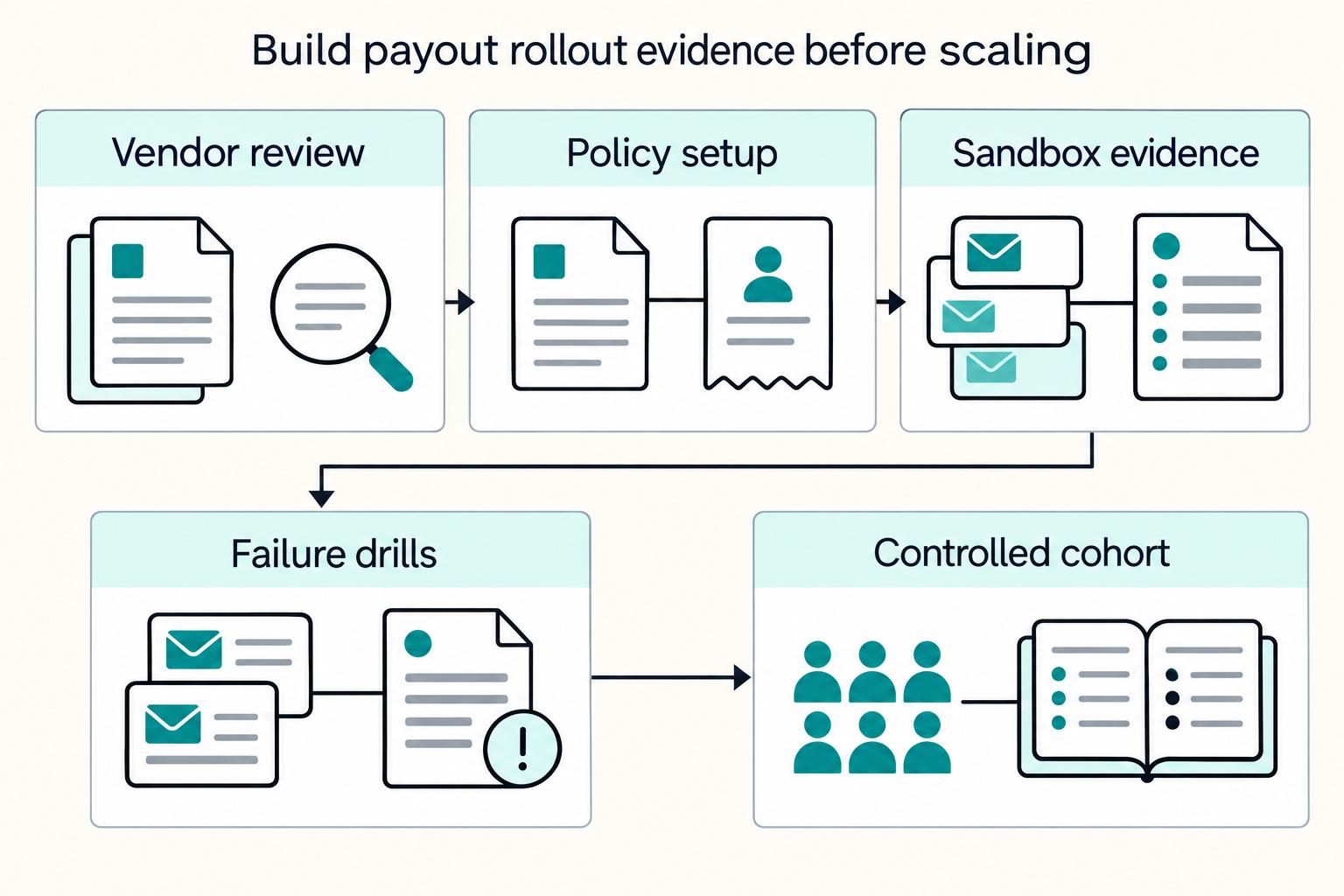
Do not jump from contract signing to live finals. A practical sequence that can reduce first-wave failures is vendor due diligence, policy configuration, sandbox payout flows, a controlled live cohort, then full rollout.
-
Start with vendor due diligence, not API optimism. Confirm your third-party governance covers the lifecycle stages of due diligence and selection, contract negotiation, ongoing monitoring, and termination. Require evidence up front for webhook handling, payout status updates, and reconciliation outputs, so you are validating operating controls, not sales claims.
-
Configure policy before testing volume. Define idempotency behavior, internal payout-status mapping, and exception ownership before stress tests. Terms and states differ by provider, so capture the exact status names and the API and webhook signals your team will act on. If your ledger flow cannot safely handle duplicate requests or duplicate webhook events, pause here.
-
Use sandbox flows to build the go-live evidence pack. Capture webhook delivery logs, duplicate-request tests, payout-state mappings, and reconciliation samples. Confirm acknowledgment deadlines and retry windows in the selected provider’s docs. Stripe’s live webhook delivery, for example, retries for up to three days; another provider may behave differently.
-
Run failure drills before live expansion. Replay duplicate webhooks and verify that they do not double post. Test expired FX quotes against the selected provider’s documented error behavior. Drill held-payout escalation and bank-data corrections so staff can handle those exceptions before volume grows.
-
Go live with a controlled cohort, then expand after finance signoff. Start with a small set of real recipients. Finance should be able to link each prize obligation to the provider attempt, reconciliation output, and available bank trace. Escalate missing payouts using the selected method’s arrival estimate and provider support process; record the trace reference where available.
That sequence keeps early defects contained. Duplicate events, stale status states, and bank-matching gaps stay operational incidents instead of turning into platform-wide trust failures. Before going live, align your evidence pack and status mapping to the implementation patterns in the Gruv docs.
Compliance and tax checks teams skip until it is too late#
Once rollout is sequenced, the next hard gate is ownership, tax boundaries, and data handling. If those are unclear, payout incidents can quickly become compliance incidents. In high-value payment environments, it is safer to build the controls from day one than to retrofit them later.
1. Put one named owner on KYC and AML gates#
Assign day-to-day AML compliance ownership to a named person or a clearly defined small group, and document who can approve exceptions and where approvals are logged. Do not leave customer-identification decisions spread across ops, support, and vendor chat threads.
If a provider or agent handles part of screening, define that split in both contract terms and internal ownership docs. The split can allocate policy, procedure, and internal-control work, but it does not remove accountability from the money services business that carries the AML obligation. Your exception records should consistently capture the trigger, reviewer, decision, timestamp, and evidence reference.
2. Separate platform tax handling from player tax handling#
Keep the boundary clear: platform operational responsibilities are not the same as a recipient's personal filing obligations. Provide payout records and clear notices, but do not present player filings as something the platform files on the player's behalf unless that structure is explicitly confirmed.
| Filing or concept | What it is | Handling boundary to keep clear |
|---|---|---|
| FBAR (FinCEN Form 114) | Separate foreign account reporting filing | Not filed with the IRS. U.S. taxpayers may need it if aggregate foreign account value exceeds $10,000 during the calendar year. Due April 15, with an automatic extension to October 15. |
| FATCA (Form 8938) | Foreign financial asset reporting attached to an annual return | Separate from FBAR, not a replacement. A general baseline is $50,000, but thresholds vary by filing status and residency. |
| Schedule SE (Form 1040) | Self-employment tax calculation | Relevant for net self-employment earnings. IRS references a 15.3% rate, split into 12.4% Social Security and 2.9% Medicare. |
Use plain-language boundary text in payout FAQ and winner communications. The platform provides payout records and applicable platform tax documents. Personal filing duties, including FBAR, Form 8938, and Schedule SE, depend on the recipient's facts.
3. Treat PII like a controlled asset, not support exhaust#
Do not allow unmasked passport data, tax forms, or bank proofs in general logs. Sensitive data should be avoided in logs and redacted when logging is unavoidable.
Set a minimum control baseline: masked sensitive fields in support tooling, encryption in transit and at rest, and role-based access control so access is granted through roles rather than direct user permissions. Maintain an access matrix that defines which roles can view full tax IDs, bank details, and identity artifacts, then test that those boundaries hold in practice.
For your evidence pack, keep proof of redaction behavior, the RBAC role map, and verification that sensitive files are encrypted at rest and over external networks.
Pick the option that matches your failure risk, then validate it before scale#
Choose based on your tournament failure profile and control requirements, not the biggest country count on a homepage. If your real risk is a payout miss during a spike, weak exception handling, or poor auditability, that should outrank broad coverage claims until those claims are validated for your program.
1. Match the option to the failure you cannot absorb#
Start by mapping your payout stress pattern. Mega-event windows and league cadence create different operational risks, and prize money is not evenly distributed across countries. That means you should prioritize controls in the corridors that carry your highest exposure first.
Use a simple rule: optimize for status visibility, duplicate prevention, and exception handling where your volume actually lands. Do not select a stack on global-reach claims alone if you have not confirmed support for your recipient types, payout methods, and compliance flow.
2. Run a scored comparison with named owners#
Run one shared scorecard before preference-driven decisions take over. Keep product, engineering, finance ops, and legal and tax on the same criteria and scale.
| Criterion | What to score | Owner |
|---|---|---|
| Failure tolerance | What breaks first under load: duplicate pay, held pay, missing status, or slow support | Finance ops + engineering |
| Coverage fit | Written confirmation for your priority countries, currencies, and program type | Payments ops + sales contact |
| Integration load | White-labeled API build vs hosted flow, expected implementation effort, sandbox quality | Engineering + product |
| Compliance inputs | Applicable recipient tax documentation, such as W-9 for U.S. persons and the appropriate W-8 form for foreign persons or entities | Legal and tax + ops |
Public figures are screening inputs. Payment Labs advertises 180+ countries and 150+ currencies; Dots’ payout page advertises over 190 countries and 135 currencies; Hyperwallet advertises 200+ countries and regions. Confirm the exact payout method and recipient program in writing, because these totals do not describe identical coverage.
3. Launch in phases with explicit checkpoints#
Phase your rollout and require evidence before expansion. Start in sandbox, then promote only after engineering and finance both verify the same outcomes.
Use checkpoints that can fail:
- Replay a payout request with the same
idempotency_keyand confirm that no second payout is created. - Verify payout-status mapping into your ledger or reconciliation export.
- Confirm that finance can trace a payout from platform record to final payout result before full-batch enablement.
If you choose white-labeled payouts, you gain more in-app control but also take on more implementation responsibility. Score that tradeoff directly.
4. Confirm sales coverage, then validate the docs path before committing dates#
Treat commercial confirmation and technical validation as separate gates. Some onboarding paths begin with sales, so use that step to confirm market and program coverage first, then verify the actual integration path in the documentation.
Watch for sales and docs mismatch. If docs add tax data collection or white-labeled integration steps that you did not plan for, your launch date is not ready. Confirm coverage, validate the implementation path, then commit rollout dates.
If your operating model is clear but coverage and program fit still need validation, use contact to confirm scope before locking rollout dates.
Frequently Asked Questions
Which countries led esports prize pools in 2025, and why does that matter for payout design?
Esports Charts describes Saudi Arabia as the top 2025 prize-pool destination, followed by China, with the United States still a major market. The same source says prize money is concentrated rather than evenly distributed. For payout design, prioritize coverage and local currency support in the markets and corridors that actually drive your volume.
Why do Esports World Cup-style spikes need different payout controls than domestic league schedules?
A mega-event can compress many winner approvals and payout requests into a few weeks, while a domestic league spreads them over recurring rounds. Plan the peak queue from the event schedule and recipient roster. Both models need duplicate prevention and reconciliation; spikes also need enough staff and provider capacity to resolve exceptions without delaying the entire batch.
How should title schedules influence prize-payout capacity planning?
Use your own title calendar to estimate the largest payout batch and the expected exception queue. A global prize-pool ranking does not show when your prizes become payable, which countries winners reside in, or how many require manual review.
How should a tournament platform evaluate Payment Labs, Dots, and i-payout when public detail is limited?
Use public coverage claims to shortlist providers, then request written confirmation for your actual destinations, currencies, recipient types, and prize-payment program. Compare failure codes, payout tracking, tax-document support, and reconciliation exports using the same sample roster. A large country count does not guarantee that a particular payout method is available to each winner.
What minimum vendor evidence should finance and engineering demand before signing?
Ask for the payout status lifecycle, webhook payload examples, retry behavior, and idempotency handling. As a benchmark pattern, Stripe documents webhook retries for up to three days in live mode and idempotency controls to prevent duplicate effects, with keys eligible for pruning after at least 24 hours. If a vendor cannot clearly show real-time event delivery and duplicate-request protection, reconciliation and double-pay risk go up.
Can one payout stack handle both mega-events and league operations, or should platforms split by region/model?
One stack can work when it supports reliable retries, status tracking, and reconciliation under both concentrated event spikes and recurring league cadence. Split by region or operating model when those patterns require different controls and one setup cannot keep finance and engineering outcomes reliable. The practical decision rule is auditability plus operational reliability, not a default preference for single-stack or multi-stack design.
Where Gruv fits
Researched and edited by the Gruv editorial team. Gruv builds cross-border billing, payouts, and finance-operations software for global businesses.
Sources
- csrc.nist.gov/Projects/Role-Based-Access-Control/faqstrusted
- docs.stripe.com/api/idempotent_requeststrusted
- docs.stripe.com/webhookstrusted
- ecfr.gov/current/title-31/subtitle-B/chapter-X/part-1...trusted
- ecfr.gov/current/title-31/subtitle-B/chapter-X/part-1...trusted
- fincen.gov/resources/money-services-business-msb-regist...trusted
- irs.gov/businesses/corporations/fatca-information-fo...trusted
- irs.gov/businesses/small-businesses-self-employed/mo...trusted
Educational content only. Not legal, tax, or financial advice.
Related Posts

The Freelance Payment Penalty: A Modeled Audit of Platform Fees, FX Spreads, and Payout Delays
The money rarely disappears through a single, easy-to-spot fee. The real loss is stacked. A marketplace takes its commission, a processor adds a charge for international cards, a bank or payment company converts the currency at a spread, a platform holds the funds before release, and a wire sheds a little to intermediaries on the way in. Each layer looks defensible on its own, but the worker feels the combined result as a smaller deposit and a later payday.

How to Respond to a Subpoena for Business Records
Move fast, but do not produce records on instinct. If you need to **respond to a subpoena for business records**, your immediate job is to control deadlines, preserve records, and make any later production defensible.

A US Expat's Guide to Investing in UCITS ETFs to Avoid PFIC Issues
The real problem is a two-system conflict. U.S. tax treatment can punish the wrong fund choice, while local product-access constraints can block the funds you want to buy in the first place. For **us expat ucits etfs**, the practical question is not "Which product is best?" It is "What can I access, report, and keep doing every year without guessing?" Use this four-part filter before any trade: