
Quick Answer
Separate the decision into three lanes: legally owed refunds, discretionary payouts, and outsourced claims recovery. For U.S. flights, anchor refund automation to DOT triggers and timing (7 business days for card refunds, 20 calendar days for other methods), and treat vouchers or travel credits as alternatives, not replacements, when cash is owed. Use B2B airline payout infrastructure for in-channel control, then add B2C claims services for disputed long-tail cases. Before launch, require idempotency replay tests and a full trace from incident record to provider reference to ledger posting.
Why Delay Compensation Payments Need to Balance Recovery and Control#
If you are evaluating an airline compensation payments customer experience delays platform, split the work into three lanes first: legally owed refunds, discretionary compensation, and outsourced claims recovery. Vendor pages often blur these together, but they lead to different policy choices, ledger treatment, and customer outcomes.
For flights to, from, or within the U.S., the DOT says its automatic refund rule created universal refund standards. An automatic refund means issuing a refund without waiting for an explicit passenger request once eligibility is undisputed. Timing is 7 business days for credit card purchases and 20 calendar days for other payment methods. DOT guidance also sets a significant-change refund trigger when a traveler declines alternatives, including 3+ hours for domestic itineraries and 6+ hours for international itineraries.
That is why refunds, vouchers, and credits are not interchangeable. DOT guidance states that eligible passengers can decline credits, vouchers, or other compensation and still receive a refund. In Europe, EU Regulation 261/2004 sets a different baseline with common compensation and assistance rules and published compensation bands of €250, €400, and €600 by flight category. In the UK, CAA guidance says compensation is not automatic and passengers must make a claim, which changes how much of the process you should automate. Those differences matter because the right vendor is usually the one that fits the lane you actually need to run.
Automated Flight Disruption Refunds#
Use this first when refund eligibility is clear and trust is already under pressure. If a flight is canceled, or a DOT-defined significant change occurs and the passenger declines the alternative, automation can be a compliance and service requirement, not just a CX feature.
What separates a solid setup from a risky one is traceability. You need an end-to-end line from disruption event to refund instruction to ledger posting, including reversals and exception states. One common failure mode is sending "refund complete" messaging before settlement and reconciliation are actually aligned.
Digital wallet deposits#
Treat wallet payouts as fast discretionary compensation or assistance, not as a substitute for a legally owed refund. Ready Credit, for example, markets direct mobile-wallet payouts for airline compensation. That makes the model clear, even if commercial and coverage claims still need validation.
The advantage is speed with low passenger friction. A common failure mode is promising instant funds where destination or wallet support is incomplete. Before rollout, verify country coverage, wallet-eligibility rules, and rejection handling when your system accepts a payout instruction but the downstream rail rejects it.
Immediate Travel Credits#
Use travel credits when rebooking likelihood is high and you want recovery to stay in your own channel. They usually fit lower-severity disruption cases where the goal is reducing abandonment, not closing a legal refund obligation.
Their value is retention, not legal finality. If credits are used where refunds are owed, complaint and policy risk rises because eligible passengers can decline the credit. Set written rules for issuance, expiry, cancellation, and reversal before scaling.
B2B airline payout infrastructure versus B2C passenger claims-recovery services#
These models solve different problems. B2B airline payout infrastructure typically supports airline-controlled customer communication and direct disbursement of funds or credits. B2C passenger claims-recovery services are usually used for after-the-fact claims handling in disputed or long-tail cases.
That split affects brand control, finance traceability, and even acceptance. UK CAA guidance notes that some airlines may not handle complaints submitted through claims management companies. Treat press coverage as signal, not implementation proof. AB Newswire identifies itself as a paid press-release distribution service, so "go live in as little as a few weeks" remains marketing until you validate it with event logs, retry behavior, and reconciliation outputs.
How to evaluate airline compensation platforms before you shortlist#
If your team will own disbursement, shortlist on controls before features. Product, payments ops, finance ops, and engineering should score vendors together, because payout speed means little if you cannot prove who was paid, why, and whether settlement matched your ledger.
- Start with ownership, not vendor category
This section is for teams selecting an Airline Passenger Compensation Platform or Airline Compensation System that the airline will run directly. Decide first whether you want airline-controlled payout infrastructure, customer messaging, and finance traceability, or whether you want a third party handling claims on the passenger's behalf.
If you only want a legal-claims partner, skip this section. ReFly is positioned as passenger compensation recovery with legal support, and Pine AI is positioned as a consumer-side dispute/refund assistant. Those may fit passenger-side claims or dispute support, but they are not airline-native payout infrastructure.
- Set legal and policy coverage before comparing speed
Define the scorecard before the demos start: payout speed, exception handling, reconciliation depth, policy gates, and support for Lost Baggage Payouts and denied-boarding compensation. In U.S. operations, automatic refund timing is compliance-critical: 7 business days for card payments and 20 calendar days for other methods (DOT rule effective June 25, 2024).
Keep disruption types separate. U.S. rules cover cancellations and significant schedule changes for refunds. They also require compensation for lost, delayed, or damaged baggage. In involuntary denied boarding, overbooking rules require asking for volunteers before bumping passengers. For EU-relevant journeys, customer notices must also cover denied boarding, cancellations, and long delays, including written notice and compensation bands (€250, €400, €600) where applicable.
- Score the operating model where failures happen
The real comparison point is the handoff chain, not the landing page. Force an end-to-end walkthrough: disruption event, eligibility decision, payout instruction, provider reference, payout reconciliation report, and ledger posting. That is where Cashless Travel Payout Solutions and Automated Flight Disruption Refunds succeed or fail.
Add one hard demo checkpoint: a cashless digital-credit flow where the recipient must enroll a payment card first. If the vendor cannot show enrollment status, payee verification, and rejection reasons, you are buying blind. A common failure is passenger messaging that says "paid" while downstream checks are still pending or the destination or instrument is unsupported.
- Require duplicate-handling and audit proof before the demo ends
Do not accept resilience claims on slides. Require raw event logs, idempotency behavior, retry handling, and audit exports. Idempotency keys and webhook replay controls should make duplicate processing visibly testable.
Use a direct test: simulate a timeout, replay the same event, and require proof that only one payout is released. Then require audit output linking the original event, retry or reversal actions, and final settlement state. If exception queues for unmatched payouts or stale statuses are not visible, do not shortlist.
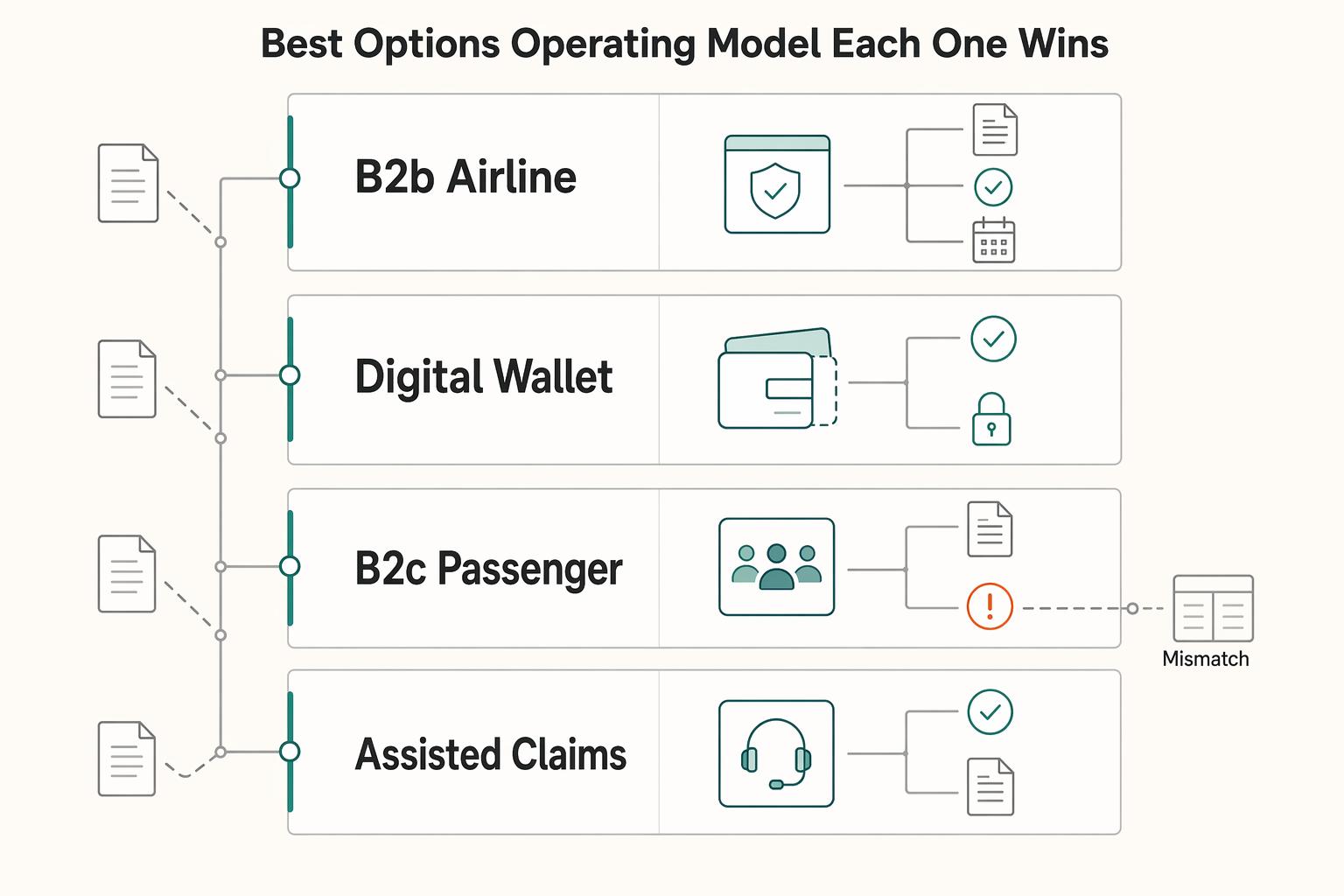
The best options by operating model and when each one wins#
If your goal is to keep passengers in your own recovery journey, B2B airline payout infrastructure is often the starting point. If your main gap is unresolved claims that need legal follow-through, a B2C passenger claims-recovery service may be a better fit. Digital wallet deposits and AI-assisted claims intake are narrower tools that usually work best in specific parts of the flow.
| Model | Best fit | Example | Tradeoff |
|---|---|---|---|
| B2B airline payout infrastructure | Direct control of payout messaging, policy gating, and release timing | Payouts Network; Swiipr | Integration weight: event intake, eligibility logic, payout orchestration, and reconciliation |
| Digital wallet deposits | Speed and low passenger effort matter more than legal complexity | Ready Credit | Compatibility varies by country, currency, and wallet or rail eligibility |
| B2C passenger claims-recovery services | Outsource disputed, long-tail, or legally involved claims | ReFly | Less direct brand control over passenger communications and pacing |
| AI-assisted claims intake | Intake and triage unless deeper adjudication and integration evidence is provided | Pine AI | Evidence depth is marketing-led, not regulator or airline implementation documentation |
- B2B airline payout infrastructure
This is a strong fit when the airline wants direct control of payout messaging, policy gating, and release timing. Providers in this model include Payouts Network and Swiipr. Public positioning lines up with that use case: Payouts Network says airlines can compensate passengers in real time and reduce operational costs, and Swiipr's API announcement says airlines can integrate with existing infrastructure, including legacy systems.
The model works best for in-journey disruption handling when you want to keep the passenger in your channel instead of routing them to a third-party claims path. Payouts Network also publishes broad scale claims on its homepage: 37M+ merchants, 200 countries, and 7B+ credit and debit cards.
The tradeoff is integration weight. You need reliable event intake, eligibility logic, payout orchestration, and reconciliation. During diligence, require a live flow from disruption trigger to payout instruction to provider reference to reconciliation export. Also verify footprint claims directly: public Swiipr figures conflict (26 airlines in 70 countries vs 137 airlines across 70 countries), so treat those as prompts for validation, not proof.
- Digital wallet deposits
Use this when speed and low passenger effort matter more than legal complexity. Ready Credit markets travel compensation through direct mobile wallet deposits for fast access.
The upside is fast access to funds for common delay scenarios with lower passenger effort. This can fit delay compensation and other low-complexity disruption payouts.
The constraint is compatibility. Public payout-network documentation shows transfer methods and currencies vary by country, and some countries have additional restrictions. Do not present wallet payout until country, currency, and wallet or rail eligibility are confirmed. A practical checkpoint is a country support matrix plus front-end eligibility validation before showing the option.
- B2C passenger claims-recovery services
Use this when you want to outsource disputed, long-tail, or legally involved claims. ReFly positions itself as delayed or canceled flight compensation support with "No win, no fee" and legal-team follow-through.
This model is useful where claims depend on legal recovery paths, including EU261-related scenarios. Public EU guidance defines the rights context for denied boarding, cancellations, and long delays. It also includes care obligations from 2 hours or more (distance-dependent) and compensation bands of EUR250 / EUR400 / EUR600 in relevant cases.
The tradeoff is less direct brand control over passenger communications and pacing. Use it as a targeted lane for escalations or backlog recovery, not necessarily your primary disruption experience. Require clear case-status handback, closure evidence, and duplicate-claim checks across channels.
- AI-assisted claims intake
Use this as an intake and triage layer unless deeper adjudication and integration evidence is provided. The clearest example is Pine AI, with travel-compensation coverage in an AB Newswire item dated March 24, 2026, describing automated situation analysis, complaint drafting, and form submission. Pine AI also positions its broader product around autonomous handling of disputes, complaints, and appeals.
The value is faster case capture and better-structured submissions when missing documents or weak narratives slow the queue. The limitation is evidence depth: current travel-compensation proof points are marketing-led, not regulator or airline implementation documentation. Keep scope to triage, document collection, and drafting unless pilots prove more. In diligence, review output samples, requested-document logic, edge-case flags, and human-review triggers before expanding rollout.
For most airline teams, the practical rule is simple: start with direct payout infrastructure for in-channel recovery, then add claims-recovery partners for harder legal cases that do not fit your primary disruption flow.
Side by side comparison criteria that matter in procurement#
Once you have chosen an operating model, the winner is the vendor that can prove coverage and reconciliation under stress, not the one with the cleanest single-delay demo.
1. Coverage breadth#
Compare disruption coverage first, because one narrow gap can break the whole flow. A vendor can look strong on Instant Compensation for Delays & Cancellations and still fail when you add Lost Baggage Payouts, duty-of-care support such as meals/accommodation, or Denied boarding compensation.
EU guidance is a useful baseline here. It covers denied boarding, cancellations, delays, and baggage loss, destruction, or damage, and it includes care items like meals, accommodation, and transport. Use that baseline to test whether a provider supports more than cash outcomes.
| Disruption area | Public rights baseline | Procurement checkpoint |
|---|---|---|
| Delays and cancellations | EU law protects passengers whose flight is cancelled or delayed | Confirm whether handling is automatic, claim-based, or manual-review only |
| Denied boarding | Explicitly covered in EU passenger rights | Verify separate eligibility logic and evidence capture |
| Baggage loss or damage | EU rights cover baggage loss, destruction, or damage | Confirm whether baggage is in the same payout stack or a separate queue |
| Duty of care | Assistance includes meals, accommodation, and transport | Verify whether vouchers are native or handled outside the payout flow |
If you also operate in the U.S., separate this analysis by carrier policy. The DOT dashboard is commitment-based by airline (green check = committed, red X = not committed), and a December 5, 2024 DOT rulemaking release said no U.S. airline at that time provided cash compensation for airline-caused disruptions.
2. Payout method flexibility#
Evaluate payout methods by channel fit, not by rail count. Public airline-focused payout pages show mixed options: bank deposit plus alternatives such as PayPal, Venmo, eGift Cards, and airline-context digital vouchers.
Use three comparison buckets: Digital wallet deposits, bank payout rails, and Immediate Travel Credits or vouchers. Then test where each method can actually be delivered and redeemed in your customer flow. If a vendor presents every rail as universally available, treat that as a diligence risk.
3. Operational controls#
For each Automated Flight Disruption Refunds transaction, require idempotent retries, visible status progression, and durable evidence. Without those controls, retry and async event behavior can create duplicate or unreconciled outcomes.
Make the test explicit in diligence:
- Replay the same passenger or incident with the same idempotency key and confirm one payout side effect.
- Review status surfaces and provider references.
- Review report outputs for success, reversal, and failure states.
Public examples set the standard: Stripe documents idempotency and payout reconciliation reporting, including failed payouts, and Adyen documents lifecycle status and event reporting across transactions.
4. Commercial clarity#
Assume public materials are market signals, not executable commercial terms. FinTech Weekly coverage of Swiipr is launch or news context. Public vendor pages here use sales CTAs like "Let's talk" and "Request a Demo" instead of publishing executable commercial terms.
Treat timeline language such as "as little as a few weeks" as directional unless the vendor contractually scopes assumptions and dependencies for your environment.
5. Reconciliation proof is the hard gate#
Make this non-negotiable: reject vendors that cannot show reconciliation artifacts across issue, reversal, and exception states. Require one trace from payout request to provider reference to settlement batch to reconciled outcome, plus linked reversal and failed examples. If that chain is incomplete, the customer experience may look fast while finance risk stays with your team.
If your team is comparing providers on retries, status visibility, and reconciliation evidence, review how Gruv Payouts is structured before final procurement scoring.
Refunds versus vouchers versus travel credits and the decision rules#
The operating rule is straightforward: match each disbursement type to the passenger right, the disruption context, and the accounting impact. Use refunds when cash is owed, use care vouchers for waiting-period support, and use travel credits only as an opt-in alternative.
| Path | Use when | Rights note | Operational note |
|---|---|---|---|
| Refunds | Cash entitlement is clear | Owed cash cannot be replaced with vouchers or credits unless the passenger affirmatively chooses that option | 7 business days for credit card payments; 20 calendar days for other payment methods |
| Interim Expense & Meal Vouchers | Duty of care is the immediate problem | Not a substitute for final compensation outcomes | Track as care events tied to the triggering disruption context and outcome |
| Immediate Travel Credits | Offer only as an opt-in alternative with finance sign-off | Not a replacement for an owed refund unless the passenger chooses them | If offered instead of a refund, it must be valid for at least five years |
1. Refunds when cash entitlement is clear#
Use refunds when regulation creates a cash right and the passenger does not accept an alternative. In U.S.-covered cases, DOT requires automatic refunds for covered cancellations or significant changes. Airlines may not replace owed cash with vouchers or credits unless the passenger affirmatively chooses that option. DOT also publishes significant-change timing thresholds used in refund determinations: 3 hours or more for domestic itineraries and 6 hours or more for international itineraries.
Operationally, keep clear eligibility evidence before triggering Automated Flight Disruption Refunds: the disruption event, the alternative offered, and the passenger's acceptance or rejection. For U.S.-covered refunds, the final rule requires prompt timing: 7 business days for credit card payments and 20 calendar days for other payment methods (effective June 25, 2024).
2. Vouchers when duty of care is the immediate problem#
Use Interim Expense & Meal Vouchers for duty-of-care support while passengers wait, not as a substitute for final compensation outcomes. UK CAA guidance for covered flights says airlines must provide care and assistance during disruption, including food and drink vouchers, communication support, and, where needed, accommodation and transport.
Track these vouchers as care events tied to the triggering disruption context and outcome. Keeping care support separate from refund and compensation logic helps keep customer communication and reconciliation clearer.
3. Travel credits only as an opt-in alternative with finance sign-off#
Immediate Travel Credits can be offered, but they are not a replacement for an owed refund unless the passenger chooses them. DOT is explicit that alternatives to owed cash are opt-in. When a voucher or credit is offered instead of a refund, it must be valid for at least five years. UK-covered cancellation guidance also frames this as a passenger choice between refund and an alternative flight.
The finance impact is material: unflown obligations sit in liability (account 2160, Air Traffic Liability), and public airline disclosures show revenue recognition occurs when transport is provided or ticket breakage occurs. If credits are used heavily, liability can remain until transport is provided or the credit expires, so finance approval should be explicit.
4. One clear message per path#
Keep customer messaging aligned to the actual policy path: refund, care voucher, or travel credit alternative. EU passenger-rights guidance requires written notice on compensation and assistance rules in disruption cases, including at delays over 2 hours at departure.
In practice, for refund-eligible events, communicate refund rights before alternative offers. Care-voucher messages should say what support is included during the wait and what is not part of final compensation.
For a step-by-step walkthrough, see How MoR Platforms Split Payments Between Platform and Contractor.
Event order and system handoffs that prevent duplicate or late payouts#
A clear handoff order does more than tidy the process: it helps reduce duplicate and late payouts. A practical sequence is to intake the disruption event, decide eligibility, issue the payout instruction, process provider callbacks, post the ledger entry, then send completion messaging.
- Intake one incident record first
Create one internal incident record for the flight or baggage event, then attach passengers and claim paths to it. This gives Instant Compensation for Delays & Cancellations, later corrections, and follow-on disputes from B2C passenger claims-recovery services a single anchor.
Capture the evidence that drives outcomes: disruption status, alternatives offered, and whether the passenger accepted or rejected them. DOT refund eligibility turns on cancellation or significant change when the consumer does not accept the alternative. For Lost Baggage Payouts, keep intake open until the Mishandled Baggage Report (MBR) is present because 14 CFR 260.5 conditions certain delayed or lost bag fee refunds on that report.
- Run eligibility before money moves
Treat eligibility as its own decision layer before any payout call. Decide compensation, refund, bag-fee refund, or no payment with notice or care only, then store a decision snapshot with rule version, inputs, and result.
That snapshot gives you a clean reversal or review path if flight status is corrected later. In EU-covered scenarios, notice duties apply in disruption contexts including departure delays of more than 2 hours.
- Issue payout with idempotency controls
Before releasing Digital wallet deposits or Immediate Travel Credits, generate a stable idempotency key for the payout request. Adyen supports safe retries with the same key after timeout or no response and caps the key at 64 characters.
Keep duplicate suppression internally as well, so the same case submitted through your app, agent tooling, or external claims services still maps to one payout instruction.
- Store webhook callbacks before processing
Webhooks are asynchronous, and both Stripe and Adyen document retry and duplicate behavior. Accept with 2xx, store first, then process. Stripe can resend undelivered events for up to three days; Adyen retries three times immediately and can continue from queue for up to 30 days.
Design callback processing to be replay-safe by reconciling each callback to one internal payout record and tracking processed event IDs. For reversals, model asynchronous outcomes explicitly: Adyen returns reversal results via CANCEL_OR_REFUND, so states like pending, succeeded, reversed, and review-required should be first-class.
- Post ledger before "paid" messaging
After provider outcome is matched to your payout ID, post the ledger entry, then send the completion notification. If settlement is still pending externally, message the payout as submitted or in progress rather than complete.
As an operational control, run replay tests of delayed callbacks across standard delay events and Lost Baggage Payouts to confirm duplicates stay suppressed and reversal states remain consistent in customer status and ledger records.
Finance controls and evidence your team needs before scaling volume#
Finance traceability is the real gate to scale. Do not increase Automated Flight Disruption Refunds volume until every payout is traceable from request to provider reference to ledger posting to settlement reporting.
- Require end-to-end lineage on every payout
Keep one complete identifier chain on each record: incident ID, passenger or claim ID, payout instruction ID, idempotency key, provider reference, and ledger posting ID. If you use Adyen, use the PSP reference with your merchant reference as the provider anchor. If a request times out, retry with the same idempotency key so you do not create a duplicate movement.
This is what lets finance, support, and audit resolve "customer sees paid, bank does not" from one trace instead of cross-team log stitching. Partial lineage makes duplicate suppression and reversal handling harder.
- Build a monthly evidence pack for close and auditability
Monthly cadence is a practical control here, not a cited regulatory requirement. Package payout batch files, reconciliation reports, exception logs, and a delta summary of matched, failed, and open-at-cutoff items for your B2B airline payout infrastructure.
Stripe's payout reconciliation report is built to match bank payouts to underlying transaction batches and includes failed payouts and transactions not settled by period end. Adyen's Settlement details report provides transaction-level settled or paid-out detail, including batch and identifier fields that support lineage checks. At scale, this gives finance and product ops one shared settlement story.
- Separate customer payout status from finance settlement status
In Cashless Travel Payout Solutions, treat "submitted," "provider accepted," "paid out," and "settled" as distinct internal states, and avoid collapsing them into one completion signal.
Stripe documents pending and available balance states, and pending funds are not yet usable. So customer messaging can say in progress while finance keeps the item unsettled until the underlying state supports settlement treatment.
- Run a standing exception queue with owners and aging
Keep one queue for unmatched payouts, stale statuses, failed payouts, unsettled-at-period-end items, and unresolved reversals. Track owner, age, next action, target resolution date, incident ID, provider reference, and ledger status.
The control objective is consistent: every exception should reconcile back to one defensible record across instruction, provider outcome, and ledger result. Review and close exceptions against provider reports, not only customer tickets.
Related: Strong Customer Authentication (SCA) for Subscription Platforms: Reducing Decline Rates.
Compliance and policy checks that should gate launch#
Policy checks should block launch until they pass. A working payment rail is not enough if identity, sanctions, coverage scope, or destination support is unresolved.
| Gate | What to verify | Blocking condition |
|---|---|---|
| Identity and sanctions release gate | Identify the customer and verify identity from reliable, independent information before the relationship or transaction proceeds | If CDD cannot be completed, do not proceed; failed identity checks and targeted financial sanctions screening matches are hard blocks |
| Coverage matrix by regime and program | Keep a versioned matrix by airline program mapping event type, route context, carrier context, and customer promise | U.S. automatic-refund standards apply to flights to, from, or within the United States, including more than 3 hours domestically and 6 hours internationally; the 2024 U.S. ANPRM was withdrawn as of November 17, 2025 |
| PII minimization for claims and disruption payloads | Limit personal data to what is necessary for the purpose, with periodic review and deletion of data no longer needed | Define a field-level allowlist and retention logic; verify sample payloads exclude unnecessary notes, attachments, or identifiers |
| Unsupported destination hard stop | Check country- and feature-dependent support before offering Digital wallet deposits | Persist the provider result on the incident record and prevent payout promises when support is unavailable |
| Pre-launch policy simulation across event types | Simulate delay, cancellation, baggage, and denied-boarding scenarios before release | Include 7 business days and 20 calendar days refund timing plus baggage-delay windows of 12, 15, and 30 hours; block launch when outputs conflict |
- Identity and sanctions release gate
Treat customer due diligence as a payout release condition for cash-equivalent flows, not a post-payout task. CDD requires identifying the customer and verifying identity from reliable, independent information, and that verification is expected before the relationship or transaction proceeds. If CDD cannot be completed, do not proceed with the transaction. Make failed identity checks and targeted financial sanctions screening matches hard blocks with explicit reason codes.
- Coverage matrix by regime and program
Do not apply one entitlement rule across all markets in your Airline Compensation System. EU coverage depends on route and carrier context, while U.S. DOT automatic-refund standards apply to flights to, from, or within the United States, including the significant-change thresholds of more than 3 hours domestically and 6 hours internationally. Keep a versioned matrix by airline program and B2B airline payout infrastructure mapping event type, route context, carrier context, and customer promise, and note that the 2024 U.S. ANPRM on broader passenger-rights compensation was withdrawn as of November 17, 2025.
- PII minimization for claims and disruption payloads
Apply data minimization rules before integrating with external partners. Personal data should be limited to what is necessary for the purpose, with periodic review and deletion of data no longer needed. Define a field-level allowlist and retention logic tied to claim purpose, then verify sample payloads exclude unnecessary notes, attachments, or identifiers.
- Unsupported destination hard stop
Block unsupported payout destinations before offering Digital wallet deposits. Payout support is country- and feature-dependent, including cases where payouts cannot be originated, and provider availability is jurisdiction-limited. Run eligibility at quote or offer time, persist the provider result on the incident record, and prevent payout promises when support is unavailable.
- Pre-launch policy simulation across event types
As an internal launch control, run pre-launch simulations across delay, cancellation, baggage, and denied-boarding scenarios so policy, payout eligibility, and customer messaging are aligned before release. Include U.S. refund timing checks under the June 25, 2024 DOT rule, including 7 business days for credit card refunds, 20 calendar days for other forms of payment, and baggage-delay windows of 12 hours domestic and 15 to 30 hours international. Require an evidence pack per scenario covering jurisdiction, expected entitlement, payout-method availability, block reason, and customer message, and block launch when those outputs conflict.
Red flags in vendor claims and how to validate them quickly#
The fastest way to avoid a bad vendor decision is to treat outcome claims and PR as directional until the provider can show live, traceable evidence from event to payout to reconciliation.
- Outcome claims without methodology
Payouts Network publishes metrics such as 270% higher customer satisfaction and 50% lower compensation costs, and ReFly markets eligibility of up to $660 per passenger for canceled flights. Those claims can be useful, but objective claims should be backed by documentary evidence. Ask for the written baseline, date range, sample, and measurement method; if that is missing, treat the claim as directional only.
- Press coverage presented as implementation proof
Announcement volume is not execution proof. ABNewswire is a paid press-release distribution service, and FinTech Weekly offers branded articles, press-release distribution, and advertising products. Ask whether the item reflects paid placement, partnership news, a pilot, or a live deployment with active payouts and reconciled settlements.
- Demos that avoid real event artifacts
Polished demos are easy; reliable webhook operations require real event artifacts. Ask to review a real JSON webhook payload, duplicate-event handling, and retry logs. Stripe notes that duplicate events can happen and undelivered events can be retried for up to three days. Require a live duplicate-event replay and confirm the resulting statuses and exception timestamps.
- No single trace from claim to payout to ledger
If a provider cannot show one continuous trace, downgrade them. For one incident, you should be able to follow incident or claim ID, payout instruction, provider reference, and reconciliation output linking payouts to underlying transactions, for example payout reconciliation output or a disbursement report with a unique Transfer ID. No end-to-end trace can mean higher risk of ambiguous status and potential duplicate payout during retries.
A practical rollout sequence from pilot to full disruption coverage#
Do not turn on every disruption payout flow at once. Start where policy triggers are clearest, and expand only when exception handling and reconciliation stay stable. This is one workable sequence, not a mandated industry standard.
- Phase 1 pilot
Start with Instant Compensation for Delays & Cancellations on one route cluster, with strict payout caps and manual review. Keep scope to cases that map cleanly to refund eligibility, including cancellations and significant changes such as 3+ hours (domestic) and 6+ hours (international) when the passenger does not accept alternative compensation. Require one trace per incident from claim to payout to ledger, and enforce duplicate-safe processing. Use idempotency keys end to end, but do not rely only on provider-side retention when keys may be pruned after at least 24 hours and webhook retries can continue for up to three days.
- Phase 2 expansion
Add Interim Expense & Meal Vouchers and Lost/Delayed Baggage Payouts only after delay and cancellation operations are predictable. Meal support is easier to defend when it matches published commitments, including the 3-hour delay threshold shown in DOT dashboard tracking. Baggage should run in a separate evidence path because bag events and timing drive outcomes, not flight status alone. Monitor duplicate, timeout, and reversal rates weekly internally, and use the monthly DOT Air Travel Consumer Report as an external health check across Flight Delays, Mishandled Baggage, and Consumer Complaints. For checked-bag fee refunds, preserve timestamps needed for delay triggers such as 12 / 15 / 30 hours.
- Phase 3 scale
Introduce Immediate Travel Credits only after you can segment by trip context, rebooking likelihood, and booking channel. Credits can be a better fit when the passenger is likely to travel with you again soon. They can be a weaker fit when refund eligibility is already clear or when third-party booking data makes disrupted passengers harder to identify and contact. Treat credits as an optimization layer, not the default recovery path. When refund rights are triggered, keep the refund flow primary and execute to timing requirements of 7 business days for card payments and 20 calendar days for other payment forms.
- Decision checkpoint after each phase
Proceed only when reconciliation variance, unresolved exceptions, and complaint signals are trending in the right direction. Record each gate in writing with exception aging, reversal and duplicate counts, and a sampled trace from claim ID to payout reference to ledger entry. If expansion worsens any of those signals, roll back the newly added payout type and stabilize before scaling further.
Related reading: How to Scale a Gig Platform From 100 to 10000 Contractors: The Payments Infrastructure Checklist.
Conclusion#
The winning option is the one you can defend at month end, not the one with the fastest payout claim. If you can turn a disruption event into a customer outcome with clear policy gates, retry safety, and transaction-level reconciliation, you can improve service and reduce the risk of finance cleanup later.
- Start with the channel you control
Consider B2B airline payout infrastructure when you need direct control of trigger, message, and disbursement in one flow. This matters most where obligations are explicit, including U.S. DOT refund scenarios tied to cancellations or significant changes (3 hours domestic, 6 hours international) when the traveler rejects the changed itinerary. The key test is not speed alone, but whether you can show why a refund, voucher, or credit was issued and whether timing met 7 business days (card) or 20 calendar days (other forms).
- Add claims partners only where direct handling breaks down
Passenger-facing claims services, including vendors positioned like ReFly, may fit disputed, long-tail, or legally escalated queues your team does not want to run end to end. In EU passenger-rights contexts, claim agencies are part of the operating market, but vendor positioning should be treated as provisional until you see case outcomes, exception rates, and handoff quality in your environment. The tradeoff is straightforward: less internal casework, but less brand control and another integration surface where duplicate submissions, stale statuses, or conflicting customer messages can appear.
- Do not launch on payout promise alone
Before scaling, verify three controls in live artifacts: event order, retry safety, and reconciliation evidence. You should be able to trace disruption intake, eligibility decision, payout instruction, ledger posting, and customer notice in one chain. Each payout should carry an idempotency key so a timeout retry does not create a second payment, and reconciliation should show settled-and-paid transaction detail, not only batch totals.
Keep the red flags non-negotiable. If payout coverage varies by country or payment type, do not promise a payout method until required recipient fields and jurisdiction support are confirmed. If sanctions and policy checks are not calibrated to product, customer, transaction, and geographic risk, compliance debt moves downstream. For cross-border flows, account for tightened payment-transparency expectations announced on 18 June 2025, including standardized information requirements above USD/EUR 1,000 for certain peer-to-peer cross-border payments.
The finish line is practical: when you can prove clean event order, policy-gated release, and reconciliation under disruption pressure, you can improve passenger outcomes without losing financial control.
For a launch plan grounded in coverage constraints, policy gates, and finance-grade traceability, contact Gruv.
Frequently Asked Questions
What is an airline compensation payments platform?
An airline compensation payments platform is the airline-side payout layer that turns a disruption decision into a disbursement you can track, reconcile, and defend. It connects eligibility rules, payout methods, customer messaging, and ledger visibility for outcomes like automatic refunds, vouchers, baggage payouts, and denied boarding compensation. In the U.S., that logic should align with DOT refund triggers for cancellations and significant changes, including 3+ hours (domestic) and 6+ hours (international) when a passenger rejects the changed itinerary.
How are delay compensation payments disbursed at scale without creating duplicate payouts?
The core control is idempotency: each payout instruction should use a unique incident-and-passenger key so retries do not create a second payment. You also need asynchronous webhook handling, because callbacks may arrive after an initial timeout and can create double-pay risk if a timeout is treated as a final failure. Keep one trace from claim ID to provider reference to ledger entry so each payment can be verified end to end.
Which is better for customer experience during delays, refunds, vouchers, or travel credits?
Use refunds when legal eligibility is clear or trust is already damaged. DOT states passengers are entitled to a refund after a cancellation if they refuse credits, vouchers, or other compensation, and the final rule sets timing at 7 business days for card payments and 20 calendar days for other forms. Vouchers can help when the traveler is mid-journey and immediate support matters most, and travel credits can fit when rebooking likelihood is high and refund rights are disclosed first.
What data and systems are required to automate flight disruption payouts end to end?
You need more than flight status. A practical stack includes disruption event intake, booking and passenger identifiers, eligibility rules by jurisdiction, payout instructioning, webhook ingestion, customer notification, and finance posting with reversal support. Keep baggage and denied boarding evidence paths separate from standard delay cases, because they follow different compensation rules, including 14 CFR 250.5 for denied boarding.
How should teams compare `B2B airline payout infrastructure` and `B2C passenger claims-recovery services`?
Choose B2B payout infrastructure when you want direct control over customer experience, disbursement timing, policy gates, and reconciliation. This category typically positions around API or embedded payout execution plus disbursement visibility, while B2C claims-recovery services position around filing claims and dealing with the airline for the passenger, sometimes with legal handling. If your goal is early recovery and retention, airline-controlled payouts usually fit better; if your pain is long-tail disputes, a passenger-facing claims partner may fit better.
What should we verify first when vendor pricing and implementation timelines are not publicly clear?
Start with operating artifacts, not sales claims. Request sample webhook payloads, idempotency behavior, exception and reversal exports, and a redacted trace that links request, provider reference, and ledger posting in one chain. Also validate source quality: press-release pickup, including ABNewswire distribution, is not proof of production readiness, and airline commitment matrices should be checked line by line against your routes and jurisdictions.
Try a related tool
Researched and edited by the Gruv editorial team. Gruv builds cross-border billing, payouts, and finance-operations software for global businesses.
Sources
- ecfr.gov/current/title-14/chapter-II/subchapter-A/par...trusted
- ecfr.gov/current/title-14/chapter-II/subchapter-A/par...trusted
- federalregister.gov/documents/2024/04/26/2024-07177/refunds-and-...trusted
- federalregister.gov/documents/2025/11/17/2025-20042/airline-pass...trusted
- sec.gov/Archives/edgar/data/27904/000002790420000004...trusted
- transportation.gov/individuals/aviation-consumer-protection/ref...trusted
- transportation.gov/briefing-room/dot-launches-rulemaking-protec...trusted
- uscode.house.gov/quicksearch/get.plxtrusted
Educational content only. Not legal, tax, or financial advice.
Related Posts
Improve Payment Experience Across Your Partner Ecosystem
Payment experience is a growth lever, not just an operations layer. It shapes partner trust, retention, expansion, and margin. This guide is for founders, revenue leaders, product teams, and finance operators who need execution choices tied to measurable results, not generic payout advice.

Strong Customer Authentication (SCA) for Subscription Platforms: Reducing Decline Rates
If you want fewer surprises, treat SCA as a scope and sequencing decision, not a feature hunt. This ranked list is for teams running recurring collections across markets that want to reduce avoidable decline risk under PSD2 without adding unnecessary checkout friction.
The Best Community Platforms for SaaS Businesses
Start by classifying the job. If you want access to other people's audience, ideas, or conversations, you are choosing a community to join. If you want a place your customers or members use under your brand, with your rules and structure, you are choosing software you will need to operate every week.